The review of Metabolic considerations in Prodrug design is a well-established dedication to the design of absolutely safe drugs by targeting the biopharmaceutical, physiochemical and pharmacokinetic properties. Its scope extends to the improving poor drug properties such as stability, permeability, solubility and toxicity by approaching through physical, chemical or biological ways. The review covers how metabolic consideration is helpful in prodrug design.
Keywords
Prodrug Design
Physiochemical
Pharmacokinetic Metabolic
INTRODUCTION
Prodrug design is productive approach for drug targeting by switching the biopharmaceutical, physiochemical or pharmacokinetic properties. Prodrugs, are active therapeutic chemical agent, which must undergo modification in vivo to release the active drug [1,2].
Design of Prodrug
Prodrug are compounds, which are inactive but are converted in the body to the active drug:
Acid sensitivity
Poor membrane permeability
Drug toxicity
Bad taste
Short duration of action
Two things are needed to consider when designing prodrugs
To ensure that the prodrug is effectively converted to the active drug once it is absorbed into the blood supply
To ensure that any groups cleaved from the molecule are non-toxic [3,4]
Prodrugs have become an initiated idea and a strong tool in developing the pharmacologically potent structures and get the better of pharmaceutical, physiological and biopharmaceutical barriers to a drug's functionality [5].
Barrier linked to the physicochemical properties of drug
Barrier in the pharmacokinetic phase
The poor drug effects such as toxicity, stability, permeability, solubility, drug targeting are genuine challenges for the fortunate growth and commercialization of drug molecules, this can be attain through physical, chemical or biological ways [6,7].
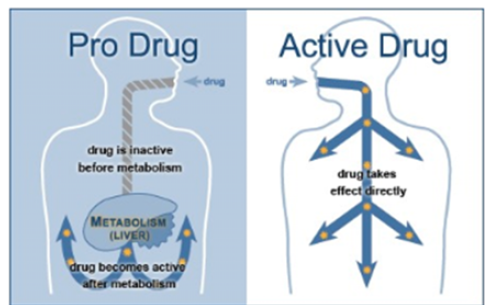
Figure 1: Comparison Between Prodrugs and Active Drugs
The biological approach is to alter route of administration which may or may not be allowable to patient. The physical approach is to adjust the plan of dosage form such as controlled delivery of drug. The third and the finest way in increasing drug selectivity while keeping down toxicity, is the chemical approach for design of prodrugs [8,9].
Functional group derivative involved in prodrug approach:
NH2
Amine
Alcohol
COOH
Carboxylic acid
Functional group compliant to prodrug design:
Factors should be examined when designing a prodrug
Parent drug-which functional group are manageable to chemical prodrug derivation
Pro moiety-ideally be safe and rapidly excreted from the body
Parent and prodrug-ADME and pharmacokinetic properties need to be comprehensively known
Esters as prodrugs of carboxyl, hydroxyl and thiol functionalities
Esters are common most prodrug used, round about 49% of all marketed prodrugs start up by enzymatic hydrolysis
Esters mainly used to enhance lipophillicity
Passive membrane permeability of water soluble drugs by disguise charged groups such as carboxylic acids and phosphates
Readily hydrolyzed by esterase found in blood, liver and other organs including, carboxyl esterase, acetylcholinesterase, butrylcholinesterases
Carbonates and Carbamates as prodrugs of carboxyl, hydroxyl or amine functionalities:
These are different from esters by the existence of an oxygen or nitrogen of carboxyl carbon on both sides
These more stable than esters but more susceptible to hydrolysis than amides. Carbonates are derivative of carboxylic acid and alcohols and carbamates are carboxylic acid and amine derivatives
Bioconversion of many carbonate and carbamates prodrugs require
Amides as Prodrugs of Carboxylic Acids and Amines
In prodrug design, amides been used only to limited range owing to their relatively high enzymatic stability in vivo. Carboxylesterases, peptidases or proteases usually hydrolyses amide bond.
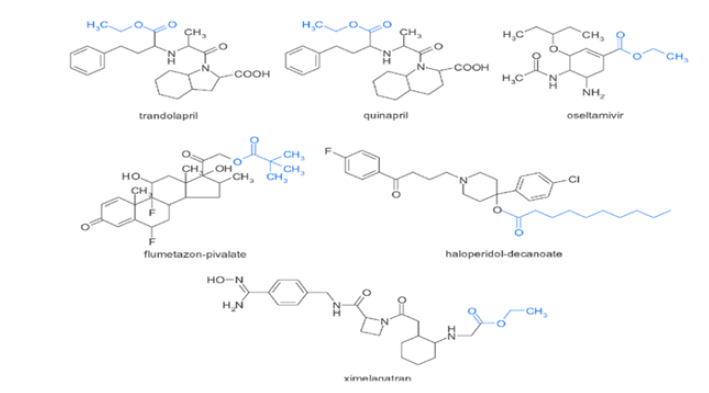
Figure 2: Representative Chemical Structures of Selected Prodrugs and Their Functional Modifications
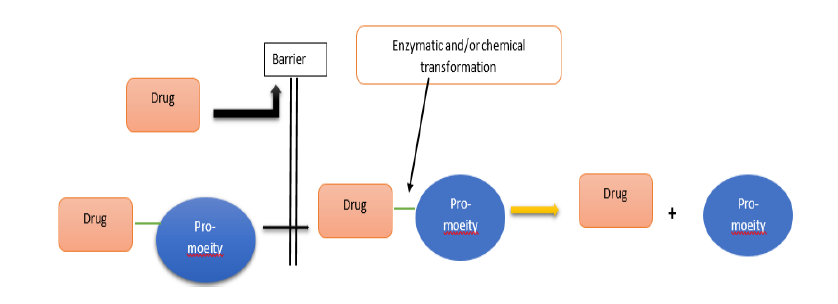
Figure 3: Schematic Representation of Prodrug Formation, Barrier Transport and Subsequent Enzymatic/Chemical Conversion
Table 1: Prodrug Approaches for Overcoming Limitations of Parent Drugs and Their Therapeutic Applications
PROBLEMS
PARENT DRUG
PRODRUG
How it is solving the problem
Therapeutic use
GI Irritation
Salicylic Acid
Aspirin
Increased stimulation of acid secretion or by interference
With protective mucosal layer.
Reducing fever, relieve mild to moderate pain.
Odour
Ethyl mercaptan
Pthalate ester
ethyl mercaptan is foul smelling liquid at BP(35 degree celsius) is converted into its pthalate ester (high BP and odorless)
treatment of Leprosy
Taste
Chloramphenicol
Palmitate ester
two approaches; a) reduction of drug solubility in saliva b) lower the affinity of drug towards taste receptor
antibiotic (mainly eye infections)
Clindamycin
Palmitate ester
two approaches; a) reduction of drug solubility in saliva b) lower the affinity of drug towards taste receptor
Bacterial infections
Physical form of drug
Ethyl mercaptan
1,3-diester
ethyl mercaptan is liquid drug and converting of such liquid drug in solid prodrug
involves formation of symmetrical molecule having higher tendency to crystallize
manufacturing of fungicides and bacteriocides
Low aqueous solubility
Dexamethasone
Hemisuccinates and phosphates
Dexamethasone, because of their low water solubility generally administered in the
form of water soluble esters as hemisuccinates and phosphates.
used at higher doses for emergency treatment or other life threatening situations.
Mitindomide
Fetindomide
Mitindomide, poor solubility in water and in most pharmaceutically acceptable solvents. Prodrug was designed so that mitindomide would be release in vivo by the loss of two molecules of phenylalanine and formaldehyde. Observed that in vitro formaldehyde exerts a catalytic effect on fetindomide hydrolysis.
Anti - tumor agent
Chemical stability
Azacytidine
Bisulfite prodrug
The aqueous solution of azacytidine is readily hydrolized but bisulfite prodrug is stable to such as degradation at acidic pH and more water soluble than parent drug. The prodrug converts to the active drug at the physiological pH of 7.4
Anti-neoplastic agent
Oximes as Derivatives of Ketones, Amidines and Guanidines
Oximes (for example, guanidoximes, ketoximes, amidoximes) are derivatives of guanidines, ketones and amidines, thus providing a chance to modify molecules that lack of carboxyl, hydroxyl, or amine functionalities.
CONCLUSION
The present review is a try to collect and confront available information on the subject. Some basic problems, however, been left untouched. For example, for extrapolation of data the difficulty from animals to humans come across during toxicologic and toxicokinetic studies with drugs is added with prodrugs because not only might the metabolism difference of the active moiety , but also its availability from the prodrug. As a matter of fact, there is currently no published rationale for the management of animal and human pharmacokinetic programs during development and pro drug research. Although the prodrug point of view it is advancing and reaching successes in providing effective medications to a variety of diseases it still needs the utilization of the sophisticated computational methods used for the design of drugs. Kinetics and thermodynamics for biological systems (active sites of receptors and enzymes and etc.) that have biomedicinal interests have been intensively researched and have been proved to be fruitful. Today, quantum mechanics, such as ab initio, semi-empirical and Density Functional Theory (DFT) and Molecular Mechanics (MM) including docking are increasingly being utilized to characterize active sites of receptors and enzymes. These widely used methods have proven as successful tools for providing structure-energy calculations for an accurate prediction of potential drugs. This plan might help substances too toxic, or impotent to show adequate pharmacologic effects in their basal form to go through primary and secondary screening, before successfully reaching human testing. It is evident that if such an approach were to become an integral part of basic drug design and not just a hindsighted attempt to solve problems associated with older drugs, it would also be necessary to develop new biopharmaceutical and pharmacokinetic approaches to tackle the new challenges.
REFERENCES
Brahmankar D.M. and S.B. Jaiswal. Biopharmaceutics and Pharmacokinetics: A Treatise. Vallabh Prakashan, 1995, pp. 162–168.
Singh H. and V.K. Kapoor. Medicinal and Pharmaceutical Chemistry. 2nd ed., Vallabh Prakashan, 2005, pp. 264–280.
Abraham, Donald J., editor. Burger’s Medicinal Chemistry and Drug Discovery. 6th ed., vol. 2, Wiley, pp. 501–512.
Patil S.J. and P.J. Shirote. “Prodrug approach: An effective solution to overcome side-effects.” International Journal of Medical and Pharmaceutical Sciences, 2011, pp. 1–13.
Verma et al. “Prodrug as a chemical delivery system: A review.” Asian Journal of Research in Chemistry, 2009, pp. 75–100.
Roche E.B. American Pharmaceutical Association—Academy of Pharmaceutical Sciences Symposium. Washington, DC, 1977.
Balant L.P. and J. McAinsh. “Concepts in drug metabolism.” Edited by P. Jenner and B. Testa, Marcel Dekker, 1980, p. 311.
Peppercorn M.A. “Sulfasalazine: Pharmacology, clinical use, toxicity and related new drug development.” Annals of Internal Medicine, vol. 101, no. 3, 1984, pp. 377–386.
Karaman R. Prodrugs Design: A New Era. Nova Science Publishers, 2014.
Recommended Articles
Research Article
Amit Jain’s System of Practice: From Modern to Super Modern Diabetic Foot Surgery
Kumar C Jain
Published: 11/12/2020
Download PDF
Research Article
Awareness Regarding Danger Sign and Symptoms During Pregnancy among Antenatal Mothers Attending Outpatient Department of Rural Hospital in Himachal Pradesh
Parul Sharma,
Kushagra Gautam
Published: 26/05/2023
Download PDF
Research Article
Curcumin: A Possible Treatment for Coronavirus Infection
R. Choudhary
Published: 10/10/2021
Download PDF
Review Article
Role of Nanotechnology in Pharmaceutical Science: A Review
Shrivastava Sakshi,
...
G.N. Darwhekar
Published: 10/09/2021
Download PDF
PO Box 101, Nakuru
Kenya.
Email: office@iarconsortium.org
Editorial Office:
J.L Bhavan, Near Radison Blu Hotel,
Jalukbari, Guwahati-India


 Download PDF
 Download XML