Seckel syndrome, a rare genetic disorder known for its striking craniofacial and skeletal abnormalities, is characterized by severe intrauterine growth restriction (IUGR). We present a case of Seckel syndrome in a neonate born to non-consanguineous parents, emphasizing the clinical manifestations, genetic complexity, and challenges associated with this condition. The neonate exhibited classic features, including a "bird-like" head, slanting forehead, microcephaly, large eyes, beaked nose, low-set ears, high-arched palate, clinodactyly of the fifth fingers, medial deviation of toes, and bilateral cryptorchidism. This case highlights the importance of early diagnosis and genetic counseling for affected families, showcasing the clinical utility of recognizing Seckel syndrome in neonates with growth restriction and craniofacial anomalies. Further genetic research is warranted to unravel the underlying mechanisms and potential therapeutic avenues for this rare syndrome, offering hope for improved medical care and support services for affected individuals and their families.
Keywords
Seckel Syndrome
Neonate
Genetic Complexity
Clinical Peculiarities
INTRODUCTION
Seckel syndrome, also known as "bird-headed dwarfism" or "nanocephalic dwarfism," is an exceedingly rare genetic disorder characterized by severe intrauterine growth restriction (IUGR), resulting in a proportionate dwarfism with distinctive craniofacial and skeletal abnormalities. First described by Seckel in 1960, this syndrome exhibits autosomal recessive inheritance, often arising from consanguineous marriages [1]. While the incidence of Seckel syndrome is exceptionally low, its clinical manifestations are striking and encompass a range of physical and developmental anomalies. These include a small, "bird-like" head, slanting forehead, microcephaly, large eyes, beaked nose, low-set ears, high-arched palate, and retrognathia [2] Skeletal anomalies such as clinodactyly (inward-curving fifth fingers), polydactyly, and medial deviation of toes are commonly observed [3]. Additionally, cryptorchidism, intellectual disability, and microcephaly further contribute to the complexity of this syndrome [4].
Seckel syndrome poses substantial challenges for affected individuals and their families due to the range of physical and cognitive impairments associated with the condition. Although the genetic basis of Seckel syndrome has been studied in recent years, much remains to be elucidated regarding its etiology and pathogenesis. Therefore, this case report sheds light on a rare presentation of Seckel syndrome in a neonate, underlining the importance of early diagnosis and genetic counseling for families affected by this condition. Additionally, it emphasizes the need for further research to comprehend the underlying genetic mechanisms and potential therapeutic interventions for Seckel syndrome.
Case Description
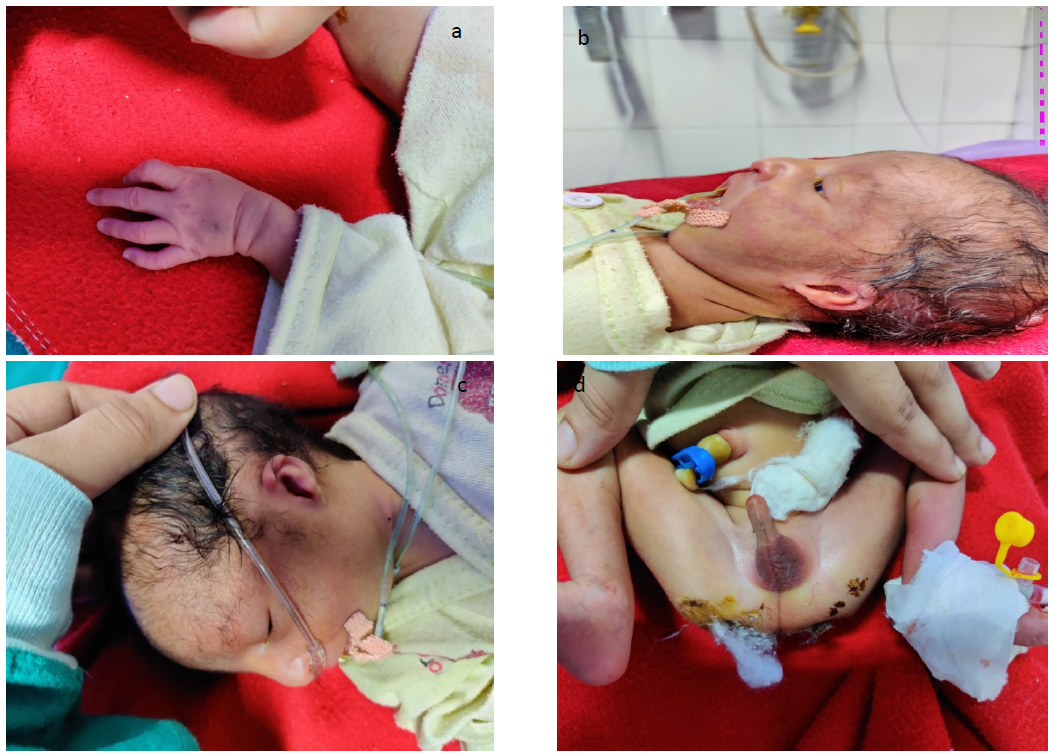
The neonate in this case report was born at 36 weeks and 6 days through normal vaginal delivery to a 21-year-old primigravidae and a 32-year-old male in a non-consanguineous marriage. The baby's birth weight was notably low at 1910 grams, and upon delivery, the infant did not cry and required immediate resuscitation. The initial APGAR score was distressing, with a score of 3 at 1 minute, which improved to 5 at 5 minutes, prompting the medical team to transfer the baby to the Neonatal Intensive Care Unit (NICU) for post-resuscitation care (Figure 1).
Upon examination, the neonate presented with a constellation of clinical anomalies characteristic of Seckel's syndrome. These included a narrow face, slanting forehead, large eyes, a beaked nose, low-set ears, and a high-arched palate, all contributing to the striking facial appearance. The presence of clinodactyly in the fifth fingers of both hands and medial deviation of the second, third, and fourth toes in bilateral feet further supported the clinical diagnosis. Additionally, the infant exhibited bilateral cryptorchidism. Based on these distinct clinical findings, a diagnosis of Seckel's syndrome was established.
Figure 1: (a-d) Various Clinical Presentation Of Seckel Syndrome
DISCUSSION
Seckel syndrome, a rare genetic disorder, presents a complex clinical picture characterized by severe intrauterine growth restriction (IUGR), craniofacial anomalies, and skeletal abnormalities. This discussion delves into the clinical features, genetic aspects, and challenges associated with Seckel syndrome, as exemplified by the neonatal case described [1].
The clinical presentation of Seckel syndrome is striking, marked by facial dysmorphism, including a small head with microcephaly, slanting forehead, large eyes, beaked nose, low-set ears, and a high-arched palate. These features align with previous reports of Seckel syndrome cases [2]. Skeletal anomalies such as clinodactyly, as observed in this case, are common findings and contribute to the distinctive phenotype of Seckel syndrome [3]. Additionally, the presence of cryptorchidism, observed in this neonate, underscores the multisystem involvement characteristic of this syndrome. Furthermore, intellectual disability, often accompanying Seckel syndrome, necessitates early intervention and comprehensive medical care [4].
The genetic basis of Seckel syndrome is complex, with several genes implicated in its pathogenesis. Mutations in genes involved in DNA damage response pathways, such as ATR, are frequently associated with Seckel syndrome [5]. Understanding the genetic underpinnings of Seckel syndrome is essential for accurate diagnosis, genetic counseling, and potential therapeutic interventions. However, the genetic heterogeneity of Seckel syndrome poses challenges, as mutations in various genes can result in similar clinical presentations.
Early diagnosis of Seckel syndrome is crucial to facilitate appropriate medical management and genetic counseling for affected families. In this case, the neonate's presentation with characteristic features allowed for a clinical diagnosis. Advances in genetic testing, including whole-exome sequencing, have enhanced the ability to confirm the genetic basis of Seckel syndrome [6]. Timely diagnosis enables families to access necessary support services and resources, improving the overall quality of life for affected individuals.
This case underscores the importance of recognizing Seckel syndrome's clinical features and considering it in the differential diagnosis of neonates presenting with growth restriction and craniofacial anomalies. Furthermore, it highlights the need for continued research into the genetic mechanisms underlying Seckel syndrome to advance our understanding and potentially identify targeted therapeutic interventions.
CONCLUSION
This case report illustrates a neonate diagnosed with Seckel syndrome, a rare genetic disorder characterized by severe intrauterine growth restriction, craniofacial anomalies, and skeletal abnormalities. The clinical presentation highlighted classic features of the syndrome, including distinctive facial dysmorphisms, skeletal anomalies, and bilateral cryptorchidism. The case underscores the importance of early recognition and diagnosis, enabling timely access to essential medical and support services for affected individuals and their families. Moreover, it emphasizes the ongoing need for genetic research to unravel the complex genetic basis of Seckel syndrome and potentially identify therapeutic interventions, offering hope for improved care and outcomes for those affected by this challenging condition.
REFERENCE
Seckel, H. “Bird-headed dwarfs: studies in developmental anthropology including human proportions.” Birth Defects: Original Article Series, vol. 36, 1960, pp. 131–173.
Majewski, F. et al. “Seckel syndrome and Moyamoya disease associated with chromosomal anomaly.” Clinical Genetics, vol. 22, no. 2, 1982, pp. 94–100.
Teebi, A.S. et al. “Seckel syndrome and Moyamoya disease.” Journal of Medical Genetics, vol. 35, no. 5, 1998, pp. 401–403.
Faivre, L. et al. “Clinical and genetic heterogeneity of Seckel syndrome.” American Journal of Medical Genetics, vol. 112, no. 4, 2002, pp. 379–383.
O’Driscoll, M. et al. “A splicing mutation affecting expression of ataxia-telangiectasia and Rad3-related protein (ATR) results in Seckel syndrome.” Nature Genetics, vol. 33, no. 4, 2003, pp. 497–501.
Kousar, R. et al. “A novel splice-site mutation in the ATR-X gene in a Pakistani family with alpha-thalassemia/mental retardation syndrome.” Gene, vol. 643, 2018, pp. 164–170.
Recommended Articles
Research Article
A study on the feasibility of online classes for medical education
Seema Bose,
Atindra Krishna Ghosh
Published: 15/02/2021
Download PDF
Research Article
Amyand’s Hernia: A Rare form of Common Entity
Download PDF
Research Article
Prevalence of Typhoid Fever among Patients Attending General Sani Abatcha Specialist Hospital Damaturu, Nigeria
Ahmed Idriss Jajere,
...
Usman Umar Faruk
Published: 10/10/2020
Download PDF
Research Article
A case report of management of a Case of Hyperalgesia by Ultrasound guided Fluoroscopically Verified Transforaminal Nerve Root Block
Sunil Dutt,
...
Anil Kumar
Published: 29/06/2024
Download PDF
PO Box 101, Nakuru
Kenya.
Email: office@iarconsortium.org
Editorial Office:
J.L Bhavan, Near Radison Blu Hotel,
Jalukbari, Guwahati-India
None, C. & Kapoor, P. (2023). Intricacies of Seckel Syndrome: A Neonatal Case Unveiling the Genetic Complexity and Clinical Peculiarities. IAR Journal of Medical Case Reports, 4(2), 1-3.
MLA
None, Chetna and Pankaj Kapoor. "Intricacies of Seckel Syndrome: A Neonatal Case Unveiling the Genetic Complexity and Clinical Peculiarities." IAR Journal of Medical Case Reports 4.2 (2023): 1-3.
Chicago
None, Chetna and Pankaj Kapoor. "Intricacies of Seckel Syndrome: A Neonatal Case Unveiling the Genetic Complexity and Clinical Peculiarities." IAR Journal of Medical Case Reports 4, no. 2 (2023): 1-3.
Harvard
None, C. and Kapoor, P. (2023) 'Intricacies of Seckel Syndrome: A Neonatal Case Unveiling the Genetic Complexity and Clinical Peculiarities' IAR Journal of Medical Case Reports 4(2), pp. 1-3.
Vancouver
Chetna C, Kapoor P. Intricacies of Seckel Syndrome: A Neonatal Case Unveiling the Genetic Complexity and Clinical Peculiarities. IAR Journal of Medical Case Reports. 2023 Jul;4(2):1-3.


 Download PDF
 Download XML