Background: Along with the growth rate of world population, the elderly population in general is expected to continue growing. With increasing age, there is a tendency of decreasing functional capacity both at the cellular and organ level in line with the aging process, one of which is the musculoskeletal system. As the elderly reach their sixth decade of life, there is a progressive decrease in their bone mineral density, muscle mass and strength, which predispose them to the risk of osteoporosis, sarcopenia, and combined condition named osteosarcopenia. Case illustration: A 78-year-old woman presented with current episode of pain in her left leg, with history of frequent falls in the last six years. After a series of examinations, patient was diagnosed with osteosarcopenia. Patient was then managed with nutritional therapy and vitamin D supplementation. Conclusion: Osteosarcopenia is a new geriatric syndrome with serious consequences in elderly. This report was presented to raise awareness of the diagnosis when faced with similar conditions. Early detection and diagnosis are crucial to provide prompt and better management, as demonstrated in this case.
Keywords
Bone Mineral Density
Muscle Mass
Osteosarcopenia
Post-Menopausal Women
INTRODUCTION
Along with the increasing global population, the elderly population (aged 60 years and older) is generally expected to continue growing. Globally, there were 703 million people aged 65 years and older in 2019 [1]. However, as age increases, there is a general tendency for a decline in functional capacity, both at the cellular and organ levels. It is often found that internal factors disrupted due to disturbed homeostasis can lead to disturbances in various organ systems, making them more susceptible to higher morbidity [2].
There is a progressive decline in bone mineral density (BMD) (around 1–1.5% per year), muscle mass (~1% per year), and strength (around 2.5–3% per year) as elderly reach their sixth decade of life, which predisposes them to the development of osteoporosis, sarcopenia, or the combined condition known as osteosarcopenia[2]. One of the contributing factors to this condition is hormonal disruption that often occurs in the elderly, particularly in women [3-4]. We report a case of an elderly post-menopausal woman who experienced osteosarcopenia. The discussion will primarily emphasize the establishment of diagnosis and management of osteosarcopenia.
Case Illustration
A 78-year-old woman presented with pain in her left leg, which she has been experiencing for the past 2 weeks, accompanied by wound on her left thigh. Patient has been immobilized since 2021, she requires assistance from her family to sit. She is unable to stand at all due to the pain in her leg and general weakness. Her daily activities are confined to her bed, including bathing and eating. Currently, she uses diapers for toileting.
Patient has a history of frequent falls at home since 2017. In 2018, she experienced a recent fall resulting in a fracture of her left thigh. At that time, a bipolar hemiarthroplasty surgery was performed on her left thigh bone at a private hospital. However, due to her inadequate knowledge about wound care and poor mobilization, she underwent multiple debridement procedures due to surgical site infections. She also has a history of diabetes for the past 20 years and she currently uses insulin as her routine medication. According to her family, patient underwent heart ring placement in October 2020. Patient denied having other chronic diseases such as hypertension and kidney or liver diseases. She has been menopausal for approximately 15 years.
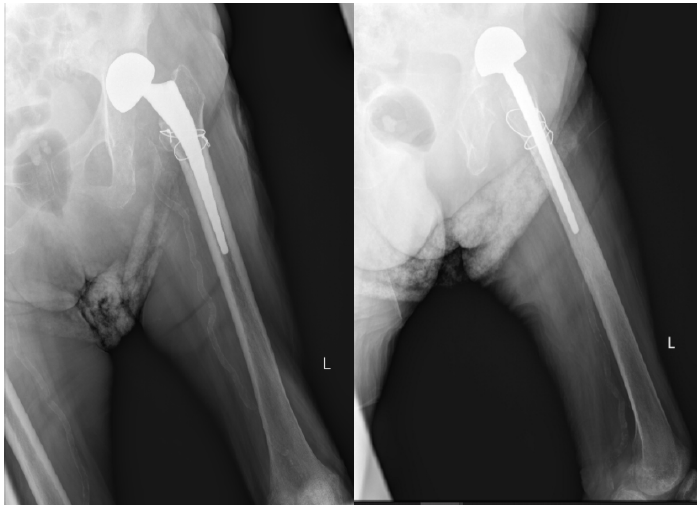
Laboratory examination revealed leukocyte count of 8.39x10³/μL, neutrophil count of 5.72x10³/μL, lymphocyte count of 1.68x10³/μL, hemoglobin level of 9.90 g/dL, and thrombocyte count of 411x103/μL. Blood chemistry showed the following results: AST 22.6 U/L, ALT 20.2 U/L, BUN 19.3 mg/dL, creatinine 1.20 mg/dL, eLFG 43.25, HbA1C 6.7, calcium 8.0 mg/dL, albumin 3.43 g/dL, vitamin D 10.8 ng/mL, and estradiol < 10 pg/mL. X-ray of the left femur showed an osteotomy at the collum os femur sinistra level with the Austin Moore hip prosthesis in an adequate position, no osteomyelitis was seen at this time (Figure 1).
A specific examination was then performed to further confirm the diagnosis of osteosarcopenia, includes hand grip strength examination, where this patient had a low hand grip strength of 7.1 kg (normal range of 14.7-24.5 kg). Additionally, to determine the level of bone density and muscle mass, an additional examination was carried out in the form of a Dual-Energy X-ray Absorptiometry or DXA examination. The DXA results showed a T-score of neck femur: -2.9 indicating the lowest bone density in the right femur, suggesting osteoporosis. Furthermore, DXA also shows the condition of muscle mass indicated in term of Appendicular Skeletal Muscle Mass or ASM of 2.39 kg/m2.
During hospitalization, patient was treated by orthopedic surgery for the management of wound infection on her right thigh. Patient underwent wound re- debridement with administration of intravenous amikacin 1 gram/day along with routine wound care. Supportive therapy was given, including vitamin D 1000 IU and physiotherapy. Additional therapy was provided by our cardiology colleague which included aspirin 80 mg, clopidogrel 75 mg, bisoprolol 2.5 mg, ramipril 5 mg, and simvastatin 20 mg.
Figure 1: X-ray of the Left Femur
DISCUSSION
Osteopenia, as defined by WHO, is a T-score between -1 to -2.5, while values less than -2.5 are diagnostic for osteoporosis [5].The European Working Group on Sarcopenia in Older People (EWGSOP) 2019 defined sarcopenia as a decrease in muscle strength (either assessed by handgrip strength or chair stand test) accompanied by a decrease in muscle mass index [6].In this case, with the finding of low T-score, ASM, and low muscle strength, it can be concluded that this patient clearly has a combined condition of osteoporosis and sarcopenia, named osteosarcopenia. The presence of fractures and prolonged immobilization are closely related to her own risk factors.
Reduced gonadal function or hormones also contribute to systemic changes in patient, especially in bones and muscles. The main consequence of decreased estrogen levels is increased bone resorption, leading to an imbalance between bone resorption and formation. The direct estrogen effects on osteocytes, osteoclasts, and osteoblasts result in inhibition of bone remodeling, reduced bone resorption, and maintenance of bone formation, respectively. Estrogen also modulates osteoblast/osteocyte and osteoclast T-cell regulation [7]. The crucial role of vitamin D as an essential element in bone formation cannot be ruled out. Low vitamin D levels in patient also contribute to the increased risk of fractures.
The management principles of osteosarcopenia consist of both pharmacological and non-pharmacological approach.8 Non-pharmacological management includes lifestyle modification, nutritional therapy, resistance training, and vitamin D supplementation [8-9]. Guideline recommends adequate calcium intake of around 1000-1300 mg a day for optimal bone health [10]. The recommended protein intake for elderly is 1.2 g per kilograms of body weight a day, which is generally higher than general population. Regarding vitamin D supplementation, current recommendation suggests oral vitamin D supplementation of 800-1000 units/day along with calcium supplementation of 500 mg/day [10-11].
The pharmacological treatment of osteosarcopenia is a relatively new area of research. Existing studies are still lacking substantial evidence in this regard. Nevertheless, the therapeutic effects of certain compounds on osteoporosis and sarcopenia suggest the potential for dual effects on muscle and bone mass, thereby indicating their potential usefulness in treating osteosarcopenia.
CONCLUSION
We report a case of 78-year-old woman diagnosed with osteosarcopenia. The diagnosis of osteosarcopenia in this patient was established based on history taking, physical examination, and supporting examination which included assessment of bone mineral density, muscle strength, and muscle mass. Management of osteosarcopenia includes non-pharmacological and pharmacological approach; however, pharmacological management is still relatively new and lacks significant evidence in this context. Osteosarcopenia is a new geriatric syndrome with serious consequences in elderly. This report aims to add value to clinical experience and knowledge, raise awareness of osteosarcopenia and enable appropriate management of this disease.
REFERENCE
United Nations, Department of Economic and Social Affairs, Population Division. “World population ageing 2019: Highlights.” World Population Ageing 2019, 2019.
Daly, R.M. et al. “Gender specific age-related changes in bone density, muscle strength and functional performance in the elderly: a 10-year prospective population-based study.” BMC Geriatrics, vol. 13, 2013, pp. 71.
Sjöblom, S. et al. “Relationship between postmenopausal osteoporosis and the components of clinical sarcopenia.” Maturitas, vol. 75, 2013, pp. 175–180.
Nielsen, B.R. et al. “Sarcopenia and osteoporosis in older people: a systematic review and meta-analysis.” European Geriatric Medicine, vol. 9, 2018, pp. 419–434.
Kirk, B., Zanker, J. and Duque, G. “Osteosarcopenia: epidemiology, diagnosis, and treatment—facts and numbers.” Journal of Cachexia, Sarcopenia and Muscle, vol. 11, 2020, pp. 609–618.
Clynes, M.A. et al. “Osteosarcopenia: where osteoporosis and sarcopenia collide.” Rheumatology, 2020, pp. 1–9.
Khosla, S., Oursler, M.J. and Monroe, D.G. “Estrogen and the skeleton.” Trends in Endocrinology and Metabolism, vol. 23, no. 11, 2012, pp. 576–581.
Kirk, B. et al. “A clinical guide to the pathophysiology, diagnosis and treatment of osteosarcopenia.” Maturitas, vol. 140, 2020, pp. 27–33.
Pai, M.V. “Osteoporosis prevention and management.” Journal of Obstetrics and Gynecology of India, 2017, pp. 237–242.
Fatima, M. et al. “Therapeutic approaches to osteosarcopenia: insights for the clinician.” Therapeutic Advances in Musculoskeletal Disease, 2019.
Volkert, D. “The role of nutrition in the prevention of sarcopenia.” Wiener Medizinische Wochenschrift, vol. 161, 2011, pp. 409–415.
Recommended Articles
Research Article
A study on the feasibility of online classes for medical education
Seema Bose,
Atindra Krishna Ghosh
Published: 15/02/2021
Download PDF
Research Article
Amyand’s Hernia: A Rare form of Common Entity
Download PDF
Research Article
Prevalence of Typhoid Fever among Patients Attending General Sani Abatcha Specialist Hospital Damaturu, Nigeria
Ahmed Idriss Jajere,
...
Usman Umar Faruk
Published: 10/10/2020
Download PDF
Research Article
A case report of management of a Case of Hyperalgesia by Ultrasound guided Fluoroscopically Verified Transforaminal Nerve Root Block
Sunil Dutt,
...
Anil Kumar
Published: 29/06/2024
Download PDF
PO Box 101, Nakuru
Kenya.
Email: office@iarconsortium.org
Editorial Office:
J.L Bhavan, Near Radison Blu Hotel,
Jalukbari, Guwahati-India
Amrita, G. P. & Kuswardhani, R. A. T. (2023). Diagnosis and Management of Osteosarcopenia in Post-Menopausal Woman. IAR Journal of Medical Case Reports, 4(2), 1-3.
MLA
Amrita, Gede P. and R. A. T. Kuswardhani. "Diagnosis and Management of Osteosarcopenia in Post-Menopausal Woman." IAR Journal of Medical Case Reports 4.2 (2023): 1-3.
Chicago
Amrita, Gede P. and R. A. T. Kuswardhani. "Diagnosis and Management of Osteosarcopenia in Post-Menopausal Woman." IAR Journal of Medical Case Reports 4, no. 2 (2023): 1-3.
Harvard
Amrita, G. P. and Kuswardhani, R. A. T. (2023) 'Diagnosis and Management of Osteosarcopenia in Post-Menopausal Woman' IAR Journal of Medical Case Reports 4(2), pp. 1-3.
Vancouver
Amrita GP, Kuswardhani RAT. Diagnosis and Management of Osteosarcopenia in Post-Menopausal Woman. IAR Journal of Medical Case Reports. 2023 Jul;4(2):1-3.


 Download PDF
 Download XML