Low vision and blindness define the two levels of visual impairment. They are a real public health problem. World Health Organization (WHO) estimates that 15 million children under the age of 15 years are affected by this impediment. Africa and Asia are the most affected. The aim of our study was to determine the causes of visual impairment in children at the Institute of African Tropical Ophthalmology (IOTA) located in Bamako (Mali). Materials and methods: This was a retrospective descriptive study covering 05 years. Our study included all children diagnosed with visual impairment with a complete medical file from January, 1st 2015 to December, 31st 2019. WHO International Classification of Diseases (ICD-10) was used to define the level of visual impairment. Results: We collected 145 cases of children aged 0 to 15 years with bilateral visual impairment out of a total of 2,500 consultations during the study period. The frequency of visual impairment accounted for 5.8%. Children under 5 were predominant with 44.14%. The sex-ratio was 1.16. According to WHO classification, low vision (category I and II) represented 37.93% (n = 55); and blindness (grade III, IV, V) was 62.02%. The anatomical site of the lesions was dominated by corneal lesions with 26.9%. Conclusion: Childhood blindness and low vision still remain a public health problem in our countries. In our study, corneal damage related to malnutrition was the most common.
Keywords
Impairment
Low Vision
Blindness
Child
Cornea
INTRODUCTION
World Health Organization (WHO) uses the International Classification of Diseases (ICD) to define the different levels of visual impairment. According to this classification, it defines two levels of visual deficit: blindness and low vision [1].
These two entities constitute global public health problems, particularly in developing countries. Almost 75% of cases of blindness are found in Africa and Asia [1]. According to 2010 data from WHO, there are around 285 million people with visual impairment worldwide, including 39 million blind and 246 million with low vision. Among them, there were 19 million children under the age of 15 [2]. Visual impairment in children has a significant socioeconomic impact because of the number of years they will have to live with this disability but also the costs generated for its care. Studies carried out in Mali on the issue included only children in schools for low vision [3,4] excluding children who are not of school age and those who had no access to these schools.
The aim of our study is then to identify the causes of bilateral visual impairment in all the children who have been seen in the pediatric ophthalmology department of the Institute of African Tropical Ophthalmology.
MATERIALS AND METHODS
This was a retrospective descriptive study over 05 years (January 1st, 2014 to January 1st, 2019). Our study included all children diagnosed with visual impairment with a complete medical file.
The data collected included age, gender, level of education, age at onset of the impairment, data from the ophthalmic examination, especially the type of visual impairment, the aetiology according to the anatomical location, the etiological factor.
We used WHO classification to define the level of visual impairment (World Health Organization. 2020c). Thus according to the distance visual acuity (DVA) of the better eye and with the best optical correction, 5 categories were defined:
Category I: Corrected DVA less than 3/10 and greater than or equal to 1/10.
Category II: Corrected DVA less than 1/10 and greater than or equal to 1/20.
Category III: Corrected DVA less than 1/20 and greater than or equal to 1/50.
Category IV: Corrected DVA less than 1/50 but light perception preserved.
Category V: Total blindness. No light perception.
Categories I and II correspond respectively to moderate and severe low impairment. Blindness was defined from category III.
The etiologies of blindness and low vision were defined according to the anatomical location of the ocular involvement. For children of preverbal age and those with difficulties for an objective evaluation, the evaluation was based on the signs of profound visual impairment observed on the ophthalmologic examination (absence of fixation, pursuit or defense reflex or presence of abnormalities of the photomotor reflex, nystagmus, fan sign, Franceschetti's finger-ocular sign).
Data were analyzed with SPSS software version 2.5.
RESULTS
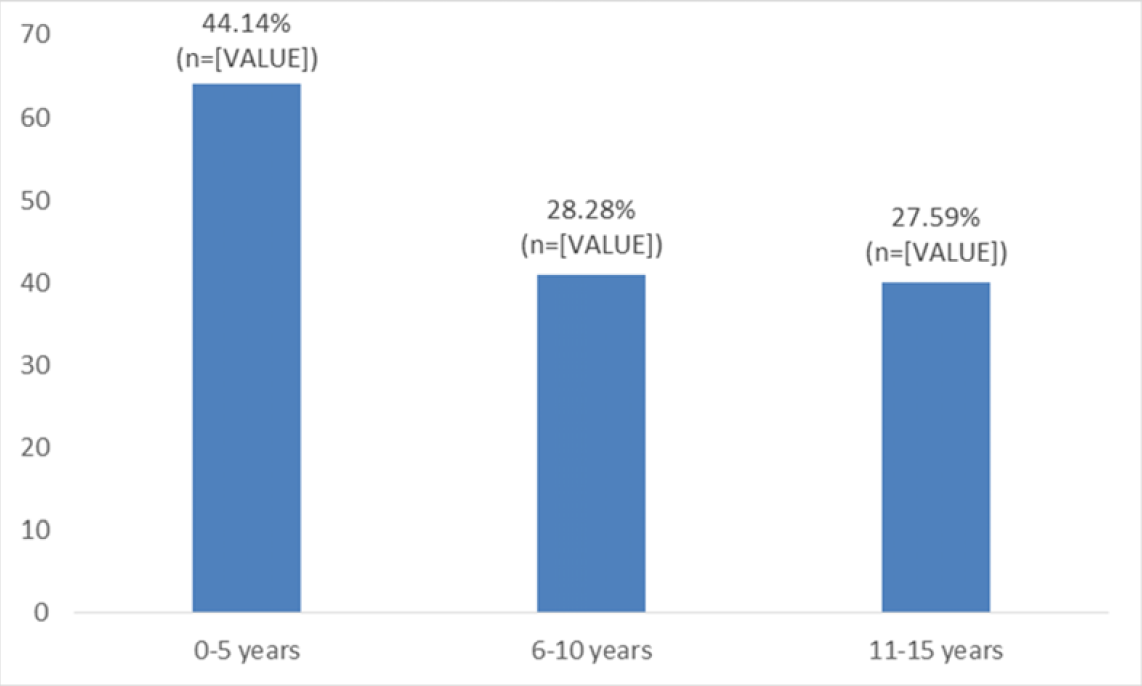
We collected 145 cases of children aged 0 to 15-year old with bilateral visual impairment out of a total of 2,500 consultations during the study period, so the frequency of visual impairment accounted for 5.8%. Children under 5 accounted for 44.14% (n = 64) (Figure 1).
Figure1: Age Group of Patients
The male gender was slightly more represented with 53.79% (n = 78) than the female gender (46.21%); the sex ratio was 1.16. The children mainly came from outside Bamako (68.97%) and mostly lived in rural areas. They were most often brought in by parents or referred from other facilities for blurring of vision in 73.8% (n = 107). A notion of family visual impairment including a case of blindness was found in 3 children. According to WHO classification, low vision (category I and II) accounted for 37.93% (n = 55); and blindness (category III, IV, V) was 62.02% (Table I). The anatomical site of the lesions was dominated by corneal damage with 26.9% (n = 39) among which corneal dystrophy predominated, with 24 cases (Table II). A positive history of malnutrition was noted in 79.49% of children with a corneal lesion. The globe appeared normal in 5.52%. Optic atrophy accounted for 12.41% and was secondary to meningitis in 66.67% and glaucoma in 10%. The etiological factors responsible for the impairment could not be determined in 62.02% of the children (Table 3). Among the factors determined (37.98%), postnatal disorders dominated with 17.24%. Intrauterine factors were found in 6 children, including 4 cases of toxoplasmosis and 2 cases of congenital rubella.
DISCUSSION
Our retrospective study estimated the hospital frequency of bilateral visual impairment in children (0-15-year-old) at 5.8%. Bella-Hiag, AL, & Ebana Mvogo, C. [5] and Bella, L.A. et al., [6] in their work had respectively found a frequency of 2.3 and 2.4% in children under 5 years of age in two hospitals in Cameroon. The national prevalence of blindness in Mali accounted for 1.2% [7]. Our result, which is higher than that of all of these studies, could be explained by a difference in methodology. Because our study was conducted in the pediatric ophthalmology Department which is the only one that welcome all the children referred by other practitioners throughout the country.
Children under 5 years old (44.14%) were the most affected by low vision in our series. At these ages, children are more likely to infections and malnutrition and most authors mentioned these two entities as the main aetiologies of low vision in Africa [8,9].
Table 1: Site of the lesions
Site anatomical + pathologies
Number
Percentage
Cornea
Corneal Dystrophy
Corneal Pillowcase
39
24
15
26.9
Crystalline
Cataract
08
08
05.52
Corneal Irido Angle
Congenital Glaucoma
11
11
07.59
Retina
Retinopathy Pigmentosa
Albinism
Chorioretinal Coloboma
Chorioretinal Scar
Retinoblastoma
19
07
04
02
04
02
13.10
Optic Nerve
Optic Atrophy
18
18
12.41
Visual Cortex
Cortical Blindness
26
26
17.93
Entire Globe
Anophthalmos
Microphthalmia
Phthisis
12
05
05
02
8.27
Normal Lazy Globe
Amblyopia Ametropia
08
08
05.52
Others
04
02.76
Total
145
100
The male gender was slightly more affected in our study with a sex-ratio of 1.16. Our result contrasts with data from WHO in 2010 which noted that women were at greater risk of visual impairment than men (http://www.who.int). Male predominance has also been reported in Nigeria [10].
In our study, children in rural areas were the most affected with 73.8%. Difficult access to health facilities, the lack of specialists and the low socioeconomic conditions are the main causes that prevent patients to have access to appropriate healthcare, particularly those from rural areas. Greater efforts need to be done to improve the quality of health services and to facilitate their access to the population regardless their origin (rural or urban).
Blindness (category III, IV, V) represented 62.02% of visual impairments against 37.93% of low vision. In Cameroon in the series of Bella et al., in children under 5 years of age, blindness represented 69.1% [6]. Other studies in Mali and East Africa (Kenya, Malawi, Uganda, and Tanzania) in schools for the visually impaired reported a predominance of blindness [11].
Table 2: Category of visual impairment
WHO Category (CIM-10)
Numbers
Percentage
I
21
14.48
II
35
24.14
III
19
13.10
IV
30
20.69
V
40
27.59
Total
145
100
A Brazilian study found 46.8% of blindness among visually impaired children [12]. Our result, like those of other African studies on the issue, proves that children in developing countries are most often affected by the severe form of visual impairment closely related to low socioeconomic conditions, lack of appropriate healthcare facilities unlike high-income countries.
The most affected anatomical site was the cornea. These children with corneal involvement were malnourished in 79.49% of cases. Malnutrition is causing polyvitaminic deficiency involving vitamin A. Avitaminosis A is the source of eye lesions, the most fearsome of which is corneal damage which worsens in the absence of appropriate or early treatment causing therefore blindness.
Corneal opacities cause visual impairment in several countries in Africa [13,14] and Asia [15,16]. In the world, these two continents are considered to be the least developed with a health system unable to face the multiple health challenges. In the specific case of Mali, despite the efforts made by the authorities, access to health facilities for rural populations remains a major challenge.
Optic nerve damage of infectious origin accounted for 66.67% and were caused by meningitis. Infectious pathologies remain a major cause of visual impairment. Congenital ocular abnormalities accounted for 8.27% of the aetiologies. These abnormalities are largely linked to embryofoetopathies, mainly toxoplasmosis (4 cases) and rubella (2 cases). Regular prenatal follow-up will prevent these causes of visual impairment. No etiologic factor could be found in most of our children (62.02%). Mba Aki T et al., found no etiological factor in 73.2% [12]. The low rate of systematic pre- and post-natal follow-up, the difficulty in carrying out some etiological assessments would be largely the causes of this fact.
CONCLUSION
Visual impairment in children remains a real public health problem in our countries. Our study, although hospital-related, showed a predominance of blindness compared to low vision, highlighting the fragility of our health system. Particular emphasis must be made on the prevention of preventable causes of blindness through the improvement of our health systems, while facilitating access to them for rural populations.
REFERENCE
World Health Organization. International Statistical Classification of Diseases and Related Health Problems: ICD-10. 2020.
World Health Organization. Visual Impairment and Blindness. 2020.
Mba Aki, T., et al. “Causes des Déficiences Visuelles dans une École Spécialisée en Milieu Urbain Africain.” Bulletin Médical d’Owendo, vol. 15, no. 43, 2017, pp. 38–44.
Guirou, N., et al. “Causes of Blindness in Children in a School for the Blind in Mali.” Tropical Medicine and Health, vol. 28, no. 4, 2018, pp. 439–442.
Bella-Hiag, A.L., and C. Ebana Mvogo. “Ophthalmological Pathology of the Cameroonian Child under 5 Years Old.” Bulletin de Liaison et de Documentation–OCEAC, vol. 30, no. 4, 1997, pp. 27–30.
Bella, L.A., et al. “Bilateral Blindness and Low Vision in Children Aged 0 to 5 at the Gyneco-Obstetrics and Pediatric Hospital in Yaoundé.” Cahiers d’Études et de Recherches Francophones / Santé, vol. 20, no. 1, 2010, pp. 35–39.
Pascolini, D., et al. “2002 Global Update of Available Data on Visual Impairment: A Compilation of Population-Based Prevalence Studies.” Ophthalmic Epidemiology, vol. 11, no. 2, 2004, pp. 67–115.
Maida, J.M., et al. “Pediatric Ophthalmology in the Developing World.” Current Opinion in Ophthalmology, vol. 19, no. 5, 2008, pp. 403–408.
Resnikoff, S., et al. “Blindness.” International Encyclopedia of Public Health, Elsevier, 2017, pp. 239–246.
Richard, A.I. “Causes of Blindness and Low Vision in Bayelsa State, Nigeria: A Clinic-Based Study.” Nigerian Quarterly Journal of Hospital Medicine, vol. 20, no. 3, 2010, pp. 125–128.
Njuguna, M., et al. “Causes of Severe Visual Impairment and Blindness in Children in Schools for the Blind in Eastern Africa: Changes in the Last 14 Years.” Ophthalmic Epidemiology, vol. 16, no. 3, 2009, pp. 151–155.
Haddad, M.A.O., et al. “Pediatric and Adolescent Population with Visual Impairment: Study of 385 Cases.” Clinics, vol. 61, no. 3, 2006, pp. 239–246.
Silver, J., et al. “Low Vision in East African Blind School Students: Need for Optical Low Vision Services.” British Journal of Ophthalmology, vol. 79, no. 9, 1995, pp. 814–820.
Kello, A.B., and C. Gilbert. “Causes of Severe Visual Impairment and Blindness in Children in Schools for the Blind in Ethiopia.” British Journal of Ophthalmology, vol. 87, no. 5, 2003, pp. 526–530.
Kalikivayi, V., et al. “Visual Impairment in School Children in Southern India.” Indian Journal of Ophthalmology, vol. 45, no. 2, 1997, p. 129.
Sitorus, R.S., et al. “Causes and Temporal Trends of Childhood Blindness in Indonesia: Study at Schools for the Blind in Java.” British Journal of Ophthalmology, vol. 91, no. 9, 2007, pp. 1109–1113.
Recommended Articles
Research Article
A study on the feasibility of online classes for medical education
Seema Bose,
Atindra Krishna Ghosh
Published: 15/02/2021
Download PDF
Research Article
Amyand’s Hernia: A Rare form of Common Entity
Download PDF
Research Article
Prevalence of Typhoid Fever among Patients Attending General Sani Abatcha Specialist Hospital Damaturu, Nigeria
Ahmed Idriss Jajere,
...
Usman Umar Faruk
Published: 10/10/2020
Download PDF
Research Article
A case report of management of a Case of Hyperalgesia by Ultrasound guided Fluoroscopically Verified Transforaminal Nerve Root Block
Sunil Dutt,
...
Anil Kumar
Published: 29/06/2024
Download PDF
PO Box 101, Nakuru
Kenya.
Email: office@iarconsortium.org
Editorial Office:
J.L Bhavan, Near Radison Blu Hotel,
Jalukbari, Guwahati-India
J. P., T., J. M., T. & A., K. (2020). Bilateral visual impairment in children in African hospitals: About 145 children at the Institute of African Tropical Ophthalmology. IAR Journal of Medical Case Reports, 1(1), 1-4.
MLA
J. P., Théra, Tiama J. M. and Konipo A.. "Bilateral visual impairment in children in African hospitals: About 145 children at the Institute of African Tropical Ophthalmology." IAR Journal of Medical Case Reports 1.1 (2020): 1-4.
Chicago
J. P., Théra, Tiama J. M. and Konipo A.. "Bilateral visual impairment in children in African hospitals: About 145 children at the Institute of African Tropical Ophthalmology." IAR Journal of Medical Case Reports 1, no. 1 (2020): 1-4.
Harvard
J. P., T., J. M., T. and A., K. (2020) 'Bilateral visual impairment in children in African hospitals: About 145 children at the Institute of African Tropical Ophthalmology' IAR Journal of Medical Case Reports 1(1), pp. 1-4.
Vancouver
J. P. T, J. M. T, A. K. Bilateral visual impairment in children in African hospitals: About 145 children at the Institute of African Tropical Ophthalmology. IAR Journal of Medical Case Reports. 2020 Jul;1(1):1-4.


 Download PDF
 Download XML