Background: Magnetic Resonance Imaging (MRI) is a revolutionary diagnostic tool with widespread medical applications. Public awareness and understanding of MRI are crucial factors that can influence healthcare decisions. This study explores the knowledge and perceptions of MRI among the general population in Himachal Pradesh, India. Materials and Methods: A cross-sectional survey was conducted from April 2023 to July 2023. A sample of 400 adults residing in Himachal Pradesh participated in the study. A structured questionnaire assessed their knowledge of MRI, covering terminology, functionality, medical indications, benefits, risks, preparation, types, and cost. Data were analyzed using Epi Info V7 Software. Results: The study revealed varying levels of knowledge among participants. Approximately 25.75% correctly identified "MRI" as an abbreviation for "Magnetic Resonance Imaging." Only 25.25% could provide a brief description of MRI and its operation. While 37% recognized medical conditions requiring MRI, only 21.75% understood the differences between MRI, CT scans, and X-rays. However, 46.75% comprehended the information MRI scans offer to healthcare providers. About 29.75% were aware of potential risks during MRI. Knowledge regarding types of MRI scans (11.25%) and the use of contrast agents (14.25%) was limited. Notably, 50.5% recognized factors influencing MRI cost. Concerning age restrictions, 26% were aware, and 24.5% knew MRI's safety for repeated scans. Conclusion: This study highlights the need to enhance public awareness and understanding of MRI in Himachal Pradesh. Efforts should focus on terminology, benefits, risks, distinctions from other imaging modalities, and clarification of age-related guidelines. Effective patient education can empower individuals to make informed healthcare choices.
Magnetic Resonance Imaging (MRI) is a transformative technology in the realm of medical diagnostics, offering non-invasive and detailed insights into the human body's inner workings. Since its inception in the 1970s, MRI has played a pivotal role in the diagnosis and management of a wide spectrum of medical conditions, ranging from neurological disorders to musculoskeletal injuries. This imaging modality employs powerful magnetic fields and radio waves to generate intricate images of tissues and organs, aiding healthcare professionals in rendering precise diagnoses and treatment plans. As MRI continues to revolutionize the landscape of modern medicine, it has become an indispensable tool in the diagnostic armamentarium, with millions of scans performed annually across the globe [1-6].
The ubiquity of MRI in contemporary healthcare practices underscores the need to assess public awareness, perception, and understanding of this advanced imaging technology. While medical practitioners are well-versed in the capabilities and intricacies of MRI, the general population may lack the same level of familiarity. This discrepancy in knowledge is a critical concern, as public awareness and perceptions can significantly influence healthcare decisions, including the acceptance of MRI as a diagnostic tool when recommended by healthcare providers [7-13].
As the utilization of MRI expands and diversifies, it is imperative to investigate how the general population perceives this imaging technique, comprehends its benefits, and weighs potential concerns. Informed decision-making is the cornerstone of patient-centered care, contingent upon individuals' understanding of medical procedures, their associated advantages, and any associated risks [14-17].
This study embarks on a comprehensive exploration of the awareness and perceptions of MRI among the general population in Himachal Pradesh, India. By evaluating knowledge, attitudes, and beliefs regarding MRI, we endeavor to elucidate the extent to which individuals are well-informed about this imaging modality. Furthermore, this investigation aims to identify misconceptions or concerns held by the public. Such insights are invaluable for healthcare providers, policymakers, and educators, enabling the development of strategies that promote informed decision-making and facilitate effective patient-provider communication concerning MRI utilization.
Objectives of the Study
To evaluate the awareness and knowledge regarding Magnetic Resonance Imaging (MRI) among general population of Himachal Pradesh
Research Approach
Descriptive
Research Design
Cross-sectional survey design
Study Area
Himachal Pradesh
Study Duration
Between April 2023 to July 2023
Study Population
The study's target population encompassed all adults aged 18 and above who had been residents of Himachal Pradesh for a minimum of 12 months
Sample Size
A robust sample size of 400 adults was determined using a 95% confidence level, an estimated knowledge level of 50% regarding Magnetic Resonance Imaging (MRI), a precise 5% absolute error margin, and a conservative 5% non-response rate.
Study Tool
A google form questionnaire consisting of questions regarding socio-demography and knowledge regarding Magnetic Resonance Imaging (MRI) was created. The questionnaire was initially pre-tested on a small number of participants to identify any difficulty in understanding by the respondents.
Description of Tool
Demographic Data Survey Instrument: The demographic form elicited information on participants’ background: age, marital status, religion, employment, education and many more.
Questionnaire
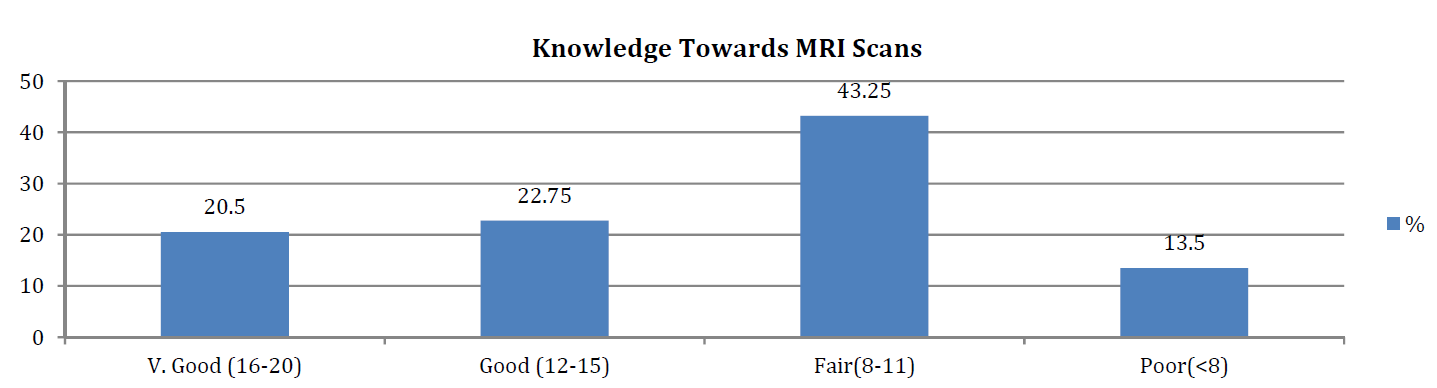
The questionnaire contains 20 structured knowledge related questions regarding Magnetic Resonance Imaging (MRI). One mark was given for each correct answer and zero for incorrect answer. The maximum score was 20 and minimum score was zero. Scoring was done on the basis of marks as >80% (16-20) = very good, 60-79% (12-15) = Good, 41-59% (8-11) = Fair, <40% (< 8) = poor
Validity of Tool
By the experts in this field
Data Collection
Data was collected under the guidance of supervisors. The google form questionnaire was circulated among the residents of Himachal Pradesh for responses using online modes like e-mail and social media platforms like Whatsapp groups, Facebook, Instagram and Linkedin till the 400 responses were collected.
Data Analysis
Data was collected and entered in Microsoft excel spread sheet, cleaned for errors and analyzed with Epi Info V7 Software with appropriate statistical test in terms of frequencies and percentage.
Ethical Considerations
Participants confidentiality and anonymity was maintained.
In the present study 33.5% (134) females had very good knowledge (16-20 marks) towards Magnetic Resonance Imaging (MRI), 39.25% (157) having good knowledge (12-15 marks), 19% (76) having fair knowledge (8-11 marks) and 8.25% (33) having poor knowledge (<8 marks) (Figure 1).

Figure 1: Knowledge towards Magnetic Resonance Imaging (MRI) Among Study Participants
The primary objective of this study was to gauge the understanding of Magnetic Resonance Imaging (MRI) among the general population of Himachal Pradesh. A total of 400 participants took part in the study, with 251 (62.75%) residing in urban areas and 149 (37.25%) in rural areas (Table 1).
Table 1: Responses of the Participants to Various Statements
| S. No. | Statements | Frequency of Correct Response | Response |
| What does "MRI" stand for in the context of medical imaging? | 103 | 25.75 | |
| Can you provide a brief description of what an MRI scan is and how it works? | 101 | 25.25 | |
| For what types of medical conditions or situations might a healthcare provider recommend an MRI? | 148 | 37 | |
| How does the MRI scanning process differ from that of a CT scan or X-ray? | 87 | 21.75 | |
| What are some of the primary advantages of using MRI for medical diagnosis? | 125 | 31.25 | |
| Are there any potential risks or side effects associated with undergoing an MRI scan? | 119 | 29.75 | |
| In what medical scenarios might an MRI be preferred over other imaging techniques like X-rays or CT scans? | 102 | 25.5 | |
| What types of information can an MRI scan provide to healthcare professionals? | 187 | 46.75 | |
| Are there any special preparations or instructions that patients need to follow before having an MRI? | 131 | 32.75 | |
| Can you name at least two different types of MRI scans used for specific medical purposes? | 45 | 11.25 | |
| Is it necessary to use contrast agents or dyes for all MRI scans, and if so, why? | 57 | 14.25 | |
| How long does a typical MRI scan procedure take, and does it vary depending on the body part being scanned? | 165 | 41.25 | |
| Can an MRI scan be used to monitor the progression of chronic diseases or conditions? | 111 | 27.75 | |
| Are there any limitations or conditions under which an MRI might not be suitable for a patient? | 105 | 26.25 | |
| How does the cost of an MRI scan compare to other imaging methods, and are there factors that affect the price? | 202 | 50.5 | |
| Are there any age restrictions or considerations for individuals undergoing MRI scans? | 104 | 26 | |
| Is it safe to undergo repeated MRI scans over time, and is there a recommended limit? | 98 | 24.5 | |
| How can patients and healthcare providers minimize patient anxiety or claustrophobia during an MRI scan? | 139 | 34.75 | |
| Can you explain the difference between open MRI and traditional closed MRI machines? | 34 | 8.5 | |
| Where can individuals find reliable information about MRI scans to make informed decisions about their healthcare? | 125 | 31.25 |
Magnetic Resonance Imaging (MRI) is a remarkable diagnostic tool that has transformed the landscape of modern medicine. This discussion delves into the findings of our study, which aimed to explore the awareness and perceptions of MRI among the general population of Himachal Pradesh, India. We analyze the results in the context of knowledge levels, misconceptions, and their implications for healthcare.
Our study revealed varying levels of knowledge among the participants regarding MRI. While a notable percentage of participants demonstrated good knowledge, it is evident that there is room for improvement in educating the general population about this advanced imaging technology. Approximately 25.75% of participants correctly identified "MRI" as an abbreviation for "Magnetic Resonance Imaging" in the context of medical imaging. This indicates a moderate level of familiarity with MRI terminology. Although this is a positive finding, enhancing public awareness of this abbreviation is crucial for clear communication between patients and healthcare providers. About 25.25% of participants could provide a brief description of what an MRI scan is and how it works. While this indicates a basic understanding of the technology behind MRI, efforts should be made to increase this percentage to ensure a more comprehensive grasp of the procedure.
Approximately 37% correctly identified various medical conditions or situations for which a healthcare provider might recommend an MRI. Recognizing the medical contexts in which MRI is utilized is essential for individuals to appreciate its diagnostic value. A significant portion of participants (46.75%) understood the types of information that MRI scans can provide to healthcare professionals. However, there was a lack of awareness regarding how the MRI scanning process differs from that of CT scans or X-rays, with only 21.75% providing correct responses. Clarifying these distinctions can contribute to more informed decisions when choosing between imaging modalities.
A noteworthy 31.25% recognized the primary advantages of using MRI for medical diagnosis. Understanding these advantages, such as high-resolution imaging and absence of ionizing radiation, is vital for appreciating the clinical significance of MRI. Approximately 29.75% of participants were aware of potential risks or side effects associated with undergoing an MRI scan. While MRI is considered safe, it is essential for healthcare providers to educate patients about the magnetic and claustrophobic aspects of the procedure to alleviate potential anxiety or concerns.
Awareness of specific preparations or instructions before undergoing an MRI was relatively high, with 32.75% providing correct responses. This indicates that many participants were knowledgeable about the importance of removing metallic objects and wearing appropriate attire during the scan. Knowledge regarding different types of MRI scans used for specific medical purposes was relatively low, with only 11.25% naming two types. Increasing awareness of the various MRI techniques and their applications can help patients understand the relevance of the procedure to their specific condition. Understanding the necessity of using contrast agents or dyes for certain MRI scans was limited (14.25%). Patient education should emphasize the importance and safety of these agents when required.
A substantial percentage (41.25%) correctly identified that the duration of an MRI scan can vary depending on the body part being scanned. Additionally, a high percentage (34.75%) recognized the importance of minimizing patient anxiety or claustrophobia during an MRI scan. Knowledge of the non-invasive nature of MRI scans is crucial for managing patient expectations. Approximately 26.25% were aware of limitations or conditions under which an MRI might not be suitable for a patient. This underscores the importance of patient education regarding the appropriateness of the procedure for specific clinical scenarios. Half of the participants (50.5%) recognized that various factors can influence the cost of an MRI scan for an individual. Understanding cost implications is essential for financial planning and healthcare decision-making.
A significant percentage (26%) were aware of age restrictions or considerations for individuals undergoing MRI scans. Public awareness campaigns should clarify age-related guidelines to ensure appropriate utilization of MRI scans. Over a quarter of the participants (24.5%) were aware of the safety of undergoing repeated MRI scans over time. While MRI does not involve ionizing radiation, educating patients about the safety of the procedure can alleviate concerns.
These findings align with existing research on public knowledge and perception of medical imaging procedures, including MRI.14,15 Similar studies have reported varying levels of understanding among the general population, with knowledge gaps regarding the benefits, risks, and differences between imaging modalities [16,17].
This study assessed the awareness and perception of MRI among the general population of Himachal Pradesh, India. The findings highlight both strengths and areas for improvement in public knowledge and understanding of MRI. Efforts to enhance awareness should focus on clarifying terminology, describing the benefits and risks, distinguishing MRI from other imaging modalities, and providing information on preparation and types of MRI scans.
Effective patient education is essential to ensure informed decision-making and foster communication between healthcare providers and patients. By addressing knowledge gaps and misconceptions, healthcare professionals and policymakers can contribute to more informed healthcare choices and improved patient outcomes.
Smith-Bindman, R. et al. “Adherence to radiology guidelines: effects on resource utilization.” JAMA Internal Medicine, vol. 169, no. 9, 2009, pp. 847–857.
O’Sullivan, J.W. et al. “Obtaining information from the medical record.” BMJ, vol. 368, 2020, m132.
American College of Radiology. ACR Manual on Contrast Media. 2020, www.acr.org/-/media/ACR/Files/Clinical-Resources/Contrast_Media.pdf.
Foley, W.D. “History of radiology.” Radiologic Clinics, vol. 46, no. 1, 2008, pp. 1–14.
Bux, S.I. et al. “Awareness and knowledge about MRI and CT imaging in an urban area of Mumbai.” Journal of Clinical and Diagnostic Research, vol. 13, no. 5, 2019, pp. TC08–TC12.
Shaw, P.J. et al. “Survey of patient perceptions of magnetic resonance imaging.” Clinical Radiology, vol. 60, no. 10, 2005, pp. 1098–1105.
Katz, R.C. et al. “Exploring beliefs about cancer among African American men.” Cancer Nursing, vol. 31, no. 5, 2008, pp. 365–372.
Srinivasan, A. et al. “Imaging in neurology: Current role and future trends.” Annals of Indian Academy of Neurology, vol. 11, no. 4, 2008, pp. 231–239.
Kravitz, R.L. et al. “Characteristics of family medicine residency programs associated with maternity care competence of graduates.” Academic Medicine, vol. 77, no. 10 suppl., 2002, pp. S16–S18.
Jespersen, B. et al. “A computational model of the fetal heart predicts the need for vasopressor treatment in advance of birth.” Science Translational Medicine, vol. 7, no. 277, 2015, 277ra30.
Gupta, R.K. and M. Bang. “Progress and perspective of radiology research in India.” The Indian Journal of Radiology and Imaging, vol. 19, no. 3, 2009, pp. 169–170.
Pakdemirli, E. et al. “The awareness of magnetic resonance imaging in Turkey: A survey in a central anatolian city.” Radiology Research and Practice, 2011, pp. 1–4.
Matsuoka, Y. et al. “The relationship between attitudes towards physical activity and fear of cancer recurrence in Japanese breast cancer survivors.” Psycho-Oncology, vol. 19, no. 9, 2010, pp. 964–969.
Mathew, R.P. et al. “Awareness about magnetic resonance imaging (mri) in an Urban South Indian population.” Journal of Clinical and Diagnostic Research, vol. 10, no. 3, 2016, pp. TC13–TC17.
Bux, S.I. et al. “Awareness and knowledge about MRI and CT imaging in an urban area of Mumbai.” Journal of Clinical and Diagnostic Research, vol. 13, no. 5, 2019, pp. TC08–TC12.
Shaw, P.J. et al. “Survey of patient perceptions of magnetic resonance imaging.” Clinical Radiology, vol. 60, no. 10, 2005, pp. 1098–1105.
Pakdemirli, E. et al. “The awareness of magnetic resonance imaging in Turkey: A survey in a central anatolian city.” Radiology Research and Practice, 2011, pp. 1–4.