Contents
Download PDF
pdf Download XML
380 Views
493 Downloads
Share this article
Research Article | Volume 3 Issue 1 (Jan-June, 2022) | Pages 1 - 5
The Effect of Whatsapp Group-Based Health Media on Knowledge, Attitudes and Behavior of Breast Cancer Early Detection of Health Students
 ,
 ,
 ,
1
Badung Regency Public Health Department, Indonesia
2
Bachelor of Midwifery, Faculty of Health, Institute of Technology and Health Bali, Indonesia
Under a Creative Commons license
Open Access
Received
Nov. 3, 2021
Revised
Dec. 9, 2021
Accepted
Jan. 13, 2022
Published
Jan. 31, 2022
Abstract

BackgroundBreast cancer is a malignancy that develops from breast tissue that arises in the lining cells (epithelium) of the ducts or lobules. Breast cancer is one of the burdens of non-communicable diseases globally, increasing every year. Breast cancer is one of the most common cancers globally with 2,089 million new cases. One of the preventions of breast cancer that every woman can do is Breast Self-Examination (BSE). The objective of this study was to determine the effect of Whatsapp Group-based health promotion on the knowledge, attitudes, and behavior of early detection of breast cancer in health students in Badung Regency. Method: This study uses a cross-sectional research design with a total sample of 54 respondents. The study was conducted in one of the private universities in Badung Regency. Data were analyzed using SPSS, including univariate and bivariate analysis with the Wilcoxon signed-rank test. ResultThe results found that the Whatsapp Group-based health promotion affected health students’ knowledge, attitudes, and behavior in Breast Self-Examination (BSE). This can be seen from the p-value of each variable, including knowledge (<0.001), attitude (<0.001), and behavior (<0.001). Conclusion: Counseling about BSE with health promotion media through Whatsapp Group is useful in increasing the knowledge, attitudes and behavior of health students.

Keywords
INTRODUCTION

Breast cancer is one of the non-communicable diseases that tends to increase every year, so the burden that must be borne by the world due to this disease is increasing. Globally, breast cancer is one of the most common cancers in the world with 2,089 million new cases [1]. Based on data from the American Cancer Society states that the average American woman is at risk of developing breast cancer by 13%. Based on 2015 data, the prevalence of breast cancer in Indonesia is 0.05%. The problem of breast cancer becomes bigger because more than 70% of patients come to health services at an advanced stage [2]. This causes delays in the treatment of breast cancer patients in line with research conducted by Taha [3] at the Haji Adam Malik General Hospital Medan showing a high percentage of patients with advanced breast cancer who came to health services for the first time for a stage IV examination of 39, 7% and at stage IIIB 34.5%. 


Patients with breast cancer detected at an advanced stage cannot be treated with surgery alone but must be combined with chemotherapy. Low survival rates are found at an advanced stage, namely 15% at stage IV and 30-50% at stage III [4]. Early detection of breast cancer is very important because if breast cancer can be detected as early as possible, appropriate action can be taken so that it can be obtained The cure rate is quite high, around 80-90% and can reduce the death rate from cancer [5]. This is in accordance with the Regulation of the Minister of Health Number 34 of 2015 concerning the prevention of breast cancer and cervical cancer [6]. One of the ways to overcome breast cancer that can be done by women is Breast Self Examination (BSE).Research on the factors of delay in breast cancer patients in carrying out initial examinations to health services states that people who have never done BSE have an 11.08 times risk and people who do not routinely do BSE have a 5.18 times risk of experiencing delays in carrying out an initial breast cancer examination to health services compared to people who routinely carry out BSE early detection every month [7]. In some developed countries, the 5-year relative survival rate of breast cancer patients is above 80% due to prevention of early detection [8].


Early detection is not popular in Indonesia because it is influenced by several factors, including lack of knowledge, indifferent attitude, media exposure regarding information and family support [9]. Anita's research on counseling about early detection of breast cancer in Tembung village, Percut Sei Tuan district, Deli Serdang district stated that as many as 53.7% had less knowledge. This shows that respondents do not know about breast cancer and early detection of breast cancer using the BSE method [10]. Another study conducted by Saraswati [11] regarding the effect of Whatsapp and Leaflet media on breast self-examination behavior in high school students in Kendari City stated that WhatsApp and leaflet media could be used as media for health education to increase BSE, and the whatsapp application can be used as a media for health education to increase knowledge and BSE actions in high school students in Kendari City.


Several things indicate that early detection of breast cancer with the BSE method can detect abnormalities in the breast early so that appropriate action can be taken. In addition, this study wanted to analyze the effect of Whatsapp Group-based health promotion on knowledge, attitudes and behavior of early detection of breast cancer in health students in Badung Regency. This study aims to determine the effect of Whatsapp Group-based health promotion on knowledge, attitudes and behavior of early detection of breast cancer in health students in Badung Regency.

MATERIALS AND METHODS

Research Design

The study uses comparative analytics with a one group pretest-posttest design and has obtained research ethics from the Research Ethics Commission at the Health Polytechnic of the Ministry of Health Denpasar with Number 04.0510/KEPITEKES-BALI/IX/2021 on 17 September 2021.


Research Sampling

The sample is a health student at a private university who meets the inclusion criteria, totaling 54 samples. The sampling method is using probability random sampling technique, namely simple random sampling. The statistical test used is the Wilcoxon Signed Rank test because the data is not normally distributed with p-value <0.05.


Research Instrument and Collecting Data

Respondents were given counseling through Whatsapp Group. Data was collected by giving pretest and posttest questionnaires containing statements about Knowledge, Attitudes and Behaviors about Early Detection of Breast Cancer which were filled out by respondents via google form. The questionnaire has been tested for validity by using face validity.


Data Analysis

Descriptive statistics are used to determine the distribution of frequencies and proportions as well as bivariate analysis using the Wilcoxon test.


Ethical Consideration

Informed consent was given to the respondent before the research was conducted and there was no coercion on the respondent. This research contains the principles of anonymity, confidentiality, beneficence, respect for human dignity and justice.

RESULTS

Characteristics of Respondents

Based on the results of the study showed (Table 1) that most of the respondents were 19 years old as many as 36 people (66.7%) and only 3 people were 22 years old (5.6%). In the variable history of breast cancer in this study, prospective respondents who did not have a history of breast cancer were selected as research respondents


Description of Respondents' Knowledge, Attitudes and Behaviors

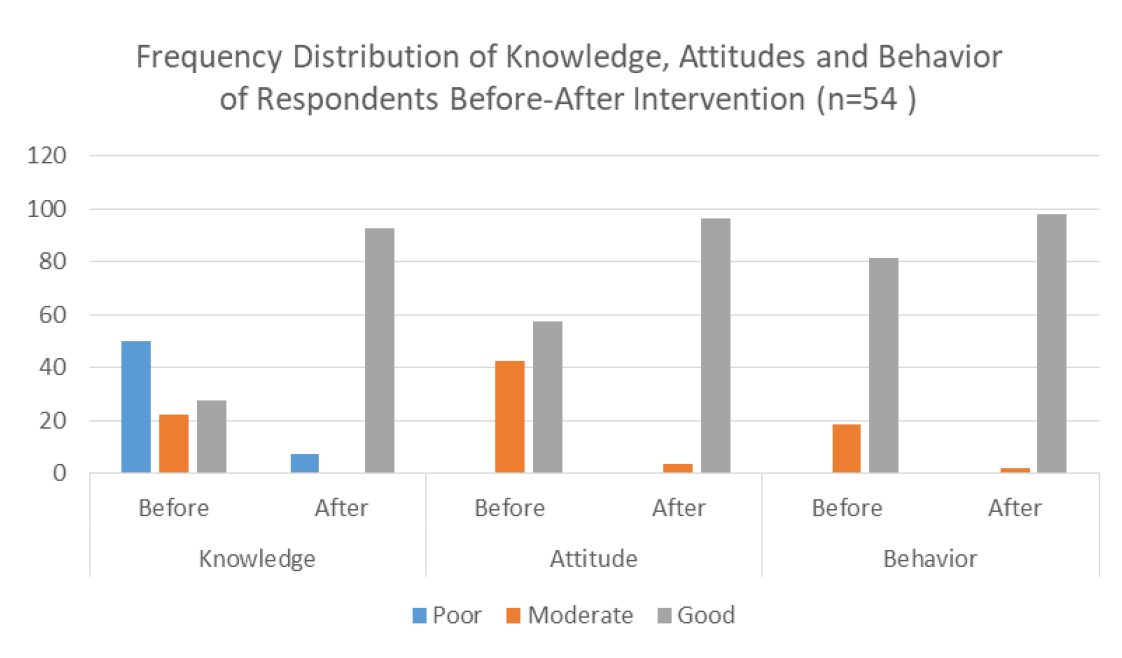
The results of this study(Figure 1) describe the results of univariate analysis of the variables of knowledge, attitudes and behavior before giving intervention to the respondents.From the knowledge variable, it was obtained that some respondents had good knowledge as many as 15 people (27.8%).In the attitude variable, most of the respondents had a good attitude as many as 31 people (57.4%). In the behavioral variable, most of the respondents have good behavior as many as 44 people (81.5%). The results of this study describe the results of univariate analysis of the variables of knowledge, attitudes and behavior after the intervention was given to the respondents. Based on the results of the study, it was found that some respondents had good knowledge as many as 50 people (92.6%). On the attitude variable, it was obtained that most of the respondents had good attitudes as many as 52 people (96.3%) and on the behavioral variable most of the respondents had good behavior as many as 53 people (98.1%).


Effect of Health Promotion on Knowledge, Attitude and Behavior

Based on the (Table 2) above, it is found that there is an effect of health promotion based on Whatsapp Group on the knowledge, attitudes and behavior of health students in breast self-examination (BSE). This can be seen from the p-value of each variable, including knowledge (<0.001), attitude (<0.001) and behavior (<0.001) showing p<0.05 so H0 is rejected, which means that there is an effect of Whatsapp Group-based health promotion on the knowledge, attitudes and behavior of health students in breast self-examination (BSE).


Table 1: Characteristics Of Respondents (N=54)

Characteristics

Frequency

Percentage

Age (year)

 -

19

36

66,7

20

8

14,8

21

7

13,0

22

3

5,6

History of breast cancer

 -

 Yes

0

0,0

 No

54

100,0


Figure 1: Frequency Distribution of Knowledge, Attitudes and Behavior of Respondents Before-After Intervention (N = 54)


Table 2: The Effect of Whatsapp Group-Based Health Promotion on Knowledge, Attitudes and Behavior in Breast Self-Examination (BSE) in College Students Kesehatan

VariableMean±SDp-value
PrePost
Knowledge6,28±1,7248,74±0,828<0,0001
Attitude21,50±1,82027,44±2,062<0,0001
Behaviour15,43±2,08017,85±0,737<0,0001
DISCUSSION

The Effect of Whatsapp Group-based Health Promotion on Knowledge of Breast Cancer Early Detection: Knowledge is the result of human sensing or the result of someone knowing about objects through their senses. A person's knowledge of objects has different intensities or levels [12]. In this study, there was a significant effect between knowledge before and after being given socialization about breast cancer detection through WhatsApp group promotional media. It can be seen that before the intervention was given, there was a lack of knowledge about early detection of breast cancer, but after the intervention, the knowledge increased. In this study, it can be seen that there is still a lack of knowledge about the clinical signs and symptoms of breast cancer before intervention is given. With the socialization of early detection, it is hoped that women of childbearing age will know more about breast abnormalities and be more aware of their own bodies to be able to do early detection of breast cancer.


This research is in line with research conducted by Haryathi [13] which states that the provision of health education through the WhatsApp social network can improve behavior in an effort to detect breast cancer early in health students. Another study conducted by Hastuti and Rahmawati [14] stated that there was a significant difference in the results of the pretest and posttest in the experimental group on the level of knowledge of Posyandu cadres about BSE with a significant value of <0.0001. Other studies have shown that women's lack of knowledge about breast cancer and identified the negative effects of lack of knowledge about BSE practices, so that relevant educational programs are needed to increase the level of knowledge related to breast cancer [15].


Based on the theory of Lawrence Green states that knowledge is one of the predisposing factors, factors originating from within a person that influence actions and behavior on health [12]. This shows that the higher the level of knowledge, the awareness in conducting early detection will be higher. Knowledge of an object contains two aspects such as positive aspects and negative aspects. These two aspects will determine a person's attitude, the more positive aspects and objects that are known, the more positive attitudes towards certain objects will be. Providing information about early detection of breast cancer with WhatsApp group promotional media is one of the efforts to increase one's knowledge. So that in this study, health students who have good knowledge are expected to be able to do BSE to detect breast cancer early.


The Effect of Whatsapp Group-based Health Promotion on Attitudes for Early Detection of Breast Cancer

In this study, there was a significant effect between attitudes before and after being given socialization regarding early detection of breast cancer through the promotion media of whatsapp group. The attitude of respondents before being given an intervention regarding early detection of breast cancer as much as 57.4% had a good category. However, after being given an intervention regarding early detection of breast cancer, it increased by 96.3% which had a good category. Attitude is a reaction or response that is still closed from a person to a stimulus or object. Attitudes clearly show the connotation of the suitability of closed reactions which in everyday life are emotional reactions to social stimuli. In this study, the attitude of the respondents refers to the response to early detection of breast cancer that can be done. This can be seen in the response to being alert about breast cancer carried out by women by making BSE efforts after the socialization efforts.


According to the theory of Notoadmojo [12] related to the results of this study that attitude is a readiness to react to objects in certain ways. The process of forming attitudes takes place gradually, then to behave is obtained through a learning process. The results of this study indicate an increase in attitudes regarding early detection of breast cancer after being given intervention through the promotional media whatsapp group, this can be caused by trust or belief, judgment and the tendency to do BSE as an effort to find out the presence of breast cancer so that if breast cancer occurs then treatment can be given immediately.


The results of this study are in accordance with Sari et al. [16] which shows that there is a significant relationship between attitudes and BSE actions as early detection of breast cancer in students of the Faculty of Public Health, University of North Sumatra in 2015. Another study conducted by Suraya [17] showed that before the counseling the attitude level was in the positive category of 19 (52.8%) respondents and the negative category of 17 (47.2%) respondents. After counseling there was an increase in respondents being positive 22 (61.1%) respondents and a decrease in respondents being negative 14 (38.9%) respondents. Research conducted by Angrainy [18] shows that there is a relationship between attitudes and the implementation of BSE at SMK N 1 Tekuk Kuantan as many as 31 respondents (62%). Other studies have shown that positive attitudes towards breast cancer screening are reflected in breast self-examination [19].


The Effect of Whatsapp Group-based Health Promotion on Breast Cancer Early Detection Behavior

In this study, there was a significant influence between behavior before and after being given socialization regarding early detection of breast cancer through the promotion media of whatsapp group. The behavior of respondents before being given an intervention regarding early detection of breast cancer was 81.5% had a good category. However, after being given an intervention regarding early detection of breast cancer, it increased by 98.1% which had a good category. The theory of HL. Blum states that behavior is one of the factors that influence health status. Behavior is a factor that affects the degree of public health because a healthy or unhealthy environment for individual, family and community health is highly dependent on human behavior itself [20].


In this study, health education regarding the early detection of breast cancer is carried out through the promotional media of the whatsapp group which is expected to be able to independently create early detection behavior for breast cancer, so that early treatment can be done if a lump is found in the breast. The results of this study are in line with research conducted by Dyanti and Suariyani [7] that the delivery and receipt of good information can directly contribute to increasing knowledge related to breast cancer and have an impact on early detection behavior and in conducting early examinations to health services for the symptoms felt on the breast. People who are not exposed to information or mass media about breast cancer have a 2.75 times risk of experiencing delays in carrying out an early examination to health services.


Another study conducted by Widiastuti [21] proved that counseling methods and leaflets can enhance behavior in an effort to detect breast cancer early in female students at SMAN Mengwi Badung. Research by Rinawati [22] showed that after counseling there was an increase in positive behavior and there was a significant effect between providing counseling and increasing behavior into a positive category with an increase of 40%. According to Notoatmodjo, the purpose of health education is to achieve changes in the behavior of individuals, families and communities in fostering and maintaining healthy behavior and a healthy environment as well as playing an active role in efforts to achieve optimal health degrees. The formation of healthy behavior in individuals, families, groups and communities in accordance with the concept of life both physically, mentally and socially so as to reduce morbidity and mortality [12].
CONCLUSION

Counseling about BSE with health promotion media through Whatsapp Group is useful in increasing the knowledge, attitudes and behavior of health students. In further research, it is possible to develop this research with several health promotion media in order to determine the effectiveness of each health promotion media that will be used in socialization to the community..


Acknowledgements

My sincere gratitude was given toward the institution who gave permission to conduct the research and the repondents who have supported us in this research


Conflict of Interest

None declared

REFERENCE
  1. WHO. “International agency for research on cancer.” Asian Pacific Journal of Cancer Prevention, vol. 4, no. 1, 2018, pp. 3–4.

  2. Kementerian KesehatanRI. Situasi penyakit kanker. 2015.

  3. Taha M.N.A. Prevalensi dan karakteristik penderita kanker payudara di Departemen Bedah Rumah Sakit Umum Pusat Haji Adam Malik Medan tahun 2010. Universitas Sumatera Utara, 2010.

  4. Wahyuni D and Harahap W.A. “Hubungan tingkat pengetahuan dan sikap terhadap pelaksanaan SADARI pada ibu rumah tangga di Kelurahan Jati.” Jurnal Kesehatan Andalas, vol. 4, no. 1, 2015, pp. 89–93.

  5. Mulyani. Kanker payudara dan PMS pada kehamilan. Nuha Medika, 2013.

  6. Peraturan Menteri Kesehatan Republik Indonesia Nomor 34 Tahun 2015. 2015.

  7. Dyanti G.A.R. and Suariyani N.L.P. “Faktor-faktor keterlambatan penderita kanker payudara dalam melakukan pemeriksaan awal ke pelayanan kesehatan.” Jurnal Kesehatan Masyarakat, vol. 11, no. 2, 2016, pp. 276–276.

  8. Sun Y.S. et al. “Risk factors and preventions of breast cancer.” International Journal of Biological Sciences, vol. 13, no. 11, 2017, pp. 1387–1397.

  9. Amri A.D. and Suariyani N.L.P. “Determinan wanita untuk melakukan pemeriksaan lanjutan setelah USG payudara.” Jurnal Kesehatan Reproduksi, vol. 11, no. 1, 2020, pp. 57–67.

  10. Anita S et al. “Penyuluhan tentang deteksi dini kanker payudara di Desa Tembung Kecamatan Percut Sei Tuan Kabupaten Deli Serdang.” Journal, vol. 2, no. 1, 2020, pp. 6–11.

  11. Saraswati P.S. et al. “Pengaruh media WhatsApp dan leaflet terhadap perilaku pemeriksaan payudara sendiri pada siswi sekolah menengah atas di Kota Kendari.” Al-Sihah: Public Health Science Journal, vol. 11, no. 2, 2019, pp. 107–117.

  12. Notoatmodjo S. Ilmu perilaku kesehatan. PT Rineka Cipta, 2014.

  13. Haryathi N.Y. et al. “Penggunaan jejaring sosial WhatsApp sebagai media promosi terhadap pengetahuan dan perilaku SADARI pada remaja putri di STIKES Bina Usada Bali.” SINTESA, 2019, pp. 9–15.

  14. Hastuti P and Rahmawati I. “Pengaruh penyuluhan tentang SADARI terhadap peningkatan pengetahuan pada ibu-ibu kader kesehatan di Dusun Bangmalang Pendowoharjo Sewon Bantul.” Jurnal Kebidanan Khatulistiwa, vol. 6, no. 2, 2020, pp. 56–65.

  15. Dandash K.F. and Al-Mohaimeed A. “Knowledge, attitudes, and practices surrounding breast cancer and screening in female teachers of Buraidah, Saudi Arabia.” International Journal of Health Sciences, vol. 1, no. 1, 2007, pp. 61–71.

  16. Sari D.P. et al. “Hubungan pengetahuan, sikap dengan tindakan SADARI sebagai deteksi dini kanker payudara pada mahasiswi Fakultas Kesehatan Masyarakat Universitas Sumatera Utara.” Garuda Ristekdikti, vol. 8, no. 1, 2015, pp. 98–102.

  17. Suraya H.N. “Pengaruh penyuluhan terhadap pengetahuan dan sikap ibu PKK tentang pemeriksaan payudara sendiri (SADARI).” JOM FK, vol. 2, no. 2, 2015, pp. 1–15.

  18. Angrainy R. “Hubungan pengetahuan dan sikap tentang SADARI dalam mendeteksi dini kanker payudara pada remaja.” Jurnal Endurance, vol. 2, no. 2, 2017, pp. 232–232.

  19. Bonsu A.B. et al. “Breast cancer knowledge, beliefs, attitudes and screening efforts by micro-community of advanced breast cancer patients in Ghana.” International Journal of Africa Nursing Sciences, vol. 11, 2019, pp. 100155–100155.

  20. Pakpahan M et al. Promosi kesehatan dan perilaku kesehatan. Edited by R. Watrianthos, Yayasan Kita Menulis, 2021.

  21. Widiastini L.P. “Penyuluhan meningkatkan pengetahuan, sikap dan perilaku tentang pemeriksaan payudara sendiri (SADARI) dalam upaya deteksi awal kanker payudara pada siswi di SMAN Mengwi Bandung.” Jurnal Dunia Kesehatan, vol. 5, no. 1, 2016, pp. 76–81.

  22. Rinawati E et al. “Pengaruh penyuluhan tentang periksa payudara sendiri (SADARI) terhadap peningkatan pengetahuan, sikap dan perilaku pada ibu-ibu PKK di Desa Sungai Melayu Baru Ketapang Provinsi Kalimantan Barat.” Jurnal Bidang Ilmu Kesehatan, vol. 9, no. 1, 2017, pp. 519–524

Recommended Articles
Research Article
Imaging Evaluation of Ultrasonography Versus Magnetic Resonance, Imaging in Diagnosis of Carpal Tunnel Syndrome among Female Patients with Positive Nerve Conduction Study
Download PDF
Research Article
An evaluation of Profile of Medico-legal autopsies conducted at Dr. Radhakrishnan Govt. Medical College, Hamirpur, Himachal Pradesh
Download PDF
Research Article
The Efficacy of 5- Fluorouracil Cream and 25% Podophyllin Solution in Treatment of Plantar Warts in Alternative Day Regimen ; An Open Therapeutic Trial.
Download PDF
Research Article
Silent Threats: Evaluating Knowledge of Pelvic Inflammatory Disease Among Reproductive-Age Women in District Kangra
Published: 27/11/2024
Download PDF
Chat on WhatsApp
Flowbite Logo
PO Box 101, Nakuru
Kenya.
Email: office@iarconsortium.org

Editorial Office:
J.L Bhavan, Near Radison Blu Hotel,
Jalukbari, Guwahati-India
Useful Links
Order Hard Copy
Privacy policy
Terms and Conditions
Refund Policy
Shipping Policy
Others
About Us
Team Members
Contact Us
Online Payments
Join as Editor
Join as Reviewer
Subscribe to our Newsletter
+91 60029-93949
Follow us
MOST SEARCHED KEYWORDS
Copyright © iARCON International LLP . All Rights Reserved.