India in itsfight against COVID-19 pandemic launched its mass vaccination campaign on 16th January, 2021. Adolescent vaccination for 15-18 year age group was started from 3rd January 2022 onwards with COVAXIN only. In addition to challenges during adult vaccination of 18+ populations, there were added challenges pertaining to adolescent vaccination. This article briefly describes the planning and execution of adolescent vaccination at a district level in a hilly state of North India. Also enlisted are challenges faced and the facilitating factors those contributed in achievement of near 90% vaccination coverage among targeted group in a time of less than one week.
Keywords
COVID-19 Vaccination
Adolescent Vaccination
Children Vaccination
INTRODUCTION
Vaccination is an effective strategy in combating many communicable diseases. The emergence of COVID-19 infection posed a great threat to the human lives. Many strategies were adopted to minimize the human loss and attempts were made worldwide to develop effective vaccines against this deadly virus. On 16th January 2021, India launched its vaccination drive with Covishield and Covaxin in phased manner and subsequently few more vaccines were added [1]. Till 6th January, 2022 it has inoculated 63.1% of its population with at least one dose and fully vaccinated 45.0 % of its population [2]. Himachal Pradesh became the front runner in COVID-19 vaccination. It achieved both the milestones of firstly vaccinating all its eligible population with first dose by end of August, 2021 and then fully vaccinating the eligible population by first week of December, 2021 [3]. Further expanding the horizon of safety and to safeguard our adolescent population against this infection, vaccination was started in the entire country for the age group between 15 to 18 years old from 3rd January 2022 onwards with Covaxin only [4].
Success Story
A district in Himachal Pradesh with a total population of around 4.38 lacks was to vaccinate its eligible population of around 23,000 adolescent in the same vaccination drive. Out of total around 17000 beneficiaries were in government institutions and 6000 were in private institutions. Winter vacations had started in private schools and were about to start in the winter closing government schools. Also due to surge in COVID cases and apprehension of parents the footfall in schools was very less. Adding to the challenges the weather forecast suggested heavy rains and snowfall in the scheduled week. It was challenging for the district vaccination teams to vaccinate all the eligible adolescents in a short span of one week. After discussion with district administration,
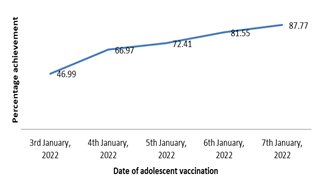
Figure 1: Progress of Adolescent Vaccination Achievement (%) In A District during Vaccination Week (3rd- 7th January, 2022)
concerned officers and stakeholders aggressive strategies were adopted and on the very first day of the campaign record 92 sites conducted the sessions. As most of the beneficiaries were in government institutions, the sessions in initial days were planned in government institutions but there was no restriction for any beneficiary to get there vaccinated. It also maintained the continuity of the vacations in the institutions. As a result about 47% of the total target was achieved on the first day of the vaccination drive and in less than a week the teams vaccinated its 87.8% of eligible adolescents (Figure 1). The district teams plan to cover the remaining beneficiaries well before 10th January.
During the adolescent vaccination drive the district management and vaccination teams had many impeding factors which could have halted the progress. But the facilitating factors helped and motivated them to work efficiently to achieve their target. Authors present few important factors as below.
Impeding Factors
Fear and Anxiety: Generally, there is fear of needle among adolescents [5]. During routine tetanus immunization in schools, the students used to avoid the injection by either being voluntarily absent or making excuses. Same fear was apprehended in this vaccination drive too which was aggravated by fear of side effects and unknown events following vaccination. There were rumors and misinformation in social media causing fear among adolescents
Apprehension of Parents and Family: Parents and family members are apprehensive for their children. They tend to avoid any harm to their children. Few adults who got one or other side effect after their COVID vaccination might not vaccinate their children
Bad Weather: This was a barrier to achieve the vaccination target in a stipulated time period. During heavy rains and snowfall people do not step out of their home. Also vaccine deliveries from a district headquarter to various cold chain points and subsequently to different session sites become challenging due to road block
Vaccine Interruption: During a nationwide vaccine drive logistics are always scarce to meet demand of a large population in India. Vaccine supply was in small but frequent lots which followed a downwards movement along the cold chain from manufacturer site to session site. This system consumes time and recourses to supply vaccine to a site in desired quantity. The problem gets aggravated by bad weather and leads to mismatch in demand and supply
Facilitating Factors
Strong Political Will: There was strong political will right from start of vaccination drive on 16th January 2021. Honorable Prime Minister himself addressed the nation on many occasion from different platforms and urged the people to get vaccinated against COVID-19. He himself tracked the progress and ensured availability as well as fair distribution of the vaccine free of cost to its people. States also owned the vaccination drive in its full spirit and targeted to vaccinate their people with the recommended vaccines
Constant Guidance and Supervision by Administration: Administration guided the district health teams in developing effective strategies and bringing different stakeholders on a single platform in physical and virtual modes. District administration also channelized its machineries to give information and messages to people through mass media, print media and social media. During vaccination week the mobile teams from the district did supportive supervision of the session sites and addressed issues of students, teachers, parents and vaccination teams
Interdepartmental Coordination: in a geographically difficult state like Himachal Pradesh the vaccination drive couldn’t have been successful without involvement of all concerned departments. Health teams were helped by Police, Anganwadi workers, education department and media which were coordinated by District administration at district level
Meticulous Planning: The sessions were planned such that maximum beneficiary can get vaccine nearest to their residence and the vaccine wastage is minimum. Conditions like strength of the students in an institution, vacations and weather were considered to prioritize the sessions. Also there were change in plans according to changing situations and same were communicated to beneficiaries time to time
Expertise of District Teams: District vaccination team had gained a lot of confidence and expertise during 18+ vaccination, which was utilized during vaccination of 15-18 vaccination. Our teams were competent enough to vaccinate as much as 500 beneficiaries in a single session site without compromising the safety and quality of vaccination
Lesson Learnt from Adult Vaccination: Lesson learnt during adult vaccination about various challenges during mass vaccination campaign and ways to deal with those challenges were helpful in adolescent vaccination
Overwhelming Participation from Adolescents: Contrary to the speculation regarding fear and anxiety among youth, the participation of the students in vaccination drive turned out to be overwhelming. There was enthusiasm among them about vaccination and they eagerly waited for their turn to get the vaccine. Most of them helped the vaccination teams by self registering on the portal which shortened the process and avoided long queues
Role Model: Students after vaccination interacted among themselves and motivated their peers. Some of students uploaded their photos and videos of the vaccination on social media. They explained that how their fears disappeared after vaccination and appealed others to get themselves vaccinated
Media Involvement: Media played a positive role in mobilizing people, spreading awareness and information among masses. Motivational messages from top authorities spread to vaccination teams and boosted their morale. Media provided coverage of vaccination in difficult circumstances which motivated other teams to achieve better coverage
CONCLUSION
Mass campaign in a populous country like India can face many challenges and destined to fail if not planned and executed well. During planning every possible avoidable or unavoidable barrier needs to be considered and strategies devices accordingly. During execution the supportive supervision and motivation by leaders and authorities is crucial to achieve best in given circumstances. And lastly involvement of all stakeholders and people participation is vital for a mass campaign like vaccination to succeed.
REFERENCES
Ministry of Health and Family Welfare. COVID-19 Vaccine Operational Guidelines. Government of India, December 2020, main.mohfw.gov.in/sites/default/files/COVID19VaccineOG111Chapter16.pdf.
Ministry of Health and Family Welfare. Cumulative Coverage Report of COVID-19 Vaccination. Government of India, 2022, www.mohfw.gov.in/pdf/CummulativeCovidVaccinationReport6thjanuary2022.pdf.
National Health Mission, Himachal Pradesh. COVID-19 Vaccination Status. Department of Health and Family Welfare, Government of Himachal Pradesh, December 2021, www.nrhmhp.gov.in/content/covid-19-vaccination.
McLenon, J. and M.A. Rogers. “The Fear of Needles: A Systematic Review and Meta-Analysis.” Journal of Advanced Nursing, vol. 75, no. 1, January 2019, pp. 30–42
Recommended Articles
Research Article
Imaging Evaluation of Ultrasonography Versus Magnetic Resonance,
Imaging in Diagnosis of Carpal Tunnel Syndrome among Female Patients with Positive Nerve Conduction Study
Download PDF
Research Article
An evaluation of Profile of Medico-legal autopsies conducted at Dr. Radhakrishnan Govt. Medical College, Hamirpur, Himachal Pradesh
Download PDF
Research Article
The Efficacy of 5- Fluorouracil Cream and 25% Podophyllin Solution in Treatment of Plantar Warts in Alternative Day Regimen ; An Open Therapeutic Trial.
Download PDF
Research Article
Silent Threats: Evaluating Knowledge of Pelvic Inflammatory Disease Among Reproductive-Age Women in District Kangra
Pankaj sharma,
Kritika Katoch
Published: 27/11/2024
Download PDF
PO Box 101, Nakuru
Kenya.
Email: office@iarconsortium.org
Editorial Office:
J.L Bhavan, Near Radison Blu Hotel,
Jalukbari, Guwahati-India
Kumar, J., Gupta, A. & Kumar, R. (2022). Covid-19 Vaccination among Adolescent Population of a Hilly District in North India: Experience Sharing With Impeding and Facilitating Factors. International Academic Research Journal of Internal Medicine & Public Health, 3(1), 1-3.
MLA
Kumar, Jitender, Atul Gupta and Rajesh Kumar. "Covid-19 Vaccination among Adolescent Population of a Hilly District in North India: Experience Sharing With Impeding and Facilitating Factors." International Academic Research Journal of Internal Medicine & Public Health 3.1 (2022): 1-3.
Chicago
Kumar, Jitender, Atul Gupta and Rajesh Kumar. "Covid-19 Vaccination among Adolescent Population of a Hilly District in North India: Experience Sharing With Impeding and Facilitating Factors." International Academic Research Journal of Internal Medicine & Public Health 3, no. 1 (2022): 1-3.
Harvard
Kumar, J., Gupta, A. and Kumar, R. (2022) 'Covid-19 Vaccination among Adolescent Population of a Hilly District in North India: Experience Sharing With Impeding and Facilitating Factors' International Academic Research Journal of Internal Medicine & Public Health 3(1), pp. 1-3.
Vancouver
Kumar J, Gupta A, Kumar R. Covid-19 Vaccination among Adolescent Population of a Hilly District in North India: Experience Sharing With Impeding and Facilitating Factors. International Academic Research Journal of Internal Medicine & Public Health. 2022 Jan;3(1):1-3.


 Download PDF
 Download XML