Impact of Covid-19 on the Sleep Patterns, Eating Habits, Mental Health and Self-Development of Youth and Young Adults: A Descriptive Cross-Sectional Study
Nidhi Chauhan
1
,
Aleesha Banwait
2
,
Ramandeep Kaur
3
,
Sethi
4
,
Manisha Bhatia
5
,
Rahul Rao
6
,
Anjali Chauhan
7
1
Community Medicine, Programme Officer, National Health Mission, Himachal Pradesh, India
2
Student, MBA Hospital Management- University Institute of Applied Management Sciences, Punjab University, Chandigarh, India
3
Student, Hospital Administration and Management- Dev Samaj College for Women, Ferozepur under Punjab University, India
4
Health and Hospital Management, State Team Lead, MAMTA HIMC
5
Health Management, Senior Program Manager, MAMTA, HIMC, India
6
Hospital Administration, Assistant Professor cum DMS, IGMC, Shimla, India
7
State Program Officer, National Health Mission, Himachal Pradesh, India
Objectives: The Covid-19 pandemic has made sudden lifestyle changes because of nationwide lockdowns, making it compulsory to isolate at home, which has affected the daily habits and lifestyle routines of millions. In the beginning, reports indicated that Covid-19 virus was mostly affecting older people, but later was found that the youth and young adults were also being affected in several ways. The survey was done to study the impact of Covid-19 on Youth and Young adults in North Indian states regarding their sleeping patterns, eating habits, mental health and self-development. Methods: A descriptive cross sectional survey was conducted amongst the participants in the age group of 15 to 30 years, using google forms. The questionnaire was circulated in the North Indian states for responses. Results: The study shows that of 334 participants, 220 (65.9%) were sleeping for 6-8 hours. Due to overeating and sedentary lifestyle, 173 (51.8%) reported gaining weight. Nearly 88% participants reported an increase in screen timings during the lockdown period. COVID-19 related news made 28.4% anxious and 26.6% depressed. Majority (69.8%) of the participants learnt new skills to cope with the stress. Conclusion: The COVID-19 pandemic has afflicted the youth and young adults of our society in many ways. They were tussling with mental health issues, eating and sleep patterns and self-development. Though, all these concerns have been tried to be addressed health care agencies and social medias, but still it needs robust deliberations to abridge the issues.
Keywords
Covid-19
North India
Online Survey
Youth and Young Adults
Mental Health
Self-Development
INTRODUCTION
The novel Coronavirus has been the focus of attention for scientists, governments and populations, since it was declared as a pandemic by the WHO. As the virus has still not ceased, it has created a blistering impact on the families worldwide- socially, mentally, physically and economically. Coronavirus has paused the lives of people worldwide, be it students, academicians, businessmen, researchers, labour class etc. All this has severely impacted the individuals’ day-to-day activities, their daily lifestyle including sleeping patterns, eating habits, travel, academics, various forms of leisure and exercise as well as their mental health [1-2].
A drastic change in the sleep cycle is seen in not only the older adults, but also the adolescents (persons aged between 10-19 years) [3], youth (those within the age group of 15-24 years) [4-5], and young adults (those aged between 22-34 years) [6] like, sleeping late at night, or sleeping the whole day due to boredom resulting in irritability and laziness. They tend to binge-watch movies online, play online games, video-calling their friends and relatives living in countries with different time zones, thus changing their sleep timings. Lack of sleep and excessive sleeping have their own potential side effects like, obesity, depression, impaired immunity and may also affect a person’s physical appearance [1].
Specifically upsetting are the lockdown implications on irregular eating habits, excessive snacking, reduced physical activities, all of which are linked to high-calorie diet and increased obesity risk. Staying at home due to the ongoing pandemic results in excessive sedentary lifestyle, resulting in low energy levels and particularly involving activities like excessive sitting [1].
It is very much possible that such changes may be associated with feelings of anxiety, fear, stress and depression which are being experienced by a lot of people, especially youth and young adults globally. In order to lessen these feelings of sadness, stress and depression, the youth and young adults may indulge themselves in increased alcohol intake, smoking and substance abuse as we all know these have stress reducing agents present in them [1].
Hence, it is pivotal to delve into that how individual behaviour has been afflicted under lockdown conditions, how the Covid-19 pandemic may directly impact the lifestyle behaviour and mental health status of populations, particularly the youth and young adults.
Aims and Objective
To assess the changes in lifestyle behaviours- particularly the sleeping patterns and eating habits along with the mental health of the youth and young adults of North India during the Covid-19 pandemic lockdown.
MATERIALS AND METHODS
Study Design
A descriptive cross-sectional study.
Study Participants
Youth and young adults aged between 15-30 years
Study Area
The study was done on the in the North Indian states which include Punjab, Haryana, Himachal Pradesh, Chandigarh, Delhi, Jammu and Kashmir and Uttarakhand.
Study Time
15 days (21st August to 4th September 2021)
Study Tool and Methodology
A google form questionnaire consisting of 22 questions regarding the sleeping patterns, diet and lifestyle, mental health and self-development during the Covid-19 pandemic lockdown was created. The google form questionnaire was circulated via online modes like e-mail and social media platforms like Whatsapp groups, Facebook, Instagram and Linkedin. Responses were then recorded in a Google Excel spreadsheet, the information from which was used to generate graphical displays.
Ethical Considerations
Participants confidentiality and anonymity was maintained.
Statistical Analysis
Data was collected and entered in Microsoft excel spread sheet, cleaned for errors and analysed using Epi info version 7.2.1.0 software. Descriptive statistics were used to summarize the demographic data. Frequencies, percentages were used to describe categorical variables.
RESULTS
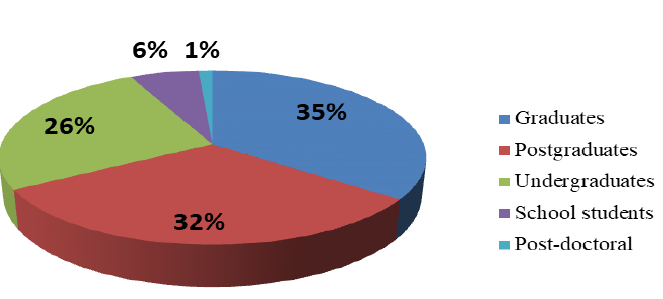
A total of 334 respondents 216 females and 118 males from North Indian states of Punjab, Haryana, Himachal Pradesh, Chandigarh, Delhi, Jammu and Kashmir and Uttarakhand participated in the study. Among the participants of the age group of 15-30 years, nearly one-third were graduates. (Figure 1).
Figure 1: Proportion of Participants According to Education
Sleeping Patterns
Majority of the participants reported sleeping for 6-8 hours at night and nearly one-fifth spent 9-12 hours for sleeping. More than one-tenth respondents slept for less than 5 hours and 1.5% slept for more than 12 hours. More than two-fifth felt lazy during the day time. Due to alteration in the sleeping pattern during lockdown, the day-to-day activities of females were hobbled more than males.
Eating Habits
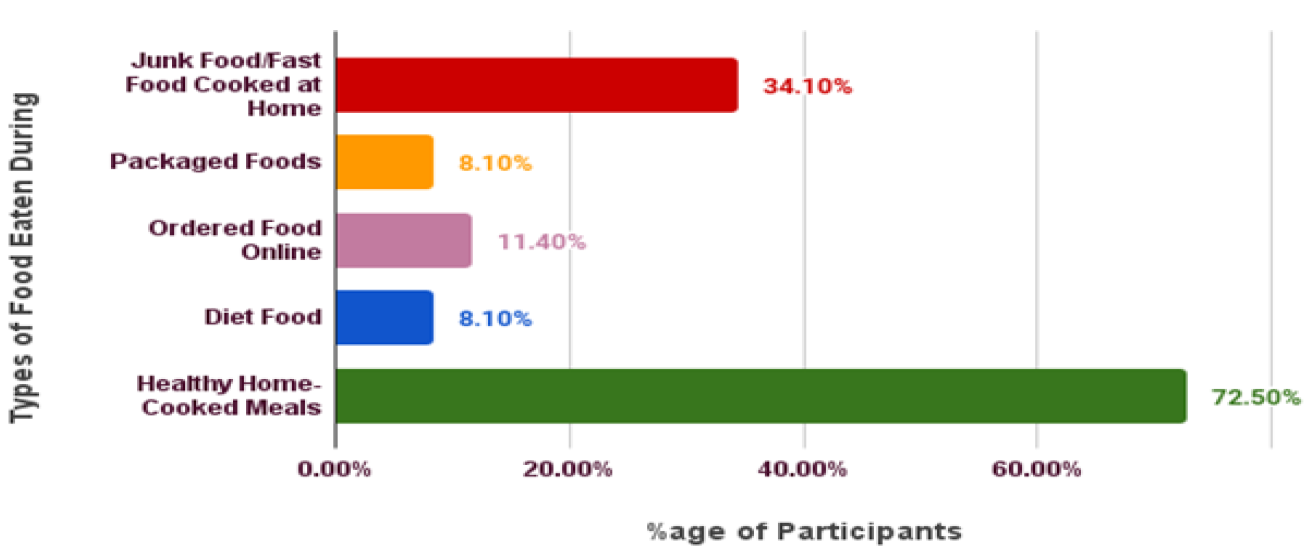
Half of the participants never skipped there any meal of the day. The significant number of respondents preferred eating healthy home cooked meals (Figure 2).
Figure 2: Percentage of Participants According to Food Preference
According to more than half of the respondents, they gained weight during COVID-19 lockdown period, due to overeating, sedentary lifestyle and lack of exercise. The weight gain was more in males compared to females.
Screen Timings
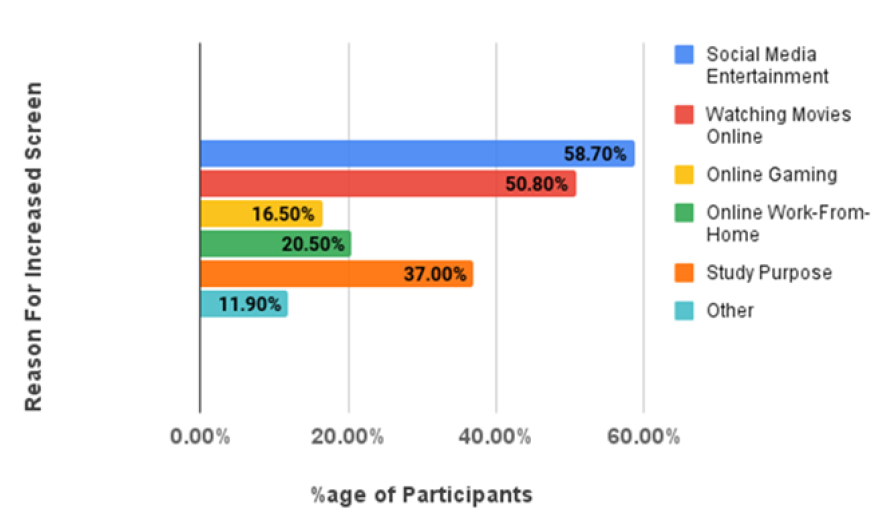
The substantial number of participants reported an increase in their screen timings during the lockdown period, the reasons for it being social media entertainment, watching movies, study purpose, work-from-home, online gaming etc (Figure 3).
Figure 3: Reasons for Increased Screen Time
Mental Health
In the study, more than one-fourth of the respondents felt anxious and depressed and less than one-fifth reported being sad during the lockdown. More than half of the participants expressed that studying and working from home during the lockdown was more stressful than it was before the pandemic, due to which their study or work interest declined. A significant proportion of the participants got indulged in harmful activities like smoking and drinking during the pandemic in order to relieve their stress and anxiety levels.
Family Relations
More than half of the participants reported that there were no change in their relations with family, friends and relatives during the lockdown. However, more than one-third said that their bond with the family, friends and relatives strengthened and one-tenth reported that they got detached from their family and friends. A considerable proportion of respondents informed that they missed going to schools, colleges and work places and interacting with the friends in person.
Self-Development
To pass their time and prevent boredom during the lockdown, more than half of the participants got themselves indulged in watching movies. Nearly half of them got themselves engaged in household chores, cooking and baking. Nearly one-third preferred playing games and one-fourth opted to complete their pending work and assignments.
DISCUSSION
Our survey revealed that most of the participants had a normal sleep, few slept for long durations and some slept for small durations. This alteration in the sleeping pattern of the participants stymied their routine daily activities. These findings unambiguously illustrate that COVID-19 lockdown had made the youth and young adults slumbered and inactive.
The study found that more than half of the respondents skipped one or two meals of the day. Though the majority preferred home cooked meals, still weight gain was reported by them during this aion of COVID-19. The apt reasoning for this could be preparation of fried and junk food at home, with no physical activity during the day. The study on Egyptian youth (14-24 years), on dietary habits during COVID-19 pandemic explicates the findings similar to our study [7]. On the contrary, an Italian survey found that during the COVID-19 lockdown, the study population declares to eat more or less healthy food (fruit, vegetables, nuts and legumes), respectively [8].
Our study elucidates that there was increase in screen time of substantial proportion of the respondents. The majority spent considerable amount of time on the platforms for socializing, for e-commuting, for study purpose or as a source of entertainment. In fact, an increase in the screen time exposure, especially before bed time at night, may be the reason for delayed sleep onset and wake-up time, as being exposed to artificial light is known to hamper the sleep-wake cycle through disturbance of melatonin mediated circadian sleep-wake behavior [9].
The study exemplified that the participants were apprehensive, despondent staying at home, watching and listening news related to Covid-19. Most of them even got indulged in pernicious activities like smoking and drinking alcohol, to cope with mental health issues. College students comprise a population that is considered particularly vulnerable to mental health concerns. In concordance with our results, were the findings of a study conducted in United States on effects of COVID-19 on College Students Mental Health [10].
COVID-19 is a global health crisis, which is impingingall sections of the population and in particular is deleterious to the youth and young adults of a country.
The youth and young adults being the most prolific age group of the society have been perplexed by this pandemic. Unanticipatedly, this has dwindled the productivity of this age group and escalated the health concerns like obesity, physical inactivity, psychological concerns etc. With no doubt, these issues have been addressed at various levels by healthcare department and agencies, by social platforms etc., but still it needs thorough speculations to abridge these challenges. For this to accomplish, robust and meticulous research need to be done, so as to comprehend, delineate and address their concerns.
REFERENCE
Allabadi H. et al. “Impact of COVID-19 lockdown on dietary and lifestyle behaviours among adolescents in Palestine.” Dynamics of Human Health, vol. 7, no. 2, 2020.
Hossain M. et al. “Mental health outcomes of quarantine and isolation for infection prevention: a systematic umbrella review of the global evidence.” Epidemiology and Health, vol. 42, 2020, e2020038.
World Health Organization. “Adolescent health: an overview.” Health Topics, 2021, www.who.int/health-top ics/adolescent-health. Accessed October 2021.
United Nations. “Definition of youth.” United Nations Youth, 2021, www.un.org/esa/socdev/documents/youth/fact-sheets/youth-definition.pdf. Accessed October 2021.
United Nations Educational, Scientific and Cultural Organization. “By youth, with youth, for youth.” 2021, https://en.unesco.org/youth. Accessed October 2021.
Medley M.L. “Life satisfaction across four stages of adult life.” International Journal of Aging and Human Development, vol. 11, no. 3, 1980, pp. 193–209.
Alamrawy R.G. et al. “Psychiatric morbidity and dietary habits during COVID-19 pandemic: a cross-sectional study among Egyptian youth (14–24 years).” Middle East Current Psychiatry, vol. 28, no. 1, 2021, pp. 1–10.
Di Renzo L. et al. “Eating habits and lifestyle changes during COVID-19 lockdown: an Italian survey.” Journal of Translational Medicine, vol. 18, 2020, p. 229.
Sinha M. et al. “Impact of COVID-19 lockdown on sleep-wake schedule and associated lifestyle related behavior: a national survey.” Journal of Public Health Research, vol. 9, no. 3, 2020, p. 1826.
Son C. et al. “Effects of COVID-19 on college students’ mental health in the United States: interview survey study.” Journal of Medical Internet Research, vol. 22, no. 9, 2020, e21279.
Recommended Articles
Research Article
An evaluation of Profile of Medico-legal autopsies conducted at Dr. Radhakrishnan Govt. Medical College, Hamirpur, Himachal Pradesh
Download PDF
Research Article
The Efficacy of 5- Fluorouracil Cream and 25% Podophyllin Solution in Treatment of Plantar Warts in Alternative Day Regimen ; An Open Therapeutic Trial.
Download PDF
Research Article
Imaging Evaluation of Ultrasonography Versus Magnetic Resonance,
Imaging in Diagnosis of Carpal Tunnel Syndrome among Female Patients with Positive Nerve Conduction Study
Download PDF
Research Article
Usage of Therapeutic Offloading In Diabetic Foot- A Clinical Audit
Amit Kumar C Jain,
Apoorva HC
Published: 05/05/2021
Download PDF
PO Box 101, Nakuru
Kenya.
Email: office@iarconsortium.org
Editorial Office:
J.L Bhavan, Near Radison Blu Hotel,
Jalukbari, Guwahati-India
Chauhan, N., Banwait, A., Kaur, R., None, S., Bhatia, M., Rao, R. & Chauhan, A. (2021). Impact of Covid-19 on the Sleep Patterns, Eating Habits, Mental Health and Self-Development of Youth and Young Adults: A Descriptive Cross-Sectional Study. International Academic Research Journal of Internal Medicine & Public Health, 2(2), 1-4.
MLA
Chauhan, Nidhi, et al. "Impact of Covid-19 on the Sleep Patterns, Eating Habits, Mental Health and Self-Development of Youth and Young Adults: A Descriptive Cross-Sectional Study." International Academic Research Journal of Internal Medicine & Public Health 2.2 (2021): 1-4.
Chicago
Chauhan, Nidhi, Aleesha Banwait, Ramandeep Kaur, Sethi , Manisha Bhatia, Rahul Rao and Anjali Chauhan. "Impact of Covid-19 on the Sleep Patterns, Eating Habits, Mental Health and Self-Development of Youth and Young Adults: A Descriptive Cross-Sectional Study." International Academic Research Journal of Internal Medicine & Public Health 2, no. 2 (2021): 1-4.
Harvard
Chauhan, N., Banwait, A., Kaur, R., None, S., Bhatia, M., Rao, R. and Chauhan, A. (2021) 'Impact of Covid-19 on the Sleep Patterns, Eating Habits, Mental Health and Self-Development of Youth and Young Adults: A Descriptive Cross-Sectional Study' International Academic Research Journal of Internal Medicine & Public Health 2(2), pp. 1-4.
Vancouver
Chauhan N, Banwait A, Kaur R, Sethi S, Bhatia M, Rao R, Chauhan A. Impact of Covid-19 on the Sleep Patterns, Eating Habits, Mental Health and Self-Development of Youth and Young Adults: A Descriptive Cross-Sectional Study. International Academic Research Journal of Internal Medicine & Public Health. 2021 Jul;2(2):1-4.


 Download PDF
 Download XML