Introduction: Hospital Information System (HIS) is a comprehensive, integrated information system designed to manage the administrative, financial and clinical aspects of a hospital2. A Hospital Information System is essentially a computer system that can manage all the information to allow health care providers to do their jobs effectively. It is also known as Healthcare Information System. Hospital information systems have become very advanced and new innovations are continuously being introduced. But a HIS is useless if it confuses the hospital employees. The system must be user friendly and should include training by the vendors. If a hospital’s information system were not compatible with the individual’s general duties, using it would be complicated and might be hard to understand. The users will not like it and in case it does not satisfy the needs, the users would ignore it, and they even might consider the system an intruder and irritating factor. Objectives: The main objective of this study is to find out the utilization of Ward management module of HIS and to understand the challenges faced by the staff in HIS at the hospital. Methodology: The existing ward management module of Hospital Information System (HIS) was studied by personal observation over a period of one month (May 2019). The detailed working of the module was observed. The design and features of the module, the flow of information, the interfacing of the module with other modules in the system, storage of information and the utilization by the end users were noted. This was supplemented with additional information from the department of Information Technology YMCH. Checklist was used to assess the level of utilization of ward management module; the checklist was prepared based on the components of ward management module. Due to the time constraints six wards were selected from out of thirty-three wards by lottery method. The data was collected by checklist for the period of six months that is each month in each selected ward. Result: In this study 6 inpatient wards were explored for their use of HIS. Out of the six inpatient wards four inpatient wards, that is General Surgery, Urology, Paediatric and OBG wards were found to have similar level of utilization of HIS, that is, around 72% and two inpatient wards i.e. General medicine and Dermatology with 68% utilization. To study the challenges faced by the staff in utilizing the HIS, Total of 90 staff members were randomly selected and included. Technical concerns, perception on security threats and consumption of time were compared with difficulties faced while using. No significant challenges were found in the utilization of HIS (p-values of 0.492, 0.342 and 0.311 respectively). In other words, there was no significant association between the various causes and factors which could lead participants to face difficulties in HIS use. Conclusion: Hospital Information Systems (HIS) is an efficient tool to aid in the diagnosis, management, training and practices. As there is a large number of patient inflow, it is a challenge for the administration to run the hospital smoothly. In such a scenario, it is important for Hospital employees to do their jobs in an efficient and effective manner. HIS can then come to rescue by helping not just employees but patients and care takers as a well.
Keywords
HIS (Hospital Information System)
EHR (Electronic Health Record)
PACS (Picture Archiving and Communication System)
INTRODUCTION
Hospitals are extremely complex institutions, with unique characteristics which include large departments and units, that coordinate care for patients. They rely hugely on Hospital Information Systems (HIS) to assist in the diagnosis, management, education for better services and practices [1]. Each day hundreds of thousands of patients enter healthcare facilities challenging the administration to run the show smoothly, hence it is important for Hospital employees to do their jobs in an efficient and effective manner. The employees have to manage and integrate clinical, financial and operational information that grows with the practice.
Hospital Information System (HIS) is a comprehensive, integrated information system designed to manage the administrative, financialand clinical aspects of a hospital [2]. A Hospital Information System is essentially a computer system that can manage all the information to allow health care providers to do their jobs effectively.It is also known as Healthcare Information System.
In 1980s, because of changes in the health care system, including change in reimbursement systems of hospitals, the patient's clinical issues were considered in the design of HIS. Therefore, designers of the systems started moving toward Electronic Patient Record (EPR) [3]. Previously, the data was organized manually, which was time consuming and failed to deliver the desired level of efficiency.Hospital information systems in recent years have been converted into digitized systems involvingcomputers, Personal Computer, Tab and Phone. Most professionally run hospitals and clinics now rely on Hospital Information Systems (HIS)that help them manage all their medical, financial and administrative information [3].
HIS plays an undeniable role in the hospital budget. Typically, around 2-5% of hospital operational budget is dedicated to HIS. Studies also show that hospital staff spend most of their time exchanging information and notifying administrative follow-ups, but only 42 percent of their time is spent on clinical activities (www.emrconsultant.com).
The aim of an HIS is to achieve the best possible support of patient care and administration by presenting data where needed and acquiring data when generated with networked electronic data processing [4]. Hospital Information Systems main elements are to provide proper data storage, reliable and accurate usage, easy and fast access of data from one department to another department, securely keep the data in storage and lower the cost of usage.Hospital Information Systems provide a common source of information about a patient’s health history.These systems enhance the ability of health care professionals to coordinate care by providing a patient’s health information and visit history at the place and time that it is needed [4].
The system should ensure data security and restricted access to this data to maintain privacy and confidentiality of the patient information. An effective HIS also delivers benefits such as:
Enhances information integrity
Reduces transcription errors
Reduces duplication of information entries
Optimizes report turnaround times
Hospital information systems have become very advanced and new innovations are continuously being introduced. But a HIS is useless if it confuses the hospital employees. The system must be user friendly and should include training by the vendors. If a hospital’s information system were not compatible with the individual’s general duties, using it would be complicated and might be hard to understand. The users will not like it and in case it does not satisfy the needs, the users would ignore it, and they even might consider the system an intruder and irritating factor.
In 2012 Yenepoya Medical college hospital implemented the Hospital Information System, called BackBone software. BackBone is a complete healthcare management software suitable from primary care to tertiary care multi-specialty hospitals. BackBone is userfriendly Hospital Information System. It is helps to transfer patient related data and information from one department to another department. There are different modules in BackBone. The main objective of this study is to find out the utilization of Ward management module of HIS and to understand the challenges faced by the staff in HIS at the hospital.
Objectives of the Study
To study the existing ward management module of Hospital Information System (HIS)
To assess the level of utilization of the ward management module
To identify the challenges in the utilization of Hospital Information System (HIS)
MATERIALS AND METHODS
Study Design
Cross Sectional Study Design.
Study Setting
This study was conducted at Yenepoya Medical College Hospital, Deralakatte, and Mangalore.
Materials and Methods Source of Data
Data was collected from the department of Information Technology (IT) and Inpatient wards of Yenepoya Medical College Hospital.
Method of Collection of Data
The existing ward management module of Hospital Information System (HIS) was studied by personal observation over a period of one month (May 2019). The detailed working of the module was observed. The design and features of the module, the flow of information, the interfacing of the module with other modules in the system, storage of information and the utilization by the end users were noted. This was supplemented with additional information from the department of Information Technology YMCH.
Checklist was used to assess the level of utilization of ward management module, the checklist was prepared based on the components of ward management module. Due to the time constraints six wards were selected from out of thirty-three wards by lottery method. The data was collected by checklist for the period of six months that is each month in each selected ward.
A semi structured questionnaire was used to identify the challenges in the utilization of Hospital Information System among the staff working in Inpatient departments. The questions included feedback on HIS use in general and specific challenges encapsulated in the form of various options provided in the framed questions. The data was collected between April 15 to May 15, 2020 (Table 1).
Tool for Data Collection
Observation Checklist
Semi structured questionnaire
Statistical Analysis
For the objective of assessing the level of utilization of the ward management module, collected data was entered in MS Excel and frequency and percentages were calculated and tabulated
For third objective which was to identify the challenges in the utilization of Hospital Information System (HIS), statistical analysis was performed using IBM SPSS Statistics 23 version. Descriptive statistics was summarized and represented in various tables. Chi square test was performed on the questions used to gauge the challenges faced using HIS. Significance of assessments was estimated using p-values. During evaluation of results, a p-value of<0.05 was considered as significant
Work Plan (Including Time Line)
The extensive review of literature for a period of one month
Data collection pertaining to the study objectives for next 6 months
Coding statistical analysis and tabulation was done from June to July 2019 using Excel for objectives first and second
Data for third objective was collected between April 15 to May 15, followed by its analysis on SPSS Statistics version 23 software
Ethical Issues
Investigation needs animals/materials from animals-NIL
Ethical clearance received by protocol no.YEC-1/2020/006dated 03/02/2020 from Yenepoya Ethics Committee-1
Utilization of Result of the Research and Specific Deliverables
Hospital Information System (HIS) plays a very important role in Health care sector for managing the day to day operations, Financial and clinical aspects of the Hospital.
Table 1: Showcasing the Various Wards and Time Period during Which Data was collected
No.
Department
From date
End date
1
Dermatology
01/06/19
30/06/19
2
Pediatric
01/07/19
31/07/19
3
General Medicine
01/08/19
30/08/19
4
General Surgery
01/09/19
31/09/19
5
Urology
01/10/19
30/10/19
6
OBG
01/11/19
30/11/19
This study will help to understand the existing Hospital Information System (HIS) and level of utilization of Inpatient Hospital Information System. And to understand the challenges which will help to plan a program for improvement in the utilization thus help in managing the Hospital operations.
RESULTS
To Study the Existing Ward Management Module of Hospital Information System (His)
Hospital Information System (HIS) is a comprehensive, integrated information system designed to manage the administrative, financialand clinical aspects of a hospital [3].
The Yenepoya Medical college Hospital has a robust data processing computer system which is developed based on the patient care requirements and implemented accordingly. In this study only the data processing system is analysed to study the utilization.
The data processing system is called BackBone which is suitable from primary care to secondary and tertiary care health care services. In 2012 Yenepoya Medical college hospital which was using G.C software system shifted to BackBone software. It is a patient-centric application integrated with the management information that modern hospitals require. There are different modules that are available in the BackBone system. Following are the HIS modules which was developed based on Inpatient requirements and implemented accordingly.
Front Office
Accounts and Billing
CSSD (Central Sterile Service Department)
BME (Bio Medical Equipment Management)
Maintenance
Human Resource
Inventory Management
Laboratory
MRD (Medical Record Department)
OT (Operation Theatre)
Pharmacy
Radiology
Ward management
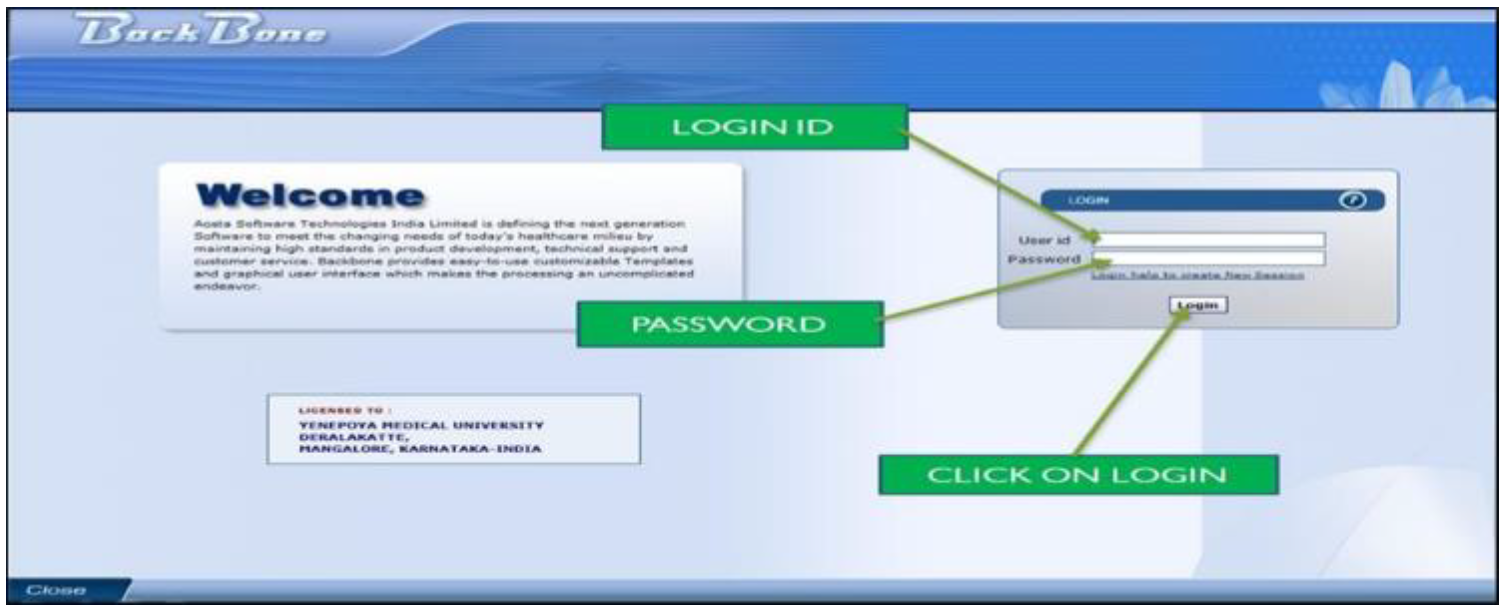
This above Figure shows the log –in page of ward management module. Login is the process by which an individual gains access to an information system by identifying and authenticating themselves where every user is given a unique ID through which the user can Log in to the Backbone system. It provides confidentiality and privacy to the patient related data’s because the ward management module has only the authorized users can access the Backbone through their unique ID and password (Figure 1-2).
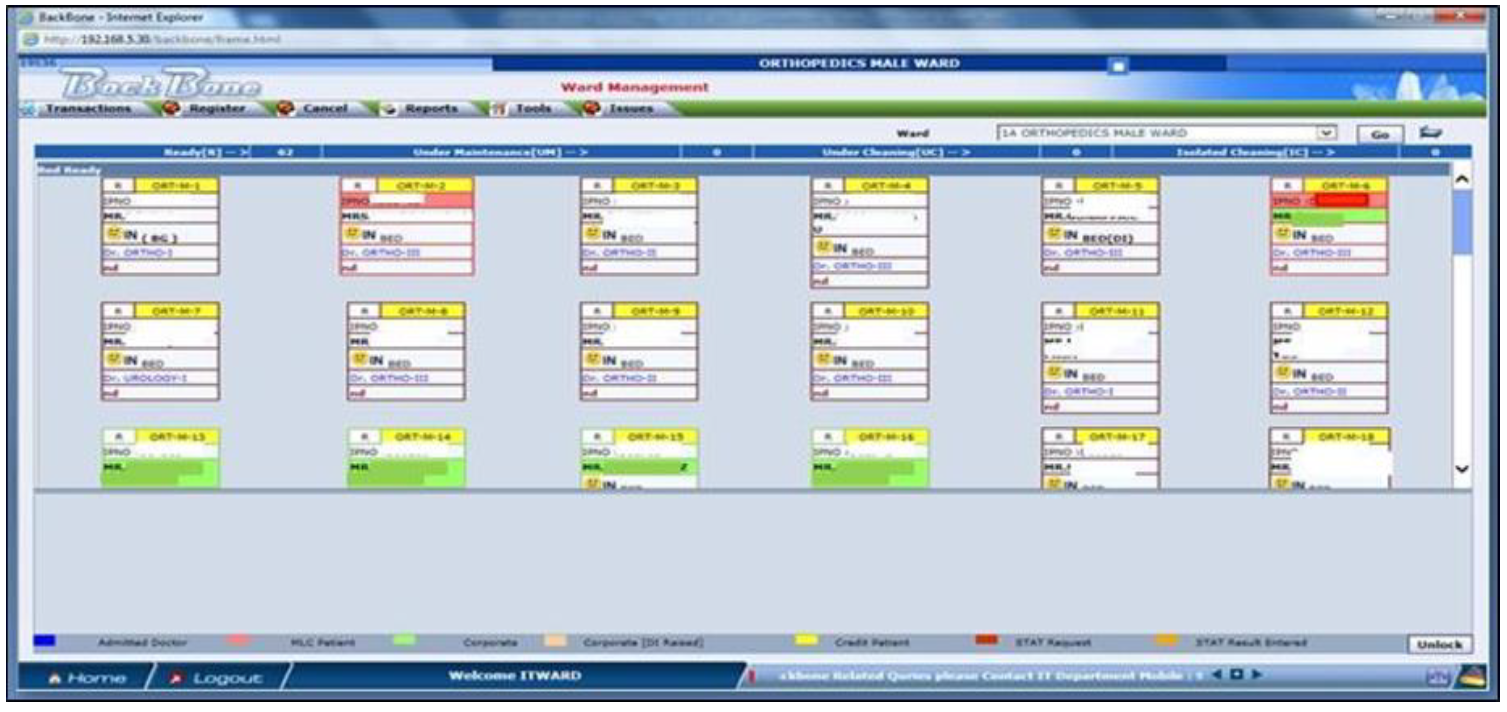
Figure 3 is the home page of ward management module, the Inpatient bed details will displayed in home page of Ward management module. so the users can see the activities of each bed, This home page provides the basic details of the patients, the Ward, Bed no, IP number, Patient name, Bed status, doctor’s name and diet type.
Different colour codes are used for each patient detailed box, like blue colour is used for identifying the doctor’s name, red colour for MLC (Medico Legal Case) patients, and Green colour for corporate patients and yellow for the credit patients.
For each ward separate Ward Management module which links all the beds, activity of each bed it details, such as the Bed no, UHID, patient details. Unit or doctor under whom the treatment and complete medical records, such as doctors reference, nurses notes along with diagnostic and therapeutic investigations and the results. Further it is also linked to the materials used and billing.
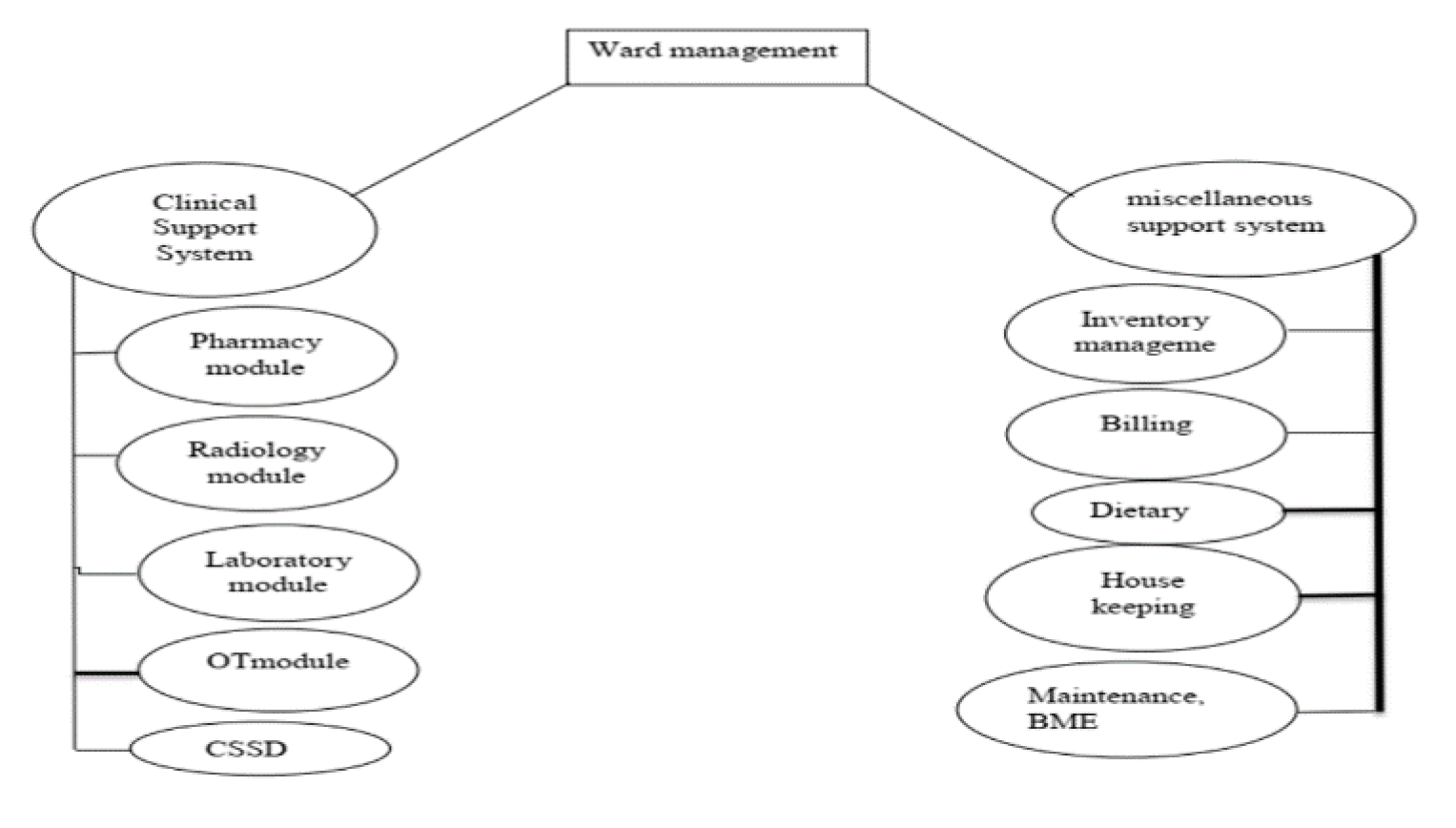
The integration of the Ward Management module with all the services is depicted in the below mentioned diagram.
Components of Ward Management Module
Figure 4 shows the components of ward management module in hospital information system. The module is divided into clinical support system and miscellaneous support system, the clinical support system is directly involved to the patients, and the miscellaneous support system for the clinical support to the staffs of the wards. The patient details will be linked to the particular ward management module, so the ward management user can see the patient details the one who admitted in their ward.
Pharmacy Module
Pharmacy module is links to the patient details, the medication for the patient can be done ordered by the Nursing or Residents from the ward. Ward Nurse or Resident will send the request to the Pharmacy module for medicine of the particular patient, the time of sent request for the medicine nurse should dispatch the medicine code or medicine name, quantity of medicine and patient IP number. Transaction number will raise in
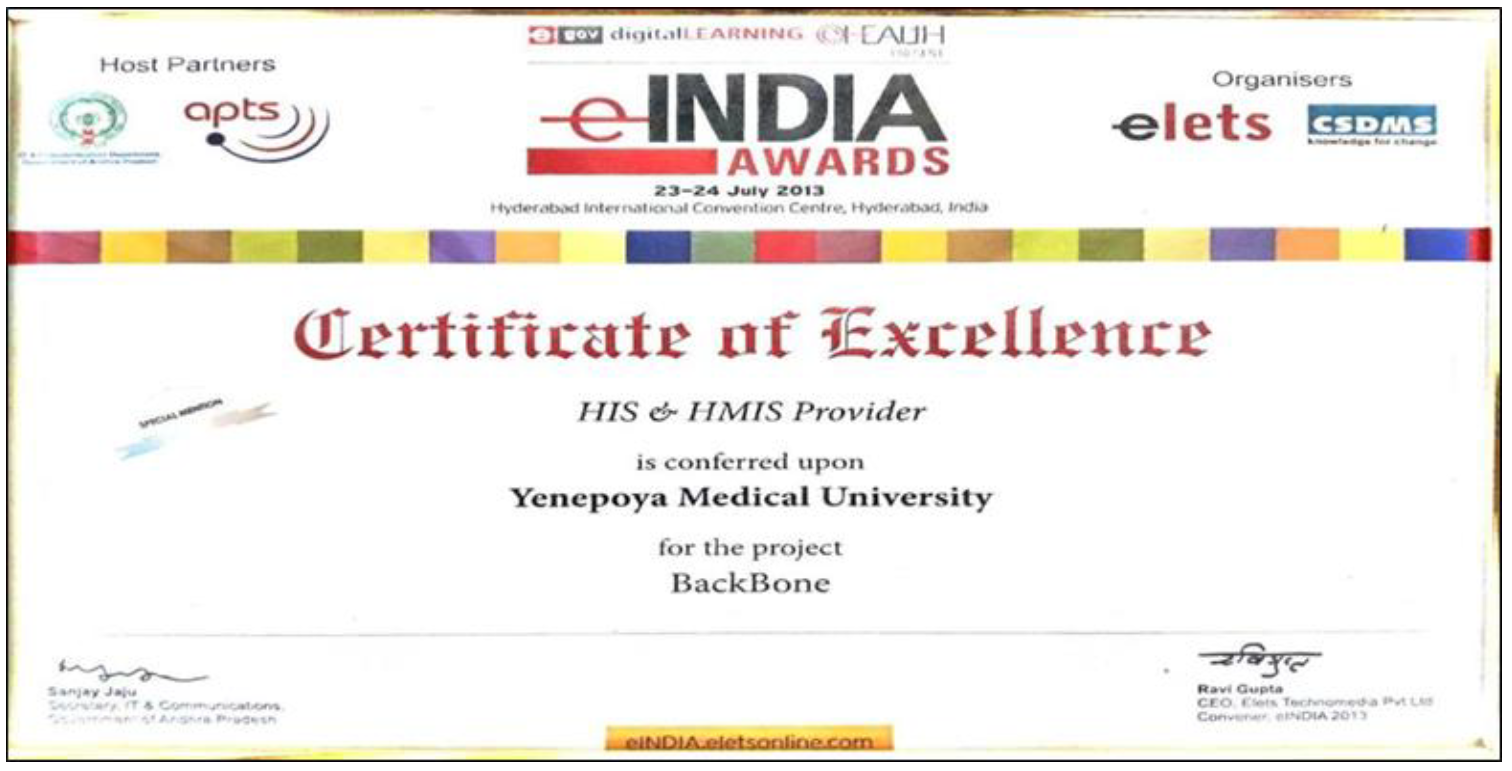
Figure 1: The Certificate of Excellence was conferred upon Yenepoya Medical College for the Project Backbone by Hyderabad International Convention Centre, Hyderabad, India
Ward Management module after the completion of the request for medicine, transaction number will be different in each request for the medicine.
Radiology Module
The patient needs to take X-RAY, CT-Scan MRI. nurse will send the request to Radiology module from the ward management module. Service code or service name and the patient IP should mention while sending the request for the radiology service. On completion of investigation result is available in digitalized images PACS (Picture Archiving and Communication System) can help HIS to provide images and reports for physicians. The physician can see the investigation results from the ward management module.
Laboratory Module
From ward management module send the request to the lab module for various lab investigations. Nurse have to dispatch the service code or service name, and patent IP number before sending the request to the lab module.
Once the investigations are done the investigation results are available at the Ward Management module. If any patient not require various lab investigation, then nurse can cancel the lab investigation request from the ward management module. The clinician can see the investigation results from ward management module.
Figure 2: User Login Page
Figure 3: Home Page of the Ward Management Module
Figure 4: Components of Ward Management Module
OT Module
If the doctor advised for the surgery then doctor has to book the OT. Doctor can book the OT through ward management module. When booking for OT user should mention date for surgery, select the OT, name of the anaesthesia doctor, name of the surgeon, patient register number, procedure name and type of the anaesthesia.
Billing
Discharge intimation will raise when patient need to discharge from the hospital, so discharge intimation will send from the ward management module to Bill module. When making the discharge intimation user has to mention discharge Doctor name, date and time of discharge and discharge type, like dead or alive, DAMA, abscond or on request. While mention the discharge intimation user can available the services which are done for the particular patient and the cost of those services, if any services not done user can cancel the services then only they can send the discharge intimation to bill module.
BME
The ward staff will raise the request in BackBone to the BME when any BME equipment needs repair. User has to mention the equipment BME code and description of the complaint while raising the request to the BME. BME staff will collect the equipment from ward after the BME staff got the request from the ward. And ward staff will close the issue from ward management module after rapier or replacement of the equipment.
Maintenance
From ward management module will send the request to the maintenance department when any equipment will damage in the ward. The request will be sent by the ward supervisor of the various wards. When sent the request to maintenance, the ward supervisor should mention the ward name, the equipment name, date and description about the complaint. The maintenance department will send the staff to the ward after they receive the request from the ward. After the completion of the repair ward supervisor will close the complaint through ward management module.
Inventory Management
The ward staff will send the request to the store through BackBone when ward needs any store items, like gloves, mask, cotton, sanitizer, drugs etc. every week ward super wiser will send the request to the store. Store will deliver the equipment to the particular ward. Once the store got the stock request from ward. The ward super wiser should do stock approval and update the status of transaction as stocks are received.
CSSD (Central Sterilization Supply Department)
CSSD is an important facility of hospital that supplies sterile instruments and materials for dressing and procedures carried out in ward and other departments in hospital. From ward the staff sending the request to the CSSD is following manually, in ward they maintaining records for CSSD. The ward staff should mention the item name, quantity of item received, quantity of item issued, and remarks when the request to the CSSD.
Utilization of the Hospital Information System in Ward Management Module
To study the utilization of the ward management module a checklist was prepared based on the components of ward management module (BackBone). Observation was carried out in 6 wards out of the 33 wards which were selected by the lottery method. Wards which were included in the study are General surgery A (male ward), General Medicine A (Male ward), Dermatology C, Paediatric B, Urology E (Male ward) and OBG A (Obstetrics ward).
General Surgery
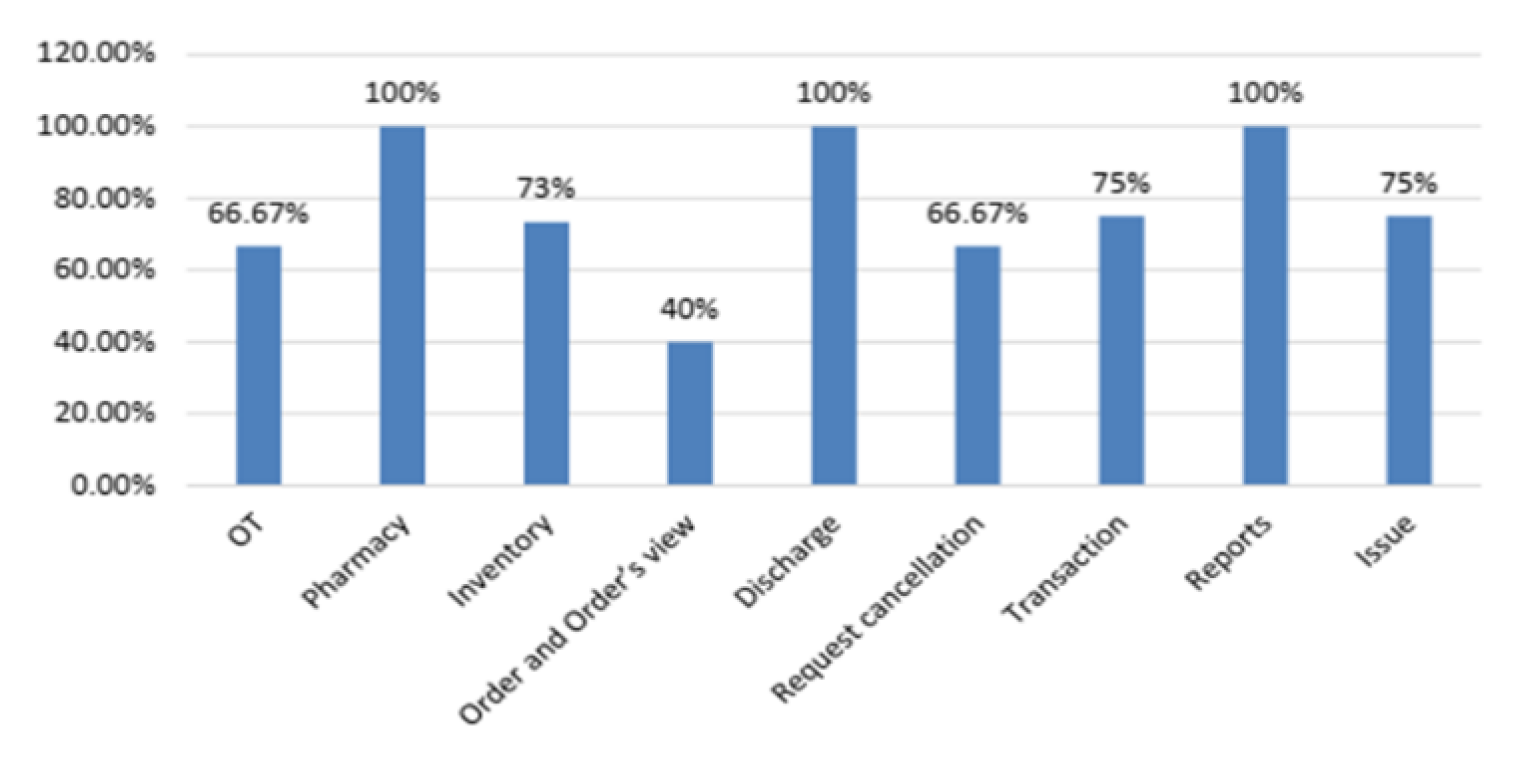
The utilization of ward management module at General surgery ward is shown in the Table 2. It indicates each of these modules have number of functions with distinct utilization patterns. Among these module, ‘Pharmacy’, ‘Reports’ and ‘Discharge’, presumably due to their wide applications, had 100% level of utilization. ‘Transaction’ and ‘inventory’ came later than these highly utilized that is around 75 and 73% respectively. In transaction module, transfer intimation, cancel intimation and IP search menus are utilized and whereas Bed clean menu is not. In inventory module the following menus are not utilized: issue pending items, available item list, item stock approval and stock return from sub-store without request.
The utilization of ‘issue’ standing at 75%, asset failure request menu is not utilised. ‘Request cancellation’ had 67% utilization, IP credit return request and IP cash credit return request are not utilised, while in ‘OT’ utilization rate is 67%. OT request menu is not utilised. Among all these, ‘Orders and Orders’ view’ had the lowest utilization rate i.e. 40%, dietary, consultation, CSSD, physiotherapy, doctor’s notes and nurse notes are not utilised in orders and order’s view Menu. Overall utilization of functions in the ward management module was found to be 71.16%.
Table 2: Utilization of Ward Management Module at General Surgery Ward
S. No
Menu
Percentage of The Utilization (%)
1
OT
66.67
2
Pharmacy
100
3
Inventory
73.33
4
Order and Order’s view
40
5
Discharge
100
6
Request cancellation
66.67
7
Transaction
75
8
Reports
100
9
Issue
75
Total
71.16
General Medicine
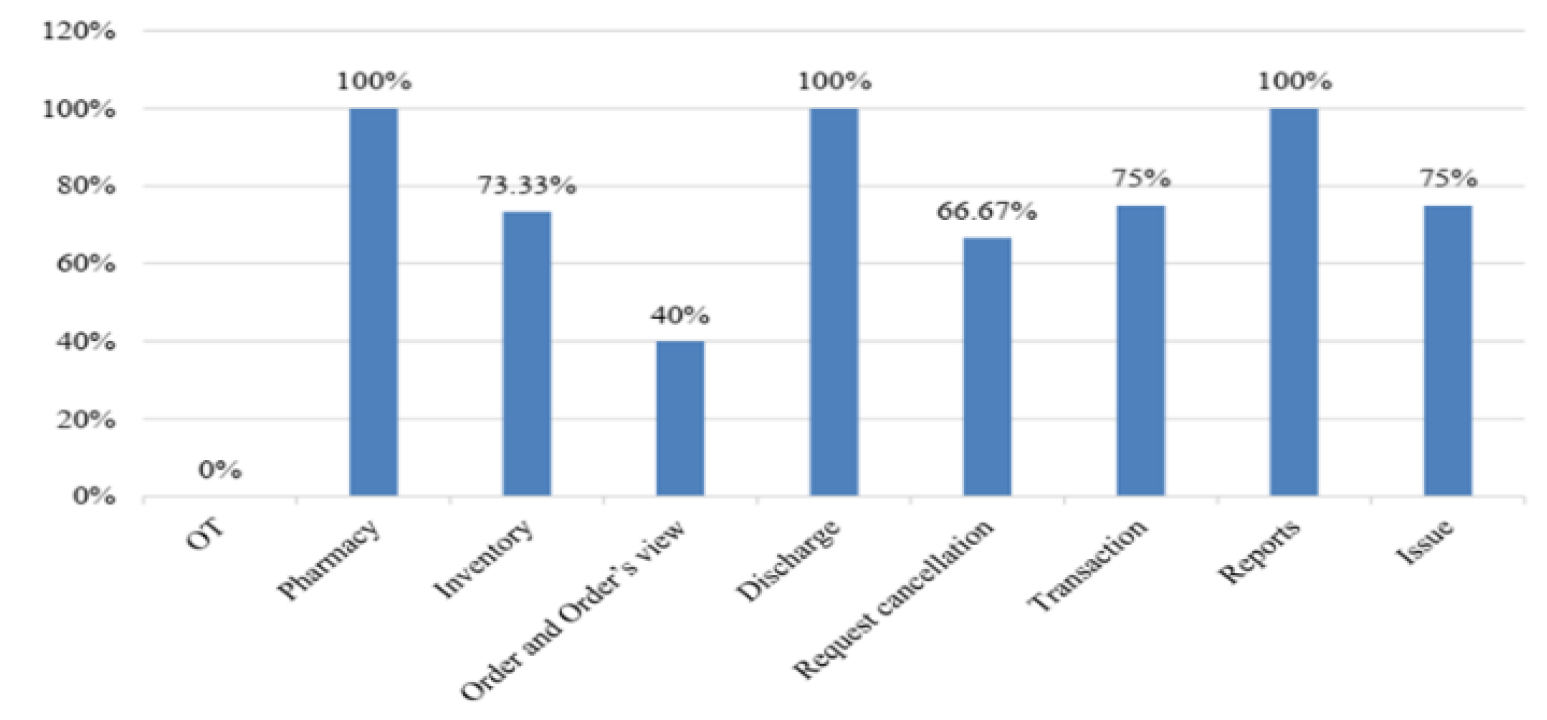
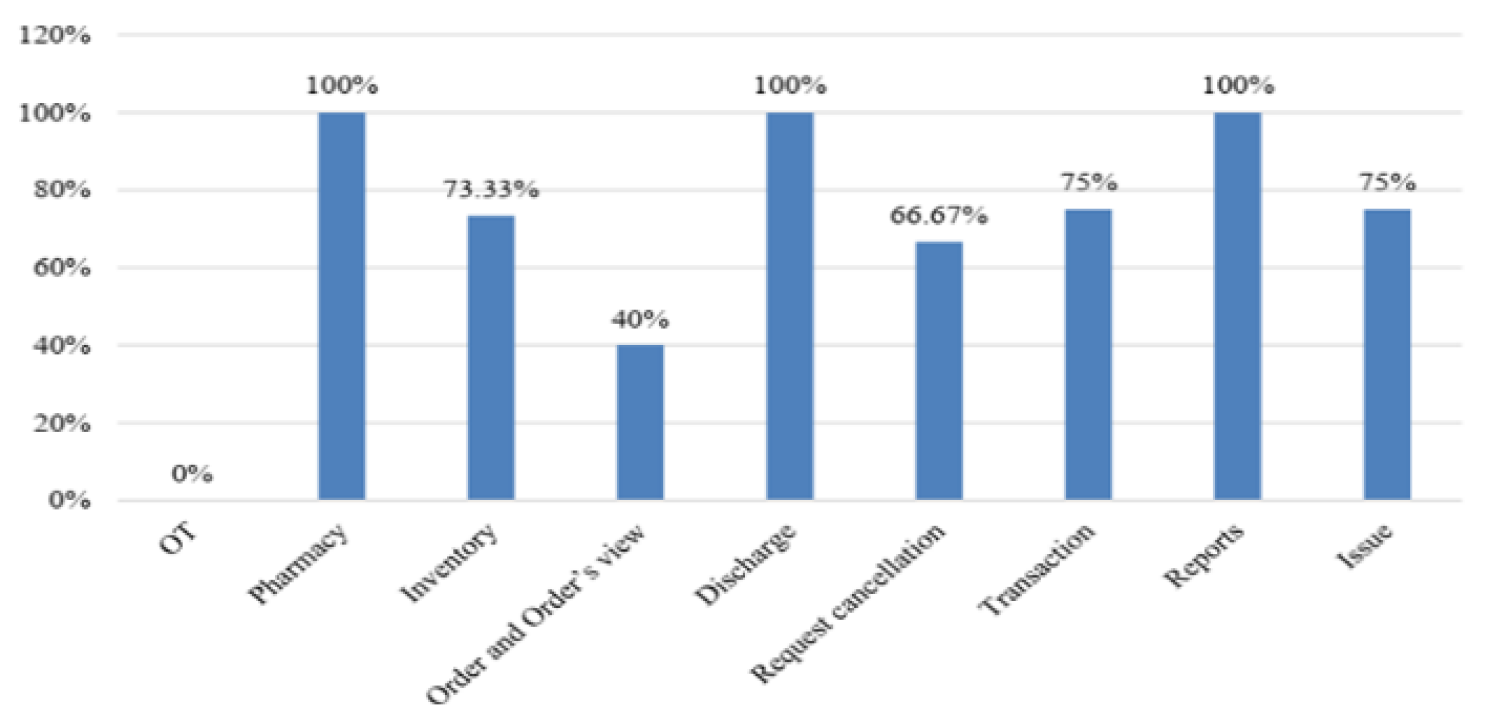
Table 3 shows the level of utilization of HIS in General medicine department. In general medicine ward module ‘Pharmacy’, ‘discharge’, and reports had 100% level of utilization. Transaction and issue menu had utilised at 75%, in transaction transfer intimation, cancel intimation and IP search functions are utilised and bed clean function is not utilised, asset failure request function is not utilised in issue menu. In inventory issue pending items, available item list, item stock approval and stock return from sub-store without request functions are not utilized, the level of utilization of inventory at around 73%. The request cancellation had around 67% level of utilization, IP credit return request and IP cash credit return request are not utilized in request cancellation menu. Orders and orders view had 40% level of utilization. OT had 0% level of utilization General medicine ward module. The overall utilization of General medicine ward module is 67.30%.
OBG
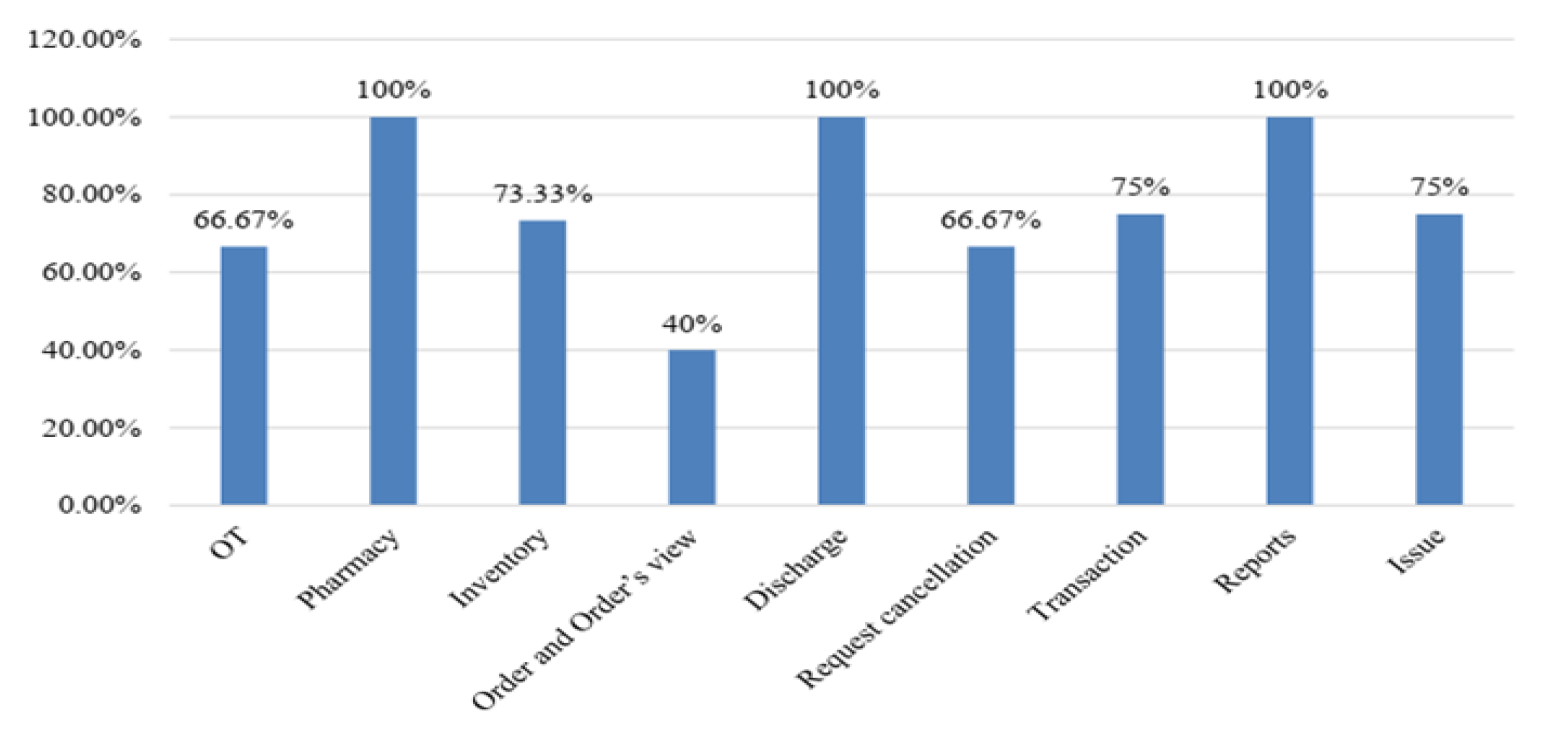
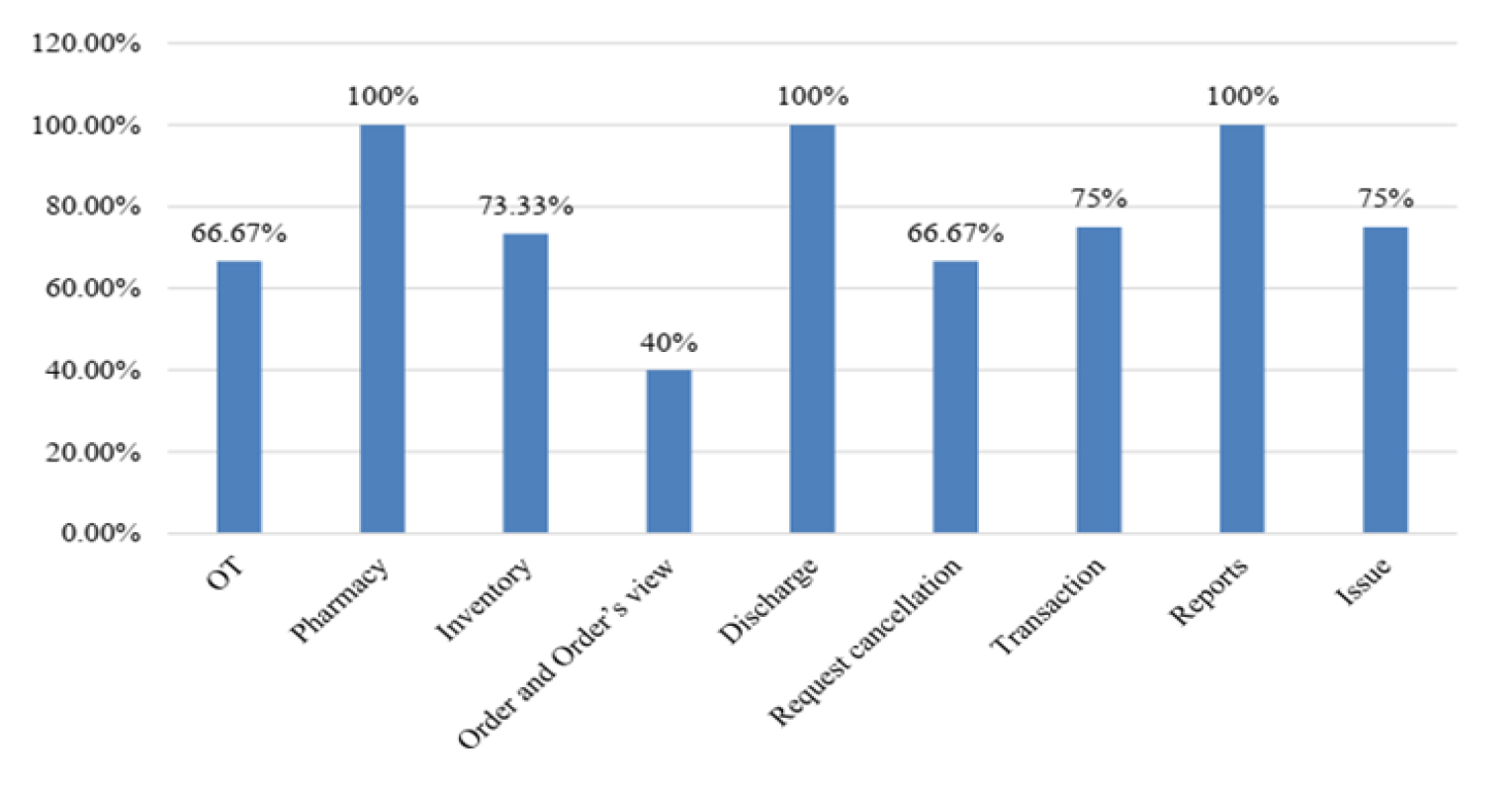
Table 4 shows the utilization level of the HIS in OBG department, Pharmacy, discharge and reports had 100% level of utilization. Transaction and issue menu had 75% level of utilization, bed clean function not utilized in transaction menu and asset failure request function not utilized in issue menu. Issue pending items, Available item list, Item stock approval, Stock return from sub-store without request functions are not utilized in inventory menu, inventory menu had around 73% level of utilized. Request cancellation menu had around 67% level of utilized. Orders and orders view menu had 40% level of utilization. OT had around 67% level of utilized, OT request function is not utilized in OT. The overall utilization of OBG ward module had 71.16% level of utilized.
Urology
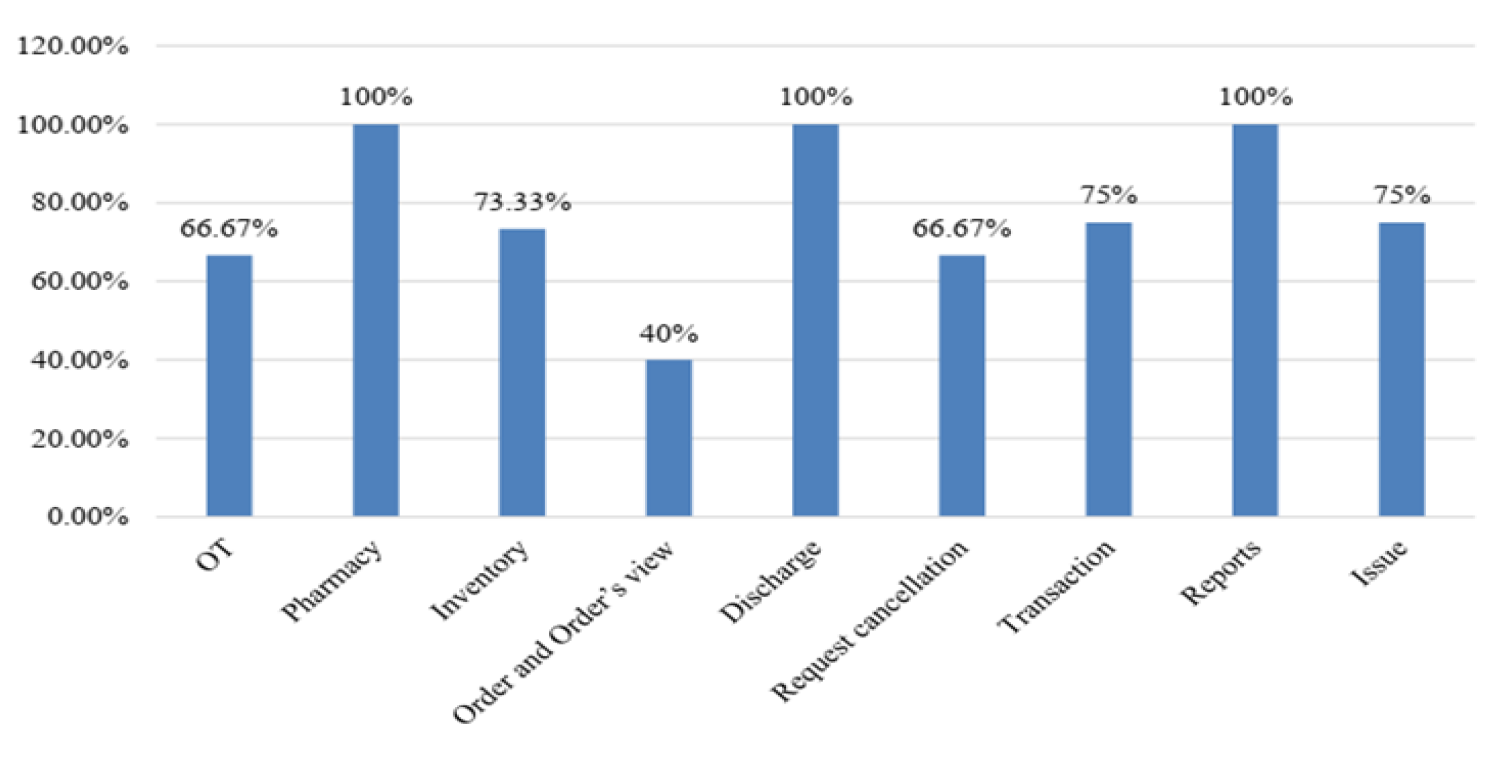
Level of utilization of HIS in Urology department is shown in the Table 5. Pharmacy, discharge and reports menu had 100% level of utilization. Service billing and bill enquiry functions are utilised in reports menu. Discharge intimation, Discharge summary, Discharge and Discharge summary view functions are utilised in discharge menu. Issue and transaction menu had 75% level of utilization, transfer intimation, cancel intimation and IP search functions are utilized in transaction menu, IP issue without request, issue entry and issue close functions are utilized in issue menu. Inventory had around 73% level of utilization. Request cancelation and OT had around 67% level of utilized. OT request function is not utilized in OT, IP credit return request and IP cash credit return request functions are not utilized in request cancellation menu. Orders and orders view menu had 40% level of utilization. The overall utilization of Urology ward had 71.16% level of utilization.
Dermatology
Table 6 shows the utilization of ward management module in Dermatology ward. Pharmacy, discharge and reports menu are most utilized i.e. 100% of utilization. Transaction and issue menu are 75% of utilization, bed clean and asset failure request functions are not utilized in transaction and issue menu respectively. 73.3% of utilization had in inventory, Issue pending items, Available item list, Item stock approval and Stock return from sub-store without request functions are not utilized in inventory. IP credit return request and IP cash credit return request functions are not utilized in request cancellation menu, the utilization level of request cancellation had around 67%. Orders and orders view menu had 40% of utilization. OT is not utilized in Dermatology ward. The overall utilization of Dermatology ward is 67.30%.
Table 3: Utilization of ward management module at General medicine ward
Sl. No
Menu
Percentage of The Utilization (%)
1
OT
0
2
Pharmacy
100
3
Inventory
73.33
4
Order and Order’s view
40
5
Discharge
100
6
Request cancellation
66.67
7
Transaction
75
8
Reports
100
9
Issue
75
Total
67.30
Table 4: Utilization of Ward Management Module at OBG Ward
Sl. No
Menu
Percentage of The Utilization (%)
1
OT
66.67
2
Pharmacy
100
3
Inventory
73.33
4
Order and Order’s view
40
5
Discharge
100
6
Request cancellation
66.67
7
Transaction
75
8
Reports
100
9
Issue
75
Total
71.16
Table5: Utilization of Ward Management Module at Urology Ward
Sl. No
Menu
Percentage of The Utilization (%)
1
OT
66.67
2
Pharmacy
100
3
Inventory
73.33
4
Order and Order’s view
40
5
Discharge
100
6
Request cancellation
66.67
7
Transaction
75
8
Reports
100
9
Issue
75
Total
71.16
Table 6: Utilization of Ward Management Module at Dermatology Ward
Sl. No
Menu
Percentage of The Utilization (%)
1
OT
0
2
Pharmacy
100
3
Inventory
73.33
4
Order d Order and Orders review
40
5
Discharge
100
6
Request cancellation
66.67
7
Transaction
75
8
Reports
100
9
Issue
75
Total
67.30
Paediatric
Utilization of ward management module at Paediatric ward is shown in the Table 7. Pharmacy, discharge and reports menu had 100% level of utilization. Service billing and bill enquiry functions are utilised in reports menu. Discharge intimation, Discharge summary, Discharge and Discharge summary view functions are utilised in discharge menu. Issue and transaction menu had 75% of utilization, transfer intimation, cancel intimation and IP search functions are utilized in transaction menu, IP issue without request, issue entry and issue close functions are utilized in issue menu. Inventory had around 73% of utilization. Request cancellation and OT had around 67% of utilized. OT request function is not utilized in OT, IP credit return request and IP cash credit return request functions are not utilized in request cancellation menu. Orders and orders view menu had 40% level of utilization. The overall utilization of Paediatric ward had 71.16% of utilization (Figure 5).
Utilization of Ward Management Module in Six Inpatient Wards
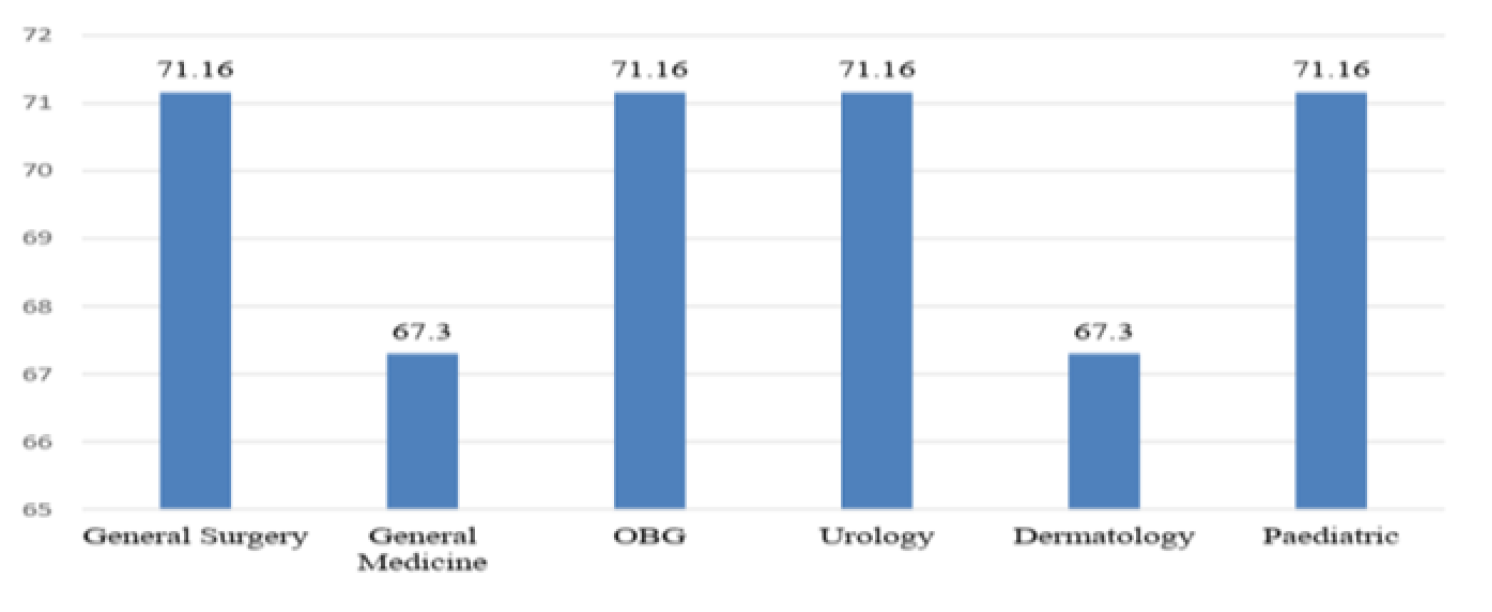
Table 8 shows the utilization of ward management module in six inpatient wards. General Surgery, OBG, Urology and Paediatric had 71.16 % of utilization while General Medicine and Dermatology had 67.30% of utilization (Figure 6).
To Identify the Challenges Faced in the Utilization of his (Hospital Information System)
A total of 90 Participants were selected by convenient random sampling method. The participants includes interns, residents, nurses and PREs. The questionnaire was developed for this purpose which includes feedback on HIS (Hospital Information System) usage in general and specific challenges encapsulated in the form of various options provided in the framed questions.
Table 9 shows the gender distribution, the population comprised approximately 29% males and 71% females. Among the recruited participants, 60 (67%) were nurses, 10 (11%) were residents, 18 (20%) were Interns and 2 (2%) were PRE’s. The participants reported varying numbers on the information sought in various questions. For instance, on the use of HIS, 49 (54%) reported that they had 0-1 years of experience on the use of HIS, 19 (21%) had 1-2 years of experience, 7 (8%) had 2-3 years of experience, 15 (17%) had more than three years of experience (Figure 7).
Table 7: Utilization of ward management module at Paediatric ward
Sl. No
Menu
Percentage of The Utilization (%)
1
OT
66.67
2
Pharmacy
100
3
Inventory
73.33
4
Order and Order’s view
40
5
Discharge
100
6
Request cancellation
66.67
7
Transaction
75
8
Reports
100
9
Issue
75
Total
71.16
Table 8: Utilization of Ward Management Module in Six Inpatient Wards
No
Inpatient wards
Percentage of utilization
1.
GeneralSurgery
71.16
2.
GeneralMedicine
67.30
3.
OBG
71.16
4.
Urology
71.16
5.
Dermatology
67.30
6.
Pediatric
71.16
Table 9: Characteristics of the Study Participants (N=90)
Characteristics
Frequency
Percentage
Gender
Male
26
29%
Female
64
71%
Years of experience
0-1 year
49
55%
1-2 years
19
21%
2-3 years
7
8%
More than 3 years
15
17%
Occupation
Resident
10
11.11%
Nurse
60
66.67%
Intern
18
20%
PRE
2
2.22%
Figure 5: Utilization of Ward Management Module at General Surgery Ward
Figure 6: Utilization of Ward Management Module at General Medicine Ward
Figure 7: Utilization of Ward Management Module at OBG Ward
Table 10 shows that out of 90 study participants 55 (61.1%) participants were aware about HIS and 35 (38.9%) participants were partially aware about the HIS. 61 (67.8%) participants were aware about the importance and benefits of HIS and 29 (32.2%) participants were partially aware about the importance and benefits of HIS.
Table 11 shows that 71 (78.9%) participant have knowledge on HIS usage and 19 (21.1%) participants do not have the proper knowledge on HIS usage.
Table 12 shows that 18 (20%) of participants said that there is display of unnecessary of information in HIS, like bed clean, asset failure request etc.
Table 13 shows that 74 (82%) participants has got training on HIS usage and 16 (17.8%) participants were did not get training.
Table 14 shows that 87 (96.7%) participants said that there is no mismatch of manual statistical report and HIS report.
Table 15 shows that 84 (93.3%) participants were said that HIS is user friendly and 6 (6.7%) participants were said that HIS is user friendly.
Table 16 shows that the confidentiality of the patient information in HIS, 84 (93.3%) participants were accepted that the HIS providing confidentiality to the patient information and 6 (6.7%) participants were not accepted with the patient confidentiality in HIS.
Table 17 shows that 25 (27.8%) participants were agreed that HIS reducing communication with the patients and 65 (72.2%) participants were did not agreed with this.
Table 10: Awareness Level about HIS (Hospital Information System), Level of Importance and Benefits
Components
Frequency
Percentage
Awareness level aboutHIS
Aware
55
61.1
Partially aware
35
38.9
Not aware
0
0
Awareness level of importance and benefits of the HIS
Aware
61
67.8
Partially aware
29
32.2
Not aware
0
0
Table 11: Showing Knowledge on HIS (Hospital Information System) Usage
Knowledge on HIS
Frequency
Percentage
Yes
71
78.9
No
19
21.1
Total
90
100
Table 12: Perception on Display of Unnecessary Information in HIS Hospital Information System
Display of unnecessary information in HIS
Frequency
Percentage
Yes
18
20
No
72
80
Total
90
100
Table 13: Showing Training Given to the Healthcare Workers on HIS Hospital Information System
HIS training
Frequency
Percentage
Yes
74
82.2
No
16
17.8
Total
90
100
Table 14: Perception on Mismatch of Manual Statistical Report and HIS (Hospital Information System) Report
Mismatchof manual statistical report and HIS report
Frequency
Percentage
Yes
3
3.3
No
87
96.7
Total
90
100
Table 15: Showing the Perception of the Healthcare Members Onuser Friendly of HIS (Hospital Information System)
HIS is userfriendly.
Frequency
Percentage
Yes
84
93.3
No
6
6.7
Total
90
100
Table 16: Showing the Perception of the Healthcare Members on patient Confidentiality
Patient confidentiality
Frequency
Percentage
Yes
84
93.3
No
6
6.7
Total
90
100
Table 17: Showing the Perception of the Healthcare Members on Reducing Communication with Patients Because of HIS (Hospital Information System)
HIS reduce communication with patients
Frequency
Percentage
Yes
25
27.8%
No
65
72.2%
Total
90
100%
Figure 8: Utilization of Ward Management Module at Urology Ward
Figure 9: Utilization of Ward Management Module at Dermatology Ward
Figure 10: Utilization of Ward Management Module at Paediatric Ward
Table 18 shows that 27 (30%) participants were said that HIS reduce the communication with colleagues and 63 (70%) participants did not agreed with this (Table 19).
Table 20 shows that 87 (96.7%) participants said that the complete data is updated in HIS and 3 (3.3%) participants were said that the complete data is not updated.
Table 21 shows that 43 (47.8%) participants were agreed that the there is lack of computers in workplace and 47 (52.2%) participants were did not agreed that the there is no lack of computers in the workplace.
As described above, there were 4 major questions put across to participants in order to gauge their difficulty levels on the use of HIS. 52 (58%) reported that they faced difficulty to use HIS. Out of the 52 participants who reported facing difficulty, 7 (8%) gave lack of skill as the reason, 12 (13%) pertained it to lack of training, 19 (21%) attributed it to low speed of HIS, 15 (17%) said all of the above as the cause (Table 22).
Table 22 shows that 63 (69%) participants were said that they faced technical issues in the use of HIS. Among the 63 individuals, 41 (45%) attributed it to cancellation of the pharmacy request, 11 (12%) gave issues related to the pending bill as the reason, 4 (5%) said return request for expired medicine, 6 (7%) gave updates of price list issue as one of the reason, 1 (1%) gave all of them as the reason of their difficulty (Figure 11).
Table 23 shows that 43 (48%) participants were reported security threat of information during use of HIS. Among them, 13 (15%), 10 (11%), 17 (19%), 1 (1%) and 2 (2%) attributed it to hardware problems, software failure or error, network failure or error, malware attack and all of the above respectively.
Table 24 shows that 55 (61%) thought that HIS consumed work schedule in some or the other way. In these participants, 9 (10%), 12 (13%), 32 (36%) and 2 (2%) gave less number of computers to use HIS, lack of skill in HIS, low speed of HIS and difficulty to use systems respectively as the reason (Table 25).
Comparing Technical Issues, Security Threats and Worktime with Difficulties Faced While Using His
To identify challenges especially with regard to technical issues, security threats, difficulty to use HIS and HIS consuming the work time, assessments were done based on Chi square tests. The factors covered in the questionnaire which could pose a challenge for the staff to use HIS effectively, were studied and it was found that is, the various causes which could lead the participants to face such as, (a) difficulties in using HIS, (b) technical issues, (c) security threats and (d) over consumption of work time were all non-significantly associated. Specifically, the Chi square statistic p-value for association between difficulties in HIS use and technical issues; security threat; and overconsumption of work time was 0.49, 0.34 and 0.31 respectively. The results are summarized in Table (Table 26-28).
Table 18: Showing the Perception of the Healthcare Members on Reducing Communication with Colleagues Because of HIS
HIS reduce communication with colleagues
Frequency
Percentage
Yes
27
30
No
63
70
Total
90
100
Table 19: Showing the Perception of the Healthcare Members on Updating the Data in HIS (Hospital Information System)
Completedata is updated in HIS
Frequency
percentage
Yes
87
96.7
No
3
3.3
Total
90
100
Table 20: Showing the Perception of the Healthcare Members on Lack of Computers in Workplace
Lack of computers inworkplace
Frequency
Percentage
Yes
43
47.8
No
47
52.2
Total
90
100
Table 21: Difficulties Faced While Utilizing the HIS
Difficulty to use HIS
Frequency
Percentage
Yes
Lack of skill
7
7.8
Lack of training in HIS
11
12.2
Low speed of HIS
19
21.1
All the above
15
16.7
No
38
42.2
Total
90
100
Table 22: Common Technical Issues Faced by the Users While Utilizing HIS
Technical issues in HIS
Frequency
Percentage
Yes
Cancellation of pharmacy request
41
44.4
Issues relatedto pending bills
11
12.2
Return request for expired medicine
4
4.4
Update pricelist
6
6.7
All the above
1
1.1
No
27
30
Total
90
100
Table 23: Common Security Threats Faced by the Users While Utilizing HIS
Securitythreats in HIS
Frequency
Percentage
Yes
Hardware problems
13
14.4
Software failure and error
10
11.1
Network failure and error
17
19.9
Malware attack
1
1.1
All the above
2
2.2
No
47
52.2
Total
90
100
Table 24: Showing the Reasons of HIS Consuming the Work Time of Users
HIS consuming the work time
Frequency
Percentage
Yes
Less no. of computers to use HIS
9
10
Lack of skill in HIS
12
13.3
Low speed of HIS
32
35.6
Difficulty to use computer
2
2.2
No
34
37.8
Total
90
100
Figure 11: Utilization of Ward Management Module in Six Inpatient Wards
Table 25: Significance Level between the Technical Issues and Difficulties Faced while Using HIS
Variables
Difficulty to use HIS
Chi-square value
p-value
Lack of skill
Lack of training in HIS
Low speed of HIS
All the
above
Techn ical issuesin HIS
Cancellation of pharmacy request
2(5%)
4(10%)
10(25%)
7(18%)
11.432a
0.492
Issues related to pending bills
1(3%)
3(8%)
4(10%)
1(3%)
Return request forexpired medicine
1(3%)
0
0
3(8%)
Update of pricelist
0
1(3%)
1(3%)
0
All the above
4(10%)
8(21%)
16(41%)
11(28.2)
Table 26: Significance Level between the Security Threats and Difficulty while Using HIS
Variables
Difficulty to use HIS
Chi- square value
p-value
Lack of skill
Lack of training in HIS
Low speed of HIS
All the above
Securitythreatsin HIS
Hardwareproblems
2(7%)
2(7%)
3(10%)
1(4%)
6.772a
0.342
Software failure or errors
3(10%)
2(7%)
1(4%)
3(10%)
Network failure or error
0(0%)
3(10%)
6(21%)
3(10%)
Table 27: Significance Level between the Consumption of Time and Difficulty Faced while Using HIS
Variables
Difficulty to use HIS
Chi- square value
p-value
Lack of skill
Lack of training in HIS
Low speedof HIS
All the above
HIS consuming theworktime
Less no. of Computers to use HIS
0(0%)
2(6%)
2(26%)
1(3%)
10.501a
0.311
Lack of skill in HIS
2(6%)
2(6%)
2(6%)
0(0%)
Low speed of HIS
3(9%)
3(9%)
7(21.2%)
7(21.2%)
Difficulty to use Computer
0(0%)
0(0%)
0(0%)
2(6%)
Table 25 shows the Significance level between the technical issues and difficulties faced while using HIS, the p-value is 0.492, which show that there is no significant challenge between the technical issues and difficulties faced while using HIS.
Table 26 shows the Significance level between the security threats and difficulty while using HIS, the p-value is 0.342, which shows that there is no significant challenges between the security threats and difficulty while using HIS.
Table 27 shows the significance level between the consumption of time and difficulty faced while using HIS, the p-value is 0.311, which shows that there is no significant challenges between the consumption of time and difficulty faced while using HIS.
DISCUSSION
The existing ward management module of HIS was studied and found to be composed of clinical support system, which is directly utilized for patient care and miscellaneous support system, catering support needs of the Ward Management. These support systems are with varying components and applications. In this study 6 inpatient wards were explored for their use of HIS. Out of the six inpatient wards four inpatient wards, that is General Surgery, Urology, Paediatric and OBG wards were found to have similar level of utilization of HIS, that is, around 72% and two inpatient wards i.e. General medicine and Dermatology with 68% utilization. To study the challenges faced by the staff in utilizing the HIS, Total of 90 staff members were randomly selected and included. Technical concerns, perception on security threats and consumption of time were compared with difficulties faced while using. No significant challenges were found in the utilization of HIS (p-values of 0.492, 0.342 and 0.311 respectively). In other words, there was no significant association between the various causes and factors which could lead participants to face difficulties in HIS use.
A descriptive–cross sectional study conducted by [5] titled, “Development of Hospital Information Systems: User Participation and Factors Affecting It” aimed to investigate the rate of participation of users in HIS development and to identify the factors affecting. The study included140 HIS users from various Teaching Hospital. Data were collected using a self-structured questionnaire which was estimated as both reliable and valid. It found that the highest participation rate of users of HIS was related to implementation phase (2.88) and the lowest was related to analysis (1.23). The test results showed that the rate of user participation was not satisfactory in none of the stages of development (P< 0.05). The significant factors in improving user participation involved teamwork from end-users and the support of management from HIS development [5]. The present study did aim at identifying challenges in HIS use but the ways it can be improved were beyond the scope of the present study. Also, as a matter of fact we didn’t found any significant challenge in HIS use (p-values of 0.492, 0.342 and 0.311 for technical issues, perception on security threats and consumption of time, respectively).
In this study titled, “A Study on the Utilization of Hospital Information System (Ward and Physician) Modules in a Tertiary Care Hospital” by “Pandit AP” et al. found that the entire hospital operations were HIS driven. It reported that the HIS was billing-centric. The main HIS modules under study were the Ward module and the Physician module. After conducting the utilization study using a structured questionnaire, it was found that the level of utilization of the Ward module is 36.4% and that of the Physician module is 6.66%. Using a Fishbone analysis, the causes of reduced HIS utilization were identified and using a Pareto analysis the main causes were found to be Work culture and Lack of mobile handheld devices [6]. Where as in the present study found no significant challenge in HIS use (p-values of 0.492, 0.342 and 0.311 for technical issues, perception on security threats and consumption of time, respectively). Also, we found General surgery, Urology, Paediatric and OBG wards to have around 72% usage, while General medicine and Dermatology was found to have 68% usage of HIS.
Further, a study conducted by “Leila A” et al. titled, “Challenges of using Hospital Information Systems by nurses: comparing academic and non-academic hospitals” exploring challenges in HIS use in academic and non-academic hospitals found that the main challenges were human environment factors, like “negative attitude of society toward using HIS” and “no incentive to use system” respectively. The results revealed that there was a significant relationship between gender and the mean score of challenges related to the organizational environment category in the academic hospitals and between familiarity with HIS and mean score of human environment factors (p<0.05) [7]. In contrast, our study didn’t find any significant challenge in HIS use like technical issues (p-value=0.492), perception on security threats (p-value=0.342) and consumption of time (0.311).
The present work attempted to explore the objectives it had set out at various levels using many strategies. It studied existing ward management module of HIS, assessed utilization states of ward management module and identified the challenges in the utilization of HIS. To achieve all of this, data was collected from credible sources in the department of Information Technology (IT) and inpatient wards. Also,the study employed a questionnaire to assess the outcomes of challenges in HIS use. The responses were well captured and covered a wide range of staff members including interns, residents, nurses and PREs. It represents important insights into the viewpoint of the major stakeholders, that is, the HIS users and could prove fruitful in furthering our understanding of how HIS could be employed in the betterment of patient care. Also, the study has its strengths in having a well characterized and diverse population.
The present study is on HIS users with a specific setting of patient care who volunteered to participate. The sample population is therefore a representative of users in these conditions.
CONCLUSION
Hospital Information Systems (HIS) is an efficient tool to aid in the diagnosis, management, training and practices. As there is a large number of patient inflow, it is a challenge for the administration to run the hospital smoothly. In such a scenario, it is important for Hospital employees to do their jobs in an efficient and effective manner. HIS can then come to rescue by helping not just employees but patients and care takers as a well.
The present study explored the existing ward management module of HIS and found it to be composed of clinical support system, employed for patient care and miscellaneous support system. The findings of the 6 inpatient wards, General surgery, Urology, Paediatric, OBG, General medicine and Dermatology were explored the use of HIS and the utilization level. General surgery, Urology, Paediatric, OBG wards had a utilization level of 72% while General medicine and Dermatology had 68% level of utilization. Even if there is no significant challenges found in the utilization of HIS in comparison to the technical components, difficulties in using HIS, technical issues, security threats and over consumption of work time. But there are certain observations which are made in the study can be further improved and the complete benefits of the HIS can be taken in patient management. Support services such as CSSD, Diet, Laundry, physiotherapy etc over all system will further improve.
In this study the Healthcare members perceived HIS will reduce communication with patients as well as with colleagues. Also, in various inpatient wards, around 66% level of utilization was found for OT (except Dermatology and General medicine). This reduced communication and level of utilization of OT can be further improved by simplifying HIS platform, providing training to staff and increasing awareness levels about its benefits of use. Increasing usage of OT in wards will help OT inventory management and scheduling of OT surgeries leading to improved revenue generation, OT process and in time patient satisfaction
Also, the current levels of utilization can further be improved (going up to a state of 100%) by improving the HIS system by investing in human resource, finance and adding other technical aids like Note pads, dicta phones, Tabs etc, this will help to maintain complete medical record in electronic form. Thus, helping in complete paperless medical record which will benefit in long-term with regard to finance, time and space. Hospital Information Systems provide proper data storage, reliable and accurate usage, easy and fast access of data from one department to another department, secure data storage and low cost of usage. An effective HIS also delivers benefits like, enhancing information integrity, reducing transcription errors, reducing duplication of information entries and optimizing report turnaround times. Thus, improving HIS system which can aid applications in other departments and services of the hospital as well. Given the benefits of HIS, its improvement in terms of usage and utilization can magnanimously enhance and support the hospital services in providing better care to the patients.
Recommendations HIS utilization can be improved in its format and presentation by simplifying the mode of accessing patient data. The features present in the current HIS system can be improved and health professionals should be encouraged to enter complete data into the medical records. HIS should be implemented as a compulsory measure and encouraged in departments like CSSD, Dietary, Laundry, Physiotherapy etc. Effectiveness of the system can be checked by scrutinising the data entered in the system.
The improved version of HIS can be introduced based on the inputs taken from the health care professionals and other stakeholders. Also, with each change being incorporated into the system, regular updates need to be shared and training to be imparted to the staff members.
For the effective and efficient use the staff can be motivate either in term monitoring benefits or non-monitoring benefits like, awards, recognition, etc.
Patients and relatives can be made a part of HIS improvement by making HIS accessible through mobile based apps and design of web portals thus making medical reports accessible and moving towards hassle free care.
Data from other departments could also be collected to study the level of utilization of the ward management module. In addition, a study can be conducted to follow up the present study in order to explore further challenges associated with HIS utilization.
REFERENCE
Ross, D.S. and Venkatesh, R. “Role of hospital information systems in improving healthcare quality in hospitals.” Indian Journal of Science and Technology, vol. 9, no. 26, 2016, pp. 1–5. ISSN 0974-5645.
Abdullah, M.J. and Ahmad, S.K. “An investigation study of hospital management information system.” International Journal of Advanced Research in Computer Science, vol. 6, no. 1, 2017. ISSN 2278-1021.
Evans, R.S. “Electronic health records: Then, now, and in the future.” Yearbook of Medical Informatics, vol. 25, no. S01, 2016, pp. S48–S61.
Ahmadian, L. et al. “Challenges of using hospital information systems by nurses: Comparing academic and non-academic hospitals.” Electronic Physician, vol. 9, no. 6, 2017, pp. 4625–4630. ISSN 2008-5842.
Rahimi, B. et al. “Development of hospital information systems: User participation and factors affecting it.” Acta Informatica Medica, vol. 22, no. 6, 2014, pp. 398–401.
Pandit, A.P. et al. “A study on the utilization of hospital information system (ward and physician modules) in a tertiary care hospital.” International Journal of Research Foundation of Hospital and Healthcare Administration, vol. 4, no. 2, 2016, pp. 51–60.
Leila, A. et al. “Challenges of using hospital information systems by nurses: Comparing academic and non-academic hospitals.” Electronic Physician, vol. 9, no. 6, 2017, pp. 625–60.
Recommended Articles
Research Article
Imaging Evaluation of Ultrasonography Versus Magnetic Resonance,
Imaging in Diagnosis of Carpal Tunnel Syndrome among Female Patients with Positive Nerve Conduction Study
Download PDF
Research Article
An evaluation of Profile of Medico-legal autopsies conducted at Dr. Radhakrishnan Govt. Medical College, Hamirpur, Himachal Pradesh
Download PDF
Research Article
The Efficacy of 5- Fluorouracil Cream and 25% Podophyllin Solution in Treatment of Plantar Warts in Alternative Day Regimen ; An Open Therapeutic Trial.
Download PDF
Research Article
Silent Threats: Evaluating Knowledge of Pelvic Inflammatory Disease Among Reproductive-Age Women in District Kangra
Pankaj sharma,
Kritika Katoch
Published: 27/11/2024
Download PDF
PO Box 101, Nakuru
Kenya.
Email: office@iarconsortium.org
Editorial Office:
J.L Bhavan, Near Radison Blu Hotel,
Jalukbari, Guwahati-India
M., M. B. N., P. K., K. & Saldanha, S. (2021). A Study on the Utilization of Hospital Information System in Inpatient Wards. International Academic Research Journal of Internal Medicine & Public Health, 2(2), 1-12.
MLA
M., Mohammed B. N., Kritharth P. K. and Sunita Saldanha. "A Study on the Utilization of Hospital Information System in Inpatient Wards." International Academic Research Journal of Internal Medicine & Public Health 2.2 (2021): 1-12.
Chicago
M., Mohammed B. N., Kritharth P. K. and Sunita Saldanha. "A Study on the Utilization of Hospital Information System in Inpatient Wards." International Academic Research Journal of Internal Medicine & Public Health 2, no. 2 (2021): 1-12.
Harvard
M., M. B. N., P. K., K. and Saldanha, S. (2021) 'A Study on the Utilization of Hospital Information System in Inpatient Wards' International Academic Research Journal of Internal Medicine & Public Health 2(2), pp. 1-12.
Vancouver
M. MBN, P. K. K, Saldanha S. A Study on the Utilization of Hospital Information System in Inpatient Wards. International Academic Research Journal of Internal Medicine & Public Health. 2021 Jul;2(2):1-12.



 Download PDF
 Download XML