Social media has been changed the scenario of marketing of goods and services. The entire marketing world has been changed due to the technological development of Web 2.0. Traditional advertising completely changed and new mode of advertising has been adopted by business concerns using new strategies in communication. There is a paradigm shift in content of advertisement, mode of delivery, reach of advertisements by the way of usage of social media, which helps consumers to search information about the product and services by the brands social media pages including Instagram on Facebook. Advertisements are more creative, entertaining and has the capacity to reach large number of customers. Instagram pages or Facebook pages of the products and services is available to interact with reviews and their viewpoints. All these changes makes goods and services become more popular among consumers including prospective buyers. This study focuses on usage of social media, penetration of social media by young people and how they search information regarding the products through various social media platforms. The study found that prospective and potential customers has got product information.
The Globalization made the world as a huge market and due to the technological innovations; it has become a global village. With developments in communication and economic activity, it has progressively become easier to move from the local to the regional and then from the regional to the national level, and finally across the nations. Goods and services produced in one part of the world are increasingly available in all parts of the world. During the last decades the technology has developed substantially and it touches its peaks. Technology acts as a multiplier to enhance its own faster developments. Communication is an inevitable part of human life and civilization. Due to technological development people can communicate any time with any one with various social media platforms. Now a day’s people are easier to access and use any kind of social media irrespective of income, gender or any other social factors. Business world also using these platforms for better communication. Developments in digital marketing and effective content writing leads social media advertisements are more enjoyable and attractive. People seeing advertisements while networking on social media may help of them to take buying decision making.
Review of Literature
[1] has conducted a study to answer questions like how does consumers gather and process information before purchase and how does social media affect consumer in different stages of their decision making etc. The study found that social media users decision making to be easier and enjoyed the process more than compare do those who used other information
[2] the study says that social media influences make a positive impact on the buying decision process of the customers. The study conducted based on empirical data from the respondents who actively involved in online shopping platforms the study found that social media is an effective way to generate more leads and sales. [3] conducted a quantitative research method on social media advertising and consumer perception on purchase intention. They used Likert scale varying from strongly agree to strongly disagree with 1-5 scale. Smart PLS has been used for the analysis purpose. The study indicate that the social media advertising has no significant influence on purchase intention. Instagram advertisement applied by stores is not able to increase purchase intention. The study also found that social media advertising has a significant positive effect on consumer perception.
Statement of the Problem
The current scenario of marketing of goods and services is mainly shifted to a technologically driven environment. It leads to communication of goods and services among the consumers through digital world. There are number of digital platforms to communicate information pertaining to goods and services, among these social media platforms are more powerful. Instagram, Facebook, YouTube etc. are some of the most popular social medias. Gods and services digital communication can reach faster and catch number of potential buyers. In this way this research paper attempts to answer whether social media advertisements provide information to potential buyers especially among youth. The current study tries to understand the solution for this problem.
Objectives
To understand the social media penetration among youth
To understand whether social media provide product information to potential buyers
The current study is descriptive in nature and it has made an attempt to understand the penetration of social media among youth buyer. The study also try to understand how social media advertisement affects consumer decision making. In order to attain the objective of the study, the following methodology has been made use of: A sample of 113 college students from Malappuram District of Kerala has been taken for the study. The respondents are selected by using random sampling method. 78 female and 35 male respondents were participated in the survey. The data required for the study were collected through google form with structured questionnaire. For analysis purpose percentage, averages, etc. were used. For presentation purpose pie chart is used.
Analysis and Interpretation
Table 1 shows the income level of respondents. The Table and Figure 1 clearly depicts that 44% percent of the respondents fall under the income category of Rs. 10000-20000, 23% of the respondent fall under the income category of Rs. 30000-40000. Figure 2 shows respondents usage of social media sites on a daily basis. Respondents can select multiple options of social media they are using regular basis. It shows that majority of the respondents were using WhatsApp, followed by YouTube, Instagram, Facebook.
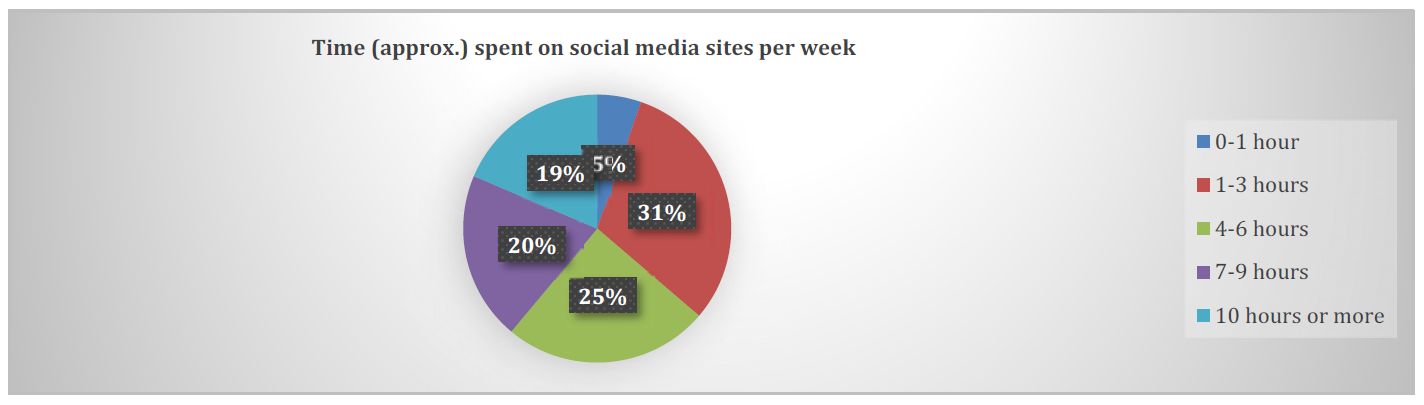
Table 2 shows that respondent’s approximate time spent on social media sites per week. The Table and Figure 3 reveals that 31% of the respondents were spent their 1-3 hours per week on social media. 25% of the repondents spend their 4-6 hours per week on social media. 20% of the respondents were spent their 7-9 hours per week on social media. 19% of the respondents were spent their 0-1 hours per week on social media.
Figure 4 shows that motive behind using social media. Respondents allowed to choose multiple options. Based on users’ response it shows that majority of the respondents using social media for entertainment purpose followed by keep in touch with friends and family, to learn about information on products and services, to catch up on the latest news etc. respectively.
Table 3 shows watch time of advertisement while using social media, which reveals that 55% of the respondent’s watched advertisements on social media for 0-10 seconds. 41% of the respondents watched advertisements on social media for 10-30 seconds. 2.65% of the respondents watched advertisements on social media for 30-60 seconds.
Table 4 shows social media use to obtain information about products and services, which shows that 57% of the respondents says that YouTube provide more product/services information followed by Instagram, Facebook and WhatsApp etc.

There are number of social media platforms were used by youth among these WhatsApp, YouTube and Facebook are more popular among youth. Youth is continuously engaged with social media and its part of their life. Many of the respondents says that long hours the spent on social media for various purpose. Majority of the respondents are reluctant to see advertisements on social media, as possible people try to skip advertisements but, in many cases, compelled to watch advertisements. Nowadays almost all the major social media platforms are delivering advertises in between their primary content. Some of the platforms are readily available to interact with users with product or service official pages like Instagram and Facebook. YouTube provide sufficient amount of product information to potential buyers. All these findings implies that there is a wide scope in digital marketing especially advertising through social media. The AIDA concept in advertising can work in social media advertising with great content strategical advertising.
Table 1: Income Level of Respondents
Income level | Number of respondents | Percentage |
Rs.10,000-20,000 | 50 | 44.25 |
Rs.20,000-30,000 | 18 | 15.93 |
Rs.30, 000-40,000 | 26 | 23.01 |
Above Rs.40, 000 | 19 | 16.81 |
Total | 113 | 100 |

Figure 1: Income Level of Respondents

Figure 2: Social Media Sites Using on A Daily Basis
Table 2: Time (approx.) Spent on Social Media Sites Per Week
Time (approx.) Spent on Social Media Sites Per Week | ||
Time | Number | Percentage |
0-1 hour | 6 | 5.31 |
1-3 hours | 35 | 30.97 |
4-6 hours | 28 | 24.78 |
7-9 hours | 23 | 20.35 |
10 hours or more | 21 | 18.58 |
Total | 113 | 100.00 |

Figure 3: Time (approx.) Spent on Social Media Sites Per Week

Figure 4: Reasons for Using Social Media
Table 3: Watch Time of Advertisement While Using Social Media
Approximate Watch Time of Advertisement While Using social media. | ||
Time | Number | Percentage |
0-10 seconds | 62 | 54.87 |
10-30 seconds | 46 | 40.71 |
30-60 seconds | 3 | 2.65 |
Full length advertisement | 2 | 1.77 |
Total | 113 | 100 |

Figure 5: Watch Time of Advertisement While Using Social Media
Table 4: Social Media Use to Obtain Information About Products and Services
Which social media do you use to obtain information about products | ||
Social media | Frequency | Percentage |
7 | 6.19 | |
0 | 0.00 | |
33 | 29.20 | |
Youtube | 65 | 57.52 |
4 | 3.54 | |
Skype | 0 | 0.00 |
Snapchat | 0 | 0.00 |
1 | 0.88 | |
Quora | 3 | 2.65 |
Total | 113 | 100.00 |

Figure 6: Social Media Use to Obtain Information About Products and Services
Gupta, C.C.S. “Impact of social media on consumer behaviour.” International Journal of Creative Research Thoughts (IJCRT), vol. 8, no. 6, 2020, pp. 1943–1961. https://doi.org/10.1504/IJIDS.2019.101994.
Varghese, Mr. Sony and M.M. Agrawal. “Impact of social media on consumer buying behavior.” Saudi Journal of Business and Management Studies, vol. 6, no. 3, 2021, pp. 51–55. https://doi.org/10.36348/sjbms.2021.v06i03.001.
Suprapto, W. et al. “Social media advertising and consumer perception on purchase intention.” SHS Web of Conferences, vol. 76, 2020, pp. 01055. https://doi.org/10.1051/shsconf/20207601055