Introduction: Potentially harmful subjects – tobacco, alcohol and other drugs are now more readily available to adolescents and threaten their health in short and long term. Suicide attempts also appear to be on the rise among the adolescents4. This study aims at bringing out the Mental health concerns and the KAP regarding reproductive and sexual health among Muslim adolescent boys of Khaja Bazaar area of Kalaburagi in relation to health, disease, social, psychological, economical, sexual and other problems. Methodology: The study was carried out on health status of 260 Muslim adolescent boys who were selected by employing simple random sampling from the entire target population on the basis of the percentage of adolescents in the country i.e., 20.9%7. A pre designed, pre tested questionnaire was used to collect the information. The questionnaire consisted a consortium of relevant SDQs borrowed from trusted sources like WHO, NIMHANS etc regarding mental health, reproductive health and sexual health practices. Results: Among the individuals who were Underweight, 58.14% were Mentally Unhealthy, giving the Highest prevalence in the comparison, followed by Obese individuals (57.14%) and Overweight individuals (52.0%). Children of Widows had the highest prevalence of Mentally Unhealthy individuals (50.0%) followed by the children of parents who were in their first marriages (36.28%) and children of Divorcees (35.29%). The Lower Class had the highest number of individuals who were Mentally Unhealthy (65.0%) followed by Lower Middle Class (58.06%).
The need to study Adolescent boys exclusively rather than just studying adolescents in general is because adolescent boys are very different than adolescent girls in the terms of physical, mental, social, cognitive and personal development [1]. The two genders are so different from each other that studies have even confirmed that the brains of the two genders grow differently during adolescent [2]. Adolescent boys are believed to display more overall risky health behaviour. Health hindering behaviours such as Inadequate consumption of nutritious food, Road risk behaviour, substance use, smoking and Alcohol consumption are seen more in Adolescent boys than Adolescent girls [4].
The lives of millions of Adolescents are marred by poverty, inadequate education and work opportunities, exploitation, war, civil unrest, ethnic and gender discrimination. Rapid urbanisation, telecommunication, travel and migration bring both new possibilities and new risks to young people. These conditions may directly jeopardise the health of the individuals. Potentially harmful subjects – tobacco, alcohol and other drugs are now more readily available to adolescents and threaten their health in short and long term. Suicide attempts also appear to be on the rise among the adolescents [4].
India being a culturally, economically and religiously diverse country, many pockets in the country are predominantly Muslim [5]. The Khaja Bazaar Area under the Urban Health Training centre of Khaja Bandanawaz Institute of Medical Sciences, Kalaburagi, is one such area which is predominantly Muslim and economically backward. Even in the larger picture, not many studies have been conducted on Adolescent Boys and fewer have been conducted in Muslim Adolescent boys. This was the rationale behind taking up such a study. This study aims at bringing out the Mental health concerns and the KAP regarding reproductive and sexual health among Muslim adolescent boys of Khaja Bazaar area of Kalaburagi in relation to health, disease, social, psychological, economical, sexual and other problems.
This cross-sectional study was carried out in the urban field practice area of Department of Community Medicine, KBNIMS, Kalaburagi, Karnataka. A house-to-house survey was carried out. Households were included in the study by using A Systematic Random Sampling technique6where every 5th house was selected (By obtaining the ratio of the total population to the sample size desired). The study was carried out on health status of 260 Muslim adolescent boys who were selected by employing simple random sampling from the entire target population on the basis of the percentage of adolescents in the country i.e., 20.9%7. A pre designed, pre tested questionnaire was used to collect the information. The questionnaire consisted a consortium of relevant SDQs borrowed from trusted sources like WHO, NIMHANS etc regarding mental health, reproductive health and sexual health practices. Comfort was ensured by establishing confidence and liaison by repeated encounters and discussions with all the participants to reduce attrition. The subjects were interviewed after obtaining informed consent. The answers were thereafter coded and quantified. All ethical boundaries were maintained and clearance for the same has also been obtained in the regard. The Phases in Adolescence were classified as follows:
Early Adolescence (10-13 Years): Characterised by a spurt of growth and development of sexual maturation. This is the phase in which the Young People start to think in an abstract way.
Middle Adolescence (14-16 Years): The physical changes are completed as the individual develops a sense of identity. The thinking becomes more reflective.
Late Adolescence (17-19 Years): The Body takes its adult form, while the individual has a distinct identity and have more settled and ideas.
The data was analysed using Statistical Package for Social Sciences (SPSS) version 23.0. To test the significance of the study, we applied Chi-Square test and ‘T’ test at 5% level of significance (p<0.05).
Comparison of Age and Sexual Health Knowledge and Information revealed that among the sexually active individuals 88.88% were from Late Adolescence while 11.11% were from Middle Adolescence. Among the ones who watched Pornography, 66.6% were from Late Adolescence and 5.13% were from Early Adolescence. 32.69% of the study subjects masturbated among which 69.41% were Late Adolescents. Only 30% of the study population knew about HIV/ AIDS and only 16.54% knew about other sexually transmitted diseases such as Gonorrhoea, Syphilis etc. Only 19.61% had knowledge about methods of Family Planning and 62.79% of these individuals were in the age group of 17-19 Years. Only 10% knew about Emergency Contraceptive Pills. It was also found that 10% of the population suffered from spontaneous nocturnal ejaculation, most of them from Middle Adolescence (64.28%).
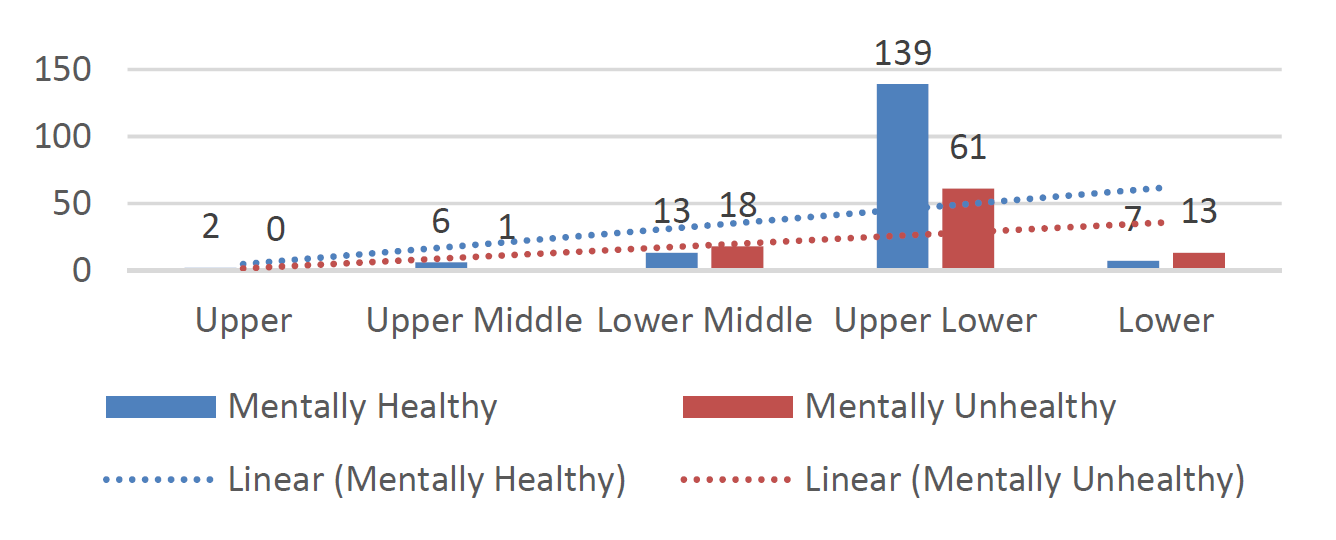
Relation between Mental Health Status and Kuppuswamy’s Socioeconomic status revealed that there was a statistically significant association between the two. The Lower Class had the highest number of individuals who were Mentally Unhealthy (65.0%) followed by Lower Middle (58.06%). The least prevalence of Mentally Unhealthy people was seen in Upper Class (0%) and Upper Middle Class (14.28%). The chi-square statistic is 19.0411. The p-value is .000268. The result is significant at p< .05.

Figure 1: Distribution of Mental Health Status of the Adolescents according to Kuppuswamy’s Socioeconomic Status
Table 1: Comparison of Age and Reproductive and Sexual Knowledge Information.
Age wise classification of the Adolescents | Early Adolescence (10-13 Years) | Middle Adolescence (14-16 Years) | Late Adolescence (17-19 Years) | Total (n=260) | ||||
Reproductive and Sexual Knowledge Information | No. | % | No. | % | No. | % | No. | % |
Is the Adolescent Sexually Active? | 0 | 0 | 03 | 11.11 | 24 | 88.88 | 27 | 10.38 |
Does the Adolescent watch pornographic material? | 04 | 5.13 | 22 | 28.21 | 52
| 66.66
| 78 | 30.00 |
Does the Adolescent Masturbate? | 0 | 0 | 26 | 30.58 | 59 | 69.41 | 85 | 32.69 |
Does the Adolescent know about HIV / AIDS? | 0 | 0 | 19 | 24.36 | 59 | 75.64 | 78 | 30.00 |
| Does the Adolescent know about other sexually transmitted diseases? | 05 | 11.62 | 11 | 25.58 | 27 | 62.79 | 43 | 16.54 |
| Has the Adolescent heard of Family Planning Contraception? | 02 | 3.92 | 18 | 35.29 | 31 | 60.78 | 51 | 19.61 |
| Does the Adolescent know about Emergency Contraceptive Pills? | 0 | 0 | 07 | 25.00 | 21 | 75.00 | 28 | 10.77 |
| Does the Adolescent suffer from Nocturnal Spontaneous Ejaculation? | 04 | 14.28 | 18 | 64.28 | 06 | 21.43 | 28 | 10.77 |
Table 2: Distribution of Mental Health Status of the adolescents according to their BMI.
Mental Health Status | Mentally Healthy (n=167) | Mentally Unhealthy (n=93) | Total (n=260) | |||
BMI Status | No. | % | No. | % | No. | % |
Underweight | 18 | 41.86 | 25 | 58.14 | 43 | 16.53 |
Normal | 134 | 72.43 | 51 | 27.56 | 185 | 71.15 |
Over Weight | 12 | 48.00 | 13 | 52.00 | 25 | 9.61 |
Obese | 03 | 42.85 | 04 | 57.14 | 7 | 2.69 |
Total | 167 | 64.23 | 93 | 35.77 | 260 | 100 |
Table 3: Distribution of Mental health status of Adolescents according to the Parents Marital Status
Mental Health Status | Mentally Healthy (n=167) | Mentally Unhealthy (n=93) | Total (n=260) | |||
Parents’ Marital status and Family Problems | No. | % | No. | % | No. | % |
In the first Marriage | 144 | 63.72 | 82 | 36.28 | 226 | 86.92 |
Widower | 03 | 75.00 | 01 | 25.00 | 4 | 1.53 |
Divorcee | 11 | 64.70 | 06 | 35.29 | 17 | 6.53 |
Widow | 02 | 50.00 | 02 | 50.00 | 4 | 1.53 |
Remarried | 07 | 77.77 | 02 | 22.22 | 9 | 3.46 |
Total | 167 | 64.23 | 93 | 35.77 | 260 | 100 |
This study showed that children of Widows had the highest prevalence of Mentally Unhealthy individuals (50.0%) followed by the children of parents who were in their first marriages (36.28%) and children of Divorcees (35.29%). The lowest prevalence of Mentally Unhealthy people was seen in the individuals whose parents had remarried (22.22%) and the children whose father was a widower (25.0%).
167 (64.23%) of the Adolescents Were Mentally Healthy while 93 suffered from one or the other Mental or Behavioural problem. Aggression was seen to have more prevalence (32.30%) followed by Learning disorders (29.23%), Anxiety (25.76%) and Stress (25.0%). The less prevalent disorders were Attention Seeking (8.46%), Depression (11.15%), Escape behaviour (12.37%) and Phobias or PTSD (16.15%). A study in Saudi Arabia concluded with the following findings or prevalence of the following disorders: Anxiety – 13.5%, Depression - 4.1%, Aggression – 8.1% etc. All the findings of our study were higher compared to the findings of this study [8]. A study conducted on the Indian Adolescents revealed that 12.1% suffered from Hyperactivity problems and 16.7% from Conduct Problems [9]. These findings were similar to the findings of our study. Another study conducted among Orphans showed the prevalence of Phobias to be 6.2%. This finding was considerably lesser than the finding of our study.
Among the Adolescents included in the Study, 24.53% had witnessed Domestic Abuse at one or the other point in their lives. In a study conducted to know a clinical perspective on Adolescent Health and family Problems, it was found that 42% of the Adolescents had been exposed to one or the other kind of abuse [10], this finding was higher than the finding of our study. A study conducted to know the relationship between functioning of a family and adolescent health pointed out that adolescent health deteriorated in dysfunctional families [11]. This was also pointed out in our study where 51.92% of the guardians of the adolescents said they had to face problems because of the adolescent.
On studying the Reproductive and Sexual Health knowledge of the Adolescents it was revealed that 10.38% of the Adolescents were sexually active and 32.69% masturbated regularly among whom 11.92% masturbated every day. 30% of the Adolescents watched Pornographic material regularly. 30% had knowledge about HIV/AIDS and its consequences and only 16.53% knew about other Sexually transmitted diseases like syphilis, gonorrhoea etc. 19.61% had knowledge about various methods of contraception while only 10.77% knew about Emergency contraceptive pills. Media (8.07%) and friends (6.53%) had served as the main source of information regarding methods of contraception and family planning. 11.15% of the Adolescent suffered from Spontaneous Nocturnal Ejaculation. In a study conducted among Boys from the slums of Urban Lucknow showed that 7.9% of the boys before the age of 18 were sexually active and that they all had High Risk Sexual Behaviour and poor knowledge of contraceptive methods and STDs [12]. These findings were similar to the findings of our study. Another study conducted among Mumbai Slums revealed that Media was the main source of information for reproductive and sexual health knowledge [13] as was the case in our study. It also reported that 18% were masturbating and that 40% suffered from spontaneous nocturnal emissions [13]. While the statistic on masturbation was higher in our study, the percentage of adolescents who experienced spontaneous nocturnal emission were lesser in our study.
Comparison of Age and Sexual Health Knowledge and Information in our study revealed that among the sexually active individuals 88.88% were from Late Adolescence. Among the ones who watched Pornography, 66.6% were from Late Adolescence. 32.69% of the Adolescents masturbated among which 69.41% were Late Adolescents. Only 30% of the study population knew about HIV/ AIDS and only 16.54% knew about other sexually transmitted diseases such as Gonorrhoea, Syphilis etc. Only 19.61% had knowledge about methods of Family Planning and only 10% knew about Emergency Contraceptive Pills. A study conducted in Tehran, Iran concluded that sexual experience and interest in pornography was associated to increasing age [14]. This finding was at par with the finding of our study. In a study conducted among the slum dwelling adolescents of Mumbai, it was found that only 5.83% were aware about STDs, 95.84% knew about AIDS and not one person knew about HIV and 15% had no idea nor were they interested in awareness about prevetion15. These low numbers were consistent with the findings of our study.
This study, which was conducted in a relatively poor area of Gulbarga city, eventually revealed that the prevalence of Mental, Behavioural and Domestic problems was widely spread and evident. The knowledge regarding HIV/ AIDS and other STDs was poor and so was the knowledge regarding methods of contraception and how to maintain good sexual Health. It was found that adolescents from disturbed families had more prevalence of health and health related sociodemographic problems. In conclusion, to minimise adolescent health risk behaviour, the following could be inculcated and emphasised upon: Special emphasis must be laid on mental and emotional health where the understanding of positive mental health must be made widely available and acceptable at the ground level. The awareness of mental health issues must be made understandable to the families residing in the community. Mental health camps may be organised in a quarterly or a half yearly basis where surveillance and educational programs could also be held.
Cook, L.J., and G. Cook. “Similarities and Differences between Boys and Girls.” Child Development: Principles and Perspectives, vol. 2, 2009, pp. 362–365.
Giedd, J.N. “Structural Magnetic Resonance Imaging of the Adolescent Brain.” Annals of the New York Academy of Sciences, vol. 1021, June 2004, pp. 77–85.
Cacodcar, J.A., and S. Colaco. “Prevalence of Adolescent Health Risk Behaviour in Rural Goa.” Indian Journal of Youth and Adolescent Health, vol. 2, nos. 1–2, 2015.
World Health Organization. Action for Adolescent Health: Toward a Common Agenda. Recommendations for a Joint Study Group. WHO, UNFPA, and UNICEF, 1997.
Dutt, A.K., and S. Davgun. “Religious Pattern of India with a Factorial Regionalisation.” GeoJournal, vol. 3, no. 2, pp. 201–214.
Singh, S.P. et al. “Knowledge Assessment regarding Puberty and Menstruation among School Adolescent Girls of District Varanasi.” Indian Journal of Preventive and Social Medicine, vol. 37, nos. 1–2, 2006, pp. 9–14.
Sivagurunathan, C. et al. “Adolescent Health: Present Status and Its Related Programmes in India—Are We in the Right Direction?” Journal of Clinical and Diagnostic Research, vol. 9, no. 3, March 2015, pp. 1–6.
Naeem, Z. et al. “Medical and Behavioural Problems among Saudi Adolescents.” International Journal of Health Sciences, vol. 7, no. 2, June 2013, pp. 5–7.
Reddy, B.K. et al. “Assessment of Mental Health of Indian Adolescents Studying in Urban Schools.” Malaysian Journal of Pediatrics and Child Health, vol. 5, 2011.
Cavanaugh, R.M., Jr., and P.K. Hennenberger. “Talking to Teens about Family Problems: An Opportunity for Prevention.” Clinical Pediatrics, vol. 35, no. 2, February 1996, pp. 67–71.
Pereira, M.L. et al. “Family Functioning in Adolescents with Major Depressive Disorder: A Comparative Study.” Campinas, vol. 32, no. 4, December 2015.
Awasthi, S., and V.K. Pande. “Sexual Behaviour Patterns and Knowledge of Sexually Transmitted Diseases in Adolescent Boys of Urban Slums of Lucknow, North India.” Indian Pediatrics, vol. 35, no. 11, November 1998, pp. 1105–1109.
Ali, M. et al. “Reproductive Health Needs of Adolescent Males in Rural Pakistan: An Exploratory Study.” September 2004, pp. 17–25.
Mohammadi, M.R. et al. “Reproductive Knowledge, Attitudes, and Behaviour among Adolescent Males in Tehran, Iran.” International Family Planning Perspectives, vol. 32, no. 1, March 2006, pp. 35–44.
Patil, S.S. et al. “Sexuality and Sexual Behaviour in Male Adolescent School Students.” Bombay Hospital Journal, July 2001.