Comparison of Change in the Total Iron Binding Capacity after Intravenous Ferric Carboxymaltose and Iron Sucrose in the Treatment of Iron Deficiency Anemia in Pregnancy
Ankita Thakur
1
,
Bishan Dhiman
2
,
Nishi Sood
3
,
Sudarshan Sharma
4
,
Sidharath Sood
5
1
Junior Resident, Department of Obstetrics and Gynaecology, Kamla Nehru Hospital, IGMC, Shimla, (H. P.), India
2
Professor and Head, Department of Obstetrics and Gynaecology, Kamla Nehru Hospital, IGMC, Shimla, (H. P.), India
3
Associate Professor, Department of Obstetrics and Gynaecology, Kamla Nehru Hospital, IGMC, Shimla, (H. P.), India
4
Professor and Head, Department of Pathology, I.G.M.C Shimla, (H. P.), India
5
Senior Resident, Dept of Orthopaedics, IGMC Shimla, (H. P.), India
Background: In order to assess the effects of intravenous ferric carboxymaltose and iron sucrose on total iron binding capacity in the treatment of iron deficiency anaemia in pregnancy, the current study was conducted. Material and Methods: This prospective study was carried out from June 1 to May 31, 2020, at the Kamla Nehru State Hospital for Mother and Child, Indira Gandhi Medical College Shimla. The study involved 86 pregnant women with iron deficiency anaemia. The participants were randomly divided into two equal groups, one of which got iron sucrose intravenously and the other, ferric carboxymaltose. At 2 and 4 weeks into the follow-up period, the treatment's effectiveness in terms of total iron binding capacity was evaluated. Results: In group A the mean value of baseline total iron binding capacity was found to be 491.85 ug/mL while in group B, the mean value of baseline total iron binding capacity was found to be 493.460 ug/dL .The baseline variables that is mean total iron binding capacity (p value = 0.687) were comparable in group A and B.In group A, the mean total iron binding capacity at 2 and 4 weeks post infusion was 387.48 ug/dL and 335.88 ug/dL respectively. In group B, the mean total iron binding capacity at 2 and 4 weeks post infusion was 410.6 ug/dL and 380.5 ug/dL respectively.The difference between the two groups was statistically significant with p value <0.001. Conclusion: It was observed that ferric carboxymaltose causes a greater fall in total iron binding capacity as compared to iron sucrose thus providing a better treatment response.
Keywords
Comparison
Change
Total Iron Binding Capacity
Intravenous Ferric Carboxymaltose
Iron Sucrose
Iron Deficiency Anemia
Pregnancy
INTRODUCTION
Total iron requirements rise throughout pregnancy to keep up with the mother's significant hematologic changes and the expanding needs of the developing child. The average daily need for absorbed iron during pregnancy is 4.4 mg, increasing from 0.8 mg in the first trimester to 7.5 mg in the third trimester. The total iron requirement in pregnancy is around 1,240 mg.However, the net iron loss in pregnancy is approximately 630 mg. Sufficient amount of iron is essential for oxygen delivery to the maternal-placental-fetal unit to meet the increased oxygen demand during pregnancy [1,2].
Iron deficiency anemia evolves through three stages. In the first stage depletion of storage iron occurs without affecting the red cell indices and hemoglobin synthesis. In stage two, both the indices change when iron supply to bone marrow is reduced (iron deficient erythropoiesis). In stage three, IDA develops due to insufficient supply of iron to sustain a normal hemoglobin concentration [3,4].
Changes in hemoglobin concentration is considered late indicator of iron deficiency but is important for determining iron deficiency anemia.Intravenous iron preparations like iron sucrose and ferric carboxymaltose are available for the treatment of iron deficiency anemia. Parenteral iron can be used in second and third trimester and during the postpartum period[5].
The present study was aimed to compare theChange in theTotal Iron Binding Capacity after Intravenous Ferric Carboxymaltose and Iron Sucrose in the treatment of Iron Deficiency Anemia in Pregnancy.
Aims and Objectives
To compare theChange in the Total Iron Binding Capacityafter Intravenous Ferric Carboxymaltose and Iron Sucrose in the treatment of Iron Deficiency Anemia in Pregnancy.
MATERIALS AND METHODS
This study was carried out in the Department of Obstetrics and Gynecology, Kamla Nehru State Hospital for Mother and Child, Indira Gandhi Medical College, after approval from hospital ethical committee, from 1st June 2019 to 31st May 2020 for a period of one year.
Study Design
Prospective study
Study Population
The study included 86 antenatal women with iron deficiency anemia.
Inclusion Criteria
Gestational age 12 to 36 weeks
Hemoglobin 7 – 9.9 g/dl
Microcytic hypochromic anemia on peripheral blood smear
Exclusion Criteria
Gestational age < 12 weeks or > 36 weeks
Prior history of blood transfusion
Anemia not caused by iron deficiency
History of disease associated with iron overload (thalassemia, hemochromatosis).
Known hypersensitivity to parenteral iron.
Chronic renal / hepatic or cardiovascular disease.
Not consenting
Methodology:
This was a hospital based randomized prospective interventional study. Enrolled women after fulfilling the inclusion and exclusion criteria were randomly assigned into two equal groups. Randomization in 1:1 ratio was carried out by computer generated simple random tables.
Group A received intravenous FCM.
Group B received intravenous iron sucrose.
The sample size was calculated by taking confidence interval as 95%, power of the study as 80% and mean difference of Hb to be detected between the two groups as 0.5 g/dl. The sample size was calculated using Epi software.
The final sample size was 86.
43 subjects received intravenous FCM in Group A.
43 subjects received intravenous iron sucrose in Group B.
Demographic data like age, educational qualification, socioeconomic status were recorded. Detailed menstrual, obstetrics and dietary history was taken from all the subjects.
Parameters used for the diagnosis of iron deficiency anemia was Total iron binding capacity
In both the groups, these investigations were done prior to infusion and at 2 and 4 weeks post infusion.
PARAMETER
NORMAL RANGE
IDA
TIBC (ng/mL)
250 – 450
>450
Group A: Ferric Carboxymaltose (FCM)
The subjects included in this group received single dose of 1000 mg intravenous FCM. 1000 mg FCM was diluted in 250 ml of normal saline and was transfused over a period of 30 minutes.
Group B: IRON SUCROSE (ISC)
The total required dose of iron sucrose was calculated by using formula:
Total iron deficit (mg) = Pre pregnancy body weight (kg) × (Target Hb – Actual Hb) × 2.4 + Depot iron (mg)
Target Hb = 11 g/dL
Depot Hb = 15 mg/kg if body weight < 35 Kg and 500 mg if body weight > 35 Kg.
Intravenous iron sucrose was given in a dose of 200 mg diluted in 200ml of normal saline over a period of 30 minutes on alternate days until required dose was administered.
All the subjects included in the study were administered antihelminthic therapy with tablet albendazole 400mg first dose followed by repeat dose after 14 days.
In both the groups the general condition of the patient, blood pressure and pulse rate was examined every 5 minutes during transfusion and fetal heart rate was checked before and after transfusion. Both the groups were observed for adverse reactions for 4 hours post infusion.
Outcomes were assessed by measuring Total Iron Binding Capacity 2 and 4 weeks post infusion. The rise in TIBC was assessed at 2 and 4 weeks post infusion in both the groups and compared at 4 weeks with respect to the baseline estimate.
Complete blood count measurements were done by an automated blood analyser machine, model MSTM 39S.
Statistical Analysis
Data was entered in Microsoft Excel spreadsheet and analysed using Epi Info Software version 7.2.2. Descriptive statistics were presented as proportions and their 95% confidence interval for qualitative variables whereas for quantitative variables means and their standard deviation were calculated.Independent student’s T- test was used for comparison of change in variables between the two groups. A two-sided p value <0.005 was considered statistically significant.
Observations
A prospective study comparing theChange in the Total Iron Binding Capacity after Intravenous Ferric Carboxymaltose and Iron Sucrose in the treatment of Iron Deficiency Anemia in Pregnancy was conducted in the Department Of Obstetrics and Gynaecology, Kamla Nehru State Hospital for Mother And Child (KNSH for MandC), Shimla, Himachal Pradesh with effect from (w.e.f.). 1st June 2019 to 31st May 2020.
In our study 86 antenatal women fulfilling the inclusion criteria were taken and divided into two equal groups. Group A was labelled for those study participants who received single dose of intravenous ferric carboxymaltose whereas group B were those study participants who received iron sucrose in multiple doses.
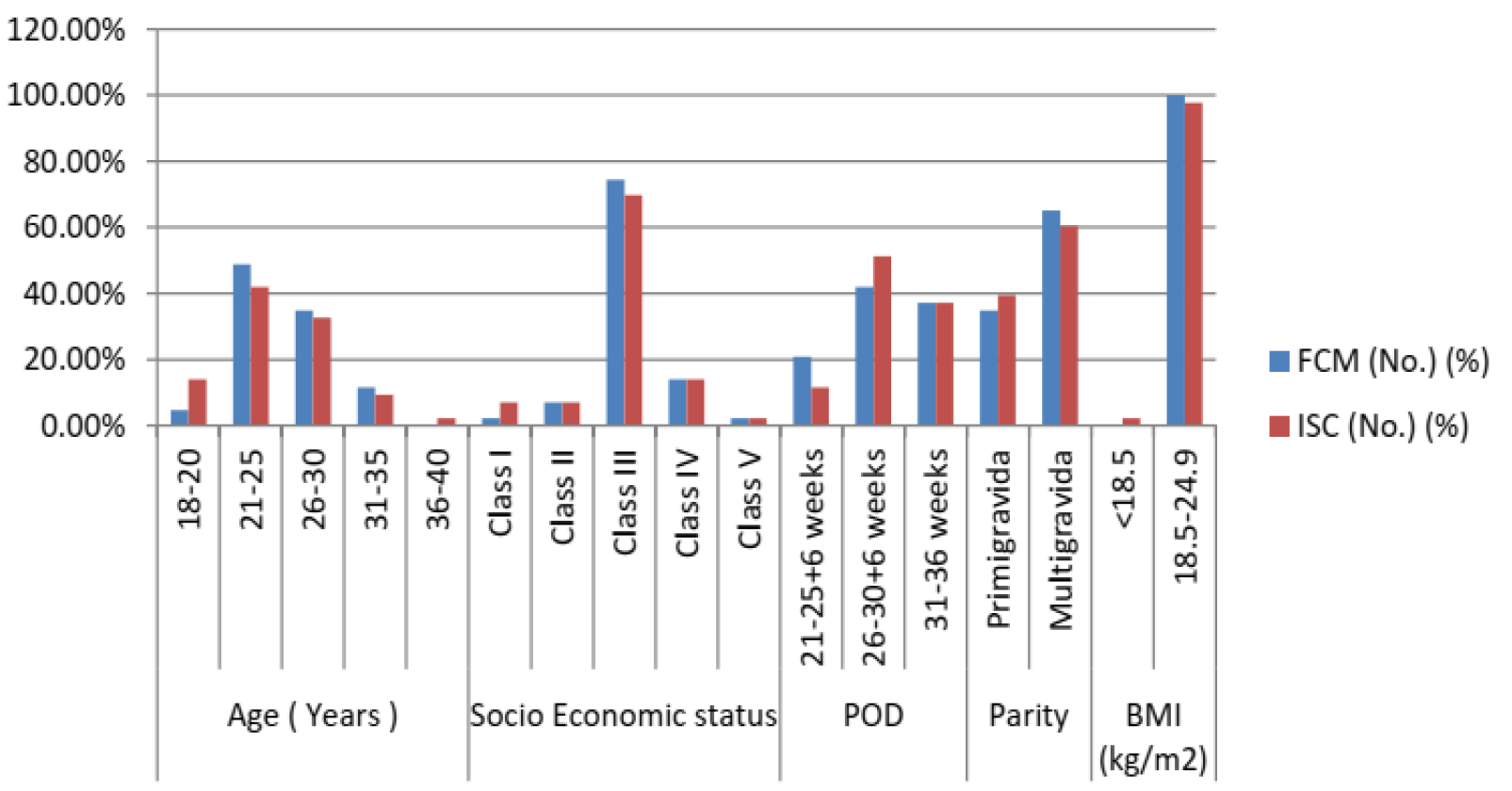
In group A, there were 2 participants in 18 - 20 years of age group, 21 participants in 21 - 25 age group, 15 participants in 26 - 30 age group and 5 participants in 31 - 35 age group. In group B, there were 6 participants in 18 - 20 years age group, 18 participants in 21 - 25 years of age group, 14 participants in 26-30 age group, 4 participants in 31 - 35 age group and 1 participant in 35 - 40 age group. It was observed that maximum subjects were in the age group of 21-25 years in both the groups.
In group A, 9 participants were in the period of gestation between 21 to 25+6 weeks, 18 participants between 26 to 30+6 weeks and 16 participants between 31 to 36 weeks.In group B, 5 participants were in the period of gestation 21 to 25+6 weeks, 22 participants between 26 to 30+6 weeks and 16 participants between 31 to 36 weeks. In our study 41.9% of the subjects in group A and 51.2% of the subjects in group B were between the period of gestation 26 to 30+6 weeks.
Among parity distribution, 65.1% belonged to multigravida and 34.9% belonged to primigravida in group A. Whereas 60.5% belonged to multigravida and 39.5% belonged to primigravida in group B.
In group A, only 1 participant belonged to class I, 3 participants belonged to class II, 32 participants belonged to class III, 6 participants belonged to class IV while 1 participant belonged to class V.In group B, 3 participants each belonged to class I and II, 30 participants belonged to class III, 6 participants belonged to class IV whereas only 1 participant belonged to class V. It was observed that maximum subjects in both the groups belonged to class III (lower middle class) according to modified Kuppuswamy scale (74.4% in group A and 69.8% in group B).
In group A all the subjects were having normal BMI (between 18.5 - 24.9 kg/ m2). Whereas in group B, only 1 subject was underweight (BMI < 18.5 kg/m2) and rest of the subjects were having normal BMI.
All the subjects included in group A received a single dose of 1000 mg FCM. Out of 43 participants in group B, 25.6% received dose of ISC between 801 - 850 mg. The mean dose of ISC was 831.26 mg.
In group A the mean value of baseline total iron binding capacity was found to be 491.85 ug/mL In group B, the mean value of baseline total iron binding capacity was found to be 493.460 ug/dL .The baseline variables that is mean total iron binding capacity (p value = 0.687) were comparable in group A and B.In group A, the mean total iron binding capacity at 2 and 4 weeks post infusion was 387.48 ug/dL and 335.88 ug/dL respectively. In group B, the mean total iron binding capacity at 2- and 4-weeks post infusion was 410.6 ug/dL and 380.5 ug/dL respectively.
Both the study groups observed a fall in total iron binding capacity following treatment with intravenous iron therapy. At 4 weeks of follow up there was a significant fall in total iron binding capacity in those subjects who were treated with ferric carboxymaltose compared to iron sucrose (155.97 ug/dL versus 112.92 ug/dL respectively). The difference between the two groups was statistically significant with p value <0.001.
Figure 1: Comparison of Socio-demographic variables in both groups
Table 1: Dose of Ferric Carboxymaltose and Iron Sucrose
Dose of FCM
Frequency (No.)
Proportion
1000 mg
43
100.0
Dose of ISC
650 - 700 mg
1
2.3
701 - 750 mg
7
16.3
751 - 800 mg
6
14.0
801 - 850 mg
11
25.6
851 - 900 mg
8
18.6
901 - 950 mg
6
14.0
951 - 1000 mg
2
4.7
1001 - 1050 mg
2
4.7
Total
43
100.0
Mean Dose of ISC
831.26 mg
Table 2: Change in Total Iron Binding Capacity in Group A And B
Parameters
Group A (FCM)
Group B (ISC)
P. Value
Baseline TIBC
491.8±17.9
493.4±19.0
0.687
TIBC at 2 weeks
387.48
410.616
<0.001
TIBC at 4 weeks
335.88
380.540
<0.001
p value < 0.001 (significant)
Table 3: Independent T-Test for comparison between two groups
Parameters
Gp Code
Mean
Std. Deviation
Std. Error Mean
Diff_TIBC_4wk
A
-155.97
21.504
3.279
B
-112.92
18.036
2.750
Independent T-Test for comparison between two groups
Gp A v/s Gp B
F
t
Sig. (2-tailed)
Mean Difference
Std. Error Difference
95% Confidence Interval of the Difference
Lower
Upper
Diff_TIBC_4wk
1.679
-10.057
<0.001
-43.044
4.280
-51.556
-34.533
DISCUSSION
Iron deficiency anemia is characterized by increase in total iron binding capacity.In the present study the subjects after treatment with intravenous ferric carboxymaltose and iron sucrose were followed up at 2 and 4 weeks.
In the present study the baseline value of TIBC was comparable in group A and group B. On follow up at 4 weeks the fall in TIBC in group A was 155.97 ug/dL and in group B was 112.92 ug/dL. The difference between the two groups was statistically significant (p value <0.001). Naqash [6] reported a statistically et al.,significant fall in TIBC in subjects treated with ferric carboxymaltose as compared to iron sucrose (142.81 ug/dL and 141.58 ug/dL respectively). Whereas Jose et al., [7] followed up patients at 3 weeks post infusion and found non-significant fall in TIBC in FCM group when compared to ISC group.
CONCLUSION
Both the study groups observed a fall in total iron binding capacity following treatment with intravenous iron therapy. At 4 weeks of follow up there was a significant fall in total iron binding capacity in those subjects who were treated with ferric carboxymaltose compared to iron sucrosethus providing a better treatment response.
REFERENCE
Milman, N. “Iron and Pregnancy—A Delicate Balance.” Annals of Hematology, vol. 85, no. 9, September 2006, pp. 559–565.
Bothwell, T.H. “Iron Requirements in Pregnancy and Strategies to Meet Them.” The American Journal of Clinical Nutrition, vol. 72, no. 1, July 2000, pp. 257S–264S.
Indian Council of Medical Research. Evaluation of Nutritional Anaemia Prophylaxis Programme: Task Force Study. New Delhi, 1989, www.icmr.nic.in/ sites/default/files/icmr_bulletins/bufeb00.pdf.
Ezzati, M. et al. Comparative Quantification of Health Risks: Global and Regional Burden of Disease Attributable to Selected Major Risk Factors. World Health Organization, 2004.
Milman, N. “Serum Ferritin in Healthy Danes: Relation to Marrow Haemosiderin Iron Stores.” Danish Medical Bulletin, vol. 30, 1983, pp. 115–120.
Naqash, A. et al. “Effectiveness and Safety of Ferric Carboxymaltose Compared to Iron Sucrose in Women with Iron Deficiency Anemia: Phase IV Clinical Trials.” BMC Women’s Health, vol. 18, no. 1, December 2018, pp. 1–10.
Jose, A. et al. “Comparison of Ferric Carboxymaltose and Iron Sucrose Complex for Treatment of Iron Deficiency Anemia in Pregnancy—Randomised Controlled Trial.” BMC Pregnancy and Childbirth, vol. 19, no. 1, December 2019, pp. 1–8.
Recommended Articles
Research Article
Pink Perspectives: Unveiling Conjunctivitis Awareness in Himachal Pradesh - A Comprehensive Study on Types, Symptoms, Prevention, and Treatment among the General Population
Sumit Kumar,
Prabhleen
Published: 14/12/2023
Download PDF
Research Article
A cross sectional study to evaluate the Correlation between Clinically Significant Macular Edema (CSME) with different Biochemical Parameters among Patients of Type 2 Diabetes Mellitus Present at Ophthalmology OPD of Tertiary Care Center
Punam ,
Vinod Kashyap
Published: 10/10/2022
Download PDF
Research Article
Silent Growths: Assessing Knowledge of Bone Tumors in Children among Hamirpur's General Public
Swati Chandel,
Vishal Dhatwalia
Published: 19/11/2024
Download PDF
Research Article
Implementation of Patient Safety Culture with Work Motivation of Indonesian Nurses in Homes In The Kuwait Region
Roganda Situmorang,
Andri Nurmansyah
Published: 22/12/2023
Download PDF
PO Box 101, Nakuru
Kenya.
Email: office@iarconsortium.org
Editorial Office:
J.L Bhavan, Near Radison Blu Hotel,
Jalukbari, Guwahati-India
Thakur, A., Dhiman, B., Sood, N., Sharma, S. & Sood, S. (2022). Comparison of Change in the Total Iron Binding Capacity after Intravenous Ferric Carboxymaltose and Iron Sucrose in the Treatment of Iron Deficiency Anemia in Pregnancy. IAR Journal of Health Care and Prevention, 2(2), 1-4.
MLA
Thakur, Ankita, et al. "Comparison of Change in the Total Iron Binding Capacity after Intravenous Ferric Carboxymaltose and Iron Sucrose in the Treatment of Iron Deficiency Anemia in Pregnancy." IAR Journal of Health Care and Prevention 2.2 (2022): 1-4.
Chicago
Thakur, Ankita, Bishan Dhiman, Nishi Sood, Sudarshan Sharma and Sidharath Sood. "Comparison of Change in the Total Iron Binding Capacity after Intravenous Ferric Carboxymaltose and Iron Sucrose in the Treatment of Iron Deficiency Anemia in Pregnancy." IAR Journal of Health Care and Prevention 2, no. 2 (2022): 1-4.
Harvard
Thakur, A., Dhiman, B., Sood, N., Sharma, S. and Sood, S. (2022) 'Comparison of Change in the Total Iron Binding Capacity after Intravenous Ferric Carboxymaltose and Iron Sucrose in the Treatment of Iron Deficiency Anemia in Pregnancy' IAR Journal of Health Care and Prevention 2(2), pp. 1-4.
Vancouver
Thakur A, Dhiman B, Sood N, Sharma S, Sood S. Comparison of Change in the Total Iron Binding Capacity after Intravenous Ferric Carboxymaltose and Iron Sucrose in the Treatment of Iron Deficiency Anemia in Pregnancy. IAR Journal of Health Care and Prevention. 2022 Jul;2(2):1-4.


 Download PDF
 Download XML