This study aims to look at the causes of COVID-19 vaccine hesitancy in Bangladesh by examining the cultural and religious values, lack of trust, misinformation, and fear of side effects as predictors of vaccine hesitancy. Self-developed measurement items, developed based on the expert's opinion, were used to accomplish the objective. Data was gathered from 268 respondents who represented their community through both an online and a physical survey. SPSS version 25 was used to optimize descriptive statistics. Besides, SmartPLS 3.0 was used to examine the hypotheses using the PLS-SEM approach. The study confirms that lack of trust, misinformation and fear of side effects all play a role in vaccine hesitancy. Besides, the results have many significant implications for public health policymakers, vaccine manufacturers and distributors, and the media. Besides that, the study proposes some new research avenues for overcoming this study's limitations and gaining more detailed information on the topic.
The COVID-19 pandemic has just drastically made the normal ways of living in the world quite vulnerable. The first human infection with the SARS CoV-2 novel coronavirus (COVID-19) was found in Wuhan, China in December 2019. In just a few months, the virus spread throughout the world exploding into a worldwide public health emergency [1]. As of 22 March 2021, globally, there have been 123,419,065 confirmed cases of COVID-19, comprising 2,719,163 deaths [2].
From the very beginning of the outbreak of COVID-19 as a pandemic, the world is experiencing an ever-increasing and alarming rate of confirmed cases and death. Consequently, plausible efforts have been devoted to reduce the infection and death rate and to alleviate the socio-economic influence of the pandemic [3]. Though physical distancing and wearing mask were being somewhat effective in abating the infections [4], this non-medical strategy is working at a huge cost due to downsized economic interactions [5]. Boosting up the percentage of individuals who are safe through vaccination would be an enduring way of facing the ever-increasing challenge of COVID-19, [4]. Therefore, significant efforts were invested to formulate effective and medically safe vaccines by some pharmaceuticals and the scientific society [3,6]. As a result of consistent efforts from the medical science community and after a long-tenured trailing process, in November 2020, Pfizer-BioNTech 2 and Moderna 3 claimed that their much-awaited vaccines resulted in over 90% effectiveness, thus having a swift development and emergency approval in December 2020 [7]. However, the effectiveness of the vaccination program against COVID-19 is not simply a function of the vaccine’s working efficiency and indemnity, over and above; the rate of vaccination coverage also seems to be a crucial factor for curving down the pandemic [3].
A vaccine has always been regarded as one of the most cost-effective and most critical ways of rooting out or curving down the existence of widely spread and devastating diseases [8]. However, the inception of a vaccine does not necessarily achieve its intended outcomes as there exists a term called ‘vaccine hesitancy’, a major impediment towards the COVID-19 vaccination [3,9]. Vaccine hesitancy refers to a tendency of being sceptical or distrustful about the advantages of vaccines and questioning their importance [10]. WHO has acknowledged vaccine hesitancy as one of the top issues to global public health [11].
A literature review regarding the COVID-19 vaccine acceptance rate found that the vaccination rate ranges from a highest of 97.0% to a lowest of 23.6% throughout the world, with an approximate acceptance rate of 14% in Bangladesh (based on government policy), which ultimately motivates to study the underlying causes of such a hesitancy toward vaccination [12].
Several studies have been conducted throughout the world regarding COVID-19 vaccine hesitancy [4,8,13-18]. In Bangladesh, Ali & Hossain has conducted a study to evaluate the status of COVID-19 vaccine hesitancy to have an idea about the subgroups with a higher level of hesitancy [19]. Besides, the consciousness of the community, their sentiment and cognition regarding COVID-19 vaccinations in Bangladesh is one of the reasons for vaccine hesitancy [20]. In addition to this, the progress of vaccine uptake in Bangladesh and the affiliated driving forces on the possibility of vaccine acceptance [21].
However, to the best of our knowledge, no study in Bangladesh has been undertaken to evaluate the influences of cultural and religious values, trust on government and vaccine suppliers, fake news and misinformation and peoples’ perceived side effects on vaccine hesitancy. Therefore, the objective of the current study is to evaluate whether these mentioned factors have any impact on vaccine hesitancy in Bangladesh. Besides, we would like to provide some recommendations for decreasing the level of hesitancy to boost up vaccine acceptance in Bangladesh.
Bangladesh is a densely populated, emerging, and lower-middle-income economy about 20.5% of people live in poverty and 6% of them are in extreme poverty [22], it is expected that it will undergo severe consequence of the COVID-19. Empirically, as of 22 March 2021; there have been 570,878 verified cases of COVID-19 with 8,690 deaths in Bangladesh [2], which indicated a to some extent better condition than expected but days are getting worse in April again. However, a huge number of workers, especially those who are working with the private and SME sector either have lost their jobs or have experienced a decrease in their income. Moreover, the educational institutions in Bangladesh are struggling to adapt to online education [23] and the problems of this sector are further fuelling the unemployment problem of the country.
In such a situation, the country must keep the virus infection rate under control. For this, the current vaccination program initiated by the government should be carried out smoothly. However, the number of vaccine uptake per day was about 230,000 in the second week of the government’s commencement vaccination program in Bangladesh, but the uptake decreased to about 150,000 per day by March 15 while infections are increasing tremendously again [24]. As vaccine hesitancy exists all over the world, Bangladesh is experiencing the same. However, if it continues, then the situation may become more devastating. In this regard, this investigation will evaluate the underlying forces of vaccine hesitancy in Bangladesh. Besides, we would like to recommend some prospective actions for the policymakers to ensure vaccine acceptance and to control and rooted out disastrous pandemic to ensure a normal life for mass people.
Literature Review and Hypothesis
Vaccine Hesitancy: For decades, the existence of once widely spread and devastating diseases had been rooted out or substantially diminished through vaccination. Besides, vaccines have brought about enormous benefits and great relief for mankind [8]. WHO estimates that about 2-3 million deaths per annum are being prevented through vaccination programs throughout the world and it can avoid another 1.5 million deaths if vaccination coverage can be extended [4,8,11]. Historically, protecting the people from low-earning regions of the world was one of the challenges to extend vaccination coverage [25]. However, over time medical sciences have developed significantly and the availability of vaccines have been increased immensely [8]. However, in the last two decades, vaccine hesitancy has emerged as a threat to global public health [25].
Vaccine hesitancy has been defined by the World Health Organization Strategic Advisory Group of Experts (WHO SAGE) working group as the "delay of acceptance or refusal of vaccination despite the availability of vaccination services" [11]. Vaccine hesitancy has been indicated as the percentage of people who believe vaccination is unimportant, unsafe, and ineffective [26]. Despite the availability of a vaccine, people of a country may be reluctant or confused to be vaccinated due to several reasons. Vaccine hesitancy is defined as “refusal to vaccinate, delaying vaccination, accepting vaccines but remaining uncertain about their safety, or using vaccines only selectively” [27]. Vaccine hesitancy has been recognized as one of the top ten impedances to global public health [11] which has been appeared as a critical public health issue directing to the manifestation of pestiferous infections [28].
WHO reported that multiple critical factors causing vaccine hesitancy including the lower level of trust in the vaccine or healthcare personnel, ignorance of the necessity of the vaccine [29]. Though vaccination is considered an effective way of restraining infections and lessening the mortality of many communicable diseases, vaccine hesitancy is curtailing the efforts of the vaccination programs [4]. Vaccine hesitancy has been considered a hindrance to boosting up vaccination coverage and abating the outbreak of vaccine-preventable diseases [8].
Cultural and Religious Values and Vaccine Hesitancy
Culture is referred to as “the shared basic assumptions, values, or beliefs of a group” [30]. Religious values are the views and rituals shared by a group of religious adherents [31]. Religious and cultural issues are often noted to be the contributor to vaccine hesitancy [32]. Several spiritual and religious groups believe that diseases and illness are the wills of God and no vaccination is required to get rid of them. Practised religions did not prohibit vaccination in any way [33]. However, people from different religions and beliefs raised questions on the Halal accreditation of vaccines [32]. Even it was evident that parents refused vaccination due to religious justifications [34]. Household members, peer groups or Religious leaders are nurturers who can influence an individual's decision to take a vaccine [35], it may be applicable for COVID 19 vaccine also. Specifically, in Asian countries, culture and religion play significant roles regarding vaccination decision [36].
H1: Cultural and religious values is positively related to vaccine hesitancy
Lack of Trust and Vaccine Hesitancy
Mistrust has been defined in the Cambridge Dictionary as “to have doubts about the honesty of someone or be unable to trust something”. Mistrust has also been defined as “an active state of uncertainty about whether a source or its assertions are to be believed” and “a cognitive or emotional trait of a person, associated with being habitually suspicious, doubtful, or sceptical” [27] Literature disclosed that some studies have examined the link between lack of trust, mistrust and vaccine hesitancy [15,27,37,38]. During this pandemic, vaccine hesitancy is being boosted up due to distrust in vaccines and in governments, where trust is considered as the key driver of vaccine hesitancy [15]. Besides, lack of trust can be the most critical driving force to vaccine hesitancy [29]. Misconceptions regarding immunity, agitation regarding the swift inception of vaccine, and a conviction that the virus is a biological weapon are fuelling vaccine hesitancy [15].
While studying parental vaccine hesitancy, Reuben found the level of trust and confidence in medical sciences are the most crucial indicators of vaccine hesitancy [38].
Some studies reported that vaccine hesitancy is fuelled by people's beliefs concerning the government's opaque policies [37,39] and the government’s intimacy with the vaccine manufacturers [37,40] or hiding the information on the side effects, and due to the lower level of trust in the pharmaceutical companies for their appetency toward profit maximization as well as due to the lack of credibility regarding the safety claims of the vaccines [37,41].
Mistrust has been evident as the most critical driving forces for vaccine refusal [42]. Specifically, the lack of trust in government, healthcare authorities, medical consultants, and pharmaceuticals are the underlying reasons [43]. Besides, “confidence in vaccines depends on trust in healthcare professionals, healthcare system, science and on socio-political context” [44]. Comparably, the belief in healthcare boosts the rate of vaccine acceptance [45]. “Hesitancy against the COVID-19 vaccine was high due to mistrust in the medical establishment” [46].
H2: Lack of trust is positively related to vaccine hesitancy
Misinformation and Vaccine Hesitancy
Misinformation on different aspects of media has been apparent to be one of the crucial contributing factors to vaccine hesitancy [47]. The SAGE task force on vaccine hesitancy has indicated that vaccine acceptance could be adversely affected by faulty or superfluous communication [11]. Misinformation has been defined by Oxford Lexico Dictionary as “false or inaccurate information especially that which is deliberately intended to deceive”. Traditional media and social media can have both negative or positive contribution regarding the conceptions towards vaccines and can create a manifesto for key opinion leaders to influence others [47]. Indeed, users of social media can easily and freely express their opinions and experiences through social media and thus can influence others’ conceptions in favour of or against vaccine [47,48].
Vaccine anxiety is accelerated by misinformation circulated by anti-vaccine groups and social media [28]. In several studies, the propagation of misinformation and fake news has been indicated as a significant source of vaccine hesitancy [12,49,50].
Even, parents have been found reluctant to vaccinate their children due to adverse media coverages [51] and having heard about the existence of problems in the vaccines [52]. Falsified and unrealistic information related to health issues floating online can influence the decision of the people who somehow rely on online social media for health care issues [53]. Currently, misinformation about COVID-19 is a severe threat to world health issues. People’s self-reported justification and recommendations to COVID-19 related health guidelines and vaccination might adversely impact vaccine uptake [1].
H3: Misinformation is positively related to vaccine hesitancy
Fear of Side Effects and Vaccine Hesitancy
The Oxford dictionary defines side effects as extra and usually bad effects of a drug. Common side effects of the COVID-19 vaccine involve tiredness, headache, muscle pain, chills, fever, and nausea [54]. Literature indicates that vaccine safety issues are one of the leading reasons for vaccine hesitancy in the case of COVID 19 in the US [55]. Empirically, caregivers do not vaccinate their children when they are afraid of side effects [57] same case may happen in the case of COVID 19. An investigation conducted in France indicated that people intended to refuse the COVID vaccine because the vaccine might have excessive side effects or may not be safe as it was developed hurriedly [44,58].

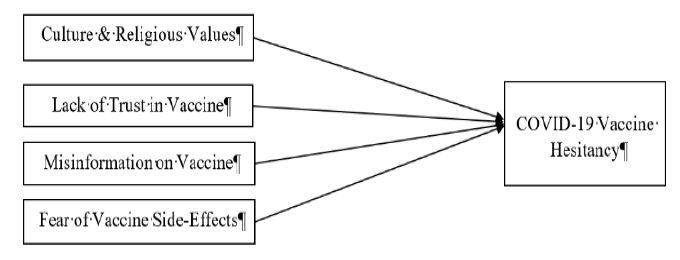
Figure 1: Research Framework
H4: Fear of side effects is positively related to vaccine hesitancy
From the discussion above, we propose the following research framework (Figure 1).
Participant Characteristics
As the authority to a developing nation, the Bangladesh government has faced tremendous challenges in ensuring vaccination to protect its mass communities from the COVID-19 outbreak. One of the main reasons behind these challenges was that people are not knowledgeable and not enough conscious to accept the vaccine. Also, the societies of Bangladesh are strongly based on religious and cultural values. Though the government has initiated to start vaccination against COVID-19 on 07 February 2021, many people were not interested to get vaccinated. Initially, the vaccine was offered to people over 60 years of age and people who worked as front-liners to fight against the COVID-19. Here, front-liners include Medicare employees, journalists, employees from some specific ministries and or administrative positions as well as the elected representative who must work in close contact with mass people. However, the government has announced that phase by phase everyone will be vaccinated. But from the very first day of vaccination, it was surprisingly noticed that many people are not interested in the vaccination program. Then the vaccination program remains questionable in terms of vaccine hesitancy. Therefore, we would like to know why people are not interested in vaccination program against COVID-19 whereas Coronavirus is considered a deadly virus causing the death of thousands. Hence, in this study we consider people from all spheres of life to present their opinion on why they feel hesitant to take the vaccine which is potentially a lifesaving remedy.
Research Setting and Process
This is cross-sectional research in nature, as it has accumulated data at a particular point in time, exclusively the COVID-19 pandemic. An online survey technique was adapted, and a virtual survey form was created using Google Forms Services. The questionnaire was initially designed in English and then translated into Bengali by a veteran translator. Therefore, both English and Bengali were used as the language of the survey simultaneously. The online form was circulated through direct emails to some personal contacts. Besides, to receive feedback from the mass people the survey form was circulated to social networking sites. Since people from all walks of life do not have equitable access to the internet, in addition to the online survey, we launched a paper-based survey in various communities across the country. However, participation in the survey was voluntary.
The government of Bangladesh (Ministry of Health & Family Welfare) has scheduled the commencement of the vaccination program on 7 February and has inaugurated the vaccination program on the same day. However, the authority has been proclaiming the vaccination program since January 2021. The data collection was completed between 1 February 2021 and 07 March 2021. We consider this time as the ideal timeframe to collect data as it provides us with the opportunity to recognise the reactions of mass people towards the vaccine before the commencement and during the campaign. A total of 183 thoroughly completed online questionnaires were returned from respondents representing urban and rural communities around the country. However, 3.83 per cent (n = 07) of the online responses were discarded by the researchers due to replication that may have caused by network failures at the time of submission by the respondents. On the other hand, 225 hard copies of the questionnaire had been distributed in multiple regions, 104 of which have been received. The response rate for the physical questionnaire was 46.22%. Ten incomplete responses were removed. Besides, several bias responses (straight-liner) have also been discarded. Overall, 5.78% of the answers were exempted. Finally, 268 thoroughly and accurately completed answers were considered in the final assessment.
Measurement Tools
The first part of the questionnaire comprised of demographic profile, specifically, gender, residential area, education, and age. The second section of the questionnaire contained items for both the dependent and independent variables. To measure Cultural and Religious values, Misinformation, Lack of Trust concerning the COVID-19 vaccine we have developed four, five and five items consecutively. Besides, to assess the Fear of Side Effects of the vaccine we have used four items, which have been developed based on the ideas from Wu et al. Finally, we have used seven self-constructed items to measure our final construct COVID-19 Vaccine Hesitancy. These items were developed based on the common misinformation identified and discussed in several national and international newspapers and television channels. Besides, we observed common people perception of the issue. Also, we have consulted two academicians from a social science background to provide feedback during questionnaire development. Moreover, we have also consulted two senior medical officers from AMC (Army Medical Corps) of CMH (Combined Military Hospital), Chattogram to cooperate with us in developing the questionnaire so that the items have the face and content validity. One of the significant aspects of our questionnaire items is that we focused on capturing data from the community perspectives from the individual respondents. The potential participants were requested to provide their valuable feedback to all the survey items on a 5-point Likert Scale, ranging from 1- strongly disagree, to 5- strongly agree. The measurement items are available in Table 2.
Descriptive statistical analysis was conducted using the application SPSS version 23. Besides, SmartPLS3 was utilized for the partial least squares (PLS) path modelling to assess both the measurement model and the structural model.
Profile of The Respondents
Table 1 represents the demographic profile of the participants (N = 268). 33.20% (n = 89) of the respondents were female and 66.80% (n = 179) were male. Among them 63.81% were married (n = 171) and 33.58%(n = 90) were unmarried. 64.6% (n = 173) of the participants were from urban areas, and 35.4% (n = 95) were from rural areas. 41.8% of respondents (n = 112) have completed their masters and higher studies, 36.2% of them have completed their graduation (n = 97), 14.9% of them have completed their Higher School Certificate (HSC) degree.
Here, (n = 37) were from 31-40 years of age, and 13.4% (n = 36) were from 41-50 years of age. 34.0% were student (n = 91), 24.6% from government services (n = 24.6), 14.6% from private sectors, and 13.4% were unemployed (Table 2).
Measurement Model
Convergent validity was examined by calculating the loadings of the items of the considered variables and the AVE- average variance extracted. From Table 3, all the items’ loading scores were higher than the standard 0.50 [59]. Though, to reach the final desired AVE, one item (LT1) from the Lack of Trust (LT) construct and two items (VH4, VH5) from the Vaccine Hesitancy (VH) construct had been deleted on account of insufficient loadings. The AVEs for Culture & Religious Value (CRV), Lack of Trust (LT), Misinformation on Vaccine (MI), Perceived Side Effects (PSE), and Vaccine Hesitancy (VH) were 0.627, 0.557, 0.573, 0.614, and 0.553 separately. Consequently, the measurements employed exhibited a satisfactory level of convergent validity, since the corresponding AVE of the constructs was above 0.50 [60,61].
Besides, the scores of Composite Reliability (CR) fluctuated from 0.832 to 0.870 and were better than the advocated cut-off score of 0.70 [62]. Cronbach’s alpha (CA) signifies the internal reliability at the item-level of a construct. Here, the CA values for each of the constructs were superior to the threshold level is 0.70 thus indicating a good level of reliability [59]. Also, Dijkstra–Henseler's indicator (rho_A) were greater than the cut-off value of 0.70. Therefore, the reliability standards] were satisfied at the item as well as construct level [63] (Table 4).
The discriminant validity, which is the degree to which each construct is different from others [59]. Evaluating this, intercorrelations between measurements of hypothetically overlapping structures were examined, see Table 5. The strength of association between the variables (the diagonal components specifying the square root of AVE) was significantly higher than the correlational values between the other variables (elements in off-diagonal). Consequently, a decent level of discriminant validity was revealed [64]. The items cross-loadings were also evaluated and discovered to be suitable in terms of the discriminant validity of the instruments, resulting in satisfactory discriminant validity for all constructs.
The Heterotrait-Monotrait ratio of correlations (HTMT) is a comparatively new technique to evaluate discriminant validity in Structural Equation Modelling [60]. To assess discriminant validity applying HTMT, a threshold score of 0.85 has been recommended [63,65]. Thus, the constructs appease the threshold, as the score of HTMT is <0.85, and as presented in Table 5. In short, all the constructs prove ardent validity and reliability.
Structural Model Evaluation
The structural model coefficients for the relationships between the variables were estimated using a sequence of regression equations. Collinearity must be tested when analysing structural relationships to make sure that there is no bias in the regression results; The Variance Inflation Factor (VIF) is frequently used to assess exogenous construct collinearity [63]. A cut-off score of 5.0 for VIF, whereas later advised that VIF values should be around 3, and the lower scores are desired [63]. Here, the VIF values found for every construct were very close to 3 and below the threshold score of 5.0 and confirmed that the collinearity problem concerning the constructs was not present.
Table 1: Demographic Profile of Respondents
| Variables | F | % | Variables | F | % |
| Gender | Residential Area | ||||
| Male | 179 | 66.8 | Urban area | 173 | 64.6 |
| Female | 89 | 33.2 | Rural area | 95 | 35.4 |
| Profession | Age Group | ||||
| Government Service | 66 | 24.6 | 20 or Less | 19 | 7.1 |
| Student | 91 | 34.0 | 21-30 Years | 157 | 58.6 |
| Private Service | 39 | 14.6 | 31-40 Years | 37 | 13.8 |
| Business/Entrepreneur | 12 | 4.5 | 41-50 Years | 36 | 13.4 |
| Unemployed | 36 | 13.4 | Above 50 Years | 19 | 7.1 |
| Housewife | 24 | 9.0 | Education Level | ||
| Marital Status | Masters and above | 112 | 41.8 | ||
| Married | 171 | 63.81 | Honours/ Graduation | 97 | 36.2 |
| Unmarried | 90 | 33.58 | HSC | 40 | 14.9 |
| Prefer not to say | 07 | 2.61 | Below HSC | 19 | 7.1 |
Table 2: Responses to Individual Questionnaire Items
| Items | Description of items | Strongly Disagree | Disagree | Neutral | Agree | Strongly Agree |
| Culture and Religious Values (CRV) | % | % | % | % | % | |
| CRV1 | Religious opinion leaders of my community (Mulla, priest, father of church, sage, and monk) discouraging us to take the COVID-19 Vaccine | 20.5 | 21.3 | 23.1 | 25.0 | 10.1 |
| CRV2 | My religion does not support vaccination (vaccination is haram) | 26.5 | 11.9 | 13.1 | 33.6 | 14.9 |
| CRV3 | People of my community believe that the potential COVID-19 vaccines contain elements that do not comply with their religious principles | 20.1 | 14.9 | 19.0 | 35.4 | 10.4 |
| CRV4 | People in my community are not interested in any vaccination programs. | 8.6 | 21.6 | 27.2 | 34.3 | 8.2 |
| Misinformation on Vaccine (MI) | ||||||
| MI1 | People in my community spreading suspicious news that the potential COVID-19 vaccination program is a trial. | 9.3 | 16.8 | 32.1 | 31.3 | 10.4 |
| MI2 | People in my community believe that the information they receive about vaccines from the vaccine program is not reliable and trustworthy. | 7.1 | 15.3 | 25.7 | 38.4 | 13.4 |
| MI3 | People in my community believe that the uptake of the vaccine may lead to infertility in women. | 22.8 | 20.9 | 26.5 | 22.8 | 7.1 |
| MI4 | People in my community believe that the taking of vaccine may lead to autism | 18.7 | 15.3 | 26.9 | 32.8 | 6.3 |
| MI5 | People of my community believe that the vaccination program is a strategy designed to spoil religious value by Jewish | 21.3 | 19.0 | 18.3 | 35.1 | 6.3 |
| Lack of Trust (LT) | ||||||
| LT1 | People in my community have less faith in government vaccination program and policies on COVID-19 Vaccination. | 4.9 | 16.4 | 19.0 | 44.4 | 15.3 |
| LT2 | People in my community have less faith in manufacturer organizations of COVID-19 Vaccine. | 1.9 | 11.9 | 23.5 | 48.9 | 13.8 |
| LT3 | People in my community have less faith in the private supplier organizations of COVID-19 Vaccine. | 1.5 | 7.8 | 19.4 | 49.3 | 22 |
| LT4 | People in my community have less confidence in the existing medical services on proper preservation, distribution, and vaccination. | 2.6 | 10.8 | 19.8 | 51.1 | 15.7 |
| LT5 | People in my community have less trust in journalists regarding their news on COVID-19 | 5.2 | 15.3 | 23.1 | 38.4 | 17.9 |
| Perceived Side Effects (PSE) | ||||||
| PSE1 | People in my community are scared of the vaccine’s side effects. | 4.1 | 17.9 | 25.4 | 30.6 | 22.0 |
| PSE2 | People in my community are willing to be vaccinated for coronavirus, provided that injections are safe and effective. | 6.7 | 16.0 | 16.0 | 36.9 | 24.3 |
| PSE3 | People in my community perceive that the potential COVID-19 vaccine may lead to serious illness. | 4.5 | 18.7 | 24.6 | 41.8 | 10.4 |
| PSE4 | People in my community perceive that the potentials COVID-19 vaccines have severe side effects than other vaccines. | 14.2 | 17.9 | 22.4 | 32.5 | 13.1 |
| Vaccine Hesitancy (VH) | ||||||
| VH1 | Most of the people in my community believe that getting the COVID-19 vaccine is not a good way to protect themselves from Coronavirus. | 15.3 | 23.1 | 22.8 | 28.0 | 10.4 |
| VH2 | They feel uncomfortable getting vaccinated of COVID-19 | 9.3 | 17.5 | 25.4 | 37.7 | 10.1 |
| VH3 | They are concerned about the serious adverse effects of COVID-19 vaccines | 7.1 | 14.6 | 23.9 | 39.9 | 14.6 |
| VH4 | Most of the people in my community believe that the available COVID-19 vaccines are not effective to protect them from Coronavirus. | 6.3 | 11.6 | 19.4 | 45.5 | 16.8 |
| VH5 | The COVID-19 vaccine offered by the government program in my community are not beneficial | 5.2 | 16.8 | 28.0 | 38.4 | 11.6 |
| VH6 | Newly available COVID-19 vaccines carry more risks than an older (established) vaccine. | 6 | 14.9 | 32.1 | 37.3 | 9.7 |
Table 3: Internal Consistency, Convergent Validity and Reliability
| Construct | Item | Outer Loading | AVE | CR | CA α | rho_A |
| Culture & Religious Value (CRV) | CRV1 | 0.892 | 0.627 | 0.870 | 0.836 0.738 | 0.856 |
| CRV2 | 0.728 | |||||
| CRV3 | 0.755 | |||||
| CRV4 | 0.782 | |||||
| Lack of Trust (LT) | LT2 | 0.752 | 0.557 | 0.834 | 0.750 | |
| LT3 | 0.730 | |||||
| LT4 | 0.718 | |||||
| LT5 | 0.785 | |||||
| Misinformation on Vaccine (MI) | MI1 | 0.803 | 0.573 | 0.868 | 0.834 | 0.894 |
| MI2 | 0.839 | |||||
| MI3 | 0.785 | |||||
| MI4 | 0.770 | |||||
| MI5 | 0.554 | |||||
| Perceived Side Effects (PSE) | PSE1 | 0.748 | 0.614 | 0.864 | 0.793 | 0.818 |
| PSE2 | 0.743 | |||||
| PSE3 | 0.800 | |||||
| PSE4 | 0.839 | |||||
| Vaccine Hesitancy (VH) | VH1 | 0.711 | 0.553 | 0.832 | 0.731 | 0.737 |
| VH2 | 0.820 | |||||
| VH3 | 0.723 | |||||
| VH6 | 0.716 |
The structural model checks the causal interactions amongst the concepts [66]. In this study, the bootstrapping (resampling = 5000, minimum) procedure was employed to calculate the magnitude of the coefficients [63]. The connections between independent and dependent variables were tested at 0.05 (p<0.05) significance level.
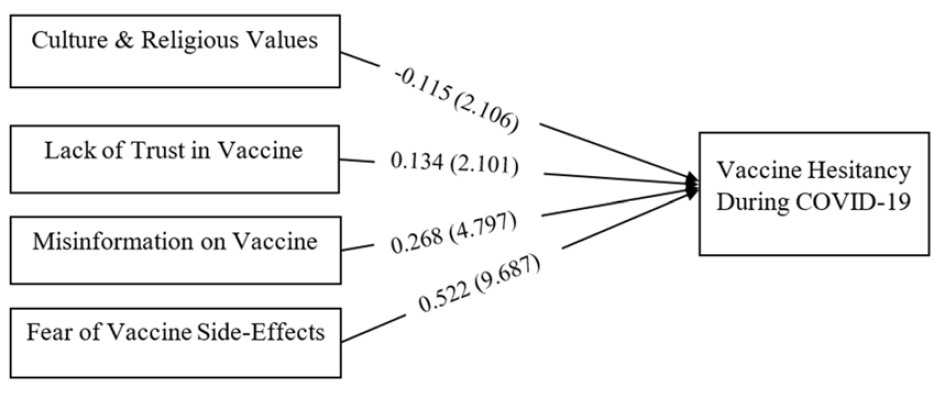
From Table 6 and Figure 2 regarding the relationships, it had been noted that practically all the independent variables had a positive and statistically meaningful association with the dependent variables as assumed, except hypotheses H1 (CRV→ VH). Specifically, CRV (H1: β = -0.115, t = 2.106, p>0.018, BCI LL: -0.219, UL: -0.041) was significantly linked to VH but the relationship is not a positive one.
To report the coefficient of determination (R2) which indicates the ability of the independent variables (e.g., misinformation, lack of trust, fear of side effects and cultural and religious values) to forecast the endogenous variable (vaccine hesitancy) in a research model [62]. In this context, R2 scores of 0.75, 0.50, and 0.25, respectively, can be perceived as significant, moderate, and small [63].
In this study, the R2 of VH- 0.465, which indicates that the predictor variables CRV, LT, MI, and PSE can account for 46.50% of the changes in vaccine hesitancy during vaccination program in Bangladesh (Figure 2). Besides, f2 identifies effect size; the magnitude to which a predictor variable can contribute to the R2 of the exogenous variable [62]. As a general rule, f2 scores higher than 0.35, 0.15, and 0.02 are recommended to depict large, medium, and small effect sizes, respectively [67]. In this investigation, Following Cohen, the relationships between LT → VH (H2: f2 >0.02) and MI → VH (H3: f2>0.02) indicate a small effect. However, PSE → VH (H4: f2 >0.35) represents a large effect size.
Because of self-reported data, there was the chance of Common Method Variance (CMV). Utilizing the Harman single-factor analysis, the first factor was found to be responsible for just 27.47 per cent of the difference, which was less than the cut-off value of 50%, suggesting that CMV didn’t influence the analysis [68].
Table 4: Discriminant Validity Using the Fornell-Larcker Criterion
| Construct | Mean | Std. Dev. | CRV | LT | MI | PSE | VH |
| Culture & Religious Value (CRV) | 2.986 | 1.068 | 0.792 | - | - | - | - |
| Lack of Trust (LT) | 3.645 | 0.732 | 0.441 | 0.746 | - | - | - |
| Misinformation on Vaccine (MI) | 3.004 | 0.818 | 0.562 | 0.418 | 0.757 | - | - |
| Perceived Side Effects (PSE) | 3.379 | 0.913 | 0.161 | 0.415 | 0.276 | 0.784 | - |
| Vaccine Hesitancy (VH) | 3.218 | 0.844 | 0.178 | 0.412 | 0.403 | 0.633 | 0.744 |
The values in italics and bold on the diagonal represent the square root of AVE, while the other entries represent the correlations
Table 5: Assessment of Discriminant Validity Using HTMT
| Parameters | CRV | LT | MI | PSE | VH |
| Culture & Religious Value (CRV) | - | - | - | - | - |
| Lack of Trust (LT) | 0.525 | - | - | - | - |
| Misinformation on Vaccine (MI) | 0.800 | 0.514 | - | - | - |
| Perceived Side Effects (PSE) | 0.309 | 0.525 | 0.289 | - | - |
| Vaccine Hesitancy (VH) | 0.261 | 0.538 | 0.477 | 0.795 | - |
Criterion Discriminant Validity is established at HTMT0.85
Table 6: Structural Model Evaluation for Direct Relations
| H | Relation | Std. Beta | Std. Error | T values | p-values | BCI LL | BCI UL | f2 | VIF | Decision |
| 1 | CRV→ VH | -0.115 | 0.055 | 2.106 | 0.018 | -0.219 | -0.041 | 0.016 | 1.595 | NS |
| 2 | LT → VH | 0.134 | 0.064 | 2.101 | 0.018 | 0.033 | 0.241 | 0.023 | 1.499 | S |
| 3 | MI → VH | 0.268 | 0.056 | 4.797 | 0.000 | 0.181 | 0.366 | 0.086 | 1.580 | S |
| 4 | PSE → VH | 0.522 | 0.054 | 9.687 | 0.000 | 0.419 | 0.599 | 0.417 | 1.239 | S |
“BCI UL: Confidence Intervals Bias-Corrected at Upper Limit”, “BCI LL: Confidence Intervals Bias-Corrected at Lower Limit”, S: Stands for Supported and NS stands for Not Supported.

Figure 2: Structural Model Demonstrating Path Coefficients, R2, and t‐ values
Our results indicated a negative relationship between cultural and religious values and vaccine hesitancy, which is quite opposite to our expectation and the result does not support our hypothesis H1. Empirically, cultural and religious conviction were found contributor to vaccine hesitancy [32,34,36]. However, a probable reason behind this unusual result may be the fact that Bangladesh has been largely successful with various vaccination programs initiated in the past decades. For example, the DPT/PENTA3 vaccine uptake rate in Bangladesh was 92% comparative to the global coverage rate of 84% in 2013 [69]. This success may have contributed to building a favourable culture for future vaccination programs. Our study also reveals that there exists a positive and significant relationship between lack of trust/mistrust and vaccine hesitancy. This result is consistent with previous studies [15,37,39-41,70]. Thus, vaccine hesitancy is being lifted because of distrust in vaccine providers and government, healthcare authorities, medical consultants, and pharmaceuticals. Besides, in Bangladesh, other possible reasons for vaccine hesitancy include misconceptions regarding immunity, agitation regarding the swift inception of vaccine, and a mixed conviction that the virus is a biological weapon. Especially, our findings indicate that people of the country exhibit a mixed attitude toward governmental vaccination program.
Our findings illustrate that misinformation on diverse media in Bangladesh has a positive and significant effect on vaccine hesitation, which supports our hypothesis H2. This result is consistent with notable prior studies [12,25,28,47,48,51,53,71]. Culturally in Bangladesh people rely on the information circulated in traditional and social media irrespective of its authenticity, thus acting as a critical influencing factor in case of vaccine hesitancy. Even, religious and political opinion leaders influence mass people's decisions on social media platforms in Bangladesh. Our result also supports the findings of that misinformation regarding the COVID-19 guide self-reported health guidelines and consent to accept the vaccine and recommending it to the surroundings. COVID-19 vaccine hesitancy might be backed by the fear of side effects [1,17,58]. We discovered the same findings in Bangladesh. The result indicated a positive relationship between fear of side effects and vaccine hesitancy. We are also consistent with [72] and more than 75% of the vaccine-hesitant in the US expressed their concern about vaccine side effects [73].
Our results will assist policymakers in designing proactive policies and strategies to counter the factors that influence vaccine hesitancy. Government agencies (e.g., ICT Ministry and BTRC) in charge of implementing rules and regulations governing the dissemination of information through social media, should develop appropriate plans in this regard.
Authorities can monitor, filter and sorts out misinformation that is being circulated on social media about vaccination. Besides, regulatory bodies can enforce legal actions against the breach. They can take reliable measurements ensuring the circulation of correct and authentic information. Besides, the government must take the requisite steps to convince people about the vaccine's efficacy and the underlying rationales for the agreement with the private pharmaceutical company in charge of vaccine distribution and vaccination. Moreover, healthcare authorities, medical consultants, and pharmaceuticals companies must be more cautious regarding their role to develop morale and belief in them and the COVID-19 vaccine among mass people.
Limitations and Future Research
The study has several downsides; these should be focused on forthcoming research projects. First, the sample size is very small in terms of prospective vaccine candidates, thus the findings of the investigation can hardly be generalized. Second, the vaccination program against COVID-19 is a very new aspect globally, therefore it is normal to take some time for acceptance. Consequently, articulating the future success or failure of such a vaccination program is beyond prediction. Besides, the survey was conducted mostly online, the sample drawn for the study may not represent the actual scenario. Moreover, there have been many television programs, online conferencing, and talk shows on the negative aspects of the vaccination program and vaccine, which may affect individuals' evaluations of the vaccine apart from misinformation only. Finally, the analysis relied on data that was cross-sectional and may not accurately reflect the genuine context. As a result, other research projects should be conducted to escape these weaknesses and to generalize the context. A future study can be conducted considering a relatively greater sample size for context generalizations. Secondly, researchers from other developing countries may have similar studies to find out the other significant predictor of vaccine hesitancy. Thirdly, a separate study could be designed to find the level of hesitancy among urban and rural communities. Finally, the considering of individual characteristics, fear of the coronavirus, demographic profiles, previous vaccine taking experience as moderators in future studies, which could influence the connections amongst these constructs.
The study is the very first initiative to assess the COVID-19 vaccine hesitancy in Bangladesh. Based on the literature and expert’s opinion the researchers identified several influential factors (e.g., misinformation, and perceived side-effects) that might be responsible for such COVID-19 vaccine hesitancy. After analysing the collected data, the researchers discovered that trust, misinformation, and perceived side-effects are the significant factor causing vaccine hesitancy. Based on the findings the research suggested few initiatives that can be taken by policy designers to alleviate COVID-19 vaccine hesitancy in Bangladesh. Further, the researchers provide some guidelines for future researchers to have more investigation to come up with very precise insights for context generalization overcoming the limitations of the current study.
Acknowledgement
We would like to acknowledge two senior medical officers from AMC (Army Medical Corps) of CMH (Combined Military Hospital), Chattogram who cooperated with us in developing the questionnaire for this study.
Conflict of Interest Statement
The authors report no conflict of interest.
Funding
The authors received no fund/grant from any organization to conduct this study.
Availability of Data and Material
The data that support the findings of this research are available on request from the corresponding author. The data are not publicly available due to privacy or ethical restrictions.
Roozenbeek, J., et al. "Susceptibility to misinformation about covid-19 around the World." Royal Society Open Science, vol. 7, no. 10, 2020, pp. 201199.
World Health Organization. "WHO coronavirus (covid-19) dashboard." WHO, 2021, covid19.who.int. Accessed 22 March 2021.
Sallam, M. "COVID-19 vaccine hesitancy Worldwide: A concise systematic review of vaccine acceptance rates." Vaccines, vol. 9, no. 2, 2021, pp. 160.
Kwok, K.O., et al. "Influenza vaccine uptake, covid-19 vaccination intention and vaccine hesitancy among nurses: A survey." International Journal of Nursing Studies, vol. 114, 2021, pp. 103854.
Thunström, L., et al. "The benefits and costs of using social distancing to flatten the curve for covid-19." Journal of Benefit-Cost Analysis, vol. 11, no. 2, 2020, pp. 179-195.
Conte, C., et al. "Vaccines against coronaviruses: The state of the art." Vaccines, vol. 8, no. 2, 2020, pp. 309.
Savoia, E., et al. "Predictors of covid-19 vaccine hesitancy: Socio-demographics, co-morbidity and past experience of racial discrimination." Preprint, 2021, https://doi.org/10.1101/2021.01.12.21249152. Accessed 5 May 2021.
Kennedy, J. "Vaccine hesitancy: A growing concern." Pediatric Drugs, vol. 22, no. 2, 2020, pp. 105-111.
Harrison, E.A., and J.W. Wu. "Vaccine confidence in the time of covID-19." European Journal of Epidemiology, vol. 35, no. 4, 2020, pp. 325-30.
Yaqub, O., et al. "Attitudes to vaccination: A critical review." Social Science & Medicine, vol. 112, 2014, pp. 1-11.
World Health Organization. Report of the SAGE Working Group on Vaccine Hesitancy. World Health Organization, 2014, www.who.int/immunization/sage/meetings/2014/october/1_Report_WORKING_GROUP_vaccine_hesitancy_final.pdf. Accessed 17 March 2021.
Aquino, F., et al. "The web and public confidence in mmr vaccination in Italy." Vaccine, vol. 35, no. 35, 2017, pp. 4494-4498.
Bogart, L.M., et al. "COVID-19 related medical mistrust, health impacts, and potential vaccine hesitancy among black Americans living with HIV." Journal of Acquired Immune Deficiency Syndromes, vol. 86, no. 2, 2021, pp. 200.
Coustasse, A., et al. "COVID-19 and vaccine hesitancy: A challenge the united states must overcome." The Journal of Ambulatory Care Management, vol. 44, no. 1, 2021, pp. 71-75.
Jennings, W., et al. "Lack of trust, conspiracy beliefs, and social media use predict covid-19 vaccine hesitancy." Vaccines, vol. 9, no. 6, 2021, pp. 593.
Lin, Y., et al. "Understanding covid-19 vaccine demand and hesitancy: a nationwide online survey in China." PLoS Neglected Tropical Diseases, vol. 14, no. 12, 2020, pp. e0008961.
Schwarzinger, M., et al. "COVID-19 vaccine hesitancy in a representative working-age population in France: A survey experiment based on vaccine characteristics." The Lancet Public Health, vol. 6, no. 4, 2021, pp. e210-221.
Wang, K., et al. "Change of willingness to accept covid-19 vaccine and reasons of vaccine hesitancy of working people at different waves of local epidemic in Hong Kong, China: Repeated Cross-Sectional Surveys." Vaccines, vol. 9, no. 1, 2021, pp. 62.
Ali, M., and A. Hossain. "What Is the extent of covid-19 vaccine hesitancy in Bangladesh? A cross-sectional rapid national survey." Preprint, 2021, https://doi.org/10.1101/2021.02.17.21251917. Accessed 2 May 2021.
Islam, M.S., et al. "Knowledge, attitudes and perceptions towards covid-19 vaccinations: A cross-sectional community survey in Bangladesh." Preprint, 2021, https://doi.org/10.1101/2021.02.16.21251802. Accessed 28 April 2021.
Abedin, M., et al. "National trends in the public's likelihood of getting a covid-19 vaccine in bangladesh: understanding the strategies to optimize vaccination coverage." Social Science Research Network, 2021, Preprint, papers.ssrn.com/abstract=3788088. Accessed 7 May 2021.
Khan, S. "Freeing the poor from poverty and hunger." The Financial Express, December 2019, thefinancialexpress.com.bd/views/freeing-the-poor-from-poverty-and-hunger1576680212. Accessed 10 April 2021.
Rahman, M.H.A., et al. "Investigating the mediating role of online learning motivation in the COVID‐19 pandemic situation in Bangladesh." Journal of Computer Assisted Learning, 2021, Preprint, www.ncbi.nlm.nih.gov/pmc/articles/PMC8014261. Accessed 24 March 2021.
"Infection increasing, vaccination decreasing." Prothom Alo, March 2021, www.prothomalo.com/bangladesh/coronavirus/বাড়ছে-সংক্রমণ-কমছে-টিকা-গ্রহণ. Accessed 11 April 2021.
MacDonald, N.E. "Vaccine hesitancy: Definition, scope and determinants." Vaccine, vol. 33, no. 34, 2015, pp. 4161-4164.
Kennedy, J. "Populist politics and vaccine hesitancy in western Europe: An analysis of national-level data." European Journal of Public Health, vol. 29, no. 3, 2019, pp. 512-516.
Breakwell, G.M. "Mistrust, uncertainty and health risks." Contemporary Social Science, vol. 15, no. 5, 2020, pp. 504-516.
Geoghegan, S., et al. "Vaccine safety: Myths and misinformation." Frontiers in Microbiology, vol. 11, no. 372, 2020.
Larson, H.J., et al. "Understanding vaccine hesitancy around vaccines and vaccination from a global perspective: A systematic review of published literature, 2007–2012." Vaccine, vol. 32, no. 19, 2014, pp. 2150-2159.
Schein, E.H. Organizational Culture and Leadership. 3rd ed., John Wiley & Sons, Inc., 2004.
Davis, L. "On the origin of religious values." Social Science Research Network, 2020, papers.ssrn.com/abstract=2991191. Accessed 20 April 2021.
Marti, M., et al. "Assessments of global drivers of vaccine hesitancy in 2014 looking beyond safety concerns." PLoS ONE, vol. 12, no. 3, 2017, pp. e0172310.
Grabenstein, J.D. "What the World's religions teach, applied to vaccines and immune globulins." Vaccine, vol. 31, no. 16, 2013, pp. 2011-2023.
Kettunen, C., et al. "Evaluation of low immunization coverage among the Amish population in rural Ohio." American Journal of Infection Control, vol. 45, no. 6, 2017, pp. 630-634.
Iwelunmor, J., et al. "Framing the impact of culture on health: A systematic review of the PEN-3 cultural model and its application in public health research and interventions." Ethnicity & Health, vol. 19, no. 1, 2014, pp. 20-46.
Wong, L.P., et al. "Multidimensional social and cultural norms influencing HPV vaccine hesitancy in Asia." Human Vaccines & Immunotherapeutics, vol. 16, no. 7, 2020, pp. 1611-1622.
Karafillakis, E., et al. "HPV vaccination in a context of public mistrust and uncertainty: A systematic literature review of determinants of HPV vaccine hesitancy in Europe." Human Vaccines & Immunotherapeutics, vol. 15, no. 7-8, 2019, pp. 1615-1627.
Reuben, R., et al. "Mistrust of the medical profession and higher disgust sensitivity predict parental vaccine hesitancy." PLoS ONE, vol. 15, no. 9, 2020, pp. e0237755.
Grandahl, M., et al. "Not the right time: Why parents refuse to let their daughters have the human papillomavirus vaccination." Acta Paediatrica, vol. 103, no. 4, 2014, pp. 436-441.
Craciun, C., and A. Baban. "'Who will take the blame?': Understanding the reasons why romanian mothers decline HPV vaccination for their daughters." Vaccine, vol. 30, no. 48, 2012, pp. 6789-6793.
Brunton, C.G., et al. "Young women's constructions of the HPV vaccine: A cross-cultural, qualitative study in Scotland, Spain, Serbia and Bulgaria." International Journal of Behavioral Medicine, vol. 21, no. 1, 2014, pp. 11-19.
Yörük, S., et al. "Vaccine mistrust among family healthcare professionals and vaccine hesitancy in the communities they serve in Turkey in 2019: A cross-sectional study." Human Vaccines & Immunotherapeutics, vol. 16, no. 12, 2020, pp. 3155-3162.
Suk, J.E., et al. "Hesitancy, trust and individualism in vaccination decision-making." PLoS Currents, vol. 7, 2015, www.ncbi.nlm.nih.gov/pmc/articles/PMC4353701. Accessed 25 April 2021.
Verger, P., and E. Dubé. "Restoring confidence in vaccines in the COVID-19 Era." Expert Review of Vaccines, vol. 19, no. 11, 2020, pp. 991-993.
Guzman-Holst, A., et al. "Barriers to vaccination in latin America: A systematic literature review." Vaccine, vol. 38, no. 3, 2020, pp. 470-481.
Momplaisir, F., et al. "Understanding drivers of covid-19 vaccine hesitancy among blacks." Clinical Infectious Diseases, 2021, Preprint, www.scienceopen.com/document_file/de5530a1-1f70-4fd2-8f51-9a2f13552470/PubMedCentral/de5530a1-1f70-4fd2-8f51-9a2f13552470.pdf. Accessed 27 March 2021.
Donzelli, G., et al. "Misinformation on vaccination: A quantitative analysis of youtube videos." Human Vaccines & Immunotherapeutics, vol. 14, no. 7, 2018, pp. 1654-1659.
Betsch, C., et al. "Opportunities and challenges of web 2.0 for vaccination decisions." Vaccine, vol. 30, no. 25, 2012, pp. 3727-3733.
Dubé, E., et al. "Vaccine hesitancy, vaccine refusal and the anti-vaccine movement: Influence, impact and implications." Expert Review of Vaccines, vol. 14, no. 1, 2015, pp. 99-117.
Romer, D., and K.H. Jamieson. "Conspiracy theories as barriers to controlling the spread of covid-19 in the U.S." Social Science & Medicine, vol. 263, 2020, pp. 113356.
Smith, L.E., et al. "A Systematic Review of Factors Affecting Vaccine Uptake in Young Children." Vaccine, vol. 35, no. 45, 2017, pp. 6059-6069.
Wolff, E.R., and D.J. Madlon-Kay. "Childhood Vaccine Beliefs Reported by Somali and Non-Somali Parents." The Journal of the American Board of Family Medicine, vol. 27, no. 4, 2014, pp. 458-464.
Chiou, L., and C. Tucker. Fake News and Advertising on Social Media: A Study of the Anti-Vaccination Movement. Working Paper No. 25223, National Bureau of Economic Research, 2018.
Centers for Disease Control and Prevention. "What to expect after getting a covid-19 vaccine." CDC, 2021, www.cdc.gov/coronavirus/2019-ncov/vaccines/expect/after.html. Accessed 20 March 2021.
Chou, W.-Y.S., and A. Budenz. "Considering emotion in covid-19 vaccine communication: Addressing vaccine hesitancy and fostering vaccine confidence." Health Communication, vol. 35, no. 14, 2020, pp. 1718-22.
Bults, M., et al. "Pandemic influenza A (H1N1) vaccination in the Netherlands: Parental reasoning underlying child vaccination choices." Vaccine, vol. 29, no. 37, 2011, pp. 6226-35.
Hagos, M.G., et al. "Magnitude and associated factors of delayed immunization among children aged 11-23 months in Edagahamus Town, Tigray, Ethiopia, 2018." In Review, 2019, www.researchsquare.com/article/rs-2192/v3. Accessed 17 February 2021.
Peretti-Watel, P., et al. "A future vaccination campaign against covid-19 at risk of vaccine hesitancy and politicisation." The Lancet Infectious Diseases, vol. 20, no. 7, 2020, pp. 769-770.
Hair, J.F., et al. "PLS-SEM: Indeed a silver bullet." Journal of Marketing Theory and Practice, vol. 19, no. 2, 2011, pp. 139-152.
Henseler, J., et al. "A new criterion for assessing discriminant validity in variance-based structural equation modeling." Journal of the Academy of Marketing Science, vol. 43, no. 1, 2015, pp. 115-135.
Igbaria, M., et al. "Why do individuals use computer technology? A finish case study." Information & Management, vol. 29, no. 5, 1995, pp. 227-238.
Hair, J.F., et al. A Primer on Partial Least Squares Structural Equation Modeling (PLS-SEM). 2nd ed., Sage Publications, 2017.
Hair, J.F., et al. "When to use and how to report the results of PLS-SEM." European Business Review, vol. 31, no. 1, 2019, pp. 2-24.
Fornell, C., and D.F. Larcker. "Evaluating structural equation models with unobservable variables and measurement error." Journal of Marketing Research, vol. 18, no. 1, 1981, pp. 39-50.
Kline, R.B. Principles and Practice of Structural Equation Modeling. Guilford Publications, Inc., 2015.
Memon, M.A., et al. "The relationship between training satisfaction, organisational citizenship behaviour, and turnover intention." Journal of Organizational Effectiveness: People and Performance, vol. 4, no. 3, 2017, pp. 267-290.
Cohen, J. Statistical Power Analysis for the Behavioral Sciences. Lawrence Erlbaum Associates, 2013.
Podsakoff, P.M., et al. "Common method biases in behavioral research: A critical review of the literature and recommended remedies." Journal of Applied Psychology, vol. 88, no. 5, 2003, pp. 879.
Sarkar, P.K., et al. "Expanded programme on immunization in Bangladesh: A success story." Bangladesh Journal of Child Health, vol. 39, no. 2, 2015, pp. 93-98.
Hilton, S., et al. "School nurses' experiences of delivering the UK HPV vaccination programme in its first year." BMC Infectious Diseases, vol. 11, no. 1, 2011, pp. 1-9.
Carrieri, V., et al. "Vaccine hesitancy and (Fake) News: Quasi-experimental evidence from Italy." Health Economics, vol. 28, no. 11, 2019, pp. 1377-1382.
Fisher, K.A., et al. "Attitudes toward a potential sars-cov-2 vaccine: A survey of U.S. adults." Annals of Internal Medicine, vol. 173, no. 12, 2020, pp. 964-973.
NORC, A. "Expectations for a covid-19 vaccine." Associated Press-University of Chicago National Opinion Research Center, 2020, apnorc.org/projects/expectations-for-a-covid-19-vaccine/. Accessed 20 March 2021.