Iraq has suffered from years-long wars. Land mines have adverse humanitarian, social, psychological and economic effects. The only way to get rid of mines without causing any damage is to remove them one at a time. To prevent human casualties, we designed and created a specific and reasonably priced device that may be used to detect the buried control wirelessly. Our proposed solution is to use a robotic vehicle driven by a robotic car to find the landmine and send a signal to a mobile phone so that the landmine detector doesn't have to be touched. It will take decades to demine the more than five hundred million landmines buried in more than seventy states. Only new and improved technology, for example enriched sensors, well-organized manipulators and mobile unmanned robot, can be used to achieve a suitable demining rate. The concept and idea are transformed from theoretical stages into tangible hardware mechanisms that can be investigated and tested by building a prototype and combining a software program with the suggested system. The model was good at finding mines, avoiding stepping on them and letting the operator know where they were.
Keywords
Land Mine Detector
Robotic System
L298N Dual H Bridge Motor Driver
Raspberry Pi3
Software Programing
INTRODUCTION
The wars over the past three decades have resulted in the housing of 8.5 million Iraqis amidst the deadly mines and remnants of war, according to the International Committee of the Red Cross. "Iraq is one of the countries most contaminated by explosive ordnance on the planet's surface." "Explosive remnants of war exist over more than 3200 square kilometers of land, twice the size of the city of London." "Mines and remnants of war caused approximately 700 casualties between 2018 and 2020." Mines and bombs are one of the challenges facing the Iraqi governments to return displaced persons in liberated areas in the north of the country, along with mines in the southern governorates of the country, as a result of Iraq's wars over the past three decades. Iraq is one of the countries most contaminated by the proliferation of mines. Mines and unexploded ordnance, such as missiles, grenades and other explosive weapons, that were left over from Iraq's conflicts and wars over the years and that the authorities failed to dispose of or mitigate the effects of, are spread across all of Iraq's cities and governorates, numbering in the millions. It takes dozens of years to process them or reduce their numbers. The Second World War is more than half a century old and European countries still find some unexploded missiles. "The percentage of mine contamination reached 6 billion square meters after survey actions after 2003 as a result of the Iraq-Iran, Gulf and ISIS wars, which caused more than 6,000 square kilometers of contamination." "There are 34 thousand victims registered so far due to mines and work is underway to register unregistered victims and we expect the number to rise to double that of the advertiser." There are no minefields in Iraq's fields in the entire world. Because the mine is defined as a non-sleeping "guard dog," the military deployed its metal and plastic dogs along the borders of neighboring states (3600 km to 6 states), until Iraq became the world's longest minefield. Clearing these mines in traditional ways is costly and complex and we may need 50 years to accomplish it. Iraq's mine problem did not stop at the time of the Iraqi-Iranian war but was exacerbated by the entry into Iraq by United States forces. US troops threw grenades that didn't go off as the ground moved toward Baghdad. These grenades sometimes killed farmers because they didn't explode.
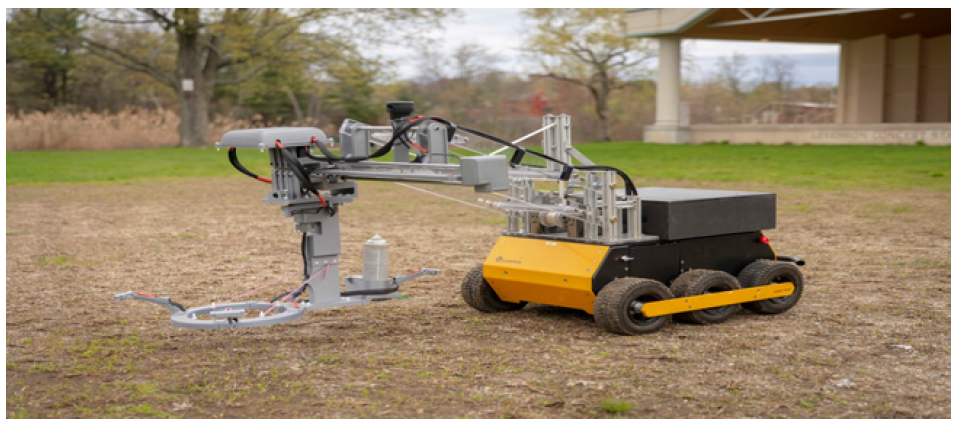
Hence the need to carry out scientific studies and innovative tools and hardware to remove landmines that pose a real challenge to agricultural and industrial development, such as preserving the lives of millions of people in areas contaminated by mines. In this study, we employ wireless technology to let a mobile device control the motion of a robot. Information will be sent through the wireless control signal using an internet-connected mobile phone or Wi-Fi using an Android-based app. The Raspberry_Pi3 integrated Wi-Fi module responds appropriately to the movement of the DC motor. The motors is connected to the L298N twin H-bridge motor driver in the Raspberry Pi 3_B model. The car may move in various directions, including stop, forward, reverse, right and left, depending on the commands it receives via a mobile application. The project aims to create a vehicle with metal detection capabilities. We use inductive proximity sensors for the identification of mines and metals. The Raspberry Pi 3 and the inductive proximity sensor are connected. The operator is informed of the discovery of a mine or metal each time the robot sends a signal to their phone. The signal is encrypted for secure transmission using the AES algorithm [1]. For the suggested metal detecting system and distinctive landmine marking technique, this research developed a mock-up3 landmine detection and pointing robot capable of localization, autonomous navigation and mapping. As seen in Figure 1, landmines generate a number of other losses in addition to harming people. Numerous studies have already been conducted on the detection, destruction and demining of landmines. Several related studies have been done on electromagnetic coil devices, remote sensor technologies, manual man handling detectors, nuclear quadrupole resonance, metal robotic vehicles and light-based imaging detectors [2-4].
Figure 1: Robotic System to Find and Safely Detonate Landmines
Robots are Used for Land Mine Detections
Robots can be utilized to conduct tasks in dangerous areas and to handle the challenging unpredictability levels in such areas. Over time, robots, For example, in military and urban hunting and salvage applications, are becoming increasingly crucial for regular subject applications. Various small robotic applications are now emerging and robots are used to carry out multiple tasks. Robots are generally used for risky jobs that endanger people, such as controlling, espionage, salvaging, medical procedures, etc. Though typically a subject for science fiction, the use of robots in warfare is currently being investigated as a potential strategy in the future. Robots used in the military can be remotely controlled or autonomous and can be used for various tasks, including attack, search and rescue and transport. A metal-detecting robot that can locate landmines is used to look for buried metal objects. Army bomb-disposal specialists use metal detectors to look for mines buried beneath roads and in minefields. Technicians also use metal detectors to look for buried cables and wires. Travelers are checked for metal complaints, like cuts and guns, using aircraft metal detectors. Various sources claim that there are increasingly more robots being deployed globally. They are becoming more common in multiple work contexts, including manufacturing, processing activities, hazardous locations, medical facilities, military settings, inaccessible areas, etc.
The aim of this project is to build and operate a robotic vehicle that can detect land mines by sensing metals along its path. It is a control unit-interfaced metal detector circuit that alerts the user when it thinks there may be metal in the area. The robotic vehicle's mounted metal detector circuit works by autonomously detecting metal underneath [5]. Additionally, when toys are based on robotic principles, robots may play as well as assist those who are disabled.
MATERIALS AND METHODS
The recommended metal detector generates an alternating current because a coil receives the AC produced by an oscillator. When a piece of electrically conductive metal is in close proximity to the electric coil, eddy currents form, which provide the alternating magnetic field. A second coil can be used to measure the magnetic field and act as a magnetometer. The magnetic field changes when a metallic object is present. A metal detector produces an electromagnetic field that is detected on the land. Any metal structure will alter the EM field, causing disruption and notifying the operator of this change with a buzzer or display. A metal is made up of two sets of windings on pure copper wire. When an electrical current passes through one winding, an electromagnetic field is created. The domain will change if a metal object is brought close to it and the receiver winding recognizes this disruption. The results of this interruption is the transmission to the operator control system. This data is shown on an LCD or by an audible buzzer [6].
The Raspberry Pi3
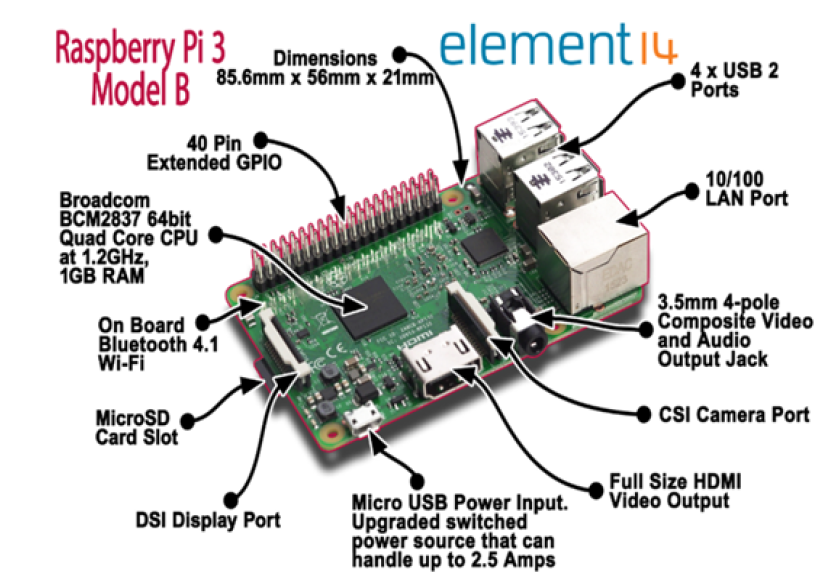
The Raspberry Pi is an affordable, credit card-sized computer that connects to a computer monitor or TV and uses a standard keyboard and mouse to operate. People of all ages can learn about computing and how to create in languages like Scratch and Python with this little capable device. It can play high-definition videos, access the internet, makes spreadsheets and word documents and play games. It also has all the functionality of a desktop computer. The Raspberry Pi3 can also communicate with the outside world and has been used in many digital maker projects, such as tweeting birdhouses with infrared cameras, parent detectors, weather stations and music players. In addition to running Linux, the Raspberry Pi has GPIO (general purpose input and output) pins that let you operate electronic devices for physical computing and investigate the Internet of Things (IoT). The best-selling computer brand in the UK, More than five million Raspberry Pi3 boards, were sold up until Jan. 2015, according to the Raspberry Pi Foundation's official report. More than 11 million pieces were sold by November 2016 [7,8] (Figure 2).
Figure 2: Raspberry Pi3 _ Model_ B
Dual H-Bridge Motor Driver L298N
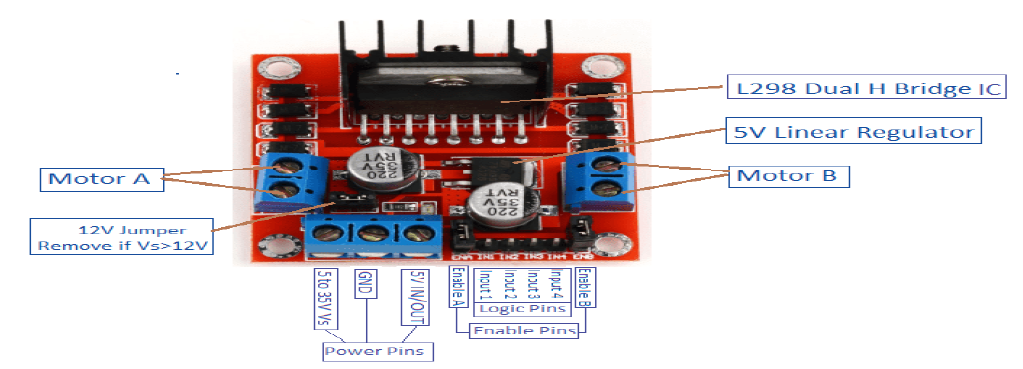
L298N Dual H Bridge Motor Driver is a breakout board for a motor controller commonly used to control the speed and direction of motors. A circuit known as an H-bridge uses pulse width modulation to regulate it and can push current in either direction. Additionally, it can be used to control the brightness of some lighting fixtures, including powerful LED arrays (Figure 3).
Figure 3: Illustration of L298N Dual H Motor Driver
Circuit Diagram
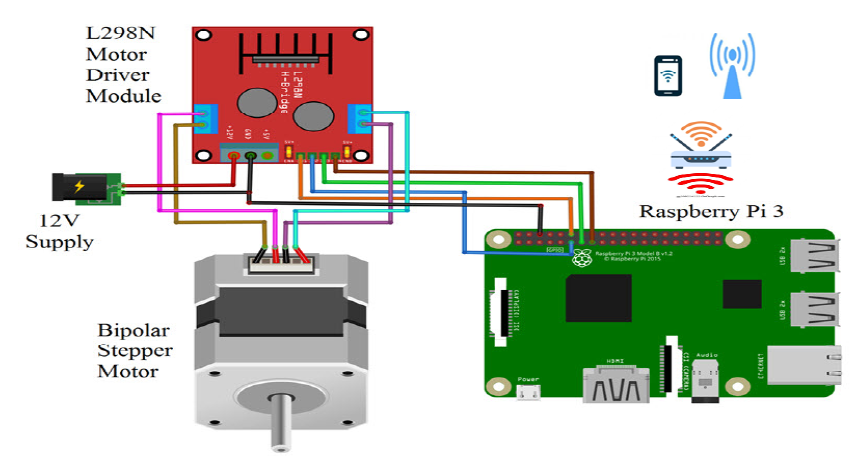
The Figure 4 shows the connection diagram of the Raspberry Pi3 and Motor driver Control L298N.
Figure 4: Block Diagram of the Developed Prototype
Software Application
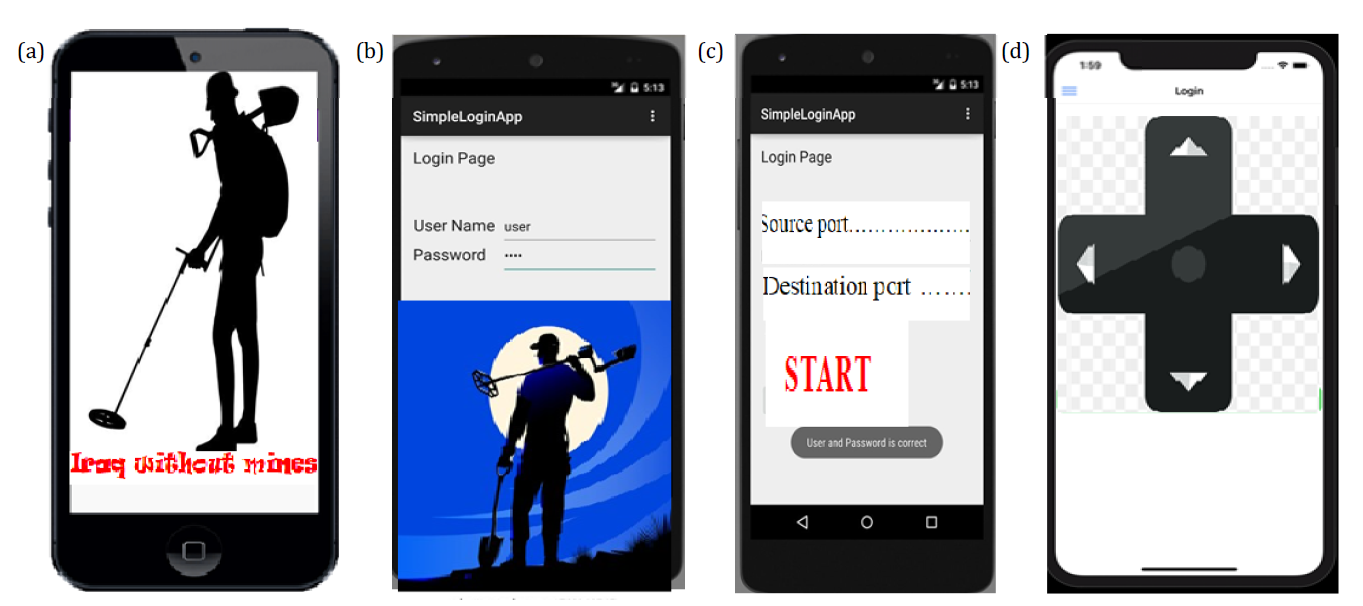
The detector car may be operated remotely via an Android app. A practical android application is created to manage the vehicle to accomplish the goal remotely. Both tablets and smartphones can use the software. Iraq Without Mines is the application's name, as seen in Figure 10. (a-d). A straightforward Android app. called "Iraq without Mines" interfaces with the Raspberry Pi3 board installed on the robotic automobile. Its user interface is clear and compelling. To Raspberry Pi 3, a data packet carrying the direction signal is sent. Every time metal is found, the program also notifies the user with an alarming message and voice sound. The application "Iraq Without Mines" features four alternative user interfaces: "Spray," "Login," "Connectivity," and "Motor Control." When a user first launches an application. It is the first GUI-based interface that is shown to them. The welcome sound is played after the splash screens have waited five seconds. After the splash screen, this is the following screen. Two edit fields are on this screen, one requesting a username and the other a password. This screen prevents unauthorized access to the detector and application.
The detector car may be operated remotely via an Android app. An efficient android application is created to manage the vehicle to accomplish the goal remotely. Both tablets and smartphones can use the software. Iraq Without Mines is the application's name, as seen in Figure 5(a-d). A straightforward Android app. called "Iraq without Mines" interfaces with the Raspberry Pi3 board installed on the robotic automobile. Its user interface is clear and compelling. To Raspberry Pi3, a data packet carrying the direction signal is sent. Every time metal is found, the program also notifies the user with an alarming message and voice sound.
The application "Iraq Without Mines" features four alternative user interfaces: "Spray," "Login," "Connectivity," and "Motor Control." When a user launches an application, this is the first GUI-based interface shown to them. The welcome sound is played after the splash screens have waited five seconds. After the splash screen, this is the following screen. Two edit fields are on this screen, one requesting a username and the other a password. This screen prevents unauthorized access to the detector and application. The login and password are invited on this screen. The user will see a notification indicating that their login was successful and will move on to the next screen if their username and password are accurate. It will prompt you to enter your username and password again if either the password or the username is wrong. The IP address of the Raspberry Pi3 and the port number of the running program must both be entered to communicate using the UDP protocol, according to the interface for Iraq without Mines application. As the Raspberry is set up with a static IP and port number for the project, a Toast message will be displayed anytime the user enters the correct IP address and port number to let them know they are connected to the Raspberry Pi3. The user is also asked to enter the port number for an Android App. on the user interface. The connectivity interface provides the base to drive the motor L298N in four directions. Each time a user clicks a button.
The Raspberry Pi3 receives the corresponding signal and the motor proceeds in the desired direction. The interface also has a stop button, which stops the motor's motion when pressed. The literature review contains works published by many scholars who study landmine detection technology [9]. Most of them employ a standard microprocessor to operate the moving detection vehicle. The majority of techniques involve using a basic metal detector and sending a small number of photos to the central unit. Each of these systems is controlled by a powerful computer system. However, utilizing a genuine computer's weight in this situation is not acceptable. In addition, the cost will always be an issue if the device needs to be repaired or replaced. The most significant fix for the problem would be a Raspberry Pi. The proposed technology can eliminate the disadvantage of operating within a constrained frequency range. It is possible to navigate both inside and outside using the system. We created a device that is efficient and compensates for performance. Because they offer a safe path across minefields, it is safer and more effective. The improvement of central unit destination speed and transmission quality relies on web servers and data_ base server app. to save location-based information for mapping, detection or upcoming research.
Figure 5(a-d): Iraq Without Mines App, (a) Splash, (b) Log_in, (c) Connectivity and (d) Motor Drive Interfaces
CONCLUSION
We are capable of successfully designing and developing a metal detector vehicle thanks to the cutting-edge developments in mobile computing and robotics. The suggested system can locate landmines and buried metals, identify their precise location and prevent itself from stepping on them. Wireless technology and mobile phones can be used to manage the car remotely. An encrypted acknowledgment signal is sent to the mobile application every time the vehicle detects a Landmine or metal to alert the operator about the interest field and metal. The car has multiple movement options: forward, backward, left, right and stopping. The project's outcome confirms that the proposed framework can be used to achieve a great deal of efficacy and utility. The created system has shown to be quite beneficial for both military and civilians. The inductive proximity sensor operates at a suitable, constant speed without problems. Creating and using a practical, compact, low-cost land mine detector is the goal of this research. This detector is based on a Raspberry Pi3 mini_computer to serve as the brain of a small robot to automatically detect and transmit information about any found metal object to a central unit that will be later responsible for inspecting the received data to benefit from it in determining the location and possibly the danger of the found object for safer extract or disable it.
REFERENCE
Saravanan, N. et al. “Wireless Land Mine Detection and Surveillance Robot.” International Journal of Advance Engineering and Research Development, vol. 4, no. 3, 2017, pp. 77-80.
Kathuria, A. and A. Gupta. “Challenges in Android Application Development: A Case Study.” International Journal of Computer Science and Mobile Computing, vol. 4, no. 5, 2015, pp. 294-299.
Ghribi, W. et al. “Design and Implementation of Landmine Robot.” 2013, pp. 250-256.
Manandhar, A. et al. “Multiple-Instance Hidden Markov Model for GPR-Based Landmine Detection.” IEEE Transactions on Geoscience and Remote Sensing, vol. 53, no. 4, 2015, pp. 1737-1745.
Sudac, D. “Improved System for Inspecting Minefields and Residual Explosives.” IEEE Transactions on Nuclear Instrumentation, vol. 15, no. 4, 2013, pp. 108-120.
Jaradat, M.A. “Autonomous Navigation Robot for Landmine Detection Applications.” IEEE Transactions on Mechatronics and Its Applications, vol. 16, no. 3, 2012, pp. 1-5.
Gini, M.L. et al. “Advances in Autonomous Robots for Service and Entertainment.” Robotics and Autonomous Systems, vol. 58, no. 7, 2010, pp. 829-832.
Rodriguez, J. et al. “Low-Cost Quadrotor Applied for Visual Detection of Landmine-Like Objects.” IEEE Transactions on Antennas and Propagation, vol. 22, 2014, pp. 51-68.
Nicoud, J. and M. Habib. “The Pemex-B Autonomous Demining Robot: Perception and Navigation Strategies.” IEEE Transactions on Intelligent Robots and Systems, vol. 3, 2015, pp. 419-424.
Recommended Articles
Research Article
OBSERVATIONS ON THE HOMOGENEOUS TERNARY QUADRATIC DIOPHANTINE EQUATION x2 + 4xy + 9y2 = 21z2
Download PDF
Research Article
Machine Learning-Based Intrusion Detection for Detecting DDoS Attacks in Software-Defined Networks
Zainab Abbas Fadhil
Published: 30/06/2026
Download PDF
Research Article
Computer Driven Library Management and Service Rendering System: Mobile Library Landscape
Yekini N. A,
...
Ojo O
Published: 10/06/2020
Download PDF
Research Article
A Deep Representation Learning Framework Based on PCA-Compressed EfficientNetB0 Embeddings and Neural Spline-Based Classification for Iraqi Banknote Authentication
Saba Hussein Rashid
Published: 30/06/2026
Download PDF
PO Box 101, Nakuru
Kenya.
Email: office@iarconsortium.org
Editorial Office:
J.L Bhavan, Near Radison Blu Hotel,
Jalukbari, Guwahati-India
Hemza, M. K. A. (2022). Design and Operation of a Small-sized and Cheap Landmine Detector. IAR Journal of Engineering and Technology, 3(2), 1-5.
MLA
Hemza, Majid K. A.. "Design and Operation of a Small-sized and Cheap Landmine Detector." IAR Journal of Engineering and Technology 3.2 (2022): 1-5.
Chicago
Hemza, Majid K. A.. "Design and Operation of a Small-sized and Cheap Landmine Detector." IAR Journal of Engineering and Technology 3, no. 2 (2022): 1-5.
Harvard
Hemza, M. K. A. (2022) 'Design and Operation of a Small-sized and Cheap Landmine Detector' IAR Journal of Engineering and Technology 3(2), pp. 1-5.
Vancouver
Hemza MKA. Design and Operation of a Small-sized and Cheap Landmine Detector. IAR Journal of Engineering and Technology. 2022 Jul;3(2):1-5.



 Download PDF
 Download XML