This paper presents a nonlinear control technique sliding mode Controller for a controller for a damped driven pendulum is designed based on sliding mode theory. Initially Transfer function for the proposed system the suspended pendulum is obtained through solving mathematical equations. Sliding mode control techniques are applied to the proposed system and examined. MATLAB platform is used to obtain the simulation result. Finally, it is observed that sliding mode controller is a robust control design for the proposed system.
Keywords
: sliding mode control
Simple pendulum
Nonlinear control.
INTRODUCTION
A wright suspended from a pivot that swings freely is considered as a pendulum. A pendulum at equilateral position when displaced sideways from its resting point is subjected to a restoring force due to gravity that will accelerate it back and towards the equilibrium position. When it is released the restoring force acting on the pendulum's mass causes it to oscillate about the equilibrium position, swinging back and forth [1] It is basically a mechanical system that exhibits periodic motion. Pendulums have been known for a long time to be good resonators, suitable for use as a reference in high quality clocks for a long time.
A compound pendulum is a standard topic in most physics courses because it includes some physical subjects such as the simple harmonic motion [2] the period of oscillation, the acceleration of gravity, the center of mass, the moment of the inertia, momentum etc.
In the fields like determination of mass distribution of an object, determination of acceleration of gravity, measurement of time etc... can be understood by taking the example of a compound pendulum. In the field of Control Systems, the behavior of control algorithm can be examined easily by understanding the mathematical equations of a pendulum related to its and the torque force inputs and therefore Control algorithm can be easily analyzed using a Pendulum system [3] Sliding-Mode control is an extension to the Variable Structure Control theory. Sliding mode control is a particular type of the variable structure control system (VSCS), which is characterized by a discontinuous feedback control structure that switches as the system crosses certain manifold in the state space to force the system state to reach, and subsequently to remain on a specified surface within the state space called sliding surface.
The switching function (sliding variable) is a function of the states and the sliding surface represents a relationship between the state variables. The system dynamics when confined to the sliding surface is referred as an ideal sliding motion and represents the controlled system behavior, which results in reduced order dynamics with respect to the original plant. This reduced order dynamics provides attractive advantages such as insensitivity to parameter variations and matched uncertainties and disturbances, making sliding mode control an appropriate method for robust control [4] The sliding mode controller consists of two phases namely the reaching phase and sliding mode phase. The reaching phase is where the system states are driven from any initial value to the sliding surface which is provided by a discontinuous control input.
The sliding phase is where the system states are in sliding motion in the sliding surface induced by the continuous control input. The sliding mode control approach is recognized as one of the efficient tools to design robust controllers for complex high-order nonlinear dynamic plants operating under uncertainty conditions[5] . The research in this area were initiated in the former Soviet Union about 40 years ago, and then the sliding mode control methodology has been receiving much more attention from the international control community within the last two decades.The major advantage of sliding mode is low sensitivity to plant parameter variations and disturbances which eliminates the necessity of exact modelling.
Sliding mode control enables the decoupling of the overall system motion into independent partial components of lower dimension and, as a result, reduces the complexity of feedback design [6] Sliding mode control implies that control actions are discontinuous state functions which may easily be implemented by conventional power converters with “on-off” as the only admissible operation mode. Due to these properties the intensity of the research at many scientific centers of industry and universities is maintained at high level, and sliding mode control has been proved to be applicable to a wide range of problems in robotics, electric drives and generators, process control, vehicle and motion control.
METHODOLOGY
Modelling of a damped driven pendulum
In figure 1, Mathematical modelling of any system is the first and foremost step to be followed before analyzing or controlling it.
Figure 1: A simple pendulum system
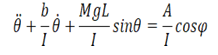
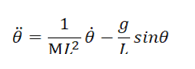
We begin with a statement of the standard equation for the damped, driven pendulum
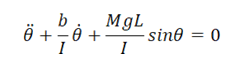
Assume to be 90 deg., thus we get
Here,
M = mass
θ = angle between the vertical and the rope
I = inertia= M
L= length of the rope
g= acceleration due to gravity
thus,
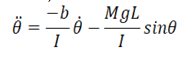
Assuming damping coefficient b= -1, and substitute for I we get,
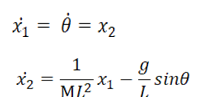
The state equations are given as,
Design of sliding mode control
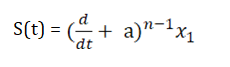
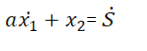
1st step we need to design sliding surface i.e., s(t)
S(t) =
Here n is the order and thus n=2
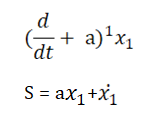
Thus, we get,
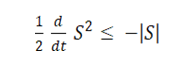
Now using Lyapunov theorem we know that
= S*
The sufficient condition for stability of the system (reaching condition)
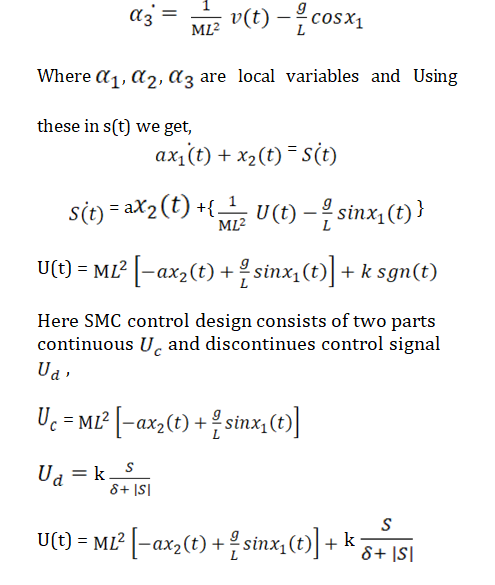
The basic discontinues control law
k
K is a manual tuning parameter for reaching mode, and to avoid chattering the discontinues signal is used
k
Here is a chattering suppression factor that is adjusted to eliminate chattering and SMC is designed as relative degree of the system is 2.
Let us consider,
This is a final control law obtained using continues and discontinues signal.
RESULT AND ANALYSIS
A simple damped driven pendulum system is taken and an SMC controller is designed to meet the objective. The phase portrait of the simple pendulum is taken. The SMC controller is simulated in MATLAB and the following results are obtained.
Figure 2: Phase plot of Damped Pendulum
It is observed that the equilibrium point (0,0) is stable as the trajectory is approaching that point and (π,0) is unstable as the trajectory is leaving that point.
The Sliding Mode controller plots for the tracking of angle of pendulum, the angular velocity and the control input are shown in the figure below.
Figure 3: Plot of angle of pendulum
Figure 4: Plot of
Figure 5: Plot of Control input u
CONCLUSION
In this work an attempt has been made to model the Simple Damped driven Pendulum system, analyze its phase portrait and a Sliding Mode controller is designed for the non-linear system. MATLAB is used as a tool to obtain the phase portrait and simulation of the Sliding Mode Controller. Satisfactory results are obtained for the above system.
Conflict of Interest:
The authors declare that they have no conflict of interest
Funding:
No funding sources
Ethical approval:
The study was approved by the Manipal Institute of Technology,Udupi, Karnataka, India
REFERENCES
De Marchi, A., Ortolano, M., Periale, F., & Rubiola, E. (1996, June). A measurement of the period stability of a free pendulum in vacuum. In Proceedings of 1996 IEEE International Frequency Control Symposium (pp. 665-673). IEEE.
Hinrichsen, P. F. (1981). Practical applications of the compound pendulum. The Physics Teacher, 19(5), 286-292.
Utkin, V. I. (1992). “Examples,” in Sliding Modes in Control and Optimization, Berlin, Heidelberg: Springer Berlin Heidelberg, 265–277.
Utkin, V.I. (2008). Sliding Mode Control: Mathematical Tools, Design and Applications. In: Nistri P., Stefani G. (eds) Nonlinear and Optimal Control Theory. Lecture Notes in Mathematics, 1932. Springer, Berlin, Heidelberg.
Nelson, R. A., & Olsson, M. G. (1986). The pendulum—Rich physics from a simple system. American Journal of Physics, 54(2), 112-121.
Whittaker, E.T. (1937). A Treatise on the Analytical Dynamics of Particles and Rigid Bodies (Cambridge, New York, 1937), 4th ed., p. 73.
Recommended Articles
Research Article
OBSERVATIONS ON THE HOMOGENEOUS TERNARY QUADRATIC DIOPHANTINE EQUATION x2 + 4xy + 9y2 = 21z2
Download PDF
Research Article
Computer Driven Library Management and Service Rendering System: Mobile Library Landscape
Yekini N. A,
...
Ojo O
Published: 10/06/2020
Download PDF
Research Article
Influence of Optimum Percentage of Waste Ceramic Powder as a Fine Aggregate Replacement on Hardened Properties of Concrete
Mohammad Ali Asaad,
...
Mohammed Muhsin
Published: 11/06/2020
Download PDF
Research Article
The Possibility of Treating Corrosion in Iron Valves of Flow Regulators, Pumping Station Components, and Suspended Solids Filtration Networks in Rivers and Streams in Al-Qadisiyah Governorate
Qasim M. Turki,
...
Ahmed Hakem Jabor
Published: 02/03/2026
Download PDF
PO Box 101, Nakuru
Kenya.
Email: office@iarconsortium.org
Editorial Office:
J.L Bhavan, Near Radison Blu Hotel,
Jalukbari, Guwahati-India



 Download PDF
 Download XML