In today’s technology Cloud Computing has become a vital side and storing of information on cloud is of high significance. This has amplified the requirement for virtual space to store huge measure of facts over the years. Hence there is a need to overcome duplicate copies of the same file from being uploaded by different clients at different geographical areas on the remote servers of the organization. This paper addresses these issues related to volume, range and speed by preventing exchange of duplicates within the virtual storage space. The strategy includes partitioning the information as numerous fixed size blocks and generating the hash code for each block of information dependent on its type of data. Thus, it prevents redundancy of data within the organizational virtual storage. This enables the optimal storage and efficient usage of network resources.
Keywords
De-Duplication
Cloud Computing
Text File
Image File
Hashing Technique
INTRODUCTION
At present, Storage outsourcing is becoming increasingly appealing to both enterprise and academic due to the benefits of low cost, excessive accessibility, and clean sharing. As one of the garage outsourcing forms, cloud garage profits wide interest in latest years. Many companies, such as Amazon, Google and Microsoft offer their own cloud garage services, where users can add their files to the servers, access them from various devices and share them with others. With the cloud services developing at a rapid rate it’s also associated by means of increasing large volumes of facts being stored on far flung servers of the cloud. But most of the remotely stored documents are duplicated due to importing the same record through one-of-a-kind users at one-of-a-kind locations, which results in wastage of storage space.
This has created a serious trouble for the data warehouses with respect to volume, variety, and velocity. This strategy aims at reducing troubles of storage and management of large volumes of facts via de-duplication process:
Volume: Size of the large scale information sets may be reduced by way of compressing the records into chunks and by figuring out the replica chunks, storage of equal chunks may be eliminated and subsequently performance in storing may be achieved
Variety: Each format of facts requires a special type of processing. Text files with extraordinary formats txt, pdf, doc, png and jpg every one need to be analyzed differently
Velocity: Instead of definitely putting the statistics in the database, it calls for statistics to be analyzed first and understand its content material first. This way transmission time is taken to analyze the moving information can be minimized
The proposed strategy includes acquire the file to be uploaded, phase into constant length blocks, generate a completely unique hash code for the block of Information based totally on its content, determine whether or not the generated hash code is already present within database and therefore fulfill the upload request without importing the block present in the database. We have used MD5 Hashing algorithm to hash the block. Minimizing duplication will increase the processing time and cost by using reducing steeply-priced add operations. It also saves storage space.
Literature Review
Youn et al. [1] clarifies about secure deduplication and honesty evaluating designation strategy which can decrease the volume of information uploaded by eliminating copied duplicates and license customers to effectively confirm the uprightness of uploaded records by assigning exorbitant activities to a confided in party. What’s more, to forestall spillage of significant data about client information, the proposed conspire underpins a customer side deduplication of encoded information, while at the same time supporting open examining of scrambled information. Also it gives preferred productivity over the current plans in the view purpose of customer side computational overhead.
Li et al. [2] clarifies about information deduplication method for eliminating copy duplicates of repeating data and it has been broadly utilized in distributed storage to lessen the measure of storage space and spare data transfer capacity. This paper additionally present a few new deduplication developments supporting approved copy check in a hybrid cloud design and furthermore clarifies about information the executives in distributed computing and productively taking care of the issue of deduplication with differential benefits in distributed computing.
Moorthy et al. [3] clarifies about distributed storage administrations and how to stay away from information excess to utilize distributed storage productively. The goal of this paper is to robotize the deduplication procedure while expanding classification and security of information and furthermore clarifies about hashing strategy that a powerful examination utilizing hash estimation of various records helps in quicker and secure correlation.
Sorer et al. [4] clarifies interest for framework that give secure information stockpiling in a cost-effective manner. By distinguishing similar chunks of information both inside and among documents and storing them just a single time, deduplication can yield cost investment funds by expanding the utility of a given amount storage. They have developed a solution that provides both space efficiency and data security in single-server storage and distributed storage in this paper.
Manogar and Abirami [5] clarifies that as of late, the blast of the data, for example, text and picture document lead to a ton of issue in both capacity and recovery process. Data deduplication is outstanding amongst other method which eliminates excess information, lessens the data transfer capacity and furthermore limits the plate utilization and cost. It has been inferred that variable size data deduplication is great when contrasted with different techniques by looking at the hash of every single chunk.
Stirner and Seelmann [6] clarifies about the that all intents and purposes for every single computerized camera depend on this configuration and most of the images are of JPEG documents in internet. Our methodology lessens benchmark JPEG picture record sizes. A few strategies are introduced that permit improved pressure of JPEG picture documents. This is predominantly accomplished through reference to EOBs (End-of-Block).
Architecture of the Proposed System
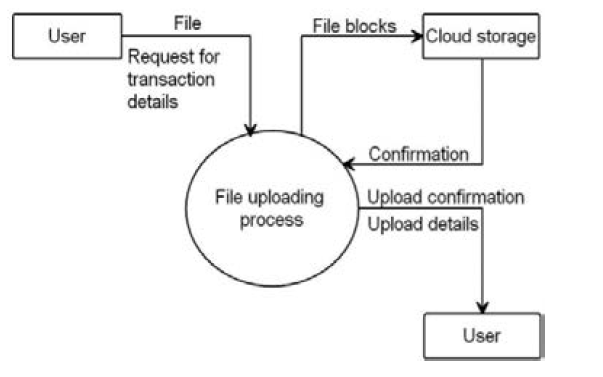
In the architectural layout of the system and the flowchart is as shown in the Figure 1. If a file ‘X’ is need to be stored on the cloud server then division of files is done into different blocks and hash code is generated for each block. And if a file ‘Y’ is need to be uploaded then it checks for hash code, if same code then it will never upload the same file instead suggest that it is already existing and shows the location of that particular file. If and only if the hash code is different than the existing files, it is stored in cloud.
Figure 1: Architecture of the Proposed System
MATERIALS AND METHODS
Block Splitting Method
In this technique when the user uploads the text files or images to the cloud. The text files or images uploaded to cloud are partitioned into number of blocks depending on packet size. Chunking could be a handle to part a record into littler records called chunks. In few applications, such as inaccessible information compression, information synchronization and information deduplication, chunking is critical since it decides the copy location execution of the system. Fixed-length chunking lets records be separated into a number of fixed-sized squares and after that applies hash capacities to extricate a hash key of the squares. This easiest chunking calculation runs quick.
Hashing Method
In this technique the partitioned number of blocks are converted to hash code by utilizing MD5 algorithm. Block-level hashing works similar to file-level hashing, except in this case, every block or chunk of data stored on the disk is mathematically hashed and the hashes are indexed. Every new block of data being stored is also hashed and the hashes are compared in the index. If the new data hash matches a hash for a block already stored, the new data does not get stored, thus eliminating duplicates.
De-Duplication Checking Process
In this technique the de- duplication of blocks is verified before uploading the image and text file blocks on to the cloud. Data deduplication compares objects and removes objects that already exist in the data set. The deduplication process removes blocks that are not unique.
It can be done in 4 steps:
Divide the input data into blocks or “chunks”
Calculate a hash value for each block of data
Use these values to determine if another block of the same data has already been stored
Replace the duplicate data with a reference to the object which is already stored in the database
Only a single instance of every chunk is stored
Block Merging Process
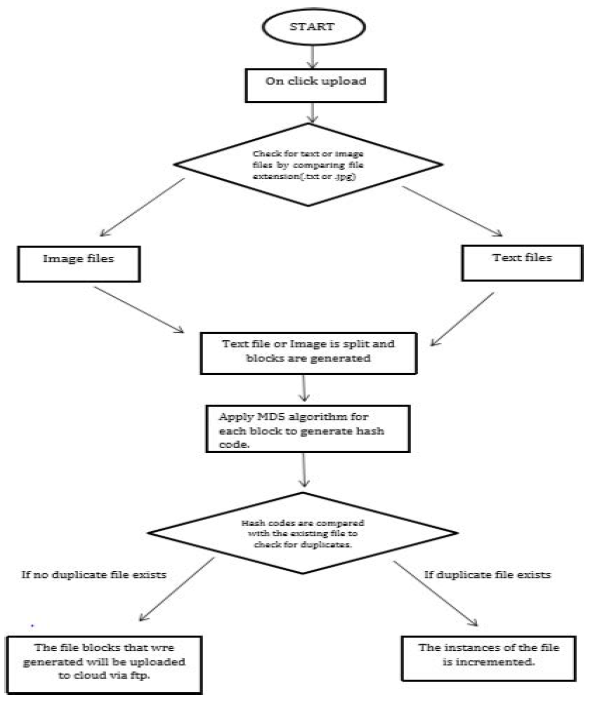
In this technique User should select the Download option and select any text file or image. Upon doing so, the file will be downloaded from the cloud here, the merging process takes place. Once the file is selected for download then all the individual blocks stored in the cloud which belong to selected files are merged back to generate a original file and that text file or image will be downloaded (Figure 2).
Figure 2: Flow Chart
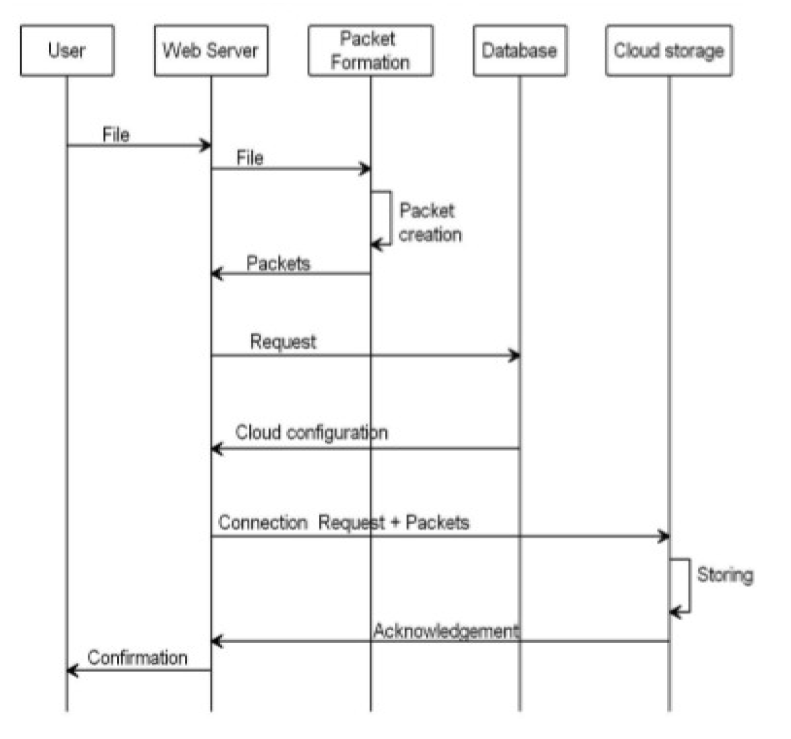
The user transfers a file to the web server, where a packet is made and a request is sent to the database from the web server for cloud configuration, at that point an association is mentioned to the distributed storage for storing the file, once the file is stored an affirmation is sent to the web server and confirmation is received by the user (Figure 3).
Figure 3: Sequence Diagram
Proposed Scheme
The framework consists of two forms of elements: (1) cloud server and (2) Clients. In all the documents, unique client is the customer who transferred the record on to cloud, while resulting purchaser the buyer who demonstrated the ownership of the report on to cloud. The four levels of de-duplicatable device are: Pre-system, De-duplication, Transfer and Update.
In the pre-method stage, client expect to transfer their neighborhood documents. Documents could be partitioned in to the chunks for each and each chunk hash code can be created and chunk may be dispatched to the de-duplication stage
In the de-duplication stage, it will check the entirety of the blocks of the file whether the block is as of now transferred to the cloud or not, at this point dependent on the hash code produced to everything about block. On the off chance that as of now the block is transferred, at that point client gets the ownership of the block, new blocks may be sent to the include stage In the transfer stage, chunks may be transferred to the cloud garage with the help of File Transfer Protocol
In the update stage, clients may likewise delete, modify and add a couple of chunks in documents. On the off chance that the fresh out of the plastic new square is embedded or refreshed handiest that square could be transferred to the distributed storage and report gets refreshed with recently embedded or modern square, without influencing to the deduplicated record
There are two models in our projected framework, purchaser and administrator. In the principal stage the utilization of logging subtleties, buyer and administrator can log in into the framework. In the subsequent one phase the customer can include a literary substance record for handling, in block splitting procedure separates the content into chunks of consistent or variable size. In the end stage, the de-duplication strategy figures hash trademark for each block and contrasts the hash result and a previously put away list for duplication discovery and update list. There chunk measure totally different procedures for block creations static configuration, content material outlined configuration and file-based configuration. In our machine we have a tendency to chunk measure the utilization of content material delineate configuration methodology, whereby chunks may be created based mostly completely on content in the file and therefore the fingerprint calculation for each substring i.e., one fingerprint for every word and process overhead for fingerprint sometimes depends upon on string period.
Once the index is made for each block the duplication or the redundancy of a bit is checked with the help of the de-duplication system. The bite is dropped at the system best if there aren’t any redundant copies of it. If it doesn’t exist then the record (or) file is hold on. Here we supply out block-level de-duplication because the decision indicates, the block-level de-duplication deals with the removal of redundant statistics copies with reference to blocks. The techniques entail dividing and storing documents during a block and have one copy of every block. It makes use of fixed-sized blocks or variable-sized chunks for duplication theme the saved chunks are given a chunk-index which has the fingerprint of all the saved chunks.
This paper is based on the idea that if the identification of a small amount is already gift within the chew index, then its way believed that the knowledge within the new chew and also the already existing chew are completely equal and so it’s far forthwith labeled, as a replica. The chunks that are categorized as new are then hold on by means of the de-duplication device by means of distribution a brand-new index. Content delineated unitization is discovered to present excessive de- duplication quantitative relation for having the backup of workloads. Hence, it’s the foremost extensively used technique in most de- duplication system for backup workloads.
Pseudo Code for File Splitting Process
Step 1: Get the input data
Step 2: Divide the file dependent on the characters and content
Step 3: The file can be separated into many sub text or picture files according to the size
Step 4: If the file contains same characters as well as same words or image then it will not be divided
Step 5: Else
Step 6: Repeat the steps
Step 7: Stop
Pseudo Code for MD5 Process
Step 1: Get the Message
Step 2: Conversion of the input message into the bits will take place
Step 3: Append Padding Bits (Make the message bit length should be the accurate of 512 bits as well as 16 word Blocks)
Step 4: Divide complete bits in to 128 bits chunks
Step 5: Initialize MD Buffer. A buffer of four word (A, B, C, D) is inculcated for computation of message digestion total 128 bits
Step 6: Perform AND, XOR, OR, NOT procedure on A, B, C, D by giving three sources of input and get one output
Step 7: Repeat the Step 6 until get the 128 bits hash (16 bytes)
Step 8: Stop
RESULTS
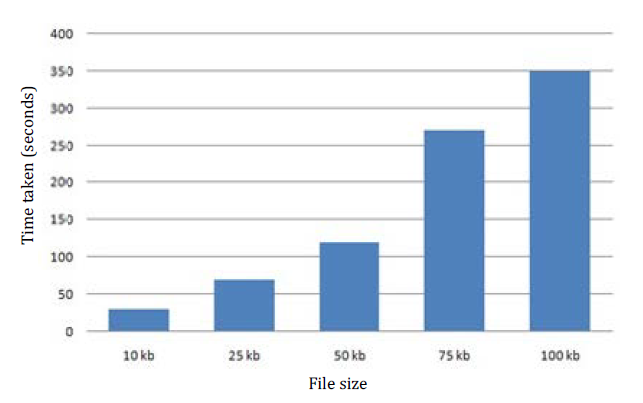
When a picture or textual content report (A) is uploaded on the cloud for the primary time, it takes considerable time. While the second instance of the file A is attempted to upload, the system compares with the existing has code and rejects the uploading and notifies the user about original copy and its location in cloud. The time taken for hashing based on the file size is as shown in the Figure 4.
Figure 4: THE TIME TAKEN for Hashing Based on the File Size
CONCLUSION
When storing blocks on remote cloud storages, users got to be assured that their out sourced facts are maintained accurately within the far-flung storage while not being corrupted. Additionally, cloud server got to apply their storage bigger with efficiency. To satisfy the necessities, we tend to planned a theme to attain stable de-duplication cloud surroundings.
De-duplication of printed substance and picture record are fulfilled by the way of hashing approach which makes the comparison faster and simpler. The current gadget does an inactive chunking depending on the parcel estimate, encourage exactness of the gadget may be expanded by implies of considering energetic chunking prepare blocking arrange evacuation of excess is being advanced which can additionally be utilized in advancement of thoughts for part degree lessening. A valuable step forward interior the advancement may be presented appropriate component to triumph over the limitations with recognize to unwavering quality of actualities de- duplication techniques and lessening the contraption overheads accelerated by utilizing record de- duplication.
REFERENCE
Youn, T.Y. et al. “Efficient Client-Side Deduplication of Encrypted Data with Public Auditing in Cloud Storage.” IEEE Access, 2019.
Li, J. et al. “A Hybrid Cloud Approach for Secure Authorized Deduplication.” IEEE Transactions on Parallel and Distributed Systems, 2015.
Moorthy, V., et al. “Deduplication in Cloud Storage Using Hashing Technique for Encrypted Data.” ARPN Journal of Engineering and Applied Sciences, 2018.
Sorer, M.W. et al. “Secure Data Deduplication.” University of California, 2018.
Manogar, E. and S. Abirami. “A Study on Data Deduplication Techniques for Optimised Storage.” Sixth International Conference on Advanced Computing, 2014.
Recommended Articles
Research Article
OBSERVATIONS ON THE HOMOGENEOUS TERNARY QUADRATIC DIOPHANTINE EQUATION x2 + 4xy + 9y2 = 21z2
Download PDF
Research Article
Machine Learning-Based Intrusion Detection for Detecting DDoS Attacks in Software-Defined Networks
Zainab Abbas Fadhil
Published: 30/06/2026
Download PDF
Research Article
Computer Driven Library Management and Service Rendering System: Mobile Library Landscape
Yekini N. A,
...
Ojo O
Published: 10/06/2020
Download PDF
Research Article
A Deep Representation Learning Framework Based on PCA-Compressed EfficientNetB0 Embeddings and Neural Spline-Based Classification for Iraqi Banknote Authentication
Saba Hussein Rashid
Published: 30/06/2026
Download PDF
PO Box 101, Nakuru
Kenya.
Email: office@iarconsortium.org
Editorial Office:
J.L Bhavan, Near Radison Blu Hotel,
Jalukbari, Guwahati-India



 Download PDF
 Download XML