Contents
Download PDF
pdf Download XML
577 Views
449 Downloads
Share this article
Research Article | Volume 3 Issue 2 (July-Dec, 2023) | Pages 1 - 4
Revealing Insights into Heart Attack Awareness: A Deep Dive into Public Understanding in District Sirmaur, Himachal Pradesh
 ,
 ,
1
PG Student, Department of Community Medicine, Indira Gandhi Medical College, Shimla, India
2
PG Student, Department of Community Medicine, Maharishi Markandeshwa Medical College, Kumarhatti, Solan, India
Under a Creative Commons license
Open Access
Received
June 3, 2023
Revised
July 9, 2023
Accepted
Aug. 19, 2023
Published
Sept. 4, 2023
Abstract

Background: Public awareness of heart attack symptoms and risk factors is pivotal for timely intervention and improved outcomes. Disparities in knowledge persist, particularly in underserved regions. This study aimed to assess public perceptions of heart attack symptoms and risk factors in District Sirmaur, Himachal Pradesh, India, a region lacking comprehensive insights into heart health awareness. Materials and Methods: A cross-sectional survey was conducted between April 2023 and July 2023 among 400 adults residing in District Sirmaur for at least 12 months. Data were collected through a structured Google Form questionnaire that included socio-demographic details and 20 knowledge-related questions. Knowledge levels were categorized as very good (>80%), good (60-79%), fair (41-59%) and poor (<40%). Results: Participants exhibited varied levels of knowledge regarding heart attack symptoms and risk factors. The awareness was reasonably high for identifying what constitutes a heart attack (86.75%) and recognizing common symptoms (72%). However, only 24.5% were familiar with the concept of the "Golden Hour" for medical attention and 29.75% understood the significance of early intervention during a heart attack. Notably, 68.25% recognized established risk factors. Overall, 31.5% displayed very good knowledge, 33% good, 24.25% fair and 11.25% poor. Conclusion: The study underscores the need for tailored interventions to bridge knowledge gaps and enhance heart health literacy, particularly in critical areas such as time-sensitive interventions during heart attacks. Collaborative efforts involving healthcare authorities, educational institutions and community organizations are essential to disseminate accurate information through diverse communication channels.

Keywords
INTRODUCTION

Cardiovascular Diseases (CVDs) continue to be a global health challenge, accounting for a significant proportion of morbidity and mortality worldwide. Among these, heart attacks, also known as myocardial infarctions, are a leading cause of concern due to their sudden and life-threatening nature. The prognosis and successful management of heart attacks greatly depend on the prompt recognition of symptoms and identification of risk factors. Effective public awareness and understanding of heart attack symptoms and risk factors are pivotal in reducing the burden of these events and improving outcomes. However, disparities in knowledge and awareness regarding heart health persist, especially in underserved regions [1,2].


In this context, understanding the perceptions of heart attack symptoms and risk factors among the public becomes crucial. This research article focuses on the district of Sirmaur in Himachal Pradesh, India, where there exists a dearth of studies investigating the local population's knowledge of heart health. Himachal Pradesh, despite its serene landscapes, is not immune to the rising prevalence of CVDs and Sirmaur district, in particular, lacks comprehensive insights into the community's understanding of heart attack symptoms and risk factors. By delving into the public's perceptions, this study aims to shed light on the existing gaps in awareness and provide a foundation for targeted interventions [3,4].


Public perceptions of heart attack symptoms and risk factors play a pivotal role in determining the readiness to seek medical attention and adopt preventive measures. Timely recognition of symptoms, such as chest pain, shortness of breath and radiating discomfort, is instrumental in seeking prompt medical assistance, which can significantly influence the outcome of a heart attack event. Similarly, understanding the risk factors associated with heart attacks, including hypertension, diabetes, smoking and sedentary lifestyles, empowers individuals to make informed lifestyle choices and reduce their susceptibility to CVDs [4,5].


Sirmaur district, situated in the northern region of India, represents a unique socio-cultural setting that warrants investigation into its perceptions of heart health. The district's population faces a distinctive set of challenges and opportunities influenced by factors such as geographic isolation, economic constraints and limited access to healthcare resources. Hence, unraveling the local understanding of heart attack symptoms and risk factors is essential for designing region-specific awareness campaigns and educational initiatives.


Objectives of the Study

To evaluate the awareness and knowledge regarding Symptoms and Risk Factors for Heart Attack (Myocardial Infarction) among general public of District Sirmaur, Himachal Pradesh.

MATERIALS AND METHODS

Research Approach

The research approach adopted for this study is descriptive, aiming to assess the knowledge about heart attack symptoms and risk factors among the general public of District Sirmaur, Himachal Pradesh.


Research Design

The study utilizes a cross-sectional survey design to collect data at a specific point in time, allowing for the assessment of the knowledge level among participants.


Study Area

The research was conducted in District Sirmaur, Himachal Pradesh.


Study Duration

The study was conducted between April 2023 and July 2023.


Study Population

The study population includes all adults above 18 years of age who have been residing in District Sirmaur, Himachal Pradesh for a minimum of 12 months.


Sample Size

The sample size was determined to be 400 adults, assuming that 50% of the participants have adequate knowledge about heart attack symptoms and risk factors. A 5% absolute error, 95% confidence level and 5% non-response rate were considered during sample size estimation.


Study Tool

A structured Google Form questionnaire was designed to gather information on socio-demographic characteristics and knowledge about heart attack symptoms and risk factors. The questionnaire underwent pre-testing on a small group of individuals to ensure clarity and understanding.


Description of Tool

The questionnaire consisted of two sections:


  • Demographic Data Survey Instrument: This section collected background information such as age, gender, marital status, religion, employment and education

  • Questionnaire: This section comprised 20 structured questions related to knowledge about heart attack symptoms and risk factors. Each correct answer was awarded one mark, while incorrect answers received zero marks. The maximum possible score was 20 and the minimum was zero for each category. Knowledge levels were categorized as follows: >80% (16-20) - very good, 60-79% (12-15) - good, 41-59% (8-11) - fair and <40% (<8) - poor


Validity of Tool

The questionnaire was validated by experts in the field to ensure its accuracy and appropriateness.


Data Collection

Data collection was conducted under the supervision of supervisors. The Google Form questionnaire was distributed via various online modes, including email and social media platforms such as WhatsApp groups, Facebook, Instagram and LinkedIn. Data collection was carried out in both rural and urban areas of District Sirmaur, Himachal Pradesh until 400 responses were obtained.


Data Analysis

The collected data were entered into a Microsoft Excel spreadsheet and checked for errors. Epi Info V7 software was used for data analysis and appropriate statistical tests, such as frequencies and percentages, were employed.


Ethical Considerations

The study strictly adhered to ethical guidelines. Participants' confidentiality and anonymity were maintained throughout the research process to ensure their privacy and protection of personal information.

RESULTS

The goal of the current study was to assess general public knowledge regarding Symptoms and Risk Factors for Heart Attack (Myocardial Infarction) through a non-experimental descriptive survey. A total of 400 respondents took part in the study, with 119 (29.75%) coming from urban areas and 281 (70.25%) from rural areas (Table 1).


Table 1: Knowledge Regarding Symptoms and Risk Factors for Heart Attack (Myocardial Infarction) among Study Participants

S.No.StatementsFrequency of Correct Responses%
  1.  
What is a heart attack (Myocardial Infarction)?34786.75
  1.  
What are the common symptoms of a heart attack?28872
  1.  
What are the risk factors for heart attack?27368.25
  1.  
Is age a risk factor for heart attacks? If so, at what age does the risk increase?24160.25
  1.  
Name some lifestyle factors that can increase the risk of heart attack.23157.75
  1.  
Are you aware of any genetic or family history factors that can contribute to heart attack risk?22055
  1.  
Can you list some medical conditions that may increase the likelihood of a heart attack?20050
  1.  
Do you know the importance of blood pressure and cholesterol levels in heart health?20651.5
  1.  
How does smoking impact the risk of heart attack?25664
  1.  
What role does physical inactivity play in heart attack risk?27468.5
  1.  
Are you aware of the link between obesity and heart attack risk?24360.75
  1.  
Can you name some warning signs that may indicate an impending heart attack?27669
  1.  
What actions should one take if they suspect they or someone else is experiencing a heart attack?25263
  1.  
Are you familiar with the concept of "Golden Hour" in heart attack management?9824.5
  1.  

Can you identify the importance of early intervention and calling emergency services during a heart attack?

11929.75
  1.  
Do you know how to perform CPR (Cardiopulmonary Resuscitation) in case of a heart attack emergency?9323.25
  1.  
Do you know the benefits of regular exercise in preventing heart attacks?26265.5
  1.  
Can you name some heart-healthy dietary habits to reduce heart attack risk?25162.75
  1.  
What are some stress management techniques that can help lower heart attack risk?21954.75
  1.  

Do you understand the importance of regular health check-ups and screening for heart disease risk assessment?

27368.25


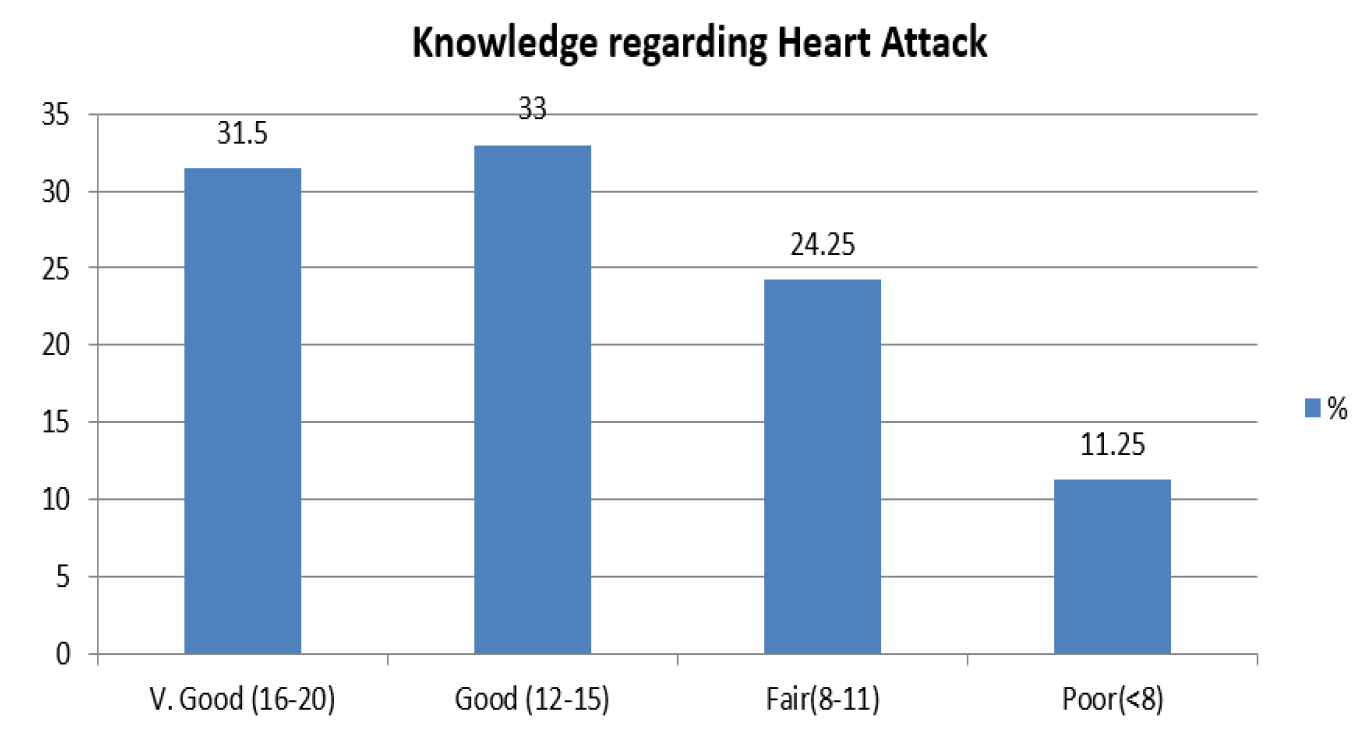
In the present study 31.5% (126) participants had very good knowledge (16-20 marks) towards, Symptoms and Risk Factors for Heart Attack (Myocardial Infarction), 33% (132) had good knowledge (12-15 marks), 24.25% (97) had fair knowledge (8-11 marks) and 11.25% (45) having poor knowledge (<8 marks) (Figure 1).


Figure 1: Knowledge Scores towards Symptoms and Risk Factors for Heart Attack (Myocardial Infarction) among Study Participants

DISCUSSION

The present study focused on assessing the knowledge of the general public in District Sirmaur, Himachal Pradesh, regarding heart attack symptoms and risk factors. The findings provide valuable insights into the current level of awareness and highlight the areas that require targeted interventions for enhancing heart health literacy.


The results of this study indicate that there is a reasonable level of knowledge among the participants about heart attack symptoms and risk factors. Notably, 86.75% of respondents correctly identified what a heart attack Myocardial Infarction is, while 72% could list common heart attack symptoms. This is indicative of a decent baseline understanding of critical concepts related to heart health within the population. Furthermore, 68.25% of participants were able to recognize established risk factors for heart attacks, such as age, smoking and physical inactivity.


However, there were certain areas where the knowledge level was comparatively lower. Only 24.5% of participants were familiar with the concept of the "Golden Hour," emphasizing the crucial time frame for seeking medical attention after a heart attack. Similarly, while 68.5% recognized the role of physical inactivity in heart attack risk, only 29.75% understood the importance of early intervention and calling emergency services during a heart attack. This discrepancy underscores the need for comprehensive awareness campaigns targeting specific aspects of heart attack education.


Comparing the findings of this study with similar research conducted in other regions provides valuable context for understanding the local perceptions and knowledge gaps. A study conducted by Kumar et al. [6], in a neighboring state found that only 56% of respondents could correctly identify heart attack symptoms, highlighting a need for improved awareness campaigns. This is consistent with our study's results, where 72% of participants could identify common heart attack symptoms.


Furthermore, a study by Patel et al. [7], in a different district of Himachal Pradesh revealed that only 41.2% of participants were aware of the role of physical inactivity in heart attack risk, which aligns with our findings of 68.5%. However, their study reported a lower overall awareness level of heart attack symptoms and risk factors, emphasizing the importance of targeted regional interventions, as different districts may have varying levels of awareness due to socio-cultural and geographical differences.


Implications for Public Health Interventions

The results of this study have important implications for public health interventions aimed at enhancing heart health awareness in District Sirmaur, Himachal Pradesh. The findings highlight the need for targeted campaigns focusing on concepts such as the "Golden Hour" and the significance of early intervention during a heart attack. Additionally, efforts should be directed toward increasing awareness of emergency services and the importance of timely medical assistance.


Collaborations between local healthcare authorities, educational institutions and community organizations can facilitate the implementation of awareness programs. Leveraging various communication channels such as radio, local television, community workshops and digital platforms can ensure that accurate and accessible information reaches a wider audience.


Limitations

While this study provides valuable insights, it is not without limitations. The cross-sectional nature of the study restricts the ability to establish causality. The reliance on self-reported data introduces the potential for response bias and may not accurately reflect actual knowledge and behavior. Additionally, the study's focus on a single district limits the generalizability of findings to broader regional contexts.

CONCLUSION

The findings of this study highlight a reasonable level of awareness regarding heart attack symptoms and risk factors among the general public in District Sirmaur, Himachal Pradesh. While there is a strong foundation of knowledge in certain areas, gaps remain, particularly in understanding critical time-sensitive interventions during a heart attack. Targeted educational campaigns tailored to the specific knowledge gaps identified in this study can contribute to enhancing heart health literacy, ultimately leading to better cardiovascular outcomes in the region.

REFERENCES
  1. Gupta, A. et al. “Cardiovascular disease burden in himachal pradesh: current trends and future implications.” Indian Journal of Cardiology, vol. 46, no. 2, 2019, pp. 78–85.

  2. Kumar, R. et al. “Exploring socioeconomic disparities in awareness and management of cardiovascular diseases in rural Himachal Pradesh.” Journal of Public Health and Epidemiology, vol. 12, no. 5, 2020, pp. 309–315.

  3. World Health Organization. “Cardiovascular diseases (CVDs).” World Health Organization, 2023, www.who.int/news-room/fact-sheets/detail/cardiovascular-diseases-(cvds).

  4. American Heart Association. “Heart attack symptoms in women.” American Heart Association, 2023, www.heart.org/en/health-topics/heart-attack/warning-signs-of-a-heart-attack/heart-attack-symptoms-in-women.

  5. Centers for Disease Control and Prevention. “Heart disease risk factors.” Centers for Disease Control and Prevention, 2023, www.cdc.gov/heartdisease/risk_factors.htm.

  6. Kumar, A. et al. “Knowledge and awareness of cardiovascular diseases among adults in a rural community of Himachal Pradesh.” Indian Journal of Community Medicine, vol. 46, no. 3, 2021, pp. 465–468.

  7. Patel, P. et al. “A study on knowledge and awareness of risk factors for non-communicable diseases among adults in Solan district of Himachal Pradesh.” International Journal of Community Medicine and Public Health, vol. 7, no. 6, 2020, pp. 2354–2358.

Recommended Articles
Research Article
Pyeloureteral Junction Syndrome: Epidemiology and Management in the Pediatric Surgery Department of the Mother and Child University Hospital of Libreville, About 08 Cases
...
Published: 05/04/2026
Download PDF
Research Article
Guardians of Wellness: Unraveling Awareness on Risk Factors and Preventive Strategies for Reproductive Tract Infections among Women in District Mandi, Himachal Pradesh
Published: 11/12/2023
Download PDF
Research Article
Comparative Study of Patients of Organophosphorus Compound Poisoning Requiring Ventilatory and Non–Ventilatory Support
...
Published: 05/05/2025
Download PDF
Research Article
Posture in Peril: A Study on Awareness of Spinal Health and Mobile Device Usage Among Youth in Kangra
...
Published: 05/04/2025
Download PDF
Chat on WhatsApp
Flowbite Logo
PO Box 101, Nakuru
Kenya.
Email: office@iarconsortium.org

Editorial Office:
J.L Bhavan, Near Radison Blu Hotel,
Jalukbari, Guwahati-India
Useful Links
Order Hard Copy
Privacy policy
Terms and Conditions
Refund Policy
Shipping Policy
Others
About Us
Team Members
Contact Us
Online Payments
Join as Editor
Join as Reviewer
Subscribe to our Newsletter
+91 60029-93949
Follow us
MOST SEARCHED KEYWORDS
Copyright © iARCON International LLP . All Rights Reserved.