Contents
Download PDF
pdf Download XML
1221 Views
80 Downloads
Share this article
Research Article | Volume 3 Issue 2 (July-Dec, 2023) | Pages 1 - 4
Comparison and Assessment of Hematological and Biochemical Parameters between Normal and Myocardial Infarction Patients
 ,
 ,
 ,
1
MGR Educational and Research Institute, Allied Health Science, Velappanchavadi 600077, Thiruvallur Dist, Tamilnadu, India
Under a Creative Commons license
Open Access
Received
July 3, 2023
Revised
Aug. 9, 2023
Accepted
Sept. 19, 2023
Published
Oct. 31, 2023
Abstract

Acute Myocardial Infarction (AMI) is one of the leading causes of death in the world, several hematological and biochemical parameters are involved in Acute Myocardial Infarction (AMI) condition can be explored for their ability to predict in hospital morality, we evaluated hematological parameter value as predictors of in hospital morality in Acute Myocardial Infarction (AMI) patients. Acute Myocardial Infarction (AMI) is the leading cause of death World Wide. One of the causes of Acute myocardial infarction (AMI) is the rupture of atherosclerotic Plaques. An ongoing inflammatory process contributes to the initiation and development of the atherosclerotic process. Atherosclerotic plaques in blood vessels can cause thrombosis and cause acute coronary syndrome (ACS) consist of unstable angina, non-ST -segment elevation myocardial infarction (NSTMI) and ST – segment elevation myocardial infarction (AMI) is still primarily poor even though it is managed according to recommended therapy Guidelines. Therefore, it is necessary to detect the risk of patient’s death as early as possible, which quick action to prevent it. Inflammatory conditions in Acute myocardial Infarction (AMI) are widely Studied, and new research is being carried out in the field of biomarkers that are useful in patients’ diagnosis and risk stratification. The results of previous studies found that in Acute Myocardial Infarction (AMI). There was an increase in myeloid cell activity and an inflammatory process associated with the acute coronary Syndrome. Causing an increase in erythropoietin concentration.


Keywords
INTRODUCTION

Acute myocardial infarction (AMI) is one of the leading causes of death in the world, several hematological and biochemical parameters are involved in Acute Myocardial Infarction (AMI) condition can be explained for their ability to predict in the hospital morality, we evaluated hematological parameter value as predictors of in hospital morality in Acute Myocardial Infarction (AMI) patients.


The condition can be identified from hematological parameters in the peripheral blood, Research in experimental micro- induced myocardial infarction shows the sympathetic nervous system was active. Release of hematopoietic stem cells from the bone marrow can lead to further system stimulation of atherosclerotic plaques, leading to plaque instability with thrombosis formation.


Hematological parameter have the potential to be studied as diagnostic and prognostic indicators in acute coronary syndrome because they are widely available, relatively inexpensive and easy to perform in daily clinical practice. In determining diagnostic and prognostic value, hematological parameter and biochemical parameters for morality cardiovascular complications, heart rhythm disturbance, and thrombosis in Acute Coronary Syndrome (ACS) but in other studies, the results controlled their predictions. Further studies on the hematological biomarkers are still needed [1-6].


Hematological parameter like (PT, APTT, HB) have the potential to be studied as diagnostic and prognostic indicators in Acute Coronary syndrome because they are widely available, relatively inexpensive, and easy to perform in daily clinical practice. PT, APTT measures the extrinsic and intrinsic pathways of coagulation or used to determine the bleeding or clotting tendency of blood. HB concentration measures the effect the prognosis of patients with MI patients. Biochemical parameters creatinine kinase – myoglobin (CK-MB) are the important tools for diagnosis of AMI (Acute Myocardial Infarction). The content of CK-MB relative to CK in myocardial cells is variable therefore low in normal myocardium and increased hypoxic myocardium.


Faster and more accurate identification of high – risk patients will support improved management and follow up of these patients, which is very useful in preventing the worsening of the condition Acute Myocardial Infarction (AMI) patients. Previous studies have a mainly focused on predicting long term mortality (six months one year) and complications in AMI (Acute Myocardial Infarction) patients. Still, few have investigated the role of these hematological parameters in predicting the risk of death in short term Acute Myocardial Infarction patients in the hospital [2,4].

MATERIALS AND METHODS

Requirements


  • EDTA tube 

  • Sodium citrate tube

  • Red top tube (plain tube) 

  • Cuvettes 

  • Stirrers 

  • Liquecelin

  • Calcium chloride

  • Uniplastin

  • Micropippette and tips

  • Syringe 

  • Tourniquete

  • L1 enzyme reagent 

  • L2 starter


Method


  • Determination of hemoglobin in 3 dimensions cell count (ERBA MANNHEIM H360)

  • PT, APTT determination for homolysis analyser

  • CK, CK-MB determination for semi auto analyser 


Procedure

Principle of PT: The calcium in whole blood is bound by sodium citrate, thus preventing coagulation. Tissue thromboplastin, to which calcium has been added, is mixed with the plasma, and the clotting time is noted.


After centrifugation separate the plasma from the cells as soon as possible. Following steps are:


  • Add magnetic stirrer in cuvette before adding sample
  • Add 100 microliter sample
  • 180 sec incubations
  • Add 200 microliter uniplastin reagent
  • After getting beep sound measure the reading


Principle of Aptt 

The APTT is based on the principle that is citrated plasma, the addition of a platelet substitute, factor XII activator, and CaCl2 allows for formation of a stable clot. The time required for the formation of stable clot is recorded in secs and represents the actual APTT result. Following steps are:


  • First, we have to incubate calcium chloride reagent

  • After centrifugation separate the plasma from the cells as soon as possible

  • Add magnetic stirrer in cuvette before adding sample

  • Add 100 micropipette liquiceiline reagent + 100 microliter sample

  • 180secs incubation

  • Add 100 microliter incubate calcium chloride reagent

  • After getting beep sound measure the reading


 Principle of CK-MB (creatine kinase -myoglobin binding) Creatinine kinase is an enzyme that occurs naturally inside muscle cells throughout the body. Different forms of CK occur in different places, and most of the myocardial band version of this enzyme occurs in muscle cells in the heart.


  • Take a clean test tube
  • Add 800u/l reagent
  • Add 200u/l R2 reagent 
  • 50u/l of serum sample
  • Incubate for 15mins in machine


Principle of CK

Creatine Kinase catalyzes the reaction between creatine phosphate between creatine phosphate (CP) and adenosine 5’-diphosphate (ADP) with formation of creatine and adenosine 5’- triphosphate (ATP). The latter phosphorylates glucose to glucose-6-phosphate (G6PD) in the presence of hexoquinase (HK).


  • Take a clean test tube

  • Add to 800u/l reagent

  • Add 200u/l R2 reagent 

  • 20u/l of serum sample add

  • Incubate in machine for 15mins

RESULTS

A total of 50 participants were screened for hemoglobin parameter and biochemical parameters between Normal and Myocardial Infarction patients. 


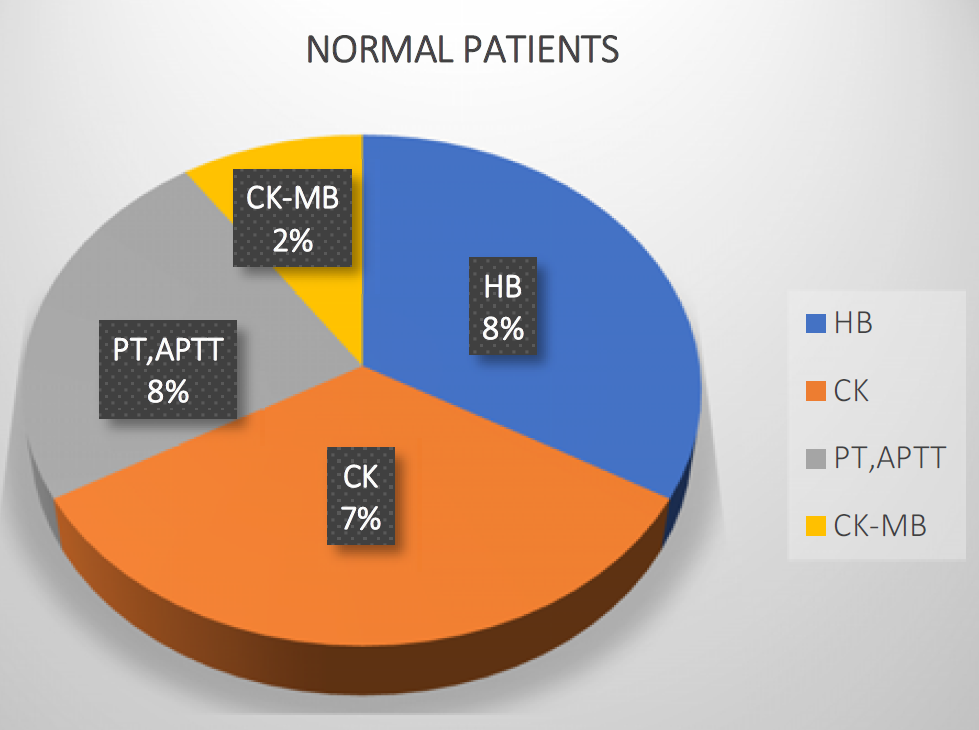
In the Figure 1 it describes the Normal patients Hematological and Biochemical parameters which are denoted according to the colour basis. Hb value is in normal range so, as the CK value which is present in the blood i.e in an adequate amount. PT and APTT is present in less amount as compared to MI patients whereas , CK-MB is present in a very low amount or almost NIL i.e negligible in a normal patients. 


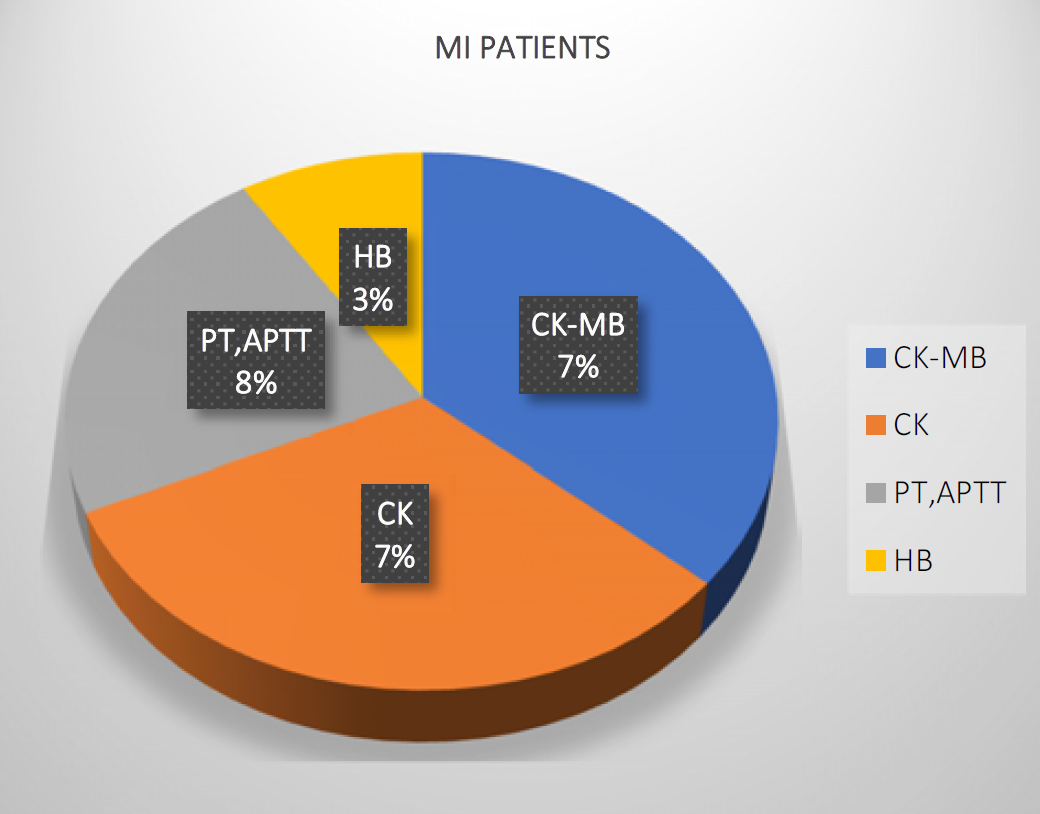
In the Figure 2 we have mentioned the parameters on the basis of colour for the patients suffering with Myocardial Infraction Patients. CK-MB is denoted in BLUE i.e higher in MI patients because normally it is not been found in our blood, unless our heart has been damaged then only its presence can be seen. Whereas, CK (denoted ORANGE) is normally seen in our blood in a normal patient i.e in less amount. PT and APTT (denoted GREY) values have been increased whereas HB (denoted YELLOW) values gradually decreased in MI patients.


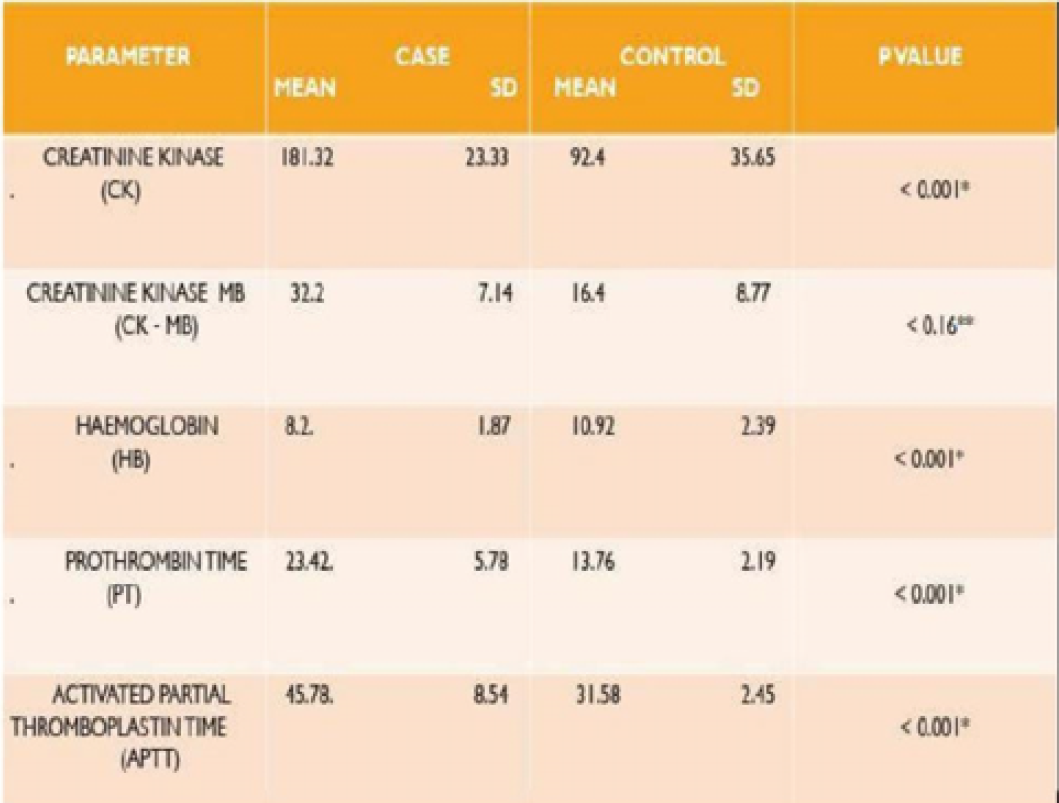
Table 1: Myocardial Infarction (MI) Patients 


Figure 1: Normal patients Hematological and Biochemical Parameters


Figure 2: The Parameters on the basis of Colour for the Patients Suffering with Myocardial Infraction Patients

DISCUSSION

Knowledge in hemoglobin varients and PT, APTT variants and ck, ck -Mb varients carrier status in this necessary in reproductive decision making to modify risk for of serious conditions such as low hemoglobin level as well as provide direct health benefit to carriers. The frequency of PT (PROTHROMBIN TIME), APTT (ACTIVATED PARTIAL THROMBOPLASTIN TIME) is an important tool determined the direction of requirements of voluntary donors as required for each zone across the country. In this study 50 blood sample are study group (25 normal patients,25 myocardial infarction patients). And the blood samples were collected on Hematological parameter for HB for the study of patients of ACS medical College for purpose of updating information on the prevalance abnormal hemoglobin varients.PT and APTT plasma samples out of 50 appearantly normal and myocardial infarction patients ACS medical College made up of 25%Normal 25% Abnormal. In this study 50 volunters (25 Normal patients ,25 Myocardial Infarction patient were included blood sample were collected on comparisons of hematological parameter to heart patients .The study has been carried out to determined the distribution of hematological and biochemical parameters between Normal and Myocardial Infarction patients [7-12].

CONCLUSION

This study should a relative high prevalence of CK, CK -Mb varients system biochemical parameters in the heart patient. Out of 50 participants we taken 25 Normal patients 25 Myocardial Infarction patients. In normal patient compared to the abnormal myocardial infarction patients. The hematological and biochemical parameters HB value is decrease and PT, APTT is Increased then biochemical parameters, CK, CK -MB values were higher in myocardial infarction compared to patient. The hematological parameter are widely routinely performed in patient with Ami (Acute Myocardial Infarction) and have the potential to prognostic indicators. The study of PT,APTT and Hemoglobin varients is not only simple data base but also create a great social awareness. In This study most of the A.C.S Medical college are high prevalence of normal patient and abnormal to study population of heart patients.

REFERENCE
  1. Yeh RW, et al. “Population trends in the incidence and outcomes of acute myocardial infarction.” New England Journal of Medicine, vol. 362, no. 23, 2010, pp. 2155–2165. https://doi.org/10.1056/NEJMoa0908610.

  2. Ibanez B et al. “2017 ESC guidelines for the management of acute myocardial infarction in patients presenting with st-segment elevation.” European Heart Journal, vol. 39, no. 2, 2018, pp. 119–177.

  3. Virani S.S. et al. “Heart disease and stroke statistics—2020 update: A report from the american heart association.” Circulation, vol. 141, no. 9, 2020, pp. e139–e596.

  4. Budzianowski J. et al. “The role of hematological indices in patients with acute coronary syndrome.” Disease Markers, 2017, pp. 1–9. https://doi.org/10.1155/2017/3041565.

  5. Sabatine M.S. et al. “Relationship between baseline white blood cell count and degree of coronary artery disease and mortality in patients with acute coronary syndromes.” Journal of the American College of Cardiology, vol. 40, no. 10, 2002, pp. 1761–1768. https://doi.org/10.1016/S0735-1097(02)02484-1.

  6. Konishi T. et al. “Prognostic value of eosinophil to leukocyte ratio in patients with st-elevation myocardial infarction undergoing primary percutaneous coronary intervention.” Journal of Atherosclerosis and Thrombosis, vol. 24, no. 8, 2017, pp. 827–840. https://doi.org/10.5551/jat.37937.

  7. Babes E.E. et al. “Value of hematological and coagulation parameters as prognostic factors in acute coronary syndromes.” Diagnostics, vol. 11, no. 5, 2021, pp. 850. https://doi.org/10.3390/diagnostics11050850.

  8. Barron H.V. et al. “Association between white blood cell count, epicardial blood flow, myocardial perfusion, and clinical outcomes in the setting of acute myocardial infarction.” Circulation, vol. 102, no. 19, 2000, pp. 2329–2334.

  9. Cannon C.P. et al. “Association of white blood cell count with increased mortality in acute myocardial infarction and unstable angina pectoris.” American Journal of Cardiology, vol. 87, no. 5, 2001, pp. 636–639. https://doi.org/10.1016/S0002-9149(00)01444-2.

  10. Ozturk C. et al. “Reduction of eosinophil percentage may predict the mortality from acute coronary syndromes.” American Journal of Cardiology, vol. 115, 2015, pp. S17.

  11. Adam A.M. et al. “Efficacy of hematological and coagulation parameters in the diagnosis and prognosis of patients with acute coronary syndrome.” Journal of Tehran Heart Center, vol. 13, no. 3, 2018, pp. 115–125.

  12. Gazi E. et al. “Prognostic value of the neutrophil–lymphocyte ratio in patients with st-elevated acute myocardial infarction.” Clinical and Applied Thrombosis/Hemostasis, vol. 21, no. 2, 2015, pp. 155–159. https://doi.org/10.1177/1076029613492011.

Recommended Articles
Research Article
Pyeloureteral Junction Syndrome: Epidemiology and Management in the Pediatric Surgery Department of the Mother and Child University Hospital of Libreville, About 08 Cases
...
Published: 05/04/2026
Download PDF
Research Article
Guardians of Wellness: Unraveling Awareness on Risk Factors and Preventive Strategies for Reproductive Tract Infections among Women in District Mandi, Himachal Pradesh
Published: 11/12/2023
Download PDF
Research Article
Posture in Peril: A Study on Awareness of Spinal Health and Mobile Device Usage Among Youth in Kangra
...
Published: 05/04/2025
Download PDF
Research Article
Mind Matters: Unveiling the Neural Nexus – A Comprehensive Exploration of Brain Tumor Awareness in District Kangra, Himachal Pradesh
...
Published: 08/12/2023
Download PDF
Chat on WhatsApp
Flowbite Logo
PO Box 101, Nakuru
Kenya.
Email: office@iarconsortium.org

Editorial Office:
J.L Bhavan, Near Radison Blu Hotel,
Jalukbari, Guwahati-India
Useful Links
Order Hard Copy
Privacy policy
Terms and Conditions
Refund Policy
Shipping Policy
Others
About Us
Team Members
Contact Us
Online Payments
Join as Editor
Join as Reviewer
Subscribe to our Newsletter
+91 60029-93949
Follow us
MOST SEARCHED KEYWORDS
Copyright © iARCON International LLP . All Rights Reserved.