Arginase effectively treats kidney failure, as it removes excess urea produced by protein breakdown in the body. High levels of arginase may lead to the risk of kidney failure. Therefore, we studied this enzyme, isolating and purifying it from the serum of patients with chronic kidney failure. We determined the optimal conditions for its activity and molecular weight and partially purified it. The study included 40 patients of both sexes (22 males and 18 females). We performed the following purification steps: protein precipitation using 65% ammonium sulfate, followed by dialysis and the Sephadex G-100 gel technique. Statistics showed that the specific activity of crude engines was 0.57 and the specific activity increased 17-fold upon purification, reaching 9.7 (U/mg). The specific activity was purified 17-fold, with an extraction rate of 64.8%. The molecular weight of purified arginase was 97,000±1,400 Daltons. The highest activity level of purified arginase was achieved in 50 μL of patient serum, pH 9.5 and a buffer solution of 100 mM sodium barbitone and 200 mM arginine as an arginase substrate, at 37°C for 30 minutes. The study concluded that the specific activity of arginase extracted from the serum of patients with renal failure increased 17-fold after purification. The properties of arginase and the optimal conditions for its activity vary depending on the source from which the purified enzyme is extracted.
Keywords
Kidney Failure
Arginase
Sephadex G-100
Isolation
Molecular Weight
INTRODUCTION
Arginase produces ornithine from urea and arginine. Its most important functions include removing ammonia (NH3), promoting cell growth and repair [1-3].
Hyperactivity of arginase is associated with cardiovascular disease because it competes with nitric oxide for arginine synthase to produce NO (EC 3.5.3.1) [4]. Arginase is a mammalian enzyme that catalyzes the production of ornithine and urea from arginine [5]. High arginase activity in mammals is associated with kidney failure, neurological dysfunction and disease. In kidney failure, arginase contributes to disease progression by decreasing nitric oxide production, elevating oxidative stress, modulating inflammatory responses and increasing fibrosis [6]. The progression of kidney disease to kidney failure is a serious health problem. It leads to many diseases, including diabetes and hypertension and is responsible for more than 40% of kidney dysfunction and disease [7]. Current treatments include controlling blood sugar and blood pressure levels, lifestyle changes and immunosuppression [8]. Increased arginase activity appears to be a major factor in kidney failure in diabetic nephropathy, glomerulonephritis-related nephropathy and hypertension Therefore, it is important to determine the role of arginase in the development of kidney failure [9].
MATERIALS AND METHODS
Population Study
The study included collecting (40) blood samples from adults with kidney failure and both sexes (22 male and 18 female) in ranged age (25-70) years for comparison purposes for the period from (10/9) September 1st to (11/12) January 1st, 2024.
Sample Collection
Serum samples were obtained 5ml of blood was placed in dry gel tubes and left to stand for 10 minutes at temperature 37°C. The serum was then centrifuged at 3000 x g for 10 minutes. The serum was separated using a micropipette and placed in tubes. It was frozen at -20°C until it was used for the techniques [10,11].
Variables Assay
Estimation of Arginase Activity: Arginase activity in patients' serum is estimated by quantitative and colorimetric methods, as demonstrated by Kokna. Ornithine is produced by the reaction of arginine with ammonia in the presence of arginase at a wavelength of 515 nm Arginase activity was measured by estimating the amount of ornithine produced, using a standard curve of graded ornithine concentrations ranging from 0.1 to 1 M. Arginine activity is expressed in micromole /L of ornithine removed from arginine. The specific activity of the enzyme is the amount of ornithine removed from arginine in mmol/min/milligram of protein [12].
Determination of Protein Concentration
The amount of protein in serum was estimated using the Lowry method. BSA was used for a standard solution to generate a standard curve, which had a suppression factor of 0.67. The method involved reducing Folin's reagent to molybdenum. The color intensity depended on the protein concentration and the absorbance was measured at a wavelength of 650 nm using a spectrophotometer [13].
Purification of Arginase
Precipitation by Ammonium Sulfate: 45 ml of serum from patients with renal failure were used and ammonium sulfate was added to it at 65% saturation to precipitate the protein. Ammonium sulfate was added gradually with stirring with a magnetic stirrer for 60 minutes at 4°C. The solution was left for 24 hours to settle and to remove the remaining proteins according to their molecular weights and the salt saturation percentage. On the second day, we discarded the precipitate and took the filtrate after sedimentation using a refrigerated centrifuge at 12,000 x g for 30 minutes. We dissolved the precipitate with a small amount of distilled water. The volume, arginase activity and protein concentration of both the filtrate and precipitate were determined. They were stored at -20°C until use in the following steps [14].
Dialysis
Dialysis technology is a process of separating small molecules from large ones. This process is performed through a cellophane membrane, a transparent, semi-permeable membrane that blocks the passage of large molecules while allowing small molecules and water to pass through. The cellophane tube is cut to the size of the protein solution to be poured, its end tightly sealed and then placed in distilled water until it swells. The resulting protein solution was then placed in a volumetric vessel containing 3 liters of 0.1 M ammonium bicarbonate (NH4HCO3) to prevent the Donnan effect, which can affect the cellophane membrane by ionizing the water and changing the pH, damaging the cellophane membrane and causing loss of its contents Ammonium bicarbonate was used to facilitate its removal without leaving any trace, as shown in the following equation: NH4HCO3(s) → NH3(g)↑ + H2O(l) + CO2.
The membrane process was carried out at approximately 4°C using a magnetic stirrer. The ammonium bicarbonate solution was emptied every 3 hours and refrigerated for 24 hours. The solution is then removed, its volume measured and protein concentration and arginase activity determined. The solution is then stored at -20°C until use in future techniques [15].
Lyophilization
The protein bands resulting from the dialysis and gel filtration processes were frozen using a cryostat to produce a concentrated protein complex. The solutions to be frozen were placed in plastic vials, placed at -20°C and then left in the cryostat until they reached the appropriate size. The protein precipitate solution was stored in sealed containers in a -20°C freezer for subsequent experiments, such as ion exchange, studying the optimal conditions for arginase purified from kidney failure patients and the effect of mineral salts on arginase activity [16].
Gel Filtration Chromatography
Gel filtration is an important technique in biochemistry, used to separate and purify compounds based on size and molecular weight differences. Proteins with large molecular weights do not enter the gel beads because their size exceeds the pore size of the beads. Therefore, they exit the gel layer with a gradually displaced solvent, which is often distilled water and a dilute buffer solution. Therefore, large molecules are removed first during the separation process, while small molecules can penetrate between the gel beads, resulting in filtration with a large operational volume The gel filtration fractions are collected using a fraction collector to measure the volume of buffer or distilled water required to elute each protein from the separation column. The eluted proteins are isolated and their absorbance intensity is measured at 280 nm [17,18].
Determination of the Molecular Weight of Arginase
The molecular weight of arginase was determined using gel filtration chromatography. A 50 cm long, 2.5 cm diameter Sephadex G-100 glass column was used to Several M.Wt markers (204-200,000) Daltons were eluted through the column using arginase. flow rate was 2 mL/portion. The absorbance was measured at a wavelength of 280 nm [19].
Study of the Optimum Conditions for the Activity of Arginase
The optimum conditions for measuring the activity of purified arginase from serum of patients with chronic renal failure were determined. Several experiments were conducted to determine the optimal conditions. The peak arginase activity was measured using different serum volumes ranging from 15 to 150 μL. The hydrogen ion concentration in the buffer solutions was not affected by the addition of any amount of base or acid to the buffer solution. The optimum pH of the buffer solution was determined and different pH values between 8 and 11 were used to determine the most favorable pH at which arginase exhibited its highest activity. Following the experiments, the optimum pH of the buffer solution was determined [2]. The effect of buffer solution concentration on enzyme activity was also measured. Sodium barbitone was used in the buffer solution at concentrations ranging from 50 to 200 mm. In addition, the optimum reaction temperature for the enzyme was determined between 25 and 50°C. The relationship between incubation time and peak enzyme activity was studied using a cyclic assay. The incubation period ranged from 15 to 60 minutes to determine the optimal time for the enzymatic reaction between the substrate (arginine) and the arginase enzyme. Different substrate concentrations (from 50 to 250 mmol/L) were used to determine the optimal substrate for the highest arginase activity [20].
Statistical Analysis
These statistics were recorded using statistical software (SPSS, version 25) and the mean test was used to calculate the mean ± standard deviation (SD) of the molecular weight of arginase. The results were analyzed with mean ± standard deviation (SD).
RESULTS AND DISCUSSION
Arginase was purified and isolated from the serum of control using three successive techniques, including protein precipitation, dialysis and gel filtration. The results are shown in Table 1, which shows the steps of arginase purification from the serum of renal failure patients. The specific activity of crude arginase was 0.29 μmol/L. When the protein precipitation technique using ammonium sulfate 65% was used, the specific activity increased to 0.48 μmol/L, with a purification rate of 1.67 times and an extraction rate of 85.5%. When using the dialysis technique, the specific activity of arginase increased to three times the specific activity of the raw, unpurified enzyme, which reached 0.77 μmol/L, with a purification rate of 2.68 times and a recovery rate of 90.7%. The specific activity of arginase also increased when using the gel filtration technique, which reached 6.17 μmol/L, which is equivalent to 17 times the specific activity of the raw, unpurified enzyme and the number of purifications reached (21.38) times and the recovery rate (74%), as shown in table 1.
Arginase was isolated and purified from the serum of patients with renal failure using four successive techniques, including protein precipitation, dialysis, ion exchange and gel filtration. The results are shown in Table (2), which shows the steps for purifying arginase from the serum of patients with kidney failure. The specific activity of the crude arginase enzyme was 0.57 IU/mg. When the protein precipitation technique was used using ammonium sulfate (65%), the specific activity increased to 0.91 IU/mg, with a purification rate of 1.59 times and a recovery rate of 82.9%. When the dialysis technique was used, the specific activity of arginase increased to three times the specific activity of the unpurified crude enzyme, which reached 1.42 μmol/L, with a purification rate of 2.49 times and a recovery rate of 80.9%. The specific activity of arginase increased when using the gel filtration technique, which reached (9.4 international units/mg), which is equivalent to (17) times the specific activity of the raw, unpurified enzyme, the recovery was (64.8%) and the number of purification times reached (17.27) times, as shown in table 2.
The Molecular Weight of Arginase was Determined using Gel Filtration
As shown in figure 2, it was found in two bands. The first band contained high arginase activity and was collected for subsequent experiments to study the optimal conditions for arginase. In contrast, the second band showed no arginase activity and was therefore discarded. The results [21]. The molecular weight of arginase was shown to be 97,000±1400.0 Daltons compared to standard markers (Figure 2). This result is similar to other studies [21], in Table 2 show the approximate molecular weight of arginase.
Table 3 depicts molecular weight of arginase produced from serum of patients with renal failure using a Sephadex G-100 column (50 cm long x 2.5 cm in diameter), at a flow rate of 2 ml/fraction: Ovalbumin: Arginase: Bovine serum albumin: Hexokinase, α-amylase, Pepsin, Solin. The optimal conditions for partially purified arginase were determined in patients with chronic renal failure,
Optimal conditions for partially purified arginase were studied in kidney failure patients and control.
Figure 3 shows that the maximum arginase activity was achieved in a volume of 50 µL of the enzyme. As shown in Figure 4, the maximum arginase activity was at a pH of 9.5. Figure 5 shows that the maximum arginase activity was at a concentration of 100 mM. Figure 7 shows the maximum arginase activity at a temperature of 37°C. Figure 6 also shows that the highest arginase activity was at a reaction incubation time of 30 minutes. Figure 8 shows that the maximum arginase activity was at a concentration of 200 mM arginine [2].
Different volumes 15-125 microliters of arginase enzyme were used to achieve the highest effectiveness. It was found that the highest effectiveness of arginase was at a volume of (50 microliters). This volume was used in subsequent experiments [22], as shown in the figure 3.
The activity of the arginase enzyme was measured using the buffer solution and the pH between 8-11 and it was found that, as shown in Figure 4, there is a clear increase in activity and the highest activity was at pH 9.5. This acidic value was used in subsequent experiments and this is don’t consistent with the study [20].
Table 1: The steps of arginase purification from serum of controls
Purification steps
Volume (mL)
Protein concentration (umol/L)
T protein conc(mg)
ARG1
conc (umol/L)
Total ARG1 conc (umol/L)
Secific protein
Purification (folds)
Recovery (%)
Crude enzyme (Serum)
40
52
2080
15
600
0.29
1
100
Ammonium sulfate precipitation 65%
27
40
1080
19
513
0.48
1.65
85.5
After Dialysis
32
22
704
17
544
0.77
2.68
90.7
Gel filtration chromatography Sephadex G-100
12
6
72
37
444
6.17
21.38
74.0
Table 2: The steps of purification of arginase from serum patients with kidney failure
Purification steps
Volume (mL)
Protein concentration (umol/L)
T protein conc(umol/L)
ARG1 conc (umol/L)
Total ARG1 conc (ng)
Secific protein
Purification (folds)
Recovery (%)
Crude enzyme (Serum)
50
56
2800
32
1600
0.57
1
100
Ammonium sulfate precipitation 65%
34
43
1462
39
1326
0.91
1.59
82.9
After Dialysis
35
26
910
37
1295
1.42
2.49
80.9
Gel filtration chromatography Sephadex G-100
14
7.5
105
74
1036
9.87
17.27
64.8
Table 3: Molecular weight and size function of standard materials used in gel filtration technique to determine the molecular weight of arginase Cefadex G-100 in renal failure
Standards name
The M.Wt of markers and ARG1 (Dalton)
Log of M.Wt of the standards
Elution volume (ml)
Hexo kinase
100,000
5.00
18
Bovine serum albumin (BSA)
67,000
4.83
26
α –amylase
58,000
4.76
28
Egg albumin
45,000
4.65
36
Pepsin
36,000
4.56
44
Insulin
5,750
3.76
70
patients
97,409.2
4.9886
22
control
97,409.2
4.942
22
Table 4: The components of an ideal reaction mixture for measuring the activity of arginine from serum patients with kidney failure and controls.
Arginine concentration (mM)
Reaction time (minutes)
Temperature (°C)
Buffer solution concentration (mM)
pH value
Arginase volume (microliter)
Enzyme source
200
30
37
100
9.5
50
serum
Table 5: Effect salts in the activity of arginase with serum of kidney failure patients and control
salts
Mm (0.1)
mM (1)
Mm (10)
Control
100
100
100
MgCl2
90(10)
20(80)
15(85)
CoCl2
86(14)
40(60)
13(87)
MnC2
127
100(0)
90(10)
CaCl2
85(15)
70(30)
20(80)
HgCl2
53(47)
40(60)
15(85)
EDTA
30(70)
42(58)
20(80)
The activity of the arginase enzyme was measured using the buffer solution and the pH between 8-11 and it was found that, as shown in Figure 4, there is a clear increase in activity and the highest activity was at pH 9.5. This acidic value was used in subsequent experiments and this is don’t consistent with the study [20].
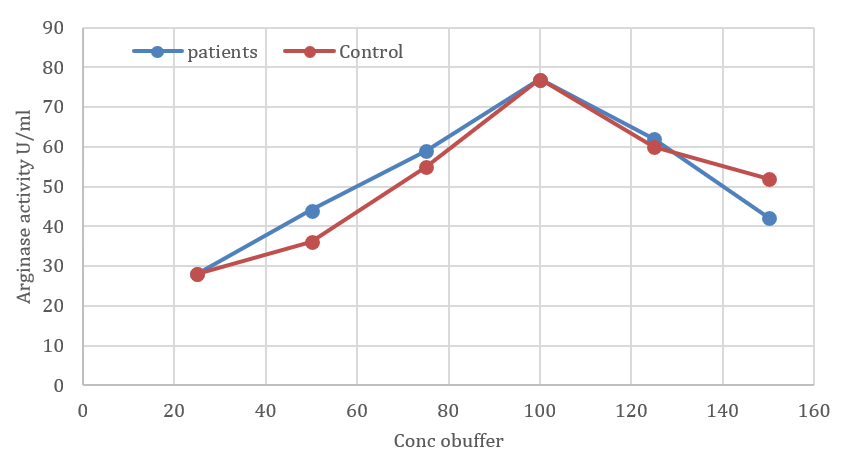
In figure 5 show, Buffer solutions are resistant to changes in hydrogen ion concentration when small 25-150 mM were added and maximum effectiveness was obtained at a concentration of 100 mM of the buffer solution. This is consistent with [23]. The reaction was carried out at different incubation periods ranging from 15-60 minutes. Figure 6 shows that the maximum activity of purified arginase is at 30 minutes and then the activity of arginase begins to decrease. This is consistent with studies [24].
The reaction was carried out at temperatures ranging between 25-50 degrees Celsius and the enzyme activity was measured during these periods. It was found that the ideal temperature for the arginase enzyme is 37 degrees Celsius, as shown in Figure 7 and this is consistent with previous research [2].
Enzyme activity was measured. Figure 8 shows that the highest activity of the arginase enzyme was 200 micromolar. This study is consistent with other studies [23].
CONCLUSION
The activity and properties of arginase vary depending on the enzyme source from which it was purified. The specific activity of impure arginase was 0.57 and purification was increased 17-fold, reaching a specific.
The purification rate was 17.87-fold and the recovery rate was 64.8%. The molecular weight of purified arginase is 97,000±1,400.0 Daltons. The highest activity of purified arginase was achieved using 50 μL of serum as the enzyme source, 100 mM sodium barbitone solution, pH 9.5, a 30-minute reaction incubation at 37°C and 200 mM arginine as the arginase substrate.
Figure 1: Gel filtration chromatography for arginase from serum with kidney failure using Sephadex G100 column 2.5 cm diameter and 50 cm length
Figure 2: Gel filtration chromatography for arginase from serum of control using Sefadex G-100 column 2.5 cm diameter and 50 cm length
Figure 3: Logarithmic M. Wt of arginase from chronic renal failure serum using Sephadex G-100 column 2.5 cm diameter and 50 cm length
Figure 4: Effect of pH values of buffer solution on arginase activity from renal failure patients and control
Figure 5: Effect of different conc of buffer solution on arginase activity from renal failure patients and control
Figure 6: Effect of (reaction time) on arginase from renal failure patients and control
When studying the effect of salts on the activity of arginase purified from patients with renal failure, which included magnesium chloride, manganese chloride, cobalt chloride, calcium chloride, cobalt chloride, mercuric chloride and EDTA at three concentrations (0.1, 1 and 10 mM), they were found to have an inhibitory effect. Arginase has a general property: it requires divalent metal ions to function fully. Arginase is a metalloenzyme catalyzed by manganese, which acts as a cofactor/activator. The table shows that manganese has a stimulating effect on arginase and increases its activity. This is consistent with studies that found manganese to be a physiological catalyst. Arginase exhibits its greatest activity in the presence of 0.1 mM Mn2+ and the enzyme's activity is enhanced by its dependence on mineral salts. When different concentrations of metal ions were added to the solution (0.1 mM), we observed a slight inhibitory effect of cobalt+, Co2+, magnesium and Mg2+ ions (Ca2+), while there was a strong inhibitory effect of mercury (Hg2+). At a concentration of 1 mM, Ca2+ ions had a slight inhibitory effect on arginase and the enzyme became inactive in the presence of cobalt, mercury, Hg2+ and Mg2+ ions. At a concentration of 10 mM, the effect of the ions was strong, as the enzyme activity was terminated by Co2+, Hg2+ and Ca2+ ions. This is consistent with studies on turtle liver arginase, which found that Zn2+, Ni2+ and Mg2+ ions inhibit arginase significantly and that the metal ions Hg2+, Ba2+ and Co2+ significantly activate arginase, while high concentrations of Mn2+ ions had no effect on arginase activity. EDTA acts as an arginase inhibitor, as shown in the table.
Figure 7: Effect of (reaction time) on arginase from renal failure patients and control
Figure 8: The effect of different concentrations of substrate on arginase activity from patients with kidney failure and controls
REFERENCE
Niu, F. et al. "Arginase: an emerging and promising therapeutic target for cancer treatment." Biomedicine & Pharmacotherapy, vol. 149, 2022, p. 112840.
Alramadhany, R.W. and Z.M.A. Hamodat. "Study the characteristics of partially purified arginase from the serum of patients with diabetes mellitus type two (DMT2) in the Nineveh Governorate." Basrah Journal of Sciences, vol. 40, no. 1, 2022, pp. 66–88.
Alramadhany, R.W. et al. "Study the arginase activity and its correlation with liver and kidney functions for patients with type-2 diabetes mellitus in Nineveh Governorate." Egyptian Journal of Chemistry, vol. 64, no. 12, 2021, pp. 7075–7082.
Rahul, G. et al. "Molecular structure, metabolic pathways and clinical relevance of arginase: a review." Asian Journal of Biological and Life Sciences, vol. 13, no. 2, 2024, p. 567.
Heuser, S.K. et al. "Biochemistry, pharmacology and in vivo function of arginases." Pharmacological Reviews, 2024, p. 100015.
Caldwell, R.W. et al. "Arginase: a multifaceted enzyme important in health and disease." Physiological Reviews, vol. 98, no. 2, 2018, pp. 641–665.
Unnikrishnan, S.N. et al. "Role of diabetes mellitus and hypertension in the progression of chronic kidney disease: a systematic review." Journal for International Medical Graduates, vol. 1, no. 2, 2022.
Bauer, A.C. et al. "Immunosuppression in kidney transplantation: state of the art and current protocols." Current Pharmaceutical Design, vol. 26, no. 28, 2020, pp. 3440–3450.
Clemente, S.G. et al. "Arginase as a potential biomarker of disease progression: a molecular imaging perspective." International Journal of Molecular Sciences, vol. 21, no. 15, 2020, p. 5291.
Hamodat, Z.M.A. "Study of serum adenosine deaminase-2 (ADA-2) activity in rheumatoid arthritis." Basrah Journal of Sciences, vol. 39, no. 1, 2021, pp. 119–134.
Hamodat, Z. et al. "Evaluation of the levels of lactate dehydrogenase (LDH), alkaline phosphatase (ALP), calcium and phosphorus in Iraqi non-Hodgkin lymphoma patients treated and untreated." The Eurasia Proceedings of Science Technology Engineering and Mathematics, vol. 9, 2020, pp. 41–45.
Gopalakrishna, R. and B. Nagarajan. "Use of centrifuge column technique in estimation of arginase in human serum." Biochemical Medicine, vol. 22, no. 1, 1979, pp. 70–75.
Ranjini, H. et al. "A specific absorbance to estimate a protein by Lowry’s method." Advanced Science Letters, vol. 23, no. 3, 2017, pp. 1889–1891.
Pei, K. et al. "Improvement of sludge dewaterability by ammonium sulfate and the potential reuse of sludge as nitrogen fertilizer." Environmental Research, vol. 191, 2020, p. 110050.
Bansal, P. and D. Ajay. "Laboratory dialysis: past, present and future." Recent Patents on Biotechnology, vol. 6, no. 1, 2012, pp. 32–44.
Zieniuk, B. et al. "Recent advances in the enzymatic synthesis of lipophilic antioxidant and antimicrobial compounds." World Journal of Microbiology and Biotechnology, vol. 38, 2022, pp. 1–16.
Masoodi, K. et al. "Gel-filtration or size-exclusion chromatography." Advanced Methods in Molecular Biology and Biotechnology, 2021, pp. 147–149.
Hamodat, Z. "Properties of alpha-L-fucosidase for serum of patients with hepatocellular cancer and cytotoxicity on some cancer cell lines." The Ukrainian Biochemical Journal, vol. 93, 2021, pp. 76–86.
Al-Samarrai et al. "Purification and determination of the arginase enzyme activity from kidney patients." Journal of Physics: Conference Series, 2021, IOP Publishing.
Ibrahim, H. et al. "Effects of temperature, pH and agitation rate on the production of microbial L-arginase." Journal of Pharmacy and Biological Sciences, vol. 13, 2018.
Hassabo, A.A. et al. "L-arginase from Streptomyces diastaticus mam5 as a potential therapeutic agent in breast cancer: purification, characterization, G1 phase arrest and autophagy induction." International Journal of Biological Macromolecules, vol. 224, 2023, pp. 634–645.
Reczkowski, R.S. and D.E. Ash. "Rat liver arginase: kinetic mechanism, alternate substrates and inhibitors." Archives of Biochemistry and Biophysics, vol. 312, no. 1, 1994, pp. 31–37.
Nile, S.H. and S.W. Park. "Purification and characterization of buffalo liver L-arginase and its kinetic properties with dihydropyrimidine and metal ions." 2016.
Roubelakis, K.A. and W.M. Kliewer. "Enzymes of Krebs-Henseleit cycle in Vitis vinifera L: iii. In vivo and in vitro studies of arginase." Plant Physiology, vol. 62, no. 3, 1978, pp. 344–347.
Recommended Articles
Review Article
Hyperuricemia and Cardiovascular Diseases: A Comprehensive Review
Neha Verma,
Ritika Kashyap
Published: 25/07/2024
Download PDF
Research Article
Role of Maternal Serum Lactate Dehydrogenase in Determining the Severity of Preeclampsia: A Case-Control Study
Alhan Ali Salih,
...
Sabah Hasan Mohammed
Published: 04/10/2024
Download PDF
Research Article
Euthanasia is a Medical Act Which Remove Any Pain
Siniša Franjić
Published: 30/11/2021
Download PDF
Research Article
C-Reactive Protein, Vitamin D and Calcium as Biomarkers for the Diagnosis in some Osteoarthriris Patients who Attending Al-Refai Teaching Hospital
Ahlam Mohsen Kudaier
Published: 30/06/2024
Download PDF
PO Box 101, Nakuru
Kenya.
Email: office@iarconsortium.org
Editorial Office:
J.L Bhavan, Near Radison Blu Hotel,
Jalukbari, Guwahati-India
Ameen Sulaiman, J. & Mohammed Ali Ahmed Hamodat, Z. (2025). Isolation and Partial Purification of Serum Arginase in Patients with Renal Failure and Controls: Comparative Study. IAR Journal of Clinical & Medical Biochemistry, 5(1), 1-9.
MLA
Ameen Sulaiman, Jalal and Zahraa Mohammed Ali Ahmed Hamodat. "Isolation and Partial Purification of Serum Arginase in Patients with Renal Failure and Controls: Comparative Study." IAR Journal of Clinical & Medical Biochemistry 5.1 (2025): 1-9.
Chicago
Ameen Sulaiman, Jalal and Zahraa Mohammed Ali Ahmed Hamodat. "Isolation and Partial Purification of Serum Arginase in Patients with Renal Failure and Controls: Comparative Study." IAR Journal of Clinical & Medical Biochemistry 5, no. 1 (2025): 1-9.
Harvard
Ameen Sulaiman, J. and Mohammed Ali Ahmed Hamodat, Z. (2025) 'Isolation and Partial Purification of Serum Arginase in Patients with Renal Failure and Controls: Comparative Study' IAR Journal of Clinical & Medical Biochemistry 5(1), pp. 1-9.
Vancouver
Ameen Sulaiman J, Mohammed Ali Ahmed Hamodat Z. Isolation and Partial Purification of Serum Arginase in Patients with Renal Failure and Controls: Comparative Study. IAR Journal of Clinical & Medical Biochemistry. 2025 Jan;5(1):1-9.


 Download PDF
 Download XML