Contents
Download PDF
pdf Download XML
982 Views
427 Downloads
Share this article
Research Article | Volume 1 Issue 2 (July-Dec, 2020) | Pages 1 - 4
Effect of Sunflower Oil and Sesame Seed Treatment Mixture at Different Ratios on Postharvest Quality of Quail Fresh Meat
 ,
1
Laboratory of Animal Husbandry, Faculty of Fisheries and Food Sciences, University Malaysia Terengganu, 21030 Kuala Nerus, Terengganu, Malaysia
2
Laboratory of Postharvest Technology, Faculty of Fisheries and Food Sciences, University Malaysia Terengganu, 21030 Kuala Nerus, Terengganu, Malaysia
Under a Creative Commons license
Open Access
Received
Sept. 3, 2020
Revised
Oct. 9, 2020
Accepted
Nov. 19, 2020
Published
Dec. 15, 2020
Abstract

To fulfill the food demand from consumer, any potential fresh food must be given fully attention in term of their quality to ensure the purchasing activity could be done at the market level. Other than well-known meat produces from all ruminant animals such as cow and goat, quail is also one of the options for meat produces. However, similar issue is also faced by quail meat which is meat deterioration due to oxidation process after slaughtering. In this study, treatment mixture consisting of sunflower oil with sesame seed at three different ratios (1:3, 1:1 and 3:1) were applied on fresh quail meat to determine the effect on postharvest quality of quail meat. Postharvest parameters which observed in this study were weight loss, color, pH and firmness of the meat. Results showed in term of prolong the shelf life with maintaining meat quality, treatment 3 at 3:1 ratio gave significant effects (p<0.05) compared to control for weight loss, pH and firmness parameters. Meanwhile for the colour parameter, none of the treatment ratios showed the ability for maintaining the red colour of meat.

Keywords
INTRODUCTION

Japanese quail (Coturnix japonica) is the smallest species in poultry group which getting more exposure to be another option for human food supply. Quail is also one of the most desirable alternatives to chicken and other animal meat due to their low-fat content and good level of phospholipid where quail mainly reared for its egg and meat [1]. Regarding to this opportunity, any issues which can harmful the quail meat quality should be studied and one of the issues is meat deterioration. Poultry product including quail meat is susceptible to deterioration due to the oxidation reaction and lipid peroxidation of polyunsaturated fatty acid [2]. Meat deterioration obviously will affect the purchasing decision among the consumers. This also will decrease the number of food supply option for consumers. At commercial level, synthetic food additive has been used to prolong meat shelf life and maintaining meat quality. However, drug residue leftover in meat was reported and has led the researchers to explore natural sources to face this meat quality issue [3,4].  Natural sources as an alternative to synthetic based antioxidant was proposed to be used as nutraceuticals, pharmaceuticals, antioxidant, colouring and flavouring in meat products as nowadays it is started to reach its maximum request, globally.  Recently, plant oil from wide ranges of plants species have been tested as additive for meat quality [5]. Thus, the study was conducted to evaluate the effect of designated treatment mixture at different ratios on postharvest quality of fresh quail meat.     

MATERIALS AND METHODS

Experimental Materials and Location

Japanese quail (Coturnix japonica) carcasses were obtained from a quail farm in Marang District, Terengganu (5°12’27.76” N, 103°12’17.8” E). Immediately after slaughtered, carcasses were properly packed for transportation to the Laboratory of Post-Harvest Technology, University Malaysia Terengganu (5°24’11.39” N, 103°05’9.60” E). Once arrived, all samples were thoroughly washed to ensure any foreign material such as feather and dust were removed.  Carcasses were equally divided into 4 batches according to the treatment (Control, 1:3, 1:1, 3:1 treatment solution ratios). Quail’s carcasses then were stored in walk-in-chiller at 5ºC.  Sunflower oil and sesame seed were purchased from local market and further processes were all conducted at this same laboratory.


Preparation of Experimental Solution

Sesame seed was cleaned with tap water followed by filtration process to separate them from any unwanted dirt. The seeds were then dried in the oven at 50ºC until the seed loss its moisture.  After a couple of days, dried sesame seed was weighted accordingly (Treatment 1: 100g, Treatment 2: 150g and Treatment 3: 62.5g) and were crashed into fined powder. Sesame seed powder was boiled in distilled water to be a decoction solution. Decoction was done until the oil started to appear on the surface of boiled water.  Sesame seed decoction was set to cool for a few minutes before it was filtered to remove the remaining seeds.  Sesame seed decoction was filled in 3 different jugs representing 3 different treatment solution. Meanwhile, the commercial sunflower oil was measured up to 625mL, 1500mL and 1000mL and were mixed with 1000mL, 1500mL, and 625mL of sesame seed decoction, respectively.  Egg yolk was added in the solution as an emulsifier for each solution. 


Post-Harvest Parameters Assessment

Weight Loss: The weight loss of quail’s carcasses was evaluated by using percentage of weight loss calculation method. Weight analysis of carcasses was measured by using an electronic balance for every 2 days of interval.  Weight difference between initial day and final weight was considered as total weight loss and expressed as percentage weight loss by using equation below [6].


Percentage of Weight Loss % = (Initial Weight - Final Weight) / Initial Weight x 100


Colour

Analysis of colour for quail’s carcasses was observed for every 2 days interval.   The carcasses lightness (L*), redness (a*) and yellowness (b*) value were all measured by using Minolta Chroma-meter (Model CR-400X Minolta Camera Co. Ltd. Japan) [7].  Commission Internationale I’Eclairage (CIE; L*, a*, b*) readings that appeared on the chromameter’s monitor was recorded and analyzed. 


Firmness

Analysis of carcasses firmness was measured for every 2 days of interval by using TA-Tx Plus Texture Analyser (Stable Micro Systems, United Kingdom). Carcasses were analyzed by using 5 mm diameter probe P/5. The machine was set up for pre-test speed at 2.0 mm/s; post-test speed at 5.0 mm/s; distance at 5.0 mm; and time for 5.0s [8]. The firmness value was expressed in Newton (N).


pH

Analysis for quail’s pH value was evaluated for every 2 days of interval. Quail carcasses for each treatment were took out from storage and cut into 5g muscle and ground in 30 mL of distilled water by using stomacher. Homogenized quail’s meat solution then filled in beaker. The pH value of the homogenized meat was measured by using pH meter (GLP 21+, Crison, Barcelona, Spain). 


Data Analysis

Experimental design involved in this study was considered as complete randomized design (CRD). The effectiveness of different ratios solution (sunflower oil to sesame seed decoction) was evaluated to the statistical One-Way Analysis of Variance (ANOVA) as well as Kruskal-Wallis and Friedman’s test. Any statistical significance was determined at p<0.05 and pairwise comparison was used to analyzed the significant difference between treatment for data obtained from each parameter observed. Data analysis was made by using IBM SPSS Statistic 25. In this study case, 3 carcasses were used on day-0 as an initial reading for all parameter. Every group including control was placed with 24 carcasses. 
RESULTS AND DISCUSSION

Percentage Of Meat Weight Loss (%)

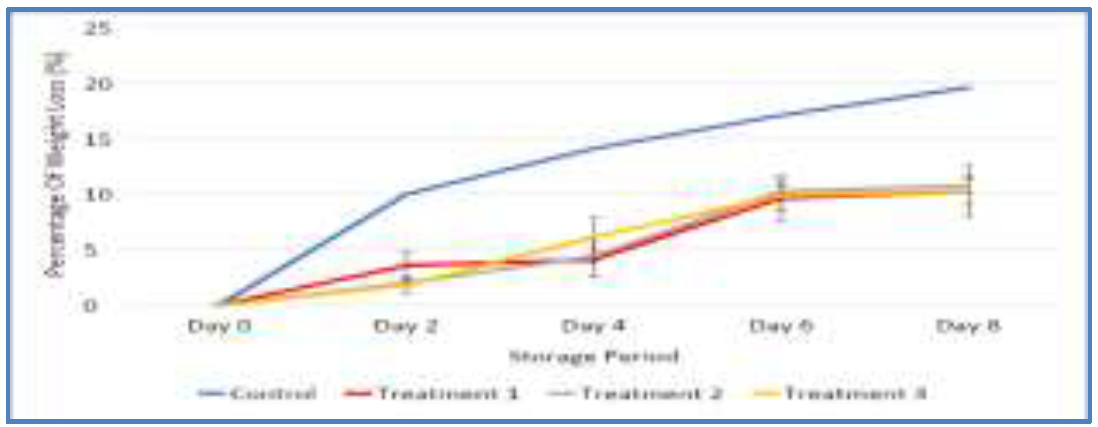
Result in Figure 1 indicates the amount of weight loss experienced by quail carcasses during the storage period. The percentage of weight loss shows how much water does the carcasses loss during storage.  At the end of day-8, there was a significant difference between control and treatment 3 (p<0.05).  Treatment 3 was able to maintain the body weight of the carcasses until the end of the study.  The treatment ratios of sunflower oil to sesame seed decoction (3:1) proved that high amount of sunflower oil was able to slowdown water loss in quail meat.  Sunflower oil has the ability to reduce oxidation of the meat due to the presence of phenolic compound [9].  


Meat Colour Observation (L* a* b*)

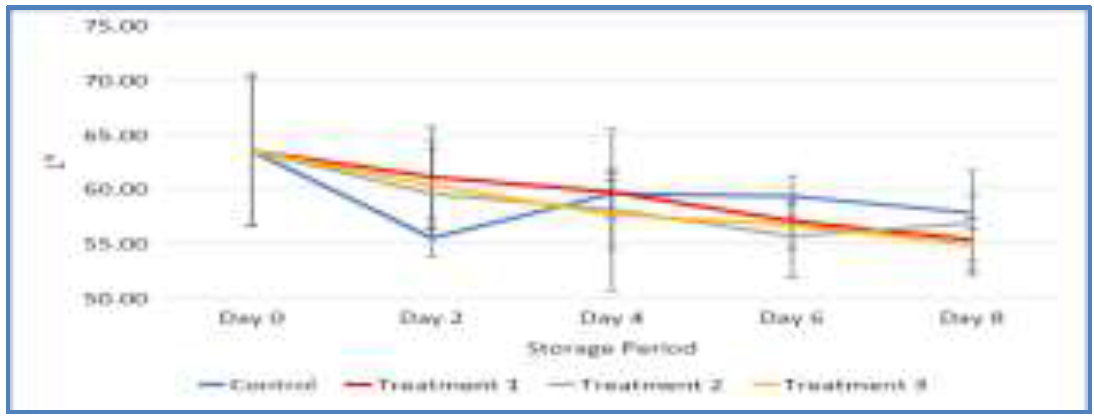
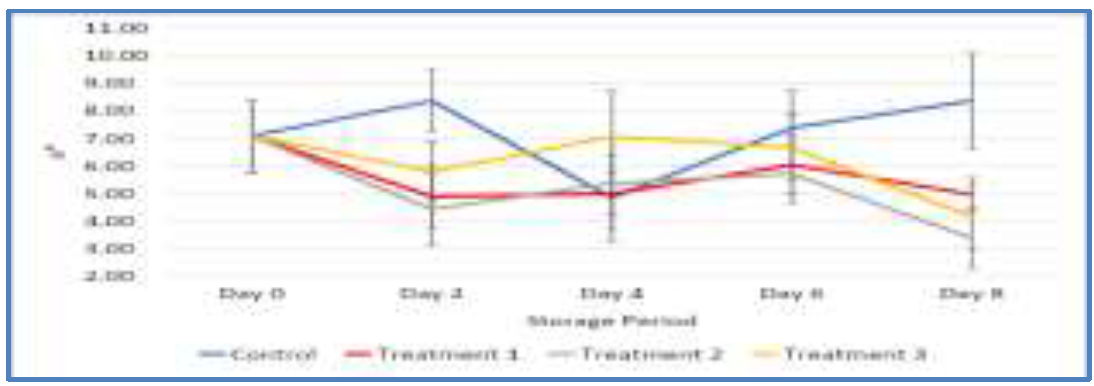
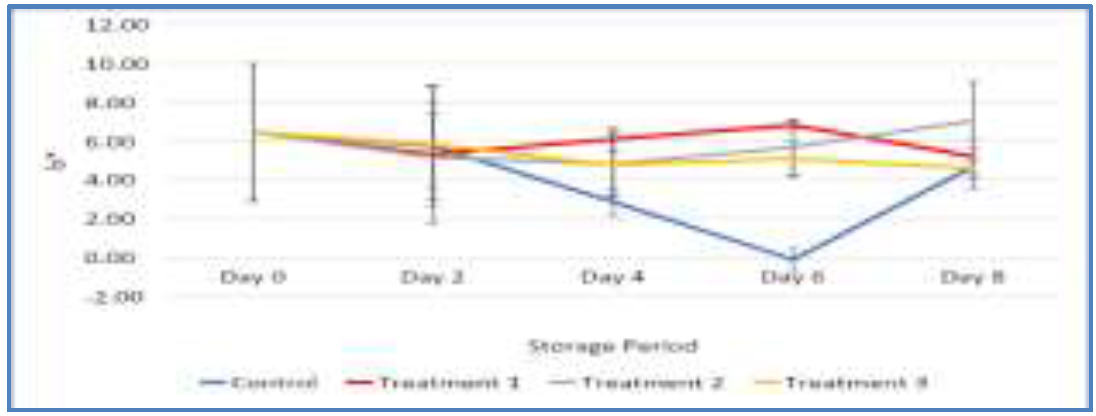
Meat colour needs to be maintained or bright in colour in order to reach its market requirement [10].  The treatment for L* value of colour was not significant (Figure 2). The application of both sunflower oil and sesame seed decoction unable to slow down the colour changes on the carcasses.  The a* value of colour is indicating the redness of the meat (Figure 3). At the end of day-8, there was a significant difference between control and treatment 2 (p<0.05).  Thus, untreated quail a* value indicates that the redness of the quail was retain. The b* value of colour indicates the yellowness of the meat (Figure 4). At the end of day-8, there was no significant difference.  Thus, the application of the plant oil was unable to slow down the colour changes of the quail meat. There was no natural ingredient from both materials can influenced the quail meat colour maintaining up to this study.


Figure 1: Percentage of Weight Loss (%)


Figure 2: The Lightness of Carcasses (L*)


Figure 3: The Redness of Carcasses (a*)


Figure 4: The Yellowness of Carcasses (b*)


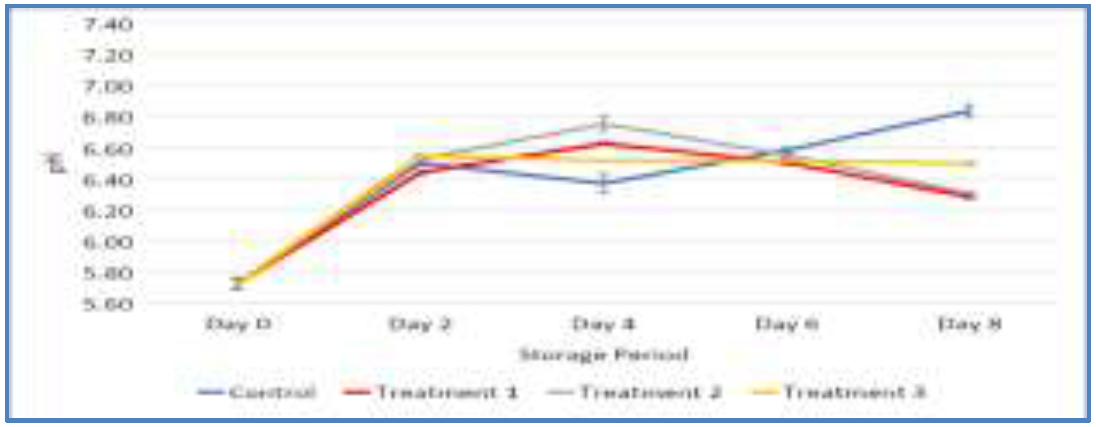
Figure 5: Meat pH Values


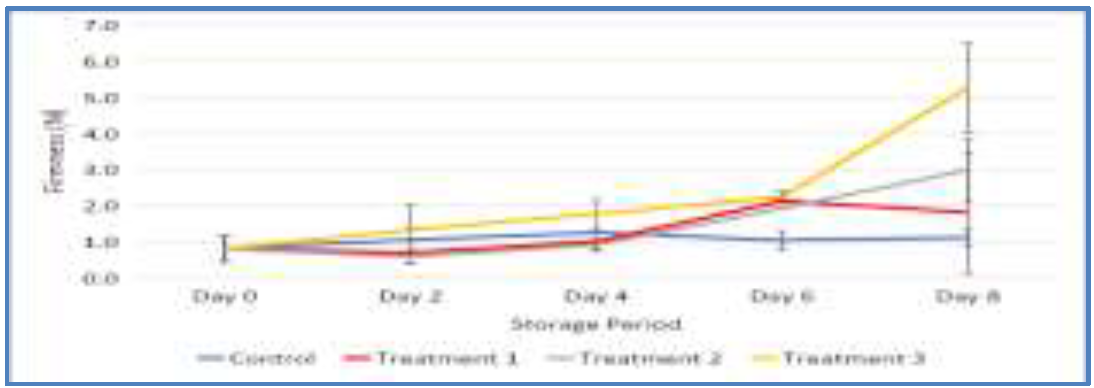
Figure 6: Firmness of Carcasses (N)


Determination of Meat pH

On day-4, there was a significant difference between treatment 2 and control (p<0.05). Figure 5 shows the meat pH values.  On day-8, there was a significant difference between treatment 1 and control (p<0.05).  Poultry meat as well as quail need to maintain its pH value (range of 5.5 to 6.3) [11].  Treatment 3 are able to maintain the quail pH at the end of the storage period.  This study showed that treatment 3 are significantly effective on maintaining pH value.  Loss of ATP in muscle during storage had trigger the conversion of glycogen to lactic acid via anaerobic thus causing pH decrement [12].  Due to the presence of phenolic compound in sunflower oil and sesame decoction, the conversion of glycogen is able to slow down.  


Meat Firmness

On day-6 and 8, there was a significant difference between control and treatment 3 (p<0.05).  Quail meat needs to maintain its firmness as an indicator to be categorized as good meat [11]. Treatment 3 increased the tenderness of quail meat and untreated quail able to maintain the firmness of the quail meat.  Sesame seed and sunflower oil were able to increase body tissue integrity [13]. However, the main objective is to maintain the condition of quail carcasses. Thus, untreated quail are significantly effective than treatment 3.  

CONCLUSION

In conclusion, the current study showed that treatment of quail carcasses with different ratios of sunflower oil to sesame seed decoction (1:3, 1:1, 3:1) are significantly effective to improve the shelf life and postharvest qualities of quail carcasses in term weight loss, pH and firmness of meat.  However, the meat colour was not influenced by these experimental materials in term of maintaining the red colour of meat. Hence, the potential of these materials to be the natural additive for postharvest quality of quail meat are still there and further study is recommended. The natural ingredient existed in both sunflower oil and sesame seed can be a promising food additive for quail meat as well as other meat produces.


Acknowledgment

Special thanks to the Faculty of Fisheries and Food Sciences of UMT through Final Year Student Allocation for research funding. Thanks to the local quail farmers for supplying us the fresh quail carcasses. Also, thanks to all the laboratory staff for helping during the study. 

REFERENCE
  1. Ioniţă, L. et al. “Bibliographical study regarding the quails’ meat quality in comparison to the chicken and duck meat.” Lucrări Ştiinţifice-Seria Zootehnie, vol. 56, 2010, pp. 224–229.

  2. Estévez, M. “Oxidative damage to poultry: From farm to fork.” Poultry Science, vol. 94, no. 6, 2015, pp. 1368–1378. https://doi.org/10.3382/ps/pev094.

  3. Florou-Paneri, P. et al. “Performance of chickens and oxidative stability of the produced meat as affected by feed supplementation with oregano, vitamin c, vitamin e and their combinations.” Archiv Fur Geflugelkunde, vol. 70, no. 5, 2006, pp. 232–240.

  4. Thomas, J. Food Additives – A Growing Global Market. The Global Food Additives Market – 6th Edition Report, 2014.

  5. Stevanović, Z.D. et al. “Essential oils as feed additives—future perspectives.” Molecules, vol. 23, no. 7, 2018, p. 1717. https://doi.org/10.3390/molecules23071717.

  6. Hatoum, I.J. and L.M. Kaplan. “Advantages of percent weight loss as a method of reporting weight loss after roux-en-y gastric bypass.” Obesity, vol. 21, no. 8, 2013, pp. 1519–1525.

  7. Janisch, S. et al. “Color values and other meat quality characteristics of breast muscles collected from 3 broiler genetic lines slaughtered at 2 ages.” Poultry Science, vol. 90, no. 8, 2011, pp. 1774–1781.

  8. Khlas, B. et al. “Chemical composition and physicochemical properties of meatballs prepared from mechanically deboned quail meat using various types of flour.” International Journal of Poultry Science, vol. 10, no. 1, 2011, pp. 30–37.

  9. Rehab, F.A. and A.M. El Anany. “Physicochemical studies on sunflower oil blended with cold pressed tiger nut oil during deep frying process.” Grasas y Aceites, vol. 63, no. 4, 2012, pp. 455–465.

  10. American Meat Science Association. AMSA Meat Color Measurement Guidelines. American Meat Science Association, 2012.

  11. Moawad, R.K. et al. “Improving the quality and shelf-life of refrigerated japanese quail (coturnix coturnix japonica) carcasses by oregano/citrate dipping.” Journal of Biological Sciences, vol. 18, no. 7, 2018, pp. 389–398.

  12. Ahmad, S. et al. “Effect of curing, antioxidant treatment, and smoking of buffalo meat on ph, total plate count, sensory characteristics, and shelf life during refrigerated storage.” International Journal of Food Properties, vol. 8, no. 1, 2005, pp. 139–150.

  13. Mohamed, N.E. and M.M. Wakwak. “Effect of sesame seeds or oil supplementation to the feed on some physiological parameters in Japanese Quail.” Journal of Radiation Research and Applied Sciences, vol. 7, no. 1, 2014, pp. 101–109.

Recommended Articles
Research Article
Strategy of Cocoa Commodity Based Agrowisata Development in Jembrana Regency
...
Published: 30/01/2021
Download PDF
Research Article
Survey on the pollutants effect of some physicals and chemicals characteristics of the White Nile River around Khartoum state in the Sudan
...
Published: 20/01/2021
Download PDF
Research Article
Effecting of Hormonal Gonads (Test, Lh, Pro) and Dopamine on Transitional Nuclear Protein /1 Gene Frequency in an Infertile-Men
Published: 18/09/2023
Download PDF
Research Article
The study on priciple of herd health maagement assesment of Jimma University college of Agriculture And Veterinary Medicine dairy farm
...
Published: 01/04/2023
Download PDF
Chat on WhatsApp
Flowbite Logo
PO Box 101, Nakuru
Kenya.
Email: office@iarconsortium.org

Editorial Office:
J.L Bhavan, Near Radison Blu Hotel,
Jalukbari, Guwahati-India
Useful Links
Order Hard Copy
Privacy policy
Terms and Conditions
Refund Policy
Shipping Policy
Others
About Us
Team Members
Contact Us
Online Payments
Join as Editor
Join as Reviewer
Subscribe to our Newsletter
+91 60029-93949
Follow us
MOST SEARCHED KEYWORDS
Copyright © iARCON International LLP . All Rights Reserved.