Seasonal Abundance and host plant preference of the Tomato Leaf Miner Liriomyza bryoniae (Kaltenbach) (Diptera: Agromyzidae) on three Summer Host Plants in Janzour Region, Libya
Albasha. Mohamed O.
1
,
Elkhouly. Alansary R.
2
,
Nawal Shelig
2
1
Department of Zoology faculty of science -Zawia University, Libya
2
Department of Biology faculty of education - Zolton, Sabratha University, Libya
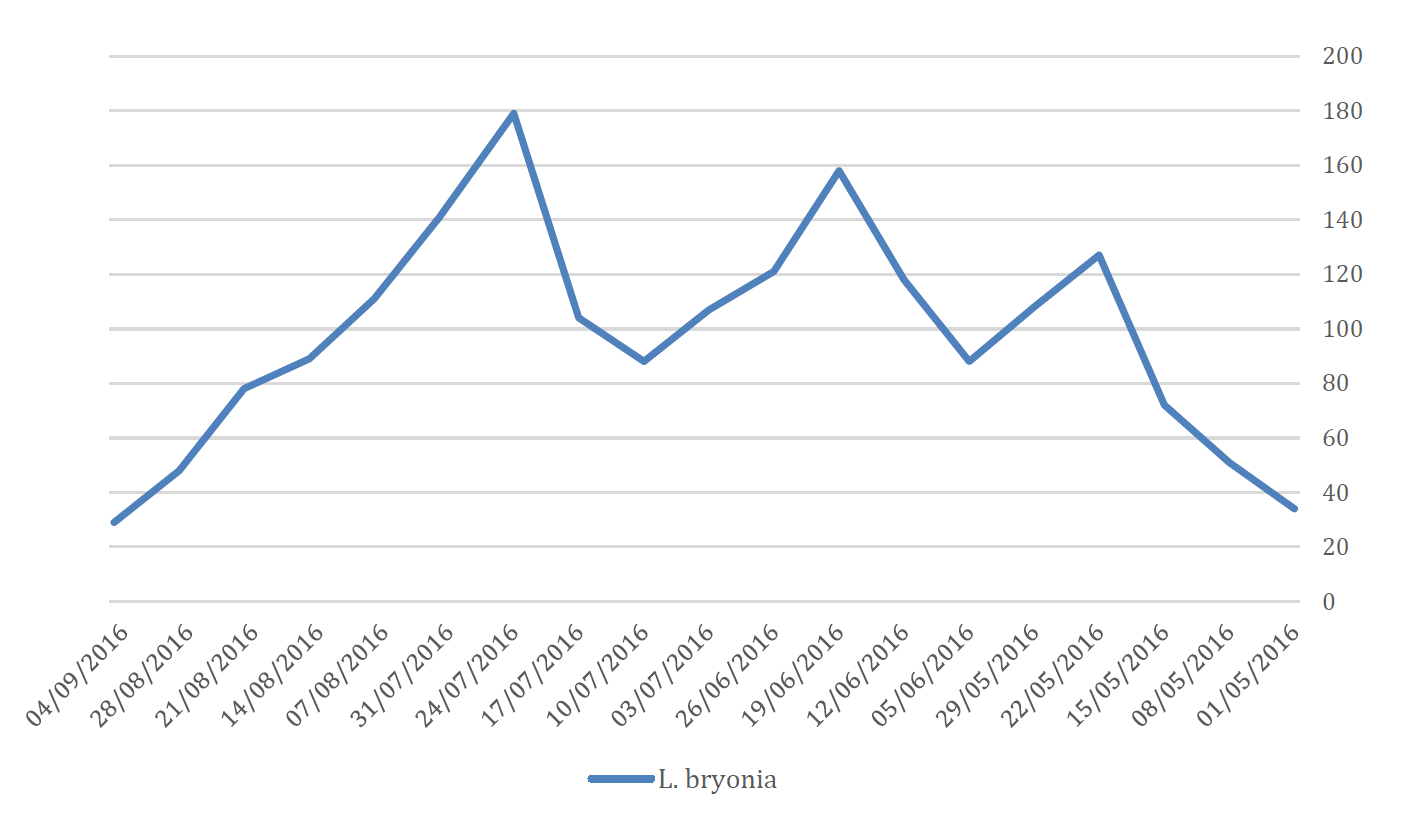
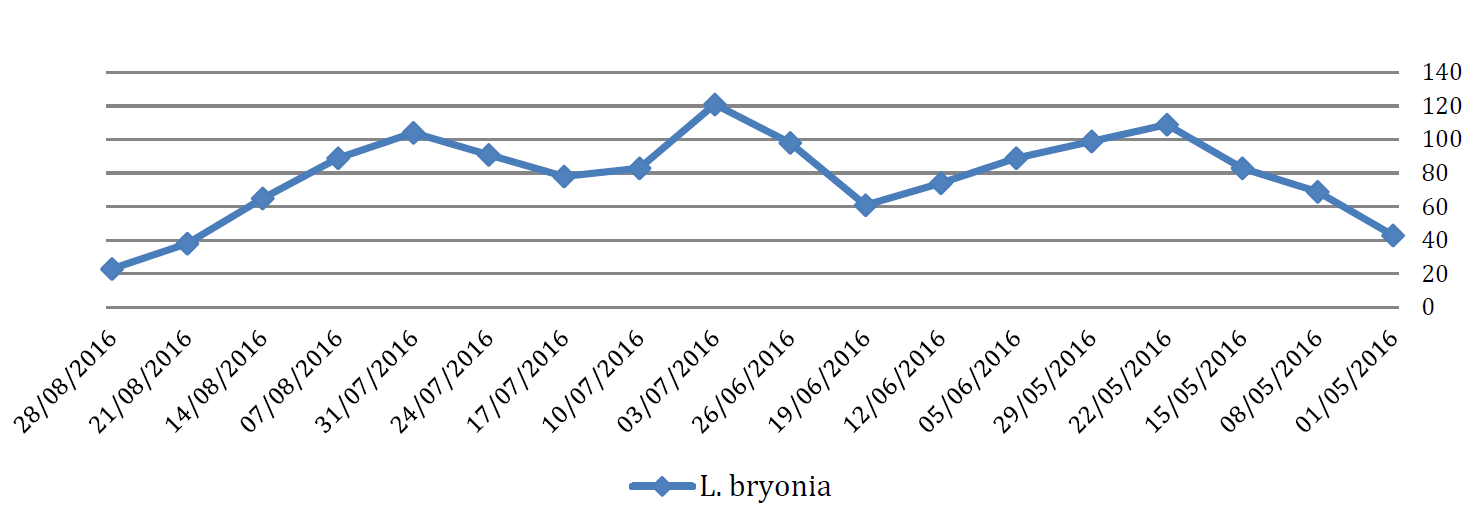
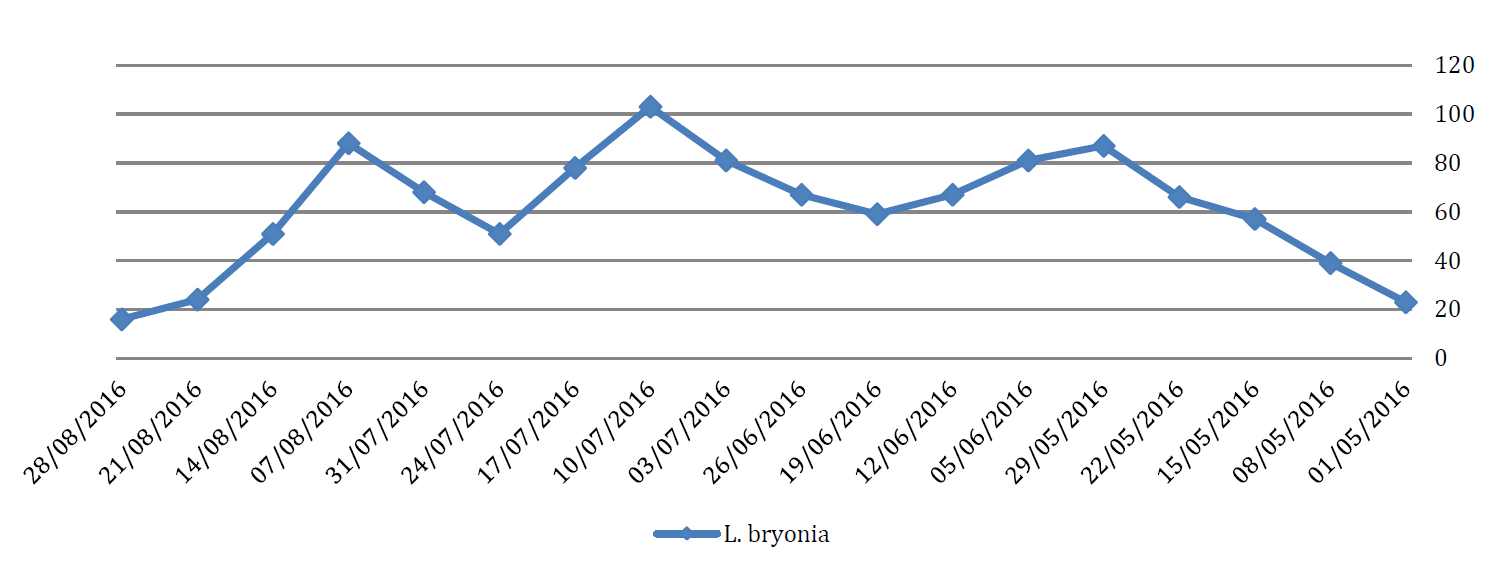
Background: L. bryoniae is a Palearctic species which probably originates from southern Europe, where it occurs commonly outdoors but has now spread to many parts of central and northern Europe and is also reported in North Africa (Morocco and Egypt), as well as in several countries in Asia. L. bryoniae is polyphagous and as such can feed indiscriminately on plants from a number of different orders, including many vegetables and ornamental species. Objectives: The present study aimed to investigate the population abundance of the tomato leafminer L. bryoniae on three selected host plants. On the other hand, host plant preference by L. bryoniae was investigated. Methods: 100 infected leaves were collected from each host plant. Samples were kept in plastic bags and transferred to be examined in the laboratory. Number of living L. bryoniae larvae were counted and recorded. Results: L. bryoniae larvae recorded low abundance on Kidney bean in early May, then the population increased recording three peaks of abundance recording (127, 158 and 179 individuals/100infested leaves) occurred in 22th of May, the 19th of June, 24th of July.On tomatoes L. bryoniae recorded low numbers in early May, then the population increased recording three peaks of abundance (109, 121 and 104 individuals/100infested leaves) occurred in 22th of May, the 3rd of July, 31th of July.On bell pepper L. bryoniae recorded low numbers in early May, then the population increased recording three peaks of abundance (87, 103 and 88 individuals/100infested leaves) occurred on 29th of May, the 10th of July and the 7th of August. Conclusions: L. bryoniae larvae recorded low numbers in the beginning of the growing season in early May on the three summer host plants, then the population increased recording 3-4 peaks of abundance.
Keywords
L. bryoniae
Tomato leafminer
Population abundance
Host plant preference
Kidney bean
Tomato
Bell pepper
Polyphagous
INTRODUCTION
The fly genus Liriomyza (Diptera: Agromyzidae) contains hundreds of species, most of which are leaf miners; their larvae tunnel within leaf tissue forming damaging and disfiguring mines. These include four species that are considered as agricultural pests among them the (tomato leaf miner) L. bryoniae. with wide host range of vegetables and ornamentals. L. bryoniae which has long been established as an important pest in open fields and under glass, was found across Europe and Asia, as well as parts of North Africa [1]. L. bryoniae was first described on Bryonia (Cucurbitaceae), but it has been rarely reported on that host [2] L. bryoniae larvae prefers to mine the spongy mesophyll of the leaf tissue [3]. In the pan-temperate region, L. bryoniae has been reported to complete its life cycle on plants from 16 families. [4] studied the population densities and the host range of L. bryoniae under Egyptian climatic conditions and found that, L. bryoniae is a highly polyphagous species on important primary hosts of economic importance include: cabbages (Brassica oleracea var. capitata), cucumbers (Cucumis sativus), lettuces (Lactuca sativa), courgettes (Cucurbita pepo), melons (Cucumis melo), tomatoes (Lycopersicon esculentum) and watermelons (Citrullus lanatus). The life history of L. bryoniae is typical of the genus. A fertilized adult female will deposit eggs individually through holes made in a leaf, formed by the thrusting of the female’s ovipositor through either surface, adaxail or abaxail, of a leaf and into the mesophyll. In this way females form two types of leaf puncture: a fan shaped puncture used only for feeding and a tubular puncture used for both feeding and oviposition [5]. Each oviposition leaf puncture contains just one opaque ellipsoidal egg [6]. Three larval instars develop within the leaf and by continued feeding mine their way through the leaf until the final larval instar cuts a semi-circular exit hole through the leaf surface. The prepupal larvae leaves its mine and pupates in the soil at the base of the plant at a depth of approximately 5cm. Pupal color ranges from light yellow to dark-brown. Adults emerge from pupae by inflating the ptilinum [5] once fully sclerotized, adult L. bryoniae have a wing length ranging from 1.7 to 2.1mm and are predominantly black and yellow with a black mesonotum and yellow thoracic shield. The genders of L.bryoniae are easily identifiable as females possess a pointed black tip to their abdomen which the males lack. Total development time from egg to adult emergence in tomato takes 26.5 days at 20°C [6].
Natural abundance of the leafminer L.bryoniae was studied on four winter host plants [broad bean (Vecia faba), pea (Pisum sativum) , Mallow (Malva sylvestris) and snow thistle (Sonchus oleraceus) in Ojilate region . L. bryoniae showed low populations in December on all studied host plants except broad bean. High populations were observed in February and march then the population decreased till the end of the growing season. L. bryoniae recorded three peaks of abundance on all host plants, except broad bean (4 peaks). The highest peak recorded 104, 260, 156 and 222 individuals/ 100 infested leaves on broad bean, pea, mallow and snow thistle respectively [7].
Therefore, the present investigation was undertaken to study the Population abundance of the tomato leafminer L.bryoniae on three summer selected host plants.
MATERIALS AND METHODS
Host Plants
Three summer host plants; kidney bean (Phasulus vulgaris) tomatoes (Solanum lycopersicum) and bell pepper, (Capsicum annuum)
Experimental Field
The present study was carried out in Janzour region, for two successive seasons. The experimental field was about ¼ hectare. which divided to equal plots (4 plots for each crop. Each plot was about 200 m2 planted during the third week of November as a winter crops. While summer crops were planted during the third week of May.
Seasonal Abundance of L. Bryoniae
100 infected leaves were collected from each host plant. Samples were kept in plastic bags and transferred to be examined in the laboratory. Number of living L. bryoniae larvae and number of killed larvae were counted and recorded. Normal agricultural practices of fertilizing and irrigation were followed and no chemical control measurements were applied. Samples were taken from the appearance of the emergence of the first leaves and continued weekly until harvest.
RESULTS
On Kidney Bean
L. bryoniae larvae recorded low numbers in the beginning of the season in early May , then the population increasedrecording three peaks of abundance (127, 158 and 179 individuals/100infested leaves) occurred in 22th of May , the 19th of June , 24th of July .
On Tomatoes
L. bryoniae larvae recorded low numbers in the beginning of the season in early May , then the population increased recording three peaks of abundance (109, 121 and 104 individuals/100infested leaves) occurred in 22th of May , the 3rd of July , 31th of July (Figure 1-2).
Figure 1: Seasonal Abundance of L.Bryoniae on Kidney Bean during the Growing Season
Figure 2: Seasonal Abundance of L.Bryoniae on Tomatoes during the Growing Season (2016)
Figure 3: Seasonal Abundance of L.Bryoniae on Bell Peppers during the Growing Season (2016)
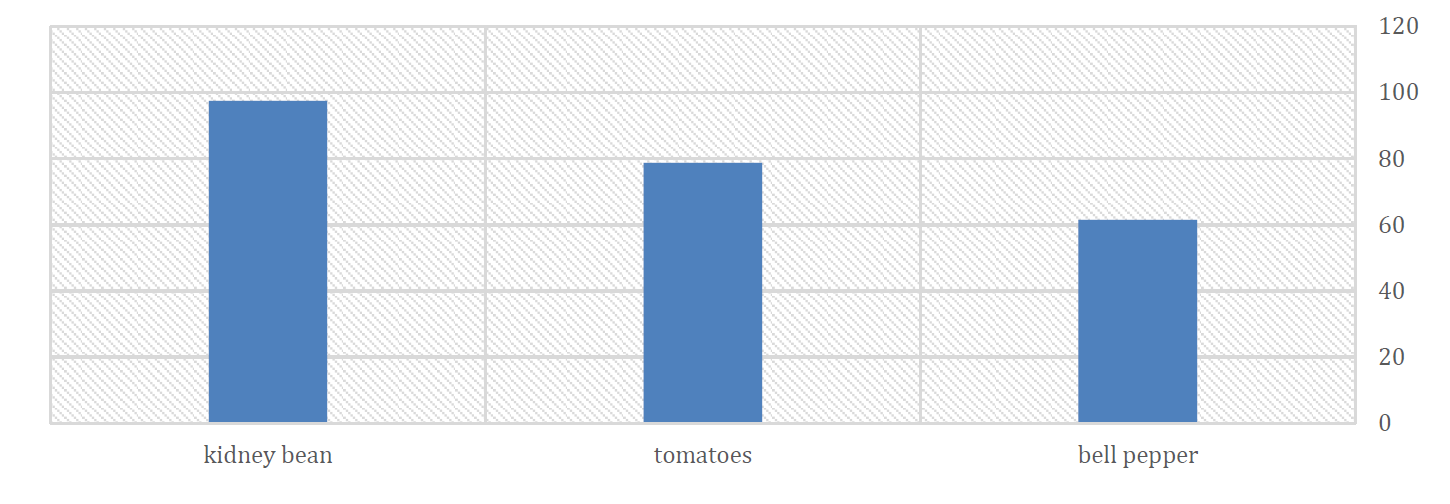
Figure 4: Host Plant Preference by L. Bryoniae on the Summer Host Plants
Table 1: Monthly Average Numbers of the L. Bryoniae Larvae on Three Summer Host Plants
Months
Kidney bean
Tomatoes
Bell pepper
May
78.4±38.73
80.6±25.97
54.4±24.6
June
121.25±28.67
80.5±16.34
68.5±9.14
July
123.8±36.9
95.5±17.35
72.2±19.1
August
81.5±26.21
53.75±29.22
44.75±32.48
Mean±S. D
101.23±25.5
77.56±8.56
60.96 ±11.05
On Bell Pepper
L. bryoniae larvae recorded low numbers in the beginning of the season in early May, then the population increased recording three peaks of abundance (87, 103 and 88 individuals/100infested leaves) occurred in 29th of May, the 10th of July , 7th of August (Figure 3).
As shown in table 1 L. bryoniae showed its highest monthly average numbers in July on kidney bean, tomatoes and, Bell pepper recording 101.23±25.5, 77.56±8.56 and, 60.96±11.05individuals / 100 infested leaflets respectively. On the other hand, the lowest monthly average numbers occurred in May on kidney bean recording 78.4±38.73 and in august for tomatoes and bell pepper recording 53.75±29.22 and, 44.75±32.48 individuals / 100 infested leaflets.
Host Plant Preference by L. Bryoniae
As shown in Figure 4 L.bryoniae showed a relatively high preference towards kidney bean followed by tomatoes and bell pepper.
DISCUSSION
The population of L. bryonia larvae showed 3 peaks of abundance on all studied host plants, recording low populations in the beginning of the growing season, then reaching its highest peaks in July on all studied host plants, then the population decreased towards the end of the season. Similar results were obtained by [8] for L.trifolii which the same number of population peaks on cowpea, kidney bean and tomatoes as a summer host plants. These results are also in agreement with those of [9-10].With regard to the previous studies on the parasitoids of different leaf mining species , it could be seen that the low population recorded in the beginning of the season is due to the activity of the larval pupal endoparasitoids, this finding seems to be true on the winter host plants due to the high abundance of the parasitic fauna in the winter but, in summer the parasitic fauna recording low abundance compared with the winter specially the larval pupal endoparasitoids so, the low abundance of L. bryoniae in the beginning of the season may due to the poor plant canopy in the summer under Libyan conditions. On the other hand the low population recorded at the end of the season is due to the high activity of the larval ectoparasitoid D.isaea. Moreover, we can’t rule out the effect of the dry climate in Libya and the poverty of the suitable alternative host plant canopy for L. bryoniae. So, the population abundance of L. bryoniae was low compared with the populations recorded under Egyptian conditions while rich plant canopy is available. Ledieu and Helyer, [11] suggested that, although the adults would feed and oviposit on the young lateral foliage (side shoots) of mature plants, they would not do so on young terminal foliage at the apex of plants. This suggests that it may be possible to exert some control of leaf miners by delaying removal of side shoots until after adults have laid eggs in them. This finding is in line with our proposal that explained the poor populations of L. bryoniae by the lack of alternative volunteers in the Libyan flora. It could be concluded from Figure 4 that, kidney bean had the highest average rates of infestation followed by tomatoes and bell pepper. L.bryoniae showed high preference towards kidney bean in comparison with tomatoes and bell pepper, this may be due to the heavy foliar abundance and the large leaflet size of kidney bean combined with heavy infestation by L.bryoniae compared with the other studied two host plants. Facknath 2005 reported that, females of Liriomyza exhibited a preference for the larger, older, lower leaves, although the middle leaves were superior for the growth and development of the young stages. He also hypothesized that adult ovipositional preference for the older, larger and thicker leaves of the lower foliage may be influenced by factors other than resource quality for larvae. It also could be seen that, cow pea is an outrigger herb which have a very large foliar area and large thick leaves in a direct attachment to the ground. So, it gained a great preference than tomatoes and bell pepper. These results are in agreement with those of Awadalla [12] and Elkhouly et al. [13] who reported a similar results for Liriomyza trifolii on broad bean (Vecia faba), pea (Pisum sativum), fenugreek (Trigonella finum gradum) and snow thistle (Sonchus oleraceus) as winter host plants.
Hanna et al. reported that Crop rotation, associations and density, weed/volunteer control are used to prevent problems related to pests and are usually applied in various combinations to make the habitat less favorable for pests The measures deal were allocation of crops to field (over time and space) (multi crop, diversity cropping), weeds control and volunteers as hosts of pests/vectors said to influence leaf miner populations. On the other hand, [11] suggested that, although the adults would feed and oviposit on the young lateral foliage (side shoots) of mature plants, they would not do so on young terminal foliage at the apex of plants. This may be possible to exert some control of leaf miners by delaying removal of side shoots until after adults have laid eggs in them.
Resistant plants are used to restrict the growth and development of a specified pest and/or the damage they cause when compared to susceptible plant varieties under similar environmental conditions and pest pressure It is important to distinguish resistant from tolerant species/varieties Some crops vary in susceptibility to leaf mining. This has been noted, e.g. in cultivars of tomato, cucumber, cantaloupe and beans. All the previous suggestions could be take place as a part of an integrated pest management program to control L. bryoniae on the economic host plants.
REFERENCE
Collins, and Anderson. “Liriomyza species – leaf mining flies.” Department for Environment and Rural Affairs, Plant Pest Factsheet, November 2016.
Spencer, K.A. Host Specialization in the World Agromyzidae (Diptera). Kluwer Academic Publishers, 1990.
Hannou, M.A. and E.M. Hegazi. “Effects of faba bean cultivars and potassium fertilization on population of Liriomyza spp.” Journal of Agricultural Science, Mansoura University, vol. 21, no. 12, 1996, pp. 4565–4574.
Abul-Nasr, S. and A.H. Assem. “Abundance of the ectoparasitoid Diglyphus isaea Walker (Hymenoptera: Eulophidae) on the tomato leaf miner Liriomyza bryoniae (Kaltenbach) (Diptera: Agromyzidae) on some winter host plants in the Ojilate region, Libya.” Journal of Agricultural Engineering and Biotechnology, vol. 3, no. 1, 1961, pp. 41–45.
Parrella, M.P. “Biology of Liriomyza.” Annual Review of Entomology, vol. 32, 1987, pp. 201–224.
Minkenberg, O.P.J.M. and J.C. van Lenteren. The Leafminers Liriomyza bryoniae and L. trifolii (Diptera: Agromyzidae), Their Parasites and Host Plants: A Review. Wageningen Agricultural University Papers 86-2, 1986.
Elbsha, M.O. and A.R. Elkhouly. “Natural abundance of the tomato leaf miner Liriomyza bryoniae (Kaltenbach) (Diptera: Agromyzidae) on some winter host plants in the Ojilate region, Libya.” International Conference on Earth, Environment and Life Science (EELS-2014), Dubai, 2014.
El-Khouly, A.R. Efficiency of Some Hymenopterous Parasitoids on Serpentine Leaf Miner Liriomyza trifolii (Burgess). PhD thesis, Mansoura University, 2009.
Awadalla, S.S. et al. “Host plant preference of the ectoparasitoid Diglyphus isaea Walker (Hymenoptera: Eulophidae).” Journal of Agricultural Science, Mansoura University, vol. 34, no. 1, 2009, pp. 505–510.
El-Khouly, A.R. Studies on Some Natural Enemies Associated with the Serpentine Leaf Miner Liriomyza trifolii (Burgess). Master’s thesis, Mansoura University, 2003.
Ledieu, M.S. and N.L. Helyer. “Observations on the economic importance of tomato leaf miner (Liriomyza bryoniae).” Agriculture, Ecosystems and Environment, vol. 13, 1985, pp. 103–109.
Awadalla, S.S. “Relationship between the serpentine leaf miner Liriomyza trifolii (Burgess) and its parasitoids on broad bean in Mansoura region.” Journal of Agricultural Science, Mansoura University, vol. 23, no. 9, 1998, pp. 4019–4026.
Elkhouly, A.R. et al. “Population abundance of the serpentine leaf miner Liriomyza trifolii (Burgess) (Diptera: Agromyzidae) on four winter host plants.” Asian Journal of Agriculture and Horticultural Research, vol. 7, no. 2, 2020, pp. 8–15.
None
None
None
Recommended Articles
Research Article
Strategy of Cocoa Commodity Based Agrowisata Development in Jembrana Regency
I Gusti Ayu Widari Upadani,
...
Luh Putu Kirana Pratiwi
Published: 30/01/2021
Download PDF
Research Article
Survey on the pollutants effect of some physicals and chemicals characteristics of the White Nile River around Khartoum state in the Sudan
Zeinb E. Elamean,
...
Egbal Osman Ahmed
Published: 20/01/2021
Download PDF
Research Article
Effecting of Hormonal Gonads (Test, Lh, Pro) and Dopamine on Transitional Nuclear Protein /1 Gene Frequency in an Infertile-Men
Taleb K. Odah
Published: 18/09/2023
Download PDF
Research Article
The study on priciple of herd health maagement assesment of Jimma University college of Agriculture And Veterinary Medicine dairy farm
Samson tesfaye,
...
Feyera Gemeda
Published: 01/04/2023
Download PDF
PO Box 101, Nakuru
Kenya.
Email: office@iarconsortium.org
Editorial Office:
J.L Bhavan, Near Radison Blu Hotel,
Jalukbari, Guwahati-India
O., A. M., R., E. A. & Shelig, N. (2021). Seasonal Abundance and host plant preference of the Tomato Leaf Miner Liriomyza bryoniae (Kaltenbach) (Diptera: Agromyzidae) on three Summer Host Plants in Janzour Region, Libya. IAR Journal of Agriculture Research and Life Sciences, 2(1), 1-5.
MLA
O., Albasha. M., Elkhouly. A. R. and Nawal Shelig. "Seasonal Abundance and host plant preference of the Tomato Leaf Miner Liriomyza bryoniae (Kaltenbach) (Diptera: Agromyzidae) on three Summer Host Plants in Janzour Region, Libya." IAR Journal of Agriculture Research and Life Sciences 2.1 (2021): 1-5.
Chicago
O., Albasha. M., Elkhouly. A. R. and Nawal Shelig. "Seasonal Abundance and host plant preference of the Tomato Leaf Miner Liriomyza bryoniae (Kaltenbach) (Diptera: Agromyzidae) on three Summer Host Plants in Janzour Region, Libya." IAR Journal of Agriculture Research and Life Sciences 2, no. 1 (2021): 1-5.
Harvard
O., A. M., R., E. A. and Shelig, N. (2021) 'Seasonal Abundance and host plant preference of the Tomato Leaf Miner Liriomyza bryoniae (Kaltenbach) (Diptera: Agromyzidae) on three Summer Host Plants in Janzour Region, Libya' IAR Journal of Agriculture Research and Life Sciences 2(1), pp. 1-5.
Vancouver
O. AM, R. EA, Shelig N. Seasonal Abundance and host plant preference of the Tomato Leaf Miner Liriomyza bryoniae (Kaltenbach) (Diptera: Agromyzidae) on three Summer Host Plants in Janzour Region, Libya. IAR Journal of Agriculture Research and Life Sciences. 2021 Jan;2(1):1-5.


 Download PDF
 Download XML