Pearlmillet is a most important staple food crop of arid and semi-arid regions of Asia and Africa. In arid and semi-arid regions, the biotic and abiotic factors are major factors in low productivity of pearl millet. Weeds are the major competitors of crops and reduce the yield and quality of crops by depleting the available plant nutrients and soil moisture in hot arid regions. Because of the wider row spacing and slow initial growth rate of crops, the weeds grow faster and are problematic in the initial stage of crop growth. To reduce the losses due to weeds in pearl millet an experiment was conducted at Agricultural research station, Bikaner, Rajasthan in three consecutive years viz., 2018, 2019 and 2020 to study the performance of herbicides and their doses on weed control and productivity of pearl millet. The experiment consisted of eight weed management treatments having two herbicides viz., Atrazine and Tembotrione with or without hand weeding by using Randomized Block Design (RBD) replicated three times. The results of three years pooled basis analysis revealed that the application of T₈ (Tembotrione 42% SC @ 120 g. a.i. ha-1 at 3-4 leaf stage of weeds) produced maximum plant height (151.3 cm), total tillers plant-1 (5.1), effective tillers plant-1 (3.2), ear head length (21.8 cm), dry fodder yield (3944.4 kg ha-1), grain yield (2073.3 kg ha-1), net return (₹ 49184 ha-1) along with minimum weed dry matter production. However, the treatment application of T₈ (Tembotrione 42% SC @ 120 g. a.i. ha-1 at 3-4 leaf stage of weeds) was statistically the same as weed free condition. The detailed methodology, results with data tables and figures are presented in the result section based on the average of three consecutive years of experimentations.
Keywords
Pearl Millet
Productivity
Weed Management
Atrazine
Tembotrione
INTRODUCTION
Pearl millet (Pennisetum glaucum (L.) R. Br.) is commonly known as Bajra, Bulrush millet, Dukn one of the most drought tolerant cereal crops grown where nothing can be grown in India. It has been grown in Africa and Indian subcontinent since prehistoric times. The center of diversity suggested area of domestication for pearl millet is in the Sahel zone of West Africa. This crop can be grown in areas where other cereal crops such as wheat or maize, would not survive and it is well tailored to production systems characterized by low rainfall, low soil fertility, and high temperature [1]. Pearl millet is the most widely grown millet crop in India. It's the 4th most broadly cultivated food crop after rice, wheat and maize. During the year 2018-19 India’s pearl millet production was 8.61 million tons from a cultivated area of 6.93 million hectares with productivity of 1243 kg ha-1. In the hyper arid region of Rajasthan (India) this crop is cultivated for dual purpose as food for humans and feed for livestock. By livestock producers it is used for hay, silage and green chop as well as dry fodder. Pearl millet grains are also used as feed for poultry and swine. Pearl millet does not produce prussic acid or have tannins, so it is safe to feed to horses/livestock as compared to sorghum [2]. It can be effectively used as a substitute of corn feed in goat diets [3].
Pearl millet is known as poor man crop and used as food crop since prehistoric era for preparation of a variety of food products and also used as staple food by peoples of Africa and India because it is highly nutrient rich than rice and wheat. The gains of this crop have high energy, concentration of amino acids and 27-32 per cent more protein than corn [4]. On an average one cup of cooked millet contains 201 calories energy, 6 grams protein, 1.7 grams fat, 40 grams carbohydrates, 2 grams fiber, 286 mg sodium and folate, Iron, Magnesium, Thiamine, Niacin, Phosphorus, Zinc, Riboflavin and Vitamin B6 by 8, 6, 18, 15, 14, 14, 14, 11, 11 percent of the daily value, respectively. It is gluten free food crop and gaining popularity in the health and food market [4]. This crop can also be used as cover crop or green manure crop because it suppresses soil-borne diseases and increases the soil organic matter. It is a tall growing crop that produces high biomass and can be used as excellent surface mulch in arid regions. Decomposition of plants of this crop in soil kept 60-80 percent of potassium in the straw for the succeeding crops [5].
The productivity of pearl millet is less than the potential yield because of harsh environmental conditions and various agronomic practices. Among these, weeds can reduce the grain yield of pearl millet from 16 to 94 percent [6] which depends upon the crop, variety, spacing, character and potency of weeds, weed invasion duration, managing practices and environmental circumstances [7]. According to Ram et al. [8] the uptake of nitrogen, phosphorus and potassium by weeds in pearl millet crop can be up to 61.8, 5.6 and 57.6 kg ha-1 respectively, resulting in lower grain yield due to increased competition for nutrient, sunlight, space, soil moisture etc. among crop plant and weeds. Management of weeds in crop production is an important aspect but getting rid of weed competition any time during the growing season is not desired [7] and time of weed elimination plays a crucial role in weed management without affecting grain yield, which refer as a critical period of crop weed competition which is 20-28 days [9] and field should be kept weed free during critical period. We can get this through various weed control practices such as mechanical, cultural and chemical weed control. By intercultural operations followed by hand weeding at 20 and 40 DAS can obtain lowest weed density [10] which is cost effective and labor intensive. During the early stage of crop growth period pearl millet crop is most susceptible for competition from weeds, so effective weed control in pre and early post emergence stage is very important. Nowadays, labor scarcity is the major issue in agriculture. For hand weeding and hoeing farmers require more labor for timely completion of the operations. In such conditions, mechanizations of farms and herbicides play an important role. In case of delayed intercultural operations, manual weeding and uncertain weather conditions post and pre-emergence herbicides are best for effective control of weeds in pearl millet crop.
MATERIALS AND METHODS
The experiment was carried out at Agricultural Research Station, Beechwal, S.K. Rajasthan Agricultural University, Bikaner (Rajasthan) during the kharif season of three consecutive years viz., 2018, 2019 and 2020. The soil of the experimental site was sandy loam in texture, low in nitrogen (122.5 kg ha-1) and medium in phosphorus (36.6 kg ha-1) and potassium (162 kg ha-1), soil pH 8.3 and EC 0.24 dSm-1. The experiment comprises treatments were evaluated viz., 1. Weedy check, 2. Weed free, 3. Two hand weeding at 3 and 5 weeks after sowing, 4. Pre-emergence application of atrazine @ 400 g a.i. ha-1 followed by one weeding at 3-4 weeks after sowing, 5. Tembotrione 42% SC @ 90 g a.i. ha-1 at 3-4 leaf stage of weeds, 6. Tembotrione 42% SC @ 100 g a.i.ha-1 at 3-4 leaf stage of weeds, 7. Tembotrione 42% SC @ 110 g a.i.ha-1 at 3-4 leaf stage of weeds and 8. Tembotrione 42% SC @ 120 g a.i. ha-1 at 3-4 leaf stage of weeds. The experiment was laid out in Randomized Block Design (RBD) with three replications. The pearl millet variety MPMH 17 was used as a test variety. The crop was sown at the spacing of 60 cm between row to row and 15 cm between plant to plant. Thinning and gap filling was done at 15 DAS of crop. Recommended dose of fertilizers viz., 30 kg ha-1 nitrogen as basal dose and remaining half dose 30 kg ha-1 nitrogen was applied as top dressing as and when rain was received after 25 DAS, 40 kg ha-1 phosphorus and 20 kg ha-1 potassium was applied at the time of sowing of crop. On an average, two lifesaving irrigations by sprinkler irrigation method were applied each year of investigation. Weed control and management practices were followed as per the treatment details. However, the brief description of herbicides used in the experimentations from 2018 to 2020 is as given below.
Atrazine
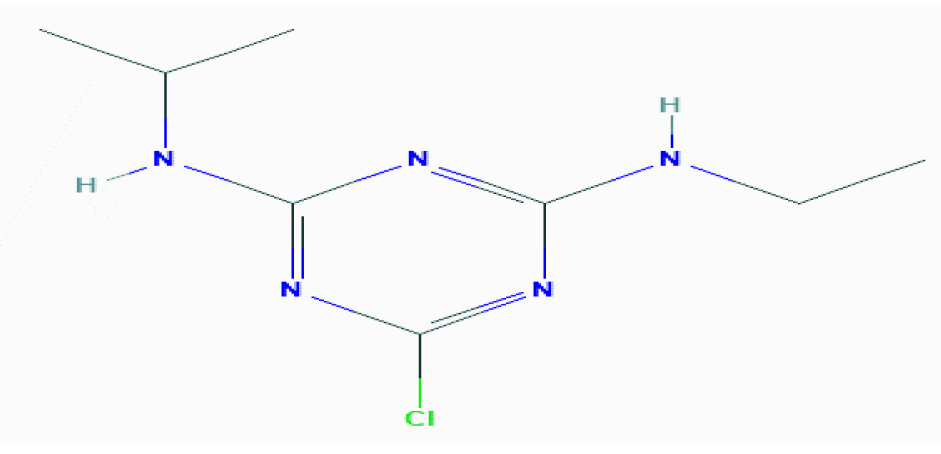
The IUPAC name of atrazine is 6-chloro-4- N-ethyl-2- N-propan-2 -yl-1,3,5- triazine-2, 4-diamine (Figure 1). Atrazine is an herbicide of the triazine group that does not occur naturally. Pure atrazine is an odorless, white powder that is not very volatile, reactive, or flammable and that will dissolve in water [11]. Atrazine is used to kill weeds, primarily on farms, but has also been used on highway and railroad rights-of-way.
Figure 1: Chemical structure of Atrazine [11]
Tembotrione
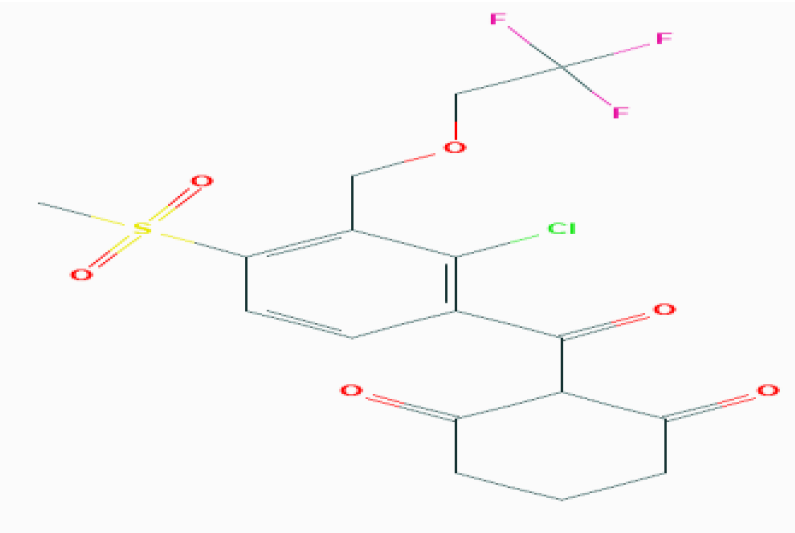
Tembotrione is an aromatic ketone that is 2-benzoyl cyclohexane-1,3-dione in which the phenyl group is substituted at positions 2, 3, and 4 by chlorine, (2,2,2-trifluoroethoxy) methyl, and methylsulfonyl groups, respectively. It is a post-emergence herbicide used (particularly in conjunction with the herbicide safener cyprosulfamide) for the control of a wide range of broad-leaved and grassy weeds in corn and other crops. It has a role as a herbicide, an agrochemical, an EC 1.13.11.27 (4-hydroxyphenylpyruvate dioxygenase) inhibitor and a carotenoid biosynthesis inhibitor. It is a sulfone, a cyclic ketone, an aromatic ketone, a member of monochlorobenzene, an organofluorine compound, an ether and a beta-triketone. The IUPAC name of Tembotrione is 2-(2-chloro-4-methylsulfonyl-3-(2,2,2-trifluoroethoxymethyl) benzoyl) cyclohexane-1,3-dione (Figure 2) [12].
Figure 2: Chemical structure of Tembotrione [12]
RESULTS AND DISCUSSION
Effect of Different Weed Management Practices on Plant Growth and Growth Parameters
Results revealed that different weed management practices viz., hand weeding and herbicide application like atrazine and tembotrione at various rate of active ingredients with or without hand weeding did not show any significant effect on plant population in the year 2018, 2019, 2020 as well as on pooled basis Table 1. The maximum plant height156.1 cm was attained in weed free plot, which was statistically at par with the treatment T₃:
Two hand weeding 3 and 5 weeks after sowing (151.3 cm) and T₈(Tembotrione 42% SC @ 120 g. a.i. ha-1 at 3-4 leaf stage of weeds) (151.3 cm) on pooled basis and similar results were also recorded in the 2019 year of experimentation. On pooled basis the per cent increase inplant height with application of T₈ (Tembotrione 42% SC @ 120 g. a.i. ha-1 at 3-4 leaf stage of weeds) was 9.21 per cent. Treatment T₈ (Tembotrione 42% SC @ 120 g. a.i. ha-1 at 3-4 leaf stage of weeds) is mainly ascribed to better weed control, rise in uptake of water and nutrient, which strengthen the photosynthetic activities, conquering increased supply of carbohydrates and in increased cell duplication and elongation leading to increased plant height. The lower values of plant height and number of total tillers per plant under weedy check plot might be due to severe competition by weeds for above mentioned resources, which made the crop plant ineffective to take up more resources, therefore photosynthesis might have affected and less production of photosynthates, ultimately growth and development was affected unfavorably owing to less supply of carbohydrates. the results in line with the findings of Chaudhary et al. [13] and Mishra et al. [14].
Table 1: Consequences of Weed Control Practices on Plant Population and Plant Height of Pearl Millet
Treatments
Plant population at harvest ha-1
Plant height (cm)
2018
2019
2020
Pooled
2018
2019
2020
Pooled
T1: Weedy check
114569
114882
114702
114717
136
132
148
139
T2: Weed free
113868
114181
113317
113789
144
151
173
156
T3: Two hand weeding 3 and 5 weeks after sowing
119495
119808
119793
119699
144
145
166
151
T4: Pre emergence application of atrazine @ 400 g a.i. ha-1 followed by one weeding at 3-4 weeks after sowing
116269
116582
116146
116332
144
137
160
147
T5: Tembotrione 42% SC @ 90 g. a.i. ha-1 at 3-4 leaf stage of weeds
114658
114971
114809
114813
140
138
165
148
T6: Tembotrione 42% SC @ 100 g. a.i. ha-1 at 3-4 leaf stage of weeds
113965
114278
114173
114139
142
138
147
143
T7: Tembotrione 42% SC @ 110 g. a.i. ha-1 at 3-4 leaf stage of weeds
117165
117478
116938
117194
142
139
151
144
T8: Tembotrione 42% SC @ 120 g. a.i. ha-1 at 3-4 leaf stage of weeds
116191
116504
116170
116288
143
147
164
151
SEm±
4440
4440
4235
2525
3
4
6
3
CD (p = 0.05)
NS
NS
NS
NS
NS
11
NS
7
NS: None significant
Effect of Different Weed Management Practices on Yield and Yield Attributes
Data Table 2 depicts that statistically longest earhead having length of 22.7 cm was obtained with weed free treatment followed by 21.8 cm in T₈ (Tembotrione 42%
SC @ 120 g. a.i. ha-1 at 3-4 leaf stage of weeds) and 21.4 cm with T₃: Two hand weeding 3 and 5 weeks after sowing, on pooled analysis of three years experimental results. Similar trend of treatment means was also followed in the year 2019. The girth of earheads was affected significantly and showed a remarkable effect in the year 2019, 2020 and on pooled data of three years of experimentation. On pooled basis the maximum girth of earhead 25.90 mm was observed with the application of T₈ (Tembotrione 42% SC @ 120 g. a.i. ha-1 at 3-4 leaf stage of weeds). However, the thinnest ear head was obtained in the weedy check (21.13 mm).
Table 2: Consequences of Weed Control Practices on Earhead Length and Girth
Treatments
Earhead length (cm)
Earhead girth (mm)
2018
2019
2020
Pooled
2018
2019
2020
Pooled
T1: Weedy check
18.7
18.6
19.8
19.0
24.89
18.20
20.30
21.13
T2: Weed free
22.2
24.7
21.1
22.7
22.91
26.12
26.49
25.17
T3: Two hand weeding 3 and 5 weeks after sowing
21.4
22.5
20.4
21.4
23.16
24.11
23.96
23.74
T4: Pre emergence application of atrazine @ 400 g a.i. ha-1 followed by one weeding at 3-4 weeks after sowing
20.6
22.1
20.2
21.0
24.32
25.13
24.15
24.53
T5: Tembotrione 42% SC @ 90 g. a.i. ha-1 at 3-4 leaf stage of weeds
19.4
20.1
20.1
19.9
25.27
21.32
23.91
23.50
T6: Tembotrione 42% SC @ 100 g. a.i. ha-1 at 3-4 leaf stage of weeds
19.6
20.7
20.1
20.1
24.13
22.75
24.67
23.85
T7: Tembotrione 42% SC @ 110 g. a.i. ha-1 at 3-4 leaf stage of weeds
19.7
21.8
20.2
20.6
24.27
26.39
24.87
25.17
T8: Tembotrione 42% SC @ 120 g. a.i. ha-1 at 3-4 leaf stage of weeds
21.5
23.6
20.4
21.8
22.43
29.23
26.02
25.89
SEm±
0.9
0.9
0.8
0.5
1.25
1.13
0.97
0.64
CD (p=0.05)
NS
2.8
NS
1.4
NS
3.42
2.96
1.85
NS: None significant
(*1. Weedy check, 2. Weed free, 3. Two hand weeding at 3 and 5 weeks after sowing, 4. Pre emergence application of atrazine @ 400 g a.i. ha-1 followed by one weeding at 3-4 weeks after sowing, 5. Tembotrione 42% SC @ 90 g a.i. ha-1 at 3-4 leaf stage of weeds, 6. Tembotrione 42% SC @ 100 g a.i. ha-1 at 3-4 leaf stage of weeds, 7. Tembotrione 42% SC @ 110 g a.i. ha-1 at 3-4 leaf stage of weeds and 8. Tembotrione 42% SC @ 120 g a.i. ha-1 at 3-4 leaf stage of weeds.)
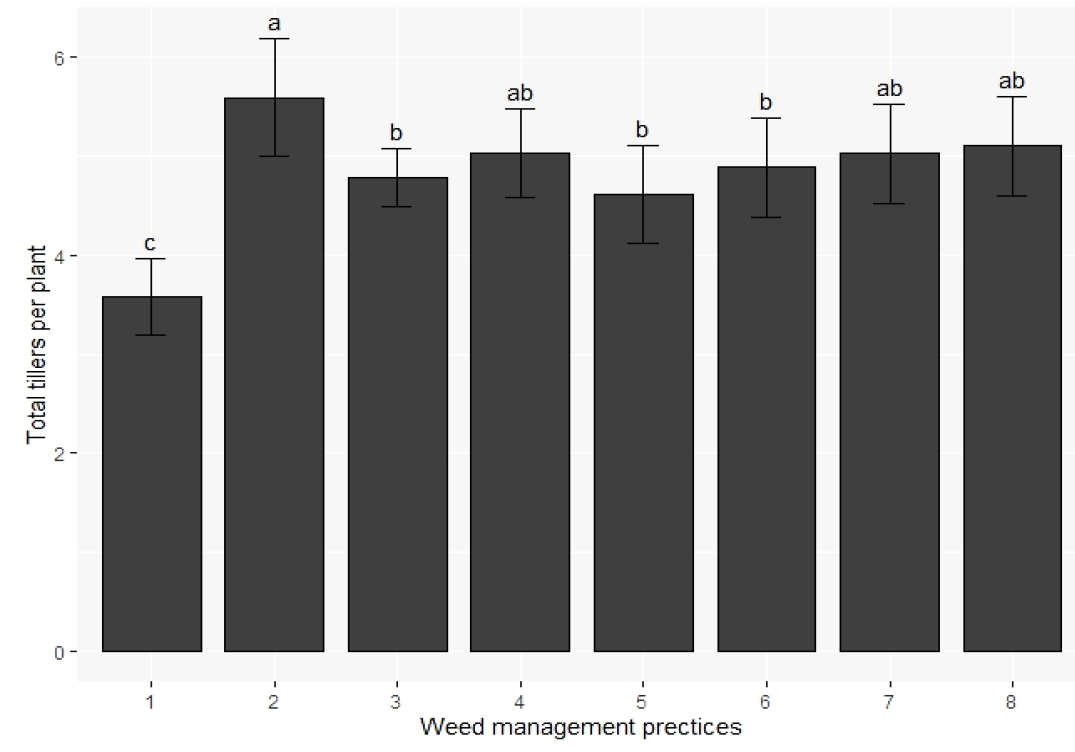
Figure 3: Effect of Different Weed Management Practices on Total Tillers per Plant of Pearl Millet (Graph Shows Three Years 2018, 2019 and 2020 Pooled Average)
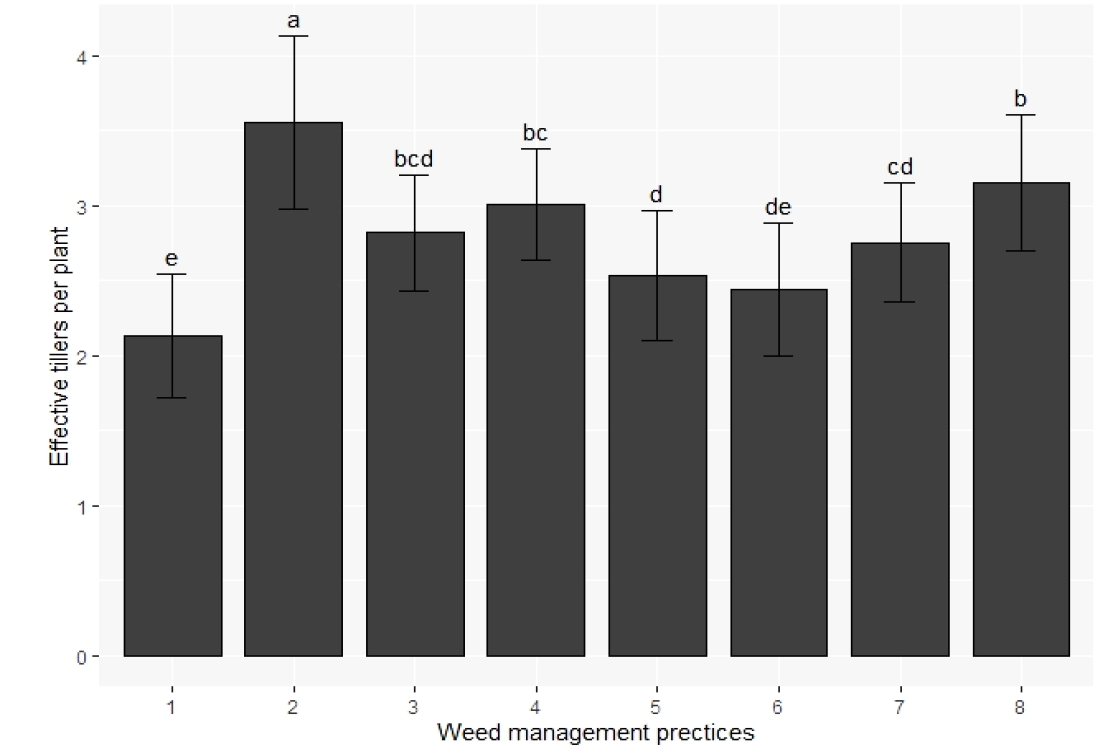
An analysis of data Table 3 and Figure3 indicates that the various weed management treatments had significantly influenced the total number of tillers per plant at harvest of crop. Results of this experiment revealed that on pooled basis the highest number of total tillers plant-1 5.6 was obtained in weed free plot, which was statistically at par with T₈(Tembotrione 42% SC @ 120 g. a.i. ha-1 at 3-4 leaf stage of weeds) (5.1), T₇ (Tembotrione 42% SC @ 110 g. a.i. ha-1 at 3-4 leaf stage of weeds) (5.0) and T₄ (Pre emergence application of atrazine @ 400 g a.i. ha-1 followed by one weeding at 3-4 weeks after sowing) (5.0). However, the lowest number of total tillers was 2.9 observed with the weedy check. The presented results revealed that on pooled analysis of three years of experimental data (Table 3 and Figure 4) the highest number of effective tillers 3.6 was recorded with the weed free plot, followed by T₈ (Tembotrione 42% SC @ 120 g. a.i. ha-1 at 3-4 leaf stage of weeds) (3.2). Further, it was observed that the application of Tembotrione 42% SC @ 120 g. a.i. ha-1 at 3-4 leaf stage of weeds significantly increased the effective tillers by 47.92 per cent over the weedy check on the basis of three years pooled data. It is clear from data Table 3 that application of herbicides along with or without hand weeding did not affect the 1000 seed weight of pearl millet, but it was ranged from 22.2 g in weed free plot to 18.7 g in weedy check on pooled basis. The data directly shows the association of crop weed competition. The lowest number of total and effective tillers plant-1 and earhead length was recorded in weedy check, whereas, maximum was in weed free conditions which could be due to lower crop-weed competition and treatments improved the yield attributing parameters by high buildup of photosynthates. These results are in agreement with the findings of Yalamati et al. [15], Kaur and Singh [16] and Munde et al. [17].
Table 3: Consequences of Weed Control Practices on Yield Attributes
Treatments
Total tillers plant-1
Effective tillers
Test weight (g)
2018
2019
2020
Pooled
2018
2019
2020
Pooled
2018
2019
2020
Pooled
T1: Weedy check
2.8
5.0
2.9
3.6
1.1
3.7
1.5
2.1
8.6
8.6
5.1
7.4
T2: Weed free
5.1
7.8
3.9
5.6
2.1
5.8
2.8
3.6
9.6
9.7
6.4
8.6
T3: Two hand weeding 3 and 5 weeks after sowing
4.8
5.7
3.8
4.8
2.6
4.2
1.7
2.8
9.8
8.8
6.0
8.2
T4: Pre emergence application of atrazine @ 400 g a.i. ha-1 followed by one weeding at 3-4 weeks after sowing
5.0
6.3
3.8
5.0
2.6
4.2
2.2
3.0
9.5
8.6
5.9
8.0
T5: Tembotrione 42% SC @ 90 g. a.i. ha-1 at 3-4 leaf stage of weeds
4.2
6.4
3.2
4.6
1.9
4.2
1.5
2.5
9.4
9.1
5.9
8.1
T6: Tembotrione 42% SC @ 100 g. a.i. ha-1 at 3-4 leaf stage of weeds
4.8
6.5
3.3
4.9
1.7
4.1
1.5
2.4
9.3
9.2
5.9
8.1
T7: Tembotrione 42% SC @ 110 g. a.i. ha-1 at 3-4 leaf stage of weeds
5.0
6.6
3.5
5.0
2.0
4.3
2.0
2.8
9.6
9.6
5.9
8.4
T8: Tembotrione 42% SC @ 120 g. a.i. ha-1 at 3-4 leaf stage of weeds
5.0
6.8
3.5
5.1
2.1
4.9
2.4
3.2
10.0
9.6
6.2
8.6
SEm±
0.4
0.5
0.2
0.2
0.2
0.3
0.2
0.1
0.3
0.7
0.3
0.3
CD (p = 0.05)
1.2
1.4
0.5
0.6
0.7
0.9
0.5
0.4
0.8
NS
NS
NS
Figure 4: Effect of Different Weed Management Practices on Effective Tillers per Plant of Pearl Millet (Graph Shows Three Years 2018, 2019 and 2020 Pooled Average)
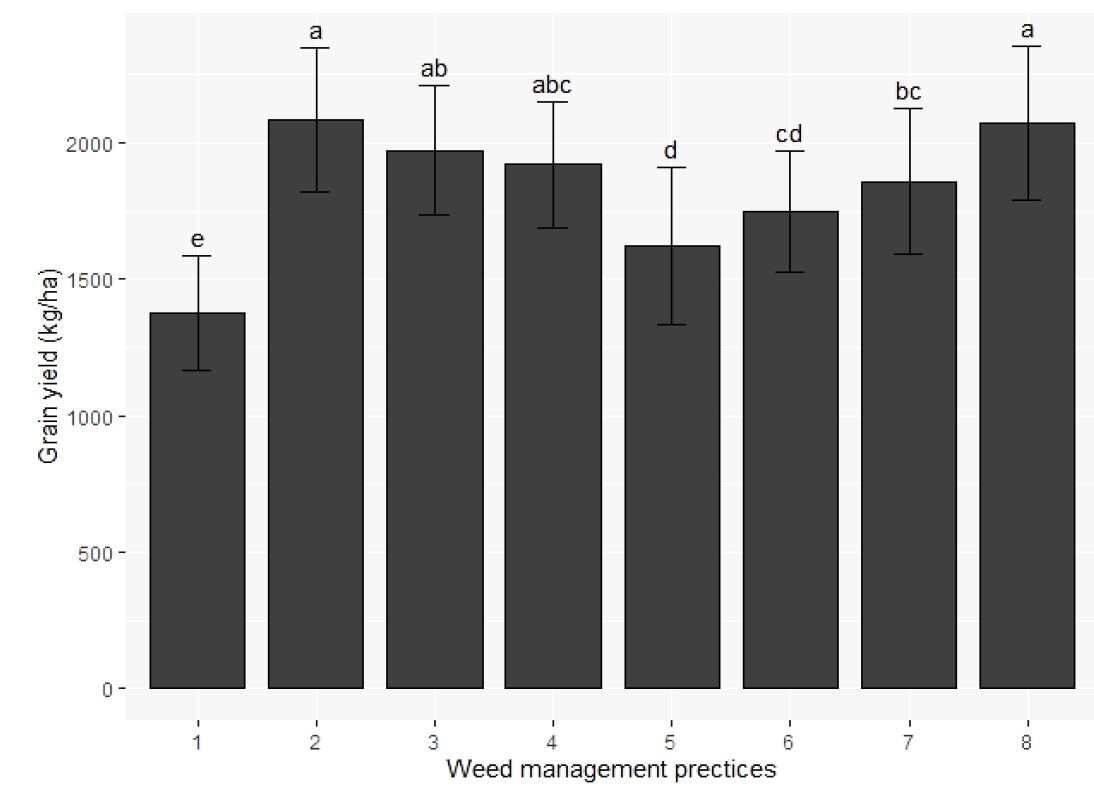
The presented results revealed that weed management practices remarkably amplified the grain yield of pearl millet during 2018, 2019, 2020 as well as on pooled basis. The maximum grain yield of 2083.2 kg ha-1 was obtained in weed free treatment, which was statistically at par with the treatment T₈ (Tembotrione 42% SC @ 120 g. a.i. ha-1 at 3-4 leaf stage of weeds) (2073.3 kg ha-1) on a pooled basis (Figure 5).
Figure 5 Effect of Different Weed Management Practices On Grain Yield of Pearl Millet (Graph Shows Three Years 2018, 2019 and 2020 Pooled Average)
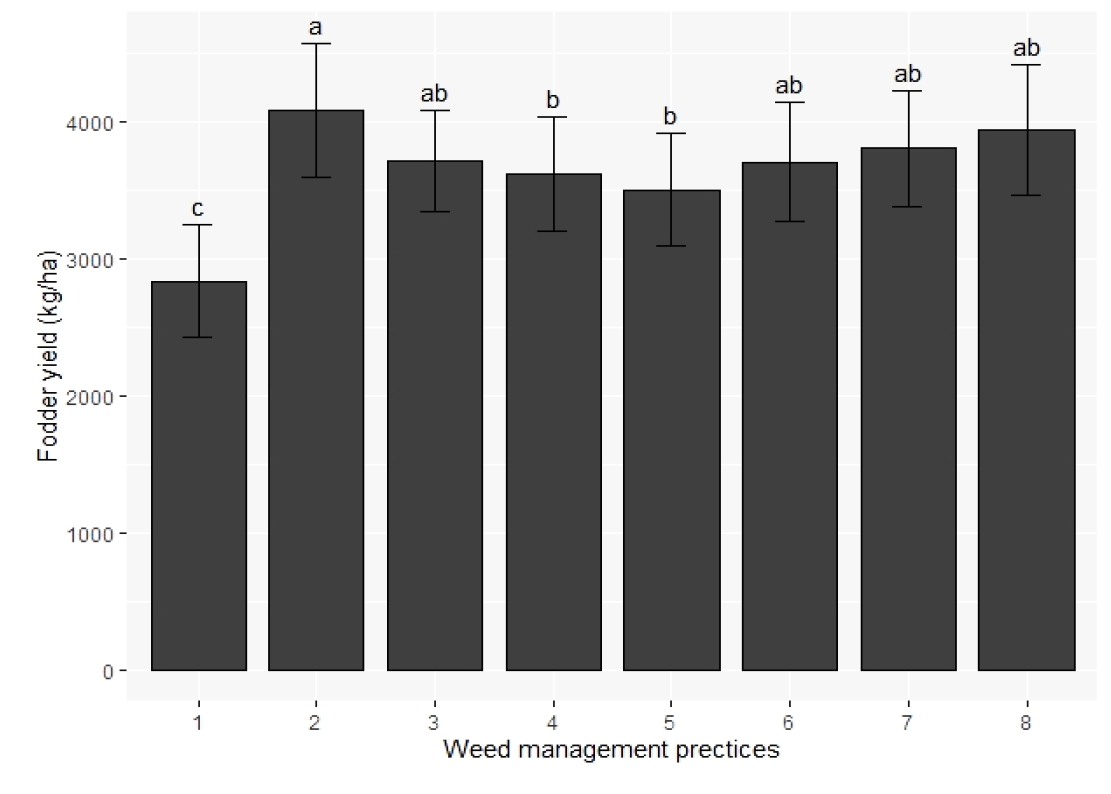
However, the minimum grain yield 1377.8 kg ha-1 was recorded under weedy check which was 51.20 per cent lesser than that of produced under weed free and 50.48 per cent lower than the treatment T₈ on pooled basis of three years. The data Table 4 and Figure 6 shows that weed management practices performed significantly on dry fodder yield in the year 2018, 2020 and on pooled basis.
Figure 6: Effect of Different Weed Management Practices on Fodder Yield of Pearl Millet (Graph Shows Three Years 2018, 2019 and 2020 Pooled Average)
Table 4: Consequences of Weed Control Practices on Dry Fodder and Grain Yield
Treatments
Yield (kg ha-1)
Grain
Dry Fodder
2018
2019
2020
Pooled
2018
2019
2020
Pooled
T1: Weedy check
1183.3
2151.7
798.4
1377.8
1657.3
4401.7
2453.0
2837.3
T2: Weed free
1935.0
3055.3
1259.3
2083.2
2530.0
5880.3
3829.7
4080.0
T3: Two hand weeding 3 and 5 weeks after sowing
2029.7
2746.7
1140.0
1972.1
2729.7
4835.0
3583.7
3716.1
T4: Pre emergence application of atrazine @ 400 g a.i. ha-1 followed by one weeding at 3-4 weeks after sowing
2040.7
2651.7
1064.0
1918.8
2723.0
4918.3
3219.8
3620.4
T5: Tembotrione 42% SC @ 90 g. a.i. ha-1 at 3-4 leaf stage of weeds
1248.3
2725.7
888.1
1620.7
2536.7
4941.0
3037.3
3505.0
T6: Tembotrione 42% SC @ 100 g. a.i. ha-1 at 3-4 leaf stage of weeds
1681.7
2526.0
1030.0
1745.9
2481.3
5296.7
3339.1
3705.7
T7: Tembotrione 42% SC @ 110 g. a.i. ha-1 at 3-4 leaf stage of weeds
1657.3
2805.3
1108.5
1857.0
2611.3
5374.0
3427.2
3804.2
T8: Tembotrione 42% SC @ 120 g. a.i. ha-1 at 3-4 leaf stage of weeds
2070.7
3028.3
1120.9
2073.3
2592.3
5714.7
3526.3
3944.4
SEm±
152.8
129.0
46.9
68.5
202.4
415.7
116.0
158.9
CD (p = 0.05)
463.6
391.2
142.2
195.4
613.8
NS
351.7
453.4
NS: None significant
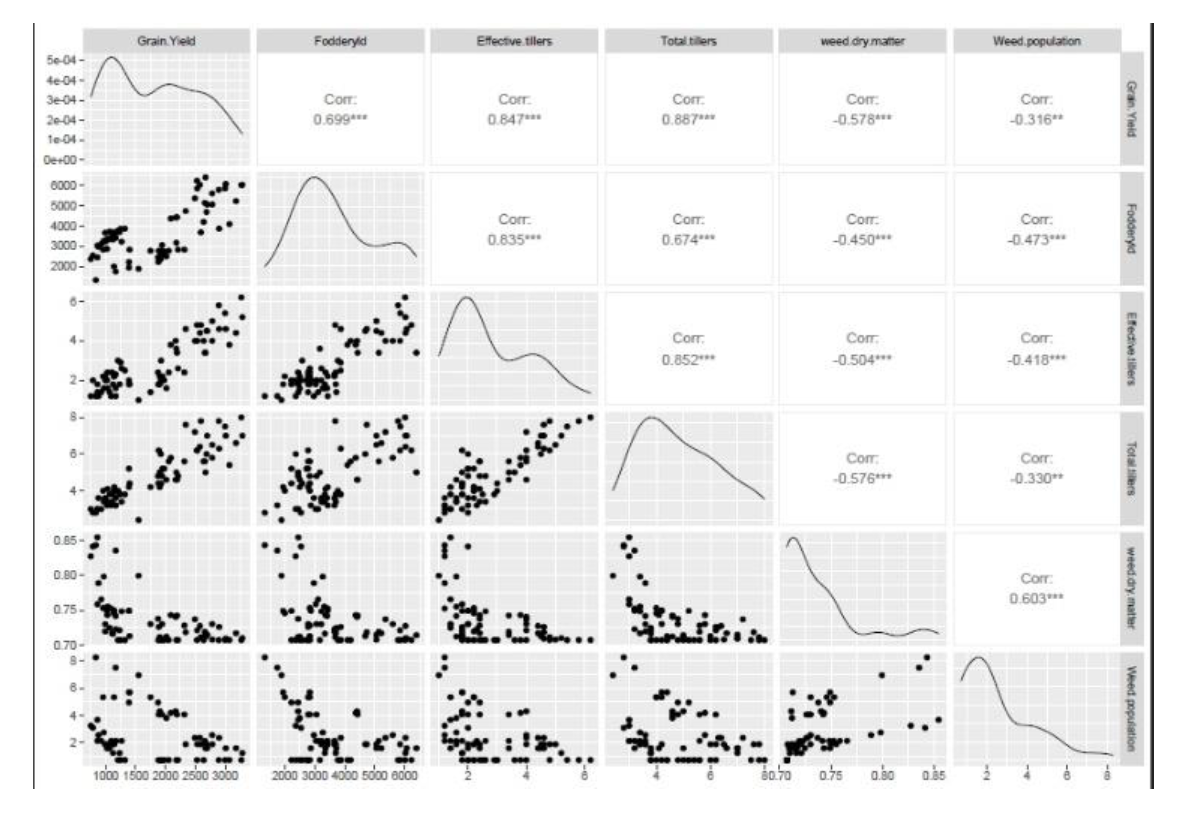
The maximum dry fodder yield 4080.0 kg ha-1 was produced in weed free condition, which was statistically at par with T₈ (Tembotrione 42% SC @ 120 g. a.i. ha-1 at 3-4 leaf stage of weeds) (3944.4 kg ha-1), T₇ (3804.2 kg ha-1), T₄ (3716.1 kg ha-1) and T₆ (3705.7 kg ha-1) on pooled basis. Further, data shows that application of T₈ (Tembotrione 42% SC @ 120 g. a.i. ha-1 at 3-4 leaf stage of weeds) increased the dry fodder weight by 39.02 per cent and weed free condition increased the yield by 43.80 per cent as compared to weedy check. The increased grain yield of pearl millet is because of the increased yield attributes and there was a positive and significant correlation between grain yield and effective tillers (r = 0.847***, p<0.001) and total tillers (r = 0.887***, p<0.001) (Figure 9) recorded, ultimately increased the yield. The higher grain and fodder yield of pearl millet was because of the lesser crop weed competition for nutrients, moisture, space and solar light in weed free treatment during crop period which resulted in improving yield attributes and resulting in higher grain and fodder yield in weed free condition, which was statistically at par with the application of Tembotrione 42% SC @ 120 g. a.i. ha-1 at 3-4 leaf stage of weeds. A highly significant and negative correlation between grain yield and weed population (r = -0.316**, p<0.01) and weed dry matter (r = -0.578***, p<0.001) (Figure 9) was observed. The synergistic effect of growth and yield attributes significantly influenced the grain and fodder yield of pearl millet and the results of this three-year investigation are in agreement with the findings of Hargilas [18] and Yalamati et al. [15].
Effect of Different Weed Management Practices on Weeds
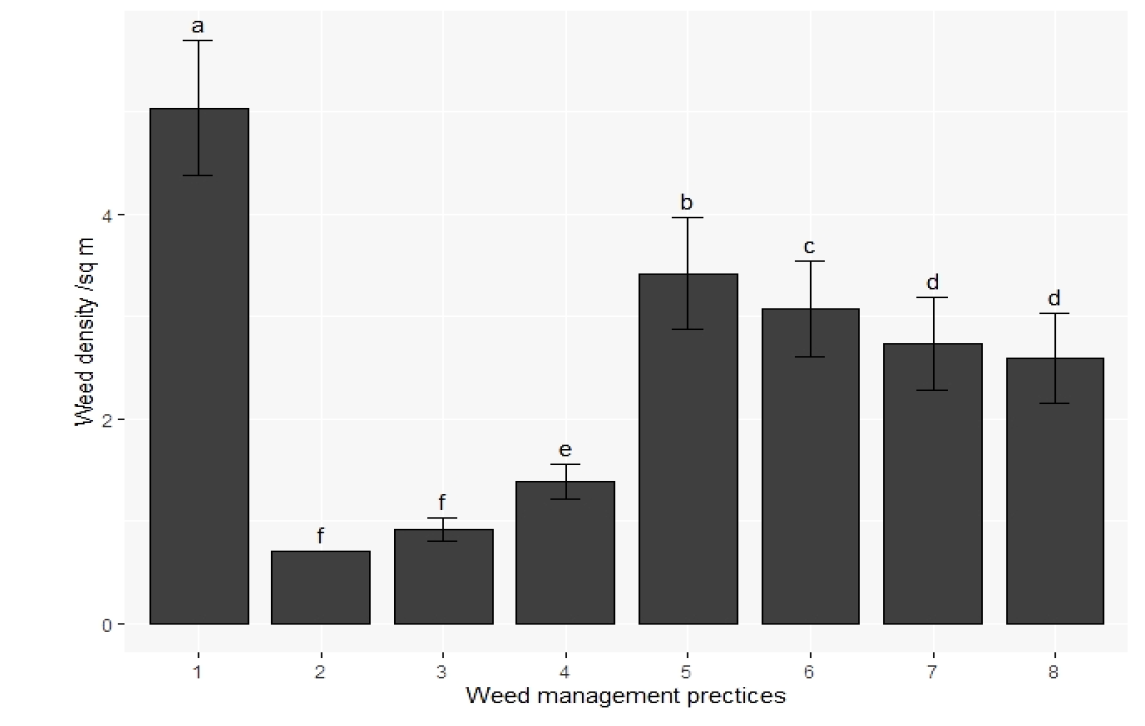
Weed studies of treatment shows that the minimum weed population at harvest stage of crop was recorded with the weed free plot. All the weed management practices significantly reduced the weed density. The lowest weed density 0.7 m-2 was observed in weed free plot, which was statistically at par with T₃ (Two hand weeding 3 and 5 weeks after sowing) (0.9 m-2) on pooled basis, followed by T₄ (Pre emergence application of atrazine @ 400 g a.i. ha-1 followed by one weeding at 3-4 weeks after sowing) (1.4 m-2). Weed density recorded with application of T₈ (Tembotrione 42% SC @ 120 g. a.i. ha-1 at 3-4 leaf stage of weeds) (2.6 m-2) differing significantly with T₅: (Tembotrione 42% SC @ 90 g. a.i. ha-1 at 3-4 leaf stage of weeds) and T₆ (Tembotrione 42% SC @ 100 g. a.i. ha-1 at 3-4 leaf stage of weeds) on pooled basis (Figure 7).
Figure 7: Effect of Different Weed Management Practices on Weed Density per Square Meter at Harvest (Graph Shows Three Years 2018, 2019 and 2020 Pooled Average)
Results revealed that based on pooled average of three years data the minimum weed dry matter at harvest 0.71 kg m-2 was recorded with weed free and T₃(Two hand weeding 3 and 5 weeks after sowing treatment), followed by T₈ and T₄ (0.72 kg m-2). The highest weed dry matter 0.80 kg m-2 was produced in weedy check, which was 13.55 and 11.52 per higher than the weed free plot and treatment T₈ (Tembotrione 42% SC @ 120 g. a.i. ha-1 at 3-4 leaf stage of weeds) respectively on pooled basis. A highly positive and significant correlation between weed density and weed dry matter (r = 0.603***, p<0.001) was observed, due to which weed dry matter has been increased. We observed the 100 per cent weed control efficiency in the weed free plot during the period of experimentation. On pooled analysis the weed control efficiency of treatment T₃ (Two hand weeding 3 and 5 weeks after sowing) (96.8%) was statistically at par with the weed free condition and followed by treatment T₈ (Tembotrione 42% SC @ 120 g. a.i. ha-1 at 3-4 leaf stage of weeds) (87.9%) Table 5. The application of T₄ (Pre emergence application of atrazine @ 400 g a.i. ha-1 followed by one weeding at 3-4 weeks after sowing) reduced the weed density due to the pre-emergence application of atrazine followed by one weeding at 3-4 weeks after sowing, in which the atrazine has controlled the weeds in the initial stage of crop up to 15 DAS and then hand weeding at 3-4 weeks after sowing of crop has managed weeds effectively for long period. Similarly, the application of tembotrione at 3-4 leaf stage of weeds also controlled the weeds and lowered the dry matter effectively. These results are corroborating with findings of Hargilas [18].
Table 5: Consequences of Weed Control Practices on Weed Density, Dry Matter and WCE
Treatments
Weed density at harvest (m-2)
Weed DM at harvest (kg m-2)
Weed control efficiency (%)
2018
2019
2020
Pooled
2018
2019
2020
Pooled
2018
2018
2020
Pooled
T1: Weedy check
7.59
(57.3)
4.18
(17.0)
3.33
(10.7)
5.03
(28.3)
0.83
(0.18)
0.742
(0.05)
0.841
(0.21)
0.803
(0.15)
0.00
0.00
0.00
0.00
T2: Weed free
0.71
(0.0)
0.71
(0.0)
0.71
(0.0)
0.71
(0.0)
0.71
(0.00)
0.707
(0.00)
0.707
(0.00)
0.707
(0.00)
100.0
100.0
100.0
100.0
T3: Two hand weeding 3 and 5 weeks after sowing
0.71
(0.0)
0.71
(0.0)
1.34
(1.3)
0.92
(0.4)
0.71
(0.00)
0.707
(0.00)
0.721
(0.02)
0.712
(0.01)
100.0
100.0
90.49
96.83
T4: Pre emergence application of atrazine @ 400 g a.i. ha-1 followed by one weeding at 3-4 weeks after sowing
0.71
(0.0)
1.77
(2.7)
1.68
(2.3)
1.39
(1.7)
0.71
(0.00)
0.713
(0.01)
0.747
(0.06)
0.722
(0.02)
100.0
84.01
71.80
85.27
T5: Tembotrione 42% SC @ 90 g. a.i. ha-1 at 3-4 leaf stage of weeds
5.58
(30.7)
2.41
(5.3)
2.26
(4.7)
3.42
(13.6)
0.74
(0.05)
0.731
(0.03)
0.771
(0.09)
0.747
(0.06)
72.95
31.87
53.94
52.92
T6: Tembotrione 42% SC @ 100 g. a.i. ha-1 at 3-4 leaf stage of weeds
4.86
(23.3)
2.11
(4.0)
2.24
(4.7)
3.07
(10.7)
0.73
(0.03)
0.722
(0.02)
0.768
(0.09)
0.740
(0.05)
79.15
59.04
55.81
64.66
T7: Tembotrione 42% SC @ 110 g. a.i. ha-1 at 3-4 leaf stage of weeds
4.49
(20.0)
1.68
(2.3)
2.04
(3.7)
2.73
(8.7)
0.73
(0.04)
0.718
(0.02)
0.731
(0.04)
0.728
(0.03)
76.75
69.91
82.65
76.44
T8: Tembotrione 42% SC @ 120 g. a.i. ha-1 at 3-4 leaf stage of weeds
4.27
(18.0)
1.56
(2.0)
1.95
(3.3)
2.60
(7.8)
0.73
(0.03)
0.709
(0.00)
0.728
(0.03)
0.721
(0.02)
84.68
94.65
84.35
87.89
SEm±
0.26
0.10
0.14
0.10
0.01
0.002
0.008
0.004
5.96
5.06
67.38
3.20
CD (p = 0.05)
0.78
0.32
0.43
0.30
0.02
0.006
0.025
0.011
18.07
15.34
0.00
9.15
Data are transformed by square root transformation and values in parenthesis are original
Economics
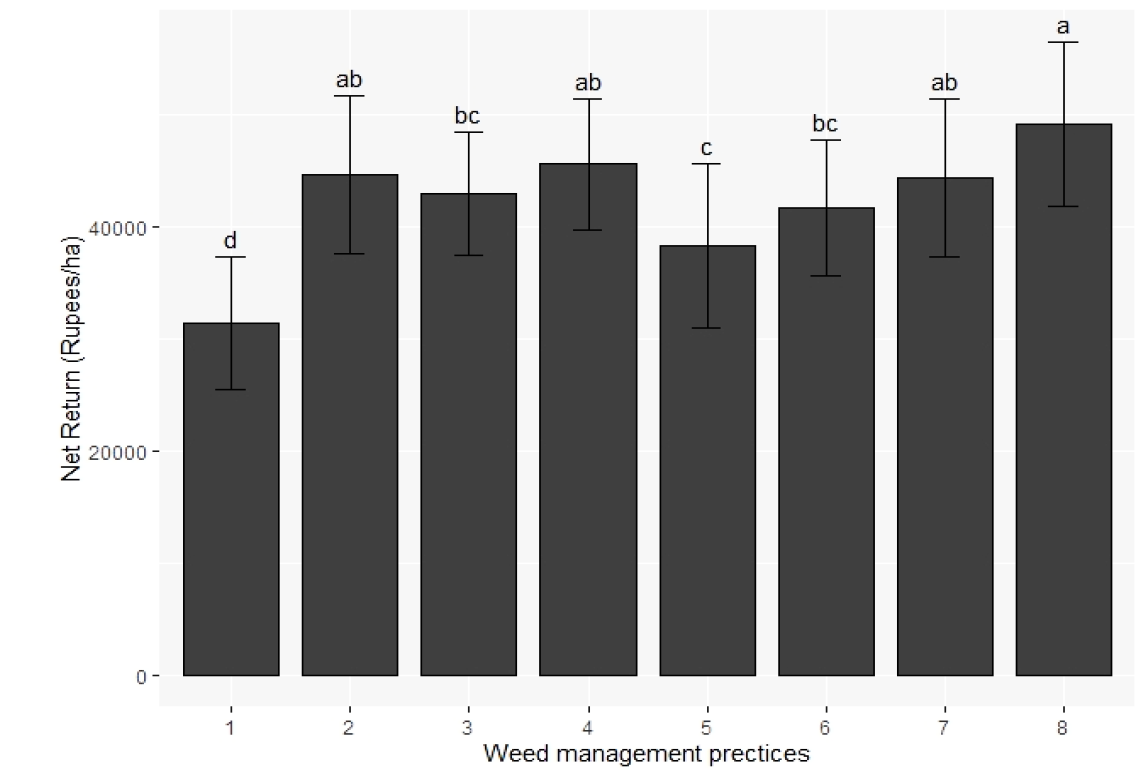
Application of various doses of herbicides with or without hand weeding significantly increased the net return and benefit cost ratio of the treatments. Data Table 6 and Figure 8 depicts that the maximum net return ₹ 49184 ha-1 was gained with the treatment T₈ (Tembotrione 42% SC @ 120 g. a.i. ha-1 at 3-4 leaf stage of weeds). The lowest return was obtained with the weedy check. The application of Tembotrione 42% SC @ 120 g. a.i. ha-1 at 3-4 leaf stage of weeds has increased the net return by 1.01 and 5.64 per cent from weed free and weedy check. Results revealed that the maximum benefit cost ratio 3.8, 6.0, 2.5 and 4.1 was obtained during 2018, 2019 and 2020 with application of T₄ (Pre emergence application of atrazine @ 400 g a.i. ha-1 followed by one weeding at 3-4 weeks after sowing), which was statistically at par with the application Tembotrione 42% SC @ 120 g. a.i. ha-1 at 3-4 leaf stage of weeds 3.4, 6.3, 2.4 and 4.0 during 2018, 2019, 2020 as well as on pooled analysis of data respectively. The increased net return and benefit cost ratio with application of Tembotrione 42% SC @ 120 g. a.i. ha-1 at 3-4 leaf stage of weeds is due to lower cost of herbicide along with higher gross return due to higher grain and fodder yield. The economic returns of this three-years investigation are in agreement with the findings of Yalamati et al. [15] and Hargilas [18].
Figure 8: Effect of Different Weed Management Practices on Net Return from Pearl Millet Crop (Graph Shows Three Years 2018, 2019 and 2020 Pooled Average)
Table 6: Consequences of Weed Control Practices on Economics and Returns of Pearl Millet
Treatments
Net return (₹ ha-1)
BC ratio
2018
2019
2020
Pooled
2018
2019
2020
Pooled
T1: Weedy check
20862
54542
18930
31444
2.0
5.2
1.8
3.0
T2: Weed free
32683
72808
28524
44672
1.8
4.1
1.6
2.5
T3: Two hand weeding 3 and 5 weeks after sowing
37927
63808
27128
42955
2.5
4.2
1.8
2.8
T4: Pre emergence application of atrazine @ 400 g a.i. ha-1 followed by one weeding at 3-4 weeks after sowing
42352
66569
27919
45613
3.8
6.0
2.5
4.1
T5: Tembotrione 42% SC @ 90 g. a.i. ha-1 at 3-4 leaf stage of weeds
25236
67429
22490
38385
2.1
5.7
1.9
3.3
T6: Tembotrione 42% SC @ 100 g. a.i. ha-1 at 3-4 leaf stage of weeds
33266
65070
26908
41748
2.8
5.5
2.3
3.5
T7: Tembotrione 42% SC @ 110 g. a.i. ha-1 at 3-4 leaf stage of weeds
33298
70900
28892
44363
2.8
5.9
2.4
3.7
T8: Tembotrione 42% SC @ 120 g. a.i. ha-1 at 3-4 leaf stage of weeds
41120
76920
29512
49184
3.4
6.3
2.4
4.0
SEm±
3647
3307
1227
1691
0.3
0.3
0.1
0.1
CD (p = 0.05)
11062
10032
3723
4827
1.0
0.8
0.3
0.4
Figure 9: Correlation between Variables of Growth, Yield and Weeds
CONCLUSION
The present study investigated the response of weed management practices in pearl millet crop and examined the weed control efficiency and economics of herbicide used in rainfed areas. According to the results presented above revealed that use of Tembotrione 42% SC @ 120 g. a.i. ha-1 at 3-4 leaf stage of weedsgave statistically similar benefit cost ratio as under pre-emergence application of atrazine @ 400 g a.i. ha-1 followed by one weeding at 3-4 weeks after sowing. Hence, in the area of labor scarcity the application of Tembotrione 42% SC @ 120 g. a.i. ha-1 at 3-4 leaf stage of weeds is profitable because it gives highest grain yield, dry fodder yield, lowest weed dry matter, highest net return, as compared to other treatments of weed management. Hence, the application of Tembotrione at 3-4 leaf stage of weeds can be recommended to the farmers cultivating pearl millet in the semiarid region of Rajasthan state of India.
REFERENCE
Gupta, P.C. et al. “Pearl millet: A compulsory crop in hyper arid zone 1C.” LS International Journal of Life Sciences, vol. 2, no. 1, 2013, pp. 58–66. doi:10.5958/j.2319-1198.2.1.008.
Newman, Y. et al.Pearl millet (Pennisetum glaucum): Overview and management. University of Florida IFAS Extension, 2010. Publication no. SS-AGR-337, edis.ifas.ufl.edu/pdffiles/AG/AG34700.pdf. Accessed March 2021.
Terrill, T.H. et al. “Protein and energy value of pearl millet grain for mature goats.” Journal of Animal Science, vol. 76, no. 7, 1998, pp. 1964–1969. doi:10.2527/1998.7671964x.
Gulia, S.K. et al. “Progress in grain pearl millet research and market development.” Issues in new crops and new uses, edited by J. Janick and A. Whipkey, ASHS Press, 2007, pp. 196–203.
Rosolem, C.A. et al. “Potassium leaching from millet straw as affected by rainfall and potassium rates.” Communications in Soil Science and Plant Analysis, vol. 36, nos. 7–8, 2005, pp. 1063–1074. doi:10.1081/CSS200050497.
Balyan, R.S. et al. “Postemergence efficacy of atrazine in controlling weeds in pearl millet.” Indian Journal of Weed Science, vol. 25, 1993, pp. 7–11.
Choudhary, C. et al. “Review and outlook of weed management in pearl millet.” International Journal of Chemical Studies, vol. 6, no. 2, 2018, pp. 2346–2350. doi:10.13140/RG.2.2.25251.35364.
Ram, B. et al. “Effect of integrated weed management and intercropping systems on growth and yield of pearl millet.” Indian Journal of Agronomy, vol. 50, no. 3, 2003, pp. 254–258.
Singh, R. and H.R. Singh. “Effects of method of sowing and herbicides on the yield of pearl millet (Pennisetum glaucum).” Progressive Agriculture, vol. 10, no. 1, 2010, pp. 111–113.
Patel, B.D. et al. “Comparative efficacy of different herbicides in summer pearl millet.” Indian Journal of Weed Science, vol. 45, no. 3, 2013, pp. 217–221.
National Center for Biotechnology Information. “PubChem compound summary for CID 2256, atrazine.” PubChem, 2021, pubchem.ncbi.nlm.nih.gov/compound/Atrazine. Accessed March 2021.
National Center for Biotechnology Information. “PubChem compound summary for CID 11556911, tembotrione.” PubChem, 2021, pubchem.ncbi.nlm.nih.gov/c ompound/Tembotrione. Accessed March 2021.
Chaudhary, L.M. et al. “Integrated weed management in summer pearl millet [Pennisetum glaucum (L.) R. Br. emend. Stuntz] under South Gujarat condition.” Environment and Conservation, vol. 22, 2016, pp. S5–S9.
Mishra, S.P. et al. “Effect of integrated weed management on weeds control, yield attributes and yield of pearl millet [Pennisetum glaucum (L.) R. Br. emend. Stuntz].” Trends in Biosciences, vol. 10, no. 2, 2017, pp. 693–695.
Yalamati, S.R.K. et al. “Effect of integrated weed management on yield, yield attributes and economics of pearl millet [Pennisetum glaucum (L.) R. Br. emend. Stuntz].” International Journal of Current Microbiology and Applied Sciences, vol. 8, no. 10, 2019, pp. 2629–2633.
Kaur, A. and V.P. Singh. “Weed dynamics as influenced by planting methods, mulching and weed control in rainfed hybrid pearl millet (Pennisetum glaucum).” Indian Journal of Weed Science, vol. 38, nos. 1–2, 2006, pp. 135–136.
Munde, S.D. et al. “Weed control study in kharif pearl millet (Pennisetum glaucum).” Bioinfolet, vol. 10, no. 2A, 2013, pp. 464–468.
Hargilas. “Effective weed management strategy for maize (Zea mays) under rainfed condition of southern Rajasthan.” Indian Journal of Agricultural Sciences, vol. 90, no. 4, 2020, pp. 693–698
Recommended Articles
Research Article
Effect of Different Tecamin Flower Concentrations on the Vegetative Growth and Yield of the Barcelona Variety of Solanum melongena L.
Samah Saleh AL- Shybany
Published: 15/09/2023
Download PDF
Research Article
Evaluating Lipid Oxidation in Potato Chips using Oxygen Consumption Kinetics under Accelerated Conditions
Taha Mohammed Taki Mohammed
Published: 15/04/2026
Download PDF
Research Article
Study the Effect of Stress Transfusion on Some Blood Parameters in Goats
Maysaa M. A. Al-Rsitmawi
Published: 29/05/2023
Download PDF
Research Article
Effects of Orientation and Wetting on the Crystallization Behavior of Peg-B-Pcl Ultra-Thin Films
Liang Minghui,
...
Sreemoy Kanti Das
Published: 15/08/2025
Download PDF
PO Box 101, Nakuru
Kenya.
Email: office@iarconsortium.org
Editorial Office:
J.L Bhavan, Near Radison Blu Hotel,
Jalukbari, Guwahati-India
Shekhawat, P. S., None, S., Shekhawat, D. S. & Satyavathi, C. T. (2021). Performance of Different Weed Management Practices on Pearl Millet (Pennisetum Glaucum (L.) R. Br.) Productivity in Semi-Arid Tracts of Rajasthan. IAR Journal of Advances in Crop Science and Technology, 1(1), 1-8.
MLA
Shekhawat, P. S., et al. "Performance of Different Weed Management Practices on Pearl Millet (Pennisetum Glaucum (L.) R. Br.) Productivity in Semi-Arid Tracts of Rajasthan." IAR Journal of Advances in Crop Science and Technology 1.1 (2021): 1-8.
Chicago
Shekhawat, P. S., Somdutt , D. S. Shekhawat and C. T. Satyavathi. "Performance of Different Weed Management Practices on Pearl Millet (Pennisetum Glaucum (L.) R. Br.) Productivity in Semi-Arid Tracts of Rajasthan." IAR Journal of Advances in Crop Science and Technology 1, no. 1 (2021): 1-8.
Harvard
Shekhawat, P. S., None, S., Shekhawat, D. S. and Satyavathi, C. T. (2021) 'Performance of Different Weed Management Practices on Pearl Millet (Pennisetum Glaucum (L.) R. Br.) Productivity in Semi-Arid Tracts of Rajasthan' IAR Journal of Advances in Crop Science and Technology 1(1), pp. 1-8.
Vancouver
Shekhawat PS, Somdutt S, Shekhawat DS, Satyavathi CT. Performance of Different Weed Management Practices on Pearl Millet (Pennisetum Glaucum (L.) R. Br.) Productivity in Semi-Arid Tracts of Rajasthan. IAR Journal of Advances in Crop Science and Technology. 2021 Jul;1(1):1-8.


 Download PDF
 Download XML




 and values in parenthesis are original