Small Arms and Light Weapons (SALW) are firearms, mini bombs, propelled grenades and rifles used for attacks and defense in an armed conflict. SALW are related to international security issues, border management, terrorism, crimes, issues associated with public health, socioeconomic development, deradicalisation and post-conflict reconstruction. A larger percentage of SALW are not government controlled. Borno State with a capital in Maiduguri was created in in 1976 after the split of the North-Eastern States. It is the homeland of the Kanuri people in Nigeria. The State has many ethnic groups but the major ones are Shuwa Arabs, Bura, Marghi, Gwoza and Chibok. The research is a detail anatomy of the role of Small Arms and Light Weapons (SALW) in escalating and spreading armed conflicts in Borno and Yobe States of Northeastern Nigeria from the perspective of both the use of primary and secondary sources.
Keywords
Small Arms and Light Weapons (SALW)
Socioeconomic
Security
North-Eastern States
Borno
INTRODUCTION
Small Arms and Light Weapons (SALW) are firearms, mini bombs, propelled grenades and rifles used for attacks and defense in an armed conflict. The SALW are locally made and are imported from abroad. The locally made include bombs, grenades and firearms that are manufactured locally and illegally sometimes. The imported SALW include rocket launchers, missile systems, light machine guns, revolvers, pistols and other related ones. Small Arms are weapons that can be operated by an individual while Light Weapons are designed for a collective operation or joint use. Light Weapons are mightier and detrimental than Small Arms [1].
Small Arms and Light Weapons (SALW) have a significant implication on the lives, livelihoods, future, security and prospects of millions of people across the globe. Their presence is correlated with human suffering and humanitarian crises contemporarily. SALW are related to international security issues, border management, terrorism, crimes, issues associated with public health, socioeconomic development, deradicalisation and post-conflict reconstruction. A larger percentage of SALW are not government controlled and although; they are being used by the government for defense and security purposes, they are mostly used by rebels, armed groups, terrorists, ethnic militias and criminal gangs illegally [2].
It is estimated that there are about 100 to 500 million SALW in circulation globally apart from the other millions designed for formal security use and civilian utilisation. Even the above figures are tentative and not sacrosanct because SALW are not recorded in official statistics on the arms trade making it difficult to quantify accurately because they are often manufactured and distributed covertly. More than 70 countries manufactured SALW. Direct sales from the manufacturers of weapons to foreign governments and private companies are a principal source of supply globally.
But such sales are usually regulated by national governments. For instance, in 1996 alone, the US State Departments licensed over $470 million of light military weapons for export. Cold War era surplus is the second source of SALW supply today globally. The participants of the War are unloading and discounting the surplus weapons for the global armed market. The third source is the covert gun running by governments to foreign governments or insurgents and criminal groups [3].
Recent UN reports show how these weapons are illicitly exported, transported with the connivance of government officials in many countries and smuggled into war zones. The majority of these SALW about 59% are in the hands of civilians, 38% are owned by government armed forces, 2.8% by police and 0.2% by armed groups [4]. Current figures indicated that 640 million SALW circulated globally and out of this figure, 100 million are located in Africa out of which 30 million are spread or obtainable in Sub-Saharan Africa and 10 million of the weapons are estimated to be in West Africa. The conglomeration of these weapons in the region resulted in prolonged conflicts, violence, humanitarian crises and human suffering for many decades [5]. Nigeria is one of the countries with the heavy presence of SALW. In 2016, the United Nations raised the alarm that the SALW circulation had significantly increased in West Africa to about 500 million and that 350 million out of the total is spread in Nigeria alone. The report concluded that Nigeria is being flooded with illicit weapons which have found their way into unauthorised hands [6].
Northern Nigeria is one of the major destinations for illegal SALW which are being trafficked through the Lagos border, Cameroon, Niger and Chad borders into the Northern parts of the country for illicit activities. This has been the major explanation behind the proliferation of protracted conflcits across the North in recent years. This research is an investigation of the role of SALW in the escalation of armed conflicts in Adamawa, Borno and Yobe States of Northeastern Nigeria. The study area was chosen following a thorough academic investigation which discloses inadequate or total lack of works in this area with specific consideration to the intensity and the effects on the political, socioeconomic and cultural aspects of the affected states.
Literature Review
In this section, relevant and existing literature on the subject matter of study are reviewed critically to enable for identification of research gap and contribution to knowledge. The literature was reviewed thematically as follows: Small Arms and Light Weapons: A conceptualisation; the global spread of Small Arms and Light Weapons; Emergence of Small Arms and Light Weapons in Africa; Small Arms and Light Weapons in Nigeria, emergence, causes and spread and the legal and institutional against illicit trafficking of SALW.
Background of the Area of Study
Borno State with a capital in Maiduguri was created in in 1976 after the split of the North-Eastern States. It is the homeland of the Kanuri people in Nigeria. The State has many ethnic groups but the major ones are Shuwa Arabs, Bura, Marghi, Gwoza and Chibok. The State is the symbol of an enduring traditional political institutions in the Chad Basin where Kanem Bornu Empire survived for over a thousand year. The State has a total area of 57, 799 km2 (22, 316 sq mi) which is the second largest in terms of area or land in Nigeria. The State has a total population of 4, 171 and 104 which is 12 out of the 36 states in Nigeria. It is neighboring West African countries of Chad, Niger and Cameroon. The State is blessed with arable farming land for both food and cash crop production. It also has a potential for irrigation farming and fishing because of Lake Chad.
Yobe State was created on 27th August 1991 during the military regime of Ibrahim Badamasi Babangida from Borno State. The State borders Bauchi, Borno, Gombe and Jigawa States within Nigeria and it is neighbouring Diffa and Zinder regions to the North of the Republic of Niger. Yobe State is also dominated by Kanuri just like Borno but there are other major ethnic groups such as Karekare, Bolewa, Bade, Hausa and Fulani. The State has a total area of 45, 502 km2 (17, 568 sq mi) which is 6 out of the 36 states in Nigeria. The State has a total population of 2, 321,339 according to 2006 Population Census. The State is an agrarian State with a wide farming land that is fertile for the cultivation of cash and food crops. The State is a linking route for international trade from within and outside Nigeria in the Lake Chad region.
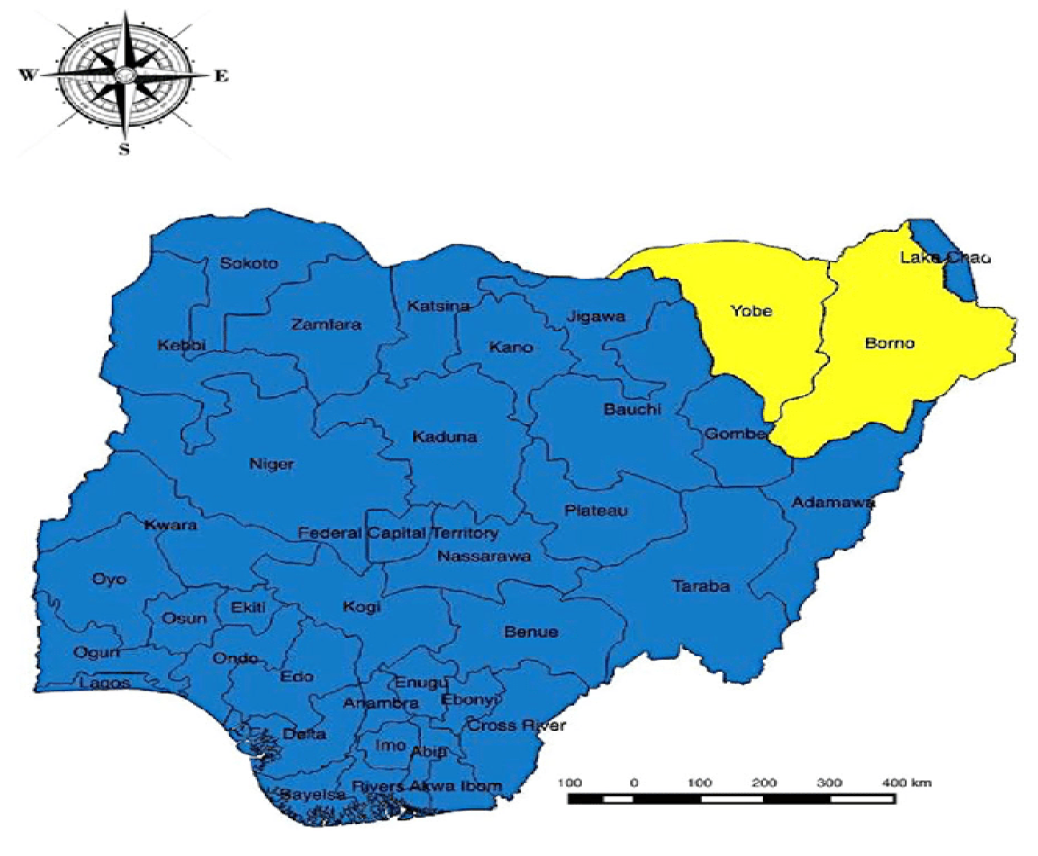
The area of study presents a significant landmass and population in Nigeria which explains why crisis in these two States will affect not only the entire Northeastern region but also the country at large. The area is presented below (Figure 1) in a map geographically for easy perception.
Small Arms and Light Weapons: A Conceptualisation
Small Arms are defined as revolvers, self-loading pistols, rifles, carbines, sub-machine guns, assault rifles and light machine guns. Light Weapons are heavy machine guns, mounted grenade launchers, portable anti-aircraft guns, portable anti-tank guns, rocket system launcher, portable launchers of anti-aircraft missile systems and mortars of calibres of less than 100 mm [7] further submitted that Small Arms and Light Weapons (SALW) are all state-held surplus, redundant, obsolete, unserviceable and confiscated semi-automatic and automatic weapons and purpose-built sniper rifles of a calibre up to and including 12.7 mm.
In another view, Small Arms are conceived as any man-made portable lethal weapon that expels or launches, is designed to expel or launch, or may be readily converted to expel or launch a shot, bullet or projectile by the action of an explosive. These include inter-alia revolvers, self-loading pistols, rifles, carbines, sub-machine guns, assault rifles and light machine guns. Light Weapons are perceived as weapons designed by two or three persons serving as a crew, although some of them may be carried and used by an individual. They include heavy machine guns, hand-held under barrel, mounted grenade launchers, portable anti-aircraft guns, portable anti-tank guns, launchers of anti-aircraft missile systems and mortars of calibre of less than 100 mm [8].
The above explanation indicates that Small Arms differ from light Weapons in their nature, purpose and operation. The Small Arms are usually individualistic in use while Light Arms are operational for group purposes and collective use and strike.
Small Arms and Light Weapons (SALW) are small arms that are operated individually or collectively for both legal and illicit purposes. They include revolvers, self-loading pistols, rifles, carbines, sub-machine guns, assault rifles, light machine guns, heavy machine guns, hand-held under barrel and mounted grenade launchers, portable anti-aircraft guns, portable anti-tank guns, recoilless rifles, portable launchers of anti-tank missile and rocket systems, portable launchers of anti-aircraft missile systems and mortars of calibres of less than 100 mm. related ammunitions and explosives are considered as part of the small arms category. In comparison to major weapon systems, Small Arms are cheap, easily accessbile, simple to operate, portable and easy to repair or replace. Small and Light Weapons are operated by state actors legally and other international agencies but, it is believed that out of the existing 640 million globally, about 60% are operated illegally by armed groups, insurgents and criminals. The international community is addressing the Small Arms problem from two sides- supply and demand. On the supply side, efforts are made on monitoring and enhancing controls over the production, stockpiling and trade in Small Arms. On the demand side, effort shave been made in concentrating on understanding what motives those seeking to acquire the weapons have [9].
Small Arms are identified as weapons designed for personal use including light machine guns, sub-machine guns, pistols, fully automatic rifles and assault rifles and semi-automatic rifles. Small Arms also includes firearms as rocket launchers and portable to expel attacks. Small Arms also consists of ammunitions including cartridge cases, primers, propellant powders, bullet or projectiles, that are used in a Small Arms or Light Weapons. Light Weapons are weapons that are designed for use by several persons serving as a crew, heavy machine guns, automatic cannons, howitzers, mortars of less than 100 mm calibre, grenade launchers, anti-tank weapons and air defense weapons [10].
Most of the international organisations and agencies agreed to the above definitions and classifications of Small Arms and Light Weapons (SALW) conventionally to the extent that the conceptualisation can be officially recognised internationally. For example, the United Nations, United Nations Development Programme, Economic Community of West African States (ECOWAS) and other international bodies accepted the above discussed meaning of SALW.
Figure 1: Map of the Area of Study: Borno and Yobe States
Source: Google Maps 2018
Emergence, Causes and Manifestations of Small Arms and Light Weapons in Nigeria
The spread of Small Arms and Light Weapons (SALW) at the global level permeated other parts of the world and one of the worst hit regions is the African continent. In Africa, it was estimated that more than half of the illicit weapons found their way into Sub-Saharan Africa via the route of Libya to Mali, Somalia, Central African Republic, Cameroon, Chad, Niger and Nigeria. Nigeria is believed to be one of the biggest destinations for the illegal weapons in the world. There are two varied positions on the presence of SALW in Nigeria. One of the views suggested that out of the estimated 650 million SALW in circulation in the world, 100 million are in Africa and 30 million of these weapons are in Sub-Saharan Africa with an estimated 10 million in Nigeria in which a significant portion of it is circulated in Northern Nigeria. The second view reported by the United Nations indicated that there are about 500 million SALW in Sub-Saharan Africa and 350 million of it is located in Nigeria currently [5]. This is devastating and outrageous in terms of armed conflicts and deaths toll in the region for the past two decades.
The proliferation of Small Arms and Light Weapons (SALW) in Nigeria has many causes. One of the causes is trafficking through borders. Nigeria has 770 kilometres of shared land border with the Republic of Benin, around 1,5 00 kilometres with the Republic of Niger, 1, 700 kilometres with Cameroon and 90 kilometres with Chad. Nigeria also has 850 kilometres of maritime border in the Atlantic Ocean. Most of the land borders with Benin Republic, Niger, Cameroon and Chad are porous and difficult to manage effectively. Smugglings and trafficking of illicit goods, contraband materials and SALW easily prevailed untraced. This is how the weapons found their way into Nigeria through an illicit means in most cases [11]. The demised of the Libyan President, Mu’ammar Ghaddafi, paved the way for arming of insurgent and armed groups from the Europe and America through the North African borders to the Central Africa and West Africa to Nigeria. Weapons influx into Nigeria from Libya through Mali and Niger after the collapse of order and security in Libya [12].
Trafficking in SALW has been ongoing since 1990s in Nigeria which suffice it to say that, the emergence of illicit weapons predated the Northern Nigeria armed group crises. For instance, in August 1999, the Nigerian Customs intercepted six nationals of a West African country with in a canoe in Lagos with a 75, 000 round of ammunition and bags containing rifles. In 2001, 10, 000 magazines were apprehended in Ikeja Lagos. The Nigerian Police also intercepted traffickers in Alabata, near Abeokuta, seizing 26, 500 cartridges hidden in 106 boxes. The Port of Warri in the Niger-Delta is also regarded as a centre for arms smugglings and illegal trading. The borders in Northern Nigeria between Niger, Cameroon and Chad served as convenient routes illegal trafficking in weapons and other criminal activities because of the nature of the porous borders [13]. SALW proliferated in Northern Nigeria when the full-blown insurgency emerged in 2009 in Northeastern Nigeria in which the insurgents took over nearly total control of the Nigerian border in the Northeast between Cameroon and Niger in which the dangerous weapons found their way into Sub-Saharan Africa through the Mali route from Libya [12].
The SALW emerged in Northern Nigeria more pronounced and in abundance when the local production took over the external supply. The insurgents, criminals and other armed groups found their way in Mali, Libya and other terrorists’ dens and got an intensive training on the manufacture of these weapons which culminated in local production. For instance, in Northern Nigeria specifically in the Northeast, the Boko Haram insurgents produced local propelled grenades, bombs and other weapons for their operation. Another means in which weapons emerged in Northern Nigeria is the theft of state weapons. Sometimes the insurgents attacked the security base in Northern Nigeria unawares and carted sophisticated weapons [12].
The emergence of SALW in Northern fueled armed conflicts of variant magnitude. It led to a significant rise in crime in various perspectives and ramifications. Another consequence of having easy access to weapons in Northern Nigeria is the rise of ethnic militias in many states. The weapons fueled and escalate ethnoreligious conflicts in Kaduna, Taraba, Adamawa, Benue, Naasarawa, Kogi, Plateau and other states. Additionally, the presence of SALW in Northern Nigeria paved the way for the emergence of a full-blown insurgency in Northeastern Nigeria. The farmers-herders conflict in Northcentral states of Benue, Plateau, Naasarawa and Taraba States in the Northeast was caused by spread of arms. In other parts of the region such as Northwest, armed banditry emanated which threatened thousands of lives and properties in Zamfara, Kaduna, Sokoto, Kebbi and Katsina. Kidnapping has become rampant in the North because of accessibility to weapons in recent years. The implications of armed groups and armed violence is death of thousands of people annually, displacement of communities, creation of IDPs with terrible conditions, insecurity, food scarcity, economic sabotage and wanton destruction of lives and properties [12]. SALW has impacts on sex in terms of violence and gender-based violence in the affected communities [14].
Theoretical Framework
This work adopted Securitisation in explaining the context of the literature and the findings. A new security debate emerged in the 1970s and 1980s principally from Barry Buzan in the field of strategic studies. The Copenhagen School led by Buzan propounded a new paradigm shift in security discourse beyond the conservative traditional realm of security discourse. In the pre-World War II, security dialogue was dominated by traditional/military debates and the potential threats to world peace and security were perceived as military conflicts only. However, after the Second World War, a new dimension was introduced and the debate was further expanded and consolidated by Buzan [15] on the inclusion fully of non-traditional security threats as palpable as the traditional in terms of threats to world peace and security.
The political, economic, social, environmental and human needs are considered as vital aspects of security and they constitute a potential risk to insecurity just like the conventional military threats if they are not catered for [16]. Political issues such as ethnic politics, lack of social cohesion, political violence, subversion of democratic process and national question can threaten the peace and security of a community or a state at large. Economic issues including underdevelopment, inflation, mismanagement, low level of industrialization and low productivity are economic threats that can lead to insecurity in the society. Social problems are another dimension to non-traditional security threats such as corruption, poverty, unemployment, disease, hunger, malnutrition, inequality and gender violence. They can constitute a potential risk and a threat to peace and security in the affected societies. Environmental hazards which include man-made and natural disasters can cause a serious security dilemma like pollution, overcrowding, overpopulation, flood, drought, desert encroachment, deforestation and other related. All these can cause a security crisis just like the traditional/military threats. Buzan [15] concludes that security discourse should be divergent and must be looked into from dual perspective. Any attempt to narrow security threats to military is a suicide in contemporary world in which the non-military threats are more dominant.
This theory can clearly explain the context of this work because the proliferation of Small Arms and Light Weapons (SALW) in Northern Nigeria is correlated with the systemic failure of the policymakers to improve the standard of living of the governed. People in the North are in abject penury, impoverishment, malnourishment, sufferings and economic hardship despite the affluence nature of the country. The unemployed restive youth made an easy prey for recruitment into armed groups and criminal activities because of the social, political, economic and environmental security threats.
MATERIALS AND METHODS
Method of Data Collection and Analysis
The research used both primary and secondary sources of data. A qualitative approach was adopted as the research design for the data collection and analysis. The primary source was an in-depth interview conducted with some selected informants that are relevant in the subject matter of study and are in a possession of vital first-hand information on the field of study. Informants were selected from five major categories and all of them were selected from the areas of study except the informants in category B. Category A is the security personnel in which four (4) senior security officials were interviewed from the military and paramilitary based on accessibility by the researchers. The second category is senior officials from the Ministry of Defense in which three (3) were selected in Defense Headquarters in Abuja based on the officers that are directly related to the subject of study. The third category is the academicians in which four (4) were selected from reputable Northeastern Universities who are specialist in the field of security and strategic studies. The fourth category is international donor agencies that are operating in Borno and Yobe States of Northeastern Nigeria in the area of security matters such as Save the Children, UNICEF and other and four (4) informants were selected in this category based on proximity and accessibility by the researchers. The last category is the civil societies in which five (5) members from different civil society organisations were interviewed in Borno and Yobe States. A total of nineteen (19) informants were interviewed.
The interview questions were designed in a semi-structured format to allow for flexibility of responses. The questions were designed differently for all the categories depending on the nature of information that each of them is expected to provide. Direct and implicating questions were avoided. The interviews were conducted under the oath of confidentiality against the disclosure of the informants for security purpose and for ethnical value of research.
The secondary sources consist of books, journals, internet sources and reports from agencies and organisations. This source was used for the critical review of literature and for the formation of theoretical framework to enable for the proper identification of research gap and contribution to knowledge.
The data obtained from both primary and secondary sources were discussed using thematic analytical interpretation where some themes were formed from the responses of the informants and the previous knowledge on the field.
RESULTS AND DISCUSSION
The Role of Small Arms and Light Weapons (SALW) in Exacerbating Armed Conflicts in Borno and Yobe States of Northeastern Nigeria
In this section, the data obtained from the field were presented, analysed, discussed and interpreted using sub-themes in which the existing literature were connected with the research findings and strengthened by the adopted theoretical framework. Because of the inadequate studies and low availability of data in the area of study, this work relied heavily on primary data from informants in making of analysis and interpretations.
Genesis and Sources of Small Arms and Light Weapons in Borno and Yobe States of Northeastern Nigeria
There are different views on the genesis of Small Arms and Light Weapons (SALW) in Borno and Yobe States of Northeastern Nigeria. Some of the views agreed that the emergence of SALW pre-dated the full explosion of the Boko Haram insurgency in the areas. They believed that the insurgents had been amassing a large stockpile of weapons categorised under SALW for several years before the commencement of attacks on security agencies and other targets. The Nigerian secret security services were aware of the situation and reliable sources revealed that they had informed the authorities concerned in Borno and Yobe but, it was politicised. In other different views from the informants, it was believed that Small Arms and Light Weapons (SALW) were traced in Borno and Yobe States and other Northeastern States through the Trans-Saharan route. However, the exact time when the weapons found themselves in the area is not certain. Illicit weapons were smuggled from Somalia, Mali, Niger, Cameroon and Chad to the Sambisa forest and delivered to the insurgents. The routes are multifaceted because of the nature of porous borders between Borno, Yobe and Cameroon, Chad and Niger which bordered the two States. Surprisingly, it was not only the Trans-Saharan route that is the genesis of the emergence of weapons in Northeastern Nigeria. Illegal weapons were discovered to have been allegedly supplied through the land, water and airspace to the States under study from as far as Lagos shores into the interior of Nigeria down to Borno and Yobe States. The above views are supported by Nowak and Gsell [12] on the genesis of SALW in Northeastern States of Nigeria where Borno and Yobe States are positioned.
There are legal SALW that were allocated substantively by the authorities in the country into the Borno and Yobe States in Northeastern Nigeria which were acquired later illegally and are being used for armed conflicts particularly insurgency, banditry and kidnapping in the Northeast according to some of the informants consulted in the work. This happened through two major processes. The first is the coordinated attacks on the security outposts by the armed groups who often times succeeded in carting away with SALW from the barracks and other places for the storage of weapons in Borno and Yobe. The second process is the purchase of weapons from the security personnel who are operating in the Northeast to combat insurgency. It was also revealed that the armed groups were trained by Al Qaeda in Somalia, Libya and Middle-East on the local manufacture of SALW and they are able to produce local IEDs, machine guns, anti-aircraft guns and other sophisticated SALW locally for operation. It has been identified that some areas such as Bama, Banki, Gamborun Ngala, Kukawa are the channels that the insurgents used to transport their weapons for attacks in Borno metropolitan and other surrounding enclaves while Sambisa forest is the hideouts for the weapons and their storage. These views by the informants is supported by some studies [12,17].
Types and Nature of Small Arms and Light Weapons (SALW) in Borno and Yobe States of Northeastern Nigeria
The data obtained from the informants in different groups revealed that armed groups in Borno and Yobe States carry and manifest different range of weapons or SALW such as pistols, reloaded revolvers, rifles, semi-automatic machine guns, machine guns, anti-aircraft guns, rocket grenade launchers, rocket system launcher, armour tanks, explosives and other different varieties of illicit weapons procured illicitly either through purchase, smuggle or local manufacture. The armed groups are found on many occasions to be wielding weapons that outmarched that of security personnel in Borno and Yobe States. There were evidences of the discovery of local manufacturing plants of weapons in Borno and Yobe States in Sambisa hideouts and other remote places whenever the government’s troops are lucky to defeat and dismantle the assembly of insurgents. These scenarios are being reported by newspapers and international donor agencies that are operating there.
The armed groups (specifically Boko Haram) attack military posts, churches, mosques, markets, public gathering using two major strategies. In some instances, they attacked through the use of explosives and RPGs before they followed it up with shootings from rifles such as AK47, machine guns and automatic weapons. In other instances, they start by shooting using simple weapons such as pistols and AK47 before they supplement with explosives. They used anti-aircraft to defend themselves whenever there is an attack by fighter jets from the government’s forces. In the process, whenever they overcame the government forces, they carted away with weapons illegally from the government’s storage. The informants collectively disclosed that the only type of weapon that the armed groups in Borno and Yobe States are not in possession is aircraft or fighter jet and this is not even classified under SALW. All forms and types of SALW are displayed by the insurgents in Borno and Yobe States and other Northeastern States in Nigeria. There is an estimated number of these weapons illicitly in the hands of armed groups to the number of 22 million according to one of the informants. In another version, an informant narrated that there is an estimated 50 million SALW in the Borno and Yobe axis alone apart from the other Northeastern states. Others argued that there is no tentative figure on the quantity and quality of SALW in Borno and Yobe States but there is certainty that more than 70% of the weapons are illegally possessed by armed groups especially Boko Haram. This position has been supported by Nowak and Gsell [12].
The Impact of Small Arms and Light Weapons (SALW) in Borno and Yobe States of Northeastern Nigeria: The Boko Haram Phenomenon
The Boko Haram insurgency is one of the deadliest insurgent and armed groups contemporarily across the globe. The Boko Haram insurgency affected nine states in the North and the FCT Abuja with all the six Northeastern states of Adamawa, Bauchi, Borno, Gombe, Taraba and Yobe. The group which started in early 2000s in Borno and Yobe states as a radical movement turned into full armed group in 2009 after the extrajudicial killing of their leader, late Muhammad Yusuf. They later metamorphosed into an insurgent group attacking and killing security personnel, civilians, foreign aid workers and other civil groups [18]. Apart from poor socioeconomic and political condition, poverty, unemployment and ignorance in Northern Nigeria, [19] identified the emergence of Small Arms and Light Weapons (SALW) in the region as another major cause of the insurgency.
The Boko Haram insurgency controlled about 20 local governments in Borno, Yobe and Adamawa states constituting nearly 30% of the Northeastern region using SALW such as pistols, AK47, machine guns, semi-automatic machine guns, propelled grenades, anti-aircraft guns, anti-tank guns and explosives. They attacked and killed soldiers, police and other security personnel and also attacking civilians in the mosques, churches, markets, at their residences and everywhere. The Boko Haram terrorism secured Nigeria the rank of 3rd in the Global Terrorism Index in 2018 because of the devastation. The Boko Haram insurgency created a serious humanitarian crisis in Northeastern Nigeria and Northern Nigeria at large with IDPs estimated as 2.5 million, mutual suspicion between Christians and Muslims in the country [20].
In a field survey in which interviews were conducted with the selected informants, all of the informants agreed that the spread of illegal arms and dangerous weapons across Sub-Saharan Africa is one of the factors that motivated the emergence and expansion of the Boko Haram armed groups. Specifically, one of the informants disclosed that: “The escape route for illicit weapons through the Trans-Saharan ways after the collapse of Libya paved the way for the dreaded Boko Haram insurgents to have easy access to illegal weapons for attacks and defense. Not only an easy access, it also offered the chance for the insurgents to establish a network which enabled for training in the manufacture and manipulation of Small Arms and Light Weapons (SALW). The resultant effect is the fact that today Boko Haram is one of the deadliest armed groups in the world reminiscent of arming of criminal movements and insurgents”.
Additionally, the Securitisation Theory which assumes non-traditional security such as poverty, unemployment and critical socioeconomic condition as well as Social Conflict Theory which explains the nature of struggles and competition to control scarce resources leading to conflict are all applicable and explanatory here. This is because the Boko Haram insurgents fall within the category of the poor impoverished in Northeastern Nigeria and they are competing and struggle for power with the ruling elites through a violent protest.
The Consequences of Small Arms and Light Weapons (SALW) in the Political and Socioeconomic Crises in Borno and Yobe States
The possession of Small Arms and Light Weapons (SALW) illegally by armed groups in Borno and Yobe States of Northeastern Nigeria has daring consequences and negative implications on the political and socioeconomic aspects of the inhabitants. Data obtained from the informants and some reports indicated one of the worst kinds of humanitarian crises in the states resulting from the proliferation of SALW. Most of the informants identified the frequency of the Boko Haram attacks in Borno and Yobe States to be estimated in hundreds numerically. For instance, one of the informants argued that the Boko Haram insurgents had attacked Borno and Yobe States from 2009 to 2019 up to 200 times in different locations with devastating effects. He added that the attacks vary in effects and impacts. In some instances, heavy ammunitions were lost to the insurgents in the battle. In other cases, heavy lost of lives were recorded ranging from 10 to 200 with the peak of the lose recorded in Baga in 2014 when it was reported that at least more than 1500 were massacred by the insurgents. Other consulted interviewers also believed that there were hundreds of heavy attacks with sophisticated weapons classified under SALW by the Boko Haram insurgency in hundreds and the bulk of the attacks occurred in Borno and Yobe States where the insurgency originates from and where the insurgents formed a resistible group that is recalcitrant to the government’s troops. More than 10, 000 people were killed and it was identified that over 60% of the victims emanated from either Borno or Yobe.
The emergence of Internally Displaced Persons (IDPs) in the Northeast which is currently officially reported as 2 million is the spillover effects of armed group conflicts in Borno and Yobe States courtesy of the possession of SALW. These IDPs are spread in the Northeast but more than 50% of them according to one of the informants are located in Borno and Yobe under a worst and terrible form of condition that a human being could ever live in. the IDPs in other states of the Northeast like Gombe, Bauchi and Adamawa are stretching the existing facilities such as hospitals, schools, housing and other necessities of life which further deepen human crisis in the entire Northeast. This is the view of some of the informants and which has been supported by Dunn [21]. Food insecurity was created not only in Borno and Yobe State but in the entire Lake Chad region. It was narrated by an informant that the fish business in the Baga and Lake Chad axis was obliterated which is economically believed to have been transacted in millions of Naira annually and a good source for international trade between Nigeria and neighbouring Chad and Niger. Farming activities was grinded to a halt in the Yobe areas which is one of the foods and cash crop producing areas.
The political activities in the two states under study were thrown into suspicion and political disintegration especially with the abduction of more than 200 Chibok Secondary school girls in Borno States in 2013 which has been followed by Dapchi abduction of over 100 secondary school girls in Yobe in 2017. The Christian and minority groups in the two States perceived the abduction as political and an oppression against the vulnerable and weak political groups in the areas. Indeed, it went to the extent of religious tension in the affected States. The educational development of Borno and Yobe States was arrested from the commencement of insurgency where more than 200 elementary and secondary schools were closed and around 11 tertiary institutions were temporarily closed because of the effects of insurgency. There were disruptions in infrastructure where the insurgents attacked schools, roads, electricity supply, water, financial services and commercial activities. The Borno and Yobe areas that interconnect the Northeastern Nigeria with the Central and North Africa for commercial activities for thousands of years were blocked and disrupted by the armed group activities in the region.
CONCLUSION
In conclusion, the research is a detail anatomy of the role of Small Arms and Light Weapons (SALW) in escalating and spreading armed conflicts in Borno and Yobe States of Northeastern Nigeria from the perspective of both the use of primary and secondary sources. The research discovered that the global spread of weapons illegally affected Nigeria with porous borders and that has many effects in terms of causing conflicts. SALW compounded armed conflicts and rejuvenate criminal activities in Northeastern Nigeria as manifested in the Boko Haram insurgency. The devastating effects according to this study is the nature and manner in which thousands of lives are lost continuously, properties worth billions of Naira are annihilated, people are displaced, farming was hindered, commercial activities were halted and mutual suspicion was created and sustained among the Nigerian communities. To this end, this study suggested the following as permanent measures that should be taken to address the problem:
Nigerian government should embark on signing of treaties and agreements on marking, tracing, brokering and possession of SALW
Security personnel should be trained effectively to develop skills in tracing and containing of SALW across Nigerian borders and within the country
Intelligence gathering should be given much priority in identifying illegal possession of SALW and illicit weapons
Public should be sensitise because right now there is low level of awareness on the spread and impacts of SALW even among the intellectuals in the country except those in the security field and academics that are researching in the area and
Nigerian borders should be monitored and scrutinise closely by Nigerian security personnel.
REFERENCES
GIABA. The nexus between small arms and light weapons and money laundering and terrorist financing in West Africa. ECOWAS, 2013.
United States Institute for Disarmament Research. Tracking and Legalising the Brokering of Small Arms and Light Weapons. Peace Research Publication, 2006.
Federation of American Scientists. “Small arms primer.” Federation of American Scientists, fas.org/asmp/ campaigns/smallarms/primer.html.
Global Policy Forum. How to guide small arms and light weapons proliferation legislation. United Nations Development Programme, 2011.
Method, S. “Stemming the tide: African leadership in small arms and light weapons control.” OEF Research, 2018, oefresearch.org/think-peace/african-small-arms-control.
Meek, S. and N. Stott. A guide to the destruction of small arms and light weapons: The approach of the South African National Defence Force. United Nations Institute for Disarmament Research, 2004.
Central African Convention for the Control of Small Arms and Light Weapons. United Nations Institute for Disarmament Research, 2011.
United Nations Institute for Disarmament Research. Developing a mechanism to prevent illicit brokering in small arms and light weapons: Scope and implications. United Nations, 2006.
Saferworld. Small Arms and Light Weapons: A Training Manual. Saferworld, 2012.
Chigozie, C.L. Nigeria and the ECOWAS convention on small arms and light weapons: A Critical Appraisal. Master’s thesis, University of Nigeria, Nsukka, 2010.
Nowak, M. and A. Gsell. Handmade and Deadly Craft: Production of Small Arms in Nigeria. Small Arms Survey Briefing Paper, German Cooperation, 2018.
Yacubu, J.G. “Cooperation among Armed Forces and Security Forces in Combating the Proliferation of Small Arms.” In: Combating the Proliferation of Small Arms and Light Weapons in West Africa, A. Ayissi and I. Sall (Eds.), United Nations Institute for Disarmament Research, 2005, pp. 55–69.
Farr, V. et al. Sexed Pistols: The gendered impacts of small arms and light weapons. United Nations University Press, 2009.
Buzan, B. People, State and Fear: An agenda for international securitystudies in the post-cold War Era. Great Britain, 1983.
Buzan, B. and L. Hansen. The evolution of international security studies. Cambridge University Press, 2009.
Bowser, E.F. and A. Sanders. Security threats in the Sahel and beyond: AQIM, Boko Haram and Al-Shabab. Civil-Military Fusion Centre, 2012.
Forest, J.J.F. Confronting the terrorism of Boko haram in Nigeria. JSOU Press, 2012.
Omotosho, M. “Dynamics of religious fundamentalism: A Survey of Boko haram insurgency in Northern Nigeria.” Journal of Philosophy, Culture and Religion, vol. 4, 2015, pp. 8–15.
Dunn, G. “The impact of the Boko Haram insurgency in northeast Nigeria on childhood wasting: A double difference study.” Conflict and Health, vol. 12, no. 6, 2018, pp. 118–130, www.ncbi.nlm.nih.gov/pmc/ articles/PMC5782364/.
Recommended Articles
Research Article
The Hidden Killer: Algorithmic Atmospheres and the Death of the User
Yaman Birawi
Published: 30/05/2026
Download PDF
Research Article
The Legal Regulation for Protecting Persons with Mental Disabilities
Budoor Salim Mahdi
Published: 30/06/2025
Download PDF
Research Article
The Role of the United Nations in Combating the Crime of Money Laundering
Asan Juma Fadil,
Musaab Ayad Ibrahim
Published: 04/01/2026
Download PDF
Research Article
The Management of Forest Area by Forest Management Unit in Creating Law Certainty and Justice (A Case Study in Daerah Istimewa Yogyakarta Province)
Septiawan Risma Saputra,
...
Lego Karjoko
Published: 30/06/2021
Download PDF
PO Box 101, Nakuru
Kenya.
Email: office@iarconsortium.org
Editorial Office:
J.L Bhavan, Near Radison Blu Hotel,
Jalukbari, Guwahati-India
Sule, B. & Mikail, I. K. (2020). The Role of Small Arms and Light Weapons (SALW) in Exacerbating Armed Groups Conflicts in Borno and Yobe States of Northeastern Nigeria. International Academic Journal of Law, 1(1), 1-8.
MLA
Sule, Babayo and Ibrahim K. Mikail. "The Role of Small Arms and Light Weapons (SALW) in Exacerbating Armed Groups Conflicts in Borno and Yobe States of Northeastern Nigeria." International Academic Journal of Law 1.1 (2020): 1-8.
Chicago
Sule, Babayo and Ibrahim K. Mikail. "The Role of Small Arms and Light Weapons (SALW) in Exacerbating Armed Groups Conflicts in Borno and Yobe States of Northeastern Nigeria." International Academic Journal of Law 1, no. 1 (2020): 1-8.
Harvard
Sule, B. and Mikail, I. K. (2020) 'The Role of Small Arms and Light Weapons (SALW) in Exacerbating Armed Groups Conflicts in Borno and Yobe States of Northeastern Nigeria' International Academic Journal of Law 1(1), pp. 1-8.
Vancouver
Sule B, Mikail IK. The Role of Small Arms and Light Weapons (SALW) in Exacerbating Armed Groups Conflicts in Borno and Yobe States of Northeastern Nigeria. International Academic Journal of Law. 2020 Jul;1(1):1-8.


 Download PDF
 Download XML