Background: Spirituality is an important for every Nursing student because it is related to nursing education and practice. When nurses are accurately educated about understanding the meaning of the spiritual health, they may be expected to understand how to provide spiritual care and the role of spiritual interventions. The aim of this study was to assess the spirituality among Nursing students in Varanasi. Materials and Methods: This was a cross-sectional study. A total of 100 nursing students were selected. The questionnaires used were on Spiritual Health Scale (SHS) and a demographic profile. The statistical analysis was performed using the SPSS software, version 25. Results: Both male and female were included in my study. The half of the Nursing students trust in God and there is significant association between status of spirituality and experience of family died & personal health problems. There is no significant association between spiritual health and socio-demographic variables like age, gender, qualification of participants, domicile, type of family, devoted religionist. Conclusion: Nursing students is aware from the impact of spirituality. Nurses is a role models for a better lifestyle, including spiritual health.
The term ‘Spiritual’, matters ‘concerning the spirits’, is derived from old French spiritual, which is derived from Latin spiritualism, which comes from spirits or ‘spirit’. The meaning of spiritual health is the quality of being concerned with the human spirit or soul opposed to material or physical things.
Traditionally, spirituality referred to a religious process to re-formation which aims to recover the original shape of man, oriented at ‘the image of God’. In general, it includes a sense of connection to something bigger than ourselves and it typically involves a search for meaning in life. People may describe a spiritual experience as sacred or transcendent or simply a deep sense of liveness and interrelation. Some may find that their spiritual life is linked to their association with a church, temple, mosque, or synagogue. Other may pray are comfort in a personal relationship with God who is super natural power. The spiritual health may change throughout your life, adjusting to your own experiences and relationship.
Spirituality is based on several foundations from various religious traditions, spiritual movements, belief system, cultures, way spiritual health is lived and felt depends on each individual since it is an individual experience, even when beliefs and tradition are shared.
According to Puchalski [1], it is a positive dimension of the human being and care and might help patient reframe their experience and condition of illness as well as find meaning in life. It means any experience or thought to bring the experience into contact with the divine. It is the aspect of humanity that refers to the way individual seeks and express meaning and purpose and the way they experience their connectedness to the moment, to self to others to nature. Spiritual health defined as spiritual development, spiritual health used as a critique from mainstream religion and the academic community without rationalism and objectivism, spiritual health understood as an empty container for individual meaning, spiritual health understood as common ground or field and spiritual health as quasi-religion [2].
Religion is often based on various organized, individual and attitudinal expression of different faith traditions and the meaning of spiritual health comes through a sense of meaning, purpose or power from within or from a transcendent source [3]. Therefore, most scholars agree that religion is a component of spiritual health and that the concept of spiritual health is intrinsically broader than that of religion [4]. Spiritual health is good for health in nursing. It is a protective resource that may assist people in avoiding disease, or it may serve as a buffer to help the patient coping with the impact of disease [5]. Spiritual health had an inverse relationship with positive health attitudes, behaviours and outcomes [6].
Spiritual care that enables the persons to meet three central universal sacred requirements that have the potential to make people concurrently resourceful and vulnerable. The spiritual needs are meaning and purpose, love and relatedness and forgiveness. These needs are principal to all sacred traditions and are common to all humanity. Spiritual care has also been set forth as the care nurses offer to meet the spiritual wants and/or problems of clients. It implies that every person is spiritual in a manner. It is assumed that non-religious, religious and secular person can share spiritual wants through these desires may be articulated and addressed in diverse way. It should be considering an important part of holistic and multidisciplinary care. We should begin with student nurses, who will soon be clinicians, to find out about potentiality of the nursing profession to put spiritual care into practice.
Spiritual care has positive effects on individual stress responses, spiritual well-being, sense of integrity and excellence and interpersonal relationships. Spiritual well-being is important for individual’s health potential and the experience of illness/hospitalization can threaten optimum achievement of this potential. Professional Nurse holds spiritual care as a dimension of practice.
Nurses are the members of health care team, who spend more time with their patients than do other healthcare providers, must recognize the spiritual needs of patients as a domain of nursing care. Nurse relates to his/her own spiritual health is an important factor of the quality of the spiritual care he/she will provide. Nurse’s perception of spiritual health can directly influence on how to behave, how to deal with their patients and how to communicate with them in favour of providing spiritual care. The importance of nurse’s abilities to understand their own perception of spiritual health before assessing others’ spiritual needs has to be stressed. Positive attitudes and perceptions of nurse’s own spiritual health might promote a delicate sensitivity to others spiritual concerns and an elevated consciousness regarding spiritual health, which could be potentially helpful in the assessment process [7].
Student nurses need to be educated in spiritual care. The education of nursing students is one of the most important items for their future career and developing a sentience of spiritual health in nursing students may deliver the surest way to provide spiritual care for patients. When nurses are accurately educated about spiritual meaning, they may be likely to understand how to provide spiritual care and the role of spiritual interventions.
The nurses in the health care team are the health care professionals who spend the most time with the patients. For this reason, nursing is the most appropriate profession to provide spiritual care [8]. Nurses should have spiritual self-awareness before observing and emphasizing patients’ spiritual needs. Qualitative and quantitative approaches must be implemented in defining spiritual health in nursing field and the best teaching strategies must be used for training spiritual merits and increasing students ‘capability in facing with spiritual needs and offering spiritual care.
Nursing education should play an important role in preparing us for the challenge of caring for patient spiritual needs.
According to Wallace et al. [9], concluded the spiritual dimensions of holistic nursing to be an area neglected in nursing education. Some professors claimed that not including such in nursing programs was a barrier to the delivery of spiritual care. Vance [10], findings, determining that 65% of surveyed nurses identified insufficient spiritual education as a barrier to providing spiritual care.
This is the first study from the perspective of nursing students to identify the spiritual care needs of nursing courses. Thus, the nursing education system in Taiwan should pay greater attention to spiritual care issues, as many other countries do. The purpose of this study was to assess the spiritual health among nursing students in College of Nursing.
In this study, cross sectional descriptive research design was used to assess the spiritual health among nursing students in College of Nursing, IMS, BHU. The purposive sampling technique was used to select 100 nursing students at College of Nursing, Banaras Hindu University. Written informed consent was taken from Nursing students. Data were gathered from participants of first- and second-year Nursing students through self-administrated questionnaire in their own classrooms. All participants agreed to enroll in this survey and they were informed that their participation was both voluntary and anonymous. The tools consisted of two sections: Section A, was Sociodemographic like age, gender. Section B, consisted of a self-assessment using the Spiritual Health Scale. A total of 30 variables were identified and constructed a spiritual health scale with five-point Likert-type scale like Strongly Disagree, Disagree, Neutral, Agree and Strongly Agree. The test -retest method was used to find the reliability as r = 0.86. Interview method was used to collect data. The Data were analyzed with SPSS version 25 according to the objectives of the study using Descriptive and Interferential statistics.
Ethical Considerations
The study was approved by the committee of the University. Preceding data collection, the aim of the study was clarified to students and informed consent was obtained. Anonymity and confidentiality of the students were maintained.
Table 1 showed the Majority of the participants (52%) were in the age group of 22-25 and 52% were female. 80% of Nursing students had taken the education up to intermediate level. 40% participant’s father were educated up to graduate level and 30% Mothers had taken education up to intermediate level. 34% father’s occupation were government employed and Majority of (92%) Mother were housewife. About 54% had family income per month more than Rs. 20,000. Majority of the participant (58%) were residing in rural area. 53% of the participants belonged to joint families. Most of the subjects (62%) had 6 members in their families. Majority (72%) of participants were devoted in religious activities. Most of the subjects (48%) regarding religious affiliation were secondary. 83% family atmosphere in home were harmonious (83%).
Table 1: Socio-Demographic Variables of the Nursing Students N = 100
S.No. | Demographic Variables | Frequency | Percentage |
1 | Age | ||
| 17-21 | 48 | 48 | |
| 22-25 | 52 | 52 | |
2 | Gender | ||
| Male | 48 | 48 | |
| Female | 52 | 52 | |
3 | Academic Qualification of Participants | ||
| Intermediate | 80 | 80 | |
| Graduate | 20 | 20 | |
4 | Father Education | ||
| Illiterate | 07 | 07 | |
| Primary | 01 | 01 | |
| Secondary | 02 | 02 | |
| High School | 14 | 14 | |
| Intermediate | 23 | 23 | |
| Graduate | 40 | 40 | |
| Post Graduate | 13 | 13 | |
5 | Mother Education | ||
| Illiterate | 26 | 26 | |
| Primary | 08 | 08 | |
| Secondary | 13 | 13 | |
| High School | 16 | 16 | |
| Intermediate | 17 | 17 | |
| Graduate | 14 | 14 | |
| Post Graduate | 06 | 06 | |
6 | Father Occupation | ||
| Farmer | 32 | 32 | |
| Daily Wages Worker | 09 | 09 | |
| Private Employee | 25 | 25 | |
| Government Employee | 34 | 34 | |
7
| Mother Occupation | ||
| Housewife | 92 | 92 | |
| Private Employee | 02 | 02 | |
| Government Employee | 06 | 06 | |
8 | Family Income | ||
| 0-10,000 | 19 | 19 | |
| 10,001-20,000 | 27 | 27 | |
| Above 20,000 | 54 | 54 | |
9 | Domicile | ||
| Urban | 42 | 42 | |
| Rural | 58 | 58 | |
10 | Types of Family | ||
| Nuclear | 47 | 47 | |
| Joint | 53 | 53 | |
| 11 | Total No. of Family Members | ||
| 3 to 4 | 16 | 16 | |
| 5 to 6 | 84 | 84 | |
12 | Devoted Religionist | ||
| Yes | 72 | 72 | |
| No | 28 | 28 | |
13 | Religious Affiliation | ||
| Primary | 47 | 47 | |
| Secondary | 48 | 48 | |
| Atheism | 05 | 05 | |
14 | Family Atmosphere | ||
| Harmonious | 83 | 83 | |
| In harmonious | 17 | 17 | |
Table 2, Revealed that the sequence of stressful events, 52% participants were not experienced about died in the family. But majority of the participants (75%) were experienced about the family health problem. 66% participants were experienced of economic problem.
65% participants were experience about personal health problem. 55% participants had experienced of failure in academic achievement. 74% participants reported they have no experienced about disappointed in love.
Table 2: Stress Experience Variables of the Nursing Students. N = 100
S.No. | Variables | Frequency | % |
1. | Experience of family died | ||
| Yes | 48 | 48 |
| No | 52 | 52 | |
| 2. | Experience of family health problem | ||
| Yes | 75 | 75 | |
| No | 25 | 25 | |
| 3. | Experience of economic problem | ||
| Yes | 66 | 66 | |
| No | 34 | 34 | |
| 4. | Experience of personal health problems | ||
| Yes | 65 | 65 | |
| No | 35 | 35 | |
| 5. | Experience of failure in academic achievement | ||
| Yes | 55 | 55 | |
| No | 45 | 45 | |
| 6. | Experience of disappointed in love | ||
| Yes | 26 | 26 | |
| No | 74 | 74 |
Prevalence of Religious Affiliation among Nursing Student
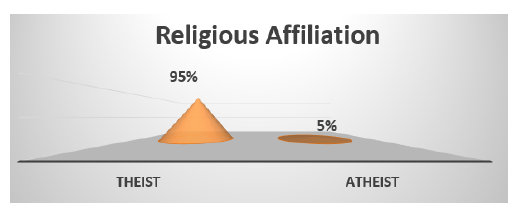
Majority of (95%) Participants used to believe in God and 5% did not believe in God (Figure 1).

Figure 1: Cone Diagram Showing Percentage Distribution of Religious Affiliation
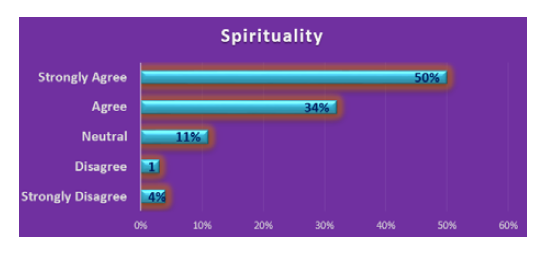
Majority 50% of Nursing Students strongly agreed and 34% agreed that they believed in Spirituality. 11% were neutral. 1% disagreed and 4% strongly disagreed, they did not believe in Spirituality (Figure 2).

Figure 2: Bar Diagram Showing Percentage Distribution of Spirituality
Table 3, There is no significant association between spirituality and socio-demographic variables like age, gender, qualification of participants, domicile, type of family, devoted religionist.
Table 3: Association Between Status of Spirituality with Selected Demographic Variables Among Nursing Students, N=100
| Socio-demographic Variables | Neutral | Agree | Strongly Agree | Total | Chi-square | p value |
| Age | ||||||
| 17-21 | 04 | 36 | 08 | 48 | 2.11 | 0.34 NS |
| 22-25 | 06 | 32 | 14 | 52 | ||
| Gender | ||||||
| Male | 08 | 29 | 11 | 48 | 4.92 | O.09 NS |
| Female | 02 | 39 | 11 | 52 | ||
| Academic Qualification of Participants | ||||||
| Intermediate | 07 | 58 | 15 | 80 | 3.74 | O.15 NS |
| Graduate | 03 | 10 | 07 | 20 | ||
| Domicile | ||||||
| Urban | 03 | 31 | 08 | 42 | 1.24 | 0.54 NS |
| Rural | 07 | 37 | 14 | 58 | ||
| Types Of Family | ||||||
| Nuclear | 04 | 33 | 10 | 47 | 0.28 | 0.87 NS |
| Joint | 06 | 35 | 12 | 53 | ||
| Devoted Religionist | ||||||
| Yes | 07 | 46 | 19 | 72 | 2.91 | 0.23 NS |
| No | 03 | 22 | 03 | 28 | ||
Table 4, Exposed that there is significant association between status of spirituality and experience of family died & personal health problems.
Table 4: Association Between Spirituality with Stress Experience Among Nursing Students, N=100
| Variables | Neutral | Agree | Strongly Agree | Total | Chi-square | p value |
| Experience of family died | ||||||
| Yes | 01 | 37 | 10 | 48 | 6.96 | 0.03 S* |
| No | 09 | 31 | 12 | 52 | ||
| Experience of family health problem | ||||||
| Yes | 07 | 53 | 15 | 75 | 0.99 | 0.61 NS |
| No | 03 | 15 | 07 | 25 | ||
| Experience of economic problem | ||||||
| Yes | 08 | 42 | 16 | 66 | 1.86 | 0.39 NS |
| No | 02 | 26 | 06 | 34 | ||
| Experience of personal health problems | ||||||
| Yes | 05 | 41 | 19 | 65 | 6.06 | 0.05 S* |
| No | 05 | 27 | 03 | 35 | ||
| Experience of failure in academic achievement | ||||||
| Yes | 05 | 40 | 10 | 55 | 1.31 | 0.52 NS |
| No | 05 | 28 | 12 | 45 | ||
| Experience of disappointed in love | ||||||
| Yes | 03 | 17 | 06 | 26 | 0.14 | 0.93 NS |
| No | 07 | 51 | 16 | 74 | ||
NS: Not Significant, S: Significant (<0.05)
Table 5, showed that several statements were more commonly recognized by the Nursing students. All the students were agreed by these statement like: God helps to cope with problems, I love of God, I feel that God is my friend, I try to expand my soul, I try to deal consciously with others, I try to be patient and tolerant, I help others, I try to empathetic with others, My life is peace and joy, I feel one with the world, I feel there is a lot of love in the world, I trust that there is only one true faith, I feel a strong spiritual bond with all of human kind, A life purpose of prayer is to avoid personal tragedy, I fear God’s punishment, My faith is an important part of my individual identity, My faith helps me to confront tragedy and suffering, My faith gives the meaning of life and I believe that the world is basically good.
Table 5: spiritual Health Among Nursing Students N = 100
| S.No. | Questionnaire | Strongly Disagree | Disagree | Neutral | Agree | Strongly Agree |
| God helps to cope with problems. | 05% | 03% | 15% | 41% | 36% | |
| I love of God. | 05% | 02% | 20% | 37% | 36% | |
| I feel that God is my friend. | 11% | 04% | 20% | 38% | 27% | |
| I try to expand my soul. | 05% | 01% | 26% | 39% | 29% | |
| I search for the spirit. | 09% | 07% | 34% | 29% | 21% | |
| I try to deal consciously with others. | 04% | 03% | 10% | 52% | 31% | |
| I try to be patient and tolerant. | 06% | 04% | 11% | 41% | 38% | |
| I help others. | 01% | 00% | 08% | 48% | 43% | |
| I try to empathetic with others. | 03% | 02% | 13% | 54% | 28% | |
| My life is peace and joy. | 03% | 12% | 20% | 34% | 28% | |
| I feel there is a lot of love in the world. | 10% | 08% | 18% | 42% | 22% | |
| I trust that there is only one true faith. | 07% | 11% | 23% | 47% | 12% | |
| I feel a strong spiritual bond with all of human kind. | 03% | 08% | 26% | 40% | 23% | |
| A life purpose of prayer is to avoid personal tragedy. | 09% | 17% | 17% | 43% | 14% | |
| I fear God’s punishment. | 04% | 14% | 25% | 36% | 21% | |
| My faith is an important part of my individual identity. | 07% | 03% | 20% | 40% | 30% | |
| My faith helps me to confront tragedy and suffering. | 04% | 04% | 22% | 44% | 26% | |
| My faith gives the meaning of life. | 01% | 06% | 17% | 38% | 38% | |
| I believe that the world is basically good. | 04% | 08% | 16% | 42% | 30% |
The present study was conducted on the spirituality among Nursing Students in College of Nursing, BHU. The present study revealed that 52% participants were in the age group of 22-25 years. These findings are consistent with the study conducted by Baldachinno and Gobier, Dyson, J. et al. [4], which revealed that 46.4% were in the age group of 22-25 years. The finding of present study females composed of 52% and males 48% of the total sample. These findings are supported by study conducted by Barnard [11], 64% were female and 36% were males of the total sample.
In present study, we can refer to figure 1, Most of the Participants used to believe in God and some of the participants did not believe in God (Refer to Figure 1). These findings are showed by Rule [12], who encourage that believers tend to be more satisfied with life than non-religious people.
The half of the Nursing students said they “Trust in God” to religious attachment. God had rewarded or punished them. This study consistent with Bussing et al., found that relying on Trust-in-God. Some students did not believe in God.
The data analysis in this study regarding there is no significant association between spirituality and socio-demographic variables like age, gender, qualification of participants, domicile, type of family, devoted religionist. However, Ziapour [13], reported that spirituality was significantly higher in female students than males, which can be related to girls' adaptability to various conditions than boys. Furthermore, Masoudi [14], suggested that there was no considerable difference regarding male and female students in terms of spirituality, but girls' scores are more than boys in terms of spirituality.
Family was a factor that particularly affected the spirituality of participants; those participants who described their family atmosphere as ‘‘harmonious” had, in general, higher scores on the Spirituality Score (Figure 2).
The Nursing students experience with sequence of stressful events, like one third of the students had experienced about the family health problem, more than half students had experienced of economic problem and failure in academic achievement. A previous report has shown by Deb [15], showed that more than half of the students had experienced serious crises in the past such as death of family member or close friend, financial crisis and breakup of intimate relationships.
Spiritual health among Nursing students, there were twenty items including belief in the power of God or Super being, want to be protected from God or Super being, believe that God would assist one through suffering and religious activities bring peace and comfort.
Most of the participant agreed that God helps to cope with problems. Jon et al. have also suggested that the evaluation of one's ability to solve a problem by religious means may serve a self-maintenance function. Thus, the individual may draw emotional support through appraising the problem as solvable with God's help. This pattern of results is consistent with the results of Pargament et al. [16]. Majority of the participant agreed that I love of God. So, some other study [17], said who most strongly affirm that they love God and that God loves them experience their health in more positive term. Most of the participants agreed that “I feel that God is my friend”, these opinions usually provide social relief. According to Chan [18], the research showed that seeing God as your friend when you are already socially connected actually provides minimal additional benefit for purpose in life. Participants agreed that I try to expand my soul, my soul that always fills me, guides me, comforts me, corrects me and delights me. I try to deal consciously with others by the participants. The Marchetti [19], view, a self-organizing system conscious are the social relations it has with the other self-organizing systems of the social structure in which it lives. I try to be patient and tolerant. According to anxiety Canada- how to tolerate uncertainty, if you can’t get rid of uncertainty in your life, then the only way to manage your intolerance of uncertainty is by learning to be more tolerant of uncertainty. The participants agreed that I help others and I try to empathetic with others. Heylighen [20], has given statement about, I can help others understand themselves better or feels along with others, helps them understand themselves. My life is peace and joy, according to Bible study: When you feel weak and seem to have no strength left, the joy of the Lord will strengthen you if you refuse to feel sorry for yourself and choose instead to remember that the Lord your God is a holy God and He has promised that His joy is your strength. I feel there is a lot of love in the world, being in love makes you feel encouraged. You can approach anything, anywhere, anytime. Being in love gives you motivation. Your attitude is optimistic and always positive, explained by the participants. I trust that there is only one true faith. When we respond to God’s call to relationship, we place our faith, our trust, in him. Participants feel a strong spiritual bond with all of human kind, so spiritual people find ways to meet the challenge and continue with purposeful lives.
A life purpose of prayer is to avoid personal tragedy, so Prayer can lead us to wisdom. Humble yourselves, therefore, under the mighty hand of God so that at the proper time he may exalt you, casting all your anxieties on him, because he cares for you. Some participants said that I fear God’s punishment, the person who experiences fear "has not been perfected in love." In other words, those who fear punishment don't have a complete relationship with God.
Most of the participants agreed that my faith is an important part of my individual identity, it helps me to confront tragedy and suffering, it gives the meaning of life and I believe that the world is basically good. It means the faith is greater than an impression in our minds. It is more than words.
Nursing care is very essential part of nursing which recognizes empathy and care. The nursing students are concerned about their own spirituality and they believe in God. They are the models for a better life style. Nursing students of College of Nursing, Banaras Hindu University has received appropriate training to develop their abilities to provide spiritual care of admitted patients in their hospital. The Nursing faculty has a crucial role to play in making the student nurses to understand their role in providing spiritual nursing care. So spiritual health is an essential concept related to nursing education and practice.
Acknowledgment
Researchers would like to acknowledge the Prof Seema Khanna, Professor Incharge of College of Nursing, Institute of Medical Sciences, Banaras Hindu University, Varanasi and all the study participants for their consistent support.
Puchalski, C.M. “Spirituality in the cancer trajectory.” Annals of Oncology, vol. 23, 2012, pp. iii49–iii55.
Estanek, S.M. “Redefining spirituality: A new discourse.” College Student Journal, vol. 40, no. 2, 2006, pp. 270–282.
Wulff, D.M. Psychology of Religion: Classic & Contemporary. 2nd ed., Hamilton Printing, 1997.
Dyson, J. et al. “The Meaning of spirituality: A literature review.” Journal of Advanced Nursing, vol. 26, no. 6, 1997, pp. 1183–1188.
Powell, L.H. et al. “Religion and spirituality: Linkages to physical health.” American Psychologist, vol. 58, no. 1, 2003, pp. 36.
Cotton, S. et al. “The impact of adolescent spirituality on depressive symptoms and health risk behaviors.” Journal of Adolescent Health, vol. 36, no. 6, 2005, p. 529.
Abbasi, M. et al. “Nursing students’ spiritual well-being, spirituality and spiritual care.” Iranian Journal of Nursing and Midwifery Research, vol. 19, no. 3, 2014, p. 242.
Coban, G.I. et al. “Reliability and validity of the spiritual care-giving scale in a Turkish population.” Journal of Religion and Health, vol. 56, no. 1, 2017, pp. 63–73.
Wallace, M. et al. “Integrating spirituality into undergraduate nursing curricula.” International Journal of Nursing Education Scholarship, vol. 5, no. 1, 2008.
Vance, D.L. “Nurses’ attitudes towards spirituality and patient care.” Medsurg Nursing, vol. 10, no. 5, 2001, p. 264.
Barnard, C.J. et al. “The role of parasite-induced immune-depression, rank and social environment in the modulation of behaviour and hormone concentration in male laboratory mice (Mus musculus).” Proceedings of the Royal Society of London. Series B: Biological Sciences, vol. 265, no. 1397, 1998, pp. 693–701.
Rule, S. “Religiosity and quality of life in south Africa.” Social Indicators Research, vol. 81, no. 2, 2007, pp. 417–434.
Ziapour, A. et al. “Examining the status of spiritual health among students at the autonomous campus of Kermanshah university of medical sciences in 2016.” Journal of Research on Religion & Health, vol. 3, no. 2, 2017, pp. 8–19.
Masoudi Asl, I. et al. “The evaluation of relationship between mental health and spiritual health of students at Tehran university of medical sciences, 2013.” Journal of Medicine and Cultivation, vol. 23, no. 3, 2017, pp. 55–66.
Deb, S. et al. “Spirituality in Indian university students and its associations with socioeconomic status, religious background, social support and mental health.” Journal of Religion and Health, vol. 55, no. 5, 2016, pp. 1623–1641.
Pargament, K.I. et al. “Religion and the problem-solving process: three styles of coping.” Journal for the Scientific Study of Religion, 1988, pp. 90–104.
Levin, J. “God, love and health: Findings from a clinical study.” Review of Religious Research, 2001, pp. 277–293.
Chan, T. et al. “When God Is Your Only Friend: Religious Beliefs Compensate for Purpose in Life in the Socially Disconnected.” Journal of Personality, vol. 87, no. 3, 2019, pp. 455–471.
Marchetti, G. “Consciousness: A unique way of processing information.” Cognitive Processing, vol. 19, no. 3, 2018, pp. 435–464.
Heylighen, F. “A cognitive-systemic reconstruction of maslow's theory of self-actualization.” Behavioral Science, vol. 37, no. 1, 1992, pp. 39–58.