A pre-experimental study to assess the effectiveness of structured teaching programme on knowledge regarding osteoporosis and its prevention among pre-menopausal women residing in selected areas of district Solan, (H.P.)
Neha Tanwar
1
,
Poonam
2
,
Madhuri Kashyap
3
1
M. Sc Community Health Nursing Murari Lal Memorial College of Nursing, Oachghat, Solan Himachal Pradesh, India
2
Assistant Professor M.Sc. Community Health Nursing Murari Lal Memorial College of Nursing, Oachghat, Solan Himachal Pradesh, India
3
Associate Professor Community Health Nursing Murari Lal Memorial College of Nursing, Oachghat, Solan Himachal Pradesh, India
Background: Osteoporosis is the most common bone disease in humans, representing a major public health problem. It has been estimated that more than 200 million people are suffering from osteoporosis. According to recent statistics from the International Osteoporosis Foundation, worldwide, 1 in 3 women over the age of 50 years and 1 in 5 men will experience osteoporotic fractures in their lifetime. Objectives: to assess the knowledge and effectiveness of structured teaching programme regarding osteoporosis among pre-menopausal women, aged 30-45years. Methodology: A pre-experimental study was conducted in 2021in selected areas of district, Solan, H.P. sample of 80 pre-menopausal women were selected using non-probability purposive sampling technique. Pre-test was conducted and same day, structured teaching programme was administered. After relapse of seven days, post-test was conducted using self-structured questionnaire. Result: the findings showed that mean pretest knowledge score was 15.58±4.5 and posttest mean knowledge score was 27.1±4.096 with mean difference of 11.520. paired ‘t’ test was applied and the value of ‘t’ was 19.039, p is <0.001 which was found to be significant and effectiveness seen in knowledge level of 32.93%, which interpreted that majority of pre-menopausal has gained knowledge to adequate level regarding osteoporosis and its prevention.
Keywords
Effectiveness
Structured Teaching Programme
Knowledge
Pre-menopause
INTRODUCTION
Osteoporosis can be defined as musculoskeletal disorder. The musculoskeletal system is made of bones, cartilage, ligaments, tendons and muscles, which form a framework for the body. Around the world, it is estimated that an osteoporotic fracture occurs every 3 seconds [1].
Women are more at risk of developing osteoporosis and broken bones than men because of the hormone changes that occurs at the time of menopause which directly affect the bone density and a woman can lose up to 20% of her bone density during the five – seven years following menopause [2].
Osteoporosis is referred to secondary disease than cardio-vascular diseases and as most common of all metabolic disease which affects more than 200 million people across the world. As one out of 4 women above the age of 50 has osteoporosis. Few studies show that 50 years old women has a similar lifetime risk of dying from hip fracture as from breast cancer. World health organization states; one in eight men above 50 years has been encountered with this disease, but it can happen to anyone at any age. The contribution of osteoporosis to mortality results in more deaths due to osteoporotic fracture rather than ovarian and breast cancer [3].
The department of health research and the government of India recently included osteoporosis as one of the priority areas in the non-communicable diseases among community [4].
In India, the reasons ascribed for lower bone mass density include genetic differences, nutritional deficiency and smaller skeletal size; this may be even more relevant for the region where consumption of milk is low. It is well known that osteoporosis often remains undiagnosed as a silent disease until a fragile fracture occurs, for which early detection can prevent fractures [5].
Objectives
To assess the pretest knowledge level regarding osteoporosis and its prevention among pre-menopausal women
To assess the posttest knowledge level regarding osteoporosis and its prevention among pre-menopausal women
To determine the effectiveness of structured teaching programme regarding osteoporosis and its prevention
To find out the association of post-test knowledge level with their selected socio-demographic variables
MATERIALS AND METHODS
Research approach: Quantitative
Research design: Pre-experimental one group pretest and posttest design.
Study duration: July-August 2021
Study population: Pre-menopausal women residing in selected area (sunny side), of district Solan, H.P.
Self-structured questionnaire was prepared to collect data.
Description of Tool
The tool comprised of three sections:
Section A included questions regarding socio-demographic variables of pre-menopausal women like, age, marital status, educational status, occupation, family type, religion, number of children, monthly income, dietary pattern, any orthopedic diseases, previous knowledge regarding osteoporosis, Body Mass Index
Section B included self-structured questionnaire which consists of 35 knowledge and prevention items regarding osteoporosis
Section C was structured teaching programme.
Validity of Tool
To ensure the validity of tool, it was submitted to 10 experts.
Permission
Permission was taken from Director of Health Services, Shimla, Himachal Pradesh to conduct the research study.
Ethical Collection
Ethical approval was taken from the Institutional Ethical Committee of Murari Lal Memorial College Of Nursing for conducting the study.
Data Collection
By myself under the guidance of my supervisor and co-supervisor.
Data Analysis
With appropriate statistical test in terms of frequency, percentage, mean, standard deviation and chi square test. Where p is <0.001 which was found to be statistically significant.
RESULTS
Frequency and percentage wise distribution of subject according to their socio demographic variables revealed the major findings that out of 80 premenopausal women, 45% of them were between age of 36 to 40 years. 96.3% of premenopausal women were married and majority of them were having two children with a percentage of 66.3%. Only 31.3 % of women had completed their middle school and majority of women are homemaker with 30%. Most of them belonging to nuclear family with 67.5% and follows Hindu religion with 88.8%. Majority 98.8% of pre-menopausal women were not having any family history of osteoporosis and 87.5% of women were not aware about osteoporosis. 65% of them were having body mass index within healthy range.
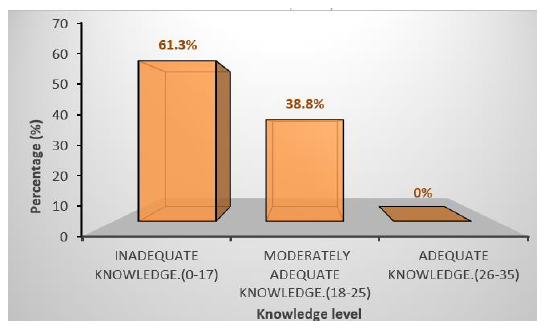
As per the mentioned figure, majority of premenopausal women were having inadequate knowledge level of 61.3% leading by 38.8% of premenopausal women with moderately adequate knowledge level regarding osteoporosis and its prevention. None of the sample lies under adequate knowledge level (Figure 1).
Table 1: Mean, Standard Deviation and Mean Percentage of Pre-Test Knowledge Level of Premenopausal Woman Regarding Osteoporosis and Its Prevention (N = 80)
Descriptive statistics
Mean
S.d.
Mean%
Pretest knowledge
15.58
±4.500
44.50
Maximum = 35, Minimum = 0
Table 2: Mean, Standard Deviation and Mean Percentage of Post-Test Knowledge Level of Premenopausal Woman Regarding Osteoporosis and Its Prevention (N = 80)
Descriptive Statistics
Mean
S.d.
Mean%
Posttest Knowledge
27.10
4.096
77.40
Maximum = 35, Minimum = 0
Figure 1: Percentage Distribution of Premenopausal Women According to Their Knowledge Level in Pre-Test
Table 1 depicts that pre-test mean knowledge level 15.58, ±4.500 which is 44.50% of total mean percentage. Hence it can be interpreted that knowledge of majority of pre-menopausal women regarding osteoporosis and its prevention was inadequate.
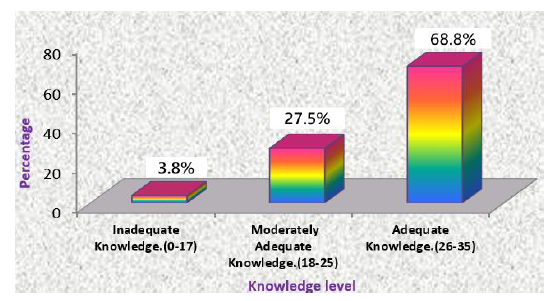
Figure 2, shows that majority of women has adequate knowledge with 68.8% following by 27.5% having moderately adequate knowledge level and only 3.8% were falling under inadequate knowledge level regarding osteoporosis and its prevention.
Figure 2: Percentage Distribution of Premenopausal Women According to Their Knowledge Level in Post-Test
Effectiveness of Structure Teaching Programme (N= 80)
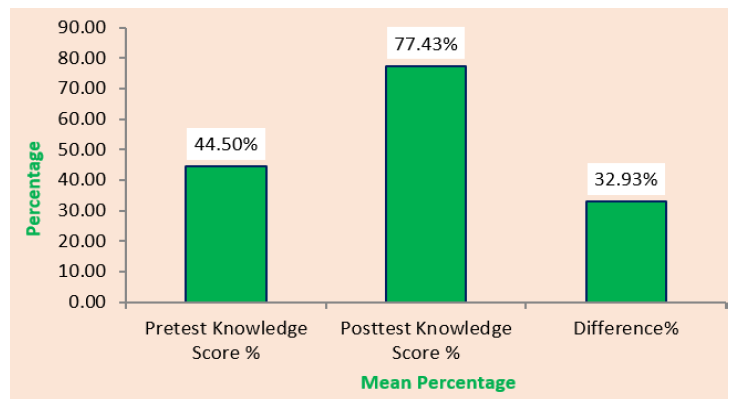
Figure 3, shows distribution of pre-menopausal women according to mean percentage of pre-test 44.50% and after implementation of structure teaching program, the mean percentage of post-test was 77.43% with the mean percentage difference of 32.93%.
Figure 3: Percentage Wise Distribution of Pre-Menopausal Women According to Mean Percentage of Pretest, Posttest and Their Differences
Hence it can be concluded that there is an increase in knowledge level of a pre-menopausal woman by 32.93% which shows that structured teaching programme was effective to enhance the knowledge of premenopausal women.
Table 3, shows that mean pretest knowledge score is 15.58±4.5 and posttest mean knowledge score is 27.1±4.096 to find the difference, paired ‘t’ test was applied. The value of ‘t’ was 19.039, mean difference is 11.520 and p is <0.001 which was found to be significant. Hence it can be inferred that after implementation of structure teaching programme to the group, the mean post-test was statistically significant that is higher than pre-test score. Thus, it can be concluded that the structured teaching programme was effective as it increases the level of knowledge among premenopausal women regarding osteoporosis and its prevention.
Table 3: Comparison of Mean, Mean Percentage and Standard Deviation Between Pre-Test and Posttest Knowledge Level (N=80)
Paired ‘t’ test
Mean ±s.d.
Mean diff.
Paired ‘t’ test
p-value
Table value
Pretest knowledge
15.58±4.5
11.520
19.039 *
<0.001
1.99
Posttest knowledge
27.1±4.096
Association of Post-Test Knowledge Level with Selected Socio-Demographic Variables of the Subjects, N = 80
There was no significant association found between the knowledge regarding osteoporosis and its prevention among premenopausal women with age, marital status, educational status, occupation, the type of family, religion from which they belong, their number of children, monthly income, dietary pattern, whether they have any orthopedic disease, any family history of orthopedic disease, previous knowledge regarding osteoporosis, source of information and the BMI of premenopausal women.
DISCUSSION
The pre-test mean knowledge level was 15.58, SD 4.500 and total mean percentage of 44.50%. Which indicates that majority of pre-menopausal women having inadequate knowledge level regarding osteoporosis and its prevention. The results are contrary to the study done by Lal L. et al., [6].
The post-test mean knowledge level was 27.10, SD 4.096 and total mean percentage of 77.40%. This shows that maximum pre-menopausal women (68.8%) were having adequate knowledge level regarding osteoporosis and its prevention. These findings are supported from the study conducted by Subarmani R [7].
The mean pretest knowledge score is 15.58, SD 4.5 and posttest mean knowledge score is 27.1, SD 4.096 with the mean difference of 11.520. paired ‘t’ test was applied and calculated value of ‘t’ test was 19.039 p is <0.001 which was found to be significant. These findings were supported by the study conducted by Nancy J [8].
The present study revealed that there was no significant association of post-test knowledge level with their selected demographic variables regarding osteoporosis and its prevention among pre-menopausal women. The findings of present study were parallel with findings of study conducted by Dandagi S [9].
CONCLUSION
This study was mainly focused on assessing the effectiveness of structured teaching programme on knowledge regarding osteoporosis and its prevention among pre-menopausal women residing in selected area (sunny side) of district Solan, (H.P). As stated by WHO that 1:3 females suffer from osteoporosis and according to International Osteoporosis Foundation, 1:2 females above 50 years of age suffers from osteoporotic fracture; there is a great significance of imparting knowledge in such group of women who in their future have chances to face such problems. So, attention can be paid to community people regarding increase in knowledge and prevention of future complications.
Hence, findings of the study revealed that majority of premenopausal women were having inadequate knowledge level of 61.3% leading by 38.8% with moderately adequate knowledge level. Then structured teaching programme was administered to them which resulted in increase of knowledge level. As a result, there was increase in knowledge level of pre-menopausal women with 68.8% majority has adequate knowledge, following by 27.5% with moderately adequate knowledge level and only 3.8% still lies under inadequate knowledge.
Future Implications
Nursing Education
The nursing students should be able to give education to the women who are pre- menopausal, yet to attain menopause, knowledge regarding osteoporosis and its prevention whether they are posted in the clinicals or in the community area
Nursing student should be aware of their responsibility to focus on enhancing women knowledge regarding osteoporosis and its prevention
The present study helps the community health nurse to plan for the health education programmes and to aware the general public regarding importance of maintaining healthy life style and intake of proper nutrition for osteoporosis and its prevention
Nursing Practice
Nurses working in the community, play a vital role in providing health awareness regarding osteoporosis and its prevention among pre-menopausal women. The nursing personnel should identify the pre-menopausal women and find out their problems and according to that conduct health teaching programs especially imparting knowledge regarding osteoporosis and its prevention
The study shows that there was lack of knowledge regarding osteoporosis and its prevention among pre-menopausal women in the urban area, for which a health care provider needs to have adequate knowledge by herself regarding osteoporosis and its prevention so that she can enhance the knowledge of people who comes in contact with them
Nursing Practice
Nurses working in the community, play a vital role in providing health awareness regarding osteoporosis and its prevention among pre-menopausal women. The nursing personnel should identify the pre-menopausal women and find out their problems and according to that conduct health teaching programs especially imparting knowledge regarding osteoporosis and its prevention
The study shows that there was lack of knowledge regarding osteoporosis and its prevention among pre-menopausal women in the urban area, for which a health care provider needs to have adequate knowledge by herself regarding osteoporosis and its prevention so that she can enhance the knowledge of people who comes in contact with them
Acknowledgment
The authors acknowledge all the teachers for taking out time from their busy schedule and participating in the study.
Boschitsch, E. et al. “Age-related prevalence of osteoporosis and fragility fractures: real-world data from an Austrian menopause and osteoporosis clinic.” Climacteric, vol. 20, no. 2, March 2017, pp. 157–163. https://doi.org/10.1080/13697137.2017.1282452.
NIH Consensus Development Panel on Osteoporosis Prevention, Diagnosis and Therapy. “Osteoporosis prevention, diagnosis and therapy.” PubMed, 2001, pp. 785–795, https://pubmed.ncbi.nlm.nih.gov/11176917/.
Lal, L. et al. “Effectiveness of STP on osteoporosis in terms of knowledge among menopausal women residing in a selected community area at Chaubepur.” Journal Name Not Provided, vol. 5, no. 3, September 2019, pp. 56–59.
Subarmani, R. “A study to assess the effectiveness of structured teaching programme on knowledge regarding prevention of osteoporosis among pre-menopausal women in selected rural areas of Chennai.” Journal of Women Health, 2019.
Nancy, J. A Study to Assess the Effectiveness of Structured Teaching Programme on Knowledge Regarding Prevention of Osteoporosis among Health Care Personnel Working in Rajiv Gandhi Government General Hospital, Chennai. College of Nursing, Madras Medical College, September 2019.
Dandagi, S. and S. Dandagi. “Risk of osteoporosis and knowledge on prevention of osteoporosis in premenopausal women residing in Bhutramatti village, Belagavi, Karnataka.” International Journal of Orthopaedic Nursing, vol. 2, no. 2, 2017, pp. 9–18.
Recommended Articles
Research Article
Anti-SRP positive myositis following a SARS-CoV-2 vaccination
Josef Finsterer
Published: 30/05/2022
Download PDF
Research Article
Isolation and Molecular Characterization of Bacterial Pathogens Associated with Circumcision-Related Infections in Pediatric Patients
Ghanim A. Abbas
Published: 30/06/2025
Download PDF
Research Article
Factors affecting pre hospital treatment delay in acute myocardial infarction patients
R. Jyoti Velmurugan,
Deepa Chugh
Published: 30/05/2022
Download PDF
Research Article
Quality of the Nursing Care Provided to Patients Diagnosed with Cerebrovascular Accident (CVA)
Qassim Jawell Odah Abed,
Hussein Abdulmohsin Dabis
Published: 30/03/2024
Download PDF
PO Box 101, Nakuru
Kenya.
Email: office@iarconsortium.org
Editorial Office:
J.L Bhavan, Near Radison Blu Hotel,
Jalukbari, Guwahati-India
Tanwar, N., None, P. & Kashyap, M. (2022). A pre-experimental study to assess the effectiveness of structured teaching programme on knowledge regarding osteoporosis and its prevention among pre-menopausal women residing in selected areas of district Solan, (H.P.). International Academic Journal of Advanced Practices in Nursing, 3(1), 1-5.
MLA
Tanwar, Neha, Poonam and Madhuri Kashyap. "A pre-experimental study to assess the effectiveness of structured teaching programme on knowledge regarding osteoporosis and its prevention among pre-menopausal women residing in selected areas of district Solan, (H.P.)." International Academic Journal of Advanced Practices in Nursing 3.1 (2022): 1-5.
Chicago
Tanwar, Neha, Poonam and Madhuri Kashyap. "A pre-experimental study to assess the effectiveness of structured teaching programme on knowledge regarding osteoporosis and its prevention among pre-menopausal women residing in selected areas of district Solan, (H.P.)." International Academic Journal of Advanced Practices in Nursing 3, no. 1 (2022): 1-5.
Harvard
Tanwar, N., None, P. and Kashyap, M. (2022) 'A pre-experimental study to assess the effectiveness of structured teaching programme on knowledge regarding osteoporosis and its prevention among pre-menopausal women residing in selected areas of district Solan, (H.P.)' International Academic Journal of Advanced Practices in Nursing 3(1), pp. 1-5.
Vancouver
Tanwar N, Poonam P, Kashyap M. A pre-experimental study to assess the effectiveness of structured teaching programme on knowledge regarding osteoporosis and its prevention among pre-menopausal women residing in selected areas of district Solan, (H.P.). International Academic Journal of Advanced Practices in Nursing. 2022 Jan;3(1):1-5.


 Download PDF
 Download XML