“A Descriptive Study to Assess The Knowledge, Attitude and Preventive Practices Regarding COVID-19 Among Adults Residing in Selected Areas of Distt. Solan (HP)”
Shiwali Sharma
1
,
Madhuri Kashyap
2
1
M.Sc. Nursing, Community Health Nursing, Murari Lal Memorial School and College of Nursing, Solan, India
2
Professor, Community Health Nursing, Murari Lal Memorial School and College of Nursing, Solan, India
Background: Knowledge and awareness of mode of disease transmission, basic hygiene principles and measures in public health crisis are vitally important for developing effective control measures. Coronaviruses are a large family of viruses that are known to cause illness ranging from the common cold to more severe diseases such as Middle East Respiratory Syndrome (MERS) and Severe Acute Respiratory Syndrome (SARS). A novel coronavirus (COVID-19) was identified in 2019 in Wuhan, China. This is a new coronavirus that has not been previously identified in humans. Objectives: To assess the Knowledge, Attitude and Practices among adults regarding COVID-19 and association with their demographic variables. Methodology: a descriptive study was conducted in 2021, in selected areas of district Solan, H.P. sample of 100 adults were selected using purposive sampling technique. The instrument used for data collection was structured knowledge questionnaires, attitude rating scale and checklist to assess the practices among adults. Result: the findings showed that the knowledge of the adults was average and the mean score was 16.94 and SD was ±2.86, the attitude of the adults was neutral and the mean score was 34.64 and SD was ±3.13 and the practice of the adults was average and the mean score was 10.46 and the SD was ±2.04. Chi square revealed a factor associated with knowledge was type of family, factor associated with practice was religion.
Keywords
Knowledge
Attitude
Practices
Adults
COVID-19
INTRODUCTION
Novel-corona virus disease is currently a global health threat and public health emergency of international concern. The severe acute respiratory syndrome outbreak that was linked to corona virus (SARS-COV) was first reported in 2003. Sixteen years later, a closely similar outbreak, which first received the name novel- SARS-COV2, was detected. The outbreak was first reported in late December 2019, when clusters of pneumonia cases of unknown etiology were found to be associated with epidemiologically linked exposure to the seafood market and untraced exposures in the city of Wuhan of China in Hubei Province. It was by far the largest outbreak of atypical pneumonia since the SARS outbreak. Subsequently, the spread of the virus has shown exponential growth and spread to all continents and received a unique name by COVID-19 from the World Health Organization (WHO). On February 11, 2020, the World Health Organization announced an official name for the disease that is causing the 2019 novel coronavirus outbreak [1,2].
The World Health Organization (WHO) has declared the coronavirus disease 2019 (COVID-19) a pandemic on 11 March, 2020. A global coordinated effort is needed to stop the further spread of the virus. A pandemic is defined as “occurring over a wide geographic area and affecting an exceptionally high proportion of the population.” The last pandemic reported in the world was the H1N1 flu pandemic in 2009. The virus that causes COVID-19 infects people of all ages. However, evidence to date suggests that two groups of people are at a higher risk of getting severe COVID-19 disease- Older people (people over 70 years of age), people with serious chronic illnesses such as: diabetes, cardiovascular disease, chronic respiratory disease, cancer, hypertension and chronic liver disease [3].
According to CDC, at present COVID-19 can spread by person-to-person, through respiratory droplets produced when an infected person coughs or sneezes, touching a surface or object that has the virus on it. Previous studies confirmed that nosocomial transmission of SARS was facilitated by the use of various nebulizers, suction, intubation, bronchoscopy, or cardiopulmonary resuscitation on SARS patients [4].
Need of the Study
Infectious diseases have emerged as major threats to human existence since centuries and can devastate entire populations. The most of the global community is not ready for COVID 1910. With the level of media exposure and impact of COVID-19 on the public's everyday life, the public are ‘pumped and primed’ into the effect of disease. Though it may be new territory for community, requiring new methods, we have a duty to recognize the importance of community people in our work and there is guidance and other free and online resources available, including practical toolkits. We should not waste this opportunity to engage and involve the public in shaping the future of their health and their healthcare. More than a year has passed since COVID-19 was declared a pandemic by World Health Organization and the working culture of urban as well as rural areas changed. Various infodemic are there in communities, that is a rapid and far-reaching spread of both accurate and inaccurate information about COVID-19. So the researcher felt need to study on COVID-19 as the numbers of cases are going up. Various infodemic are responsible for spreading misinformation regarding this disease. So to ascertain the knowledge, attitude and preventive practices of general public regarding COVID-19, researcher want to know about the knowledge, attitude of general public regarding COVID-19 and also want to explore their preventive practices in selected areas of Solan (H.P.) [5].
Objectives of the Study
To assess the knowledge regarding COVID-19 among adults residing in selected areas of Distt. Solan (HP)
To assess the attitude towards COVID-19 among adults residing in selected areas of Distt. Solan (HP)
To assess the preventive practices regarding COVID-19 among adults residing in selected areas of Distt. Solan (HP)
To find the association of knowledge, attitude and preventive practices related to COVID-19 among adults with their selected demographic variables
MATERIALS AND METHODS
Research Approach: Quantitative Research Approach
Research Design: Non-Experimental Descriptive Research Design
Setting of the study: Selected area of Distt. Solan (H.P.)
Study Population: Adults
Sample Size: 100
Sampling Technique: Purposive Sampling Technique
Informed consent: Informed consent was taken from the selected adults and confidentiality of the adults was also maintained.
Inclusive criteria: Primarily contacted adult who were able to read and write in Hindi or English and willing to participate in the study.
Exclusive criteria: Adult who were sick at the time of data collection and were not able to give information.
Development of tool:
Self-Structured Knowledge Questionnaire,
Attitude scale and
Checklist.
Description of Tools
Section I:Sociodemographic Profile
This part of the tool consists of the socio demographic data related to the adults which was developed by reviewing various studies. The purpose of having demographic profile was to assess the background status of the adults. It contains 9 items like age (in years), gender, type of family, religion, educational status, occupation, source of information regarding COVID-19 etc. This tool does not consist of any scoring.
Section II: Knowledge Questionnaire
This section consists of 29 questions to assess the knowledge of adults regarding COVID-19. Knowledge questionnaire consists of 29 items; each correct response was awarded single score (1) according to the predetermined key and zero (0) to the wrong response. Total possible maximum scores are 29 (Table 1).
Table 1: Level of Attitude Based on Attitude Scores
Score
Category
Percentage level
0-9
Poor Knowledge
<50
10-19
Average knowledge
51-75
20-29
Good Knowledge
>76-100
Section III: Attitude Scale
Attitude scale consists of 16 items out of which 8 are positive and 8 are negative items. It was measured with the help of self structured likert scale. For positive items allocated scoring was 3, 2, 1 and for the negative items 1, 2, 3. Total possible maximum scores are 48 (Table 2).
Table 2: Level of Practice Based on Attitude Scores
Score
Level of practice in percentage
Category
48-38
>76 -100%
Positive attitude
37-27
51-75%
Neutral
26-16
<50%
Negative attitude
Section IV: Checklist
Checklist consists of 20 items, each correct response was awarded single score (1) according to the predetermined key and zero (0) to the wrong response and omission. Total possible maximum scores are 20 (Table 3).
Table 3: Level of Practice Based on Practice Scores
Score
Level of practice in percentage
Category
0-9
<50%
Poor practice
10-20
>51%
Good practice
YES = 1, NO = 0, Validity of Tool: By the experts in this field
Data Analysis and Interpretation
Section-I
Findings related to description of selected demographic characteristics of adults.
Table 4, Shows that majority of adults were in the age group of 19-28 years and more than half (58%) of the adults were females. Near to half (56%) of the participants were from nuclear family and 72% of the adults were Hindu. As per education 40% of the adults had no formal education and 47% of the adults were from non-medical profession. 76% of the adults had no COVID-19 positive family member. Majority of adults (88%) had previous information regarding COVID-19 and internet was the source of information of 41% adults and 76% of adults were vaccinated against COVID-19.
Table 4: Frequency and Percentage Wise Distribution of Adults According to Demographic Characteristics N = 100
Demographic variable
Frequency
Percentage
AGE
19-28 years
38
38
29-38 years
30
30
39-48 years
23
23
49-58 years
9
9
GENDER
Male
42
42
Female
58
58
TYPE OF FAMILY
Nuclear
56
56
Joint
32
32
Extended
12
12
RELIGION
Hindu
72
72
Muslim
17
17
Christian
2
2
Sikh
9
9
EDUCATION
No formal education
40
40
Undergraduate
21
21
Graduate
26
26
Postgraduate & above
13
13
PROFESSION
Medical
21
21
Non-medical
47
47
Others
32
33
Did any of your family member become COVID positive
Yes
24
24
No
76
76
Do you have any previous information about COVID-19
Yes
88
88
No
12
12
If yes then specify the source
Internet
41%
41
Television/Radio
28%
28
Family/Friends
14%
14
Newspaper
5%
5
Are you vaccinated
Yes
76
76
No
24
24
Section II
Findings related to knowledge regarding COVID-19 among adults residing in selected areas of Distt. Solan, Himachal Pradesh.
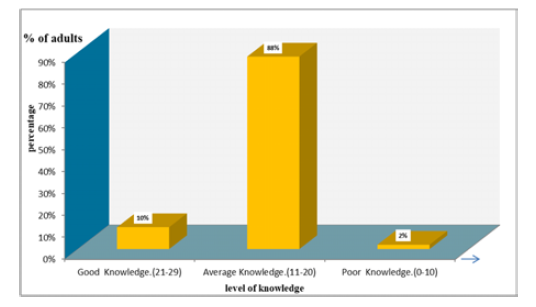
Figure 1 reveals that 10% participants had good knowledge and 88% participants had average knowledge and 2% participants had poor knowledge regarding COVID-19.
Hence, it can be concluded that 88% of participants had average knowledge regarding COVID-19.
Figure 1: Frequency and Percentage Wise Distribution of Adults as Per Their Knowledge Score
Section-III
Findings related to attitude regarding COVID-19 among adults residing in selected areas of Distt. Solan, Himachal Pradesh
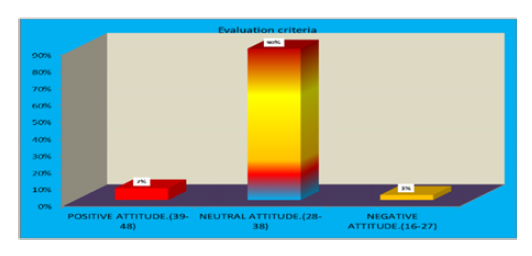
Figure 2 reveals that 7% study participants had positive attitude, 90% had neutral attitude and 3% had negative attitude towards COVID-19.
It can be concluded that majority of 90% participants had neutral attitude.
Figure 2: Frequency and Percentage Wise Distribution of Adults as Per Attitude Scores
Section IV
Findings related to preventive practices regarding COVID-19 among adults residing in selected areas of Distt. Solan, Himachal Pradesh.
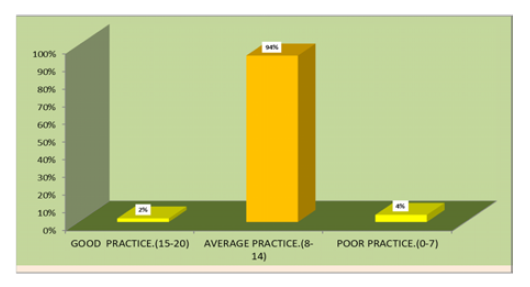
Figure 3 reveals that only 2% of participants had good practice and 94% participants had average practice and 4% participants had poor practice regarding COVID-19.
Hence, it can be concluded that majority of 94% adults had average practice.
Figure 3: Frequency and Percentage Wise Distribution of Adults as Per Their Practices
Section V
Findings related to the association between knowledge scores regarding COVID-19 among adults and their selected demographic variables. The chi-square test was used to determine the association between the score levels and selected demographic variables.
CONCLUSION
The present study shows that 38% adults were in the age of 19-28 years. More than half of the adults were females (58%) and majority of adults were belonging to Hindu religion (72%), large part of adults was from nuclear family (56%) and 40% of adults had no formal education. With regards to profession, 47% of adults belong to non-medical stream and majority of adults 76% had no history of COVID positive cases in their family. With regards to previous information about COVID-19, 88% of adults had information. Majority of adults (41%) had information regarding COVID-19 through internet and majority of adults (76%) were vaccinated against COVID-19. Maximum adults (88%) had average knowledge. The total mean knowledge score was 16.94 and SD was ±2.86 and the range of knowledge score was 16. Among the study participants, majority of adults had neutral attitude (90%), it shows that the total mean attitude score was 34.64 and SD was ±3.13 whereas range of attitude score was 16.
The Chi-square value shows that there is significance association between the level of knowledge score of adults and demographic variable (type of family). There is no significance association between the level of scores of adults and other demographic variables (Age, Gender, Religion, Education, Profession, did any of your family member become COVID positive, previous knowledge about COVID-19, Source of information, Vaccination). The calculated chi-square values were less than the table value at the 0.05 level of significance.
Chi-square test used to associate the level of attitude and selected demographic variables. The Chi-square value shows that there is no significance association between the attitude score level and demographic variable (Age, Gender, Type of family, Religion, Education, Profession, Family member become COVID positive, previous information about COVID-19, Source of information and Vaccination). The calculated chi-square values were less than the table value at the 0.05 level of significance.
The Chi-square value shows that there is significance association between the practice score and demographic variable (religion). The Chi-square value shows that there is no significance association between the practice score level and demographic variables (Age, Gender, Type of family, Education, Profession, Family member become COVID positive, previous information about COVID-19, Source of information and Vaccination). The calculated chi-square values were less than the table value at the 0.05 level of significance.
Recommendations
The following recommendations are made for the future research:
A similar study can be conducted in different population group e.g. office going staff, nursing staff, college students.
A structured teaching programme to assess the knowledge, attitude and practices regarding COVID-19 among college students.
A survey study to assess the incidence and prevalence rate of COVID-19 among college going students.
A descriptive study on COVID-19 can be done to explore the perceived threats and perceived barriers in the minds of general public.
A correlation study can be conducted on the level of knowledge and attitude regarding COVID-19 among the students.
A comparative study to assess the knowledge, attitude and practices among urban and rural population regarding COVID-19
Eurosurveillance Editorial T. “Note from the editors: world health organization declares novel coronavirus (2019-ncov) sixth public health emergency of international concern.” Eurosurveillance: Bulletin Europeen sur les Maladies Transmissibles = European Communicable Disease Bulletin, vol. 25, no. 5, 2020.
Bekele D. et al. “The knowledge and practice towards covid-19 pandemic prevention among residents of Ethiopia: An online cross-sectional study.” PLOS ONE, vol. 16, no. 1, 2021, https://doi.org/10.1371/journal.pone.0234585
Recommended Articles
Research Article
Anti-SRP positive myositis following a SARS-CoV-2 vaccination
Josef Finsterer
Published: 30/05/2022
Download PDF
Research Article
Isolation and Molecular Characterization of Bacterial Pathogens Associated with Circumcision-Related Infections in Pediatric Patients
Ghanim A. Abbas
Published: 30/06/2025
Download PDF
Research Article
Factors affecting pre hospital treatment delay in acute myocardial infarction patients
R. Jyoti Velmurugan,
Deepa Chugh
Published: 30/05/2022
Download PDF
Research Article
Quality of the Nursing Care Provided to Patients Diagnosed with Cerebrovascular Accident (CVA)
Qassim Jawell Odah Abed,
Hussein Abdulmohsin Dabis
Published: 30/03/2024
Download PDF
PO Box 101, Nakuru
Kenya.
Email: office@iarconsortium.org
Editorial Office:
J.L Bhavan, Near Radison Blu Hotel,
Jalukbari, Guwahati-India
Sharma, S. & Kashyap, M. (2022). “A Descriptive Study to Assess The Knowledge, Attitude and Preventive Practices Regarding COVID-19 Among Adults Residing in Selected Areas of Distt. Solan (HP)”. International Academic Journal of Advanced Practices in Nursing, 3(1), 1-4.
MLA
Sharma, Shiwali and Madhuri Kashyap. "“A Descriptive Study to Assess The Knowledge, Attitude and Preventive Practices Regarding COVID-19 Among Adults Residing in Selected Areas of Distt. Solan (HP)”." International Academic Journal of Advanced Practices in Nursing 3.1 (2022): 1-4.
Chicago
Sharma, Shiwali and Madhuri Kashyap. "“A Descriptive Study to Assess The Knowledge, Attitude and Preventive Practices Regarding COVID-19 Among Adults Residing in Selected Areas of Distt. Solan (HP)”." International Academic Journal of Advanced Practices in Nursing 3, no. 1 (2022): 1-4.
Harvard
Sharma, S. and Kashyap, M. (2022) '“A Descriptive Study to Assess The Knowledge, Attitude and Preventive Practices Regarding COVID-19 Among Adults Residing in Selected Areas of Distt. Solan (HP)”' International Academic Journal of Advanced Practices in Nursing 3(1), pp. 1-4.
Vancouver
Sharma S, Kashyap M. “A Descriptive Study to Assess The Knowledge, Attitude and Preventive Practices Regarding COVID-19 Among Adults Residing in Selected Areas of Distt. Solan (HP)”. International Academic Journal of Advanced Practices in Nursing. 2022 Jan;3(1):1-4.



 Download PDF
 Download XML