The synergistic effect of COVID-19 and NCDs has the potential to augment the global burden of the disease. People living with NCDs like diabetes, hypertension, chronic kidney diseases, heart failure, cancer or any other cardiovascular disease are more prone for acquiring severe infection due to COVID-19. With this background, a study was done on a population more than18 years of age by an online survey, to assess the possible hurdles in management of NCDs during COVID-19 pandemic. The study observed the lack of physical exercise as a major risk factor. It was reported that there was difficulty in seeking the services of a doctor, there was insufficient staff in the hospitals to provide primary healthcare services during the lockdown period. Telemedicine consultation on the other hand has proved to be useful for the individuals and study showed that there was easy accessibility. The prevention and management of NCDs during the COVID-19 pandemic has been a challenge for the whole world. There is an utmost need to strengthen the primary healthcare services and alleviate people’s fear about living with NCDs during COVID-19.
Keywords
Non Communicable Diseases
COVID-19
Telemedicine Consultation
Risk Factors
Primary Healthcare Services
INTRODUCTION
The burden of NCDs falls disproportionately on people living in LMICs, with more than 85% of premature deaths due to NCDs occurring in low- and middle-income countries (LMICs) (World Health Organization) According to the WHO report on NCDs and COVID-19, the new coronavirus had the potential to affect individuals in all the age groups, but the individuals who were at higher risk included; older age group and individuals with pre-existing NCDs [1].
Non-communicable diseases (NCDs) pose a higher risk of acquiring severe COVID-19 disease and subsequently a higher risk of mortality in an individual. To combat this timely and ensure continuity of care during the COVID-19 pandemic, health services need to be strengthened [2].
NCDs contribute to about more than two-third (61.8%) of deaths in India, maximum is contributed by the cardiovascular diseases (28.1%), followed by chronic respiratory diseases (10.9%), neoplasms (8.4%), diabetes (6.5%) and other blood and endocrinal diseases. The main risk factors for NCDs include consumption of alcohol, tobacco, high blood pressure, high blood plasma glucose, drug abuse, high total cholesterol levels, inadequate diet or poor dietary habits, low physical activity and pollution (most commonly air pollution) [3].
The COVID-19 pandemic is one of the most challenging public health calamities to control. The impact of COVID-19 has been observed globally and it has affected all levels of the system and economy. Also, it has shown major disruptions in some of the major and essential healthcare delivery services that were emerging during the COVID-19 pandemic including prevention, screening, and diagnosis of NCDs [4-5].
Telemedicine services for providing health care to public has expanded a lot during ongoing pandemic and also played a vital role in providing accessible and affordable health care services in this era [6].
The present study aimed to gain insights about the possible hurdles faced to provide NCD management during this pandemic era and also identify the importance of telemedicine services during this period.
Aims and Objectives
To study the risk factors of Non-communicable diseases during COVID-19
To assess the impact of COVID-19 on primary healthcare delivery system for NCDs
To study the role of telemedicine consultation in the management of NCDs during the COVID-19 pandemic
MATERIALS AND METHODS
Study Design
A descriptive cross-sectional study.
Study Area
The research was conducted in the northern region of India in the States/UTs of Punjab, Himachal Pradesh and Chandigarh.
Study Participants
Included people suffering from NCDs or those taking care of people with NCDs.
Study Tool
A closed ended questionnaire in the google form was framed for the data collection. The questionnaire was circulated via online modes (like e-mail, whatsapp, etc). The questionnaire was divided into four sections: Demographic profile, risk factors in management of NCDs, changes observed in the primary healthcare services and the role of telemedicine consultation in managing NCDs during the COVID-19 pandemic.
Ethical Considerations
Participants confidentiality and anonymity was maintained.
Statistical Analysis
Data was collected and entered in Microsoft excel spread sheet, cleaned for errors and analysed using Epi info version 7.2.1.0 software. Descriptive statistics were used to summarize the demographic data. Frequencies, percentages were used to describe categorical variables.
RESULTS
A total of 351 responses were recorded, out of which 225 were female and 126 were male respondents. Most of the responses (228) were received from the age group of 18-30 years, 53 from 31-45 years, 62 responses from age group 46-60 years and 8 responses were received from those more than 60 years of age.
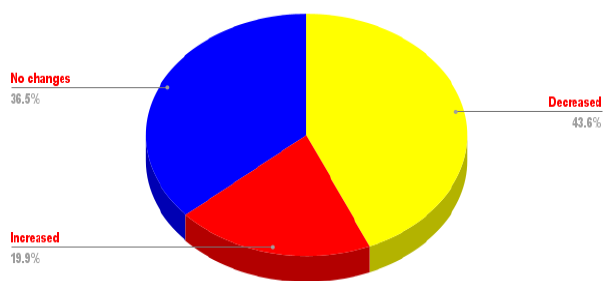
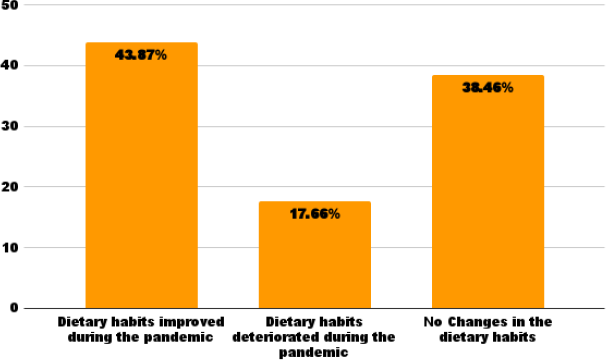
It was observed that only 2.84% people smoked tobacco and 15.95% people consumed alcohol. It was seen that there was decrease in routine physical activities (Figure 1) and improvement in the dietary habits (Figure 2) of the respondents during the COVID lockdown period.
Figure 1: Changes in Daily Routine of Physical Activity during COVID-19 Pandemic
Figure 2: Changes in the Dietary Habits during the COVID-19 Pandemic
The survey found that 7.69% individuals were diagnosed with diabetes and 17.94% individuals were diagnosed with hypertension for the first time.
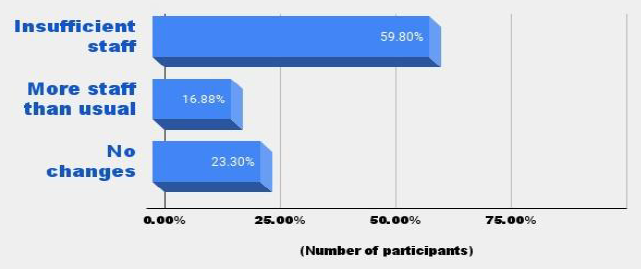
Maximum individuals felt that there were changes in the staff patterns in the hospitals (Figure 3).
Figure 3: Changes in Terms of Staff Observed in Hospitals for Non-Communicable Diseases
More than half of the individuals stated that it was difficult to access the laboratory facilities for the non-communicable diseases during the lockdown period. While, 47.2% individuals experienced difficulty in making an appointment with doctor and 29.05% individuals were not able to discuss the problem properly. However, there was a positive response in terms of the type of treatment received by the patients as 68.9% individuals were not redirected to any alternate healthcare facility rather regular treatment protocols were followed. About 69% individuals felt that there wasn’t any trouble in buying the medicines for non-communicable diseases from medicine shops.
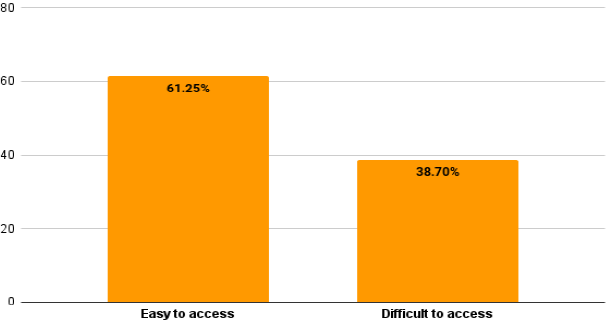
Further, it was observed that maximum individuals were satisfied with the telemedicine services provided in their area and were able to access the telemedicine services easily (Figure 4).
Figure 4: Experience in Accessing Telemedicine Consultation during COVID-19 Pandemic
Nearly three-fourth of the participants were of the opinion that telemedicine consultation should be implemented in the future as well. However, 73.78% individuals believe that getting physical healthcare services is better than telemedicine consultation as they can easily make appointments and discuss their issues with the doctor.
DISCUSSION
The continuum of care plays vital role for prevention and control of NCDs and also helpful in preventing development of complications. During COVID 19 health care services has been disrupted because of multiple factors which has also affected the management of the NCDs. Our study found that the level of physical activity decreased and dietary habits improved during COVID 19 lockdown corroborated with the study conducted by arrieta et al. [7] and Alshareef et al. in Saudi Arabia [8].
The study also observed that participants had also faced difficulty in seeking the services of a doctor and there was insufficient staff in the hospitals to provide primary healthcare services during the lockdown period. However, Telemedicine consultation on the other hand has proved to be useful for the individuals and study showed that there was an easy accessibility to the services.
Ongoing COVID-19 pandemic has dynamically affected the health care delivery system and also created fear among the people living with NCDs. There is dire need to strengthen primary health care system to curb the need of people to visit higher health care facilities for follow ups as well as to decrease burden over secondary and tertiary care facilities. Moreover, the telemedicine services should be encouraged for providing online consultations by the health professionals.
REFERENCE
Thakur J.S. et al. “COVID-19 and noncommunicable diseases: Impact and the strategic approaches.” International Journal of Noncommunicable Diseases, vol. 5, no. 2, 2020, p. 29.
PAHO and WHO. NCDs and COVID-19. https://www.paho .org/en/ncds-and-covid-19.
Mathur P. and Rangamani S. “COVID-19 and noncommunicable diseases: Identifying research priorities to strengthen public health response.” International Journal of Noncommunicable Diseases, vol. 5, no. 2, 2020, p. 76.
NCD Alliance. Impacts of long COVID on health systems and NCD care. www.ncdalliance.org, April 2021.
Bullen C. et al. “The impact of COVID-19 on the care of people living with noncommunicable diseases in low-and middle-income countries: An online survey of physicians and pharmacists in nine countries.” Primary Health Care Research & Development, vol. 22, 2021. doi: 10.1017/S146342362100030X.
Hacker K.A. et al. “COVID-19 and chronic disease: The impact now and in the future.” Preventing Chronic Disease, vol. 18, 2021, p. 210086. https://doi.org/10.5888/pcd18.2 10086.
Arrieta M.I. et al. “Insuring continuity of care for chronic disease patients after a disaster: Key preparedness elements.” The American Journal of the Medical Sciences, vol. 336, no. 2, 2008, pp. 128-133.
Alshareef R. et al. “Impact of the COVID-19 lockdown on diabetes patients in Jeddah, Saudi Arabia.” Diabetes and Metabolic Syndrome: Clinical Research and Reviews, vol. 14, no. 5, 2020, pp. 1583-1587.
Recommended Articles
Research Article
Serum IL-22, miRNA-146a Expression and Total Antioxidant Status as Integrated Biomarkers in Rheumatoid Arthritis
Khalid R. Kareem
Published: 13/08/2026
Download PDF
Research Article
Electrochemical Comparative Studies On The Redox Behavior Of Cu(II) And Cr(II) Before And After Interactions With Ciprofloxacin In Solutions
H. M. Naseem Akhtar,
M. Q. Ehsan
Published: 10/08/2021
Download PDF
Research Article
A Rare Case Report of Waugh Syndrome in an Eight Months Old Male
Pielly Hanna,
...
Bassem Abou Merhi
Published: 10/03/2021
Download PDF
Research Article
Study on Prevalence and Etiology of Early Neonatal Deaths in Jasin district, Melaka from 2014-2017
Sujat a Khobragade,
...
Yadneshwar Khobragade
Published: 30/05/2021
Download PDF
PO Box 101, Nakuru
Kenya.
Email: office@iarconsortium.org
Editorial Office:
J.L Bhavan, Near Radison Blu Hotel,
Jalukbari, Guwahati-India
Chauhan, A., Batra, R., None, G., Sethi, G., Bhatiya, M. & None, P. (2022). Non-Communicable Diseases in the COVID-19 Era: A Study on How COVID-19 Has Affected the Prevention and Management of Ncds. International Academic Journal of Applied Bio-Medical Sciences, 3(1), 1-3.
MLA
Chauhan, Anjali, et al. "Non-Communicable Diseases in the COVID-19 Era: A Study on How COVID-19 Has Affected the Prevention and Management of Ncds." International Academic Journal of Applied Bio-Medical Sciences 3.1 (2022): 1-3.
Chicago
Chauhan, Anjali, Ruchika Batra, Gurpriya , Gaurav Sethi, Manisha Bhatiya and Priyanka . "Non-Communicable Diseases in the COVID-19 Era: A Study on How COVID-19 Has Affected the Prevention and Management of Ncds." International Academic Journal of Applied Bio-Medical Sciences 3, no. 1 (2022): 1-3.
Harvard
Chauhan, A., Batra, R., None, G., Sethi, G., Bhatiya, M. and None, P. (2022) 'Non-Communicable Diseases in the COVID-19 Era: A Study on How COVID-19 Has Affected the Prevention and Management of Ncds' International Academic Journal of Applied Bio-Medical Sciences 3(1), pp. 1-3.
Vancouver
Chauhan A, Batra R, Gurpriya G, Sethi G, Bhatiya M, Priyanka P. Non-Communicable Diseases in the COVID-19 Era: A Study on How COVID-19 Has Affected the Prevention and Management of Ncds. International Academic Journal of Applied Bio-Medical Sciences. 2022 Jan;3(1):1-3.


 Download PDF
 Download XML