Contents
Download PDF
pdf Download XML
1070 Views
16 Downloads
Share this article
Research Article | Volume 2 Issue 1 (Jan-June, 2021) | Pages 1 - 4
Evaluation of Libyan Health Care System Situation During the Outbreak of COVID-19: An Analytical Study
 ,
1
Department of biology faculty of education – Zolton, Sabratha University, Libya
2
Department of computer science faculty of education – Sabratha University, Libya
Under a Creative Commons license
Open Access
Received
Nov. 3, 2020
Revised
Dec. 9, 2020
Accepted
Jan. 19, 2021
Published
Jan. 30, 2021
Abstract

Background: An outbreak with unknown etiology was reported in Wuhan, Hubei province, China, in December 2019, associated with the Huanan Seafood Wholesale Market. The causative agent of the outbreak was identified by the WHO as the severe acute respiratory syndrome coronavirus-2 (SARS-CoV-2), producing the disease named coronavirus disease-2019 (COVID-19). The virus is closely related (96.3%) to bat coronavirus RaTG13, based on phylogenetic analysis. Human-to-human transmission has been confirmed even from asymptomatic carriers. The virus has spread to at least 200 countries, and more than 1,700,000 confirmed cases and 111,600 deaths have been recorded, with massive global increases in the number of cases daily. Therefore, the WHO has declared COVID-19 as a pandemic. Methods: data were collected from the published reports by 16 global organizations who worked in Libya. Results: total Medical procedures provided recorded were (45296) while, the Percentage of reached municipalities (57%) Percentage of reached municipalities in areas of severity scale higher than 3 recorded (42%).  The COVID-19 testing centers in Libya recorded is (14). Total number of hospitals (97) closed (16) functional (81). Number of established inpatient beds (20369). Number of Intensive e care unit (other than neonatal ICU) (79). Number beds in Intensive care unit (498). Conclusion: the provided efforts and the financial supports by the Libyan government and the global organizations seems to be very low. So, more efforts to support the Libyan people during this pandemic outbreak combining with a serious political efforts should be take place.

Keywords
INTRODUCTION

Coronaviruses have repeatedly evolved during the past 100 years [1]. The first recovery of coronaviruses involved the identification of illnesses in animals followed by the isolation of infectious bronchitis virus (IBV) from chickens in 1937 [2].


The COVID-19 pandemic has been declared as modern history’s gravest health emergency by many countries. The way the world is responding to this unprecedented global crisis will be part of history books. Memory institutions, including national archives, libraries, museums, as well as educational and research bodies, are already recording the decisions and actions being made which will help future generations to understand the extent of the pandemic and its impact on societies.


The COVID-19 pandemic has had major impacts on all aspects of life worldwide. No country can be considered safe, whether rich or poor. COVID-19 is a global concern not only as a huge health problem, but also socially, economically, politically and even ethically [3]. On the other hand, [4] described Coronaviruses as an enveloped, single-strand RNA virus that can infect a wide range of hosts including avian, wild, domestic mammalian species, and humans. Coronaviruses are well known for their ability to mutate rapidly, alter tissue tropism, cross the species barrier, and adapt to different epidemiological situations. 


Due to the importation of COVID-19 from epidemic states and countries to different states and countries, the disease has spread throughout China and all over the world in a short time, though the outbreak was recognized in Wuhan [5].       


COVID-19 has also affected most of the African countries, with over 103,875 cases and 3,184 deaths. The largest number of cases has been recorded in South Africa, and 64,388 cases have been reported in the WHO African region [6]. 


Coronaviruses are genetically diverse and have a high tendency towards frequent genetic mutations    and   gene recombination, which increases the risk of interspecies transmission. Information about the incubation period can help in establishing an effective quarantine for asymptomatic carriers, thus preventing the virus spread [7].


Several control measures are being instituted by nations around the world to extinguish the COVID-19 pandemic, including the issuance of travel advisories or even flight bans to and from infected countries, strict quarantine measures and traveler screenings, implementation of mitigation measures by healthcare specialists, application of social distancing measures for schools and popular gatherings, strict personal hygiene such as frequent handwashing, and wearing face masks [8]. Currently, world public health authorities such as the Centers for Disease Control and Prevention (CDC), World Health Organization (WHO), and other global partners are trying to control and prevent the spread of COVID-19. Additionally, WHO issued a guide to managing the recent pandemic including instructions for the rapid detection of the disease, emergency treatment, application of prevention and control strategies, supportive therapy, and prevention of disease complications [9].


Armed conflicts cause deaths, injuries, destruction of infrastructures, and physical damage or destruction of healthcare delivery facilities. This facilitates the spread of newly emerging diseases. Hence, conflict zones are more susceptible to the spread of infectious diseases, including COVID-19. Concerns about the impact of the pandemic in countries experiencing armed conflict have been expressed. Such countries include Syria, Libya and Yemen, where the impact may go even beyond the borders of these countries [10].


The protracted crisis in Libya is now entering its ninth year and has left over 400,000 people in displacement, including nearly 120,000 children. Since 15 March 2020, schools and non-formal learning centers in Libya have remained closed to limit the spread of COVID-19; this has left at least 1.3 million students out of school. The closure has also left conflict- affected children and adolescents unable to access various essential services including psychosocial support, as schools and non-formal earning centers serve as access points for these services. on the other hand, following years of neglect and under-investment in the health sector, Libya is ill-equipped to tackle COVID-19 [11]. 


A recent health sector assessment found that only just over half of communities had emergency health services or health care services for children, and just under half had any kind of general clinical services. The situation is even worse when it comes to reproductive health care. Mental health services are basically non-existent. The severity of the impact of COVID-19 on Libya will be heavily influenced by progress (or lack of progress) dealing with the political crisis. The failure of political rivals to reach a sustained peace agreement has taken a heavy toll on the economy, which the pandemic is exacerbating. The rival governments in the east and west have introduced separate measures to combat COVID-19 [9].


From the currently available information about the virus and its epidemiology, the control of the COVID-19 requires an effective and global disease coordination effort including multidisciplinary research efforts (One-Health approach) through collaboration between governments, epidemiologists, virologists, health authorities, veterinarians, physicians, and the global organizations.
MATERIALS AND METHODS

Data were collected from the published reports by the global organization who worked in Libya such as World Health Organization (WHO), The United Nations Children's Fund (UNICEF), The United Nations Population Fund (UNFPA), UN Women United Nations Office on Drugs and Crime (UNODC), The United Nations Development Program (UNDP), The World Food Program (WFP) The International Organization for Migrations (IOM), The United Nations Humanitarian Air Service (UNHAS), The United Nations High Commissioner for Refugees (UNHCR), The WFP-led Emergency Telecommunications Sector Common Feedback Mechanism (CFM), Emergency Telecom Sector (ETS), Terre des hommes (TDH), International Medical Corps (IMC) Emergenza Sorrisi/Naduk , Humanity & Inclusion (HI), The International Rescue Committee (IRC) and, Project Implementation Unit (PUI).

RESULTS AND DISCUSSION

The socio-economic impact of COVID-19 in Libya will be profound and long-lasting. Several major external and internal factors will affect its course: Externally, COVID’s effect on the global economy has drastically reduced demand for oil and gas –which constitute Libya’s main source of revenues. 

(COVID-19 aside, in the first half of this year, Libya had already lost around 6 billion dollars because of an oil blockade. The continued disruption of oil and gas production and exports is likely to have disastrous economic and social consequences for Libya. The former conditions will have a greet effects on the Libyan health system(Table 1-3).


Table 1: 2020 PMR (Periodic Monitoring Report) Related Indicators (May)

 Medical procedures No
1Medical procedures provided (including outpatient consultations, referrals, mental health, trauma consultations, deliveries, physical rehabilitation)45296
2Public health facilities supported with health services and commodities104
3Mobile medical teams/clinics (including EMT)39
4Health service providers and CHW trained through capacity building and refresher training464
5Number of attacks on health care reported4
6Percentage of EWARN sentinel sites submitting reports in a timely manner64%
7Percentage of disease outbreaks responded to within 72 hours of identification78%
8Number of reporting organizations11%
9Percentage of reached districts100%
10Percentage of reached municipalities57%
11Percentage of reached municipalities in areas of severity scale higher than 342%

Health sector Libya (2020)


Table 2: COVID-19 Testing Centers in Libya

Municipality COVID-19 Testing FacilityNo
TripoliNCDC Tripoli1
Tripoli Central Hospital2
Biotechnical Research Center Laboratory3
Tripoli University Hospital4
National Animal Health Center5
Mitiga Isolation Center6
Al Khadra hospital7
Misrata NCDC Misrata8
Sabha NCC Sabha9
Benghazi Benghazi Medical Center10
Benghazi Kweifia Chest Hospital11
Zliten NCDC Zliten Reference Center Laboratory12
Gharyan NCDC Gharyan lab13
Al Jafra Al Jafra hospital   14

Health sector Libya (2020)


Table 3: NCDC Managing Disease Surveillance System to Receive the Required Technical Support

Electronic system:
  • NCDC staff did not have admin right to view and modify collected data
  •  The system itself is difficult to use, not used friendly
  •  No data analysis component/ report generation in the system
  • EWARN system
  •  Alert logs were never used and some information regarding the alert is filled by central level electronically
  •  An alternative mechanism to share the alerts using Viber/what’s apps are used
  •  Lack of patient registry at some health facility
  •  Surveillance officers need refresher training on EWARN principles
  •  Many alerts are not investigated due to workload and lack of resources
  • RRT (rapid response teams)
  •  There is a need for refresher training for RRT
  •  Lack of supplies especially PPEs
  •  High staff turnover rate

Health sector Libya (2020)


The worldwide production of goods and services has been drastically reduced because of COVID-19. This has left Libya’s health system extremely vulnerable, since it is heavily dependent on both imported medicines, supplies and equipment, and imported services provided by international medical experts). Internally, the country is facing a perfect storm of vanishing revenues, divided governance, widespread corruption, the near collapse of the health system and other basic services, and the escalating fighting. The lack of foreign exchange will have a huge impact on all sectors in Libya and on the lives of ordinary people.


It is very clear that the health system in Libya suffering from a critical problem such as, the shortage of medical staff members and difficulty to introduce a foreign medical staff during this global pandemic outbreak in addition to the military conflict in Libya. The former data also cleared that, a great shortage of medical equipment and materials is occurred. Moreover, not only the infected people by COVID-19 or those who may infect are in danger, also neonates, children and women who need a special medical care like vaccines and medical measurements are facing a dangerous situation. On the other hand, the university education in Libya facing a great financing and security challenges specially the medical colleges and institutes that suffering from a great shortage of specialist staff members, in addition to pandemic outbreak closing. So, the shortage of medical staff members will be continue (Table 4-5).


Table 4: The Situation with Vaccines’ Availability in the Country during the COVID-19 Pandemic out Break

PriorityDefinition of priorityType of vaccinePatient profileRequired  dosage
1 Critical BCG Neonates 1 dose at birth
1 Critical Hepatitis B Neonates 1 dose at birth
1 Critical OPV Infants 5 doses in first year of life
1 Critical Pentavalent (DTwp-Hib-Hep B) Children under two 4 doses at 2, 4, 6 and 18 months of age
1 Critical IPV Infants 2 doses at 2 and 6 months of age
1 Critical MMR Children under two 2 doses at 12 and 18 months of age
1 Critical PCV Infants 3 doses in first year of life
1 Critical Rotavirus Infants 3 doses in first year of life
1 Critical DTwP Children of school age One dose at school entry
2 Essential Seasonal  influenza High-risk groups 1dose annually
2 Essential IPV Infants 1 dose at 4 months of  age
2 Essential TdChildren aged 15 Women of childbearing age1 dose
3 Important Meningococcal conjugate vaccine Children  under two 2 doses first year of life
3 Important HPV Children under 15 1 dose at 12 years
3 Important Hepatitis A Children under two 1 dose at 15 months
3 Important Chicken pox Children  under two 1 dose at 15 months
Total number of vaccines 16

Health sector Libya (2020)


Table 5: Availability of ICU Departments and ICU Beds in Hospitals (2017)

RegionNo. hospitalsclosedfunctionalTotal number of established inpatient  beds

Number Intensive e care unit (other than neonatal ICU)


Number beds in Intensiv
e care unit (other than neonatal ICU)
Bengasi1991041871190
South10281280221
Tripoli23221776326160
East1401425391458
West21120318114105
Central10281419864
Total9716812036979498

Health sector Libya (2020)


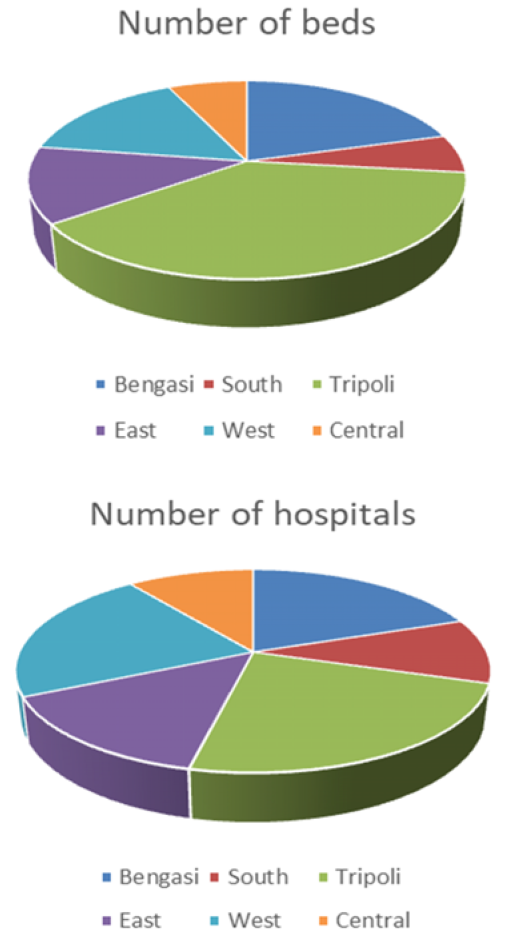
According to the WHO report 2020 on Libya, the following years of neglect and under-investment in the health sector, Libya is ill-equipped to tackle COVID-19. A recent health sector assessment found that only just over half of communities had emergency health services or health care services for children, and just under half had any kind of general clinical services. The situation is even worse when it comes to reproductive health care. Mental health services are basically non-existent (Figure 1). Moreover, Attacks on health care are continuing. Thus far this year, there have been more confirmed attacks on health care in Libya than in any other country worldwide. The resulting closure of health facilities has an obvious immediate impact on people who need health care, including some who may be infected by COVID-19.


Figure 1: Number of Beds and Number of Hospitals All Over the Libyan Country

REFERENCE
  1. Forni, D. et al. “Molecular evolution of human coronavirus genomes.” Trends in Microbiology, vol. 25, no. 1, 2017, pp. 35–48.

  2. Beaudette, F.R. and C.B. Hudson. “Cultivation of the virus of infectious bronchitis.” Journal of the American Veterinary Medical Association, vol. 90, 1937, pp. 51–56.

  3. Hartley, D.M. and E.N. Perencevich. “Public health interventions for COVID-19: Emerging evidence and implications for an evolving public health crisis.” JAMA, vol. 323, no. 19, 2020, pp. 1908–1909.

  4. Decaro, N. et al. “Recombinant canine coronaviruses in dogs, Europe.” Emerging Infectious Diseases, vol. 16, no. 1, 2010, pp. 41–47.

  5. Gorbalenya, A.E., S.C. Baker, and R.S. Baric. “The species severe acute respiratory syndrome-related coronavirus: Classifying 2019-nCoV and naming it SARS-CoV-2.” Nature Microbiology, vol. 5, 2020, pp. 536–544.

  6. Tadesse, D.B. et al. “The burden, admission, and outcome of COVID-19 in Africa: Protocol for a systematic review and meta-analysis.” Emerging Microbes & Infections, vol. 9, no. 1, 2020, pp. 1372–1378.

  7. Chan, J.F.W. et al. “A familial cluster of pneumonia associated with the 2019 novel coronavirus indicating person-to-person transmission: A study of a family cluster.” The Lancet, vol. 395, no. 10223, 2020, pp. 514–523.

  8. Cowling, B.J. and G.M. Leung. “Epidemiological research priorities for public health control of the ongoing global novel coronavirus (2019-nCoV) outbreak.” Euro Surveillance, vol. 25, 2020, article 2000110.

  9. World Health Organization. Clinical Management of Severe Acute Respiratory Infection When Novel Coronavirus (nCoV) Infection Is Suspected. WHO, March 2020.

  10. Daw, M.A. “Corona virus infection in Syria, Libya and Yemen: An alarming devastating threat.” Travel Medicine and Infectious Disease, Apr. 2020, article 101652.

  11. World Health Organization. WHO Director-General’s Opening Remarks at the Media Briefing on COVID-19. WHO, March 2020.

Recommended Articles
Research Article
Electrochemical Comparative Studies On The Redox Behavior Of Cu(II) And Cr(II) Before And After Interactions With Ciprofloxacin In Solutions
Published: 10/08/2021
Download PDF
Research Article
A Rare Case Report of Waugh Syndrome in an Eight Months Old Male
...
Published: 10/03/2021
Download PDF
Research Article
Study on Prevalence and Etiology of Early Neonatal Deaths in Jasin district, Melaka from 2014-2017
...
Published: 30/05/2021
Download PDF
Research Article
In Acute Appendicitis, Neutrophil/Lymphocyte Rate and C-Reactive Protein’s Radiological Relation with Appendix Diameter and İnvestigation of İts İmpact on The Diagnosis
Published: 10/03/2021
Download PDF
Chat on WhatsApp
Flowbite Logo
PO Box 101, Nakuru
Kenya.
Email: office@iarconsortium.org

Editorial Office:
J.L Bhavan, Near Radison Blu Hotel,
Jalukbari, Guwahati-India
Useful Links
Order Hard Copy
Privacy policy
Terms and Conditions
Refund Policy
Shipping Policy
Others
About Us
Team Members
Contact Us
Online Payments
Join as Editor
Join as Reviewer
Subscribe to our Newsletter
+91 60029-93949
Follow us
MOST SEARCHED KEYWORDS
Copyright © iARCON International LLP . All Rights Reserved.