The main objective of the present study is to investigate the factors effective on firms performance in the context of coronavirus (COVID-19), and to test this Phenomenon in the export firms of Iran through mixed method (qualitative-quantitative) researcch. To this end, 30 exporter firms were selected from Iranian Food industry Exporters as the statistical sample of the study and the data were gathered using questionnaire and interview and data analyzed with fuzzy Delphi methods and partial least squares technique. The research findings show that Innovation has been the main factor in the success of companies in the field of exports during the first six months of the corona virus entering the country among food industry exporters. The research findings have led to the identification of vital export incentives and drivers in critical situations . It has finally led to a new typology of innovation tailored to the Covid 19 pandemic.
Businesses face many challenges in today's business world. Informed customers, intense competition, the rapid growth of information and communication technologies on the one hand, and specific environmental crises on the other hand have caused them problems [1-2]. The coronavirus (COVID-19), has turned it into a phenomenon of the century and affected all aspects of human life, from individual and organizational, economic and social to political and cultural.
In business area, the virus has been affected all aspects so hard that it has shut down many companies around the world, forced some firms to decrease their human resources [3]. But in this frustrating situation, innovative companies have not left the scene and are thinking of creating opportunities from the imposed conditions. Using the capacity for innovation, think about creating value for existing customer conditions.
On the other hand, innovativeness has been introduced as a key indicator of success in the new business world. And its positive impact on performance in international and global markets has been reported.
On the one hand, There are many complexities and certain ambiguities threatening the exporters if, they decide to enter into foreign markets due to the current unpleasant condition of the world economy. In fact, they have to encounter and cope with certain challenges some of which are the followings: the coronavirus crisis, severe competition in the field of business, the risks existing in some developing markets, limitations of financial resources, providing the raw material, wide changes occurring in the interests of markets, management of costs. As a matter of fact, these are only a small part of the challenges of today’s international business world.
Therefore, firms are increasingly forced to try to survive through enhancing their market share in the market of foreign countries. Competition among firms throughout the world will get more and more severe as the World Trade develops. In such a condition, firms are forced to enhance their activity throughout the world or at least in the area beyond their national borders.
On the other hand, to improve export performance is considered by the policy-makers in the field of economy as a main element effective on the national income of each country. In fact, through improvement of export, can achieve the following goals: stable growth of economy, reduction of unemployment, and social justice. Moreover, the phenomenon (i.e. improvement of export performance) can play a significant role in equalizing the balance of payments and increase of the countries’ resources.
A great deal of research has in the past been done in different countries regarding the factors effective on the development of stable export. In general, two factors have been introduced to be important to this end including inner-firm and outer-firm factors.
In critical situations such as the present, many questions arise in the minds of business researchers. In a crisis like the coronavirus, how do business managers view foreign markets?
Although numerous studies have been conducted on the sustainable export performance of firms and the factors affecting it [4-7], but this issue in the context of critical conditions such as the Covid 19 virus (Corona) requires new and contingent research specific to these conditions.
Firms active in Iran's food industry as an important and influential industry, play an important role in developing the country's export performance, currency appreciation in sensitive sanctions conditions and job creation. Examining the status of firms operating in critical situations such as the Covid virus 19 and how to manage the situation and the degree of innovativeness of senior managers in the field of exports can be effective in improving the performance of other firms and also identifying the weaknesses of firms.
Research has been conducted on the critical condition of the Covid-19 virus and its findings have been extracted from an up-to-date database, which can help design and introduce innovative findings and solutions.
Literature review
The corona virus has affected the lives of almost all people everywhere in the world and has led to new lifestyles in all areas. In the field of business, the virus has imposed new conditions on businesses and has brought about many changes and developments [8-9]
Accordingly, businesses and their senior executives are thinking of taking advantage of the opportunities at the heart of this crisis to better meet the needs and wants of their customers [10-11].
One of the main factors and indices which are highly important for the economic growth of each country, especially in today’s trembling world is ‘stable export’. As a matter of fact, a first step that should be taken toward stable export is to recognize the factors effective on it. The results of the previous studies in this area are all indicative of the existence of two types of factors which are considered highly important and effective on the development of export.
In his classification, Leonidou has divided the factors effective on stable export into two types of factors:
The first type: environmental factors. Such factors are called environmental because they can hardly, or at most restrictively, be controlled by exporters. Among these factors are the ones related to macro economy, social, physical, cultural factors, and political aspects. A simple example for such factors is, the elements related to industry which influences firm’s export behavior and performance. The second type, the factors at the level of firm or corporation. They are also referred to as organizational factors and consist of structural and behavioral factors occurring inside the firm which have a potential influence on export performance
In another classification, Zou and Stan have divided the factors effective on export performance into two types including internal and external factors, for which they have introduced two types of theories including ‘resource-based theory’ and ‘industrial organization theory’. While the industrial organization attitude can be particularly helpful to explain the economic performance of exporters, the effect of internationalization process on internal factors (resource theory) can also be beneficial as the main incentives for such a process. In other words, having access to facilities, knowledge about market, physical distance, management’s attitudes and perceptions, and many other capacities are all among the many internal factors effective on the development of export.
In a pervasive model, Ortega and Vera have also examined the factors effective on the development of export. In his research they have divided these factors into the three following groups:
Firm’s capabilities and resources
Managerial characteristics
Attitudes and perceptions of management
Having studied the research done in the area of export and international trade, the factors effective on the success of exporting firms in world markets can be classified as follows:
Based on the findings of some studies, there are three general factors effective on the development of export performance including: structural factors, managerial factors and export obstacles and incentives [12-13].
Structural factors consist of firm’s size, age, managerial system, the state of its technology and structure, the position of research and progress in the firm, innovativeness, etc [14].
Managerial factors usually refer to the entrepreneurial and managerial characteristics of the supreme management team and those who are responsible for making decisions In a critical situation. Such factors consist of the expected profitability of export performance, attitude towards risk and costs, education level and experience of management team, etc.[15]. And the role of small, creative and flexible enterprises in this situation is undeniable [16].
Another point is that members of a value chain in critical situations move towards more cooperation to use innovative strategies. And all members of the value chain, like members of a family, find greater adaptation to the new wants and needs of customers, especially in foreign markets, by making greater use of the strategy of cooperation and reducing competitive areas within the chain [17].
The obstacles and incentives for export are competition pressure, internal negative trends, accessibility to information, etc.
Cavusgil and Naor, in theor resercah showed that firm size has positive effect on export performance. Hart and Tzokas, however, in their study reported that success in export performance is not specifically influenced by firm size. Some studies have also reported that firm size has so little impact on export performance.
Capital power is among the most important financial determinants effective on the development of export performance whose positive impact has been shown in most studies in this area.
In general, based on the results from numerous studies done in the area of the factors effective on export performance and as far as effectiveness on export performance is concerned, the most important variables in inner-firm spectrum can be classified into three general categories:
Marketing Factors: market research, market information, marketing advertisement, marketing strategies, and attendance in international exhibits are among the most important variables effective on export performance[18-19]
Financial Factors: capital power, benefiting from circulating capital and management of financial resources are introduced as the most important financial variables effective on the development of export performance
Managerial Power: the attitude of supreme mangers towards risk, organizational learning, organization profitability, supreme managers’ education level and their field of study, export commitment of supreme managers’ team, technology and IT, the experience and knowledge of supreme managers’ team in foreign markets and international trading, creativity and the status of export in the culture dominant over organization are introduced as the most significant variables effective on the development of export performance [19]
In a study investigating the relationship between innovation and firm export behavior, Lages and Montgomery showed that innovation, which was formerly assessed by the research and progress costs, is a key element effective on the growth of export performance.
O’Cass, A. and Julian, C. showed that the ratio of research and progress costs to sale has a direct impact on firm’s export performance. In their model, export performance had been examined by the ratio of export to total sale.
Lages and Lages in their model showed that the cost of research and progress is an important factor effective on the export performance of small and medium-sized firms. The variable, however, does not lead so much to competitive advantage in high-tech enterprises. In fact, the effect of the variable “research and progress costs” on export performance is shown in other research models, too. Based on the findings of such models, the cost of research and progress is an important factor increasing the probability of firm’s entrance into foreign markets and eventually the increase of export share from the total sale.

The steps for collecting and analyzing data, or the process for doing research in general, are shown below. In the first part of the work, a review of the literature was used to identify new business strategies and an initial set of strategies was developed.
Then the interview protocol was designed and after identifying Iranian food industry exporters, 30 firms were selected through purposeful sampling for interview. The interviews were semi-structured and the senior managers of the firms were selected for the interviews. The research method used in this study is multiple case study and for data analysis, theme analysis method was used as analysis tool. Fuzzy Delphi technique has also been used after identifying the main themes to objectify them and increase its validity and reliability. In other words, the main themes extracted from the interviews were distributed through a questionnaire among exporter firms.
The statistical population of the study includes all companies that operated in the value chain of Iran's food industry exporters in 2019 and 2020 and their service or product has led to the export of this industry to foreign markets.
The statistical sample of the research was selected from the statistical population and in the qualitative part of the research, purposive sampling method was used and 30 exporting companies were selected. Theoretical sampling is a type of purposeful sampling that helps the researcher to create or discover a theory or concepts whose theoretical connection with the evolving theory has been proven. In theoretical sampling, events are sampled, not necessarily from individuals, if we go to individuals with the aim of exploring events, events that represent various themes related to the phenomenon under study. In the qualitative part, semi-structured interviews were conducted with the managers of 30 exporting companies. Also, in the quantitative part, 178 managers were examined as a statistical sample.
The research has been conducted with multiple methodology in such a way that in the qualitative part of the research, it has been studied using the case study method of food exporting companies. Accordingly, theme analysis has been used to analyze the research data in the qualitative part, and in the quantitative part, three techniques include; Fuzzy Delphi technique and interpretive structural method are used. The reason for using these two techniques is that for screening themes identified in the qualitative section, a suitable technique introduced is the fuzzy Delphi method. On the other hand, in the next stage of the research, in order to determine the level of readiness of firms, as well as the effectiveness and effectiveness of the existing infrastructure of innovation programs, a method is needed that the structural-interpretive technique does well. Finally, considering that a general framework of innovative strategies has been presented, a method for confirming the relationships between the introduced indicators or in other words, final approval of the model and validation of the presented indicators and relationships (validity and reliability) is needed. Jizi has done this. Therefore, with the multiple methodology used in the present study, the validity of the final model presented increases the research. The first step of the present study was performed using a qualitative research method. One of the methods of qualitative data analysis or qualitative content analysis is the method of theme analysis. Team analysis is a way to determine, analyze and express the patterns (themes) in the data. This method at least organizes the data and describes it in detail. But it can go beyond this and interpret different aspects of the research topic. Qualitative data analysis in this study was performed by theme analysis method. Fuzzy Delphi technique will be used to screen early indicators. To fuzzy the view of experts, a spectrum of seven degrees is used according to the table below.
Table 1: Seven Fuzzy Degrees for Evaluating Indicators
| Completely insignificant | Very insignificant | Insignificant | medium | significant | Very significant | Completely significant |
(0.9, 1, 1) | (0.75, 0.9, 1) | (0.5, 0.75, 0.9) | (0.3, 0.5, 0.75) | (0.1, 0.3, 0.5) | (0, 0.1, 0.3) | (0, 0, 0.1) |
In the next step, the fuzzy average of people's scores must be calculated. In fact, these aggregation methods are experimental methods that have been proposed by various researchers. For example, a conventional method for aggregating a set of triangular fuzzy numbers is considered to be minimum 1, mean m, and maximum u. In this study, we have used the fuzzy mean method. Fuzzy mean n Triangular fuzzy number will be calculated as follows:
![]()
In this equation, the triangular fuzzy number,
, Fuzzy equivalent of expert view number k, Around the criteria i. Eventually, fuzzing will take place. The surface center method is used for de-fuzzing as follows:
![]()
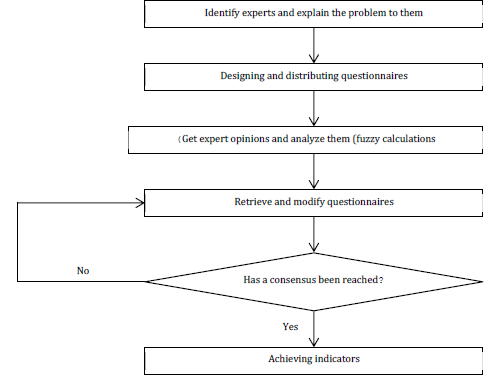
In this study, the tolerance threshold is considered 0.7. Therefore, the de-fuzzy value greater than 0.7 is acceptable and any index with a score above 0.7 is approved. It should be noted that the steps of using fuzzy technique for the present study are outlined in the Figure 1.

Figure 1: Steps and Methods of Research
Structural-interpretive modeling method can be used to analyze the relationship between multivariate properties defined for a problem. Structural-interpretive modeling is a methodology for creating and understanding relationships between elements of a complex system. In other words, interpretive-structural modeling is an interactive process in which a set of different and related elements are structured in a comprehensive systematic model. ISM methodology helps to establish order in complex relationships between elements of a system. Structural-interpretive modeling helps to identify the internal relationships of variables, and a suitable technique for parsing and ISM can be to prioritize and analyze the effect of one variable on other variables. It can also prioritize and level the elements of a system, which helps managers to better execute the designed model. Therefore, for the present study, which analyzes the relationships of members of the value chain on the coast and offshore, understanding the set of complexities between the elements of this chain can be made possible and facilitated by this method. In this model, after identifying the dimensions and characteristics of the study, the relationships between the dimensions and the identified indicators are analyzed using the conceptual relationship "leading to". The states and symbols used in this conceptual relationship are presented in Table 2.
Table 2: Signs Used In Designing a Structural-Interpretive Model
V | A | X | O |
The variable i affects j | The variable j affects i | Two-way relationship | Lack of relationship |
A very important point is that the logic of interpretive structural modeling (ISM) works in accordance with the non-parametric method and is based on mod in frequencies. In this study, the output of the Demetel technique has been used to form the input matrix of the structural-interpretive model. One of the main reasons for the tendency to use the partial least squares technique is that this technique does not rely on the assumption that the statistical population is normal and also the sample size. In the present study, SmartPLS software has been used to solve partial least squares or PLS problems. Finally, the fit of the model is examined. The structural part of the model, unlike the measurement models, does not deal with the questions and observable variables of the model and only pays attention to the hidden variables and the relationships between them. In this research, structural model fitting is used using coefficient of determination (R2), redundancy and finally GOF statistics.

Figure 2: Steps To Implement the Fuzzy Delphi Method
Research Findings
In the qualitative part of the research, the following themes were identified in the critical factors of sustainable export success, key decisions and incentives for Covid 19 virus conditions . Theme analysis was performed based on the 6-step model of Clarke and Braun, the final findings of which are presented in the Table 3 and 4.
Table 3: Theme Analysis of Critical Factors Related To Sustainable Export Success
| Row | Basic themes | Comprehensive themes |
| 1 |
| Innovativeness |
| 2 |
| Firm’s capabilities and resources
|
| 3 |
| Managerial characteristics |
| 4 |
| Strategic capability |
| 5 |
| Company human resources |
Table 4: Key Decisions and Incentives for Success in Covid 19 Virus Conditions
| Row | Basic themes | Comprehensive (main) themes |
| 1 |
| opportunities Discovering |
| 2 |
| Innovation |
| 3 |
| Cooperation |
| 4 |
| Company specialized personnel |
| 5 |
| Research and development team |
After analyzing the theme, the identified themes were left to the experts and for this purpose, fuzzy Delphi technique was used. For the first round of the Delphi technique, managers with a bachelor's degree or higher and university professors related to the industry were selected and a questionnaire related to the items extracted from the theme analysis process was distributed among them. The views of 14 experts on each indicator are shown in the table 5.
Table 5: Fuzzy Expert Panel View for Each of the Research Indicators
Fuzzy | Expert 1 | Expert 2 | Expert 3 | ... | Expert 14 |
| Q01 | (0.9, 1, 1) | (0.5, 0.75, 0.9) | (0.9, 1, 1) | ... | (0.75, 0.9, 1) |
| Q02 | (0.5, 0.75, 0.9) | (0.9, 1, 1) | (0.3, 0.5, 0.75) | ... | (0, 0, 0.1) |
| Q03 | (0.75, 0.9, 1) | (0.5, 0.75, 0.9) | (0.75, 0.9, 1) | ... | (0.75, 0.9, 1) |
| Q04 | (0.75, 0.9, 1) | (0.5, 0.75, 0.9) | (0.1, 0.3, 0.5) | ... | (0.75, 0.9, 1) |
| Q05 | (0.5, 0.75, 0.9) | (0.1, 0.3, 0.5) | (0.5, 0.75, 0.9) | ... | (0.9, 1, 1) |
| Q06 | (0.75, 0.9, 1) | (0.3, 0.5, 0.75) | (0.9, 1, 1) | ... | (0.75, 0.9, 1) |
| Q07 | (0.75, 0.9, 1) | (0.5, 0.75, 0.9) | (0.9, 1, 1) | ... | (0.5, 0.75, 0.9) |
| Q08 | (0.75, 0.9, 1) | (0.5, 0.75, 0.9) | (0.75, 0.9, 1) | ... | (0.9, 1, 1) |
| Q09 | (0.5, 0.75, 0.9) | (0.3, 0.5, 0.75) | (0.5, 0.75, 0.9) | ... | (0.75, 0.9, 1) |
| Q10 | (0.75, 0.9, 1) | (0.9, 1, 1) | (0.75, 0.9, 1) | ... | (0.5, 0.75, 0.9) |
| Q11 | (0.1, 0.3, 0.5) | (0.75, 0.9, 1) | (0.9, 1, 1) | ... | (0.5, 0.75, 0.9) |
| Q12 | (0.9, 1, 1) | (0.75, 0.9, 1) | (0.9, 1, 1) | ... | (0.9, 1, 1) |
| Q13 | (0.5, 0.75, 0.9) | (0.75, 0.9, 1) | (0.3, 0.5, 0.75) | ... | (0.9, 1, 1) |
| Q14 | (0, 0, 0.1) | (0.5, 0.75, 0.9) | (0.9, 1, 1) | ... | (0.75, 0.9, 1) |
| Q15 | (0.9, 1, 1) | (0.9, 1, 1) | (0.75, 0.9, 1) | ... | (0.9, 1, 1) |
| Q16 | (0.9, 1, 1) | (0.9, 1, 1) | (0.5, 0.75, 0.9) | ... | (0.75, 0.9, 1) |
| Q17 | (0.75, 0.9, 1) | (0.9, 1, 1) | (0.75, 0.9, 1) | ... | (0.5, 0.75, 0.9) |
| Q18 | (0.9, 1, 1) | (0.9, 1, 1) | (0.9, 1, 1) | ... | (0.75, 0.9, 1) |
| Q19 | (0.75, 0.9, 1) | (0.1, 0.3, 0.5) | (0, 0.1, 0.3) | ... | (0.5, 0.75, 0.9) |
| Q20 | (0.9, 1, 1) | (0.9, 1, 1) | (0.9, 1, 1) | ... | (0.9, 1, 1) |
| Q21 | (0.75, 0.9, 1) | (0.9, 1, 1) | (0.9, 1, 1) | ... | (0.75, 0.9, 1) |
| Q22 | (0.5, 0.75, 0.9) | (0.3, 0.5, 0.75) | (0.5, 0.75, 0.9) | ... | (0.75, 0.9, 1) |
| Q23 | (0.75, 0.9, 1) | (0.9, 1, 1) | (0.75, 0.9, 1) | ... | (0.9, 1, 1) |
| Q24 | (0.1, 0.3, 0.5) | (0.75, 0.9, 1) | (0.9, 1, 1) | ... | (0.5, 0.75, 0.9) |
| Q25 | (0.9, 1, 1) | (0.75, 0.9, 1) | (0.9, 1, 1) | ... | (0.9, 1, 1) |
| Q26 | (0.5, 0.75, 0.9) | (0.75, 0.9, 1) | (0.3, 0.5, 0.75) | ... | (0.9, 1, 1) |
| Q27 | (0.9, 1, 1) | (0.9, 1, 1) | (0.9, 1, 1) | ... | (0.9, 1, 1) |
| Q28 | (0.75, 0.9, 1) | (0.3, 0.5, 0.75) | (0.9, 1, 1) | ... | (0.5, 0.75, 0.9) |
| Q29 | (0.75, 0.9, 1) | (0.5, 0.75, 0.9) | (0.9, 1, 1) | ... | (0.9, 1, 1) |
| Q30 | (0.75, 0.9, 1) | (0.9, 1, 1) | (0.75, 0.9, 1) | ... | (0.9, 1, 1) |
| Q31 | (0.75, 0.9, 1) | (0.5, 0.75, 0.9) | (0.75, 0.9, 1) | ... | (0.75, 0.9, 1) |
| Q32 | (0.9, 1, 1) | (0.9, 1, 1) | (0.9, 1, 1) | ... | (0.75, 0.9, 1) |
| Q33 | (0.75, 0.9, 1) | (0.1, 0.3, 0.5) | (0, 0.1, 0.3) | ... | (0.9, 1, 1) |
| Q34 | (0.9, 1, 1) | (0.9, 1, 1) | (0.9, 1, 1) | ... | (0.9, 1, 1) |
| Q35 | (0.75, 0.9, 1) | (0.9, 1, 1) | (0.9, 1, 1) | ... | (0.9, 1, 1) |
| Q36 | (0.5, 0.75, 0.9) | (0.3, 0.5, 0.75) | (0.5, 0.75, 0.9) | ... | (0, 0, 0.1) |
The next step is to consolidate the views of experts. Various methods have been proposed to aggregate the n respondents' opinions. In fact, these aggregation methods are experimental methods that have been proposed by various researchers. For example, a conventional method for aggregating a set of triangular fuzzy numbers is the minimum l, the geometric mean m, and the maximum u.
![]()


Each triangular fuzzy number resulting from the aggregation of experts' views for the jth index is represented as follows:
![]()
![]()

![]()
Index I, refers to an expert. So that:
X_ij: The value of the i-th expert evaluation of the j-th criterion
L_j: The minimum value of evaluations for the criterion j
M_j: The geometric mean of the experts' assessment of the performance of the standard j
U_j: The maximum value of evaluations for the criterion j
In this study, we have used the fuzzy mean method. It is usually possible to sum the sum of triangular and trapezoidal fuzzy numbers by a definite value which is the best corresponding mean. This operation is called de-fuzzing. There are several ways to de-fuzzy. In most cases, the following simple method is used for decapsulation,
![]()
In this study, the surface center method is used for de-fuzzing:
![]()
The fuzzy mean and the de-fuzzy output are the values for the indices. A de-fuzzy value greater than 7 is acceptable, and any indicator with a score less than 7 is rejected. Therefore, all the findings related to the theme analysis phase were confirmed by management experts and this issue was shown in the Delphi technique section in the Tables 6.
Table 6: Results of Screening Indicators (First Round)
Indicators | Bottom line | Probable value | upper bound | Fuzzy average | Definite amount | First round result |
Item 1 | 0.597 | 0.839 | 0.957 | (0.597,0.839,0.957) | 0.798 | Accept |
Item 2 | 0.673 | 0.729 | 0.947 | (0.673,0.729,0.947) | 0.783 | Accept |
…. | …. | …. | …. | ………………….. | …… | … |
Item 36 | 0.623 | 0.748 | 0.934 | (0.623,0.748,0.934) | 0.768 | Accept |
The present study dealt with investigating the inner firm factors effective on the development of stable export. The research model was formulated by identifying the critical success factors, incentives, and also by taking into account specific factors of critical conditions such as coronavirus 19 (coronavirus).
According to the research findings, the most important critical factors for the success of companies' export performance are:
Innovativeness
Firm’s capabilities and resources
Managerial characteristics
Marketing capacity
Strategic capability
Company human resources
In addition, key incentives for critical situations such as the Covid 19 virus; as follows:
Discovering opportunities
Innovation
Cooperation
Company specialized personnel
Research and development team
Another important finding of the present study, which according to the authors is research innovation; Providing a simultaneous combination of critical success factors and specific incentives and innovations is a critical condition for achieving a sustainable export performance. Based on the relationships identified between these factors, four categories of innovation were finally identified and approved by experts at both managerial and academic levels. it placed. Accordingly, the new typology is introduced as follows.
Organizational Innovation
Personnel innovation
Managerial innovation
Inter-firm innovation
Therefore, in order to respond promptly and quickly to environmental changes in critical situations such as the Corona virus, it is necessary for businesses to be empowered in these four levels of innovation (organizational, personnel, managerial and inter-firm).
Moreover, the findings of the study showed that there is a direct relationship between management’s risk-taking behavior (i.e. the amount to which they accept risk) and firms’ export performance. In other words, the amount to which managers accept risk and adopt entrepreneurship behavior, is a factor effective on firms’ export performance. In fact, the more managers adopt a risk-taking personality and the more creative persons they are, the more they’ll decide to seek for generating an environment which leads to the offering of new ideas and attendance in new markets. The most significant of all, the creative personality of manager will in itself be an effective factor that provides the staff with incentives to participate more in the decision makings of the firm, hence leading them to become more satisfied with their jobs. This, in the end, will improve the performance of firm.
With respect to the attitude of management towards export, it is necessary to maintain that managers’ knowledge about export is directly related to export performance. As a matter of fact, the more the mangers are aware of export performance (i.e. the more they are familiar with the principles and concepts of export), the more export performance of the firm will improve. Moreover, based on the results, The findings of the Critical Success Factors are consistent with many studies done in this area [18,6,17].
And in the section of special incentives for critical situations, the research findings are in line with the research results of Bini et al [20], Craven et al. [11]. Johanson and Vahlne [14].
Research suggestions
Based on the research findings, the proposed research package and policy of the present study have been designed in two levels;
At the first level, the government and government agencies related to economics and business enterprises and organizations related to crisis management, it is necessary to design new training for managers and other personnel categories on empowering businesses to deal with crisis situations.
At the enterprise level, too, senior managers are needed to empower critical situations at all four levels; Organize organizational, managerial, personnel and inter-enterprise, and include the necessary culture-building in preparation for future crisis situations and discovering opportunities from potential crises as part of the organization's strategies.
An important point, based on the findings of the present study, is the need to focus on innovation to manage crises such as the Corona virus, which requires senior executives to work towards comprehensive empowerment at all four levels.
Research Limitations
The main limitation of the present study was its implementation in the corona situation in 2020. Due to social constraints such as maintaining physical distance, researchers were forced to interview the statistical sample through video conferencing with virtual tools such as WhatsApp, etc.
Another point is the combination of the opinions of business managers with university professors that the research team had to select managers with higher university education at this level, which ultimately allows the combination of opinions. In addition, we added a round to the steps of the fuzzy Delphi technique, in which the opinions of both groups and their combinations were returned to the members of the statistical sample (managers and professors) and after their desired corrections were approved.
Ozili, P.K. and T. Arun. “Spillover of COVID-19: Impact on the global economy.” SSRN, 2020, Available at SSRN 3562570.
Ozili, P.K. “Covid-19 pandemic and economic crisis: The Nigerian experience and structural causes.” SSRN, 2020, Available at SSRN 3567419.
Huang, C. et al. “Clinical features of patients infected with 2019 novel coronavirus in Wuhan, China.” The Lancet, vol. 395, no. 10223, 2020, pp. 497–506.
Racela, O.C. and A. Thoumrungroje. “Enhancing export performance through proactive export market development capabilities and ICT utilization.” Journal of Global Marketing, 2019, pp. 1–18.
Mittal, R. et al. “Exploring business networks and its impact on firm performance in an auto-component cluster: A study of Gurgaon autocomponent cluster.” Research Journal of Humanities and Social Sciences, vol. 10, no. 2, 2019, pp. 449–464.
Abeykoon, M. and C. DeAlwis. “The impact of total quality management practices on export performance of apparel exporters in Sri Lanka.” Kelaniya Journal of Human Resource Management, vol. 10, no. 1, 2015.
Boso, N. et al. “The effect of export marketing capabilities on export performance: Moderating role of dysfunctional competition.” Industrial Marketing Management, 2017.
Guan, W.J. et al. “Clinical characteristics of coronavirus disease 2019 in China.” The New England Journal of Medicine, vol. 382, no. 18, 2020, pp. 1708–1720.
Ziegler, C.G.K. et al. “SARS-CoV-2 receptor ACE2 is an interferon-stimulated gene in human airway epithelial cells and is detected in specific cell subsets across tissues.” 2020.
Rodrigues, T. “Exploring impacts of COVID-19 from sport business manager’s perspective.” Master’s thesis, School of Business, Degree Programme in Sport Business Management, JAMK.FI, June 2020.
Craven, M. et al. “Covid-19: Business implications.” McKinsey & Company, April 2020.
Mira, M. et al. “Mediating role of port supply chain integration between involvement of human resource practices and port performance in Kingdom of Saudi Arabia.” Uncertain Supply Chain Management, vol. 7, no. 3, 2019, pp. 507–516.
Manzoor, S. “Furniture industry in Pakistan and its export status.” 2016. Retrieved from https://www.slideshare.net/jik1959/1-furniture-industry.
Johanson, J. and J.-E. Vahlne. “Markets as networks: Implications for strategy-making.” Journal of the Academy of Marketing Science, vol. 39, no. 4, 2011, pp. 484–491.
Radzi, M. et al. “The effect of information, communication and technology (ICT) and quality management to export performance of Malaysian’s SME in manufacturing sector.” Journal of Scientific Research and Development, vol. 2, no. 14, 2015, pp. 146–157.
Rekarti, E. et al.“Development model of marketing capabilities and export performance of SMEs: A proposed study.” European Journal of Business and Management, 2018, ISSN 2222–1905.
Celec, R. et al.“Resources, capabilities, export performance and the moderating role of entrepreneurial orientation in the context of SMEs.” European Journal of International Management, vol. 8, no. 4, 2014, pp. 440–464.
Voerman, J.A. “The export performance of European SMEs.” 2002, ch. 6, pp. 169–201.
Voerman, J.A. et al.“Export market information behaviour of SMEs: The influence of firm characteristics.” SOM Theme B: Marketing and Network, 2000.
Bini, L. et al. “Integrating sustainability in business model disclosure: Evidence from the UK mining industry.” Journal of Cleaner Production, vol. 171, 2018, pp. 1161–1170.