Events in the baby-care industry in Nigeria suggest that perhaps the inability of some firms for example Procter & Gamble Nigeria to engage her customer, partly accounted for the huge loss of market share and market relevance in the baby diaper category in Nigeria. Going by Euromonitor international market report on Child-specific products in Nigeria, with the exception of Hayat Kimya's Moflix, other brands (Pampers, Huggies baby essential and Dr Brown) have lost varying percentages of market share of baby-care products in Nigeria: 33%, 2% and 1.1% respectively [1]. These percentage losses across brands represented nearly 50% loss of market share in actual value loss within 2014-2018 and with Procter and Gamble Nigeria been the biggest loser, losing more than 33% of its market share of diaper category in less than four years [2,1].
Extant literature upholds that in today's highly competitive market, the desire for organisations to consistently achieve significant market performance is critical for its going-concern [3]. One way to achieve this market performance has stressed by scholars is to regard customer as key intangible asset. Hence, it become imperative to develop the capability to engage the customers because in such a highly competitive market, firms who can guaranty customer satisfaction are more likely to secure customer loyalty than firms who cannot. The ripple effect of customer satisfaction and loyalty have been documented in literature to enhance repeated patronage, sale revenue and market share. In addition, developing customer engagement capability means that firm can better understand customer erratic behaviour; an attribute of a changing environment and consequently use the information gathered to develop new products which can come as expansionary or exploratory product strategy given the capabilities of the organisation. Although scholars have position the effect of customer engagement on firm performance focusing on multinational firms in mostly developed country, however, more studies are needed to substantiate the effect customer engagement capability has on market share of firm in baby-care product in Nigeria. To achieve this, a cross-sectional survey was adopted and a first order hypothesis was developed and tested. The reminder of the article is in four sections. Section two which follows after this introduction is the literature review. Section three addressed the methodology. Section four focused on data analysis and section five dealt with discussions of findings, conclusion and recommendations.
Literature Review
Theoretical Framework and Hypotheses Development: This study adopted the Resource-Based View to provide theoretical support for the objective investigated. The RBV is an internal environment (inside-out) perspective aimed to explain how firms can achieve and sustain a competitive advantage. It emergence to limelight came after Barney's "Firm resources and sustained competitive advantage", Wernerfelt's "The resource-based view of the Firm", Prahalad and Hamel's "The core competence of the corporation" and Penrose's "The theory of firm the growth of firm" had published there works between 1980s and 1990s. The fundamentals of RBV, as put forward by its proponents is that a firm can better exploit its external environment and achieve decent returns simple by using its firm-specific resources and competence considered valuable, rare and complex to replicate. By implication, for firms that are desirous of accomplishing superior performances (as against competitive parity), such firms must possess knowledge, skill, ability and tangible productive asset, the proficiency to deploy it and the ability to consistently improve these capabilities (even though they were initially considered to have VIRO features) to stay afloat. Thus, RBV provided theoretical explanations for the functional association between the customer engagement capability and market share as hypothesized in this study.
Customer engagement has in recent times received substantial attention from contemporary scholars given it significance for firm performance in developed economies. For instance, Scholars pointed out that through customer engagement activities, organisations shares knowledge which enables the customer to uncover firms' unique capabilities and present value co-creation prospects that drive customer satisfaction and the resultant market share [4-5]. However within the context of developing economy like Nigeria not much has been done particularly focusing on multinational firms. The few studies for example Ateke and Iruka [6], investigated the relationship between customer involvement management and market performance focusing on small and mid-sized manufacturing firms in River State, Nigeria. While the submission of Ateke and Iruka [6] cannot be faulted however, the scholar did not establish the effect of customer engagement capability on market share. In contrast, when Anning-Dorson [3] examined the performance effect of customer involvement capability, the scholar posited that customer involvement capability is not a first-order capability that drives customer satisfaction, profit and market share. Similary, Beckers et al. posited that customer engagement initiative resulted in a negative outcome. The submissions of these prior studies on customer engagement capability suggest the need to position what effect does customer engagement capability has on market performance. Therefore this study posits that: Customer engagement has no significant effect on market share of selected manufacturers of baby-care products in Lagos State, Nigeria.
Conceptual Review
Customer Engagement: The concept of customer engagement (CE) began with subjects like psychology and it has found its way into organisational behaviour studies [7]. Contemporary scholars Kumar and Pansari [8] and Pansari and Kumar [9], have broadened its scope to reflect CE behaviours such as transactional behaviour (procurement) and non-transactional behaviour (recommendation and swaying). To advance the course of CE conceptually, scholars came up with different definitions to capture its essence. For instance, Pansari and Kumar considered CE "as the mechanics of a customer's value addition to the firm, either through direct or indirect contribution" [9]. Their definition did not incorporate what CE entails; however, in an earlier study in 2015, Kumar and Pansari suggested that CE comprised buyer buying behaviour, buyer recommendation behaviour, buyer swaying and buyer awareness behaviour.
Nevertheless, this definition is more a description of the attributes of CE as it did not explain how CE is created, nor does it clearly define the benefit derivable from it. To address the weakness in Kumar and Pansari's 2015 definition, Brodie et al. in 2011 viewed CE to be a mental state which results from customer interacting and co-creation experience with a business. Similarly, CE is considered multilevel activities that happen from a customer's feelings of positive experience with a brand that results in the attainment of the personal goal [10]. Also, Vivek, Beatty, Dalela and Morgan [11] expressed CE as the degree of a customer's involvement in and his/her association with a company's products and its production activities.
Dessart, Veloutsou and Morgan-Thomas [12], on the other hand, suggested that CE is a state that shows a customer attitude towards an organisation's engagement effort, communicated through emotional, intellectual and social interaction that goes beyond purchase activities. Several scholars have addressed how CE is created and the authors did not identify potential benefits derivable from CE [10,12]. As a follow-up, Van-Doorn et al. [13] opined that CE is a customer's behavioural expression towards a company, beyond buying activities, resulting from a company-induce motivation activity. Another scholar who accentuated the benefit of CE attributable to firms was Bowden in 2009. According to Bowden, CE is an emotional process through which customer loyalty is formed both for new and existing customers.
Harmeling, Moffett, Arnold and Carlson [14] suggested that CE is a state where a customer willingly contributes to a company's marketing responsibility beyond patronage. This definition suggested that the customer is responsible for the organisation in driving CE, however viewing CE as a firm-initiated resource is essential because organisations typically take the initiative to engage the customer and firms should proactively manage the CE experience [15-16,10,13]. Supporting this line of thought, Harmeling et al. [14] opined that CE is "the firm's deliberate effort to motivate, empower and measure a customer's voluntary contribution to its marketing functions, beyond a core, economic transaction".
In view of the above definitions, this study defined customer engagement (or involvement) as a firm internally-initiated activities designed to form a platform; one that allows customers to engage in a direct and voluntary collaboration with the organisation in the manufacturing activities (value co-creation) and distribution process [17] aimed at creating a sense of brand identity and brand loyalty while building strong marketing capability toward the overall business success. Defining customer engagement in this manner emphasized the value-creation potentials, which can stimulate customers' buying behaviour and in turn, improve patronage for the organisation.
Jaakole and Alexander [18] believed this value-creation potential is an essential characteristic of customer engagement. Resonating Kumar and Pansari [8], the authors identified the features of CE to include buying actions, referral actions, swaying actions and awareness actions. To substantiate these features, a study conducted by Rosetta Consulting in [19] revealed that customers that are genuinely engaged are highly likely to spend more than 60% on buying actions, have considerable potentials to repurchase up to 90% frequency rate from a company and with the capacity to sway other customers to follow in similar direction. This is because CE helps an organisation to develop a meaningful business relationship outside economic transactions with customers so that it can attain a competitive edge [8,20].
Hence it was not surprising when Alvarez-Milán et al. [15], opined that marketers believed that through CE firms are expected to enjoy increase both in terms of financial (profit & Sales) and market (market share & brand equity) performance. Similarly, Adel-Saleh could not agree any less, as the scholar attributed several benefits to organisations who engage their customers honestly. One such benefit of CE is its capacity to influence a firm's overall performance significantly [21]. Specifically, CE is at the heart of developing "Outside-in-marketing-capability" that allows a firm to be a profitable going concern. These narratives are in line with the value-creation consequences attributable to CE by Pansari and Kumar in 2017. Buttressing the value-creation attribute, Nitzan and Libai [22] pointed out that "when stimulating customer engagement behaviours, companies involve customers in activities that were once reserved for the firm: promoting the brand, suggesting ideas for new products, choosing advertising copy, deciding on logos and even reacting to competitive actions" (p. 275).
Customers indirectly assume the responsibilities of companies' staff, hence saving selling expenses like advert expenses and other product support activity expenses such as brand identity[23]. By implication, when customers have a sense of identity with a company's product, they will patronize the product (since they co-produced it) and will help to advertise the product to other potential customers. This referral aspect of CE, enable the company to engage the customer further in a "non-employed sales force capacity" without paying a dime but enjoying increasing patronage [21,8]. In addition, Hirschman [24] suggested that creating a platform to engage with customers offers the company opportunities to obtain feedback from potential customers. The customers are likely to offer information about the company's product and how the end-user might perceive it. This activity has the potential of preventing the problem that can impact the company product negatively hence saving the fixed cost associated with product recalls and refurbishment.
In the same vein, some scholars have echoed the submission of Hirschman [24], they believed that emphasizing CE activities, provides the organisation with a more cost-effective means of promoting its products and increasing customer base. For instance, a customer will listen to another customer's recommendation to sway a purchase intentions more than a company's sale reps or advertisement campaign [25-26]. Also, the idea that when customers are engaged beyond buying-responsibility, it forms and deepens their relationship and loyalty with an organisation [18,27,13]. This is because during these interactions, customer are keenly involved and they develop opinions about the company and for the company it is a learning process, they get to understand how their customers are thinking and consequently devising a strategic response that aligns with the customers' expectations [28]. Beyond the value-creation opportunities, scholars suggested that CE has become a key driver of customer satisfaction and loyalty for organisations [29,27].
Literature has positioned the advantages of CE for organisations who can initiate it, nevertheless majority stair-away from its drawbacks- this is understandable because the concept suggested positive disposition to an organisation, therefore, by implication not having the capability to adequately engage customers would certainly mean negative consequences to such an organisation. Beckers et al. [30], suggested the following disadvantages; first, there exists the possibility of losing firm-inherent innovative tendencies because the organisation will be working from a reactive standpoint and this can be very limiting. Ernst, Hoyer, Krafft and Krieger [31] corroborated this argument by emphasizing that one of the significant challenges of co-creation is diminished control over a firm's strategic management and planning. Innovation is a vital function of management and has a crucial impact on business performance. Hence, transferring control over innovation processes and their outcomes from a firm to its consumers aggravates a firm's strategic planning efforts [32].
Second, customers exhibit erratic behaviour. Their needs consistently change, suggesting that organisations may not be able to keep up with consumer demands after engagement activities and not delivering on the promise of CE activities may result in reject from customers. Lastly, as much as CE can assist with saving selling and other product supporting costs, CE activities are equally not cheap, as it requires a concerted effort by management to set up the platform, including personnel, designing its mode of operation and the objective to achieve. Even though scholars have stressed the positive influence CE has on organisational performance, yet contrary submission found in empirical studies [30] suggest a different outcomes and thus become a source of apprehension about its rightful planning and implementation.
Market Share
As part of measures of non-financial performance, market share (MS) is a critical indicator of market-related firm performance. So much that MS has received much attention from corporate-level management [32-35], corroborate the general assertion in marketing literature that MS is amongst the primary marketing goal used to evaluate the performance of a new product. It is not surprising when Okwachi, Gakure and Ragui [36] stated that MS is a fundamental business objective. Similarly, Bendle, Farris, Pfeifer and Reibstein [37] opined that MS is the percentage of a market accounted for by a specific entity and can be represented as a firm's sales revenue or as a firm's sales volume in a given market divided by the total volume sales in that market. Corroborating the above definition, O'Regan [37] defines MS as a company's sales to total industry sales for a specified period.
The definitions put forward by Bendle et al. [38] and O'Regan [39] emphasized total sales. However, scholars suggested that MS comprised of volume sales and value. Accordingly, Edeling and Himme [40] conceptualized MS as a business entity's monetary-based or volume-based fraction of the total market (absolute MS) or of the output of the most significant competitor/combined MS of several leading competitors (relative MS). On the contrary, Romaniuk, Dawes and Nenycz-Thiel [41] considered MS to be reflective of a firm's strength relative to its industry competitors. This definition failed to show what constitutes the 'relative strength' of a firm. Also, Edeling and Himme [40] suggested that the MS consists of the capability of a company for operating or using a brand image that can enjoy vital importance in every category of products or services. They stressed further that MS is the percentage of an industry or market's total sales that is earned by a particular company over a specified time. Also, MS is calculated by taking the company's sales over the period and dividing it by the total sales of the industry over the same period [37].
Addressing the inadequacies in the definition reviewed so far, Rego, Morgan, & Fornell [44], posited that MS should be conceptualized and measured in terms of the unit of measurement (sales, unit sales, units purchased, users). Also, with the product definition (product lines, brands in various forms, sizes and positioning). The market definition (defined market in terms of geographic area, customer segments, channels and usage occasions), the time horizon (long versus short-term) and the competitive frame of reference [43]. Given the above definition, this study described market share as the proportion of market size (both in volume and in value) in a specific product category controlled by a firm; and considered a significant factor that determines a firm's market leadership position and by extension superior performance.
One such feature of MS is that it does not respond to a specific macro variable. By nature, it is quantitative based on definitions by [36-38]. Moreover, it involves using numbers (both in units and value) to determine a firm's market positive relative to its competitors [38]. The significant benefit of MS as a performance measure of business success is based on the notion that it does not get easily affected by macro-environmental variables, for instance, the state of the economy, variations in its policies, or changes in tax administration Dragnic [43]. Market share is said to be a necessary measure of market competitiveness and performance. More so, it established the degree to which a firm performs relative to its major rivals. The MS figures, supplemented by changes in sales revenue, helps managers evaluate both primary and selective demand in their markets [38]. That is, it enables them to judge not only total market growth or decline but also trends in customers' selections among competitors. Generally, sales growth resulting from primary demand (total market growth) is less costly and more profitable than that achieved by capturing share from competitors [44].
Conversely, losses in market share can signal serious long-term problems that require strategic adjustments. Firms with market shares below a certain level may not be viable. Similarly, within a firm's product line, market share trends for individual products are considered early indicators of future opportunities or problems [44].
Empirical Review
Customer Engagement and Market Share
To substantiate the relevance of customer engagement to firm market performance, Ateke and Iruka's [6] study revealed that customer involvement management and market share are positive correlates. Fidel et al. [45] focused on manufacturing companies in Valencia and the result revealed that customer knowledge efforts contribute significantly to market share. Despite the research context of both Ateke and Iruka [6] and Fidel et al. [45] differ as the former was done in Nigeria and the latter in Spain, yet underlining their findings is the information which suggests customer engagement capability would produce positive outcome to a firm’s market share and consequently organisational performance.
Roya, Balajib, Soutarc, Lassard and Roy [46], investigated how customer engagement behaviour (CEB) influence customer outcomes of firms in Australia, China, India and the USA, the study revealed that to develop motivated and satisfied customers, firms need to build trust, treat customers fairly and engage in value co-creation activities. This findings, upheld Mahr, Lievens and Blazevic, [47] submission, that Co-creation activity positively influences organisational performance through providing the opportunity to understand the customer desires [48] and to meet them with the right market offering. These chains of activities make customers happy and improve market share through repeated purchase.
Also, in an attempt to substantiate Mahr et al. [47] submission on the relevance of customer relationship building, Elbedweihy et al. [49] found that when customers acknowledged a brand, they tend to overlook adverse report concerning such product. This buttress the point that firms who build a positive relationship with their customer enjoy more from the relationship. More so through relationship building, the firm shares knowledge which enables the customer to uncover firms' unique capabilities and present value co-creation prospects that drive customer satisfaction and the resultant market share [4-5]. Although Roya et al. [46] and Elbedweihy et al. [49] differ in terms of the unit of analysis, the procedures for data collection and analysis, however, highlighting their findings showcase the relevance of ensuring that customers are satisfied through appropriate engagement. Mainly because organisations have been set up to cater for various human needs and how well they meet these needs or exceeds them, is sacrosanct to the going-concern of this organisation.
Zhang et al. [50] shared similarity with Elbedweihy et al. [49] but different contexts. The author's focus was on China and their finding suggested that advertisement strategy moderates the interaction between NPD and Customer lifetime value as a proxy to customer satisfaction. In addition, Ateke and Iruka [6] assessed whether customer involvement relates to market performance of manufacturing firms in River State. The study was done in Nigeria which differ from Zhang et al. [50] and Elbedweihy et al. [49] done in North-East UK and China respectively, however, Ateke and Iruka [6] result revealed the existence of a significant positive relationship between customer involvement management and market share with regards to the manufacturing companies under study. The highpoint of these several studies is that they accentuated the significance of customer engagement capability to organisational performance.
In contrast, when Beckers et al. [29] assessed the implications of customer engagement initiative on customer behaviour, the result suggested a negative outcome. It showed that such an initiative decreased the market appeal because of the risk of the initiative backfiring on the organisation's brand equity. Although Anning-Dorson [3] study did not support Beckers et al. [29], neither did it align with earlier reviewed empirical findings. Anning-Dorson [3] result showed that customer involvement capability is not a first-order capability that drives customer satisfaction, profit and market share. Explicitly, the study posits that the customer involvement capability is a second-order competency whose performance effect was explained by a first-order proficiency such as innovation capability.
In addition, in a study which seek to unravel the interactions amongst firm-specific dimensions (innovation capability, service quality and customer engagement) and performance measures (Sales, market share & profitability), Ngo and O'Cass [51] found that customer engagement plays a crucial role in ensuring that innovation activities achieved desired firm performance. This finding provided evidence for Beckers et al. [29] submission, which averred that customer involvement is not a first-order capability. More so, it emphasized the relevance of allowing customer participation in product innovation activities, an act Bendapudi and Leone [52] recommended. One lesson to be learned here is that despite having innovation capability, firms should not ignore their customers' contributions when deciding on what to produce or which services to render. Ngo and O'Cass's [51] study upheld the submission of earlier scholars such as Prahalad and Ramaswamy [53], which pointed out that customer involvement act as a contingent factor which organisations can endorse to maximize the benefit of innovation capability.



 Download PDF
 Download XML




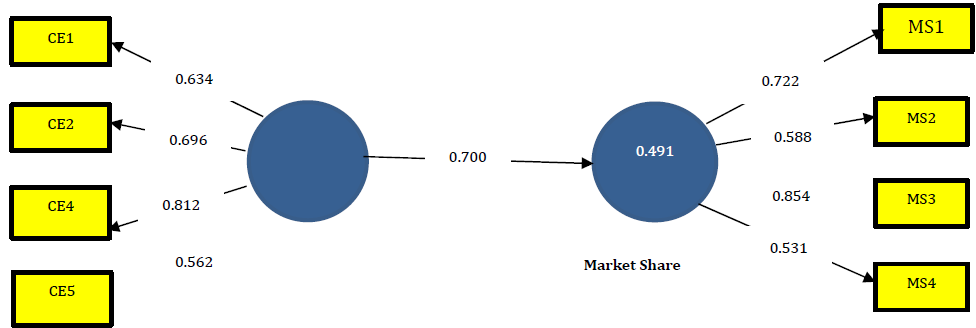
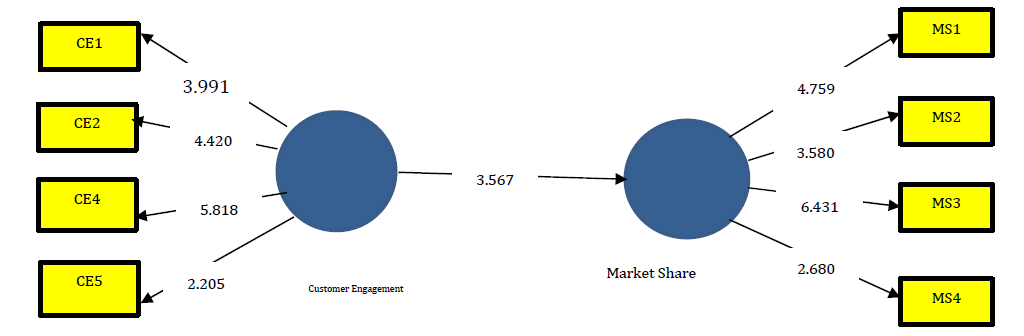
 ) also shows that a unit change in customer engagement will result in 0.70 changes in market share. To ascertain if this interaction is statistically significant, a tests of significance for all paths were performed on the basis of 200 bootstrapping runs. The result in displayed in diagram 2 shows that the factor loadings of the two latent variables, the R2 and the path coefficient all have t statistic value were greater than 1.96 with a corresponding P values of less than the 0.05 threshold to suggest that the interaction between customer engagement and market is statistically significant.