The Effectiveness of Green Marketing Communications and Its Impact on Green Consumer Behavior: A Survey Study of the Opinions of a Sample of Citizens in Nineveh Governorate
Mohammad Mahmood AL-Mulla Hasan
1
1
Assistant Professor, Department of Marketing Management, College of Administration and Economics, University of Mosul, Mosul, Iraq
This research aims to provide a clear concept of green marketing communications and its role in green consumer behavior based on the opinions of a sample of citizens in Nineveh Governorate. The importance of the research lies in focusing on green consumer behavior as a basic element in competitive markets, which enables organizations to outperform their competitors in a highly competitive environment. The current research relied on testing green marketing communications as an independent variable and green consumer behavior as a dependent variable within an analytical field framework to identify the nature of the relationship between the research variables. Based on this, the researcher formulated a number of main hypotheses, which were tested using a set of analytical statistical methods. (374) citizens in Nineveh Governorate were surveyed using a form valid for statistical analysis. The research reached a set of conclusions, the most prominent of which are: Green marketing communications lead to enhancing the consumer's perception that the product provides added value, not only functionally but also ethically and environmentally. Among the important proposals reached by the research: The most effective marketing channels must be identified and used to reach consumers in Nineveh Governorate and influence them regarding green products.
Keywords
Green Marketing Communications
Green Consumer Behavior
Nineveh
INTRODUCTION
In recent decades, the world has witnessed a rapid shift towards adopting sustainability concepts across various fields, particularly in marketing. New trends have emerged aimed at enhancing environmental awareness and shifting consumer behavior toward more sustainable choices. In this context, green marketing communications have emerged as a strategic tool used by organizations to convey marketing messages that highlight their environmental commitment and contribute to building a positive public image. Green marketing communications are the means by which organizations highlight environmental values within their marketing operations, making the environment an integral part of their organizational identity. Furthermore, green consumer behavior represents an advanced pattern of consumer behavior characterized by the selection of products and services that take environmental conservation into account and reduce pollution and waste. Based on the above, the current research presents the impact of green marketing communications on green consumer behavior. This is addressed through three sections. The first section covers the research methodology. The second section presents the theoretical aspect of the research, which includes green marketing communications and green consumer behavior. The third section covers the fieldwork, along with the most important conclusions and proposals presented.
RESEARCH METHODOLOGY
The Research Problem
The current era has witnessed a significant increase in environmental awareness among individuals and organizations alike, giving rise to the concept of "green consumption," which reflects consumers' preference for environmentally friendly products and services. In this context, "green marketing communications" has emerged as a vital tool through which organizations seek to highlight their positive environmental characteristics and influence consumer decisions, Despite the growing importance of green marketing communications, there is still a need for a deeper understanding of their effectiveness in influencing green consumer behavior, especially in specific cultural and social contexts. Nineveh Governorate in Iraq is a unique environment influenced by economic, social and political factors that may shape consumers' perceptions and responses to green marketing messages.
Accordingly, there is a need for an in-depth survey study targeting the opinions of a sample of citizens in Nineveh Governorate to understand the nature of the relationship between green marketing communications and various dimensions of green consumer behavior, including environmental awareness, attitudes toward green products, purchase intention and actual purchase behavior. The study also seeks to identify the factors that may enhance or hinder the effectiveness of these communications in influencing consumers in this local context. Understanding this dynamic will provide companies and organizations operating in Nineveh Governorate with valuable insights into how to design and implement more effective green marketing communications strategies that align with the characteristics and preferences of local consumers and contribute to promoting the adoption of sustainable consumption practices in the region.
In light of the above, the current research problem can be formulated with the following question:
Is there a correlation and influence between green marketing communications and green consumer behavior?
The Importance and Objectives of the Research
This study derives its importance from several theoretical and applied aspects that contribute to enriching knowledge and providing practical benefits to stakeholders in Nineveh Governorate and beyond. The importance of the research is evident in the following.
Theoretical Significance
Bridging the knowledge gap: This research contributes to bridging an existing knowledge gap in the literature related to green marketing communications and their impact on green consumer behavior in the context of the Middle East in general and Iraq and Nineveh Governorate in particular. Studies addressing this topic in this region are still limited. Furthermore, it enriches the academic literature by presenting empirical findings on the effectiveness of green marketing communications in a unique cultural, social and economic environment, adding value to the academic literature in the fields of green marketing and consumer behavior. The research findings may contribute to the development or modification of existing theoretical models that explain the relationship between green marketing communications and green consumer behavior, taking into account the contextual characteristics of Nineveh Governorate.
Practical Significance
Guidance for companies and organizations: The research provides valuable insights for companies and organizations operating in Nineveh Governorate on how to design and implement more effective green marketing communications strategies that are more appropriate to the characteristics and preferences of local consumers
Improving the effectiveness of marketing campaigns: The study results help marketers understand the types of green marketing messages that most influence consumers in Nineveh, enabling them to improve the effectiveness of their marketing campaigns and increase the adoption of green products and services
Providing data for decision-makers: The study results provide important data and indicators for decision-makers and government agencies in Nineveh Governorate to understand consumer attitudes toward environmental issues and the impact of marketing communications in this context, helping them make informed decisions regarding environmental and development policies
Possibility of expansion in future studies: The results of this research can be a starting point for more in-depth future studies that address other aspects of the relationship between green marketing communications and consumer behavior in other geographical and cultural contexts in Iraq
The Objectives of the Research
The research objectives can be defined by focusing on the relationship between the effectiveness of green marketing communications and green consumer behavior, highlighting the theoretical and applied dimensions of this relationship. The primary goal is to understand how green marketing communications influence the purchasing behavior of green customers, which goes beyond mere purchase to the recommendation of green products. The research also aims to build a comprehensive theoretical model that links these concepts, helping to provide a deeper and more integrated understanding of this relationship. Finally, it seeks to provide practical recommendations that customers can implement to improve their green purchasing experience. In this way, the research objectives focus on bridging theoretical gaps and providing practical solutions that contribute to the development of scientific knowledge and achieve tangible benefits in the field of marketing.
The Hypothetical Research Model and its Hypotheses
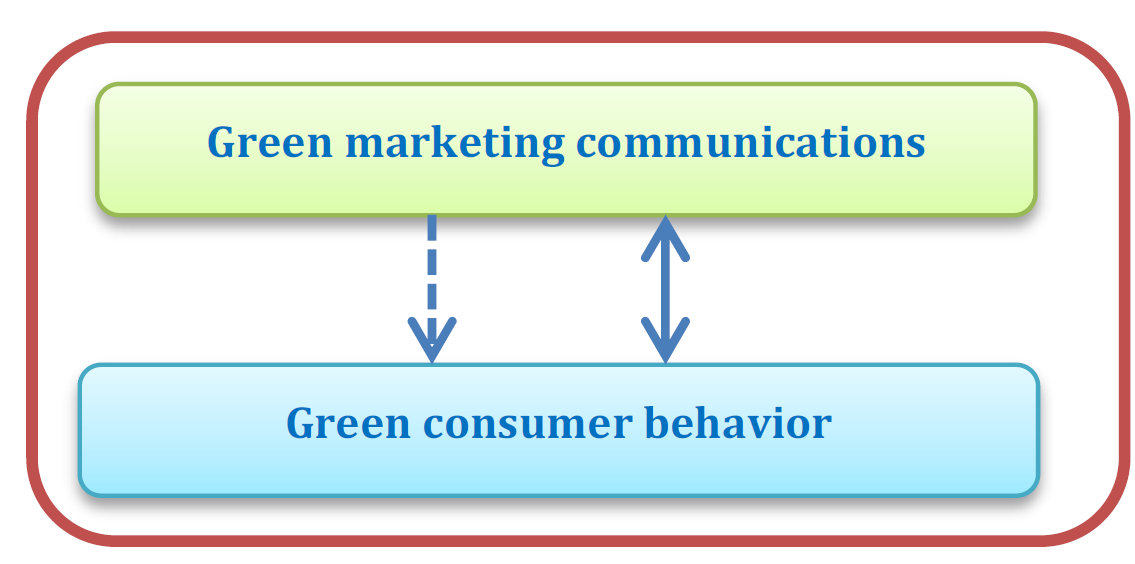
Based on the research problem and its importance to achieve its objectives, we adopted a model that expresses the assumed relationship between the research variables, the pharmaceutical marketing mix and pharmaceutical purchasing decisions as a hypothetical model that can be adopted to verify the research hypotheses as follows in Figure 1.
Figure 1: Default Search Scheme
Source: Prepared by the researcher
Therefore, the research adopted the following hypotheses:
Hypothesis 1: There is no correlation between green marketing communications and green consumer behavior
Hypothesis 2: There is no significant relationship between green marketing communications and green consumer behavior
The researcher adopted a descriptive and analytical approach in his current research to achieve the research objectives, answer its questions and test its hypotheses through the two research axes: theoretical construction and fieldwork, enabling consistency between these two components in research and analysis.
Research Limits
The main limits of the research revolved around the following:
Cognitive Limits: Our research addressed all aspects of green marketing communications and green consumer behavior
Spatial Limits: The research was conducted in the city of Mosul
Human Limits: In our research, we relied on a survey of a sample of citizens in Nineveh Governorate, whose number reached 374
Methods of Collecting Data and Information
We relied on several methods to collect data and information, both primary and secondary, to complete the current research, both theoretical and field-based. Secondary data, drawn from sources related to the research variables, were the primary basis for establishing the theoretical frameworks of the research, including books, periodicals, theses and dissertations, in addition to scientifically validated sources on the Internet. The field aspect of the research focused on the primary data collected through the questionnaire, as well as the interviews conducted by the researchers with the research individuals to whom the questionnaire was distributed. The sources of the questionnaire items were represented by the demographic variables of the research individuals, as well as by the brand experience items, which were measured by (10) items (X1-X10). Green consumer behavior was the third part of the questionnaire, as it was measured The study also included (10) paragraphs (Y1-Y10) and the five-point Likert scale was used to set limits for the answers of the researched individuals to the questions raised in the questionnaire form, which were (strongly disagree, disagree, neutral, agree, strongly disagree) with weights (5, 4, 3, 2, 1) respectively and with a hypothetical arithmetic mean of (3). The number of distributed questionnaires amounted to (374) questionnaire forms.
Theoretical Review
Green Marketing Communications: Green marketing communications is a marketing approach that focuses on promoting environmental values and sustainability in all communications messages and activities with customers and consumers. This strategy aims to build a positive image of a company as environmentally responsible and demonstrate its commitment to protecting the environment through its business practices. This approach goes beyond traditional advertising and promotion to encompass all communication channels between a company and its customers, including public relations, promotional campaigns, social media engagement and even product and packaging design, Green marketing communications is defined as a set of activities designed to convey marketing messages that emphasize the importance of environmental values and encourage consumers to choose products or services that contribute to reducing their environmental impact. These messages often include environmental benefits, such as using recyclable materials, reducing carbon emissions, or supporting sustainable communities [1].
What distinguishes green marketing communications from traditional marketing communications is its direct focus on the environmental dimension, while seeking to raise public awareness about environmental issues. This approach aims not only to improve sales but also to build long-term relationships with customers based on trust and credibility. Therefore, green marketing communications contribute to achieving a company's goals while taking into account its impact on the environment, making it an essential part of sustainable development strategies [2], Green marketing communications can be considered an effective means of influencing consumer behavior, as it enhances their sense of environmental responsibility and encourages them to support companies that share their values. With consumers' growing concern for environmental issues, companies are compelled to adopt green communication strategies not only to improve their image but also to ensure their survival in a market where demand for sustainability is growing [3], Green marketing communications is an integrated strategy used by companies to communicate with their customers through marketing messages that reflect their commitment to protecting the environment and promoting sustainability. This type of communication highlights the company's positive environmental practices, such as using eco-friendly materials, reducing carbon emissions, relying on renewable energy, or supporting environmental causes through social responsibility activities [4], Green marketing communications are not just a promotional tool; they are a strategic element that contributes to building a strong relationship with customers and society. When a company announces its environmental initiatives, it creates an emotional response with consumers who prefer to support companies that care about the environment. Furthermore, these communications are considered a means of creating additional value for products, as consumers are often willing to pay more for environmentally friendly products. Therefore, green marketing communications focus on [5]:
Focus on sustainability: Green marketing messages revolve around promoting sustainable practices, such as reducing resource consumption, recycling and conserving energy
Transparency and credibility: Messages must be clear and honest to avoid accusations of "greenwashing," a situation in which companies claim false environmental practices
Use of green language and environmental symbols: Relying on words such as "natural," "recyclable," "organic," and "eco-friendly," in addition to using symbols such as leaves or the globe
Integrated communication: It is not limited to advertising only, but includes public relations, social media, community events and even product packaging design
Green marketing communications play a strategic role in achieving companies' long-term goals, whether at the level of brand building or enhancing customer relationships. Given the growing environmental challenges, adopting this approach has become a necessity for companies seeking to align with market and societal trends toward sustainability. The importance of green marketing communications can be highlighted as follows [6]:
Enhancing brand image: Green marketing communications is an effective means of building a positive corporate image. When a company highlights its commitment to environmental practices and social responsibility, it appears as a reliable partner that seeks to balance profit and environmental protection. Companies that adopt a green approach are viewed as innovative and responsible and customers feel more confident in brands that demonstrate concern for environmental issues [3]
Increasing market competitiveness: With the growing demand for sustainable products and services, green marketing communications has become a tool for differentiation in a crowded market. Customers, especially younger generations such as millennials and Generation Z, prefer to engage with companies that reflect their ethical and environmental values. Products and services that promote sustainability often command higher prices due to the added value they offer. Green communications help companies reach new environmentally conscious markets [7]
Influencing consumer behavior: Green marketing communications play an important role in changing consumer behavior and encouraging them to make environmentally friendly choices. By highlighting the benefits of green products, companies can guide customers toward sustainable purchasing decisions. Green promotional campaigns encourage consumers to reduce waste, recycle and choose products with a low environmental impact. Strategies based on environmental values enhance long-term customer loyalty [8]
Contributing to sustainable development: Green marketing communications are a key tool for achieving sustainable development, as they contribute to balancing economic, environmental and social goals. By promoting green practices, companies also encourage customers to participate in building a sustainable future [9]
Achieving compliance with environmental legislation: In many countries, compliance with environmental laws and regulations has become essential. Green marketing communications help companies comply with these regulations by effectively promoting their environmental practices [10]
Strengthening Relationships with Stakeholders: Green marketing communications strengthen the relationship between the company and various stakeholders, including customers, investors, regulators and the local community [11]
Reducing the risk of accusations of "greenwashing": Greenwashing is an accusation faced by companies that claim to have environmental practices without actually implementing them. Green marketing communications help companies craft transparent and credible messages that reflect their true commitment to sustainability [12]
Supporting innovation and development: Green marketing communications encourage companies to seek innovative ways to develop environmentally friendly products and services by stimulating investment in new technologies such as renewable energy and biodegradable materials and by promoting innovation in product design to make them more efficient and less impactful on the environment [13]
Creating a positive impact on the environment: The primary goal of green marketing communications is to reduce companies' environmental impact and promote sustainable practices. By promoting these values, companies directly contribute to reducing pollution and conserving natural resources [14]
Motivating employees and improving company culture: Green marketing communications impact not only customers but also employees within the company
Green marketing communications seek to achieve a set of strategic objectives that benefit companies, society and the environment. These objectives go beyond promoting products to building a sustainable relationship between the brand and customers and achieving harmony between profits and environmental protection. In this context, the main objectives of green marketing communications can be summarized as follows [15]:
Promoting environmental awareness: Green marketing communications aim to increase consumer awareness about sustainability and environmental protection issues and the positive impact of environmental products or services on the planet [16]
Enhancing transparency and credibility: Building a strong reputation by disseminating accurate and clear information about a company's environmental practices and the green products it offers, which enhances customer confidence in the brand [13]
Stimulating sustainable consumer behavior: Encouraging customers to make environmentally friendly purchasing decisions by highlighting the benefits of sustainable products or services that contribute to reducing the environmental impact [17]
Creating a positive brand impression: Associating a brand with environmental values and its commitment to sustainable development can contribute to improving the company's image and attracting customers who prefer environmentally friendly options [18]
Strengthening relationships with environmentally conscious customers: Building a close relationship with customers who care about sustainability, increasing their loyalty and engagement with the brand [19]
Achieving market differentiation: Differentiating from competitors by offering environmentally friendly products and services that stand out in markets where environmental values are increasingly important [20]
Supporting environmental innovation: Highlighting the company's efforts to develop green products and innovations that meet customer needs while minimizing environmental impact [21]
Achieving compliance with environmental standards: Working to ensure the company's adherence to the highest environmental standards and local and international legislation and communicating with customers about its commitment to these standards, which enhances the company's reputation
Stimulating innovation in the field of sustainability: Encouraging innovation in developing new environmental solutions that can contribute to reducing environmental impact, which helps build a strong brand image as a leader in the field of sustainability [10]
Supporting the circular economy: Encouraging customers to purchase recyclable products or products made from recycled materials, which supports the concept of the circular economy and enhances engagement with the brand through these practices [22]
Reducing the environmental impact of marketing activities: Identifying ways to reduce the environmental impact of marketing campaigns themselves, such as using digital media instead of printed materials or reducing emissions from marketing events
Encouraging responsible consumption: Highlighting the importance of balancing consumption and protecting natural resources, which reinforces the brand's commitment to providing responsible choices to consumers [23]
Enhancing cooperation with environmental Partners: Building strategic partnerships with environmental organizations or other companies focused on sustainability contributes to strengthening the brand's market position and increasing its influence [24]
Promoting environmental education for consumers: Implementing educational awareness campaigns for consumers on how to choose sustainable products and the impact of these choices on the environment, by providing information and educational content [25]
Investing in environmental projects: Supporting and sponsoring projects that focus on environmental conservation, afforestation and renewable energy, which contributes to improving the company's image and increasing engagement with customers who appreciate these initiatives [26]
Strengthening the company's relationship with the local community: Encouraging local communities to participate in environmental activities, such as clean-up campaigns or sustainable agriculture, strengthens relationships with the local community and increases brand support [27]
Green marketing communications strategies are key tools for effectively delivering environmental messages that enhance a company's image and drive consumer behavior toward more sustainable practices. The importance of these strategies lies in their ability to transform environmental practices into competitive advantages and attract more sustainability-minded customers. Green marketing communications strategies vary depending on the company's goals and the interests of its customers. By employing these diverse strategies, companies can effectively and innovatively promote their environmental messages, helping them stand out in the market, increasing customer awareness of environmental issues and motivating more sustainable behaviors. The following are some of the most prominent green marketing communications strategies [28]:
Environmental content marketing: Environmental content marketing involves the use of articles, blogs, videos and infographics that focus on environmental issues and showcase the company's environmental initiatives. This strategy aims to raise environmental awareness and provide customers with practical information on how to reduce the environmental impact in their daily lives [29]
Social media marketing: Social media is a powerful tool for direct customer engagement and communicating environmental messages. This strategy enhances immediate customer engagement, raises awareness about environmental practices and strengthens the brand's green image [30]
Relying on environmental certifications and accreditations: Using environmental certifications such as "organic product," "eco-friendly," or "recyclable" as marketing tools can enhance the credibility of green marketing communications messages. This strategy seeks to foster trust and transparency with customers by offering officially recognized environmental certifications, allowing consumers to verify the validity of a company's environmental claims [31]
Targeted environmental advertising: Marketing through targeted environmental advertising allows companies to showcase their green products or environmental initiatives across media channels such as television, newspapers and digital advertising. The objectives of this strategy are to disseminate specific environmental messages that reach a target audience concerned with environmental issues [21]
Experiential marketing: This strategy involves providing customers with live experiences to try products or services that promote sustainability and contribute to environmental protection. This strategy aims to enhance consumers' understanding of the benefits of environmentally friendly products, facilitating purchasing decisions [11]
Marketing through environmental partnerships: Working with environmental partners, non-profit organizations, or government agencies to promote environmental messages and engage with customers. This strategy attempts to demonstrate a company's commitment to environmental issues by collaborating with recognized entities in the field of sustainability [15]
Marketing through environmental influencers: Using social media influencers who have a strong influence on followers through their support of green products and services. This strategy seeks to reach a broad and engaged audience that follows influencers who promote environmental values [13]
Marketing based on environmental values and principles: This strategy involves integrating environmental values into the core of marketing messages, demonstrating a company's genuine commitment to green practices. This strategy aims to build a deep and sustainable relationship with customers through values consistent with environmental issues [15]
Marketing through stories: Using impactful environmental stories to communicate with customers about how the company has adopted green practices or how its products have helped bring about positive environmental change. This strategy attempts to capture customers' emotional attention and strengthen personal connections between consumers and the brand [18]
Marketing through interactive applications: Using specialized applications that encourage consumers to participate in environmental activities and continue using eco-friendly products. This strategy aims to engage directly with consumers and reward them for their environmental choices [3]
Green marketing communications is a strategic tool for companies seeking to enhance their brand image and promote sustainability practices. To achieve this, a set of key elements contribute to building an effective green marketing strategy. These elements include messages, channels, target audiences and environmental content, with an emphasis on transparency and honesty in communication. Together, the elements of green marketing communications form a powerful marketing strategy that enhances brand equity by delivering a clear, transparent and motivating environmental message. It requires coordination between environmental messages, channels, audiences and content, while ensuring the company's credibility and authenticity in offering green products and services. The following are the most important elements of green marketing communications [16]:
Environmental messages: Environmental messages are the core of any green marketing campaign, communicating the environmental values the company wants to spread among its audience. The goal of environmental messages is to deliver clear and convincing messages about sustainability, reducing environmental impact and demonstrating how the company contributes to solving environmental issues. Messages must be honest and realistic about the impact of products on the environment, while avoiding misleading claims. Messages include highlighting how products are designed with recyclable materials or how services contribute to reducing carbon emissions [7]
Media channels: Media channels are a vital part of communicating environmental messages to the target audience. A variety of channels can be used to reach the largest number of people. Choosing the most appropriate channels that ensure maximum engagement with the target audience and effective message delivery is an important goal. Media channels include two main categories: traditional channels, which include television, radio, newspapers and magazines. These channels can help reach broad audiences and digital channels, which include social media, websites, email and apps. These channels provide interactive capabilities that enable customers to participate in environmental activities and awareness campaigns [7]
Target audience: Understanding the target audience is one of the most important elements contributing to the success of green marketing communications. It requires identifying groups that care about environmental issues and want to contribute to environmental conservation. The goal of identifying target audiences is to target people who have positive attitudes toward the environment and feel responsible for preserving it. Audience types include consumers who care about sustainability, other businesses, or even non-profit environmental groups. Appropriate messages and resources should be identified that meet the needs and expectations of each target audience group
Environmental content: This element involves creating content that reflects the company's environmental values and enhances the brand's image as an environmentally responsible brand. This content may take the form of videos, articles, infographics, or promotional materials. The goal of environmental content is to raise awareness among the public and motivate them to participate in environmental activities and purchase green products. Organizations should work to organize awareness-raising content that explains how to recycle, conserve energy, or how products impact the environment. They should also organize motivational content that includes success stories or real-life experiences of customers who have benefited from eco-friendly products [1]
Audience engagement: Audience engagement is an essential component of building lasting relationships with customers and enhancing their loyalty. This requires opening channels of communication with customers, listening to their feedback and building long-term relationships based on transparency and credibility. This can be achieved by creating interactive campaigns on social media, such as environmental challenges or surveys to obtain customer opinions about the company's environmental practices and by maintaining continuous communication through prompt and effective responses to customer questions and inquiries. Companies demonstrate their commitment to effective and continuous communication
Credibility and transparency: Credibility and transparency are vital factors that ensure the success of any green marketing campaign. Companies promoting environmental practices must be honest and clear in their communication with the public. The goal of credibility and transparency is to confirm the credibility of the marketing campaign and increase trust between the company and customers. This is achieved by providing details about how the products are manufactured, their environmental impact and any environmental certifications they have obtained. It is important to support environmental messages with internationally recognized certifications, such as ISO 14001 or the "Organic Products" certification [15]
Marketing through partnerships: Partnerships with NGOs, environmental organizations, or even other companies can be an important element in promoting green marketing communications. The goal is to enhance the company's credibility by collaborating with recognized external entities in the field of sustainability. Types of partnerships can include joint awareness campaigns or support for environmental projects, such as collaborating with environmental organizations to organize awareness events or campaigns [18]
Innovation and technology: Modern technology offers innovative ways to increase the effectiveness of green marketing campaigns. By utilizing data analytics and artificial intelligence tools, marketing strategies can be significantly improved, leveraging technology to improve audience reach and personalize environmental messages. This is achieved through the use of technologies such as Augmented Reality (AR) to interactively showcase green products, or the use of big data to better understand customer behavior [21]
Green Consumer Behavior
Green consumer behavior refers to purchasing and consumption decisions that align with the principles of environmental sustainability. It involves choosing products and services that reduce environmental impact, such as recyclable, environmentally friendly products and those produced using sustainable practices. Green consumer behavior is also defined as the behavioral pattern individuals adopt when making consumer decisions, focusing on reducing the environmental impact of their consumption. This behavior involves choosing products and services produced in environmentally friendly and sustainable ways and avoiding those that harm natural resources or cause environmental pollution. This behavior reflects consumers' awareness of their responsibility toward the environment and their efforts to support sustainability [32]. Green consumer behavior expresses a consumer orientation characterized by environmental awareness and responsibility toward the planet. This behavior manifests in everyday consumer choices aimed at reducing negative environmental impact, whether through purchasing environmentally friendly products, reducing resource consumption, or reusing materials instead of discarding them. This concept relates to making informed purchasing decisions based on environmental values and beliefs, such as preferring recyclable products or those made from natural and sustainable materials. Green consumer behavior also reflects a commitment to supporting companies that adopt environmentally friendly production practices and reduce carbon emissions [33].
Green consumer behavior goes beyond simply purchasing environmentally friendly products. It also includes educating consumers about the importance of reducing unnecessary consumption and considering the environmental impact of each purchase. This behavior aims to promote environmental awareness and make sustainability an integral part of everyday decisions. Green consumer behavior not only has a positive impact on the environment but can also contribute to stimulating the green economy. By supporting products and companies that adhere to sustainable practices, consumers can drive innovation and encourage more companies to adopt environmentally responsible practices. Green consumer behavior is evident in many everyday practices, such as reducing plastic use, choosing biodegradable products and seeking eco-friendly alternatives in daily life. This behavior promotes a healthy and sustainable lifestyle and reduces one's personal carbon footprint [34].
The importance of green consumer behavior is evident on several levels, as it contributes to improving the environment and promoting sustainable development. Environmentally, this behavior contributes to reducing pollution and conserving natural resources, mitigating the effects of climate change and helping to protect biodiversity. Green consumers reduce the consumption of harmful materials and encourage the use of recyclable or biodegradable products, contributing to waste reduction [35].
Green consumer behavior plays a pivotal role in achieving environmental, social and economic sustainability and is an essential component of global efforts to protect the environment and conserve resources for future generations. Its importance is evident in several key aspects [36-38].
Preserving the environment and reducing environmental impact: Choosing environmentally friendly products and services reduces harmful gas emissions and industrial pollution. Green behavior encourages reduced depletion of resources such as water, energy and minerals and encourages green consumers to recycle and reduce waste that ends up in landfills or marine pollutants
Promoting sustainable development: Green behavior supports a circular economy that focuses on reusing resources rather than consuming them. It helps achieve the United Nations Sustainable Development Goals by promoting responsible consumption, reducing pressure on ecosystems and enabling communities to adapt to environmental changes
Supporting the transition to a green economy: The rising demand for green products encourages companies to adopt sustainable production practices, helps open new markets for innovative environmentally friendly products and services and encourages investment in renewable energy, sustainable transportation and waste management technologies
Improving quality of life: Sustainable consumption practices reduce human exposure to harmful chemicals in food and products and contribute to a cleaner and healthier environment, reducing pollution-related diseases. These practices also promote social sustainability by improving air and water quality and reducing global warming. 5. Encouraging Individual and Social Responsibility: It enhances individuals' awareness that their daily consumption can have a positive or negative impact on the environment. It also contributes to building conscious and sustainable communities that work together to solve environmental problems and fosters a sense of responsibility among consumers toward future generations
Contributing to Combating Climate Change: Green behavior reduces carbon emissions from manufacturing, transportation and energy and supports global efforts to mitigate the effects of climate change by reducing reliance on fossil fuels and the consumption of non-renewable resources
Encouraging Business Innovation and Sustainability: The growing demand for green products drives companies to innovate more efficient and environmentally friendly production methods and it motivates brands to improve transparency and ethical practices in their supply chains
Influencing Government Policies: Green behavior prompts governments to enact laws and regulations that support sustainability and prevent pollution. It also contributes to shaping long-term environmental strategies and policies to achieve national and international environmental goals
Supporting the Local Economy: Green products are often produced locally, which strengthens local economies, reduces transportation footprints and supports small businesses that adopt sustainable practices, increasing economic market diversity
Promoting Innovation and Clean Technology: Interest in green behavior leads to the emergence of innovative technologies to solve environmental problems and stimulates research and development in clean energy and sustainable infrastructure
Green consumer behavior is influenced by multiple factors, ranging from trust in sustainable products to the influence of media, education and personal beliefs. Understanding these factors helps companies and policymakers develop effective strategies to promote sustainable consumption, whether by improving product quality, raising environmental awareness, or making green options more accessible [39].
Trust in environmental products and certifications: Consumers' trust in environmental products influences their purchasing decisions. Some individuals question the credibility of environmental claims made by companies, especially with the spread of "greenwashing," where some brands claim to be sustainable without implementing real environmental practices. Environmental certifications such as "organic product" or "carbon neutral product" can play a key role in enhancing consumer trust and motivating purchases [40]
Convenience and accessibility of sustainable products: Even if consumers are interested in sustainability, they may not be willing to put in the extra effort to find eco-friendly products. The availability of these products in traditional markets and stores and the ease of purchasing them online, significantly contributes to consumers' adoption of green behavior. If a sustainable product is scarce or not readily available, consumers may prefer to purchase conventional alternatives, even if they are not environmentally friendly [39]
Quality and performance of green products: It is not enough for a product to be environmentally sustainable alone; its performance and quality must be comparable to or better than conventional products. Some consumers are reluctant to purchase green products because they believe they are less efficient or durable. For example, some may avoid purchasing environmentally friendly cleaning products if they are not as effective as conventional chemicals, or they may be reluctant to purchase electric cars due to concerns about their performance and driving range [41]
The influence of media and digital marketing: Media and digital marketing campaigns significantly influence consumer decisions. Advertisements promoting the benefits of green products, awareness-raising content on social media and news articles about climate change can encourage consumers to make more sustainable decisions. Additionally, user experiences and online reviews can strengthen or weaken consumers' attitudes toward environmentally friendly products
The influence of societal pressures and collective responsibility: In some social settings, consumers may be subject to peer pressure to adopt environmentally friendly behaviors. For example, if most members of a community use reusable shopping bags or prefer restaurants that reduce plastic use, an individual may feel the need to adapt these habits to avoid being perceived as uncaring for the environment [42]
Consumers' previous experiences with green products: A consumer's previous experience with sustainable products directly influences their future decisions. If their experience was positive, such as using an environmentally effective product or receiving good service from a sustainable brand, they are more likely to continue this behavior. However, if their experience was negative, such as a low-quality or high-priced product with no real benefit, they may hesitate to repeat the purchase [43]
The influence of environmental education and knowledge: The more knowledgeable a consumer is about environmental problems and the importance of their role in reducing them, the more likely they are to adopt more sustainable behavior. Environmental education through schools, universities and the media can enhance this awareness. Furthermore, the availability of clear information about the environmental impact of products can influence purchasing decisions [44]
The factor of moral and religious values: In some cultures and societies, moral and religious beliefs motivate individuals to adopt responsible consumer behaviors. Some religions encourage respect for the environment and reducing waste, which influences the way individuals in those societies consume [45]
The impact of major economic shifts and crises: Economic crises, such as inflation or recession, may prompt consumers to change their purchasing habits, which can negatively or positively impact green behavior. In some cases, consumers may turn to cheaper products regardless of their environmental impact, while in other cases, a crisis may lead to increased interest in sustainability through energy and water conservation and reduced food waste [46]
Consumers face many challenges when trying to adopt green behavior, ranging from economic factors to social and cultural norms. However, these barriers can be overcome by raising awareness, improving pricing policies, developing effective marketing strategies and strengthening the role of governments in supporting sustainability. Achieving sustainable consumption requires a joint effort between individuals, businesses and policymakers to ensure a more sustainable future for all. The following are the most prominent challenges consumers face when trying to adopt green behavior [47]:
High prices of sustainable products: Cost is one of the biggest barriers preventing consumers from purchasing environmentally friendly products. These products are often more expensive than conventional alternatives due to the use of sustainable materials or more complex production processes. This high price makes low-income consumers less able to adopt green behavior, reducing the spread of these products in the market [48]
Lack of environmental awareness and knowledge: There is still a lack of awareness among some consumers about the importance of environmentally friendly products and how their purchasing decisions impact the environment. Some individuals are unaware of the true benefits of sustainable products or do not realize that their daily choices can contribute to reducing environmental pollution. Information about green products may also be complex or unclear, making consumers less motivated to choose them [41]
Doubt about the credibility of environmentally friendly products: The spread of the phenomenon of "greenwashing," where some companies claim to be sustainable without implementing real environmental practices, has led to some consumers losing confidence in green products. This manipulation makes it difficult for consumers to distinguish between truly environmentally friendly products and those that merely use sustainability as a marketing tool, reducing the adoption of green behavior [49]
Lack of availability of green products in the market: In some areas, sustainable products may be difficult to easily find, leading consumers to purchase available conventional alternatives. The lack of distribution and the unavailability of environmentally friendly options in traditional stores makes the purchasing process uncomfortable, especially when consumers are forced to search for specialized stores or resort to ordering online [50]
The impact of entrenched consumer habits: Consumers face difficulty changing their consumption habits, especially if they are accustomed to certain products or unsustainable consumption methods. For example, some may find it difficult to stop using plastic bags or purchasing products with traditional packaging due to familiarity and a lack of urgency to change [51]
Convenience and ease of use: Sometimes, a conventional option is more convenient than a green option. For example, consumers may find that electric cars require more charging than conventional fuel-powered cars, or that biodegradable products require special storage conditions. These factors lead some consumers to prefer conventional products for their ease of use [52]
Lack of government incentives and supportive legislation: In many countries, government policies remain insufficient to support the adoption of green behavior. The lack of incentives such as tax rebates or financial support for environmentally friendly products can be a reason for some consumers' inability to adopt this behavior. The lack of strict laws that force companies to reduce their environmental impact also contributes to the continued production of environmentally harmful products [53]
Social Influence and Group Pressure: In some societies, environmental behavior may be viewed as unnecessary or unimportant, making consumers reluctant to adopt it. If an individual's social environment doesn't support green choices, it may be difficult for them to change their consumer behavior on their own without group support [54]
Lack of Promotion and Marketing of Sustainable Products: Some companies still don't pay enough attention to marketing green products, making them unknown to many consumers. Weak promotion can lead to people being less aware of sustainable alternatives, leading them to continue purchasing conventional products without considering other available options [55]
Infrastructure and Recycling Challenges: Even if consumers are willing to adopt green behavior, they may find themselves frustrated by the weak infrastructure to support sustainability. For example, some cities may lack advanced recycling systems, making it difficult to dispose of waste in an environmentally friendly manner. Also, some green products may require special recycling that is not easily available [56]
Describing the Research Variables, Diagnosing them and Testing its Hypotheses
This axis will include three paragraphs:
Description of the individuals studied: It can be said based on the data in Table 1 that the individuals being studied are mature, because the individuals, whether males whose numbers reached (210) individuals, are considered to be in the prime of their lives, as most of them are in the middle age groups, between (less than 21-40 years), with some exceptions that reached (20.5%) for those above these ages. On the other hand, the overwhelming percentage with regard to the educational level of the individuals being studied was among those with a bachelor’s degree, as their percentage constituted (78.9%)
Table 1: Description of the Individuals Surveyed
Sex
Male
Female
Number
%
Number
%
210
56.1
164
43.9
Certificate (scientific qualification)
Preparatory school and below
Bachelor's
Higher degree
Number
%
Number
%
Number
%
38
10.2
295
78.9
41
10.9
Age
20-30
31-40
41-50
50 and more
Number
%
Number
%
Number
%
Number
%
146
39.1
151
40.4
52
13.9
50
6.6
Source: Prepared by the researcher based on the questionnaire form
Respondents' attitudes and opinions regarding the research dimension indicators: Respondents' attitudes and opinions regarding the various items contained in the questionnaire form are explained as follows:
Their attitudes toward green marketing communications indicators: Table 2 reflects the frequencies, arithmetic means and standard deviations for all indicators in this dimension. It also reflects the average of these means and the average of these deviations, which amounted to (3.662) and (0.933), respectively. The high values of these two indicators, or their high values in general, indicate the extent to which this relates to each of the relevant indicators, particularly indicator (X2), which states, "Marketing communications that are environmentally oriented affect my future purchasing behavior." The level of agreement on this indicator reached 78.1%, while disagreement on this indicator was 6.4% and the percentage of neutrality was 15.5%. All of this came with an arithmetic mean of 3.871 and a standard deviation of 0.834. The aforementioned indicators were met with agreement from all respondents
Table 2: Respondents' Positions on Green Marketing Communications Indicators
Paragraph
I strongly disagree
I do not agree
Neutral
I agree
Strongly agree
Mean
S.D
Variables
N
%
N
%
N
%
N
%
N
%
X1
15
4
31
8.3
110
29.4
168
44.9
50
13.4
3.553
0.96
X2
9
2.4
15
4
58
15.5
225
60.2
67
17.9
3.871
0.834
X3
18
4.8
43
11.5
117
31.3
151
40.4
45
12
3.433
1.003
X4
10
2.7
34
9.1
88
23.5
184
49.2
58
15.5
3.657
0.938
X5
8
2.1
39
10.4
71
19
180
48.1
76
20.3
3.74
0.968
X6
8
2.1
21
5.6
76
20.3
201
53.7
68
18.2
3.802
0.874
X7
8
2.1
31
8.3
87
23.3
198
52.9
50
13.4
3.671
0.885
X8
11
2.9
40
10.7
72
19.3
182
48.7
69
18.4
3.689
0.987
X9
10
2.7
22
5.9
102
27.3
179
47.9
61
16.3
3.692
0.905
X10
12
3.2
42
11.2
115
30.7
150
40.1
55
14.7
3.518
0.981
General Average
11.4
23.96
64.62
3.662
0.933
The source was prepared by the researcher based on SPSS
Their attitudes towards indicators of green consumer behavior: Just as the previous table included a set of rates and standard deviations, Table 3 also included similar ones, but this time they pertain to green consumer behavior. It is evident from examining these rates that there is general satisfaction or agreement among those surveyed regarding the indicators of this variable as well, which amounted to (3.904) and (0.837), respectively. The high values of these two indicators, or their high values in general, indicate the extent to which this relates to each of the relevant indicators, particularly indicator (X15), which states that "a customer is happy to make a purchase with the goal of preserving the environment." The level of agreement on this indicator reached (91.2), while disagreement on this indicator was (1.1) and the neutrality rate was (7.8). All of this came with an arithmetic mean of (4.382) and a standard deviation of (0.721). The aforementioned indicators were met with agreement from all respondents
Table 3: Respondents' Positions and Opinions on Green Consumer Behavior Indicators
Paragraph
I strongly disagree
I do not agree
Neutral
I agree
Strongly agree
Mean
S.D
Variables
N
%
N
%
N
%
N
%
N
%
Y1
8
2.1
22
5.9
89
23.8
204
54.5
51
13.6
3.716
0.85
Y2
6
1.6
19
5.1
53
14.2
215
57.5
81
21.7
3.925
0.837
Y3
6
1.6
21
5.6
72
19.3
180
48.1
95
25.4
3.901
0.898
Y4
4
1.1
16
4.3
66
17.6
202
54
86
23
3.935
0.819
Y5
4
1.1
0
0
29
7.8
157
42
184
49.2
4.382
0.721
Y6
6
1.6
4
1.1
66
17.6
206
55.1
92
24.6
4
0.781
Y7
6
1.6
11
2.9
81
21.7
183
48.9
93
24.9
3.925
0.85
Y8
5
1.3
21
5.6
96
25.7
184
49.2
68
18.2
3.772
0.856
Y9
6
1.6
4
1.1
45
12
193
51.6
126
33.7
4.147
0.92
Y10
3
0.8
25
6.7
113
30.2
173
46.3
60
16
3.7
0.845
General Average
5.27
18.99
75.75
3.904
0.837
The source was prepared by the researcher based on SPSS
Testing the research hypotheses
The first hypothesis: Which states (there is no correlation between green marketing communications and green consumer behavior)
To identify the nature of the correlation between green marketing communications and green consumer behavior, the data in Table 4 indicate the presence of a significant positive correlation between the two dimensions, as the total correlation coefficient reached (0.624) at a significance level of (0.05).
Table 4: Correlation coefficient between green marketing communications and green consumer behavior
Correlations
Green Consumer Behavior
Green Marketing Communications
Pearson Correlation
0.624**
P-Value
0
N
374
The second hypothesis: Which states (there is no significant relationship between green marketing communications and green consumer behavior)
This paragraph will focus on the nature of the significant relationships included in the research model, as follows.
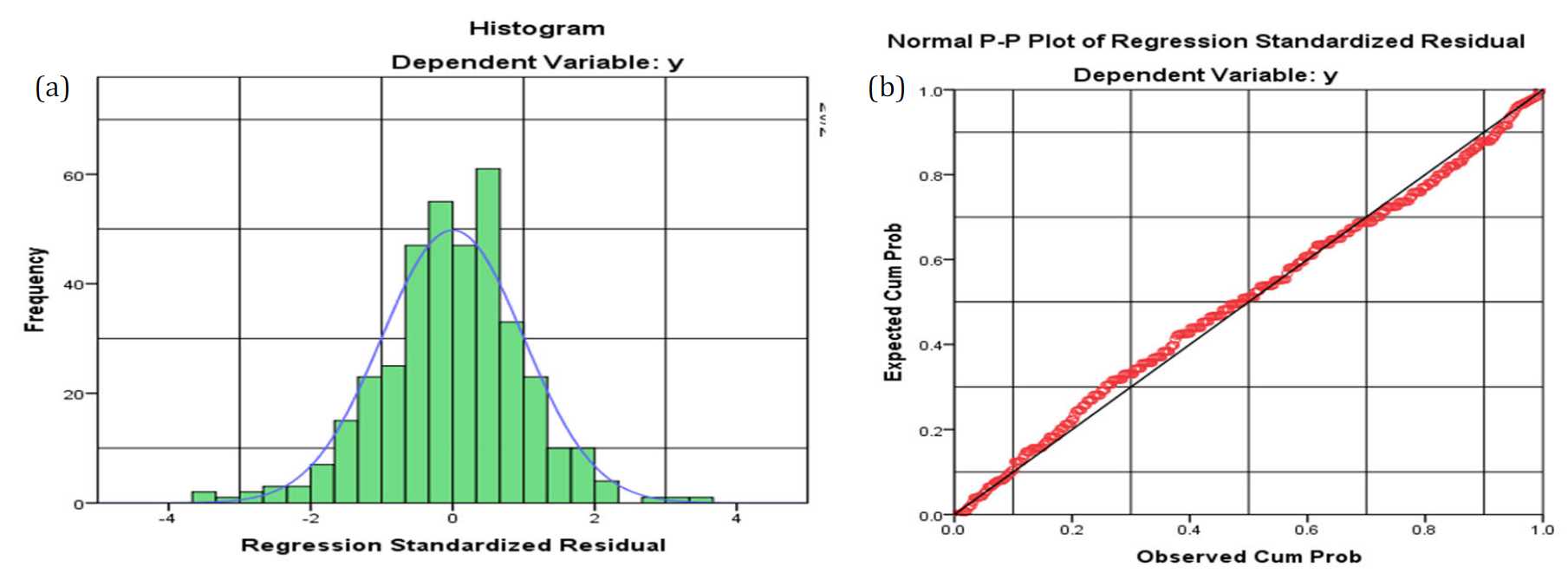
Table 5 of the regression analysis results shows that there is a significant impact of the green marketing communications variable as an independent variable on green consumer behavior, considering it as a dependent variable. The calculated F value reached (236.703), which is greater than its tabular value of (3.84) at two degrees of freedom (1.372) and a significance level of (0.05). The value of the coefficient of determination (R2) reached (39.2%). This means that the explained differences in the green marketing communications variable are explained by green consumer behavior and this is due to the effect of the dimensions of green marketing communications combined and the remainder is due to random variables that cannot be controlled or are not included in the regression model at all. By following up the value of the coefficient β1, which is (0.569) and testing it (T), it was found that the calculated value of (T) reached (16.372), which is a significant value and greater than its table value, which is (1.645) at a significance level of (0.05) and two degrees of freedom (1.372). This result indicates that improving the green marketing communications variable as an independent variable in green consumer behavior by considering it a dependent variable. Figure 2 indicates that the data is distributed normally.
Figure 2(a-b): Data distribution in a normal distribution relative to the green marketing communications variable in green consumer behavior
Table 5: The significant relationship between green marketing communications and green consumer behavior
p-value
F
R2
Confidence Interval
Std. Error
Estimate
Dependent variable
Direction of the relationship
Dependent variable
95%
0
268.042
39.2
2.124
1.585
0.137
1.855
Green consumer behavior
→
Green marketing communications
0.642
0.497
0.037
0.569
Source: Prepared by the researcher based on the results of the statistical program SPSS
CONCLUSION AND SUGGESTIONS
Conclusions
The study emphasizes the theoretical importance of green marketing communications as an effective tool in shaping and promoting green consumer behavior in a local context such as Nineveh Governorate
The more credible and transparent green marketing messages are, the greater the trust green consumers will have, and consequently, the higher the purchasing response to green products
Green marketing communications may provoke a sense of cognitive dissonance among consumers who do not behave environmentally, prompting them to adjust their behavior to align with their environmental values or the brand's promotion
Green marketing communications enhance the consumer's perception that the product offers added value, not only functionally but also ethically and environmentally
Green consumers make their decisions based on a value system that includes environmental responsibility, ethics, and the protection of natural resources, which is reflected in their preference for eco-friendly products
Green consumers are influenced by personal motivations, such as the desire to reduce their environmental impact, and social motivations, such as the search for recognition or belonging to a group that shares similar environmental values
The results of the description and diagnosis of the research variables showed a positive agreement by the research individuals regarding the research variables, which confirms the importance of the research variables by the research individuals
Suggestions
Companies and organizations operating in Nineveh should focus on building environmental awareness among consumers through clear and consistent marketing communications campaigns
It is important to periodically evaluate the results of green marketing communications through tools such as surveys or sales data analysis
Companies should focus on delivering credible and transparent green marketing messages to avoid consumer skepticism and build trust
The most effective marketing channels should be identified and utilized to reach and influence consumers in Nineveh Governorate regarding green products
Companies should design green marketing messages that take into account the different demographic characteristics of Nineveh consumers, as certain groups may respond better to certain types of messages
Companies that adopt effective green marketing communications strategies can gain a competitive advantage in the Nineveh Governorate market by attracting consumers concerned about environmental issues
Sustainability should ideally be part of the brand identity, not just a temporary tool in marketing campaigns
Acknowledgment
The author is very grateful to the University of Mosul, College of Administration and Economics, for their provided facilities, which helped to improve the quality of this work.
REFERENCE
Al-Talawi, Noha Hussein Mohammed. “The Application of Green Integrated Marketing Communications Strategies in Financial Institutions and Their Relationship to Customer Attitudes Towards Them: A Study of the Communicator and Customers.” Egyptian Journal of Mass Communication Research, vol. 5, no. 2, 2023, pp. 715-781.
Ali Ahmed Maqia, D. and Ahmed Jamaa. “The Effectiveness of Public Relations Communication Programs in Promoting Tourism Awareness Among Yemeni Citizens.” Journal of Humanities and Natural Sciences, vol. 3, no. 12, 2022, pp. 412-440.
Fath El-Bab, Hala El-Sayed Yousry et al. “Modern Trends in Digital Marketing Communications Research.” Scientific Journal of Public Relations and Advertising Research, no. 31, 2025, pp. 299-336.
Abdel Ghani, Hanan Rabie. “The Impact of Marketing Communications on Consumer Relationship Management Towards the Brand.” Scientific Journal of Public Relations and Advertising Research, no. 30, 2024, pp. 263-288.
Asaad Abdel Hamid, Talaat et al. “The Impact of Digital Marketing Communications on Purchase Intention: An Applied Study on Customers of Cosmetics Companies in Egypt.” Scientific Journal of Business Research (Menoufia University), 2025.
Twum, Kojo Kakra and Andrews Agya Yalley. Green Integrated Marketing Communication. Springer Nature Switzerland AG, 2021.
Stoica, Mihai. “Green Marketing Communication Strategies: An Integrative Literature Review.” The Annals of the University of Oradea, Economic Sciences, vol. 30, no. 1, July 2021, p. 389.
Bouguerra, Randa et al. “The Impact of Electronic Marketing Communications on Women's Purchasing Behavior.” 2022.
Khabezi, Samia. “Integrating Marketing Communication Elements in the New Communication Environment: The Djezzy Foundation Website as a Model.” Al-Resalah Journal of Media Studies, vol. 7, no. 2, 2023, pp. 117-134.
Ragab, Mohamed and Ibrahim Abdel Fattah. “The Impact of Integrated Marketing Communications on Egyptian Citizens' Behavior Towards Environmental Sustainability Issues.” Journal of Administrative Research, vol. 42, no. 3, 2024.
Touahri, Wali Al-Din. The Impact of Digital Marketing Communications on Improving the Performance of Tourism Institutions. 2024.
Ben Attia, Qaddour et al. “The Role of Marketing Communications in Crisis Management: The COVID-19 Pandemic - A Model.” Les Cahiers du Mecas, vol. 20, no. 2, 2024, pp. 389-402.
Ottman, J. The New Rules of Green Marketing: Strategies, Tools, and Inspiration for Sustainable Branding. Berrett-Koehler Publishers, 2011.
Correia, Elisabete et al. “Analysing the Influence of Green Marketing Communication in Consumers’ Green Purchase Behaviour.” Journal of Environmental Research and Public Health, vol. 20, no. 2, 2023, p. 1356. https://doi.org/10. 3390/ijerph20021356.
Vijai, C. and P. Anitha. “The Importance of Green Marketing.” International Journal of Future Generation Communication and Networking, vol. 13, no. 3, 2020, pp. 4137-4142.
Taufique, Khan Md.Raziuddin. “Integrating Environmental Values and Emotion in Green Marketing Communications Inducing Sustainable Consumer Behaviour.” Journal of Marketing Communications, vol. 28, no. 3, 2022. https://doi. org/10.1080/13527266.2020.1866645.
Shandi, Hoda. “The Impact of Marketing Communications on Customers' Perceived Mental Image: Applied to the Communications Sector in the Arab Republic of Egypt.” Journal of Administrative Research, vol. 43, no. 1, 2025.
Diefenbach, Sarah and Carmen Grebmer. “The Challenges of Green Marketing Communication: Effective Communication to Environmentally Conscious but Skeptical Consumers.” Designs, vol. 4, 2020, p. 25. www.mdpi.com/journal/ designs.
Taufique, K.M.R. “Integrating Environmental Values and Emotion in Green Marketing Communications Inducing Sustainable Consumer Behaviour.” Journal of Marketing Communications, 2020. doi:10.1080/13527266.2020.1866 645.
Borah, P.S. et al. “Green Market Orientation, Green Innovation Capability, Green Knowledge Acquisition and Green Brand Positioning as Determinants of New Product Success.” European Journal of Innovation Management, vol. 26, no. 2, 2023, pp. 364-385. https://doi.org/10.1108/ EJIM-09-2020-03.
Al-Nazer, Alaa Abdel-Qader Mohamed El-Saeed Youssef et al. “The Mediating Role of Electronic Marketing in the Relationship Between Interactive Marketing Communications and Customer Conversion to Purchase from Websites.” Delta University Scientific Journal, vol. 5, no. 2, 2022, pp. 438-472.
Haid, Ezzedine et al. “The Use of Digital Marketing Communications in Charitable Organizations: A Case Study of the Suleiman bin Abdulaziz Al Rajhi Charitable Organization.” Journal of Management and Development for Research and Studies, vol. 12, no. 1, 2023, pp. 529-555.
Awan, Ali et al. “Elements of the Marketing Communications Mix and Their Impact on Enhancing Customer Loyalty: A Field Study on Djezzy Mobile Phone Customers in Algeria.” Entrepreneurship for Business Economics, vol. 9, no. 1, 2023, pp. 243-264.
Abdullah, Dalia Hassan, et al. “The Impact of Marketing Communications Through Augmented Reality Applications on Audience Attitudes Towards Products and Their Purchasing Intentions.” Egyptian Journal of Media Research, no. 86, 2024, pp. 1-38.
Khattab, Ahmed. “Values and Implications of Good Governance in Integrated Marketing Communications and Its Relationship to Brand Loyalty.” Egyptian Journal of Media Research, no. 79, 2022, pp. 551-610.
Qarani, Yassin and Boussouf. “Marketing Communications and Its Role in Promoting 3G Service: A Field Study on a Sample of Mobilis Telecom Customers.” Algerian Journal of Research and Studies, vol. 6, no. 1, 2023, pp. 146-160.
Marabti, Abdelkader, et al. “Marketing Communications and Its Role in Improving Brand Image: A Case Study of the Numidia Chlef Agency.” Knowledge Groups, vol. 9, no. 2, 2024, pp. 104-123.
Brisam, Maha Aref and Ahmed Hamed Hussein Sultan. “Marketing Communications Strategy and Its Impact on Customer Satisfaction: A Survey Study in the Iraqi National Library and Archives.” Journal of Administration and Economics, vol. 46, no. 131, 2021, pp. 78-89.
Al-Jundi, Salwa Suleiman. “Modern Trends in the Use of Social Media in Integrated Marketing Communications: An Analytical Study.” Journal of Media Research, vol. 56, no. 4, 2021, pp. 1473-1524.
Ahmed, Mamdouh Abdel Fattah. “The Role of Ethical Marketing Practices in Marketing Communication Activities in Achieving Marketing Excellence: A Comparative Applied Study of Customer Opinions of Telecommunications Companies Operating in Saudi Arabia and Egypt.” Arab Journal of Management, vol. 42, no. 1, 2022, pp. 203-236.
Bouhaddad, Halawi and Abdel Malik Hussein. Consumer Purchasing Behavior Trends Towards Green Products. Doctoral Dissertation, Abdelhafid Boussouf University Centre, Mila, 2020.
Alagarsamy, S. et al. “How Green Consumption Value Affects Green Consumer Behaviour: The Mediating Role of Consumer Attitudes Towards Sustainable Food Logistics Practices.” Vision, vol. 25, no. 1, 2021, pp. 65-76.
Barbu, A. et al. “Factors Influencing Consumer Behavior Toward Green Products: A Systematic Literature Review.” International Journal of Environmental Research and Public Health, vol. 19, no. 24, 2022, p. 16568.
Boufensh, Lubna and Zubaida Boghwas. “The Impact of Technical Practice on Consumer Behavior in Light of the Green Marketing Philosophy.” 2022.
Khalladi, Nour El-Hoda Souad and Hajira Aissani. “The Impact of Green Marketing Strategy on Algerian Consumer Purchasing Decisions: A Field Study on Consumer Behavior in Tissemsilt Province.” 2019.
Ismoyowati, D. et al. “Pigmented Rice Niche Market Expansion: Green Consumer Attitudes and Purchase Intention to Be Considered.” Proceedings of the International Conference on Sustainable Environment, Agriculture and Tourism (ICOSEAT 2022), Atlantis Press, 2022, pp. 524-531.
Khawla, Loucif. Green Marketing in Promoting Environmentally Friendly Consumer Behavior. Doctoral Dissertation, University Center of Abdelhafid Boussouf-MILA, 2024.
Shahid, Elias. “Determining Consumer Behavior Towards Green Products: An Analytical Study of the Opinions of a Sample of Consumers in El Oued Province.” Journal of Business Administration and Economic Studies, vol. 3, no. 2, 2017, pp. 7-25.
Putri, N.M.D.R. et al. “Pengaruh Green Marketing Terhadap Green Consumer Behavior Fore Coffee Di Jakarta.” Jurnal Sains Terapan Pariwisata, vol. 6, no. 2, 2021, pp. 115-126.
Masadia, Ahmed and Mohamed El-Taher Darboush. “The Role of Green Promotional Mix Elements in Directing Algerian Consumer Behavior Towards the Consumption of Green Products: A Study of a Sample of Customers in Tebessa City Markets.” Journal of Studies in Economics and Business Administration, vol. 4, no. 1, 2021, pp. 483-502.
Qureshi, Halima Saadia. Determinants of Green Consumer Behavior: A Case Study of the Algerian Consumer. Doctoral Dissertation, Université de Ouargla-Kasdi Merbah, 2009.
Raharja, S.U.J. and A. Chan. “Youth’s Green Consumer Behavior: A Study in Citarum Watershed West Java Indonesia.” AdBispreneur: Jurnal Pemikiran dan Penelitian Administrasi Bisnis dan Kewirausahaan, vol. 6, no. 3, 2021.
Rana, S. et al. “Online Environmental Platforms Service and Green Consumer Behavior Nexus: A Multi-Mediator Study.” Future Business Journal, vol. 10, no. 1, 2024, p. 3.
Qwaidri, Khadija and Qourine. “Factors Influencing Consumer Behavior in Making the Decision to Purchase a Green Product: A Case Study of Energy-Saving Lamps.” Roa Iktissadia Review, no. 11, 2016.
Kanoush, Jaadi and Nabila. “The Impact of Green Marketing on Consumer Purchasing Behavior: A Comparative Study Between Turkey and Algeria.” Researches Economiques Manageriales, vol. 15, no. 1, 2021, pp. 65-84.
Tampubolon, N.K. et al. “An Analysis of Consumer Behavior Regarding Green Product Purchases in Semarang, Indonesia: The Use of SEM-PLS and the AIDA Model.” Open Agriculture, vol. 10, no. 1, 2025, p. 20220407.
Taufique, K.M.R. and S. Islam. “Green Marketing in Emerging Asia: Antecedents of Green Consumer Behavior Among Younger Millennials.” Journal of Asia Business Studies, vol. 15, no. 4, 2021, pp. 541-558.
Matraf, Wassim and Baghdad Karbali. “The Impact of Green Marketing on Tourist Consumer Behavior: A Survey Study to Determine the Level of Local Tourist Awareness of Green Tourism as a Consumer Choice.” Journal of Quantitative Economic Studies, vol. 7, no. 1, 2021, pp. 177-190.
Timpanaro, G. and G. Cascone. “Consumer Behavior and Sustainability: Exploring Italy's Green Cosmetics Market with Prickly Pear Seed Oil.” Heliyon, 2025.
Wei, Q. et al. “The Influence of Message Frame and Product Type on Green Consumer Purchase Decisions: An ERPs Study.” Scientific Reports, vol. 14, no. 1, 2024, p. 23232.
Xiao, J. et al. “A Review of Social Roles in Green Consumer Behaviour.” International Journal of Consumer Studies, vol. 47, no. 6, 2023, pp. 2033-2070.
Yalley, A.A. and K.K. Twum. “Green Consumer Behaviour.” Green Marketing in Emerging Markets: Strategic and Operational Perspectives, 2021, pp. 61-92.
Taher, Sara Mohamed et al. “The Extent of the Impact of Green Marketing on Purchasing Behavior: A Field Study of Consumer Goods.” Journal of Environmental Sciences, vol. 53, no. 6, 2024, pp. 1578-1600.
Naini, S.R. et al. “Redefining Green Consumerism: A Diminutive Approach to Market Segmentation for Sustainability.” Environmental Science and Pollution Research, vol. 31, no. 9, 2024, pp. 12916-12932.
Al-Harbi, Shaza. “The Impact of Green Marketing Strategy on Consumer Behavior in the Kingdom of Saudi Arabia: A Case Study of L'Occitane.” University of Sharjah Journal of Humanities and Social Sciences, vol. 20, no. 4, 2023.
Recommended Articles
Research Article
Developing Social Media Marketing Visual Contents to Increase Engagement Rate (A Case Study of Healthy Tails Animal Clinic in Malang City)
Aditya Nirwana,
...
Felicia Joscelind Verrel
Published: 20/11/2022
Download PDF
Research Article
Longitudinal Research into the History of Debts
Kathleen Okafor
Published: 20/03/2022
Download PDF
Research Article
Responsibility Accounting in Food Enterprises – A Case Study at Kinh do Holdings Company Limited
Thi Ngoc Lan,
...
Ta Thi Thuy Hang
Published: 08/07/2023
Download PDF
Research Article
The Determinants of the Financial Behaviour of SMEs: Empirical Evidence from an Emerging Economy
Santiago Hernandez,
...
Remo Roscigno
Published: 20/03/2022
Download PDF
PO Box 101, Nakuru
Kenya.
Email: office@iarconsortium.org
Editorial Office:
J.L Bhavan, Near Radison Blu Hotel,
Jalukbari, Guwahati-India
Mahmood AL-Mulla Hasan, M. (2025). The Effectiveness of Green Marketing Communications and Its Impact on Green Consumer Behavior: A Survey Study of the Opinions of a Sample of Citizens in Nineveh Governorate. IAR Journal of Business Management, 6(2), 1-14.
MLA
Mahmood AL-Mulla Hasan, Mohammad. "The Effectiveness of Green Marketing Communications and Its Impact on Green Consumer Behavior: A Survey Study of the Opinions of a Sample of Citizens in Nineveh Governorate." IAR Journal of Business Management 6.2 (2025): 1-14.
Chicago
Mahmood AL-Mulla Hasan, Mohammad. "The Effectiveness of Green Marketing Communications and Its Impact on Green Consumer Behavior: A Survey Study of the Opinions of a Sample of Citizens in Nineveh Governorate." IAR Journal of Business Management 6, no. 2 (2025): 1-14.
Harvard
Mahmood AL-Mulla Hasan, M. (2025) 'The Effectiveness of Green Marketing Communications and Its Impact on Green Consumer Behavior: A Survey Study of the Opinions of a Sample of Citizens in Nineveh Governorate' IAR Journal of Business Management 6(2), pp. 1-14.
Vancouver
Mahmood AL-Mulla Hasan M. The Effectiveness of Green Marketing Communications and Its Impact on Green Consumer Behavior: A Survey Study of the Opinions of a Sample of Citizens in Nineveh Governorate. IAR Journal of Business Management. 2025 Jul;6(2):1-14.



 Download PDF
 Download XML