The development of economic progress triggers increasingly fierce competition in the business world, including the banking world. Rapid changes in the external environment encourage the need for an understanding of organizational culture and the existence of an appropriate organizational culture. To face competition, of course, it must be accompanied by hard work. Innovation is needed to stay afloat in the world market. With innovation, organizations will be able to respond to challenges, be able to survive and more easily develop. Another factor that can foster innovative behavior in employees is organizational culture. Therefore, this study aims to explain the role of innovation behavior mediating organizational culture on the performance of LPD employees in Badung district. This research was conducted in Badung district and total sample is 105 respondents. The analytical method used is Path analysisand the Sobel test to test the hypothesis regarding the mediation role. The results of this study indicate that Organizational Culture has a positive and significant influence on the performance of LPD employees in Badung Regency. Organizational culture has a positive and significant effect on the innovative behavior of LPD employees in Badung Regency. Innovation behavior is able to significantly mediate organizational culture on employee performance. Therefore, innovation behavior of every employee will certainly give a positive added value to the company.
Keywords
Innovation behavior
Organizational culture
Employee performance
And LPD
INTRODUCTION
Village Credit Institutions (LPD) are a type of service business. In the service industry the role of human resources is very strategic because it affects the image and performance of the organization, therefore the management of Human Resources (HR) plays an important role in achieving organizational goals. Increased business competition between organizations in gaining profits, customers, and achieving their goals shows the important role of managers in these efforts. Dynamizing the external environment also demands the importance of the organization's ability to innovate.
In many cases, creative and innovative organizations have a greater chance of success than passive and reactive organizations. The rapid changes in the external environment encourage the need for an understanding of organizational culture and the existence of an appropriate organizational culture. To face competition, of course, must be accompanied by a hard effort at each company, in addition to the product the participation of marketers is also very necessary. Innovation is needed to stay afloat in the world market. With innovation, organizations will be able to respond to challenges, be able to survive and more easily develop.
Kotter and Hesket in their research found that companies that embrace a culture of customer orientation, shareholders and employees as well as managerial leadership at all levels, are able to outperform companies that do not have such a culture. Second, organizational culture can be a key factor determining the success or failure of a company. Third, even though it is difficult the organizational culture can be changed in such a way that it further supports performance.
The results of evaluations carried out on LPD employees in Badung Regency revealed that the majority of employees were unable to meet the targets set by the LPD, so this shows that the quality of the work of the employees to complete the work is still low. Given the importance of employee performance, the need for planned, directed, intensive, effective and efficient human resource management. Failure to manage human resources can result in disruption in the achievement of organizational goals, profits, and organizational survival. Managers should understand that success in improving performance and productivity must involve employees because employees are not only a major force in bringing about change, but also increasingly actively participating in planning changes (Robbins and Judge 2012: 143). Gupta and Sharon (2013) explained that companies need employees who are able to work better and faster, so that employees who have high performance are needed.
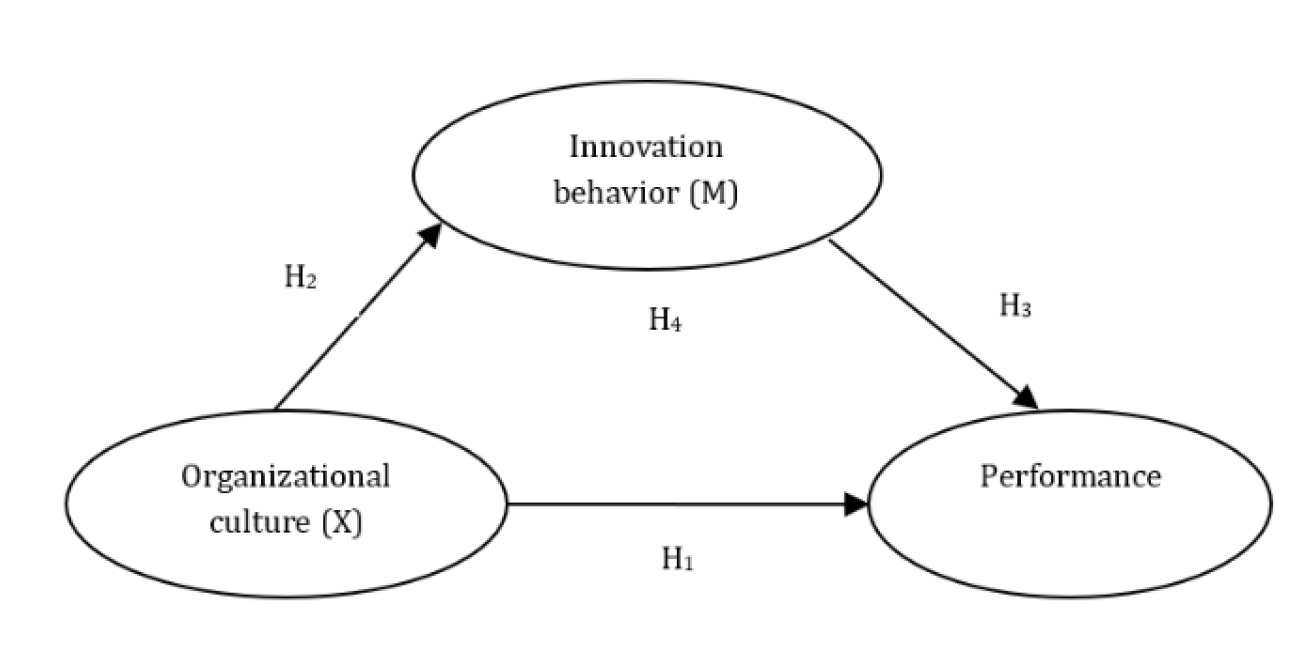
Based on the background of the problem and the formulation of the existing problems, the aim of this study is to explain the role of innovation behavior mediating organizational culture with LPD performance in Badung Regency. Research hypothesis and conceptual framework are mentioned in Figure 1
Figure 1: Research Conceptual Framework
H1: Organizational culture has positive and significant influence on performance, H2: Organizational culture has positive and significant influence on innovation behavior, H3: Innovation behavior has positive and significant influence on performance, H4: Innovation behavior is able to mediate organizational culture significantly on performance
MATERIALS AND METHODS
This research is a type of causality research, which aims to examine the causality relationship between the variables of innovation behavior and work culture, and employee performance. This research will be conducted at LPD in Badung Regency. This study takes the subject of LPD employees in Badung Regency with the object of research on innovation behavior and work organization culture and employee performance. Based on the problem formulas and hypotheses developed, the variables in this study can be identified as follows:
Endogenous variables in this study are employee performance (Y1)
Exogenous variables in this study are Organizational Culture (X)
Mediation variable in this research is Behavior Innovation (M)
Variables and indicators in this study are
Employee Performance (Y1)
The indicators used to measure employee performance in this study use the indicators used by Mathis and Jackson (2009) as follows:
Work quantity (Y2.1)
Quality of work (Y2.2)
Working time (Y2.3)
Collaboration with colleagues (Y2.4)
In accordance with SOP (Y2.5)
Organizational Culture (X)
According to Denison & Mirsha (1995) there are 4 dimensions consisting of 12 indicators in organizational culture, namely:
Adaptability (X1)
The three indicators of adaptability are as follows:
(a) Creating Change (X1.1)
(b) Customer Focus (X 1.2)
(b) Organizational Learning (X1.3)
Mission (X2)
In this case there are three indicators to measure the mission, namely:
(a) Strategic Direction and Intent (X2.1)
(b) Goals and Objectives (X2.2)
(c) Vision (X2.3)
(3) Involvement (X3)
There are three elements in involvement, namely:
(a) Empowerment (X3.1)
(b) Team work (X3.2)
(c) Capability Development (X3.3)
Consistency (X4)
Three indicators are
(a) Core Values (X4.1)
(b) Agreement (X4.2)
(c) Coordination and Integration (X4.3)
Behavior Innovation (M)
According to De Jong & Hartog (2010) there are 4 (four) dimensions of innovation work behavior, namely:
(a) Idea exploration (M1)
(b) Idea generation (M2).
(c) Champion Idea (M3)
(d) Idea implementation (M4)
RESULTS
The Influence of Innovation Behavior Mediating Organizational Culture
Equation 1 testing is done by looking at the effect of innovation behavior mediating the culture of the organization which is done using the SPSS program. Organizational culture is an exogenous variable that is examined and tested in influencing innovative mediating behavior variables. Based on calculations obtained that the calculation results show a standardized beta of 0.935 with a significance level of 0,000 <0.05. From the acquisition of these figures appear indications and can give an idea that organizational culture has a positive and significant influence on innovative behavior.
The influence of organizational culture on performance
Furthermore, from this research is to determine the effect of organizational culture on the performance of LPD employees in Badung regency. Calculation results obtained indicate that the standardized beta value of 0.431 with a significance level of 0.025 < 0.05. This indicates that organizational culture variables have a positive and significant effect on the performance of LPD employees in Badung regency.
The Influence of Innovative Behavior on Performance
The next objective of this research is to determine the effect of innovative behavior on the performance of LPD employees in Badung regency. Calculation results obtained indicate that the standardized beta value of 0.431 with a significance level of 0.032 < 0.05. This indicates that innovative behavior has a positive and significant effect on the performance of LPD employees in Badung regency.
The Role of Organizational Culture's Innovative Behavior Mediated on Performance
The results of research on testing organizational culture on innovative behavior, obtained a standardized beta value of 0.935 and a significance of 0,000 < 0.05, which means that organizational culture has a significant positive effect on innovative behavior. Standardized beta value of 0.935 is the value of the path or path.
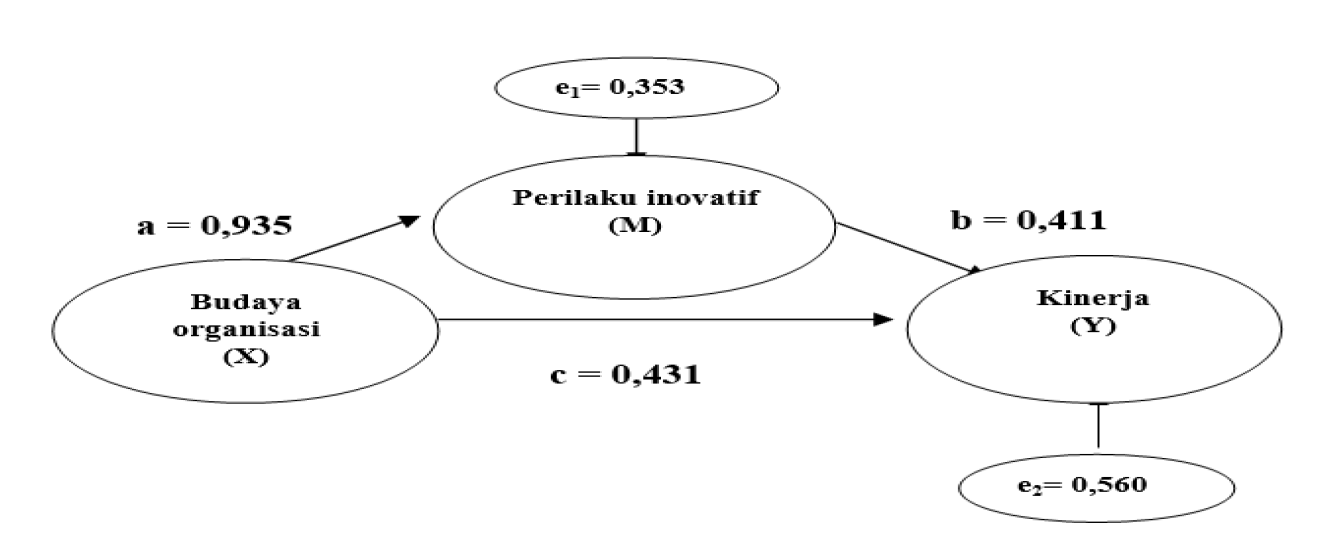
In the regression equation as explained in model II, the standardized beta value for organizational culture value of 0.431 shows a significant effect. Then the standardized beta value of innovative behavior of 0.411 shows a significant positive effect. The standardized beta value of organizational culture of 0.431 is the value of path or path c and the value of standardized beta of innovative behavior of 0.411 is the value of path or path b. Based on the calculation of the value of the error variable (e), it is known that the value of e1 = 0.353 and e2 = 0.560.
Based on these results, it can be concluded that the results of the path analysis show that organizational culture has a direct and indirect influence on performance with innovative behavior (as a mediating variable). Based on the results obtained, the hypothesis of the indirect effect between organizational culture on performance through innovative behavioral variables can be accepted.
Calculates path coefficients based on regression coefficients.
Direct influence
Effect of organizational culture variables (X) on innovative behavior (M) X M = 0.935
The effect of employee empowerment variable (X) on innovative work behavior (Y) X Y = 0.431
The effect of variables on innovative behavior (M) on performance behavior (Y) M Y = 0.411
Indirect effect
The influence of organizational culture variables (X) on performance (Y) with innovative behavior (M) as intermediaries
X M Y = (ρ1) (ρ3) = (0.935 0.411) = 0.384
Total effect
The total effect of variable X on Y through M is formulated as follows:
Total effect = c + (a b)
= 0.431+ (0.935 x 0.411)
= 0.815
Berdas Based on the explanation of the structural equation above, it can be stated that the path coefficient diagram of this study (Figure 2).
Figure 2: Validation of the Final Path Diagram
Table 1: Direct Influence, Indirect Influence and Total Influence of Organizational Culture (X), Innovation Behavior (M) and Performance (Y)
Variable Influence
Direct Influence
Indirect Influence Through M (a x b)
Total Influence
X → M
0,935
-
0,935
X→Y
0,431
0,384
0,815
M→Y
0,411
-
0,411
Source: Computed primary data, 2019
Table 2: Sobel Test Result
Nilai z
Sig
2,9954
0,000
Source: Computed Primary Data, 2019
Mediation Testing Results using Sobel Analysis
The sobel test is an analytical tool to test the significance of the indirect relationship between exogenous variables and endogenous variables mediated by mediating variables. The sobel test is formulated with an equation and can be calculated using the Microsoft Excel 2010 application. If the z calculation value is greater than 1.96, the mediating variable is assessed to significantly mediate the relationship between endogenous variables and exogenous variables.
The calculation results show the comparison of z count value of 2.9954> z table of 1.96 then H0 is rejected and H1 is accepted. This means that innovative behavior has a significant and positive effect in mediating organizational culture on the performance of LPD employees in Badung regency.
CONCLUSION
Based on the results of research, discussion and interpretation that have been described in the previous chapter with reference to several theories and the results of previous studies, then some conclusions can be drawn as follows :1). Organizational culture has a positive and significant effect on the Performance of LPD Employees in Badung Regency, meaning that the better the organizational culture in LPD, the performance of LPD employees also increases.2). Organizational culture has a positive and significant effect on the innovation behavior of LPD employees in Badung Regency, meaning that the better the organizational culture, the innovation behavior of LPD employees also increases.3). Innovation Behavior has a positive and significant effect on the Performance of LPD Employees in Badung Regency, meaning that the more employee innovation the LPD employee performance also increases.4). Innovative behavior is able to significantly mediate organizational culture on employee performance. That is, by developing innovative behavior the influence of organizational culture on the performance of LPD employees in Badung regency is increasing.
Based on the results of this study, several things can be suggested as follows :1). With empirical evidence that the application of innovation behavior can improve LPD performance, the LPD manager or manager should always pay more attention to innovation work behavior within the company, because the high work behavior of innovation will improve performance 2). Empirical evidence that organizational culture can improve performance, LPD leaders and managers must always maintain organizational culture that can encourage the emergence of employee innovation behaviors which in turn will certainly be able to improve LPD performance.
REFERENCE
Denison, Daniel R. Corporate Culture and Organizational Effectiveness. John Wiley & Sons, 1990.
Jong, Jeroen P. J. de, and Ron Kemp. “Determinants of Co-workers’ Innovative Behaviour: An Investigation into Knowledge-Intensive Services.” International Journal of Innovation Management, vol. 7, no. 2, 2003, pp. 189–212.
Kotter, John P. “Leading Change: Why Transformation Efforts Fail.” Harvard Business Review, vol. 73, no. 2, 1995, pp. 59–67.
Mathis, Robert L., and John H. Jackson. Manajemen Sumber Daya Manusia. Salemba Empat, 2009.
Ojo, Oladapo. “Impact Assessment of Corporate Culture on Employee Job Performance.” Business Intelligence Journal, vol. 2, no. 2, 2009.
Podsakoff, Philip M., Michael Ahearne, and Scott B. MacKenzie. “Organizational Citizenship Behavior and the Quantity and Quality of Work Group Performance.” Journal of Applied Psychology, vol. 82, 1997, pp. 262–270.
Porter, Michael E. “How Competitive Forces Shape Strategy.” Harvard Business Review, vol. 57, no. 2, 1979.
Sutrisno, Edy. Manajemen Sumber Daya Manusia. Prenada Media Group, 2016.
Wirawan. Budaya dan Iklim Organisasi. Salemba Empat, 2007.
Yildiz, P. D., et al. “Factors Associated with Post-Traumatic Stress Symptoms (PTSS) 4–6 Weeks and 6 Months after Birth: A Longitudinal Population-Based Study.” Journal of Affective Disorders, vol. 221, 2017, pp. 238–245.
Yuswani, W. “Pengaruh Budaya Organisasi dan Stres terhadap Motivasi Kerja dan Dampaknya terhadap Kinerja Karyawan pada PT. Kerinci Permata Motor Jambi.” Jurnal Sainstech Politeknik Indonusa Surakarta, vol. 2, no. 5, 2016.
Recommended Articles
Research Article
Agentic AI in Information Systems: Toward Autonomous Decision-Making in Organizations
Duoha Suhail Najm
Published: 30/07/2026
Download PDF
Research Article
A Comparative Study of Online Fashion Promotion: Hennes & Mauritz (H&M) and Label in India
Riya Jamble
Published: 20/07/2021
Download PDF
Research Article
Developing Social Media Marketing Visual Contents to Increase Engagement Rate (A Case Study of Healthy Tails Animal Clinic in Malang City)
Aditya Nirwana,
...
Felicia Joscelind Verrel
Published: 20/11/2022
Download PDF
Research Article
The Determinants of the Financial Behaviour of SMEs: Empirical Evidence from an Emerging Economy
Santiago Hernandez,
...
Remo Roscigno
Published: 20/03/2022
Download PDF
PO Box 101, Nakuru
Kenya.
Email: office@iarconsortium.org
Editorial Office:
J.L Bhavan, Near Radison Blu Hotel,
Jalukbari, Guwahati-India
Dewi Adnyani, I. G. A. & Suwandana, SE., MM, I. G. M. (2021). The Role of Innovation Behavior in Mediating the Influence of Organizational Culture on LPD Employee Performance in Badung District. IAR Journal of Business Management, 2(2), 1-4.
MLA
Dewi Adnyani, I Gusti Ayu and I Gusti Made Suwandana, SE., MM. "The Role of Innovation Behavior in Mediating the Influence of Organizational Culture on LPD Employee Performance in Badung District." IAR Journal of Business Management 2.2 (2021): 1-4.
Chicago
Dewi Adnyani, I Gusti Ayu and I Gusti Made Suwandana, SE., MM. "The Role of Innovation Behavior in Mediating the Influence of Organizational Culture on LPD Employee Performance in Badung District." IAR Journal of Business Management 2, no. 2 (2021): 1-4.
Harvard
Dewi Adnyani, I. G. A. and Suwandana, SE., MM, I. G. M. (2021) 'The Role of Innovation Behavior in Mediating the Influence of Organizational Culture on LPD Employee Performance in Badung District' IAR Journal of Business Management 2(2), pp. 1-4.
Vancouver
Dewi Adnyani IGA, Suwandana, SE., MM IGM. The Role of Innovation Behavior in Mediating the Influence of Organizational Culture on LPD Employee Performance in Badung District. IAR Journal of Business Management. 2021 Jul;2(2):1-4.


 Download PDF
 Download XML