Contents
Download PDF
pdf Download XML
286 Views
522 Downloads
Share this article
Research Article | Volume 2 Issue 2 (July-Dec, 2021) | Pages 1 - 6
Determinants of Employee Career Development on PT Perkebunan Nusantara III (Persero) Medan
 ,
1
University of Muhammadiyah North Sumatera, Indonesia
2
University of Pembangunan Panca Budi, Indonesia
Under a Creative Commons license
Open Access
Received
Sept. 3, 2021
Revised
Oct. 9, 2021
Accepted
Nov. 19, 2021
Published
Dec. 20, 2021
Abstract

In line with the development of an organization, efforts are needed to improve the skills and professionalism of employees with increased education and job training and organizational support in providing attention and coaching that is ultimately expected to develop the careers of employees. An employee's career development needs to be done because an employee working in an organization not only wants to get what he has, but also expects change, there is progress and opportunities given to him to advance to a higher and better level. Thus, the better the application of career development in the company will have an effect on improving employee performance. Based on the results of research that education and training program affect significantly the career development of employees at PT. Perkebunan Nusantara III (Persero) Medan, where the form of education and training programs applied by the company is in training house that is classically in Pusdiklat Unit P2WAS with internal and external sources, self-study or assignment and on the job training in the work unit. In addition, organizational support affects the career development of employees at PT. Perkebunan Nusantara III (Persero) Medan significantly, where organizational support in the form of providing various facilities needed by employees in work, opportunities for ability development and improving the welfare of employees.

Keywords
INTRODUCTION

Many issues arise related to employment, especially those related to employee education and job training issues. This is what makes the management function must really consider in more depth in the framework of decision making related to employee job education and training. Educational programs and exercises are required for both old and new employees, depending on the needs of the company itself. Education and training also encourage employees to be more productive at work because the employee already knows well his duties and responsibilities and strives to reach a higher level.


Employee performance is generally driven by the development of career levels such as promotions, promotions, promotions, initiative, creativity, rewards and others. Human resource management system with the right career level development is the key to the company's success in achieving its goals. The company's development process must be supported by qualified human resources, which is expected through education and training will produce employees with nature and attitude and have responsiveness, initiative and creative and high performance. 


Employee performance is generally driven by the development of career levels such as promotions, promotions, promotions, initiative, creativity, rewards and others. Human resource management system with the right career level development is the key to the company's success in achieving its goals. The company's development process must be supported by qualified human resources, which is expected through education and training will produce employees with nature and attitude and have responsiveness, initiative and creative and high performance. 


In addition to education and job training, organizational support also plays an important role in the company, especially in terms of dedication and support from the company's managerial side in full to improve the t ability and performance of employees to jointly work for the survival of the company which means also to achieve he overall welfare of employees. In line with the development of an organization, efforts are needed to improve the skills and professionalism of employees with increased education and job training and organizational support in providing attention and coaching that is ultimately expected to develop the careers of employees.


An employee's career development needs to be done because an employee working in an organization not only wants to get what he has, but also expects change, there is progress and opportunities given to him to advance to a higher and better level. Thus, the better the application of career development in the company will have an effect on improving employee performance.


At PT. Perkebunan Nusantara III (Persero) Medan which is engaged in angrobusiness, plantations and oil palm and rubber industries. Based on preliminary research conducted it was found that employee career development has not been done as a whole so there are employees who feel not given the opportunity to participate in job promotions. In addition, it was also found that the implementation of education and training is only given to employees who have a high-level management group consisting of chiefs of staff and managers only, so it can be said that the implementation of education and training has not been carried out as a whole to all employees.


Early research also found a tendency toward lack of organizational support influenced by evaluations of experience and observations about the way organizations treat their employees fairly, thereby causing employees to be less motivated to further improve performance at work. In anticipating this, the company or organization must be able to place its human resource position that can be run by the company by educating and training employees, so that they get better knowledge and skills, in accordance with their field of work. This method is known as education and training that is supported also with the organization of the company to run in accordance with established work procedures and rules by providing opportunities for each employee to achieve a higher career level as their work motivation.


Factors that influence employee career development include employee and organizational relationships, employee personality, external factors, politicking within the organization, reward systems, employee numbers, organizational size, organizational culture, and management types. While the factors that affect education and job training are formal education, educational background, mastery of disciplines, use of training methods, training objectives with work spirit orientation, skills in the required job and management and education skills. Furthermore, factors that affect organizational support are the organization's attitude to employee ideas, response to employees who face problems and response to employee welfare and health. 


Theoretical Basis

Career Development: Career is a journey that a person goes through during his life. Suwatno and Priansa [1] quoting Yuniarsih and Suwatno stated that "career development is a formal approach that organizations use to ensure that employees with appropriate and experienced qualifications are available in times of need". Mangkunegara [2] quoted Andrew J. Dubrin as saying that "career development is a staffing activity that helps employees plan their future careers at the company so that the company and the employees concerned can develop themselves to the maximum".


Current careers indicate the series or sequence of jobs/positions held by people during their work history, not in view of their employment level or organizational level. A career doesn't just show a change in vertical moving up in an organization. Although most of the people are still trying to make progress, but the number of people who refuse the more difficult job responsibility to remain in the position he now holds and likes. There are two approaches: the first approach is to view a career as ownership (a property) and occupation or organization where a career is seen as a path of mobility within a single organization. The second approach views careers as individual property or quality and not cooperatives or organizations.


Career development such as promotion is expected by every employee because with this development will get better rights than what was obtained previously both material and non-material. Career development is carried out through career coaching and assessment of the work performance system and the career system in general through promotions, job mutations and appointments in positions. Every employee in his career needs career development to use existing career opportunities. Because this has to do with employee development, the career development function determines the goals for systematic employee development, so that career goals have been approved, career development activities can be selected and channeled in a meaningful direction for individuals as well as for the organization.


Education and Training Program

It is difficult for an employee to develop himself without a special education. Self-development through only through the many human resources apparatus that can develop only through education. How many human resources the apparatus can develop only through experience alone. This proves that the self-development of the human resources apparatus will be further improved through education and training. That is why education aims to accelerate the development of employees. According to Mudyahardjo [3] that: "Education is life. Education is any learning experience that takes place in all environments and throughout life. Education is any life situation that affects an individual's growth.


According to M. Manullang [4] "With training / education is interpreted as company activities designed to improve or improve the knowledge, skills, and attitudes of employees in accordance with the needs of the company so that the employees concerned are more advanced in carrying out certain tasks". Education and training not only increase knowledge but also skills (skills) and attitudes (attitudes), so as to improve the main tasks and functions in the organization. Conceptually education is everything to foster the person and develop the ability for unity building and is also a learning process to acquire and improve skills outside the prevailing system in a relatively short period of time based on methods that prioritize practice rather than theory.


Education and training are not the same. Although many similarities, both are related to providing assistance to employees, so that the employee can develop to a higher level of intelligence, knowledge and ability. Education is more theoretical, and expertise becomes more practical. In accordance with this understanding, training is a short-term process that uses systematic and organized procedures in which non-managerial employees learn technical knowledge and skills in limited purposes. Training consists of programs that are planned to improve performance at the individual, group and organizational levels. Improve performance that can be measured by its changes through the knowledge, skills, attitudes and social behavior of that employee.


Organizational Support

The treatment of the organization received by employees is captured as a stimulus organized and interpreted into a perception of organizational support. This perception will foster a certain level of trust from employees over the appreciation an organization gives to their contributions and the organization's attention to their lives.


Employees' level of trust in the organization's support will be influenced by their evaluation of experience and observations about the way the organization treats its employees in general. Organizational support can also be viewed as an organization's commitment to individuals. When in individual-organizational interaction, known as organizational commitment from individuals to their organizations; Organizational support means the opposite, namely the organization's commitment to individuals (employees) in the organization. Organizational commitment to employees can be given in various forms, including rewards, equal compensation, and a fair organizational climate. These forms of support also develop from extrinsic (material) such as salaries, benefits, bonuses, and so on, to the intrinsic (non-material), such as attention, praise, acceptance, familiarity, information, self-development, and so on.


It can be concluded that organizational support is how the company or organization values the contribution of employees to the progress of the company (valuation of employees. contribution) or organization and the company's attention to their lives (care about employees. well-being). Every individual (employee) considers that the work he does is an investment, where they will give time, effort, and effort to get what they want. While on the other hand, the organizations they invest in (work) are faced with the pressures of an ever-changing environment, which requires those organizations to improve performance. For this reason, the organization will reward its employees who work according to their desired goals. Thus, there is a transaction in the form of social exchange in the workplace, between individuals and organizations. Employees or individuals in the organization will develop a thorough belief in determining the readiness of the organization's personification in rewarding increased work efforts and meeting the employee's need to be praised and appreciated. This is at the core of organizational support. Perceived organizational support will depend on some attributional process used to demonstrate the commitment made by others in a social relationship. This support is determined by the frequency, extriment and efforts of giving praise and awards and other prizes such as salary, assessment, and addition of job responsibilities.


The concept of organizational support has also long been described by management scientists in the literatures of distributive justice theory. The distributive theory of justice states that individuals in an organization will evaluate the results of an organization with regard to some distributive rules based on rights according to fairness or fairness. While the theory of fairness (equity theory) also suggests that organizational awards must be distributed according to the level of individual contribution. A supportive organization is one that takes pride in their workers, compensates fairly, and follows the needs of its workers.
MATERIALS AND METHODS

Research is a type of research that is descriptive quantitative. Quantitative descriptive research is a research method that is done to find out and decipher the picture of attachment between one variable and other variables about the object studied that is done by statistical testing. The sample was taken 10% of the total number of employees of PT. Perkebunan Nusantara III (Persero) Medan which numbered 94 people. The data collection techniques used are through observation and interviews.


  • Observation (Observation) is by conducting a direct review of the objects studied, namely the employees of PT. Perkebunan Nusantara III (Persero) Medan to know directly from employees in relation to research topics

  • Quesioner (angket) is a number of questions related to the problem and disseminated to be filled out by employees and then presented in the form of tabulation

RESULTS

Data Normality Test Result 

Good regression requires normality in the research data or in its residual value rather than in each variable. The regression model normality test in this study used graph analysis by looking at histograms and normal probability plots. If the ploting of the data forms a diagonal straight line then the distribution of the data is normal and the following is the result of the normality test using a diagram (Table 1).


Table 1: Data Normality Test Result

One-Sample Kolmogorov-Smirnov Test

Parameters

Education and Training Program

Organizational Support

Career Development

N

94

94

94

Normal Parametersa

Mean

41.2021

41.3191

40.5745

Std. Deviation

1.23201

1.13794

1.55535

Most Extreme Differences

Absolute

0.222

0.196

0.165

Positive

0.193

0.196

0.165

Negative

-0.222

-0.187

-0.143

Kolmogorov-Smirnov Z

2.153

1.896

1.603

Asymp. Sig. (2-tailed)

0.000

0.002

0.012

a. Test distribution is Normal.

-

-

-


Heteroskedasticity Test Result

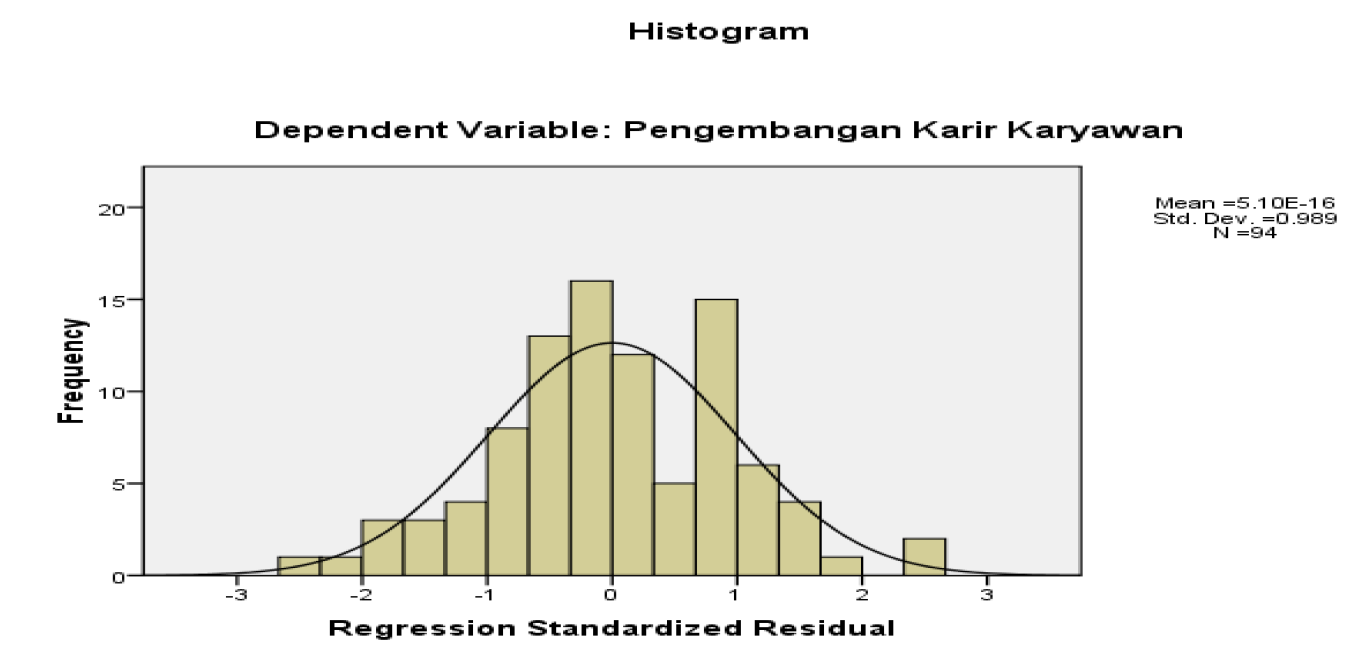
This test is done to find out whether in a regression model, there is a variance inequality from residual observation to another observation (Figure 1). 


Figure 1: Histogram


From the histogram chart above it is known that the resulting points form a pattern of a particular graph, the distribution of data forms a graph that has the highest point on the vertical line of zero. The results of this test showed that this regression model was free from the problem of heteroskedasticity, in other words: the variables to be tested in this study were homoskedastis.


Multicollinearity Test Result

The multicollinearity test in this study was to look at the Variance Inflation Factor (VIF) coefficient and tolerance value. According to Imam Ghozali [5] that: The common cutoff value used to indicate the existence of multicolonierity is a Tolerance value of < 0.10 or equal to the value of VIF ≤ 10. In other words, good data can be seen if it has a Tolerance value smaller than 0.10 and a VIF value smaller than 10 and if the Tolerance and VIF values are not in accordance with these provisions then the research data contains multicollinearity which means it is not suitable for use as research data. Here are the results of the multicollinearity test of the SPSS output conducted (Table 2).


Table 2: Multicollinearity Test Result Coefficientsa


Model

Colinearity Statistics

Tolerance

VIF

1

(Constant)

-

-

2

Education and Trainng Program

0.983

1.017

3

Organizational Support

0.983

1.017

a. Dependent Variable: Career Development


The results of the multicollinearity test showed a tolerance value of > 0.10 and a VIF value of < 10 for educational and training research variables as well as organizational support, this indicates that there is no multicollinearity in the regression model so the data is said to be good and can be used for further testing.


Partial Test (t test) Result

Statistical tests are performed to test whether an independet variable (X) individually has a significant relationship or not to the dependent variable (Y) (Table 3).


Table 3: Partial Hypothesis Test results (t) Coefficients

Parameters

Unstandardized Coefficients

StandardizedCoefficients

t

Sig.

Model


B

Std. Error

Beta


1

(Constant)

39.090

5.423

-

7.208

0.000

2

Education and Training Program

2.036

0.132

0.029

3.274

0.008

3

Organizational Support

0.231

169

0.169

2.642

0.004

  1. Dependent Variable: Career Development


Based on the results of the data analysis it appears that:


  • Constant Value of 39.090 means that if the Xand X2 is worth 0 then career development is worth 39.090

  • The Beta Coefficient value for the education and training program variable of 2.036 means that each increase in the education and training program 

variable then career development will increase by 2.036 assuming other variables are considered constant

  • Beta Coefficient value for organisasional support variables of 0.231 means that any increase in organisasional support variables will increase career development by 0.231 assuming other variables are considered constant


The Effect of Education and Training Program on Career Development

Based on table 1 test results on the effect of education and training program on career development obtained significance value 0.008 (Sig.<0.05) then H0 was rejected and Ha acceptted. This means that education and training program significantly affects career development at PTPN III.


The effect of Organizational Support on Career Development

Based on Table 1 test results of the influence of organizational support on career development obtained a value of significance 0.004 (Sig.<0.05) then H0 was rejected and Ha accepted. This means that organizational support has a positive and significant effect on career development at PTPN III.


Determination Coefficient

Statistical Test coefficient determination in this study the goal is to find out how far the model is in explaining variations in dependent variables. Statistical tests of the determination coefficient can be seen in the Table 4.


Table 4: Determination Coefficient Model Summaryb

Model

R

R Square

Adjusted R Square

Std. Error of the Estimate

1


 0.169a

 0.428

 0.018

1.54137


a. Predictors: (Constant), Education and Training Program, Organizational Support, b. Dependent Variable: Career Development


Table 3 shows that the R Square value of 0.428 means that the percentage of the influence of independent variables (education and traning program and organizational support) on dependent variables (career development) is the value of the determination coefficient or 42.8%. While the remaining 57.2% were affected or described by other variables not included in this study model.

DISCUSSION

Based on the results of research that has been analyzed using logistic regression, the test results above show that education and training program and organizational support effect on career development. Discussion of each variable is as follows:


Effect of Education and Training Program on Career Development

There is a positive influence of educational and training variables on employee career development. This is shown from the results of the t test with a significant probability that is less than 0.05. In accordance with research conducted by J.F.X Susanto Soekiman [6] found that education and training have a positive influence on employee career development. Indra Iman and Siswandi [7] explained that education and training is a systematic process with individual management enhanced his expertise, knowledge or attitude to facilitate the tasks given to him in order to achieve organizational goals and career development of the employee.


Based on the analysis of the results of research findings conducted by spreading questionnaires to employees of PT. Perkebunan Nusantara III (Persero) Medan, concluded that employees at PT. Perkebunan Nusantara III (Persero) Medan feels that the education and job training applied by the company in accordance with the needs of work and career development of employees. This is characterized by the always implementation of education and training programs to employees of certain fields gradually for all fields for the sake of improving employee work outcomes.


Effect of Organizational Support on Career Development

There is a positive influence of organizational support variables on employee career development. This is shown from the results of the t test with a significant probability that is less than 0.05. In accordance with research conducted by J.F.X Susanto Soekiman [6] stated that there is an influence of organizational support on employee career development. M. Manullang [4] said organizational support is how the company or organization appreciates the contribution of employees to the progress of the company (valuation of employees: contribution) or organization and the company's attention to their lives (care about employees: well-being) which is one of the career developments for improving employee life welfare. 


Based on the analysis of the results of research findings conducted by spreading questionnaires to employees of PT. Perkebunan Nusantara III (Persero) Medan, concluded that employees at PT. Perkebunan Nusantara III (Persero) Medan feels that existing organizational support has supported the career development of employees. Characterized by the application of career development for all employees who deserve it, which includes employees who have good work performance and are responsible for all duties and obligations given to him.

CONCLUSION

After analyzing the data and getting the results of research and described in this discussion are as follows:


  • Education and training significantly affect the career development of employees at PT. Perkebunan Nusantara III (Persero) Medan, where the form of education and training applied by the company is in house training that is classically in Pusdiklat Unit P2WAS or Kandir with internal and external sources, self-study or assignment and on the job training in the work unit.

  • Organizational support significantly affects the career development of employees at PT. Perkebunan Nusantara III (Persero) Medan, where organizational support takes the form of providing various facilities needed by employees in work, opportunities for ability development and improving the welfare of employees.

REFERENCE
  1. Suwatno and D.J. Priansa. Human Resource Management in Public and Business Organizations. Alfabeta, 2011.

  2. Mangkunegara, A.A.A.P. Management of Human Resources of the Company. PT. Remaja Rosdakarya Offset, 2011.

  3. Mudyahardjo, R. Introduction to Education. PT. RajaGrafindo Persada, 2013.

  4. Manullang, M. Management Basics. Gadjah Mada University Press, 2009.

  5. Ghozali, I. Aplikasi Analisis Multivariate dengan Program SPSS. Badan Penerbit Universitas Diponegoro, 2005.

  6. Soekiman, J.F.X.S. “The Effect of Perception of External Organizational Support on Career Development.” National Seminar IX, Padang, 2012.

  7. Iman, I. and S. Siswandi. Enterprise Management Application: Case Analysis and Its Solving. Mitra Wacana Media, 2009.

Recommended Articles
Research Article
Developing Social Media Marketing Visual Contents to Increase Engagement Rate (A Case Study of Healthy Tails Animal Clinic in Malang City)
...
Published: 20/11/2022
Download PDF
Research Article
Responsibility Accounting in Food Enterprises – A Case Study at Kinh do Holdings Company Limited
...
Published: 08/07/2023
Download PDF
Research Article
Longitudinal Research into the History of Debts
Published: 20/03/2022
Download PDF
Research Article
The Determinants of the Financial Behaviour of SMEs: Empirical Evidence from an Emerging Economy
...
Published: 20/03/2022
Download PDF
Chat on WhatsApp
Flowbite Logo
PO Box 101, Nakuru
Kenya.
Email: office@iarconsortium.org

Editorial Office:
J.L Bhavan, Near Radison Blu Hotel,
Jalukbari, Guwahati-India
Useful Links
Order Hard Copy
Privacy policy
Terms and Conditions
Refund Policy
Shipping Policy
Others
About Us
Team Members
Contact Us
Online Payments
Join as Editor
Join as Reviewer
Subscribe to our Newsletter
+91 60029-93949
Follow us
MOST SEARCHED KEYWORDS
Copyright © iARCON International LLP . All Rights Reserved.