African-Centered Contextualization: The Missing Imperative that Has Put Africa in the Position to Miss Most of the Sustainable Development Goals and the Few Achievements Made Not Be Sustained
Going all the way back to 31000 BC, the Pprotodynastic/Ancient Kemetians/Egyptians were so well-informed about the import of contextualization in their daily lives that even hair and hairstyles were contextualized. Yet, today, the descendants of Africans in other parts of the continent who are the ancestors of the Kemetians are willy-nilly ready to accept all sorts of Western-oriented development designs without demanding that when targeted at them they be contextualized based on Africa’s realities and necessities-i.e. African-centered. This negligence is true of the 2030 Agenda for Sustainable Development Goals (SDGs) adopted by the United Nations General Assembly in September of 2015 and accepted by Africans. Approximately one-third of the 2030 Agenda timeframe already completed, Africa is only relatively on track to meet the following three out of the 17 goals: (1) SDG 5, gender equality; (2) SDG 13, climate action; and (3) SDG 15, life on land. Given how the SDGs were contextualized, I therefore tender the proposition that the missing African-centered conceptualization has put Africa in the position to miss most of the SDGs and the few achievements not be sustained. Thus, the following four major research questions are probed in this paper: (1) what is the essence of contextualization? (2) What is African-centered contextualization? (3) How has Africa performed on the SDGs? (4) What could have been done for Africa to perform better on the SDGs? In order to test the preceding proposition and provide answers to the questions, the research methodology employed is a mixture of descriptive and explanatory approaches. Also, both secondary data from existing studies on the topic and primary data from the United Nations and the Sustainable Development Goals Center for Africa (SDGC/A) were utilized for the analysis.
Keywords
SDGs in Africa
Development Contextualization
African Epistemology
Global Development Agendas
Policy Adaptation
Sustainable Development in Africa
INTRODUCTION
Going all the way back to 31000 BC, the Pprotodynastic/Ancient Kemetians/Egyptians were so well-informed about the import of contextualization (i.e. placing the circumstances that form the setting for an event, statement, or idea and in terms of which it can be fully understood and assessed) in their daily lives that even hair and hairstyles were contextualized. As Geoffrey John Tassie points out in his systematic and quantitative study:
After experimentation with a broad spectrum of hairstyles during the Protodynastic and early Dynasty I, an institutionalised canon for hairstyles was established, coinciding with the creation of administrative institutions. These codified hairstyles continued to serve as the norms for identifying members of the administration or signs of authority. By the end of the Old Kingdom, the hairstyles of the elite had been adopted by the lower officials of the increased bureaucracy and provincial elites as representations of their newly acquired power and status. Although initially the majority of the men had their hair cut short, modifications of short hair and the adoption of mid- and shoulder-length hair became progressively common. The use of certain hairstyles was restricted to the higher social offices, with longer hair being emblematic of power and divinity [1].
Tassie continues:
Women, by contrast, initially had long hair with greater variety occurring by Dynasty I and a more restricted array from Dynasty II onwards. However, long hair was predominant among women of all social statuses in all periods. Long hair may have thus been related to the perception of women as mothers (responsible for childbirth and nursing) and hence their perceived role as directly linked with procreation and fecundity. Although the adoption of the tripartite by high officials was related to this ‘generative’ aspect of feminine hairstyles, it was primarily in imitation of the God Osiris and his regenerative powers [1].
Yet, today, the descendants of Africans in other parts of the continent who are the ancestors of the Kemetians are willy-nilly ready to accept all sorts of Western-oriented development designs without demanding that when targeted at them they be contextualized based on Africa’s realities and necessities-i.e. African-centered. This negligence is true of the 2030 Agenda for Sustainable Development Goals (SDGs) adopted by the United Nations General Assembly in September of 2015 and accepted by Africans. The Agenda encompasses 17 SDGs. With the goal of “building on the principle of ‘leaving no one behind,’ the new Agenda emphasizes a holistic approach to achieving sustainable development for all” [2].
Approximately one-third of the 2030 Agenda timeframe already completed, Africa is only relatively “on track to meet the following three out of the 17 goals: (1) SDG 5, gender equality; (2) SDG 13, climate action; and (3) SDG 15, life on land” [3,4]. Given how the SDGs were contextualized, I therefore tender the proposition that the missing African-centered conceptualization has put Africa in the position to miss most of the SDGs and the few achievements not be sustained. Thus, the following four major research questions are probed in this paper: (1) what is the essence of contextualization? (2) What is African-centered contextualization? (3) How has Africa performed on the SDGs? (4) What could have been done for Africa to perform better on the SDGs? In order to test the preceding proposition and provide answers to the questions, the rest of the paper is divided into the four sections that follow. In the end, a conclusion is drawn and a recommendation is made. But before doing all this, it makes sense to end this section with brief discussions of (a) the research methodology utilized for the examination and (b) what the 17 SDGs are for those readers who may not be familiar with them.
The research methodology employed for this investigation is a mixture of descriptive and explanatory approaches. The former answers the question “What is?” and the latter answers the question “How?” [5]. Also, both secondary data from existing studies on the topic and primary data from the United Nations and the Sustainable Development Goals Center for Africa (SDGC/A) were utilized for the analysis.
The 17 SDGs with their brief descriptions culled from the United Nations’ website are the following [2]:
“No Poverty: End poverty in all its forms everywhere”
“Zero Hunger: End hunger, achieve food security and improved nutrition and promote sustainable agriculture”
“Good Health and Well-being: Ensure healthy lives and promote well-being for all at all ages”
“Quality Education: Ensure inclusive and equitable quality education and promote lifelong learning opportunities for all”
“Gender Equality: Achieve gender equality and empower all women and girls”
“Clean Water and Sanitation: Ensure availability and sustainable management of water and sanitation for all.”
“Affordable and Clean Energy: Ensure access to affordable, reliable, sustainable and modern energy for all”
“Decent Work and Economic Growth: Promote sustained, inclusive and sustainable economic growth, full and productive employment and decent work for all”
“Industry, Innovation and Infrastructure: Build resilient infrastructure, promote inclusive and sustainable industrialization and foster innovation.”
“Reduced Inequality: Reduce inequality within and among countries”
“Sustainable Cities and Communities: Make cities and human settlements inclusive, safe, resilient and sustainable”
“Responsible Consumption and Production: Ensure sustainable consumption and production patterns”
“Climate Action: Take urgent action to combat climate change and its impacts”
“Life below Water: Conserve and sustainably use the oceans, seas and marine resources for sustainable development”
“Life on Land: Protect, restore and promote sustainable use of terrestrial ecosystems, sustainably manage forests, combat desertification and halt and reverse land degradation and halt biodiversity loss.”
“Peace and Justice Strong Institutions: Promote peaceful and inclusive societies for sustainable development, provide access to justice for all and build effective, accountable and inclusive institutions at all levels”
“Partnerships to achieve the Goal: Strengthen the means of implementation and revitalize the global partnership for sustainable development.”
The 17 SDGs are contextualized to be universal and, therefore, apply to all countries, no matter their economic, political and social standings.
The Essence of Contextualization
As I demonstrate in my essay titled “From Diop to Asante: Conceptualizing and Contextualizing the Afrocentric Paradigm” [6], without the notion of context, there would be no theory of pragmatics, much less a theory of ethnomethodology. This is one reason pragmatics calls for some explicit characterization of the concept of context, despite the difficulty encompassed in such an activity. I state that this truism is captured by Deborah Schiffrin when she posits in her examination of those factors that aid pragmaticists in “discovering the context of an utterance” that:
Discourse markers, contextualization cues and sociolinguistic variables all have a contextualizing function. The markers are clues to the local contexts of utterances, contextualization cues to the interpretive schemes within which communicative intent is situated and sociolinguistic variables to the social and expressive meanings of self, other and situation. But because discourse markers are functionally linked to these other devices, the study of all these devices together can provide an emic guideline to speakers’ contextualization of language at several different levels at once [6,7].
Also, I point out that for ethnomethodologists, the analyzability of actions in context as a practical accomplishment is a must. As Harold Garfinkel insists, this must be the case because “not only does no concept of context-in-general exist, but every use of context without exception is itself essentially indexical” [8]. Ethnomethodologists are interested, therefore, less in the contribution to the conversational system made by the specific identities of the speakers and more in the contribution of immediate conversational context [6].
In addition, I mention that as John Heritage notes, the significance of a speaker’s communicative action is doubly contextual in being both context-shaped: i.e. “its contribution to an ongoing sequence of actions cannot adequately be understood except by reference to the context-including, especially, the immediately preceding configuration of actions-in which it participates;” and context-renewing: i.e. “the character of conversational actions is directly related to the fact that they are context-shaped…the extent of a next action is repeatedly renewed with every current action” [9]. Furthermore, I state, Heritage [9] suggests that while these aspects of context are traceable to Garfinkel’s notions of indexical and reflexive characteristics of talk and action, they have also found some parallel expression in Erving Goffman’s more ethnographically-oriented studies [6].
Thereafter, I allude to the fact that for Goffman [10], context helps us to rule out unintended meanings and suppress misunderstandings (but even more primary, it is the role that context helps to create). For him, the immediate surrounding could not have this power apart from the cultural competence of interpreters. In addition, he notes that the correct interpretation of any statement may have as one of its implications the saving of the interpreter from exposure as someone who presumes cultural and linguistic competence s/he does not possess [6].
Moreover, I posit that this way of conceptualizing context can be thought of as a process whereby the native speaker of a given language produces contextually appropriate and internally coherent utterance-a process which involves a lot more than knowledge of the language system. Thus, as I proffer, the factors identified by a systematic ethnomethodological framework as contextual must be those factors that determine the native speaker’s production and interpretation of utterances in actual activities of use [6].
Furthermore, I note that another notion of context in Goffman’s discussions, even though he does not call it so, is a physical one: the role of “setting” in performance. According to Goffman [10], “setting” includes furniture, décor, physical layout and other background items which provide the scenery and stage props for the spate of human action. Setting stays put, geographically speaking, so that those who use it as part of their performance cannot begin their act until they have brought themselves to the appropriate place and must end their performance upon their departure. Context then, as formulated by Goffman, is pragmatic: i.e. context covers the identities of participants, the temporal and spatial parameters of speech events, the knowledge and meta-knowledge, intentions and beliefs of the participants in those speech events. This makes context paramount in any discussion of a phenomenon [6].
African-Centered Contextualization
As I also point out in my aforementioned essay [6], Firth [11], regarded by many as the founder of modern British linguistics, suggests that the context of a phenomenon brings into relation the following categories:
The relevant features of participants: persons, personalities
The verbal action of the participants
The non-verbal action of the participants
The relevant objects
The effect of the verbal action
Thus, I add that, correspondingly, for African-centered contextualization, the following aspects must be taken into consideration: (a) a sample of personalities/pioneers such as Diop [12] and Asante [13] for the relevant features of participants; (b) major research questions, major theories and concepts such as those of African-centeredness for relevant objects; and (c) academic areas such as the Mathematics of Sustainability in which the phenomenon has been investigated for the effect of the action [6]. Nowhere have I found evidence that this has been done for the 17 SDGs vis-à-vis Africa.
Indeed, as Diop taught us in his groundbreaking work titled The African Origin of Civilization: Myth or Reality, it is imperative to contextualize our analysis of Africa from the perspective that Ancient Kemet/Egypt and its citizens were Negroid in origin. He put it as follows: “In contemporary descriptions of ancient Egyptians, this question is never raised. Eyewitnesses of that period formally affirm that the Egyptians were Black” [12]. Also, from the late 1980s to the mid-1990s, many and consistent, ways to contextualize African-centeredness were proffered by Africanists. The first was by Asante who proffered that “Afrocentricity [African-centeredness] requires the placing of African ideals at the center of any analysis that involves African culture and behavior” [13].
Africa’s Performance on the Sustainable Development Goals
The rankings and scores for 52 African countries for the year 2020, the year for which the most up-to-date data are available from the SDGC/A, are presented in Table 1. According to the organization:
The score signifies a country’s position between the worst (0) and the best or target (100) outcomes. The difference between 100 and countries’ scores is therefore the distance in percentage that needs to be completed to the best possible outcome across the 17 SDGs. The same basket of indicators is used for all countries to generate comparable scores and rankings. It should be noted that differences in rankings may be due to small differences in the aggregate score [14].
It is also important to state here the many limitations of the data as reported by the SDGC/A: (a) “there are persistent data gaps that continue to inhibit the inclusion of certain countries and indicators in the SDG Index”; (c) “there was a lack of comparable data for the Seychelles and Equatorial Guinea” and, thus, excluded from the rankings; (c) “the total proportion of missing values was 6.5%”; (d) “some of the indicators for which a high proportion of countries did not have data (over 10%) include: social protection coverage, undernourishment, fertilizer consumption, malaria testing for children, primary school enrollment, secondary completion, affordability of electricity, modern slavery, financial inclusion, R&D (research and development) expenditure, slum dwelling, waste production, emissions in exports, child labor and levels of import duties”; (e) “this list does not include indicators which are only applicable to some countries, such as sea-related indicators for landlocked countries and natural resource value realization for countries without mining or oil industries”; (f) “there are several goals whose targets are not fully captured due to a lack of comparable data across African countries”; (g) “data on educational outcomes are insufficient and there is not enough data on secondary school enrollment and completion”; (h) “there is no universal metric for the sustainability of farmland, despite the importance of agriculture in African economies” [14].
In addition, the organization points out that for SDG 10 (i.e. reduced inequality), it is “reliant on estimates of GINI coefficients, but is unable to account for social protection measures to reduce inequalities. Lastly, despite the importance of climate change adaptation for African countries, there is no available metric to assess how well countries are adapting and building resilience to climate change” [14]. It adds that “Another persistent issue in this and any other cross-country analysis is that they are necessarily bound to data sources that provide a cross-country comparison of values. Such data sources often do not include the most up-to-date or the more specific information that is generated by National Statistical Offices, especially in countries with good statistical capacity. Nationally-generated data cannot be included in a cross-country analysis because the methodology used to generate that data may not be the same as is used in other countries and this would result in biased results” [14].
As can be seen in Table 1, the country with the highest score (67.10) is Tunisia and the one with the lowest score (32.36) is South Sudan. Thus, the score for the former country is about twice as that for the latter. Also, 12 (23.08%) of the 52 countries have scores below 50.
Table 1: Africa’s SDG Index, September 2020
Ranking
Country
Score
1
Tunisia
67.10
2
Mauritius
66.79
3
Morocco
66.30
4
Algeria
65.90
5
Cabo Verde
65.59
6
Egypt
65.44
7
Botswana
63.93
8
Ghana
62.69
9
South Africa
62.20
10
São Tomé and Príncipe
61.61
11
Senegal
58.69
12
Kenya
58.54
13
Namibia
58.31
14
Gabon
58.07
15
Côte d’Ivoire
57.67
16
Rwanda
57.65
17
Tanzania
57.00
18
Burkina Faso
55.90
19
Uganda
55.71
20
The Gambia
55.53
21
Togo
54.41
22
Ethiopia
54.15
23
Zimbabwe
53.79
24
Mauritania
53.78
25
Benin
53.53
26
Cameroon
53.37
27
Zambia
53.25
28
Mali
53.22
29
Eswatini
52.94
30
Libya
52.70
31
Malawi
52.64
32
Lesotho
52.43
33
Mozambique
52.17
34
Sierra Leone
51.59
35
Djibouti
51.30
36
Angola
51.18
37
Republic of Congo
50.81
38
Niger
50.47
39
Burundi
50.37
40
Guinea
50.20
41
Liberia
49.33
42
Nigeria
48.84
43
Madagascar
47.94
44
Sudan
47.85
45
Comoros
46.98
46
Guinea Bissau
46.37
47
Democratic Republic of Congo
44.83
48
Eritrea
44.17
49
Somalia
42.73
50
Chad
40.34
51
Central African Republic
38.05
52
South Sudan
32.36
Source: Self-generated by the Author Using Data from the
African SDG Index Dashboard 2020 Report [14]
Also, Table 2 shows that the Range (i.e. the area of variation between the upper and lower limits on a particular scale) is quite significant, with, looking back at Table 1, South Sudan having the Minimum score and Tunisia having the Maximum score. The Mean (or average: i.e. the value obtained by dividing the sum of several quantities by their number) is about half of the expected highest score of 100. Also, looking again at Table 1, 30 (57.69%) countries have scores below the Mean. The Standard Deviation (i.e. a quantity calculated to indicate the extent of deviation for a group as a whole) is relatively small, indicating that the scores of the countries are clustered closely around the Mean.
The Skewness (i.e. the asymmetry of the probability distribution of a random variable about its Mean) is negative, indicating a longer or fatter tail on the left side of the distribution. The Kurtosis (i.e. the sharpness of the peak of a frequency-distribution curve) falls between the acceptable value of between −3 and +3.
Table 2: Descriptive Statistics
Statistic
Score
Range
34.74
Minimum
32.36
Maximum
67.10
Mean
53.82
Standard Deviation
7.47
Skewedness
Standard Error
-0.30
1.04
Kurtosis
Standard Error
0.48
0.65
Source: Self-generated by the Author Using Data from the African SDG Index Dashboard 2020 Report (SDGC/A, 2021)
In addition, as it can be gleaned from Table 3, the t-Statistic (i.e. the size of the difference relative to the variation in the sample data) is statistically significant at the 0.1 level. Furthermore, the lower and upper levels of the 95% Confidence Interval (i.e. the range of values that one can be 95% certain contains the true Mean of the population) show that the latter is slightly larger than the former.
Furthermore, as I pointed out earlier, Belay Begashaw tells us that with about one-third of the 2030 Agenda timeframe already completed, Africa is only relatively “on track to meet the following three out of the 17 goals: (1) SDG 5, gender equality; (2) SDG 13, climate action; and (3) SDG 15, life on land” [3,4]. He therefore urges that “To be successful, there is need for effective and coordinated partnerships to domesticate the SDGs-i.e., to fully transpose the SDG ecosystem into national and regional planning and implementation mechanisms-as well as the African Union’s (AU) Agenda 2063 and to bridge the large financing and data gaps” [4]. His yearning comes too late, as what he is proposing should have been done at the development stage of the Agenda.
Table 3: One-Sample Test
Statistic
Score
t
51.98
Degrees of Freedom
51.00
Significance (2-tailed)
0.01
95% Confidence Interval of the Difference
Lower
Upper
51.74
55.89
Source: Self-generated by the Author Using Data from the
African SDG Index Dashboard 2020 Report [14]
How Africa Could Have Performed Better
In this section, I make the case that Africa could have performed better on the SDGs had the Agenda been informed by the Mathematics of Sustainability. What I provide here is section of my essay titled “Promoting Sustainability and Predicting Tipping Points in Africa: Suggestion for a Collaborative Initiative via E-Clustering” I presented at the 14th General Assembly of the Council for the Development of Social Science Research in Africa (CODESRIA) convened in Dakar, Senegal from June 8 to 12, 2015.
The proposition that African countries, like those on other continents, are quite ambitious when it comes to launching development projects is hardly a matter of dispute. The constant challenge, however, has been to ensure the sustainability of many of these projects. The challenge prompted, to the best of my knowledge, two high-level meetings and two scholarly books to address it. The first meeting was convened by the United Nations on November 21, 2011 at which the organization’s Deputy Secretary-General Asha-Rose Migiro emphasized the point that sustainable development is critical for addressing the economic, social and environmental challenges in Africa [15]. The second meeting was held in Cape Town, South Africa and brought together scientists and lawmakers from across Arica to discuss ways to promote sustainable development in Africa South of the Sahara [16]. The first book titled Sustainable Development in Africa [17] comprises papers from various contributors suggesting tools from various disciplines to examine factors limiting sustainable development in Africa and making recommendations. The second book, Chemistry for Sustainable Development in Africa [18], entails a series of papers dealing with current chemical research in Africa focusing on environmental chemistry, renewable energies, health and human well-being, food and nutrition and bioprospecting and commercial development. The major shortcoming with all of these efforts from an African-centered perspective is that they offer no encompassing or indigenous African scientific approach to address the challenge of sustainability in Africa. An answer to the challenge is Mathematics of Sustainability. Before discussing this aspect, it makes sense to first answer the following poignant question: What is all this talk about sustainability?
Each year, we use more and more natural resources to maintain our way of life. Some of these resources are renewable and will never run out while others are fading quickly. Natural gas is slowly fading and efforts are being made to harness other energy sources such as solar, wind and, of course, electricity. Houses are being powered by solar panels, cars by electricity and businesses by wind. These efforts help to keep our environment safe while also giving us the energy we need to survive. These new sources of energy do not only help us personally and environmentally, but also economically. These new ventures generate new businesses and they can be quite profitable as well. Governments, different organizations and numerous corporations are making an effort to provide a sustainable way of life, making the concept of sustainability quite significant right now in science. But, what exactly is sustainability? How do we use it? What purpose does it serve? According to the United States Environmental Protection Agency (EPA):
Sustainability is based on a simple principle: Everything that we need for our survival and well-being depends, either directly or indirectly, on our natural environment. Sustainability creates and maintains the conditions under which humans and nature can exist in productive harmony, that permit fulfilling the social, economic and other requirements of present and future generations [19].
For North Carolina State University (NCSU), the “concept of sustainability centers on a balance of society, economy and environment for current and future health. Responsible resource management in all three areas ensures that future generations will have the resources to survive and thrive” [20]. The NCSU definition adds the economy, while the EPA definition just deals with society and nature living in harmony. Thus, the NCSU definition is more comprehensive by providing us a nexus among society, nature and economy.
With the broader definition, the fields in which the concept of sustainability is being used can now be discussed. Just looking at the definition, it would seem that sustainability can be used in almost any field, since it deals with society, nature and the economy. But for the sake of this essay, let us look at the available research. Steve Cohen, director of the Master of Public Administration program in Environmental Studies at Columbia University, has found that there has been much growth in the field of Environmental Studies. As he notes:
One of the most encouraging trends I’ve seen in recent years has been the growth of environmental studies programs in many American Universities. For the past decade I’ve directed an MPA program in Environmental Science and Policy at Columbia University’s School of International and Public Affairs and Earth Institute. Today over 500 graduates of that program are working as environmental professionals all over the world [21]
Cohen would go on to discuss how the school later launched a program in sustainability Management and also how many other schools are developing sustainability programs.
Kate Galbraith wrote an article for the New York Times titled “Sustainability Field Blooms on Campus”, describing how schools are ramping up their sustainability programs to meet the demand in society. Galbraith also discussed how many older individuals are going back to school for jobs in sustainability fields. As she put it [22]:
Mr. Gressens’s trajectory will sound familiar at educational institutions across the country, whose continuing education arms have seen influx of students interested in the relatively new field of sustainability. At Harvard’s extension school, enrollment in environmental courses has soared by more than 70 percent in two years, according to the university, which has responded with new offerings in fast-changing fields like carbon neutrality and environmental economics [22].
Obviously, these institutions realize that this is a fast-growing market and are boosting their programs to meet the needs of society.
But still, what industries are using sustainability the most? This question leads to an article by Helen Coster [23] in the Forbes magazine which listed the top 100 most sustainable companies. The list, which includes companies such as General Electric, H&M, Nokia and Vodafone, shows that there exists a wide range of industries that use sustainability. With this concept’s popularity and the growing threat of damage to our world, more industries and academic institutions are taking sustainability more seriously and really putting their thoughts and money behind how to become more sustainable. As Cohen states:
The challenges of global sustainability are also starting to influence higher education. The liberal arts have begun to reemphasize science, including earth sciences, ecology and environmental biology. The physics and finance of energy production and consumption are of obvious and increasing importance. My own academic field of organizational management is beginning to study the growing importance of the earth's resources in determining organizational effectiveness [21].
So sustainability is being used in almost every field now and everyone has a feeling of responsibility to society and the earth.
Along with the numerous fields in which sustainability is being used, it is also being employed to study different aspects of life. In essence, sustainability has an almost limitless potential for studying anything: the way we live, the way we do business, the way we go to school and even the way we deal with other nations. Sustainability is used to study how we impact society, the environment and the economy, which is mostly how we live in general. In short, sustainability allows us to study the aspects of the way we live our lives.
A number of mathematical models have been used or suggested for measuring sustainability. The following is an inventory of the works in the chronological order in which they were published:
Rassafi and Vaziri [24] use pairwise correlation to examine sustainability in 52 African countries
The Global Community WebNet [25] suggests the use of the Gross Environmental Sustainable Development Index (GESDI), which quantitatively describes quality indicators rather than merely measuring different variables by focusing on the interactions between four major quality systems: (1) people, (2) economic development, (3) environment and (4) availability of resources
Hersh [26] employs state space system representations, mental models, systems methodologies, optimization, mathematical decision making, multi-criteria problems, multi-criteria decision support methods and fuzzy set operations to develop models for sustainable development
System Analysis and Decisions [27] utilizes a gauging matrix mathematical model to measure sustainable development, which is characterized by two main constituents: (1) security of population (Isec) and (2) quality of their life (Iql). The generalized sustainable development measure is then presented by a quaternary (Q) with an imaginary scalar part j(Isec), which describes the security of people and a real vector part (Iqf), which describes quality of life in the space with three dimensions: (1) economic (Iec), (2) ecological (Ie) and (3) social-institutional (Is)
Jason Phillips [28] applies ideas of coupled environment-human systems to develop a mathematical model of sustainable development
Ugwa and Agwu [29] tap difference equations, ordinary differential equations, partial differential equations, optimization modeling, simulation modeling and function fitting data modeling to develop a mathematical tool for sustainable development in Nigeria
Assaf et al. [30] suggest Life Cycle Analysis (LCA) that is useful for comparing the impacts of different activities in order to make hard choices for creating a climate-friendly sustainable energy future.
Clark [31] implements the “logistic” model of population dynamics to measure sustainable resource management
Hadlock [32] uses differential equations, probability statistics, simulation, evolutionary game theory and network theory to show how human society can be sustained in a rapidly changing world.
Hughes and Harrington [33] show how the mathematics of Greenworks is comprised of baselines, absolute versus relative measurements and interpolation
Kung [34] employs numbers, statistics and functions to demonstrate the connection between social justice and sustainability
Roberts [35] calls for the utilization of statistical and algorithmic methods of data analysis, advanced computational tools and new cryptographic tools to aid us in making management and policy decisions about the electric power grid
The Sheward Partnership, LLC [36] applies the LEED Rating System, which is the internationally-accepted benchmark for high performance green buildings, to calculate return on investment in sustainable design
The problem with these models from an African-centered perspective is that a majority of them are not indigenous to the continent. They few that have their origins in Africa are not so identified, probably because the authors are oblivious to the fact.
Indeed, the notion of sustainability was quite present in the minds of classic Egyptians. In Egyptian Hieroglyphic, the word sānkhu represented the word “peasant,” “sustainer,” or “vivifier” [37], meaning to give or bring life to, animate, to make more lively, intense, or striking enliven [38]. In fact, in the funerary texts of later periods (c. 300 BC), Isis, the goddess of motherhood, magic and fertility (380-362 BC), due to her great power, was considered the mourner, protector and sustainer of the deceased in the afterlife. Isis’ “protective and sustaining roles were extended to nobles and commoners and her power and appeal grew to the point that she eventually eclipsed Osiris (her brother and husband) himself and was venerated by virtually every ancient Egyptian” [26].
From Joyce Tyldesley, we also learn that Pharaoh Hatchepsut/Hatshepsut (throne name Maatkare, meaning Foremost of Noble Ladies, 1508-1458 BC), in her effort to ensure sustainability in ancient Egypt, launched a number of bold initiatives. First, Hatchepsut increased the demand for scribes which led to an expansion of the education system. Second, the Pharaoh poured a lot of money into the building of monuments to ensure that the past is resuscitated and her name lives on forever, which in turn benefited a lot of artists and sculptors [39]. Third, she launched theological and technological advances to make sure that “New Kingdom Egypt remained tied to Middle and Old Kingdom Egypt by an unparalleled continuity of language, religion and artistic/architectural convention and by the idiosyncratic Egyptian view of the world and the position of Egypt, her people and her gods within the world, which had remained basically unchanged for over a thousand years” [39]. Fourth, she dreaded uncontrolled chaos, which was by definition a maat-less period and therefore did everything in her power to avoid it by engaging in many international trade and diplomatic ventures [39]. Fifth, she advocated for large number of offspring, especially for the royal family which was plagued by the dearth of children, with sons particularly being in short supply and single daughters being the norm [39].
In terms of the Mathematics of Sustainability in Africa, Diop teaches us plenty. First, the geometric progression of ratio seven, commonly called the problem on “the inventory of goods contained in a house,” and the classical formula for the arithmetic progression, which I mentioned earlier, were invented in ancient Egypt. The mathematical series also invented included the following polygonal numbers [40]:
Trigonal or triangular numbers whose ratio, or difference of terms, is equal to 1
Tetragonal or square numbers such as 1, 4, 9, 16, 25, etc. whose difference in terms is 2, meaning that of the odd numbers 1, 3, 5, 7, 9, etc.
Gnomons, or successive rectangular belts, that allow one to obtain all squares from one unit square from the arithmetic series of odd numbers
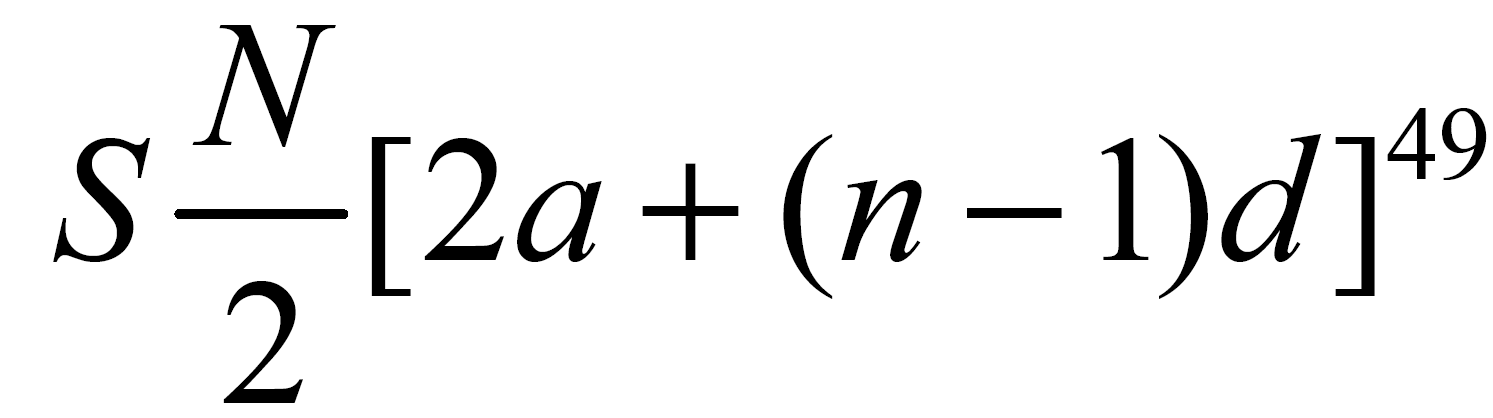
Summing up of arithmetic progression:
In sum, these are all the elements that led to the “discoveries” of Pythagoras’ theorem. This fact is echoed by Corinna Rossi when she points out that the first unambiguous evidence of the use of the theorem is a Demotic papyrus that dates back to the third century BC on which the numbers involved correspond to three triplets which might have been used as early as the Old Kingdom to construct some pyramids. Rossi observes that this truth is reflected in the insistence of the late Greek sources to link the 3-4-5 triangle to ancient Egypt [41]. She goes on to also cite the following most quoted passage from Plutach’s De hide et Osiride (“His and Osiris”) to prove the point:
…the better and more divine nature consists of three elements-what is spiritually intelligible, the material and the element derived from these, which the Greeks call the cosmos. Plato is wont to call what is spiritually intelligible the form and the pattern of the father; and the material he calls the mother, the nurse and the seat and place of creation, while the fruit of both he calls the offspring and creation. One might suppose that the Egyptians liken the nature of the universe especially to this supremely beautiful of the triangles which Plato also in the Republic seems to have used in devising his wedding figure. That triangle has a vertical of three units of length, a base of four and an hypotenuse of five, which is equal, when squared, to the squares of the other two sides. The vertical should thus be likened to the male, the base to the female and the hypotenuse to their offspring; and one should similarly view Osiris as the origin, Isis as the receptive element and Horus as the perfect achievement. The number three is the first and perfect odd number; four is the square of the even number two; five is analogous partly to the father and partly to the mother, being made up of a triad and a dyad [41].
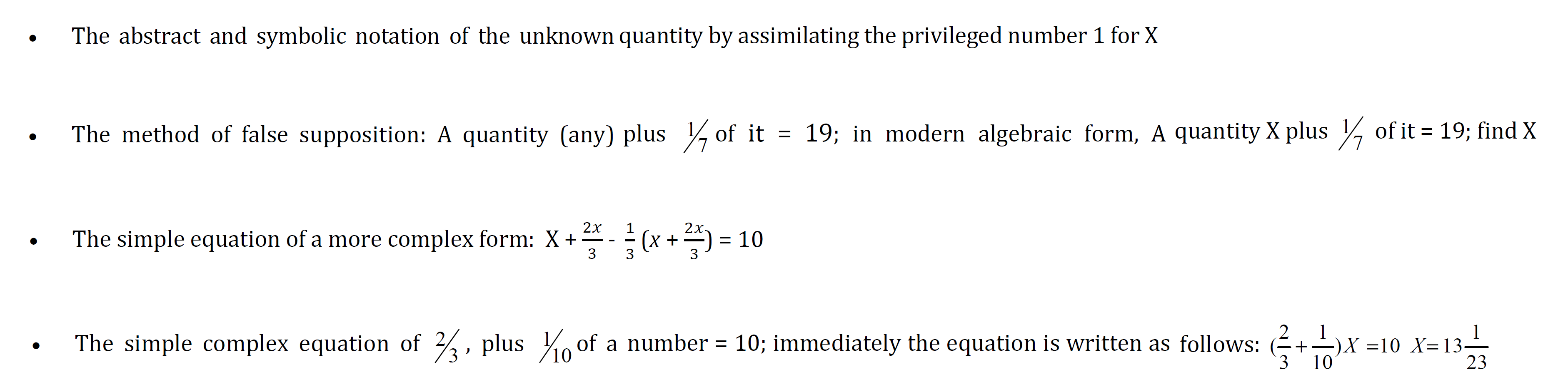
Second, the following simple equations were invented by classic Egyptians [40]:
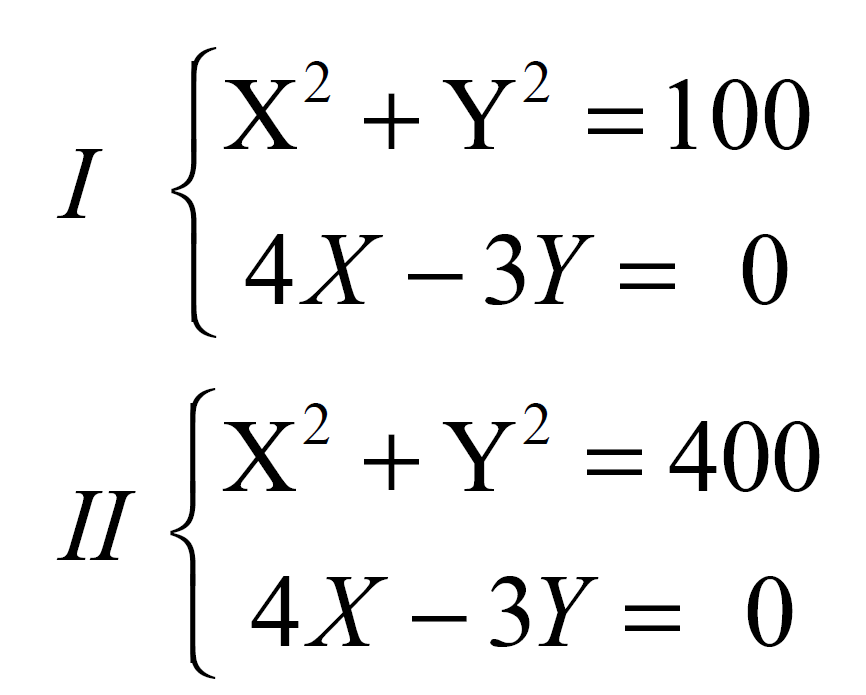
Third, classic Egyptians invented the following quadratic equations [40]:
The explicit wording of this system of simultaneous equations for the quadratic problem is the following: How to divide 100 into pairs, so that the square root of one of them is 3/4 that of the other. Stated in modern symbols, the equation reads as follows:
Fourth, the balance of quantities (pesou) was the invention of classic Egyptians. An example is that if the pesou of a loaf of bread is 12, then it means that this loaf of bread contains 1/12 of a bushel. Also, the sacred right-angled triangle shows that some mathematical proportions had a divine essence. Furthermore, a table found from 2000 BC to 600 AD has a division of the number 2 by the odd numbers from 3 to 101. The table 2/n has no error. Even more, the Egyptian notation of fractions of 2200 BC was as follows [40]:
Finally, in the area of arithmetic, the following three observations by Diop are poignant [40]:
The originality of Egyptian arithmetic is that it does not require any effort of memory. Multiplication and division are reduced to addition after a series of duplication. Only the multiplication by 2 needs to be known in order to easily carry out the most complex calculations
Operations on the fractions generally deal with fractions whose numerators equal a unit; however, the Egyptians knew and used also the following complimentary fractions: 2/3 (frequently used); 3/4, 4/5, 5/6, (less frequently used). Owing to this fact, the Egyptians had made a table of factorization of the fractions of type 2/n, including the fractions from 2/5 to 2/101
By the third millennium onward, the Egyptians had already invented decimal notation and discovered or portended the zero. The proportional divisions were known. They knew how to rigorously extract the square root of any number, even fractional ones. All these are evident in the examples dealt with by the Egyptian scribe Ahmes in the Berlin Papyrus
And even more interesting is that, as Diop demonstrates, many Egyptian mathematical terms have survived in the Wolof language [40].
It should also be noted here that other scientific areas utilized to promote sustainability in ancient Egypt included (a) Astronomy, encompassing the phases of the moon, the calendar, the orientation of the monuments and the decans; (b) Medicine, (c) Chemistry, including the etymology of the word chemistry itself and the metallurgy of iron; and (d) Architecture, comprising the mathematical bases and the aesthetic canon of Egyptian art [40].
CONCLUSION
The analyses in the preceding sections make it abundantly clear that an African-centered contextualization was preemptory for providing the foundation that would allow Africa to meet the SDGs. This was not done. Consequently, Africa will fail to meet most of the SDGs and the few successes it has achieved will not be sustained.
As I have recommended elsewhere [6,42], an important aspect in the implementation process of innovative actions for Africa calls for an African-centered management of tools necessary to support the innovation process from the generation of ideas to launching successful ventures throughout the innovation life cycle. The availability of innovation infrastructure and support tools becomes a crucial factor for the deployment of innovative actions in Africa. This action line will provide the necessary tools and methods needed to enhance the innovation capacity and the networking interoperability.
REFERENCES
Tassie, G.J. The Social and Ritual Contextualisation of Ancient Egyptian Hair and Hairstyles from the Protodynastic to the End of the Old Kingdom. Doctoral thesis, University College London, 2009, https://discovery.ucl.ac.uk/id/eprint/18730/. Accessed June 2021.
Bangura, A.K. et al. Conducting Research and Mentoring Students in Africa: CODESRIA College of Mentors Handbook. CODESRIA Publications, 2019.
Bangura, A.K. “From Diop to Asante: Conceptualizing and Contextualizing the Afrocentric Paradigm.” Journal of Pan African Studies, vol. 5, no. 1, 2012, pp. 103–125.
Schiffrin, D. “Discovering the Context of an Utterance.” Linguistics, vol. 25, 1987, pp. 11–32.
Garfinkel, H. Studies in Ethnomethodology. Polity Press, 1967.
Heritage, J. Garfinkel and Ethnomethodology. Polity Press, 1984.
Goffman, E. Frame Analysis. Harper and Row, 1974.
Firth, J.R. Papers in Linguistics. Oxford University Press, 1957.
Diop, C.A. The African Origin of Civilization: Myth or Reality. Lawrence Hill, 1974.
Asante, M.K. The Afrocentric Idea. Temple University Press, 1987.
Sustainable Development Goals Center for Africa. Sustainable Development Goals., 2021, https://sdgcafrica.org/. Accessed June 2021.
United Nations News Centre. “Sustainable Development Key to Africa’s Socio-Economic Challenges.” November 2011, http://www.un.org/apps/news/story.asp?NewsID=40463. Accessed October 2013.
Rassafi, A.A. and M. Vaziri. “African Sustainable Transport by Numbers.” Journal of Sustainable Development in Africa, Fall 2003, http://www.jsd-africa.com/Jsda/Fall2003/articlepdf/ARC-African%20Sustainable%20Transport%20by%20number%20(article).pdf. Accessed May 2013.
Phillips, J. “A Mathematical Model of Sustainable Development Using Ideas of Coupled Environment–Human Systems.” Pelican Web’s Journal of Sustainable Development, vol. 6, no. 5, May 2010.
Ugwa, K.A. and A. Agwu. “Mathematical Modeling as a Tool for Sustainable Development in Nigeria.” International Journal of Academic Research in Progressive Education and Development, vol. 1, no. 2, April 2012, pp. 251–258.
Assaf, G. et al. “Creating a Climate-Friendly Sustainable Energy Future: The Role of Mathematics.” Mathematics Awareness Month, April 2013, http://www.mathaware.org/index.html. Accessed February 2013.
Clark, C.W. “Mathematics and Resource Management.” Mathematics Awareness Month, April 2013, http://www.mathaware.org/index.html. Accessed February 2013.
Hadlock, C.R. “Sustaining Human Society in a Rapidly Changing World.” Mathematics Awareness Month, April 2013, http://www.mathaware.org/index.html. Accessed February 2013.
Hughes, M.A. and E. Harrington. “Making Greenworks Count.” Mathematics Awareness Month, April 2013, http://www.mathaware.org/index.html. Accessed February 2013.
Kung, D. “Mathematics, Social Justice & Sustainability.” Mathematics Awareness Month, April 2013, http://www.mathaware.org/index.html. Accessed February 2013.
Roberts, F.S. “Energy as a Contributor to Human Well-Being: Electric Power Grids.” Mathematics Awareness Month, April 2013, http://www.mathaware.org/index.html. Accessed February 2013.
The Sheward Partnership. “Calculating Return on Investment in Sustainable Design.” Mathematics Awareness Month, April 2013, http://www.mathaware.org/index.html. Accessed February 2013.
Tyldesley, J. Hatshepsut: The Female Pharaoh. Viking, 1996.
Diop, C.A. Civilization or Barbarism: An Authentic Anthropology. Présence Africaine, 1981. English trans., Lawrence Hill Books, 1991.
Rossi, C. Architecture and Mathematics in Ancient Egypt. Cambridge University Press, 2007.
Bangura, A.K. “Promoting Sustainability and Predicting Tipping Points in Africa.” Proceedings of the 14th General Assembly of CODESRIA, 2015, pp. 1–60.
Recommended Articles
Research Article
Agentic AI in Information Systems: Toward Autonomous Decision-Making in Organizations
Duoha Suhail Najm
Published: 30/07/2026
Download PDF
Research Article
A Comparative Study of Online Fashion Promotion: Hennes & Mauritz (H&M) and Label in India
Riya Jamble
Published: 20/07/2021
Download PDF
Research Article
Developing Social Media Marketing Visual Contents to Increase Engagement Rate (A Case Study of Healthy Tails Animal Clinic in Malang City)
Aditya Nirwana,
...
Felicia Joscelind Verrel
Published: 20/11/2022
Download PDF
Research Article
The Determinants of the Financial Behaviour of SMEs: Empirical Evidence from an Emerging Economy
Santiago Hernandez,
...
Remo Roscigno
Published: 20/03/2022
Download PDF
PO Box 101, Nakuru
Kenya.
Email: office@iarconsortium.org
Editorial Office:
J.L Bhavan, Near Radison Blu Hotel,
Jalukbari, Guwahati-India
Bangura, A. K. (2021). African-Centered Contextualization: The Missing Imperative that Has Put Africa in the Position to Miss Most of the Sustainable Development Goals and the Few Achievements Made Not Be Sustained. IAR Journal of Business Management, 2(2), 1-9.
MLA
Bangura, Abdul K.. "African-Centered Contextualization: The Missing Imperative that Has Put Africa in the Position to Miss Most of the Sustainable Development Goals and the Few Achievements Made Not Be Sustained." IAR Journal of Business Management 2.2 (2021): 1-9.
Chicago
Bangura, Abdul K.. "African-Centered Contextualization: The Missing Imperative that Has Put Africa in the Position to Miss Most of the Sustainable Development Goals and the Few Achievements Made Not Be Sustained." IAR Journal of Business Management 2, no. 2 (2021): 1-9.
Harvard
Bangura, A. K. (2021) 'African-Centered Contextualization: The Missing Imperative that Has Put Africa in the Position to Miss Most of the Sustainable Development Goals and the Few Achievements Made Not Be Sustained' IAR Journal of Business Management 2(2), pp. 1-9.
Vancouver
Bangura AK. African-Centered Contextualization: The Missing Imperative that Has Put Africa in the Position to Miss Most of the Sustainable Development Goals and the Few Achievements Made Not Be Sustained. IAR Journal of Business Management. 2021 Jul;2(2):1-9.


 Download PDF
 Download XML