The purpose of this research is to analyze and identify effect of Customer Relationship Management (CRM), web quality on customer satisfaction and their implication to customer retention. The research used Structural Equation Model software, in this case Lisrel 8.7 to analyze quantitative data to prove 5 hypotheses statements. We explore 200 millennial generation (age between 20-35) who use online shop website to buy goods and services and live in Jakarta and its rural areas. The statistical computation results support the 5 hypotheses therefore to retain customer, the online shop owner should consider the web quality, CRM to achieve customer satisfaction and to retain customers. Web quality gives the highest significant effect on customer satisfaction and low significant effect on the customer retention. The result give an implication that need shop owner’s attention, to retain customer, they need to enhance the web quality because it provides 60% contribution effect to customer satisfaction.
Keywords
CRM
Web quality
Customer satisfaction and customer retention.
INTRODUCTION
High growth of online shop (e-commerce) in Indonesia has brought a significant effect on young generation habit of buying goods or services and it has increased the growth of users who shop online. According to The Central Bureau of Statistic Republic of Indonesia (2019) e-commerce selling goods and services conducted through computer network which is designed specifically to ease customer to shop on the e-commerce is increasing. CNBC indicates the 115% growth of e-commerce users during 2018 with 77 trillion rupiahs transaction amount [1].
Customer Relationship Management (CRM) is a comprehensive approach to maintain and to broaden relationship with customer [2]. CRM is a way to persuade customer to retain and to repurchase at the same store. In this research, technology base online shops use CRM to send various persuasive messages direct to the customer email which has been registered at the shop.
Online shops such as shopee, Bukalapak, Tokopedia, Elevania, etc, always communicate with their customer using CRM technology base strategies to retain their customers. Does the CRM really effect the customer satisfaction? Simultaneously, Web plays dominant role to always connect with the customer, without high quality of web, it is probably impossible to win the competition to retain existing customer and to attract potential customers. Does web effect customer satisfaction?
Web online shop is the main media to interact with their customer and it plays a dominant role to attract customers. The human and machine interaction is going to prove that the interaction can increase customer satisfaction. These are supported by previous research [4].
The problem exists in online stores is that online shops always send information related to goods and services of their stores to their Customers (CRM) and online shop services are carried out using the Web (Web Quality), both are expected to increase customer satisfaction and finally the customer will retain.
In this study, the combination of CRM and WEB quality are seen as medium for online shop customers to make repeat purchases. Thus, the core problem of this research is whether CRM effects on customer satisfaction, whether WEB quality effects on customer satisfaction and the ultimate goal (customer Retention) of this research can be achieved.
The purposes of this research are to identify and analyze the effect of CRM on customer satisfaction, the effect of WEB quality on customer satisfaction and whether satisfied customers will retain to be customer.
Literature Review
Various studies have shown the effect of CRM to customer satisfaction and the implication to customer loyalty [4,5]. Their research showed a significant difference, Al-Hawary, [6] emphasized telecommunication company customers. Hassan et al. emphasized bank employees and [3] emphasized on one online shop only. Whereas Mithas et al. [4] emphasized secondary data and indirectly survey customers. Meanwhile [5] emphasized the implementation of CRM in a hotel. A research [7] that explored “Online Small size Shopping Mall” indicated that the shopping mall was not very successful. Many of them went bankrupt because of a lack of strategy in carrying out CRM element that was right for them.
Web as a medium to market various goods and services is growing rapidly and having a considerable influence on the movement, behavior and desires of customers. The web has undergone a fundamental development and it will continue to change marketing practices. Sharma et al. [8]. Therefore the quality of web determines whether the customer will visit regularly or be left behind by the customer, the quality of the web must pay attention to the following key elements, namely Appearance, Content, Functionality, Usability, Search Engine Optimization [9].
Many studies use web quality as independent variable. The most recent research was conducted by Wilson, which used the variables Web design quality, service quality, customer satisfaction, customer repurchase intention. The results indicated that web design quality affects customer satisfaction. It is suggested by [10] to focus on design attributes such as web-layout and web structure. Along with this research, content quality and navigation have a strong factor in influencing trust. Interactivity, color and typography have a strong influence on user satisfaction [11].
Research Framework
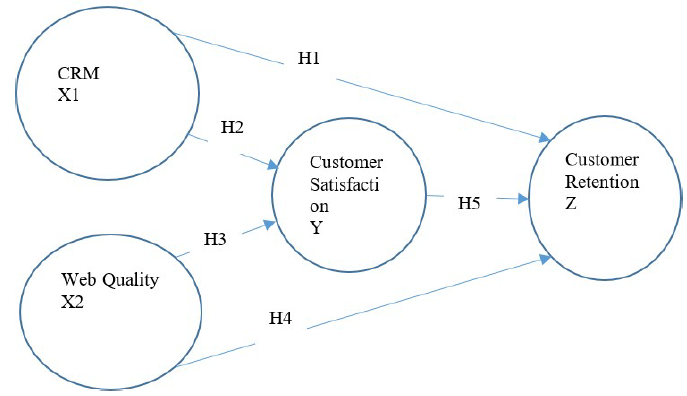
The situation (Figure 1) illustrated in this framework is that CRM activities carried out by online stores (including direct mail, chat, promotions) through customer accounts will reach customers who have made a purchase at an online store or have registered. Even with the help of technology, customers who have not registered in an online shop will be reminded via other social media to come to the online shop. The incessant CRM activities have provided many choices for customers. Here, lies the problem, whether the customer is influenced by the seduction or ignores it for a while. The role of Web Quality is very dominant because with this web, customers can interact with the shop every time and, reply the chat and finally do the shopping online. The combination of these two things (CRM and Web Quality can satisfy customers and ultimately can retain customer.
Figure 1: Conceptual Framework Showing the Relationships between CRM, web Quality, Customer Satisfaction and Customer Retention
Hypotheses Development
Base on the research framework, the following hypotheses were developed.
In order to retain customers, on line shops create many ways to maintain a positive relationship with the customers. For current situation, the easiest and cheapest way to keep communicate with the customer is using CRM, but CRM required suitable database and application. They use the customer database to keep in touched with customers. The hypothesis is going to prove that there is a positive and significant effect of CRM on customer retention (H1).
CRM cannot be implemented alone, for the current situation, the choice is using a web. This combination of variables, enhance the probability of customers to retain. But according to studies, CRM and web influence the customer satisfaction before achieving customer repurchase intention or repurchase or retention Wilson, [10]. In this research, the researcher is going to prove that there is a positive and significant effect of CRM on Customer Satisfaction. (H2) and there is a positive and significant effect of Web-Quality (WQ) on Customer Satisfaction (H3).
Customer uses web to interact with the store or to buy goods and services. Qualified and reliable web can improve the probability of customer to revisit the web and result to be returning customer. The store can indicate that this is a potential customer to implement CRM. Therefore the hypotheses that is going to be proved that there is a positive and significant effect of Web-quality on customer retention (H4).
According to the research framework customer satisfaction is one of the results of interaction between CRM and Web quality. The last hypothesis is to prove that there is a positive and significant effect of Customer Satisfaction on Customer Retention (H5).
MATERIALS AND METHOD
This study used a proving hypotheses approach and descriptive methods to explain the results of the survey of 200 millennial generation who shop at online stores in Indonesia. Choosing respondents using purposive sampling method. The measurement test was done by determining the validity and reliability of the indicators in the construct. The validity test aims to determine the level of ability of an indicator (manifest variable) in measuring its latent variable. The condition for an indicator is valid if it has a loading factor value of more than 0.50 and the t-count is greater than t-table (1.96).
Reliability test aims to measure the level of consistency of the manifest variable in measuring latency constructs. The reliability test shows the extent to which a measuring instrument can give relatively the same results if the same object is premeasured. Reliability is calculated with the construct reliability and variance extract formula. The requirement to achieve reliability is that the construct reliability value must be greater than 0.70 and the extract variance value is more than 0.5.
In this study, the data analysis technique used Structural Equation Modeling (SEM) which was operated through the Linear Structural Relationship (LISREL) program, version 8.7. Modeling through SEM enables a researcher to answer research questions that are both regressive and dimensional. Hypothesis testing can be seen from the printed output of the syntax process in the equation formulas processed by researchers and also in the path diagram. A significant relationship will be indicated by t-value on the path diagram with a value of ≥1.96. Meanwhile, an insignificant relationship is indicated by the t-value in the path diagram with a value below 1.96.
RESULTS
The respondents profile match the purposive sampling method, whereas the most respondent’s age are between 20-35 years old, main residential are Jabotabek. The result has shown a reliable data that support the hypotheses arguments (Table 1).
Validity and Reliability Test
The validity test aims to determine the level of ability of an indicator in measuring its latent variable. The measurements is valid if it has a loading factor value of more than 0.50 and the t count is greater than the t table (1.96). This indicates that the research frameworks is valid to measure the relationship.
Reliability test aims to measure the level of consistency of the manifest variable in measuring the latency construct.
Table 1: Profile of Respondents
Respondents Demography
Frequency
Percentage
Age
Between 20-35
305
88.2
Between 35-40
16
4.6
Between 40-45
9
2.6
>45
16
4.6
Sex
Man
114
32.9
Women
232
67.1
Residential
Bali
5
1.4
West Jawa
14
4.0
Jabodetabek
302
87.3
Middle Jawa
7
2.0
East Jaza
8
2.3
Kalimantan
2
0.6
SULAWESI
8
2.3
Education Level
SMP
3
0.9
SMA
88
25.4
Diploma
49
14.2
S1/D4
180
52.0
S2
21
6.1
S3
5
1.4
Job
PNS/TNI
21
6.1
Private Company
148
42.8
Entrepreneur
31
9.0
Other
146
42.2
Source: Prime data
The requirement to achieve reliability is that the construct reliability value must be greater than 0.70 and the extract variance value is more than 0.5 the result approves these conditions, this means that the research framework is reliable to measure the relationship.
Below is the Table 2 of the validity and reliability of all indicators in the SEM model
Table 2: Validity and Reliability Indicator Model
Indicators
Loading Factor
EI
t-value
CR
VE
CRM1
0.51
0.74
17.07
0.9214
0.5276
CRM2
0.73
0.47
17.97
CRM3
0.53
0.72
15.44
CRM4
0.78
0.39
17.65
WQ1
0.65
0.57
21.08
WQ2
0.70
0.51
21.51
WQ3
0.62
0.62
20.07
WQ4
0.54
0.71
17.09
WQ5
0.57
0.67
18.43
CS1
0.84
0.30
11.37
CS2
0.70
0.51
10.49
CS3
0.65
0.58
10.45
CS4
0.66
0.56
21.60
CR1
0.70
0.51
12.66
CR2
0.65
0.58
7.78
CR3
0.53
0.72
7.27
Source: Prime data
Based on the Table 2 above, it shows that each indicator of each latent variable meets the requirements because the loading factor is >0.50. The regression weights and standardized estimates of this construct are significant with T-values greater than 1.97. This means that all indicators are valid in measuring their latent variables.
The greater the construct reliability value indicates that the constituent indicators for a latent variable modifier are reliable indicators in measuring the latent variable. Suggested construct reliability value >0.7. The results of the calculation show that the construct reliability has met the requirements of reliability.
Overall Fit Test of Model
In this study, the use of the Structural Equation Modeling (SEM) model; Lisrel program where this tests consisting of independent and dependent variables together. After passing the validity and reliability test, the next step is to analyze the suitability of the data with the model as a whole or in Lisrel it is called Goodness of Fit (GOF). This test will evaluate whether the resulting model is a fit model or not. GOF of the overall fit of the model can be seen from the following Table 3.
Table 3: Goodness of Fit
Test
Requirements
Value
Result
CHI SQUARE
X2 < X2(a= 5%)
21.55
Good Fit
P-Value
p> 0,05
0.067512
Good Fit
RMSEA
< 0,08
0.039
Good Fit
RMR
< 0,05
0.030
Good Fit
SRMR
< 0,05
0.033
Good Fit
AGFI
>0.90
0.97
Good Fit
NNFI
>0.90
0.95
Good Fit
NFI
>0.90
0.95
Good Fit
RFI
>0.90
0.96
Good Fit
CFI
>0.90
0.99
Good Fit
PNFI
0,6 – 0,9
0.85
Good Fit
PGFI
0,6 – 0,9
0.84
Good Fit
ECFI
Est < sat.model
0.758 > 1.100
Good Fit
Est < ind.model
1.100 > 2.795
Good Fit
GFI
>0.90
0.98
Good Fit
Source: Prime Data
Hypotheses Testing
The results of the hypotheses test using SEM is shown below (Figure 2).
Soure: Prime data, *t tabel alpha 5% = 1.96
The hypotheses testing can be summarize in the following Table 4.
Table 4: Result of Hypotheses Calculation
Hypotheses
SLF
T count
Coefficient
T count> t table
Conclusions
Hypotheses 1. There is a positive and significant effect of CRM on customer retention
0.11
2.49
0.11
2.49>1.96
Supported
Hypotheses 2. There is a positive and significant effect of CRM on Customer Satisfaction
0.36
15.36
0,26
15.36>1.96
Supported
Hypotheses 3. There is a positive and significant effect of Web-quality on Customer Satisfaction
0.62
26.39
0.62
26.39>1.96
Supported
Hypotheses 4. There is a positive and significant effect of Web-quality on customer retention
0.23
3.47
0.23
3.47>1.96
Supported
Hypotheses 5 There is a positive and significant effect of Customer Satisfaction on Customer Retention
0.35
2.79
0.35
2.79 >1.96
Supported
Soure: Prime data, *t tabel alpha 5% = 1.96
DISCUSSION
It is shown that all hypotheses supported by the statistical calculation. This means that the research frame work is valid and reliable to measure the hypotheses. Both CRM (26%) and Web Quality (62%) are significant and dominant to satisfy the online store customers.
CRM must focus on customer and use information technology to keep communicate with the customer. CRM also must provide customer good knowledge regarding the products and services provided by the CRM.
Customer have shown their positive attitude toward various information sent to them and most customer accepted those information before and after transactions. Most customer said the information to help faster interaction with the web. This indicates that CRM has a positive impact to gain customer satisfaction and customer retention.
Web quality has a highest significant value among the other hypotheses (62%). Customer support that web Search engine optimization, Web Appearance, web Contents Quality, web Functionality, web Privacy and security and web interactivity (speed) effect the customer satisfaction and customer retention. Most customers support that those dimensions help the process of making decision. This is an indication that Web quality is able to retain customer as long as they are well informed by value information. Fulfillment of customer needs and expectations, timeliness, quality of product and overall satisfaction are indications of online shop customer satisfaction. Those dimensions increase the likelihood of the customer retention.
Revisit online store, repurchase at the same online store and make recommendation are indications of customer retention because CRM, Web Quality and Customer Satisfaction effect the customer retention.
To retain customer regularly visit and repurchase at the same online store, the store owner must prepare high quality of web and continuously remain them with valuable information (CRM). Both (web Quality and CRM) work simultaneously to influence the customer satisfactions and have highest significant impact to retain customer. Web quality alone does not guarantee that customers will revisit and remain as customer of the online store. CRM alone also does not guarantee that customers will remain as customers.
CONCLUSION
All the hypotheses have effect on customer retention, the highest significant effect is the web quality, this means that online store owner must provide professional web to retain customer and influence them to repurchase at the same store. Search engine optimization, Web Appearance, web Contents Quality, web Functionality, web Privacy and security and web Interactivity (speed) are among the web quality that effect on customer satisfaction and customer retention.
Web must be accompanied by the CRM activity, because both have highest significant effect on customer satisfaction and customer retention.
Acknowledgement
Thank you for the research unit of Politeknik Negeri Jakarta which provide funds for this research.
REFERENCES
Badan Pusat Statistik.Statistik E-Commerce 2019. BPS, 2019.
Buttle, F. and S. Maklan. Customer Relationship Management: Concept and Technology. Routledge, 2015.
Safari, M. et al. “An Empirical Model to Explain the Effects of Electronic Customer Relationship Management on Customer E-Satisfaction and E-Loyalty: Evidence from Iranian Service Shopping Websites.” Journal of Internet Banking and Commerce, vol. 21, no. S2, 2016, pp. 1–11. https://search.proquest.com/docview/1799378244?accountid=17242.
Mithas, S. et al. “Why Do Customer Relationship Management Applications Affect Customer Satisfaction?” Journal of Marketing, vol. 69, no. 4, 2005, pp. 201–209. https://doi.org/10.1509/jmkg.2005.69.4.201.
Herawaty, T. et al. “The Effect of Customer Relationship Management on Customer Loyalty (Study at Crown Hotel in Tasikmalaya).” Review of Integrative Business and Economics Research, vol. 8, no. 3, 2019, pp. 150–156. https://search.proquest.com/docview/2236122087?accountid=17242.
Al-Hawary, S. “Effect of Electronic Customer Relationship Management on Customers’ Electronic Satisfaction of Communication Companies in Kuwait.” Acces la Success, vol. 21, no. 175, 2020, pp. 97–102. https://search.proquest.com/docview/2381632421?accountid=17242.
Shim, B. et al. “CRM Strategies for a Small-Sized Online Shopping Mall Based on Association Rules.” Expert Systems with Applications, vol. 39, no. 9, 2012, pp. 7736–7742. https://doi.org/10.1016/j.eswa.2012.01.080.
Sharma, A. and J.N. Sheth. “Web-Based Marketing: The Coming Revolution in Marketing Thought and Strategy.” Journal of Business Research, vol. 57, no. 7, 2014, pp. 696–702. https://doi.org/10.1016/S0148-2963(02)00350-8
Dianat, I. et al. “User-centred web design, usability and user satisfaction: The case of online banking websites in Iran.” Applied Ergonomics, vol. 81, 2019. https://doi.org/10.1016/j.apergo.2019.102892.
Faisal, C.M. et al. “Web Design Attributes in Building User Trust, Satisfaction and Loyalty for a High Uncertainty Avoidance Culture.” IEEE Transactions on Human-Machine Systems, vol. 47, no. 6, 2017, pp. 847–859.
Recommended Articles
Research Article
Agentic AI in Information Systems: Toward Autonomous Decision-Making in Organizations
Duoha Suhail Najm
Published: 30/07/2026
Download PDF
Research Article
A Comparative Study of Online Fashion Promotion: Hennes & Mauritz (H&M) and Label in India
Riya Jamble
Published: 20/07/2021
Download PDF
Research Article
Developing Social Media Marketing Visual Contents to Increase Engagement Rate (A Case Study of Healthy Tails Animal Clinic in Malang City)
Aditya Nirwana,
...
Felicia Joscelind Verrel
Published: 20/11/2022
Download PDF
Research Article
The Determinants of the Financial Behaviour of SMEs: Empirical Evidence from an Emerging Economy
Santiago Hernandez,
...
Remo Roscigno
Published: 20/03/2022
Download PDF
PO Box 101, Nakuru
Kenya.
Email: office@iarconsortium.org
Editorial Office:
J.L Bhavan, Near Radison Blu Hotel,
Jalukbari, Guwahati-India
Purwaningrum, E. & Masjono, A. (2021). How to Retain Online Shop Customers (A Case Study on Indonesian Millennial Generation’s Habit of Shopping Online). IAR Journal of Business Management, 2(1), 1-5.
MLA
Purwaningrum, Endang and Ali Masjono. "How to Retain Online Shop Customers (A Case Study on Indonesian Millennial Generation’s Habit of Shopping Online)." IAR Journal of Business Management 2.1 (2021): 1-5.
Chicago
Purwaningrum, Endang and Ali Masjono. "How to Retain Online Shop Customers (A Case Study on Indonesian Millennial Generation’s Habit of Shopping Online)." IAR Journal of Business Management 2, no. 1 (2021): 1-5.
Harvard
Purwaningrum, E. and Masjono, A. (2021) 'How to Retain Online Shop Customers (A Case Study on Indonesian Millennial Generation’s Habit of Shopping Online)' IAR Journal of Business Management 2(1), pp. 1-5.
Vancouver
Purwaningrum E, Masjono A. How to Retain Online Shop Customers (A Case Study on Indonesian Millennial Generation’s Habit of Shopping Online). IAR Journal of Business Management. 2021 Jan;2(1):1-5.



 Download PDF
 Download XML