We are all living a world where automation and artificial intelligence are part of our life. Across the globe companies are heavily investing on these new age technologies. Companies are exponentially using the benefits of these advanced technologies like Block chain, Machine learning etc. to optimize their core business competencies. This new platforms opens up companies to plethora of opportunities and threat. The main threat is that companies are no longer maintaining any hard copy of audit evidences or vouchers. Banking companies are not an exception to this and most of the banks across the world are moving completely to digital platforms. Since banking is crucial part of any country’s economy, its books of accounts must be fairly stated and free from errors and fraud for a larger economic interest. Professional judgement is an integral part of the profession of any auditor to express an overall audit opinion. This study is to analyze the impact of digitalization of audit evidence on professional judgement of internal auditors in selected banks in Sultanate of Oman. The result shows that there is significant statistical relationship between the digitalization of audit evidence by the banks in Sultanate of Oman and the professional judgement of internal auditors of these banks.
Keywords
Digitalization
Audit evidence
Professional judgment
INTRODUCTION
The audit profession plays an essential role in business world to achieve the integrity and ethnicity of financial statements. The decision made by the auditor must be based on facts and figures in order to make the financial statement more trustworthy. Since most of the company’s expanding their business globally and magnificent use of technology from data collection, to filing reports to regulators made auditors job much easy on one hand and more challenging on the other. [1] One of the important challenges is that how an auditor can capitalize the exponential growth of technology for increasing the effectiveness and efficiency of the audit opinion. The other important challenge is that how an auditor must reskill himself with the changing scenarios of conventional paper- pen methods to modern computer programmed evidence collection and verification. [2]
The changed scenario is making the process of audit more complex both for internal auditors and for external auditors. Auditors may have to change their outlook towards number of variables that are come up every day in the process of auditing including their approach towards verification of various assertions. Audit evidence are vital for expressing an auditor’s opinion. A prudent auditor exercises his professional judgment to increase the effectiveness and efficiency of audit to ensure reasonable assurance of financial statement. In this context, it is very important to examine/understand whether the digitalized audit evidences are really effecting the professional judgment of an internal auditor.[3]
Significance of the study and Statement of the problem
It is the epoch of information technology where large volume of data is generated and disseminated in every nano second. Most of the companies across the globe exploring the benefit of advanced technology in bringing down their cost and maximizing value of the firm. This creates a path for digitalization and automation in every field of business including accounting and auditing. Advanced technologies are used for transaction processing to finalization of the annual report. [4] Most of the evidences which support the business transactions are digital in nature and vulnerable to modification, alteration etc. In these circumstances the conventional auditing practices will not yield the required results. It is very inevitable to understand how internal auditors are dealing with such challenges and whether these changed scenarios are really effecting their professional judgment to assess the reliability and relevance of audit evidences. [5]
Banks are dealing with depositor’s hard-earned money and it has to take extra care while handling its resources. Everyday banks surged with millions of transaction ranges from small to large amount. Internal auditors are responsible for ensuring whether banks are binding to all required rules and regulations and ensuring transparency in their operation. Most of the banking transactions are digital, leaving behind many digital evidences. It is important to understand how these digitalized auditing evidences are going to impact the professional judgment of internal auditors. [6]. The study intended to identify the practices of digitablisation of aduit evidences of banking instiutions selected for the study and to deterine the various challenges on professional judgment in evaluating digitalized audit evidences. The study investigate various aspects of digitalization of audit evidences that influence the professional judgment of internal auditors and to identify the impact of digitalization of audit evidences in professional judgment of internal auditors. Researchers have been attempted by creating research questions to identify the research practices in digitalization of audit evidences and to understand the challenges associated with digitalization that could harm the auditor’s professional judgment. The research questions also made to find the areas of digitalization that have an influence on the auditor professional judgment and to determine the digitalization that could influence the auditor professional judgment.
LITERATURE REVIEW
Selezneva, tried to analyze what are the impacts of change in conditions of rules and standards for evaluation of digital business. However, comparing to the previous rules and standards should be change in to modern rules and standards to adapt to new digital business. Researcher focus in this study to identify rules and standards which effect on digital business and it can be favorable or unfavorable on digital business.
Wallberg and Anna, [7] identified that digitalization can affect work of auditor positively in which there is no restriction in the on applying digitalization in business practices. They also found that digital technology can increase efficiency of the auditor by reducing the time spend on reviewing and analyzing audit evidence. Moreover it can also reduce the complexity of the audit work by documenting large number of document in the business. The authors of this study concluded the digitalization can really reduce the complexity of the work but could not throw light whether it can influence the professional judgment of auditors.
Meuldjk, M [8] argued that the auditor has no choice but to evolve with these changes and comprehend what digitalization could add for the best of auditing field. It is not yet known of what are the kinds of technologies, processes and mechanism that will be introduced to go along with these technologies. He also found that digitalization has three main effect on audit work: data analytics, robotics and artificial intelligence and block chain. All of these elements will add positive value to the auditor work and make it more effective.
In a recent study conducted by Ellen van Schoten in [9], stated that in the future audit firms globally relies on digital technology. It is more likely that the auditor work in near future will focus on analyzing financial data instead of giving assurance on data. This study concluded that the digital revolution has a positive impact on audit work profession, there will be a tremendous change in efficiency, profitability, and risk management due to the data transformation into digital format
Danielle [10] investigated the capability of auditor to perform in a sophisticated working environment. They used Delphi Method, which is a forecasting technique that based on mutual consent. A number of experts were given a structured questionnaire in order to reach their consensus. The questionnaire result showed that the auditor line of work is more sensitive and need long time to process the changes in development of new technology. The conclusion showed that digitalization will not have much impact on auditing profession as auditors profession cannot be replaced with machine.
Lee [11] examined the effect of information technology in the auditor’s work within the organization. Theoretically, the Information Technology allows the auditors to send the reports in a more effective way. The author stated that each company cannot give its financial reports before the date of audit confirmation. The final result stated in this research is that period of prepare financial statements and audit fees is decrease with the increase of technology and the audit work become more qualitative.
George explored how fraud can be detected using computerized auditing system. This study concluded that computerized auditing system will not be enough to check detect errors and frauds. The regular review of the financial transaction through manual auditing decreases the chance of fraud.
Lee [11] argued that using information technology allows the auditors to send the reports in a better way that allow the client to pay less audit fees. Also Selezneva, A. and Amordzhanova, N.identified that Information technology has positive effect which can help to increase opportunities in the market by using common tools to enhance operation in the organization and there by auditing. However, Ahmed [12] stated that information technology comes at cost and there are many risks related to information technology and that have to be taken into consideration such as losing computer files, vulnerability of hacking computer files and figures can be manipulated easily.
Conceptual Framework
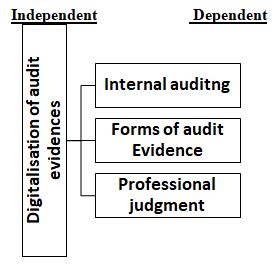
This study uses four important variables and they are Digitalization of audit evidences, Professional judgment, and Different form of digitalized audit evidences. Digitalization of audit evidences is independent variable and internal auditing, forms of audit evidences and professional judgements are dependent variable. The dependent variables are those variables that are influenced by independent variables, but the independent variables are remain unchanged.
RESEARCH GAP AND METHODOLOGY
Though many studies have already been conducted on how information technology is going to impact on auditor’s profession, unable to find any research which examined how the digitalization is going to impact on professional judgment of an internal auditors- one of the key elements of overall audit efficiency. This study explored how digitalisation of audit evidence can impact on the professional judgment of internal auditors in selected companies in Oman.
In this study researchers used quantitative type of research because it involves collection of data from internal auditors using a structured questionnaire and analyze the same with statistical tools. Researchers used descriptive research design to explore various characteristics of the digitalization that have an impact on the professional judgement of internal auditors. The population of the study contains internal auditors working in 6 banks registered in Sultanate of Oman. Out of all the internal auditors employed by these six banks, data have been collected from 28 internal auditors based on convenience sampling. Data have been collected from internal auditors of Bank Muscat, Bank Al Izz, Oman Arab Bank, Oman National Bank, HSBC Bank and Bank Nizwa. A structured questionnaire has been used which consist of 15 questions related to impact of digitalization on professional judgement and two open ended questions.
FINDINGS AND DISCUSSIONS
Researchers were used tools like multi regression analysis and correlation coefficient analysis to measure and examine relationship between digitalization and professional judgment of internal auditors.The results of the study are consistent with all the previous studies mentioned earlier that digitalization have a positive impact on work of an internal auditor. Unlike previous researches, in this study researchers tried to prove that the practices of the banks have a significant influence on digitalized audit evidences and therefor it influences the auditor’s professional judgement professional judgment. The respondents were asked some questions in this regard. To identify the readiness of banks in digitalizing it audit documents, the respondents were asked whether access to any computer system are password protected or not, the majority of respondents 96% stated that it is password protected and only 4% disagreed to the statements. Similarly, another question was asked about multi-level security system existing in each of the banks to ensure highest safety to digitalized audit evidences. 93% of the respondents agree for the same and only 7% disagreed to this. One more question was asked about the company practices when it comes to the data backup in order to preserve the digitized audit evidences in case something goes wrong. The result reveals that 54% of respondents are strongly agreed,36% of the respondent agreed and 11% of them strongly disagreed with this question. Through these responses from the internal auditors, researchers found that banks are following some good practices on digitalization.
Regarding the challenges associated with professional judgment in evaluating digitalized audit evidences, this study found that there will be a substantial obstacle that the internal auditors have to face due to the automation of business process. To conform this theory, the respondents were asked about the important challenges that may face by internal auditors in near future because of process of automations and majority of respondents (about 64%) strongly agreed and that there is going to be a challenge. 25% just agreed and 11% of respondents did not feel that there is going to be a challenge. Furthermore, the researchers asked about how fast the internal audit unit need to upgrade itself to face technological challenges. All respondents agreed that the banks internal audit team needs to be equipped themselves to face future technological challenges.
The result shows that there is moderate positive correlation between digitalization of audit evidence and that of auditor’s professional judgment. However, the two other variables “forms of audit evidence and professional judgment” have strong and direct relation with the digitalization of audit evidence. Coefficient co-relation for both variables is 0.48 and percentage. This can be interpreted that if one unit change in the dependent variables then the independent variable (digitalization of audit evidence) will change around 23% proportionately.
The study also shows that there is negative relation between the different forms of digitalized evidence that the auditors collect to support the professional judgment. The digitalization is applied in the banks with different forms like digitalized evidences, communication system, banking programs etc. This digitalization which comes in different forms influence the professional judgment of the auditors like upgrades of programs, protected software and advance technology, where they touch the formation of digitalization of Audit Evidence positively. In addition, professional judgment strongly influenced and related to new process of internal auditor work after training and the strong regulation of digitalization. This findings of the research agrees with Anna and Ahmed [12]
Moving to the impact of digitalization on auditor professional judgment, both correlation and regression analysis shows strong positive relation. Karl Pearson’s correlation has been used to investigate the sub-variables within the three main variables. Based on the data collected and analyzed, digitalization makes the internal auditors work easier because of new technology, digitalized forms of audit evidence. In addition, digitalization also offers high safety provided by the technology even if the forms of documents move with difference person for authorized purpose. The analysis clearly shows that the digitalization (new programs, advance technology and developed systems) could help the auditor to gain experience and skills in order to evaluate and assess evidence properly. Generally, the system and new technology used by the banks support the auditor work by saving the time and reduce chances of fraud and manipulation. These results are agreed with previous literatures [7,9-12]. As well as, the digitalization (high safety, advance technology) help the auditor to analyze data and evidence in order to gain greater knowledge, experience for professional opinion, where this result supported by [8]
CONCLUSION & RECOMMENDATION
To conclude, most of the studies were focusing on the relation between the information technology and the auditor’s profession. However, this research is investigating the relationship between the digitalization of audit evidences and professional judgment on the internal auditors. The study revealed that there is positive relationship between digitalization of audit evidence and internal auditor’s professional judgment. The result shows that the banks in Sultanate of Oman have been moved to digitized audit evidences, password protected computer system, the banks have multi-level security layer and data back-up etc.
The challenges that the auditor will face due to future automation of business process is that the banks internal auditing departments need to be equipped to face every new technological development. Finally, the digitalization can positively impact the auditor professional judgment from different ways like saving the time because of paperless and the reduce time employed to investigate more in different areas, so chances of fraud and manipulation will be reduced. High safety of systems helps the auditor to analyze data and evidence in order to gain greater knowledge and experience for expressing professional opinion. It is advised that banks should migrate from conventional way of maintaining audit evidences to digitalized platform if they have not done it already. It is better to train internal auditors to acquire enough knowledge, experience, and skills to cope up with the digitalization. It is advised that the banks must ensure its internal audit department equip with technological up gradation to face future technological challenges.
Conflict of Interest:
The authors declare that they have no conflict of interest
Funding:
No funding sources
Ethical approval:
The study was approved by the Higher College of Technology, Sultanate of Oman.
REFERENCES
Dudovskiy et al., "Causal Research: Explanatory Research," 1.1 (2018), Pp. 1-2.
Agnew et al., "The Emergence of Artificial Intelligence: How Automation Is," 1.1 (2017), Pp. 1-2.
Harris et al., "The Future of Auditing: Technology Brings Opportunities and Challenges," 37.2 (2019), Pp. 151-164.
Group et al., "The Impact of Transformational Technology on Auditing and Accounting," 1.1 (2019), Pp. 1-2.
Hazianti Abdul Halim et al., "Factors Influencing Professional Judgment of Auditors in Malaysia," 1.1 (2018), Pp. 1-2.
IFAC et al., "A Framework for Audit Quality, Key Elements That Create an Environment For," 1.1 (2014), Pp. 1-2.
Carin et al., "The Effects of Digitalization on Auditors’ Tools and Working Methods: A Study of the Audit Profession," 1.1 (2017), Pp. 1-2.
Meuldijk et al., "Impact Digitization on the Profession," 1.1 (2017), Pp. 1-2.
Ellen et al., "The Digital Revolution: Threat or Opportunity for the Audit Profession," 1.1 (2016), Pp. 1-2.
Lee et al., "The Effects of Information Technology Innovativeness on Audit Efficiencies," 1.1 (2015), Pp. 1-2.
Ahmad et al., "Information Technology and Its Implications for Internal Auditing: An Empirical Study on Saudi Organizations," 1.1 (2008), Pp. 1-2, DOI https://doi.org/10.1108/02686900810875280.
Recommended Articles
Research Article
Agentic AI in Information Systems: Toward Autonomous Decision-Making in Organizations
Duoha Suhail Najm
Published: 30/07/2026
Download PDF
Research Article
A Comparative Study of Online Fashion Promotion: Hennes & Mauritz (H&M) and Label in India
Riya Jamble
Published: 20/07/2021
Download PDF
Research Article
Developing Social Media Marketing Visual Contents to Increase Engagement Rate (A Case Study of Healthy Tails Animal Clinic in Malang City)
Aditya Nirwana,
...
Felicia Joscelind Verrel
Published: 20/11/2022
Download PDF
Research Article
The Determinants of the Financial Behaviour of SMEs: Empirical Evidence from an Emerging Economy
Santiago Hernandez,
...
Remo Roscigno
Published: 20/03/2022
Download PDF
PO Box 101, Nakuru
Kenya.
Email: office@iarconsortium.org
Editorial Office:
J.L Bhavan, Near Radison Blu Hotel,
Jalukbari, Guwahati-India
Hinai, M. T. A. A., Habsi, M. H. A., Hinai, M. J. A. & Puthukulam, G. (2021). A Study on Impact of Digitalization of Audit Evidences on Professional Judgment of Internal Auditors in Selected Banks in Oman. IAR Journal of Business Management, 2(1), 1-5.
MLA
Hinai, Muayad T. A. A., et al. "A Study on Impact of Digitalization of Audit Evidences on Professional Judgment of Internal Auditors in Selected Banks in Oman." IAR Journal of Business Management 2.1 (2021): 1-5.
Chicago
Hinai, Muayad T. A. A., Marwa H. A. Habsi, Mohammed J. A. Hinai and Gopalan Puthukulam. "A Study on Impact of Digitalization of Audit Evidences on Professional Judgment of Internal Auditors in Selected Banks in Oman." IAR Journal of Business Management 2, no. 1 (2021): 1-5.
Harvard
Hinai, M. T. A. A., Habsi, M. H. A., Hinai, M. J. A. and Puthukulam, G. (2021) 'A Study on Impact of Digitalization of Audit Evidences on Professional Judgment of Internal Auditors in Selected Banks in Oman' IAR Journal of Business Management 2(1), pp. 1-5.
Vancouver
Hinai MTAA, Habsi MHA, Hinai MJA, Puthukulam G. A Study on Impact of Digitalization of Audit Evidences on Professional Judgment of Internal Auditors in Selected Banks in Oman. IAR Journal of Business Management. 2021 Jan;2(1):1-5.


 Download PDF
 Download XML