Introduction: LEMON (Look-Evaluate-Mallampati-Obstruction-Neck mobility) scoring system is considered as one of the popular assessment tools to predict difficult laryngoscopy and tracheal intubation. Previous studies aimed to use LEMON score to predict difficult laryngoscopy and tracheal intubation by correlating them to Cormack and Lehane grading where 3 and above was considered difficult laryngoscopy. None of these studies have identified a precise cut off LEMON score that would predict difficult laryngoscopy and intubation. The aim of this study was to identify an exact LEMON score at or above which we can predict difficult laryngoscopy and tracheal intubation. This would help to prepare equipment and personnel for expected difficult intubation based on this cut off LEMON score. Materials and Methods: 32 consenting patients of either gender between 18-65 year who were scheduled to undergo elective surgical intervention in Khoula Hospital were assessed for LEMON score and its correlation was made with Cormack Lehane grade for assessing difficulty in laryngoscopy and intubation under a uniform general anesthetic technique. The primary objective was to determine the LEMON score at or above which difficult laryngoscopy and tracheal intubation could be predicted. The secondary objectives were to study the role of age, gender and BMI in this study, as well as the sensitivity and specificity of each parameter of the LEMON score. Results: The primary outcome showed LEMON score of 2 and more can predict difficult laryngoscopy and tracheal intubation. For the secondary outcome, it showed different strengths in each component of the LEMON score in predicting difficult intubation. The best specificity (91.30%) and sensitivity (77.78%) to predict difficult tracheal intubation was noted to be hyomental distance <3. We could not show conclusive evidence that age and BMI are variables that could influence the prediction of difficult laryngoscopy and tracheal intubation, possibly because of the small sample size. Conclusion: LEMON score of 2 and more may be predictive of difficult laryngoscopy and tracheal intubation. Hyomental distance and Mallampati grade as individual predictors of the LEMON score can be more effective than others in predicting difficult laryngoscopy and tracheal intubation.
Keywords
LEMON Score
Difficult Laryngoscopy and Tracheal Intubation
Cormack-Lehane Grade
INTRODUCTION
Difficult tracheal intubation is a well-known problem that anesthesiologists face on a regular basis in the operating room [1]. An unexpected difficult intubation is not only challenging but if not managed properly, may subject the patient to significant risks. The prevalence of difficult intubation varies widely from 0.1% to 20% [2-4]. There are several methods to evaluate patient’s airway pre-operatively in order to predict the difficulty that one could face during airway management [5-7]. One of these diagnostic tests is LEMON (Look- Evaluate- Mallampati-Obstruction-Neck movement) score, which is a quick examination method to pick abnormalities that would predict difficult intubation. This enables the attending anesthesiologist to prepare with appropriate airway equipment and request for experienced help if needed. LEMON score consists of 9 total score points [7].
There have been several studies that have assessed the utility of LEMON score in predicting difficult tracheal intubation [6,8-10]. However, none have reported an exact cut off LEMON score at or above which difficult tracheal intubation can be predicted [2,3,11-14].
The aim of the present study was to evaluate the patient airway using LEMON score and to obtain a cut off value at or above which difficult tracheal intubation maybe anticipated. This was our primary objective. Our secondary objective was to identify if age, weight and gender could influence the LEMON scoring, as well as to see which of the nine parameters of LEMON score best correlates with prediction of difficult tracheal intubation.
MATERIALS AND METHODS
This prospective blinded study was conducted on 32 adult patients after obtaining Ethical Approval from Centre of studies and research, Ministry of Health, Oman (proposal ID MoH/CSR/21/23788). Approval was obtained on 28-03-2021. All patients gave their informed consent for participating in this study.
Airway evaluation data of all enrolled patients was done by the primary researcher while the laryngoscopy and tracheal intubation was done by an experienced laryngoscopist of more than 3 years who was blinded to the airway assessment result.
All patients were 18-65 years who underwent elective surgical procedures under general anesthesia requiring endotracheal intubation. All of the patients were evaluated for the LEMON score by the primary researcher a day prior to the surgery in the admitting ward. None of these patients were premedicated. Once the patient was inside the operation theater, monitoring was initiated and induction of anesthesia started with intravenous administration of 2mg/kg of propofol, 2mcg/kg fentanyl and 0.15mg of cisatraciurum. 3 minutes after the administration of muscle relaxant, conventional Macintosh Laryngoscopy was performed by the attending anesthesiologist and he/she graded the Cormack-Lehane view prior to performing tracheal intubation. Correct tracheal intubation was confirmed by capnography and clinically by adequacy of ventilation. Thereafter, anesthesia was maintained with appropriate anesthetic technique as per the attending anesthesiologist’s decision.
Parameters recorded for this study included:
Demographic data (age, BMI and sex of the patients)
LEMON score
Assessment
Description
Score
Look externally
Facial trauma
1
Large incisors
1
Large tongue
1
Incisor distance <3 finger breadth
1
Evaluate 3-3-2 rule
Hyoid-mental distance <3 finger breadths
1
Thyroid to mouth distance <2 finger breadths
1
MALLAMPATTI GRADE = or >3
1
Obstruction
Obstruction
1
Neck mobility
Neck movement (chin to chest)
1
Cormack-Lehane grade
Grade
Description
I
A full view of the entire glottic aperture
II
Represents a partial glottic view
III
Visualization of the epiglottis only
IV
Represents inability to visualize even the epiglottis
Statistics
The estimated sample size was 96 subjects. Out of the total 96 subjects, the number of positive cases (difficult intubation) required was 32 and the number of negative cases (easy intubation) required was 64. The estimation was based on the anticipated AUC (area under the ROC curve) of 0.70 and a ratio of 1:2 (2 negative cases for each positive case). The type I error alpha was set at 5% and the power was set at 90%. The calculation was done using the Med Calc software version 20.109. unfortunately, most of the data collection period was jeopardized by COVID 19 pandemic. We could only collect data from 32 patients who consented and fulfilled our inclusion criteria. This was a serious drawback of this study.
Data pertaining to gender in Table 1 was analyzed statistically using Fisher’s exact test, while
t-test was used to analyze BMI and age of the patients (Table 2). The ROC curve plotted sensitivity versus 1 minus specificity for a range of parameter threshold values. Areas Under the ROC Curve (AUC) was computed along with 95% confidence intervals as an indicator of overall diagnostic performance.
RESULTS
Gender did not demonstrate any influence over difficult tracheal intubation in this series of 32 patients (Table 1). Mean age and BMI were nearly identical in patients who had easy or difficult laryngoscopy and tracheal intubation; hence we cannot presume that they have influence over the difficult laryngoscopy and tracheal intubation in the present study (Table 2).
In this series of 32 patients, we noted 71.87% of the patients showed easy intubation as compared to 28.12% patients showing difficult intubation (Table 3).
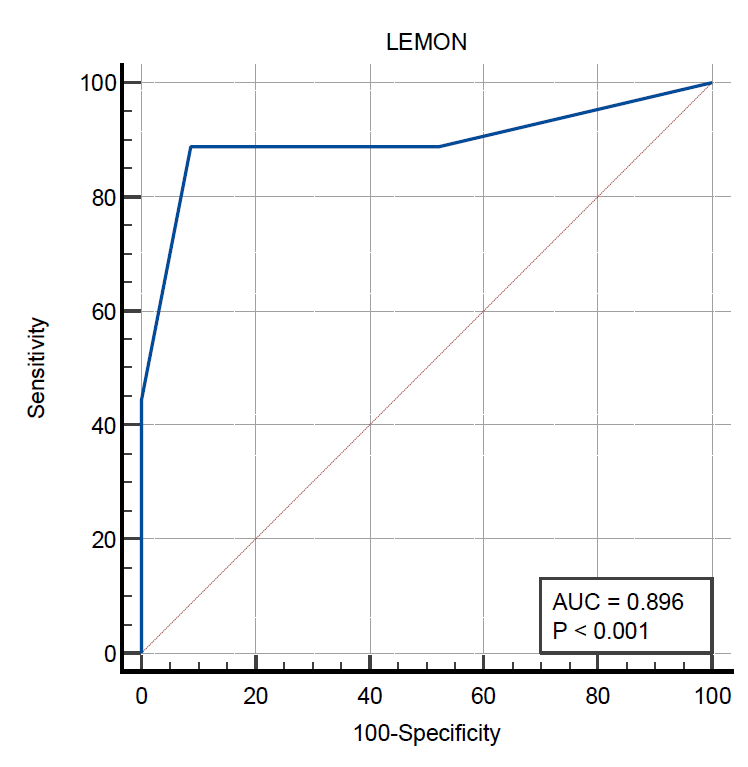
ROC curve demonstrates that LEMON score of 2 and above may be a predictor of difficult laryngoscopy and tracheal intubation, suggesting a prior preparation before undertaking tracheal intubation in these patients (ROC Figure 1).
As can be seen from Table 4, the best individual predictor of the nine LEMON parameters was noted to be hyomental distance of <3 fingers. It showed a specificity of 91.30% and sensitivity of 77.78%. This was followed by Mallampati grade 3 and 4 with specificity 86.96% and sensitivity 77.78% respectively. We did not have any patients with large tongue or obstruction to analyze for their role in predicting difficult laryngoscopy and tracheal intubation.
DISCUSSION
In this study, the incidence of difficult laryngoscopy and tracheal intubation (Cormack-Lehane 3 and 4) was 28.12%. This is almost in agreement to the findings of earlier workers who reported the incidence of difficult intubation to range from 0.1-20%.2-4 This wide range of incidence reported in literature may be attributed to difference in defining what constitutes a difficult intubation.
A somewhat higher incidence of difficult tracheal intubation in the present study may be a chance finding that may be attributed to the small sample size of 32 patients as compared to much larger size of earlier studies.
Table 1: Showing Influence of Gender on Difficult Tracheal Intubation
Variable
Gender
Total
Male
Female
LEMON
Easy intubation (0-1)
Count
13
9
22
% within LEMON
59.1%
40.9%
100.0%
Difficult intubation (>= 2)
Count
7
3
10
% within LEMON
70.0%
30.0%
100.0%
Total
Count
20
12
32
% within LEMON
62.5%
37.5%
100.0%
Fisher’s exact test
0.703
Table 2: Showing The Influence of Age and BMI on Difficult Tracheal Intubation
Group Statistics
LEMON
N
Mean
Std. Deviation
p-value
Age
Easy intubation (0-1)
22
36.86
13.984
0.950
Difficult intubation (>= 2)
10
37.20
13.871
BMI
Easy intubation (0-1)
22
26.5758
6.05852
0.462
Difficult intubation (>= 2)
10
28.1520
4.08934
Table 3: Showing The Overall Incidence of Difficult and Easy Intubation in This Series
Type of intubation
Number of patients
%
Easy intubation
23
71.875
Difficult intubation
9
28.125
Figure 1: Showing ROC Curve of the Present Data
The present study evaluated the predictive power of LEMON score for difficult laryngoscopy (Cormack-Lehane grade of 3 and 4) and tracheal intubation in patients coming for surgery under general anesthesia. We observed that LEMON score of 2 and above predicted difficult laryngoscopy (Cormack-Lehane grade of 3 and 4). This finding agrees with the earlier report that a higher LEMON score predicts difficult laryngoscopy and tracheal intubation. Contrary to the present study, none of the earlier studies have given mean cut off score above which difficult laryngoscopy and tracheal intubation would be correctly predicted [6,8-10].
There are no studies in literature that have assessed the effect of demographic variables like age, gender and BMI on the predictability of LEMON score to difficult laryngoscopy and tracheal intubation. In this study, we made an attempt to study if these demographic variables play a role in predicting difficult tracheal intubation. Our findings, with this limited sample size of 32 patients, are inconclusive in respect of age and BMI having any influence as their means were nearly identical in easy and difficult laryngoscopy groups. Gender of the patient did not demonstrate any influence on the predictability of LEMON score in relation to prediction of difficult laryngoscopy and tracheal intubation. A study with a larger sample size would be needed to confirm these findings.
We observed that out of the nine parameters included in LEMON score, the best single predictive parameter of the LEMON score was hyomental distance <2, with the best sensitivity and specificity. This was followed by Mallampati grade of 3 or 4 that was associated with difficult laryngoscopy and tracheal intubation with a marginally lower sensitivity and specificity. There has been an earlier study that has identified some components of LEMON score that have stronger prediction power of difficult laryngoscopy and tracheal intubation [15].
Two of the LEMON parameters in this study (large tongue and obstruction) demonstrated no influence over difficult laryngoscopy. This is attributed to none of our patients having large tongue or obstruction in this series.
Limitations of this study included a small sample size of 32 patients and being single centric. In addition, this study included patients undergoing elective surgeries and not enrolling pediatric patients. Future studies may be directed to overcome these handicaps.
In conclusion, data from this study suggests that the modified LEMON score of 2 and above may be useful in predicting difficult tracheal intubation. We would recommend that laryngoscopy and tracheal intubation in any patient with LEMON score of 2 and more should be performed by or under the direct supervision of an experienced airway personnel, while paying careful attention to preoxygenation and availability of readily accessible airway adjuncts like Video laryngoscope, bougie, laryngeal mask airway, or cricothyrotomy kit.
REFERENCES
D. McPherson et al. “A survey of anesthetic practice in predicting difficult intubation in UK and Europe.” European Journal of Anaesthesiology, vol. 29, 2012, pp. 218–222.
D.K. Rose and M.M. Cohen. “The incidence of airway problems depends on the definition used.” Canadian Journal of Anaesthesia, vol. 43, 1996, pp. 30–34.
J.L. Benumof “Management of the difficult adult airway: with special emphasis on awake tracheal intubation.” Anesthesiology, vol. 75, 1991, pp. 1087–1110.
K. El-Radaideh, et al. “Evaluation of different airway tests to determine difficult intubation in apparently normal adult patients undergoing surgical procedures.” Patient Safety in Surgery, vol. 14, 2020, p. 43.
“Haster, Christopher Evan”. A Comparison of Preoperative Airway Assessment Techniques: The Modified Mallampati and the Upper Lip Bite Test, 2007.
M.J.Reed et al. “Can an airway assessment score predict difficulty at intubation in the emergency department?” Emergency Medicine Journal, vol. 22, 2005, pp. 99–102.
L.C. Berkow and P. Ariyo. “Preoperative assessment of the airway.” Trends in Anaesthesia and Critical Care, vol. 5, 2015, pp. 28–35.
S. Soyuncu et al. “Determination of difficult intubation in the ED.” American Journal of Emergency Medicine, vol. 27, 2009, pp. 905–910.
Y.Hagiwara et al. “Prospective validation of the modified lemon criteria to predict difficult intubation in the ED.” American Journal of Emergency Medicine, vol. 33, 2015, pp. 1492–1496.
S.M.Ji et al. “Correlation between modified lemon score and intubation difficulty in adult trauma patients undergoing emergency surgery.” World Journal of Emergency Surgery, vol. 13, 2018, p. 33.
D.B.Mshelia et al. “Use of LEMON score in predicting difficult intubation in Africans.” Respiratory Research Journal, vol. 15, 2018, pp. 17–23.
O. Selvi et al. “Evaluation of the reliability of preoperative descriptive airway assessment tests in prediction of the Cormack Lehane score: a prospective randomized clinical study.” Journal of Clinical Anesthesia, vol. 36, 2017, pp. 21–26.
W. Ittichaikultholet al. “Modified Mallampati test and thyromental distance as a predictor of difficult laryngoscopy in Thai patients.” Journal of the Medical Association of Thailand, vol. 93, 2010, pp. 84–89.
İ. Yıldırım et al. “Determining the efficiency of different preoperative difficult intubation tests on patients undergoing caesarean section.” Balkan Medical Journal, vol. 34, 2017, pp. 436–443.
S. Tripathi et al. “LEMON Score: A tool to predict difficult airway in ed in Indian setting.” International Journal of Medical and Biomedical Studies, vol. 3, 2019, pp. 62–67.
Recommended Articles
Research Article
Evidence Guided, Experience Based and Patient Compatible 3-Step Protocol for Managing Moderate to Severe Category of COVID19 Infections
Farah Husain,
...
Kirti N Saxena
Published: 05/01/2021
Download PDF
Research Article
A Descriptive Cross-Sectional Study to Evaluate the Knowledge about Symptoms and Risk Factors for Heart Attack (Myocardial Infarction) Among the General Population of New Delhi
Aastha Sehgal,
...
Avneet Kaur
Published: 06/05/2023
Download PDF
Research Article
Knowledge About Risk and Preventive Factors for Osteoarthritis Knee among Ortho OPD Patients in Regional Hospital, Keylong in District Lahaul and Spiti of Himachal Pradesh
Ajay Thakur,
Jaspal Chaudhary
Published: 20/06/2022
Download PDF
Research Article
A Randomized Controlled Trial Comparing the Effect of Oral Preemptive Pregabalin Compared to IV Lignocaine in Attenuating Hemodynamic Response to Laryngoscopy
P. Aashik,
...
B.N. Reddy
Published: 17/05/2023
Download PDF
PO Box 101, Nakuru
Kenya.
Email: office@iarconsortium.org
Editorial Office:
J.L Bhavan, Near Radison Blu Hotel,
Jalukbari, Guwahati-India
Saadi, N. R. A., Haris, A. & Khan, R. (2022). A Prospective Study to Identify the Critical Lemon Score for Predicting Difficult Intubation. IAR Journal of Anaesthesiology and Critical Care, 3(2), 1-4.
MLA
Saadi, Nada R. A., Aziz Haris and Rashid Khan. "A Prospective Study to Identify the Critical Lemon Score for Predicting Difficult Intubation." IAR Journal of Anaesthesiology and Critical Care 3.2 (2022): 1-4.
Chicago
Saadi, Nada R. A., Aziz Haris and Rashid Khan. "A Prospective Study to Identify the Critical Lemon Score for Predicting Difficult Intubation." IAR Journal of Anaesthesiology and Critical Care 3, no. 2 (2022): 1-4.
Harvard
Saadi, N. R. A., Haris, A. and Khan, R. (2022) 'A Prospective Study to Identify the Critical Lemon Score for Predicting Difficult Intubation' IAR Journal of Anaesthesiology and Critical Care 3(2), pp. 1-4.
Vancouver
Saadi NRA, Haris A, Khan R. A Prospective Study to Identify the Critical Lemon Score for Predicting Difficult Intubation. IAR Journal of Anaesthesiology and Critical Care. 2022 Jul;3(2):1-4.


 Download PDF
 Download XML