Comparison Between Ultrasound Guided Femoral Block Versus Intravenous Fentanyl for Their Analgesic Effectiveness in Ease of Patient Positioning for Subarachnoid Block
K.R. Vasantha Kumar
1
,
Anand P. MATH
2
,
Saikumar C. Patil
3
,
Musunuri Bala Tripura
3
,
C.R. Sanjay
3
1
Professor, Anaesthesiology, AIMS, ACU, B. G. Nagara, Bellur, Mandya, Karantaka, India.
2
Senior Resident, Anaesthesiology, GIMS, Gulbarga, Karnataka, India
3
Post-Graduate, Anaesthesiology, AIMS, ACU, B.G. Nagara, Bellur, Mandya, Karantaka, India
Aim of the Study: Comparison between ultrasound guided femoral block versus intravenous fentanyl for their analgesic effectiveness in ease of patient positioning for subarachnoid block. Materials and Methods: This double-blind study was planned with fifty patients of ASA 1 and ASA 2, aged between 20 to 80 years scheduled to undergo surgery for fracture neck of femur. It is a randomized prospective study where patients were allocated to two groups. Group A (N = 25) patients were given 10ml of Inj. Bupivacaine 0.5% for femoral nerve block with the help of ultrasound guidance. Group B (N = 25) patients received titrated doses. of Inj. Fentanyl 0.5mcg/kg I.V. This dosage was repeated to 3 doses with a total of 1.5 mcg with 5 minutes interval between the doses. Visual analogue scale was used 15 minutes after the block/I.V. Fentanyl i.e., during positioning to assess the analgesia provided. Sub arachnoid block was performed using appropriate dose of Inj. Bupivacaine (hyperbaric, dextrose 80mg/mL). was recorded by another anaesthesiologist blinded to the mode of analgesia with scores of 0-3. Results: Statistically significant difference was noted in VAS score among Group A (Mean = 1.44, SD = 1.583) and Group B (Mean = 2.96, SD = 2.010) with a p value of 0.044 (Chi Square test). Conclusion: From this study it can be concluded that in comparison to I.V Fentanyl, femoral nerve Block is more efficacious for ease of positioning during spinal anaesthesia in fracture neck of femur surgeries. Femoral nerve Block provides superior analgesia and better quality of patient positioning. This further aids in reducing the time taken to perform spinal anaesthesia in sitting position when compared to intravenous Fentanyl in fracture neck of femur surgery.
Keywords
Neck of Femur Fracture
Intravenous Fentanyl
Femoral Nerve Block
FNB
Ease of Positioning
INTRODUCTION
Neuraxial anaesthesia is the most preferred technique of anaesthesia for many of the infraumbilical surgeries unless contraindicated. And when it is combined with peripheral nerve blocks it has various advantages over general anaesthesia as it renders perioperative pain relief, reduction in requirement of systemic analgesics, avoiding poly pharmacy, airway manipulation and also enables early ambulation of the patient. This decreasing the chances of deep vein thrombosis in the postoperative period. Proper positioning of the patient is a basic requirement for neuraxial procedures. Positioning should be comfortable to the patient and is a prerequisite for the anaesthesiologist performing the procedure.
Neck of femur fracture is one of the commonest orthopedic injuries especially in elderly age group. Fracture neck of femur itself is a very painful bony injury. This is because the periosteum has very low pain threshold among the deep somatic structures [1-3]. Any movement of the injured limb causes severe pain and patient will not be comfortable to maintain the position during neuraxial procedures. Several analgesic modalities such as: intravenous opioids, femoral nerve block, fascia iliaca block with local anaesthetics have been employed to decrease the pre-operative pain and improve the quality of positioning the patients [4-6]. However, varied results were obtained regarding superiority of FNB on intravenous Inj. Fentanyl. Review of literature has shown the superiority of the FNB as compared to the intravenous Inj. Fentanyl. However, as per the recent studies there is no benefit of FNB over intravenous Inj. Fentanyl [3]. Hence, in this prospective randomized control trial we intend to compare the analgesic efficacy of ultrasound guided femoral nerve block and intravenous Inj. Fentanyl.
Aim of the Study
Comparison between ultrasound guided femoral block versus intravenous fentanyl for their analgesic effectiveness in ease of patient positioning for subarachnoid block.
MATERIALS AND METHODS
After the required institutional ethical clearance, fifty patients belonging to American society of anaesthesiology physical status grading 1 and 2, aged between 20 to 80 years scheduled to undergo surgery for fracture neck of femur were randomly allocated to two groups by a computer-generated list. All the patients were explained about the anaesthesia procedures and a written informed consent was obtained. Exclusion criteria were patient’s refusal, multiple fractures, peripheral neuropathy, bleeding disorders, allergy to local anaesthetics and presence of wound or infection at the site of block.
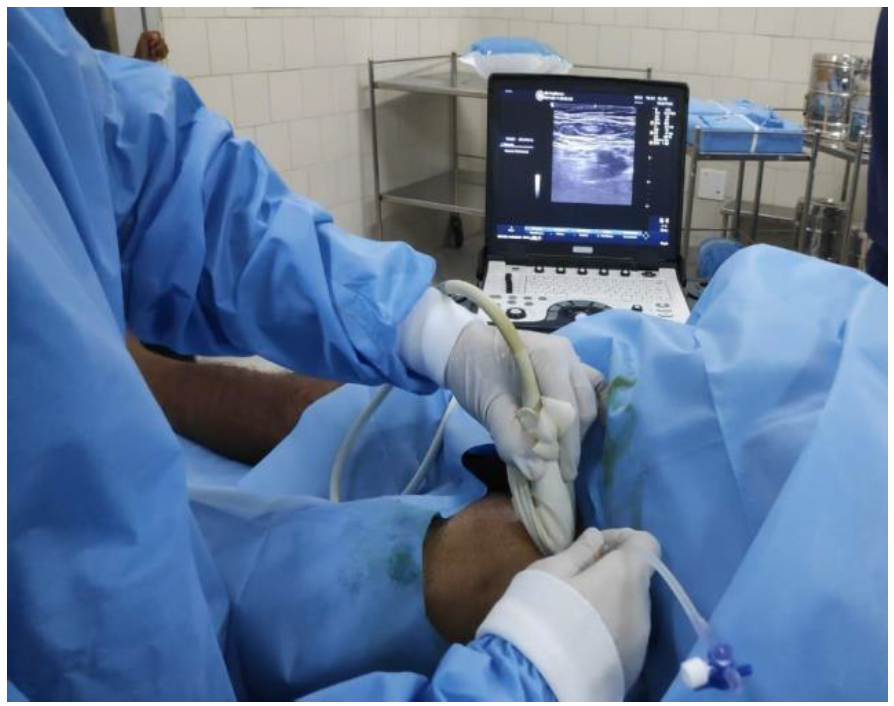
Figure 1: Femoral Nerve Block Being Performed Under Ultrasound Guidance
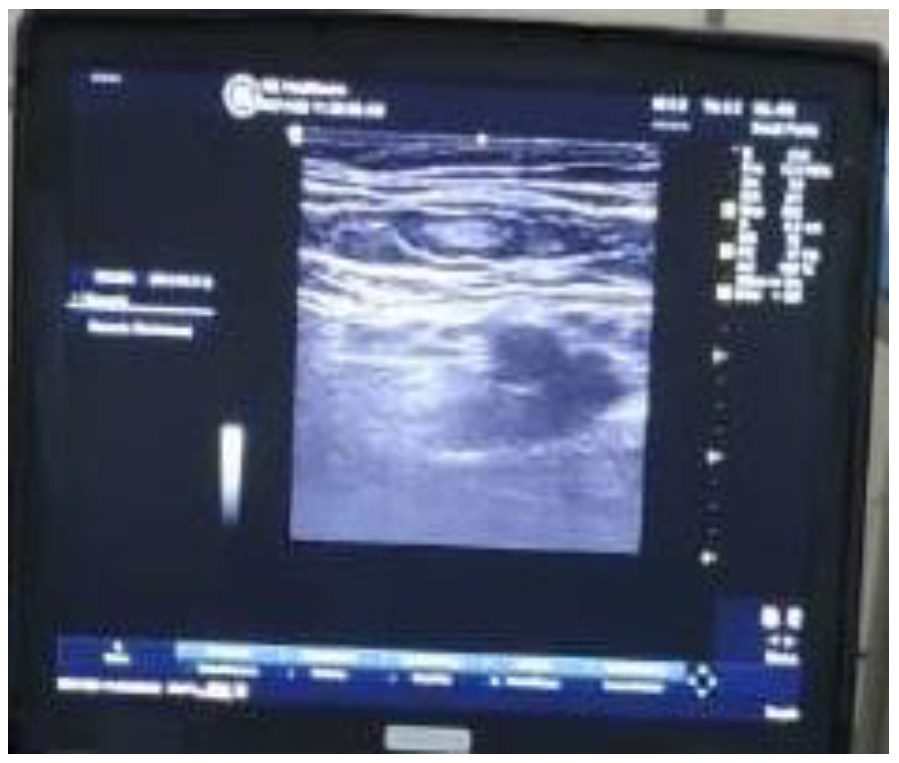
Figure 2: Local Anaesthetic Being Deposited Around Femoral Nerve
Patient belonging to group A (N = 25) received ultrasound guided femoral nerve block using 10ml of Inj. Bupivacaine 0.5% (Figure 1 and 2). And those belonging to group B (N = 25) received titrated doses of Inj. Fentanyl 0.5mcg/kg via intravenous route, repeated to maximum of three doses (1.5 mcg/kg totally) with 5 minutes interval between doses.Visual analogue scale was used 15 minutes after the block/I.V. Fentanyl i.e., during positioning to assess the analgesia provided.
Following strict aseptic precautions, sub arachnoid block was given in the sitting posture in the L2-L3/L3-L4 space using appropriate dose of Inj. Bupivacaine (hyperbaric, dextrose 80mg/mL).
Scores of 0-3 were given to the quality of positioning the patient by another anaesthesiologist who is blinded to the method of analgesia (Table 1).
Time taken from beginning of positioning the patient to end of spinal anaesthesia procedure was recorded as Time to perform spinal anaesthesia. Hemodynamic parameters during the procedure and after positioning of the patients were recorded. Data were analysed using an SPSS version 19 software. Various variables of mean, standard deviation were obtained. Pearson chi square test was used to perform the statistical analysis. p-value of <0.05 was considered statistically significant.
RESULTS
During the study period 56 patients meeting the inclusion criteria were included. 2 patients were excluded for having multiple fractures in the lower limb, 3 patients were excluded because of infection at the site of block and one patient had deranged coagulation profile. No statistically significant difference was obtained among various demographical parameters like age and sex of the patient, weight, ASA physical status and hemodynamic parameters, time taken for subarachnoid block between the two groups.
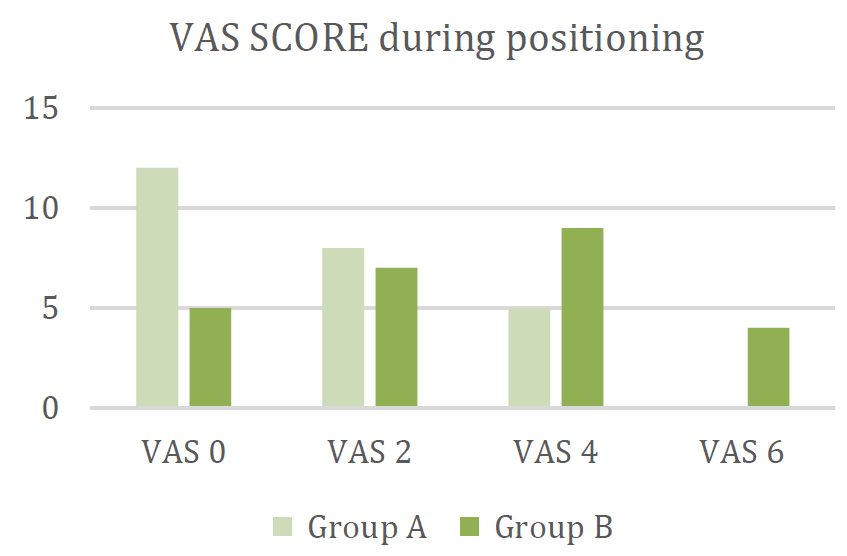
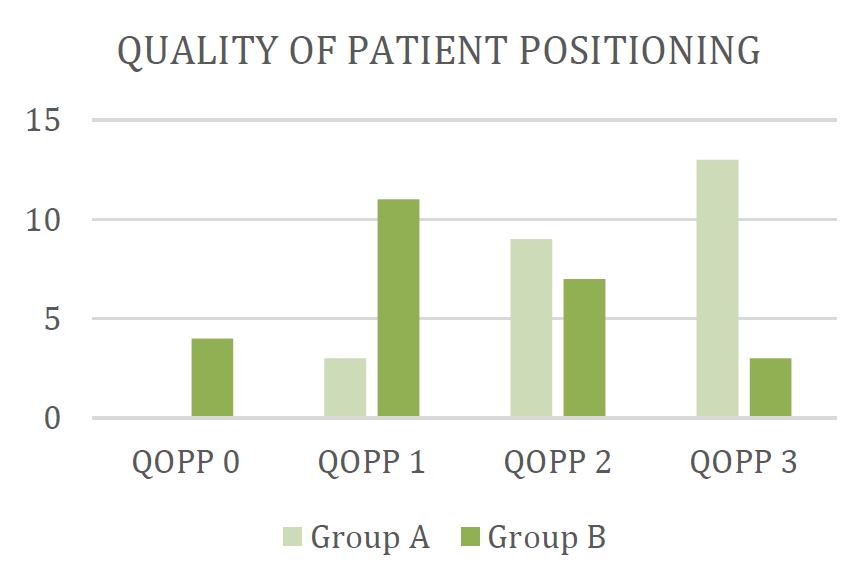
There was a statistically notable difference in mean VAS score values during positioning in between Group A (Mean = 1.44, SD = 1.583) and Group B (Mean= 2.96, SD = 2.010) with a significant p-value of 0.044. Also, statistically significant difference was observed in relation to quality of patient positioning among Group A (Mean = 2.40, SD = 0.707) and Group B (Mean = 1.36, SD = 0.907) patients with p-value of 0.002 as per Chi Square test.
Table 1: Scoring of Quality of Patient Positioning
Score
Inference
0
Not Satisfactory
1
Satisfactory
2
Good
3
Optimal
Table 2: Visual analogue scale score after positioning
Variables
Group A
%
Group B
%
VAS 0
12
48.00
5
20.00
VAS 2
8
32.00
7
28.00
VAS 4
5
20.00
9
36.00
VAS 6
0
0.00
4
16.00
Total
25
100
25
100
Table 3: Quality of Patient Positioning Score for Subarachnoid Block
Variables
Group A
%
Group B
%
QOPP 0
0
0.00
4
16.00
QOPP 1
3
12.00
11
44.00
QOPP 2
9
36.00
7
28.00
QOPP 3
13
52.00
3
12.00
Total
25
100
25
100
Table 4: Comparison of Mean Scores of VAS and QOPP
Mean VAS Score
Mean Score For QOPP
GROUP A
1.44±1.583
2.4±0.707
GROUP B
2.96±2.01
1.36±0.907
Table 5: Pearson Chi Square Test
Variables
Value
Degree of freedom
p-value
VAS score
8.092
3
0.044
QOPP score
15.071
3
0.002
Figure 3: VAS Score During Positioning
Figure 4: Quality Of Patient Positioning
DISCUSSION
Subarachnoid block is the preferred plan of anaesthesia for reduction of fracture neck of femur. It has many advantages like avoiding polypharmacy and airway manipulation, early mobility of the patient, reduced chances of deep vein thrombosis and post operative analgesia when compared to general anaesthesia. Positioning of the patient plays a vital role for performing the subarachnoid block procedure. As the fracture neck of femur is very painful injury, positioning of the patient for subarachnoid block will cause discomfort and the patient cannot maintain the position, which poses difficulty while performing the subarachnoid block. Hence adequate analgesia must be provided before performing the subarachnoid block.
The various systemic analgesics like opioids used to provide pain relief during positioning these patients affects the morbidity of the patient by their copious side effects like cognitive impairment, respiratory depression, urinary retention, vomiting etc. Hence, Nerve blocks like the femoral nerve block, fascia iliaca compartment block, 3 in 1 block provide an alternative approach for pain relief and ease of positioning for subarachnoid block procedure [7,8].
This prospective, randomized study was performed to compare the analgesic efficacy of intravenous fentanyl and ultrasound guide femoral nerve block. Visual analogue scale values in femoral nerve block group were significantly lower than intravenous fentanyl group. In other study by Iamaroon A et al. [3], it was unable to demonstrate significant benefit of femoral nerve block using peripheral nerve stimulator over intravenous fentanyl. In this study we have performed femoral nerve using GE LOGIQ ultrasound with linear probe. Ultrasound guided nerve block helps in accurately depositing the local anaesthetic solution around the nerve sheath. We observed a statistically significant difference in mean VAS score at the time of positioning the patient for subarachnoid block between the with two groups with a p-value of 0.044. The quality of patient positioning was also better in femoral nerve block group with a mean QOPP score of 2.4±0.707 and it was statistically significant when compared to intravenous fentanyl group with p-value of 0.002 (Table 5).
CONCLUSION
From this study it can be concluded that in comparison to I.V Fentanyl, femoral nerve Block is more efficacious for ease of positioning during spinal anaesthesia in fracture neck of femur surgeries. Femoral nerve Block provides superior analgesia and better quality of patient positioning. This further aids in reducing the time taken to perform spinal anaesthesia in sitting position when compared to intravenous Fentanyl in fracture neck of femur surgery. Ultrasound guidance increases the accuracy and safety of depositing the local anaesthetic solution around the nerve sheath.
REFERENCES
S. Sia et al. "Analgesia before performing a spinal block in the sitting position in patients with femoral shaft fracture: A comparison between femoral nerve block and intravenous fentanyl." Anesthesia and Analgesia, vol. 99, 2004, pp. 1221–1224.
F. Mosaffa et al. "Analgesia before performing a spinal block in the lateral decubitus position in patients with femoral neck fracture: A comparison between fascia iliaca block and IV fentanyl." Regional Anesthesia and Pain Medicine, vol. 30, suppl. 1, 2005, p. 61.
A. Iamaroon et al. "Femoral nerve block versus fentanyl: analgesia for positioning patients with fractured femur." Local and Regional Anesthesia, vol. 3, 2010, pp. 21–26.
I. Stanley. "The anaesthetic management of upper femoral fracture." Current Anaesthesia and Critical Care, vol. 16, 2005, pp. 23–33.
C.P. Gosavi et al. "Use of femoral nerve block to help positioning during conduct of regional anesthesia (Abstract)." Bombay Hospital Journal, 2001. http://www.bhj.org/journal/2001_4304_oct/org_531.htm.
R.M. Sorenson and N.L.Pace. "Anesthetic techniques during surgical repair of femoral neck fractures: A Meta-Analysis." Anesthesiology, vol. 77, 1992, pp. 1095–1104.
A.K. Fletcher et al. "Three-in-one femoral nerve blockade as analgesia for fractured neck of femur in the emergency department: A randomized, controlled trial." Annals of Emergency Medicine, vol. 41, 2003, pp. 227–233.
B. Urbanek et al. "Onset time, quality of blockade and duration of three-in-one blocks with levobupivacaine and bupivacaine." Anesthesia and Analgesia, vol. 97, 2003, pp. 888–892.
Recommended Articles
Research Article
Evidence Guided, Experience Based and Patient Compatible 3-Step Protocol for Managing Moderate to Severe Category of COVID19 Infections
Farah Husain,
...
Kirti N Saxena
Published: 05/01/2021
Download PDF
Research Article
A Descriptive Cross-Sectional Study to Evaluate the Knowledge about Symptoms and Risk Factors for Heart Attack (Myocardial Infarction) Among the General Population of New Delhi
Aastha Sehgal,
...
Avneet Kaur
Published: 06/05/2023
Download PDF
Research Article
Knowledge About Risk and Preventive Factors for Osteoarthritis Knee among Ortho OPD Patients in Regional Hospital, Keylong in District Lahaul and Spiti of Himachal Pradesh
Ajay Thakur,
Jaspal Chaudhary
Published: 20/06/2022
Download PDF
Research Article
A Randomized Controlled Trial Comparing the Effect of Oral Preemptive Pregabalin Compared to IV Lignocaine in Attenuating Hemodynamic Response to Laryngoscopy
P. Aashik,
...
B.N. Reddy
Published: 17/05/2023
Download PDF
PO Box 101, Nakuru
Kenya.
Email: office@iarconsortium.org
Editorial Office:
J.L Bhavan, Near Radison Blu Hotel,
Jalukbari, Guwahati-India
Kumar, K. V., MATH, A. P., Patil, S. C., Tripura, M. B. & Sanjay, C. (2022). Comparison Between Ultrasound Guided Femoral Block Versus Intravenous Fentanyl for Their Analgesic Effectiveness in Ease of Patient Positioning for Subarachnoid Block. IAR Journal of Anaesthesiology and Critical Care, 3(2), 1-4.
MLA
Kumar, K.R. Vasantha, et al. "Comparison Between Ultrasound Guided Femoral Block Versus Intravenous Fentanyl for Their Analgesic Effectiveness in Ease of Patient Positioning for Subarachnoid Block." IAR Journal of Anaesthesiology and Critical Care 3.2 (2022): 1-4.
Chicago
Kumar, K.R. Vasantha, Anand P. MATH, Saikumar C. Patil, Musunuri Bala Tripura and C.R. Sanjay. "Comparison Between Ultrasound Guided Femoral Block Versus Intravenous Fentanyl for Their Analgesic Effectiveness in Ease of Patient Positioning for Subarachnoid Block." IAR Journal of Anaesthesiology and Critical Care 3, no. 2 (2022): 1-4.
Harvard
Kumar, K. V., MATH, A. P., Patil, S. C., Tripura, M. B. and Sanjay, C. (2022) 'Comparison Between Ultrasound Guided Femoral Block Versus Intravenous Fentanyl for Their Analgesic Effectiveness in Ease of Patient Positioning for Subarachnoid Block' IAR Journal of Anaesthesiology and Critical Care 3(2), pp. 1-4.
Vancouver
Kumar KV, MATH AP, Patil SC, Tripura MB, Sanjay C. Comparison Between Ultrasound Guided Femoral Block Versus Intravenous Fentanyl for Their Analgesic Effectiveness in Ease of Patient Positioning for Subarachnoid Block. IAR Journal of Anaesthesiology and Critical Care. 2022 Jul;3(2):1-4.



 Download PDF
 Download XML