Background/Aim: Norepinephrine, first line adrenergic agent used in critically ill patients with septic shock status, may additionally exacerbate catecholamine toxicity and in certain circumstances may contribute to poorer clinical outcomes that mostly related to sinus tachycardia or tachyarrythmia. Methods: A retrospective study was conducted between Jan 2018 to May 2021. New Onset Prolonged Sinus Tachycardia (NOPST) incidence was recorded if the HR increased by at least 20% from baseline and exceeded 100 bpm and it was correlated with the corresponding Norepinephrine infusion rate. The correlation between NOPST incidence and its corresponding NE infusion rate was statistically investigated by Spearman Correlation Test. The studied critically ill patients divided to either Non-Septic Shock Cohort (Group I) or Septic Shock Cohort (Group II). In addition to One Sample and Independent-T Tests, Chi Square Test was used for the non-parametric data. The ROC analysis was used to investigate the AUROC and the operational Cutoff Norepinephrine rate was picked by investigating the highest youden’s index. Results: The overall NOPST incidence for our 1638 eligible studied critically ill patients was assessed at 65.6% during an average of 14.08±4.06 days and 21.00±5.61 days of the ICU and overall hospital admission days, respectively, in which only ICU stay days was significantly lower in Non-Septic Shock Cohort compared to the Septic Shock Cohort [13.85±3.39 days vs 14.40±4.82 days]. The operating cut-off NE infusion rate to elicit NOPST was investigated at 11.3 mcg per min with sensitivity and specificity of 55.70%, 90.80%, respectively. Conclusion: Septic critically patients on Norepinephrine infusion have significantly higher risk of New Onset Prolonged Sinus Tachycardia (NOSPT) and significantly higher ICU admission days, especially if this infusion rate exceeding 11.5 mcg/min.
Keywords
Norepinephrine
Sinus Tachycardia
Septic Shock
Admitted ICU Patients
Overall Mortality
Early and Late Mortality
INTRODUCTION
Basically, measurement of systolic, diastolic, and mean arterial pressures (SBP, DBP, and MAP, respectively) have been considered an appropriate practical way to translate patients’ hemodynamic statuses into a meaningful clinical data that can guide us to early actively management, or proactively in certain circumstances [1].
Initially, the hyperadrenergic related tachycardia, a physiological compensatory fight mechanism, may negate some of the septic shock vasodialtory associated hypotension. After fluid resuscitation failure to stabilize blood pressure indices at or near targets, sepsis induced hypotension (SIH) status is clinically termed as septic shock (SS). Septic shock is commonly associated with an early massive catecholamines hypersecretion for life-saving and it can be arbitrarily considered as a Norepinephrine dependent condition that physiologically characterized by an accelerated organ failures which can be numerically translated by an upgrading in Sequential Organ Failure Assessment (SOFA) score by at least 2 points. Despite advances in critical care medicine and facilities, septic shock is still a serious medical status with high mortality rate [2-3].
Of important, Norepinephrine, a first line vasopressor in septic critically ill patients, may further exaggerate this hyper-catecholaminisation status and its related toxicities, in particular of, cardiotoxicity. Cardiotoxicities are initially appeared as sinus tachycardia, HR>100 bpm with %∆ HR>20%, or as new onset prolonged sinus tachycardia (NOPST), if it is persisted > 6 hours, or in more advances cases as supraventricular tachyarrythmia. These hyperadrenergic related complications are clinically contribute to a poorer outcome, including, cardiomyopathies and other organ dysfunctions, higher ICU and overall hospital stay days, lower ventilation free days (VFDs), and overall mortality rate [4-5].
While tachyarrythmia or even sinus tachycardia is clearly considered as an independent risk factor for mortality and morbidity in several myocardial clinical conditions and is well linked to cardiology patients’ outcomes, it is gained less attention in septic critically ill patients and only a limited small clinical studied have investigated the correlations regarding Norepinephrine infusion rates and the incidences of sinus tachycardia and overall major clinical outcomes [6-7]. In this study we pursued to investigate these correlations and major clinical negative outcomes of length of stay days and overall mortalities.
MATERIALS AND METHODS
This study was retrospectively conducted in a 33-bed multi-disciplinary Intensive Care Unit in the King Hussein Medical Center (KHMC) of the Royal Medical Services (RMS) Hospitals, a major tertiary referral medical center in our country, Jordan. Admitted Critically ill patient’s data were retrospectively retrieved from our electronic medical record system (Hakeem) over 2 years and 5 months from Jan 2018 to May 2021. Critically ill patients who were below 18 years, whose ICU length of stay (LOS) didn’t exceed 3 days, and whose studied variables were totally or partially missed were excluded from our study.
Hemodynamics was retrospectively retrieved from Hakeem system for the whole Norepinephrine infusion duration and mathematically averaged. Shock index (SI) and modified Shock Index (mSI) were mathematically calculated by taking the quotient of HR over SBP and MAP, respectively. Serial serum albumin measurements and other laboratory chemistries were also retrospectively retrieved and taking the average of at least 3 measurements for each.
All collected variables are thereafter divided into parametric data and non-parametric for which the comparative parametric data were analyzed across the two studied groups, Non-Septic Shock Cohort (Group I) and Septic Shock Cohort (Group II), by Independent and One Sample T Tests to express the analysis results as either Mean±SD or Mean difference±SEM as fully described in Table 1. In other side of data, the non-parametric variables were analyzed using the Chi Square Test and the outcomes results were expressed as Number (Percentage) and the relative risk estimates were expressed as odd ratio (OD) as thoroughly summarized in Table 2. Additionally, the eligible studied critically ill patients’ Pre-ICU admission wards were further classified into medical and surgical wards.
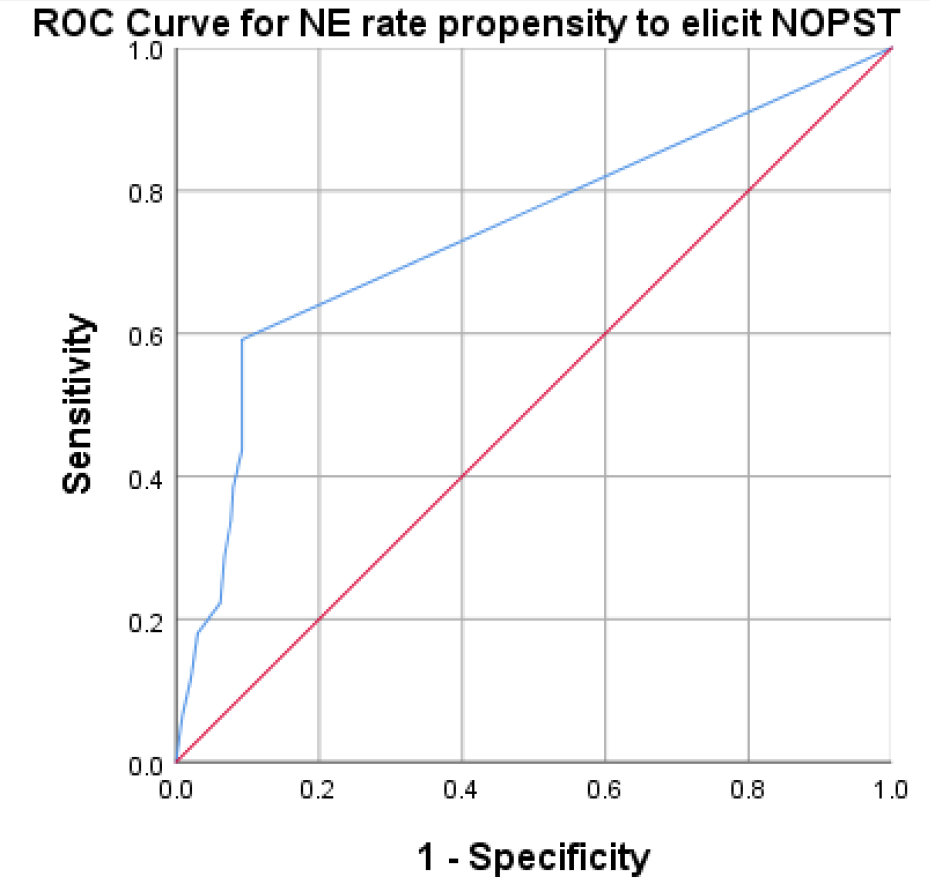
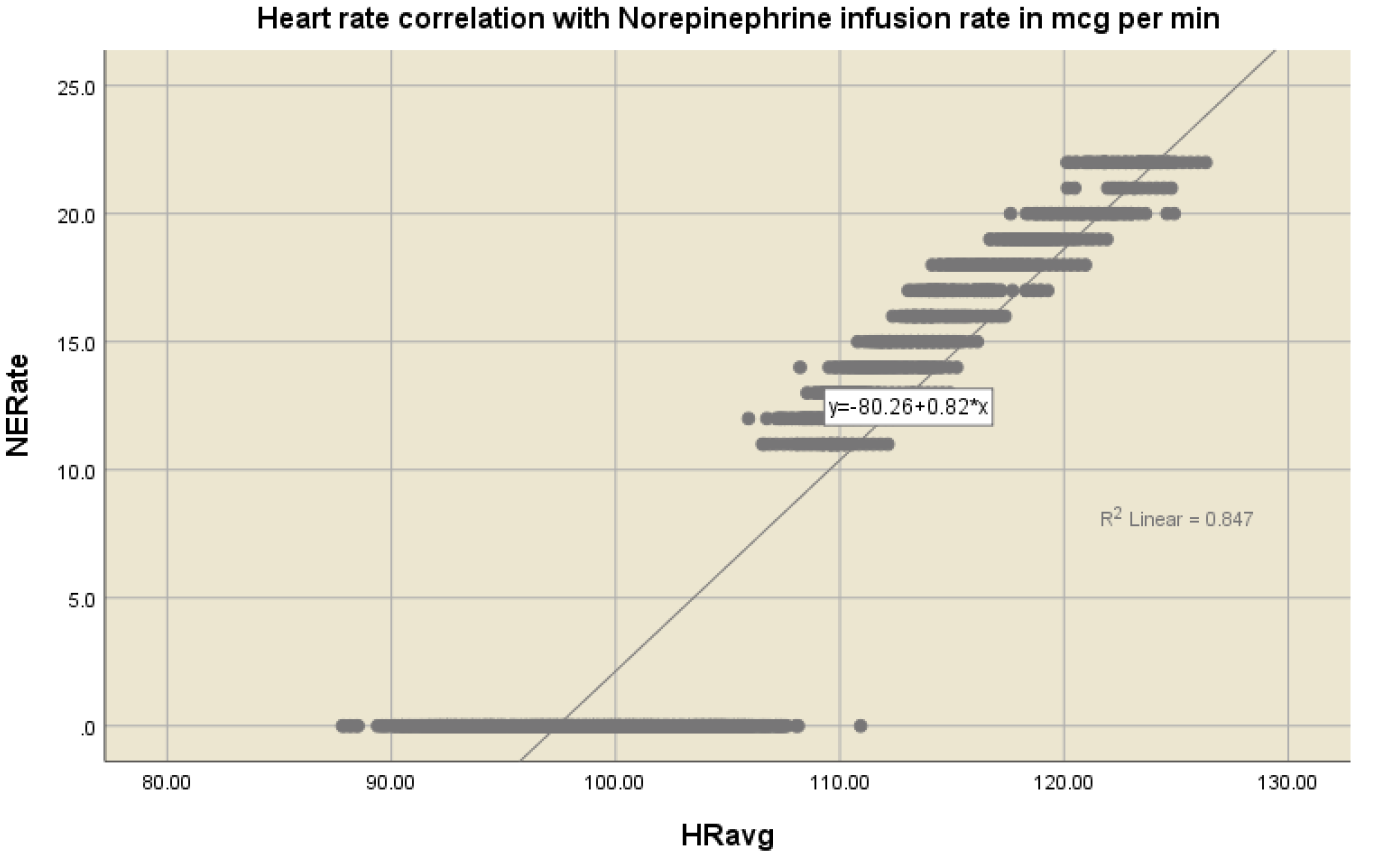
New Onset Prolonged Sinus Tachycardia (NOPST) incidence was recorded if the HR increased by at least 20% from baseline and exceeded 100 bpm and it was correlated with the corresponding Norepinephrine infusion rate. The correlation between NOPST incidence and its corresponding NE infusion rate was statistically investigated by Spearman Correlation Test. The NE infusion rates, as NOPST prognosticator, were constructed with the NOPST incidences on Receiver Operating Characteristic (ROC) Analysis Test to investigate the area under the ROC curves (AUROC) from which the optimal operating NE infusion rate cutoff point and its correlated sensitivity outcomes were picked after investigating the highest NE infusion rate youden’s index value. Sensitivity analysis results, including but not excluded to, sensitivities, specificities, accuracies, positive and negative predictive values, and negative likelihood ratios were also reported in this study as distinctly presented in Table 3. The correlation and AUROC of NE infusion rates and NOPST incidences were fully illustrated in Figure 1 and Figure 2, respectively.
Figure 1: The Areas Receiver Operating Characteristic (ROC) Curves For The Norepinephrine Rate in Mcg.Per Min And Its Tendency To Elicit New Onset Prolonged Sinus Tachycardia (NOPST). Our Tested Prognosticator Has AUROC with Area±SEM (95% Cl; Range) Of 0.742±0.012 (95%; 0.718-0.766)
Figure 2: The Correlation between Norepinephrine Infusion Rate (In Mcg per Min) and Average Heart Rate (In Bpm). The Above Figure Indicates That NE Rate Has A Significant Positive and Strong Correlation with HR (0.921, p<0.01 Level -2 Tailed, NE Rate = 80.26+0.82*HR, R2 = 0.847)
Table 1: Comparative Studied Variables between Non-Septic Shock Cohort (Group I) and Septic Shock Cohort (Group II) Among Admitted Critically Ill Patient at King Hussein Medical Centre
Variables
Total (N = 1638)
Non_Septic Shock (N = 950, 58%) Mean±SD
Septic Shock (N = 688, 42%) Mean±SD
Mean Difference
±SEM
p-Value
Age (Yrs)
51.88±16.22
51.92±16.29
51.82±16.13
+0.104±0.81
0.898
Pre-ICU Stay day(s)
6.92±3.81
6.92±3.81
6.91±3.82
+0.009±0.19
0.961
ICU Stay day(s)
14.08±4.06
13.85±3.39
14.40±4.82
-0.547±0.20
0.007
Hospital Stay day(s)
21.00±5.61
20.77±5.88
21.31±5.20
-0.537±0.28
0.056
ALB
(g/dl)
At admission
2.07±0.27
2.13±0.34
1.98±0.05
+0.142±0.013
0.000*
2nd -3rd day
2.08±0.46
2.16±0.54
1.97±0.29
+0.182±0.023
0.000*
4th-5th day
2.20±0.79
2.27±0.91
2.12±0.57
+0.147±0.039
0.000*
H.ALB (g/day)
19.69±12.79
14.2±14.0
27.3±4.45
-13.082±0.553
0.000*
H.ALB 20% (ml/day)
98.47±63.98
71±70.0
136.4±22.3
-65.409±2.766
0.000*
K (mEq/l)
3.174±0.333
3.39±0.22
2.88±0.20
+0.514±0.011
0.000*
cMg (mg/dl)
2.518±0.306
2.72±0.19
2.24±0.21
+0.474±0.009
0.000*
SBP (mmHg)
95.92±5.34
99.37±3.57
91.1±3.31
+8.23±0.173
0.000*
DBP (mmHg)
52.52±4.63
55.9±2.27
47.8±2.28
+8.172±0.114
0.000*
MAP (mmHg)
66.98±4.69
70.4±2.41
62.2±2.31
+8.191±0.119
0.000*
NE rate
6.90±8.379
0.0000.00
16.4±3.24
-16.43±0.105
0.000*
HR (bpm)
HR1
88.45±3.88
87.4±3.80
89..9±3.48
-2.54±0.184
0.000*
HR2
105.89.36
98.8±4.54
115.4±4.65
-16.53±0.23
0.000*
%∆HR
19.48%7.526%
13.1%±0.39%
28.3%±0.38%
15.22%±0.02%
0.000*
SI (bpm/mmHg)
1.11±0.16
0.99±0.08
1.27±0.09
-0.272±0.004
0.000*
mSI (bpm/mmHg)
1.59±0.26
1.41±0.11
1.86±0.15
-0.452±0.006
0.000*
Data results of the comparative variables between the Group I and Group II are statistically analyzed by independent T and One-Sample T-Test (at p-value< 0.05) and expressed as Mean±SD and Mean difference±SEM. Group I: Non-septic shock critically ill patients. Group II: Septic shock critically ill patients. HR1: Baseline heart rate before initiation norepinephrine infusion for septic shock critically ill patients.HR2: Average heart rate after initiation norepinephrine infusion for septic shock critically ill patients.ICU: Intensive care unit.*:Significant (p-Value<0.05).N: Number of study’s critically ill patients.H.ALB: Human albumin.ALB: Albumin level.K: Potassium.cMg: Corrected magnesium level.%∆HR: Percent changes in heart rate.SBP: Systolic blood pressure.DBP: Diastolic blood pressure.MAP: Mean arterial pressure.HR: Heart rate.SI: Shock index.mSI: Modified shock index.NE: Norepinephrine.Bpm: Beat per minute.
Table 2: Continued Comparative Studied Variables between Non-Septic Shock Cohort (Group I) and Septic Shock Cohort (Group II) Among Admitted Critically Ill Patient at King Hussein Medical Centre
Variables
Total (N = 1638)
Non Septic Shock (N = 950, 58%) Mean±SD
Septic Shock (N = 688, 42%)Mean±SD
OD
p-Value
Gender
F
461 (28.1%)
376 (39.6%)
85 (12.4%)
OD (F/M)
4.647 (95% CI; 3.577-6.037)
0.000*
M
1177 (71.9%)
574 (60.4%)
603 (87.6%)
M: F ratio
0.39: 1
1.53: 1
7.09: 1
Ward
Med
994 (60.7%)
594 (62.5%)
400 (58.1%)
OD (Med/Sur)
1.201 (95% CI; 0.983-1.468)
0.073
Sur
644 (39.3%)
356 (37.5%)
288 (41.9%)
NOPST
No
563 (34.4%)
511 (53.8%)
52 (7.6%)
OD (No/Yes)
14.237 (95% CI; 10.440-19.413)
0.000*
Yes
1075 (65.6%)
439 (46.2%)
636 (92.4%)
APACHE II
< 13
381 (23.3%)
381 (40.1%)
0 (0.0%)
OD (<13/≥13)
2.209 (95% CI; 2.079-2.348)
0.000*
≥ 13
1257 (76.7%)
569 (59.9%)
688 (100.0%)
SOFA 1
< 5
151 (9.2%)
151 (15.9%)
0 (0.0%)
OD (<5/≥5)
1.861 (95% CI; 1.775-1.951)
0.000*
≥ 5
1487 (90.8%)
799 (84.1%)
688 (100.0%)
SOFA 2
< 5
281 (17.2%)
281 (29.6%)
0 (0.0%)
OD (<5/≥5)
2.028 (95% CI; 1.922-2.141)
0.000*
≥ 5
1357 (82.8%)
669 (70.4%)
688 (100.0%)
Data results of the comparative variables between the Group I and Group II are statistically analyzed by Chi Square Test (at p-value<0.05) and expressed as Number (Percentage) and odd ratio. Group I: Non-septic shock critically ill patients. Group II: Septic shock critically ill patients. *: Significant (p-Value<0.05).N: Number of study’s critically ill patients. F: Female. M: Male. Med: Medical. Sur: Surgical. NOPST: New Onset Prolonged Sinus Tachycardia.APACHE II: Acute Physiological and chronic Health Evaluation.SOFA: Sequential Organ Failure Assessment.
Table 3: Sensitivity Analysis Results of the Tested Prognosticator for Its NOPST Propensity
From 2155 adult and elderly admitted critically ill patients in our ICU department at KHMC, RMS, Amman, Jordan between Jan 2018 and May 2021, 1638 critically ill patients were finally included in this study with 517 non-eligible patients were excluded. The mean age of the whole study cohort was 51.88±16.22 years, and the Non-Septic Shock Cohort were insignificantly older than the Septic Shock Cohort (51.92±16.29 years versus 51.82±16.13 years, respectively, p-value = 0.898). Significantly, females were distributed in the study in approximately 0.39: 1 ratio compared to males (461 (28.1%) versus 1177 (71.9%), respectively, p<0.05) in which 60.4% (574 critically ill men) and 39.6% (376 critically ill women) were belonged to the Non-Septic Shock Cohort compared to 87.6% (603 critically ill men) and 12.4% (85 critically ill women) were belonged to the Septic Shock Cohort. The NOSPT risk estimate for males relative to females in our study was setted at 4.647 (95% CI; 3.577-6.037).
The overall NOPST incidence for our 1638 eligible studied critically ill patients was assessed at 65.6% (1075 patients with positive NOPST) during an average of 14.08±4.06 days and 21.00±5.61 days of the ICU and overall hospital admission days, respectively, in which only ICU stay days was significantly lower in Non-Septic Shock Cohort compared to the Septic Shock Cohort (13.85±3.39 days and 20.77±5.88 days vs 14.40±4.82 days and 21.31±5.20 days, respectively, p-values = 0.007 and 0.056).
There were an overall 994 (60.7%) studied medical patients and 644 (39.3%) studied surgical patients which respectively distributed to 594 (62.5%) and 356 (37.5%) within the Non-Septic Shock Cohort and 400 (58.1%) and 288 (41.9%) within the Septic Shock Cohort. The septic shock risk estimate for critically ill patient admitted from medical wards compared to surgical wards was OD (Med/Sur), 1.201 (95% CI; 0.983-1.468).
As illustrated in Figure 1-2, NE rate had a significant positive and strong correlation with HR (0.921, p<0.01 level-2 tailed, NE rate = 80.26+0.82*HR, R2 = 0.847) and the area under receiver operating characteristic (AUROC) curve for the Norepinephrine rate in mcg per min and its tendency to elicit New Onset Prolonged Sinus Tachycardia (NOPST) had Area±SEM (95% CI; Range) of 0.742±0.012 (95% CI; 0.718-0.766).
Regarding sensitivity analysis of the tested prognosticator for its NOPST propensity, the optimal operating cut-off NE infusion rate to elicit NOPST was investigated at 11.3 mcg per min with sensitivity, specificity, positive and negative predictive values, negative likelihood ratio, and accuracy index of 55.70%, 90.80%, 79.65%, 76.02%, 48.79%, and 77.02%, respectively.
DISCUSSION
The present study includes two studied outcome cohorts, the Non-Septic Shock Cohort and the Septic Shock Cohort, of admitted critically ill patients at KHMC between Jan 2018 and May 2021. To the best of our knowledge, the uniqueness of our study is primarily involved in its direct correlation investigation between Norepinephrine infusion rates and the incidences of NOPST. Other investigated secondary outcomes in this study, including; ICU and overall hospital stay days, serial albumin levels changes during sepsis episodes, and optimal operating cutoff Norepinephrine infusion rate with its corresponding sensitivity analysis indices.
As showed in et al Parker study, admitted septic patients with an averaged heart rate not exceeding 106 bpm, were associated with a better prognosis. In our study, septic critically ill patients had significantly elevation in HR after infusion NE compared to Group I NON-septic patients (28.3%±0.38% vs 13.1%±0.39%) with Mean difference ±SEM of +15.22%±0.02%. This increasing magnitude in HR were also accompanied with study with significantly higher ICU LOS (+0.547±0.20 days, p-value = 0.007) but insignificantly higher in overall hospital LOS (+0.537±0.28 days, p-value = 0.056) [8-9].
Also, our study stated that critically ill patients that belonged to Septic Shock Cohort (Group II) had that the Survivors Cohort had a significantly lower albumin at all date levels than Non-Septic Shock Cohort (Group II) Cohort with Mean±SD of 1.98±0.05 g/dl vs 2.13±0.34 g/dl, 1.97±0.29 g/dl vs 2.16±0.54 g/dl, and 2.12±0.57 g/dl vs 2.27±0.91g/dl, for serum albumin level at admission, 2nd-3rd day level, and 4th-5th day level. Also, the gap difference in albumin level was steadily increased at least during the first 3 days of septic shock episodes with Mean difference ± SEM of +0.142±0.013 g/dl, and +0.182±0.023 g/dl eventhough the Septic Shock Cohort received approximately twice the H. Albumin dosing that Non-Septic Shock Cohort received (27.3±4.45g H. Albumin/day vs 14.2±14.0 g H. Albumin/day or 136.4±22.3 ml H. Albumin 20%/day vs 71±70.0 ml H. Albumin 20%/day, respectively, p-Value = 0.000). This negative trending and gaping in albumin levels across the two studied groups, can be theoretically explained by the significantly higher of both Shock Index (SI) and modified Shock Index (mSI) in septic critically ill patients versus non-septic critically ill patients with Mean±SD of 1.27±0.09 bpm/mmHg vs 0.99±0.08 bpm/mmHg and 1.86±0.15 bpm/mmHg vs 1.41±0.11 bpm/mmHg. Of important, both these shock indices correlated HR with BP parameter, SBP in case of SI and MAP in case of its modified version. The significantly higher values of these hemodynamic indices can be scientifically translated into higher fluid resuscitation requirement in Group II versus Group I, and subsequently higher hemodilutional associated hypoalbumenia, and also into higher albumin escaping rate from intravascular compartment to interstitial compartments, and subsequently vasodilatory associated hypoalbumenia [10-12].
In conclusion, septic critically patients on Norepinephrine infusion have significantly higher risk of New Onset Prolonged Sinus Tachycardia (NOSPT) and significantly higher ICU admission days, especially if this infusion rate exceeding 11.3 mcg/min. This study is limited by its retrospective design. A larger, multisite, and prospective study is needed to control for multiple confounders and to clarify the causations between the tested independent and dependent variables. Despite these limitations, our conclusions may have an added value to the current excessively evolving controversial pieces of evidence, especially in critically ill cohorts.
REFERENCES
Li R. et al. "Maresin 1 mitigates inflammatory response and protects mice from sepsis." Mediators Inflamm, vol. 2016, no. 1, 2016, pp. 1–9.
Kuipers S., et al. "Incidence, risk factors and outcomes of new-onset atrial fibrillation in patients with sepsis: a systematic review." Crit Care, vol. 18, no. 1, 2014, pp. 1–9.
Leibovici L. et al. "Relative tachycardia in patients with sepsis: an independent risk factor for mortality." QJM, vol. 100, no. 10, 2007, pp. 629–634.
Dellinger R.P. et al. "Surviving sepsis campaign." Crit Care Med, vol. 41, no. 2, 2013, pp. 580–637.
Parker M.M. et al. "Serial cardiovascular variables in survivors and nonsurvivors of human septic shock: heart rate as an early predictor of prognosis." Crit Care Med, vol. 15, no. 10, 1987, pp. 923–929.
Chou H.L. et al. "Systemic inflammatory response syndrome is more associated with bacteremia in elderly patients with suspected sepsis in emergency departments." Medicine, vol. 95, no. 36, 2016, p. e5634.
Correa T.D. et al. "Fluid therapy for septic shock resuscitation: which fluid should be used?" Einstein (Sao Paulo), vol. 13, no. 4, 2015, pp. 462–468.
McEvoy C. and Kollef M.H. "Determinants of hospital mortality among patients with sepsis or septic shock receiving appropriate antibiotic treatment." Curr Infect Dis Rep, vol. 15, no. 5, 2013, pp. 400–406.
Labelle A. et al. "The determinants of hospital mortality among patients with septic shock receiving appropriate initial antibiotic treatment." Crit Care Med, vol. 40, no. 7, 2012, pp. 2016–2021.
Pavon A. et al. "Profile of the risk of death after septic shock in the present era: an epidemiologic study." Crit Care Med, vol. 41, no. 11, 2013, pp. 2600–2609.
Bai X. et al. "Early versus delayed administration of norepinephrine in patients with septic shock." Crit Care, vol. 18, no. 5, 2014, p. 532.
Morimatsu H. et al. "Early and exclusive use of norepinephrine in septic shock." Resuscitation, vol. 62, no. 2, 2004, pp. 249–254.
Recommended Articles
Research Article
Evidence Guided, Experience Based and Patient Compatible 3-Step Protocol for Managing Moderate to Severe Category of COVID19 Infections
Farah Husain,
...
Kirti N Saxena
Published: 05/01/2021
Download PDF
Research Article
A Descriptive Cross-Sectional Study to Evaluate the Knowledge about Symptoms and Risk Factors for Heart Attack (Myocardial Infarction) Among the General Population of New Delhi
Aastha Sehgal,
...
Avneet Kaur
Published: 06/05/2023
Download PDF
Research Article
Knowledge About Risk and Preventive Factors for Osteoarthritis Knee among Ortho OPD Patients in Regional Hospital, Keylong in District Lahaul and Spiti of Himachal Pradesh
Ajay Thakur,
Jaspal Chaudhary
Published: 20/06/2022
Download PDF
Research Article
A Randomized Controlled Trial Comparing the Effect of Oral Preemptive Pregabalin Compared to IV Lignocaine in Attenuating Hemodynamic Response to Laryngoscopy
P. Aashik,
...
B.N. Reddy
Published: 17/05/2023
Download PDF
PO Box 101, Nakuru
Kenya.
Email: office@iarconsortium.org
Editorial Office:
J.L Bhavan, Near Radison Blu Hotel,
Jalukbari, Guwahati-India
Odeh Aldaoud, S., Sa'id Al-Bdour, E., Lutfi Bani Salameh, M., Hifith Alhindawi, M., Mohammad Al Dumoor, Q. & Khazar Haddadin, B. (2021). Correlation between Norepinephrine Rate, Sinus Tachycardia and Clinical Outcomes among Septic Shock Critically Ill Patients. IAR Journal of Anaesthesiology and Critical Care, 2(2), 1-5.
MLA
Odeh Aldaoud, Shadi, et al. "Correlation between Norepinephrine Rate, Sinus Tachycardia and Clinical Outcomes among Septic Shock Critically Ill Patients." IAR Journal of Anaesthesiology and Critical Care 2.2 (2021): 1-5.
Chicago
Odeh Aldaoud, Shadi, Emad Sa'id Al-Bdour, Moh’d Lutfi Bani Salameh, Mahmoud Hifith Alhindawi, Qais Mohammad Al Dumoor and Baha Khazar Haddadin. "Correlation between Norepinephrine Rate, Sinus Tachycardia and Clinical Outcomes among Septic Shock Critically Ill Patients." IAR Journal of Anaesthesiology and Critical Care 2, no. 2 (2021): 1-5.
Harvard
Odeh Aldaoud, S., Sa'id Al-Bdour, E., Lutfi Bani Salameh, M., Hifith Alhindawi, M., Mohammad Al Dumoor, Q. and Khazar Haddadin, B. (2021) 'Correlation between Norepinephrine Rate, Sinus Tachycardia and Clinical Outcomes among Septic Shock Critically Ill Patients' IAR Journal of Anaesthesiology and Critical Care 2(2), pp. 1-5.
Vancouver
Odeh Aldaoud S, Sa'id Al-Bdour E, Lutfi Bani Salameh M, Hifith Alhindawi M, Mohammad Al Dumoor Q, Khazar Haddadin B. Correlation between Norepinephrine Rate, Sinus Tachycardia and Clinical Outcomes among Septic Shock Critically Ill Patients. IAR Journal of Anaesthesiology and Critical Care. 2021 Jul;2(2):1-5.


 Download PDF
 Download XML