Contents
Download PDF
pdf Download XML
383 Views
466 Downloads
Share this article
Research Article | Volume 2 Issue 1 (Jan-June, 2021) | Pages 1 - 6
Effect of Aırway Management Traınıng Gıven on Famıly Physıcıan Assıstants
1
Associate Professor Osmangazi mh. Nuribaş sk. 9, 2, Meram, Konya
Under a Creative Commons license
Open Access
Received
Dec. 10, 2020
Revised
Jan. 20, 2021
Accepted
Feb. 28, 2021
Published
March 30, 2021
Abstract

Objectıves: Family physicians working in primary health care services are more alone when compared to other branches in matters requiring this type of urgency. In this study, we aimed to evaluate the knowledge, awareness, concerns, and gains of the participants as a result of the clinical training given to the family physicians by the anesthesiologists. Methods: This cross-sectional study was conducted in the Department of Anesthesiology and Reanimation, Konya Training and Research Hospital, Health Sciences University. A total of 32 individuals consisting of Family physician Assistants, were included in the study voluntarily. Clinical training was conducted in live patients in groups of 4 people in the operating room.The duration of the training was one week for each group. To evaluate the airway management, 10 questions were asked to the participants. Results: When we asked that ‘’ Do you believe you can intubate patients with respiratory arrest? ’’ For this question, before and after the clinical training, the meaningful relationship was in favor of the answer ‘Yes, I believe I can definitely do it’ (OR = 0.7, p = 0.004).  Conclusıons: According to the main resuscitation guidelines, significant improvements in self-confidence have been detected in live patients after airway management training.We believe that our study will contribute airway management training programmes planned for the future.

Keywords
INTRODUCTION

Many current studies show that health professionals have severe deficiencies in recognizing typical signs and symptoms in patients at high risk [1]. When difficult airway conditions are considered in the treatment of patients seeking respiratory support, one of the most important factors is the early diagnosis and correct and rapid intervention of the signs and symptoms [2]. Also, the importance of effective airway management in patients in emergencies, such as cardiac arrest, has been demonstrated by studies [3]. In this sense, it is seen that the doctors who are at the beginning of their professional life have deficiencies in the airway and they need more training.


Especially after the graduation of medical school, they start to work as an emergency physicians. In the first days of their professional life, they are more likely to encounter cases requiring airway control, such as sudden cardiac arrest [4]. Family physicians working in primary health care are morelonely and need to increase their emergency practice skills more than other branches.


Moderate stress and anxiety can increase the creativity and development of health workers. On the other hand, stress can increase anxiety and mistakes made in work practice [5]. In particular, family physicians faced with emergency situations need a quality of medical training [6]. There are few studies about opinions of family physician assistants towards airway management training.


In this study, we aimed to evaluate the knowledge, awareness, concerns, and gains of the participants as a result of the clinical training given to the family physicians by the anesthesiologists.

MATERIALS AND METHODS

This clinical study was conducted with the approval of the Ethics Committee of the Education and Research Hospital of Health Sciences University, Konya, 48929119/774 on family physician assistants studying at the Health Sciences University, Konya Training and Research Hospital between 1 April 2019 and 1 June 2019. This study was conducted in the Department of Anesthesiology and Reanimation. A total of 32 individuals consisting of family physician assistants were included in the study voluntarily. Volunteer family physician assistants were divided into groups with a maximum of 4 people. Each group received one hour of theoretical airway management training and one hour of practical airway management training on a mannequin before practical clinical training. Theoretical training was given using slides based on 2015 ERC (European Resuscitation Council) guidelines prepared by ILCOR (The International Liaison Committee on Resuscitation) recommendations [7].


Practical application was performed on AMBU® mannequin according to the standards. Practice training included appropriate position, airway application, optimal bag-mask ventilation, optimal direct laryngoscopy, intubation devices, LMA (Laryngeal Mask Airway) application, supraglottic airways, and video laryngoscopes.


The clinical training was conducted in live patients in groups of 4 people in the operating room environment. The duration of the training was one week for each group. The training was given by ERC certified physicians with at least five years of anesthesiology and reanimation experience. Socio-demographic characteristics of trainees were recorded.


To evaluate the airway information, ten questions were asked to the participants as five questions before training, three questions before and after training and two questions after training. Questions were asked in the form of a multiple-choice test and Likert scale were used to measure the airway information. The questions were prepared based on the sections of the training. Achievement grades were evaluated one by one, and scores and responses were calculated and evaluated separately. No practical exams were applied.


Statistical Analysis 

SPSS 22.0 for Windows software was used for statistical analysis. Shapiro Wilks test was used to determine whether the data showed normal distribution. Descriptive statistical analyses were used to evaluate demographic data and data collected from tests and scales. Paired sample T-test was used to compare pre- and post-training data. Logistic regression analysis was used to evaluate the relationship between the data. Data were expressed as mean±standard deviation and percentages. p<0.05 was considered statistically significant. In the logistic regression analysis, Nagelkerke R Square (R2) = 0 showed no interaction, R2 = 1 showed a full and strong positive interaction, R2 = −1 showed a statistically significant inverse interaction.

RESULTS

Thirty-two family physician assistants were recruited voluntarily. The youngest age was 25, and the oldest was 51 years. The mean age of the male participants (n: 15 (46.8%)) was 35.1±9.6, and the mean age of the female participants (n: 17 (53.2%)) was 29.4±5.8. There was no statistically significant difference between the mean age of men and women (p = 0.61). The Shapiro Wilks test showed that the descriptive values were normal.


Questions

 Before-training, before and after-training, and after-training questions were divided into three parts.

Before-Training Questions


  • ‘’Have you received any training in airway management? ’’When the question was evaluated; 67.7% of the participants answered that they received both theoretical and practical training; 19.4% stated that they had no education

  • ‘’Have you received any training in intubation? ’’ 59.4% of the participants answered that they received both theoretical and practical training; 15.6% stated that they had no education

  • ‘’Have you ever intubated the patient before? ’’ 31.3% of respondents answered ‘I've done it many times’; 3.1% of respondents answered ‘I tried, but it didn't happen’ replied

  • ‘’Have you put an airway on a patient before?’’ 68.8% of the respondents answered ‘yes’, and 31.2% answered ‘no’

  • ‘‘Have you previously ventilated the patient with a bag-mask?’’ 87.5% of respondents answered ’Yes,’ and 3.1% answered ’No’


Before Training and After Training Questions


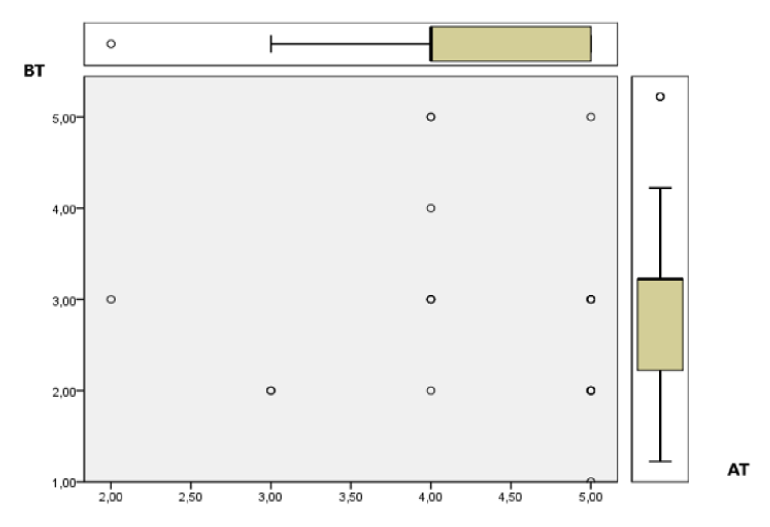
  • "Do you think you have sufficient knowledge of airway management?" The answer of ‘I have no information’ was 1point; the answer of ‘I think I'm pretty good at it’ was 5 points (Likert Scale). The average score of the answers given to this question before-training was 2.84±1.08 out of 5 points. The average score of the answers given to this question after the training was 4.37±0.75 out of 5 points. The lowest grade was 1, and the highest grade was 5. There was a statistically significant difference between the t-test and the responses before and after airway training (p<0.001) (Table 1). In logistic regression analysis, where clinical training was a dependent factor before and after clinical training, no significant correlation was found for this question (OR = 5.0, p = 0.282) (Table 2), (Figures 1)


Figure 1: Scatter/Dot chart figures showing the question 1 is before training (BT) and after training (AT). The question 1 is “Do you think you have sufficient knowledge of airway management?" The answer of "I have no information" is 1; the answer of "I think I'm pretty good at it" is 5 points (Likert Scale).


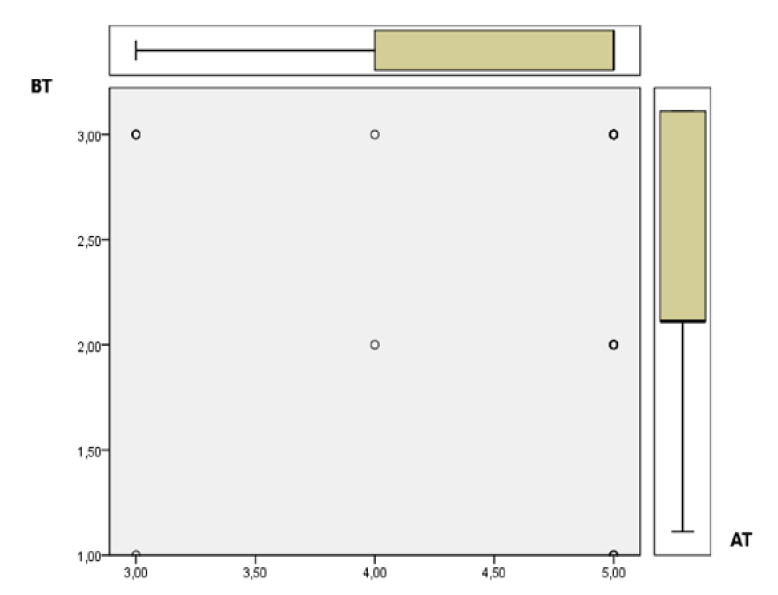
Figure 2: Scatter/Dot chart figures showing the question 2 is before training (BT) and after training (AT). The question 2 is ‘’ Do you have any information about other methods of airway application (LMA, I-GEL, Videolaryngoscope)? ’’The answer of "I have no information" is 1; the answer of “Yes, I have enough information” is 5 points (Likert Scale)


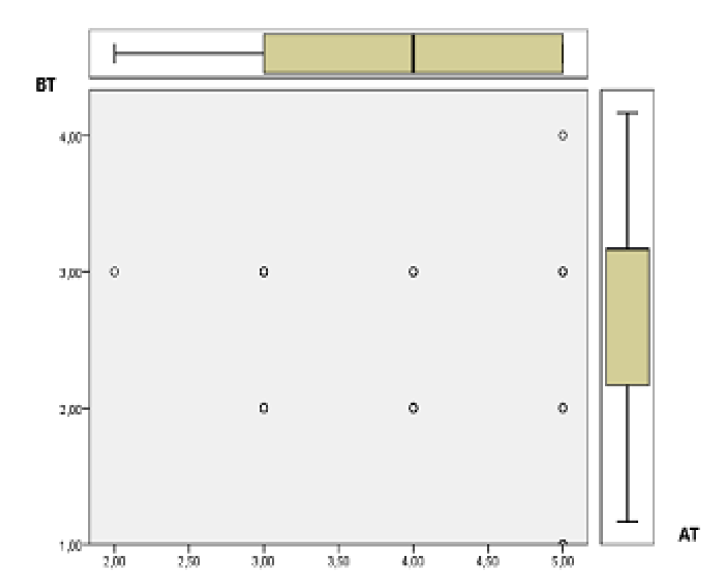
Figure 3: Scatter/Dot chart figures showing the question 3 is before training (BT) and after training (AT). The question is 3‘’ Do you believe you can intubate patients with respiratory arrest? ’’ The answer of ’’ No I can't ’’ is 1; the answer of ‘’I definitely believe I can’’ is 5 points (Likert Scale)


Table 1:  Question 1’s Answers before Training and after Training

  1. ’’Do you think you 

Have sufficient knowledge of airway management? ‘’

1  I have no information(n)2(n)3(n)4(n)5 I think I'm pretty good at it(n)
Before training9.4%(3)28.1%(9)40.6%(13)12.5%(4)9.4%(3)
After training--19%(6)4.8%(2)76.2%(24)


Table 2: Question 1, 2, 3’s Results of The Logistic Regression Analysis before Training and after Training

Common  QuestıonsNagelkerke R SquareStandart Errorp-ValueOdds ratio (OR)(95% Confidence Interval)
Question 10.3181.5030.2825.0(0.2-95.8)
Question 20.6241.4400.5052.6(0.1-43.8)
Question 30.7220.4830.004*0.7(0.03-29.8)


  • ‘’Do you have any information about other methods of airway application (LMA, I-GEL, Videolaryngoscope)?’’ The answer of ‘I have no information’ was 1 point; the answer of ‘Yes, I have enough information’ is 5 points (Likert Scale). The average score of before-training participants was 2.21±0.79 out of 5 points. After the training; the average score of the participants was 4.62±0.70 out of 5 points.  There was a statistically significant difference between the t-test and the responses before and after airway training (p<0.001). In logistic regression analysis, where clinical training was a dependent factor, was not found to be significant before and after clinical training for this question (OR = 2.6, p = 0.505) (Table 2), (Figures 2)

  • ‘’Do you believe you can intubate patients with respiratory arrest? ’’ The answer of’ No I can’t’ was 1 point; the answer of ‘I definitely believe I can’ is 5 points (Likert Scale). The average score of the before-training participants was 2.71±0.85 out of 5 points.  After the training; the average score of the participants was 4.31±0.85. There was a statistically significant difference in t-test analysis before and after airway training (p<0.001). For this question, before and after the clinical training, in the logistic regression analysis where the clinical training was a dependent factor, the meaningful relationship was in favor of the answer ‘Yes, I believe I can definitely do it’ (OR = 0.7, p = 0.004) (Table 2), (Figures 3)


After Training Questions


  • ’’Do you think you have any gains in post-training airway management? ’’ The answer of ’I had no gains’ was 1 point; the answer of ’I've had some big gains’ was 5 points (Likert Scale). The average score was 4.59±0.71 out of 5 points

  • ‘’Do you think the training period is enough? ’’ 31.2% of respondents answered ’Yes,’ and 68.8% answered ’No’

DISCUSSION

In this study, the effect of airway management training given by the anesthetist was investigated in family physician assistants. The positive effects of clinical training were mainly observed about the answers after the training.


Before the study, a training program was prepared based on the 2015 ERC guidelines, following the ILCOR recommendations, in terms of preparation for clinical training of the participants and the responsibilities required for intervention to the live patient, both theoretical and practical on the model [7].


Doctors who do not receive regular airway management training experience inadequate health practices. As a result, emergency interventions cannot be implemented in a standard and correct way, and unfortunately, poor results were encountered [8].


In a study by Webb et al. [9] It was found that only 40% of general practitioners applied respiratory and cardiac massage correctly [9]. Again, to emphasize the effect of education, Deakin et al. [10] noted that the procedure of providing airway to be managed by trained anesthesiologists leads to fewer complications. In our study, the training was given by anesthesiologists with at least five years of professional experience and ERC certificate.


Airway management training is one of the essential trainings that should be given to in-service training before and after graduation. Although some universities have initiated pioneering initiatives, sufficient time and attention have not been provided for resuscitation education [11].


In our study, 67.7% of the family physician assistants have received both theoretical and practical airway management training before, and 59.4% of them have received intubation, but 25% did not intubate on the patient. 12.5% of the participants did not ventilate with a bag-mask before the training. Even 31.2% of the participants did not also use an airway.


In this respect, the success of oropharyngeal airway application in malocclusion and orthodontic procedures was mentioned in Vampy et al.  Review, and it was stated that the success of airway clearance with proper airway use was mentioned in many studies [12]. 


In the airway skills study by Deakin et al. [13], on ambulance technicians and paramedics, 75.8% of the ambulance technicians performed intubation once or less within one year, and 47.6% of the paramedics did not intubate at all. However, it was determined that 87.8% of the laryngeal masks were used by health care providers when they preferred an airway method.


Noninvasive methods were observed to be more prone to the studies. In a study by Elliott, M.W. (, a review was done about the effectiveness of noninvasive ventilation. As emphasized here, training, teamwork, and experience were essential for adequate noninvasive ventilation. However, the efficacy and indication of noninvasive ventilation were limited.


In our study, as high as 87.5%, participants stated that they used bag-mask ventilation. The studies contributed the effectiveness of bag-mask ventilation and intubation in CPR [15], it was emphasized that less neurological sequelae occurred and more CPR success was achieved in the case of CPR in early intubation. In this sense, when we look at the rates of answers, it was obvious how important the training which we provided.


In the study of Su-ji Kim et al. [16], medical students who received basic life support education were evaluated, and it was found that especially the progressive education led to an increase in the skills of the participants.


In our study, a significant number of participants responded that they were competent in airway management after training. Also, this difference was evaluated statistically by the t-test and found to be substantial, but there was no significant difference in logistic regression analysis. We believe that providing training following the guidelines (ERC) was useful in this training.


Another common question was, "Do you have information about other airway application methods (LMA, I-GEL, Video laryngoscope) besides intubation?". 21.9% of the students said that they do not have any information before the training, while 71.5% of the assistants said that they have enough information after the training.


In a study by Alismail et al. [17]. On health professionals, it was found that intubation skills were increased as a result of intubation training with the newly developed simulation method [17]. As it can be seen from these and similar studies, alternative approaches and airway vehicles were needed, especially in difficult airway situations. Besides, in some studies, alternative airway devices were evaluated in the practice of inexperienced anesthesia assistants, and the superiority of alternative airway devices was mentioned [18].


In our study, the awareness of alternative airway devices, which became more prominent in difficult airway applications, was revealed with the answers of the participants. In addition, this difference was found to be statistically significant with t-test, but there was no significant difference in logistic regression analysis. 


The third common question was the question, ‘‘Do you believe that you can intubate patients in case of respiratory arrest?’’. This question was about whether we were making progress in responding to the patient. No participant before the training said that I believe that I can do, yes. Those who mark the same preference after the training were found to be 38.1%.


Out-of-hospital airway control is even more critical, especially for family physicians, because their study area is non-hospital first-step health centers. At this point, Wang and his colleagues [19], examined the situation of non-hospital intubations. It was said that there were very few studies about out-of-hospital intubation. The complications related to unsuccessful intubation may result from the failure of out-of-hospital intubation. It was also emphasized that training and clinical experience were needed to reduce this failure.


Another essential factor in airway management is the stress factor. McKay et al. [20]. During the intubation procedure, part of the simulator was analyzed for α-amylase secretion, heart rate, and anxiety levels in 78 anesthesia nurses. As a result, the results of these three markers in favor of stress reduction increased the performance of the participants.


In the light of all these studies, when we look at our study, the number of participants who think that it was sufficient for intubation in the intervention to the patient in need of airway has increased. It was revealed that the participants were more confident after the training. After these answers, development t-test was also statistically significant. In addition, logistic regression analysis, which was a much more meaningful statistical analysis, also found a significant difference in a calculation of clinical education. This noteworthy development shows that our clinical training based on the 2015 ERC guidelines has achieved its goal [7].


When the questions asked only after the training "Do you think you have any gains in airway management after the training?" while none of the participants answered no, 76.2% of the participants answered yes.


When we looked at the gains from other studies, Johnston et al. [21], reported that paramedic students were educated in the operating room, but the students complained that they could not be given enough attention due to other health students. In our study, to prevent this, we employed only participants for airway management training for two months.


The students who were likely to receive this training at the same time were left outside the operating rooms and did not constitute an obstacle to the participants' airway management training. The participants did not interview the patients who had difficult airway expectations considered by the anesthesiologists.


Another question after the training was" Do you think the training period is sufficient? ". 68.8% answered that no was not enough.


In the new studies, it was emphasized that the duration of education in which new methods should be applied, and the training of new alternative methods were insufficient [22]. In our study, we had to plan the training time to the extent that the participants' rotation times allowed, but it was clear that more time was needed for this.


When we look at the limitations of our study, we could not prolong the time due to the limited rotation period. As can be understood from the studies, it was necessary to provide more intervention opportunities to the participants in a more extended time. Also, another limitation was that if we increased the number of participants, we would be able to obtain more statistically representative values of the universe.
CONCLUSION

In our study, airway management training on the live patients increased the knowledge of family physician assistants. We think that this study can be a correct example for the future studies.


Disclosures

We have no any conflict interest.


Funding 

The study was funded by departmental resources.

REFERENCE
  1. Sun, Y. et al. "Airway Management Education: Simulation Based Training versus Non-Simulation Based Training-A Systematic Review and Meta-Analyses." BMC Anesthesiology, vol. 17, no. 1, 2017, pp. 1–7.

  2. Peterson, G.N. et al. "Management of the Difficult Airway: A Closed Claims Analysis." Anesthesiology, vol. 103, no. 1, 2005, pp. 33–39.

  3. Whitcroft, K.L. et al. "ENT and Airways in the Emergency Department: National Survey of Junior Doctors' Knowledge and Skills." The Journal of Laryngology & Otology, vol. 130, no. 2, 2016, p. 183.

  4. Lüscher, F. et al. "Proficiency in Cardiopulmonary Resuscitation of Medical Students at Graduation: A Simulator-Based Comparison with General Practitioners." Swiss Medical Weekly, vol. 140, no. 0304, 2010.

  5. Ocaktan, M.E. et al. "Abidinpaşa Sağlık Grup Başkanlığı'na Bağlı Sağlık Ocaklarında Çalışan Sağlık Personelinde Spielberger Durumluluk ve Sürekli Kaygı Düzeyi." Ankara Üniversitesi Tıp Fakültesi Mecmuası, vol. 55, no. 01, 2002.

  6. Chan, B.T. et al. "Frequent Users of Emergency Departments. Do They Also Use Family Physicians' Services?" Canadian Family Physician, vol. 48, no. 10, 2002, pp. 1654–1660.

  7. Soar, J. et al. "European Resuscitation Council Guidelines for Resuscitation 2015: Section 3. Adult Advanced Life Support." Resuscitation, vol. 95, 2015, pp. 100–147.

  8. Panchal, A. et al. "Development of a Medical Student Cardiopulmonary Resuscitation Elective to Promote Education and Community Outreach." Cureus, vol. 11, no. 4, 2019.

  9. Webb, D. et al. "Evaluation of House Officer Skills in Cardiopulmonary Resuscitation." Circulation, 1977.

  10. Deakin, C.D. et al. "Does an Advanced Life Support Course Give Non-Anaesthetists Adequate Skills to Manage an Airway?" Resuscitation, vol. 81, no. 5, 2010, pp. 539–543.

  11. Uskun, E. et al. "Bir Tıp Fakültesi Birinci Sınıfında Uygulanan İlkyardım Eğitiminin Etkinliğinin Değerlendirilmesi." SDÜ Tıp Fakültesi Dergisi, vol. 26, no. 2, 2019, pp. 183–188.

  12. Vompi, C. et al. "Effects of Functional Appliances on Pharyngeal Airways in Patients with Class II Malocclusions: A Literature Review."

  13. Deakin, C.D. et al. "Prehospital Advanced Airway Management by Ambulance Technicians and Paramedics: Is Clinical Practice Sufficient to Maintain Skills?" Emergency Medicine Journal, vol. 26, no. 12, 2009, pp. 888–891.

  14. Elliott, M.W. "Non-Invasive Ventilation: Essential Requirements and Clinical Skills for Successful Practice." Respirology, vol. 23, no. 10, 2018, pp. 940–951.

  15. Hemmy, D. "Effect of Bag-Mask Ventilation vs Endotracheal Intubation during Cardiopulmonary Resuscitation on Neurological Outcome after Out-of-Hospital Cardiorespiratory Arrest: Jabra P, Penaloza A, Pinero D, et al." JAMA, vol. 319, no. 8, 2018, pp. 779–787. Journal of Emergency Medicine, vol. 54, no. 5, 2018, p. 744.

  16. Kim, S.J. et al. "The Analysis of Self and Tutor Assessment in the Skill of Basic Life Support (BLS) and Endotracheal Intubation: Focused on the Discrepancy in Assessment." Resuscitation, vol. 82, no. 6, 2011, pp. 743–748.

  17. Alismail, A. et al. "Augmented Reality Glasses Improve Adherence to Evidence-Based Intubation Practice." Advances in Medical Education and Practice, vol. 10, 2019, pp. 279–286.

  18. Hohlrieder, M. et al. "Guided Insertion of the ProSeal Laryngeal Mask Airway Is Superior to Conventional Tracheal Intubation by First-Month Anesthesia Residents after Brief Manikin-Only Training." Anesthesia & Analgesia, vol. 103, no. 2, 2006, pp. 458–462.

  19. Wang, H.E. et al. "Out-of-Hospital Endotracheal Intubation: Where Are We?" Annals of Emergency Medicine, vol. 47, no. 6, 2006, pp. 532–541.

  20. McKay, K.A.C. et al. "Determining the Relationship of Acute Stress, Anxiety, and Salivary α-Amylase Level with Performance of Student Nurse Anesthetists during Human-Based Anesthesia Simulator Training." AANA Journal, vol. 78, no. 4, 2010, pp. 301–309.

  21. Johnston, B.D. et al. "Limited Opportunities for Paramedic Student Endotracheal Intubation Training in the Operating Room." Academic Emergency Medicine, vol. 13, no. 10, 2006, pp. 1051–1055.

  22. Spaliaras, J. et al. "Teaching and Training in Airway Management: Time to Evaluate the Current Model?" Airway, vol. 2, no. 1, 2019, pp. 28–33.

Recommended Articles
Research Article
A Descriptive Cross-Sectional Study to Evaluate the Knowledge about Symptoms and Risk Factors for Heart Attack (Myocardial Infarction) Among the General Population of New Delhi
...
Published: 06/05/2023
Download PDF
Research Article
Evidence Guided, Experience Based and Patient Compatible 3-Step Protocol for Managing Moderate to Severe Category of COVID19 Infections
...
Published: 05/01/2021
Download PDF
Research Article
Knowledge About Risk and Preventive Factors for Osteoarthritis Knee among Ortho OPD Patients in Regional Hospital, Keylong in District Lahaul and Spiti of Himachal Pradesh
Published: 20/06/2022
Download PDF
Research Article
A Randomized Controlled Trial Comparing the Effect of Oral Preemptive Pregabalin Compared to IV Lignocaine in Attenuating Hemodynamic Response to Laryngoscopy
...
Published: 17/05/2023
Download PDF
Chat on WhatsApp
Flowbite Logo
PO Box 101, Nakuru
Kenya.
Email: office@iarconsortium.org

Editorial Office:
J.L Bhavan, Near Radison Blu Hotel,
Jalukbari, Guwahati-India
Useful Links
Order Hard Copy
Privacy policy
Terms and Conditions
Refund Policy
Shipping Policy
Others
About Us
Team Members
Contact Us
Online Payments
Join as Editor
Join as Reviewer
Subscribe to our Newsletter
+91 60029-93949
Follow us
MOST SEARCHED KEYWORDS
Copyright © iARCON International LLP . All Rights Reserved.