Acridone is planer molecule with no atoms deviating by more than 0.02 Å from the molecular plane defined by non-H ring atoms and the oxygen atoms, all torsion angle lies with in +1.5 to -1.5 of 0 to 180 degrees. The molecules adopt a special packing arrangement very similar to that found in anthraquinone & quinaacridone. Hydrogen bonding is maximized in such structures. The synthesis of the acridone derivatives was carried out by condensing 2-chlorobenzoic acid with different substituted anilines to get the substituted acridones. These acridones were further reacted with chloroacetic acid and 2-chloropropionic acid to get their acetic acid and propionic acid derivatives. The structures of the compounds were confirmed by FTIR and 1H-NMR spectral data. The compounds were then evaluated for their analgesic & anti-inflammatory activity against Diclofenac sodium as standard drug. Out of these synthesized derivatives 2-carboxy-9-acridone-N-isopropionic acid showed significant analgesic activity when compared to standard drug Diclofenac sodium. No significant anti-inflammatory activity was found when compared to standard drug.
Keywords
Acridone
N-Phenylanthhranilic Acid
Analgesic
Anti-Inflammatory
Diclofenac
INTRODUCTION
Heterocyclic compounds are cyclic compounds with the ring containing carbon and other elements, the commonest being oxygen, nitrogen and sulphur. There are a number of heterocyclic rings which are easily opened and do not possess any aromatic properties.e.g. γ- & δ- lactones etc. These are not considered to be heterocyclic compounds. Heterocyclics are those compounds with five or six-membered heterocyclic rings that are stable, contain conjugated double bonds and exhibit aromatic character [1].
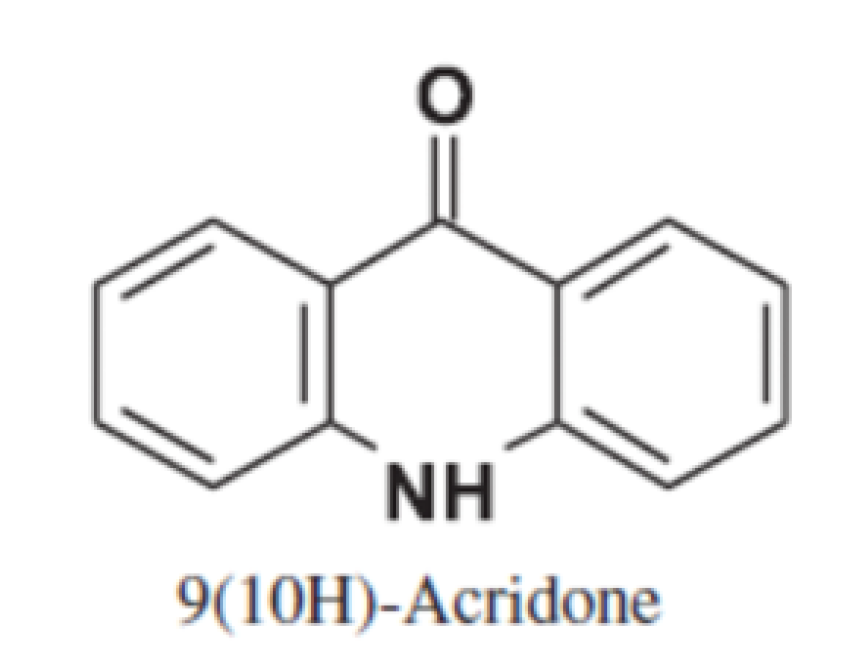
Acridone is planer with no atoms deviating by more than 0.02 Å from the molecular plane defined by non-H ring atoms and the oxygen atoms, all torsion angle lies with in +1.5 to -1.5 of 0 to 180 degree. The molecules adopt a Harringbone Packing Arrangement very similar that found anthraquinone and quinaacridone. Hydrogen bonding is maximized in such structures [2] (Figure 1).
Figure 1: Olecular Structure of 9(10H)-Acridone
Experimental
The purity of synthesized compounds was ascertained by thin layer chromatography on silica gel G in various solvent systems using the UV radiation as detecting agents. The IR spectra of the com- pounds were recorded on Perkin-Elmer InfraRed-283 FTIR spectrometer in KBr phase and are expressed in cm-1. 1H-NMR spectra were recorded on Brucker 300 MHz NMR spectrometer (chemical shift in δ ppm) using TMS as an internal standard (at Sophisticated Analytical Instrumentation Facility, Punjab University, Chandigarh).
Procedure for Synthesis of N-Phenylanthranilic Acid Derivatives (3a-C)
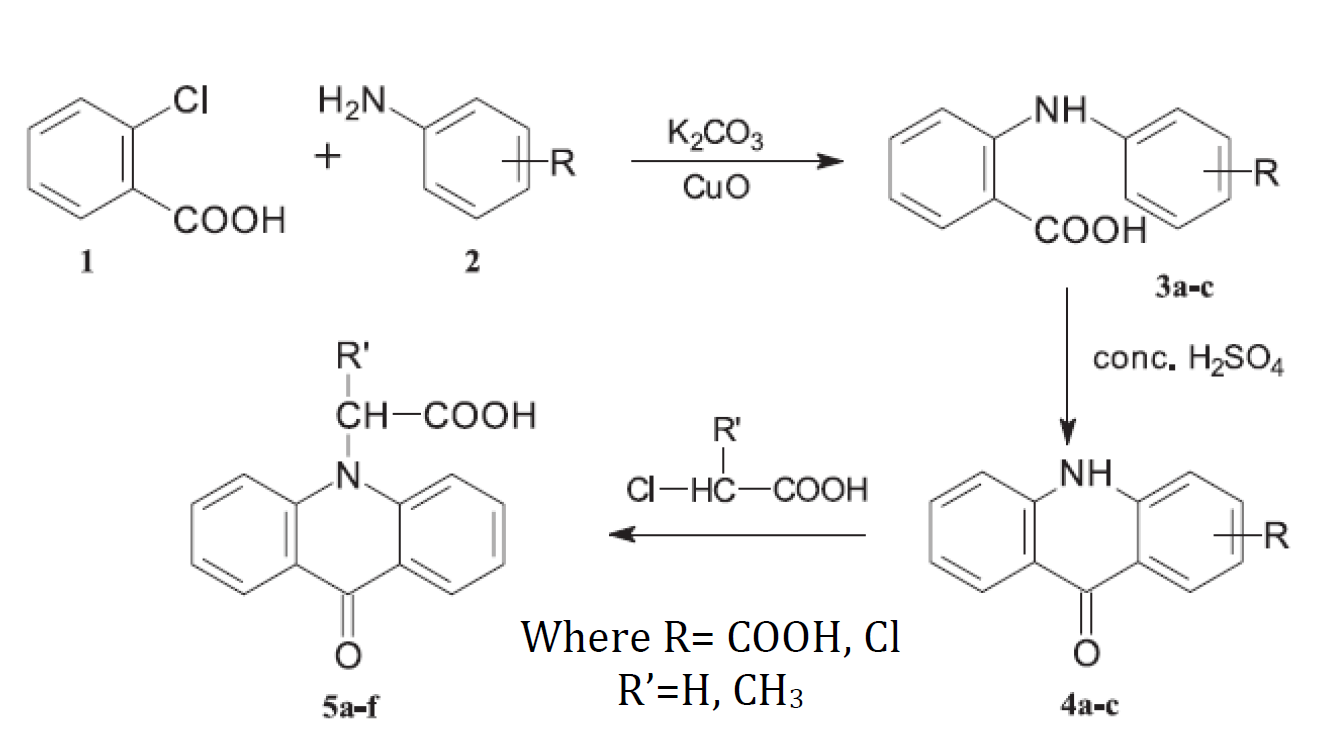
A mixture of 5.5 mL (0.06 M) of aniline, 9.4 g (0.06 M) of o-chlorobenzoic acid, 8.3 g (0.06 M) of anhydrous potassium carbonate and 3 g of copper oxide was prepared in a 500 mL round-bottomed flask fitted with an air-condenser. The mixture was boiled under reflux for 4-5 h. The mixture tended to foam during the earlier part of the heating owing to the evolution of carbon dioxide, and hence the large flask is used. When the heating was completed, the flask was fitted with a steam-distillation head and the crude product was steam-distilled until all the excess of aniline had been removed. The residual solution contained the potassium N-phenylanthranilate. Two g of animal charcoal was added to this solution and boiled for about 5 min, and filtered hot. Diluted hydrochloric acid (1:1 by volume) was added to the filtrate until no further precipitation occured, and then, the mixture was cooled in ice water with stirring. N-phenylanthranilic acid was filtered under diminished pressure, washed with water, drain and dry. The acid was recrystallized from aqueous ethanol with addition of charcoal (Figure 2) [3-4].
Figure 2: Synthesis of N-Substituted Acetic Acid Derivatives of Acridone 5(A-F)
Procedure for Cyclization of N-Phenylanthranilic Acid Derivatives to Acridones (4a-C)
A mixture of 4.26 g (0.02 M) of N-phenylanthranilic acid and 10 mL of conc. sulfuric acid was prepared in a conical flask, and heated for 4 h on a steam bath. The hot dark green solution was poured slowly and cautiously into 200 mL of boiling water in a 500 mL beaker, allowed the acid to run down the side of the beaker. The mixture was boiled for 5 min, and it was filtered whilst hot through a Buchner funnel, and the precipitate was washed on the filter with hot water. For purification, acridone was transferred to a solution of 4 g of hydrated sodium carbonate in 50 mL of water. The mixture was boiled for 5 min, and then filtered hot. Acridone was washed with boiling water and dried thoroughly. Recrystallization from acetic acid using charcoal or better sublimation, gives the bright yellow product [3-4].
Procedure for Synthesis of N-Substituted Acetic Acid Derivatives of Acridone (5a-F)
A solution of 0.4 g (0.01 M) of NaOH was prepared in a beaker and 0.005 M of acridone derivative was dissolved in it by heating. Then, 0.01 M chloroacetic acid or 2-chloropropionic acid was added and the mixture was refluxed for 2-3 h. Then, diluted HCl was added dropwise to get the crystalline product (Table 1). It was recrystallized from distilled water [5].
Table 1: Physical Data of N-Substituted Acetic Acid Derivatives of Acridone
The aim of the study was to synthesize and characterize good and effective antibacterial agents having acridone as basic nucleus. For synthesizing the acridone derivatives, 2-chlorobenzoic acid was condensed with different substituted anilines to get the acridones. These acridones were further reacted with chloroacetic acid and 2-chloropropionic acid to get their acetic acid and propionic acid derivatives. The structures of the compounds were confirmed by FTIR and 1H NMR spectral data. The compounds were then evaluated for their analgesic (Table 2) and anti-inflammatory activity (Table 3) against Diclofenac sodium as standard drug [6- 7].
Table 2: Analgesic Activity of N-Substituted Acetic Acid Derivatives of Acridone
Table 3: Anti-Inflammatory Activity of N-Substituted Acetic Acid Derivatives of Acridone
Compound
Change in paw volume±SEM
% Anti-inflammatory activity
2 h
4 h
2 h
4h
Control
0.75±0.006
1.81±0.006
-
-
Standard
0.37±0.004
0.72±0.004
84
15.4
2-carboxy-9-acridone-N-acetic acid
0.73±0.006
0.69±0.006
36
17.12
2-carboxy-9-acridone-N- isopropionic acid
0.66±0.007
0.62±0.006
45.33
20.99
2-chloro-9-acridone-N-acetic acid
0.64±0.003
0.61±0.003
48
21.54
2- chloro-9-acridone-N- isopropionic acid
0.65±0.004
0.59±0.013
46.66
22.65
3- chloro-9-acridone-N-acetic acid
0.74±0.007
0.73±0.003
34.66
21.54
3- chloro-9-acridone-N- isopropionic acid
0.72±0.007
0.68±0.004
37.33
17.67
Analgesic activity
Acetic acid induced writhing response in mice: Mice weighing approximately 18-25 g of either sex were used. Animals were divided into 8 groups of 6 animals each. Animal were pre-treated with test compounds (dose compared with 50 mg/kg, 47 µM of diclofenac sodium) were administered by gastric probe. Control group was received a similar volume of 1% CMC. The reference group will receive standard drug. In experiment, acetic acid solution (0.7%) at dose of 10 ml/kg body weight was injected i.p. and the no. of writhes during the following 20 minimum periods was observed [6].
Anti-inflammatory activity
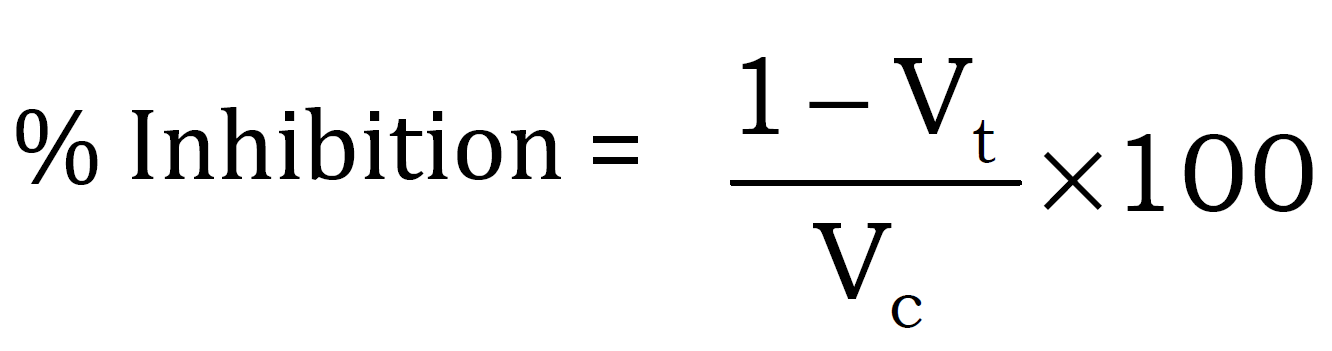
Carrageenan induced paw edema in rats: The anti-inflammatory activity of the synthesized compounds was evaluated by the hind paw edema method utilizing carrageenan as phlogistic agent in rats. The initial left hind paw volume of animal was measured by digital venire caliper. The animals were divided into different groups (control, standard and test groups). Each consisting of six rats. The animals were starved over night and only water were given ad-libitium. A group of rat were treated with tween 80 (1%) suspension (control). The standard group was treated with standard drug (Diclofenac sodium, 15 mg/kg) and the test group was treated with the suspension of test compounds. The route of administration was oral. After 30 minutes, the animals were injected with 0.1 ml of carrageenen (1% w/v) in the sub planter region of left hind paw of rats. The final paw volume was measured digital vernire caliper immediately after injection and at one-hour intervals till 04 hours and eventually after 24 hours. The percent inhibition of the inflammation was calculated by the formula.
Where, Vt and Vc are the mean relative changes in the volume of paw edema in the test and control respectively.
CONCLUSION
In conclusion, only six compounds were synthesized so structure activity relationship was not possible. Out of these derivatives 2-carboxy-9-acridone-N-isopropionic acid showed good analgesic activity when compared to standard drug Diclofenac sodium. No significant anti-inflammatory activity was found when compared to standard drug.
Acknowledgments
The authors are thankful to the Chairperson of the Department of Pharmaceutical Sciences, Guru Jambheshwar University of Science & Technology and the authorities of the University for providing necessary facilities to complete this work.
REFERENCE
Pohs, G.D. and W. Jones. “Acta Crystallographica Section C.” Acta Crystallographica, vol. 51, 1995, p. 267.
Mehta, G. et al. “Journal of the Chemical Society, Perkin Transactions 1.” Journal of the Chemical Society, Perkin Transactions 1, 1993, p. 2667.
Allen, C.F.H. et al.“Organic syntheses.” Organic Syntheses, vol. 19, 2002, p. 6.
Mann, F.G. and B.C. Saunders. Practical organic chemistry. 4th ed., Orient Longman Private Ltd., 2003, pp. 393–394.
Edwards, M.L. et al. “Journal of medicinal chemistry.” Journal of Medicinal Chemistry, vol. 2, 1977, pp. 560.
Girdhar, A., Raheja, S., Jain, N., Jain, S. & Setia, A. (2021). Syntheses and Pharmacological Evaluation of Novel 9(10H)-Acridone Derivatives. Scientific Research Journal of Pharmacy, 1(1), 1-4.
MLA
Girdhar, Amit, et al. "Syntheses and Pharmacological Evaluation of Novel 9(10H)-Acridone Derivatives." Scientific Research Journal of Pharmacy 1.1 (2021): 1-4.
Chicago
Girdhar, Amit, Shikha Raheja, Neelam Jain, Sandeep Jain and Anupama Setia. "Syntheses and Pharmacological Evaluation of Novel 9(10H)-Acridone Derivatives." Scientific Research Journal of Pharmacy 1, no. 1 (2021): 1-4.
Harvard
Girdhar, A., Raheja, S., Jain, N., Jain, S. and Setia, A. (2021) 'Syntheses and Pharmacological Evaluation of Novel 9(10H)-Acridone Derivatives' Scientific Research Journal of Pharmacy 1(1), pp. 1-4.
Vancouver
Girdhar A, Raheja S, Jain N, Jain S, Setia A. Syntheses and Pharmacological Evaluation of Novel 9(10H)-Acridone Derivatives. Scientific Research Journal of Pharmacy. 2021 Jul;1(1):1-4.


 Download PDF
 Download XML