Background: Cardiovascular diseases (CVDs) pose a significant threat to public health, with myocardial infarction (heart attack) being a critical event in this category. Timely recognition of heart attack symptoms and awareness of risk factors are essential for improving patient outcomes. This study aims to assess the awareness and knowledge of heart attack symptoms and risk factors among the general public in Himachal Pradesh, India. Materials and Methods: A cross-sectional survey was conducted from April to July 2023 among 400 adults residing in Himachal Pradesh for at least 12 months. A structured questionnaire assessed participants' knowledge about heart attack symptoms and risk factors. Data were analyzed using Epi Info V7 software, and knowledge levels were categorized as very good, good, fair, or poor. Results: While 71.25% of participants correctly identified common heart attack symptoms, a significant knowledge gap remains, emphasizing the need for enhanced awareness efforts. Only 24.25% were aware of the "Golden Hour," highlighting the importance of immediate medical attention during a heart attack. Awareness of risk factors was relatively better (67.5%), but gaps existed in understanding medical conditions contributing to heart attack risk. Encouragingly, 64.75% recognized the benefits of exercise, and 62% identified heart-healthy dietary habits. Conclusion: This study reveals both strengths and weaknesses in public awareness and knowledge of heart attack symptoms and risk factors in Himachal Pradesh. Targeted educational campaigns are essential to improve recognition of symptoms, emphasize the significance of the "Golden Hour," and enhance understanding of risk factors. Such efforts can contribute to reduced heart attack-related morbidity and mortality in the region.
Among Cardiovascular diseases (CVDs), myocardial infarction, commonly known as a heart attack, is a critical and often life-threatening event. Timely recognition of heart attack symptoms and awareness of associated risk factors are crucial for early intervention, which can significantly improve patient outcomes [1-3].
A heart attack occurs when there is a sudden disruption of blood flow to a part of the heart muscle, typically due to the blockage of a coronary artery. The lack of oxygen-rich blood can cause damage to the heart muscle and can be life-threatening if not promptly treated [4-7]. Therefore, recognizing the symptoms of a heart attack is essential for seeking immediate medical attention.
Common symptoms of a heart attack include chest pain or discomfort, which may radiate to the arm, neck, jaw, or back. Other associated symptoms can include shortness of breath, cold sweats, nausea, and lightheadedne. Early recognition and seeking emergency care can significantly improve the chances of survival and reduce long-term complications [8,9].
Several risk factors contribute to the development of heart attacks. These risk factors can be categorized into modifiable and non-modifiable factors. Non-modifiable risk factors include age, gender, and family history of heart disease. Modifiable risk factors encompass lifestyle choices such as smoking, poor diet, physical inactivity, high blood pressure, diabetes, and obesity. Raising awareness about these risk factors and their role in heart health is a crucial aspect of heart attack prevention [9,10]. Public awareness campaigns and educational initiatives play a pivotal role in promoting early recognition of heart attack symptoms and encouraging individuals to adopt heart-healthy lifestyles [11,12]. Understanding the current levels of awareness and knowledge among the general public in Himachal Pradesh is vital for tailoring effective awareness programs and interventions.
This study employs a systematic approach to assess public awareness and knowledge regarding heart attack symptoms and risk factors in Himachal Pradesh. By identifying gaps in awareness and knowledge, this research aims to inform targeted health promotion strategies that can enhance heart attack prevention, recognition, and timely intervention. Ultimately, improving public awareness in Himachal Pradesh can contribute to the reduction of heart attack-related morbidity and mortality in this scenic state.
Objectives of the Study
To evaluate the awareness and knowledge regarding Symptoms and Risk Factors for Heart Attack (Myocardial Infarction) among general public of Himachal Pradesh
Research Approach
The research approach adopted for this study is descriptive, aiming to assess the knowledge about heart attack symptoms and risk factors among the general public of Himachal Pradesh.
Research Design
The study utilizes a cross-sectional survey design to collect data at a specific point in time, allowing for the assessment of the knowledge level among participants.
Study Area
The research was conducted in Himachal Pradesh
Study Duration
The study was conducted between April 2023 and July 2023.
Study Population
The study population includes all adults above 18 years of age who have been residing in Himachal Pradesh for a minimum of 12 months.
Sample Size
The sample size was determined to be 400 adults, assuming that 50% of the participants have adequate knowledge about heart attack symptoms and risk factors. A 5% absolute error, 95% confidence level, and 5% non-response rate were considered during sample size estimation.
Study Tool
A structured Google Form questionnaire was designed to gather information on socio-demographic characteristics and knowledge about heart attack symptoms and risk factors. The questionnaire underwent pre-testing on a small group of individuals to ensure clarity and understanding.
Description of Tool
The questionnaire consisted of two sections:
Demographic Data Survey Instrument: This section collected background information such as age, gender, marital status, religion, employment, and education
Questionnaire: This section comprised 20 structured questions related to knowledge about heart attack symptoms and risk factors. Each correct answer was awarded one mark, while incorrect answers received zero marks. The maximum possible score was 20, and the minimum was zero for each category. Knowledge levels were categorized as follows: >80% (16-20) - very good, 60-79% (12-15) - good, 41-59% (8-11) - fair, and <40% (<8) - poor
Validity of Tool
The questionnaire was validated by experts in the field to ensure its accuracy and appropriateness.
Data Collection: Data collection was conducted under the supervision of supervisors. The Google Form questionnaire was distributed via various online modes, including email and social media platforms such as WhatsApp groups, Facebook, Instagram, and LinkedIn. Data collection was carried out in both rural and urban areas of Himachal Pradesh until 400 responses were obtained.
Data Analysis: The collected data were entered into a Microsoft Excel spreadsheet and checked for errors. Epi Info V7 software was used for data analysis, and appropriate statistical tests, such as frequencies and percentages, were employed.
Ethical Considerations
The study strictly adhered to ethical guidelines. Participants' confidentiality and anonymity were maintained throughout the research process to ensure their privacy and protection of personal information.
The goal of the current study was to assess general public knowledge regarding Symptoms and Risk Factors for Heart Attack (Myocardial Infarction). A total of 400 respondents took part in the study, with 123 (30.75%) coming from urban areas and 277 (69.25%) from rural areas (Table 1).
Table 1: Knowledge Regarding Symptoms and Risk Factors for Heart Attack (Myocardial Infarction) among Study Participants
S.No. | Statements | Frequency of Correct Responses | Percent |
What is a heart attack (Myocardial Infarction)? | 344 | 86 | |
What are the common symptoms of a heart attack? | 285 | 71.25 | |
What are the risk factors for heart attack? | 270 | 67.5 | |
Is age a risk factor for heart attacks? If so, at what age does the risk increase? | 239 | 59.75 | |
Name some lifestyle factors that can increase the risk of heart attack. | 229 | 57.25 | |
Are you aware of any genetic or family history factors that can contribute to heart attack risk? | 218 | 54.5 | |
Can you list some medical conditions that may increase the likelihood of a heart attack? | 198 | 49.5 | |
Do you know the importance of blood pressure and cholesterol levels in heart health? | 204 | 51 | |
How does smoking impact the risk of heart attack? | 253 | 63.25 | |
What role does physical inactivity play in heart attack risk? | 271 | 67.75 | |
Are you aware of the link between obesity and heart attack risk? | 241 | 60.25 | |
Can you name some warning signs that may indicate an impending heart attack? | 273 | 68.25 | |
What actions should one take if they suspect they or someone else is experiencing a heart attack? | 249 | 62.25 | |
Are you familiar with the concept of "Golden Hour" in heart attack management? | 97 | 24.25 | |
Can you identify the importance of early intervention and calling emergency services during a heart attack? | 118 | 29.5 | |
Do you know how to perform CPR (Cardiopulmonary Resuscitation) in case of a heart attack emergency? | 92 | 23 | |
Do you know the benefits of regular exercise in preventing heart attacks? | 259 | 64.75 | |
Can you name some heart-healthy dietary habits to reduce heart attack risk? | 248 | 62 | |
What are some stress management techniques that can help lower heart attack risk? | 217 | 54.25 | |
Do you understand the importance of regular health check-ups and screening for heart disease risk assessment? | 270 | 67.5 |
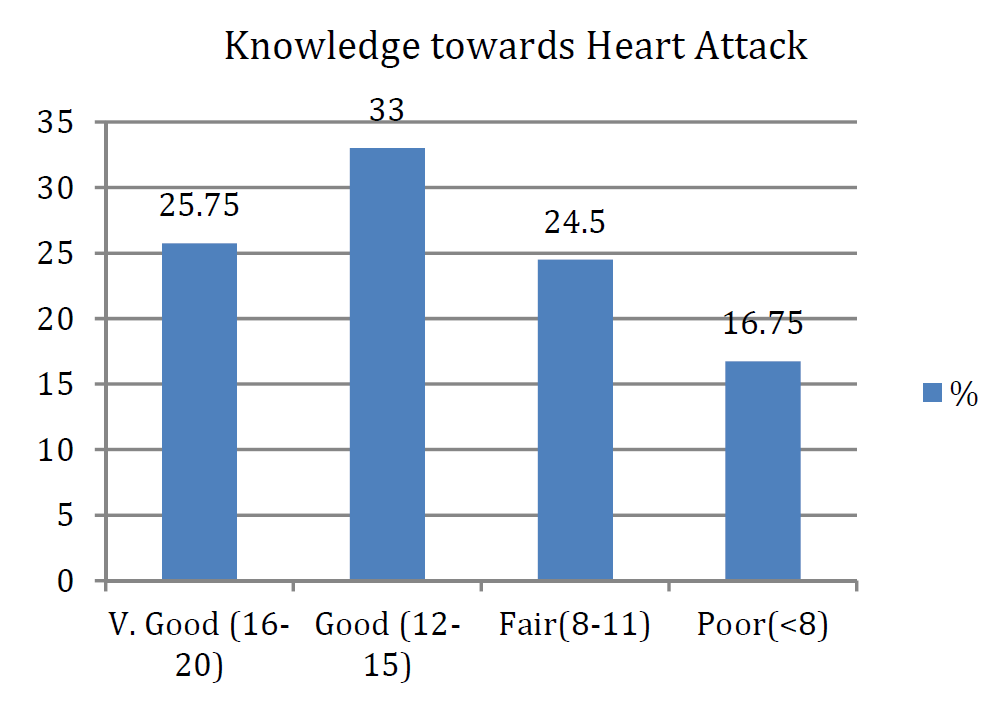
In the present study 25.75% (103) participants had very good knowledge (16-20 marks) towards, Symptoms and Risk Factors for Heart Attack (Myocardial Infarction) ,33% (132) had good knowledge (12-15 marks), 24.5%(98) had fair knowledge (8-11 marks) and 16.75% (67) having poor knowledge (<8 marks) (Figure 1).

Figure 1: Knowledge Scores towards Symptoms and Risk Factors for Heart Attack (Myocardial Infarction) among Study Participants
The present study aimed to assess the general public's awareness and knowledge regarding the symptoms and risk factors associated with heart attacks (Myocardial Infarction) in Himachal Pradesh. The findings shed light on the level of understanding among the population and provide insights into areas that may require targeted awareness campaigns and educational interventions.
The study results indicate that there is reasonable awareness among the participants about the symptoms of a heart attack, with 71.25% correctly identifying common symptoms such as chest pain or discomfort, shortness of breath, cold sweats, nausea, and lightheadedness. However, this leaves almost 30% of respondents without adequate knowledge of these critical symptoms. This gap in knowledge emphasizes the need for focused efforts to ensure that the general public can recognize the signs of a heart attack promptly.
Furthermore, only 24.25% of participants were aware of the concept of the "Golden Hour" in heart attack management, which underscores the importance of seeking immediate medical attention during a heart attack. This finding highlights the need for increased public education regarding the time-sensitive nature of heart attack treatment.
While the awareness of risk factors for heart attacks was relatively better, with 67.5% of participants correctly identifying them, there is still room for improvement. Notably, risk factors like age, family history, lifestyle choices (smoking, physical inactivity, obesity), and the importance of blood pressure and cholesterol levels were recognized by a significant proportion of respondents.
However, some risk factors, such as medical conditions that may increase the likelihood of a heart attack, were less well-known, with only 49.5% correctly identifying them. This suggests the need for enhanced public education on the role of medical conditions like diabetes and hypertension in heart attack risk.
The study found that a substantial percentage of participants (64.75%) understood the benefits of regular exercise in preventing heart attacks. This is a positive sign; as physical activity is a crucial component of heart health. Similarly, a majority of respondents (62%) could identify heart-healthy dietary habits to reduce the risk of heart attacks.
Despite these encouraging findings, it is evident that knowledge gaps persist, particularly concerning the "Golden Hour" concept, the importance of early intervention, and the performance of CPR during a heart attack emergency. These areas require targeted educational campaigns to raise awareness and equip the public with the information and skills needed to respond effectively to a heart attack.
The findings of this study are in line with previous research conducted in various regions. 9-12 Similar studies have shown that while there is a reasonable level of awareness regarding heart attack symptoms and risk factors, there are notable gaps in knowledge, particularly concerning time-sensitive interventions like the "Golden Hour" and CPR.
The study results have several implications for public health initiatives in Himachal Pradesh. Firstly, efforts to enhance public awareness about heart attack symptoms and risk factors should be intensified, with a particular focus on reaching those with lower levels of education and awareness. Secondly, educational programs should emphasize the importance of seeking immediate medical attention during a heart attack and the role of early intervention in improving outcomes. Targeted campaigns can help bridge the gap in knowledge regarding the "Golden Hour" and CPR. Lastly, healthcare authorities should consider utilizing multiple channels for disseminating information, including social media, community health workers, and local health centers, to ensure that heart attack awareness reaches all segments of the population.
The study provides valuable insights into the level of awareness and knowledge among the general public in Himachal Pradesh regarding heart attack symptoms and risk factors. While there is a reasonable understanding of these aspects, there are notable gaps that require targeted interventions. Public health initiatives should aim to improve awareness of the "Golden Hour," the significance of early intervention, and the importance of CPR during a heart attack emergency. These efforts have the potential to reduce heart attack-related morbidity and mortality in the region.
Virani, S.S. et al. “Heart disease and stroke statistics—2020 update: a report from the American Heart Association.” Circulation, vol. 141, no. 9, 2020, pp. e139–e596.
Anderson, J.L. and Morrow, D.A. “Acute myocardial infarction.” New England Journal of Medicine, vol. 376, no. 21, 2017, pp. 2053–2064.
Ibanez, B. et al. “2017 ESC guidelines for the management of acute myocardial infarction in patients presenting with ST-segment elevation.” European Heart Journal, vol. 39, no. 2, 2018, pp. 119–177.
Prabhakaran, D. et al. “Cardiovascular diseases in India: current epidemiology and future directions.” Circulation, vol. 133, no. 16, 2016, pp. 1605–1620.
Thakur, J.S. et al. “Profile of risk factors for non-communicable diseases in Himachal Pradesh, India.” Indian Journal of Public Health, vol. 60, no. 1, 2016, pp. 17–23.
Thygesen, K. et al. “Fourth universal definition of myocardial infarction (2018).” Circulation, vol. 138, no. 20, 2019, pp. e618–e651.
Benjamin, E.J. et al. “Heart disease and stroke statistics—2017 update: a report from the American Heart Association.” Circulation, vol. 135, no. 10, 2017, pp. e146–e603.
Amsterdam, E.A. et al. “2014 AHA/ACC guideline for the management of patients with non-ST-elevation acute coronary syndromes.” Journal of the American College of Cardiology, vol. 64, no. 24, 2014, pp. e139–e228.
Yusuf, S. et al. “Effect of potentially modifiable risk factors associated with myocardial infarction in 52 countries (the INTERHEART study): case-control study.” The Lancet, vol. 364, no. 9438, 2004, pp. 937–952.
Mozaffarian, D. et al. “Heart disease and stroke statistics—2016 update: a report from the American Heart Association.” Circulation, vol. 133, no. 4, 2016, pp. e38–e360.
Redeker, N.S. et al. “Heart attack symptom knowledge in a community sample.” Journal of Cardiovascular Nursing, vol. 33, no. 5, 2018, pp. 413–419.
Mosca, L. et al. “Tracking women's awareness of heart disease: an American Heart Association national study.” Circulation, vol. 109, no. 5, 2004, pp. 573–579.