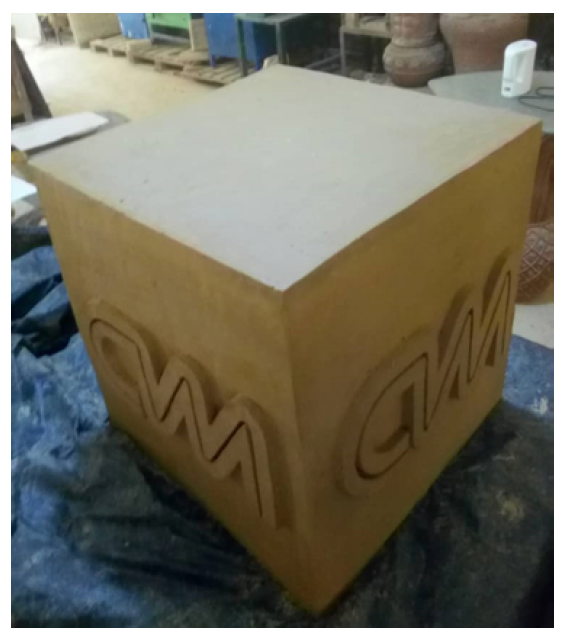
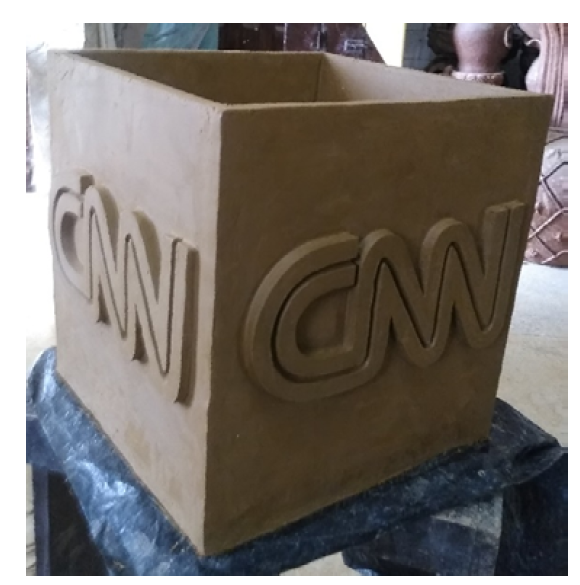
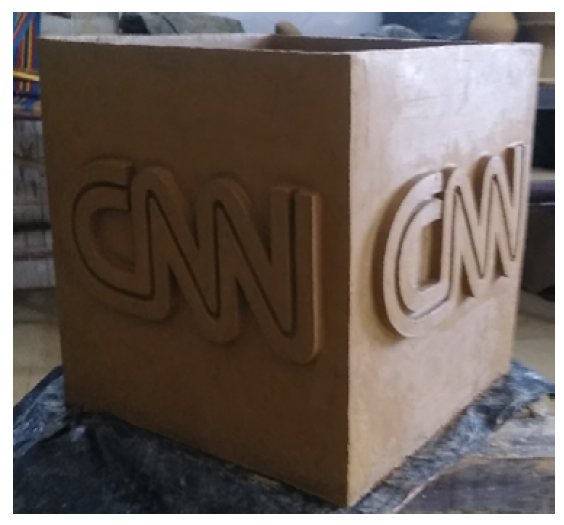
Pottery is indisputably an age long tradition; rooted in man’s domesticity, housing liquid, culinary and horticulture. Interestingly, pots come in small, medium and large sizes with conical, globular, cylindrical, disk-like, rectangular and tubular forms. These forms have over the years saturated the global built space that, they require a fresh breath in Potlogo1; a budding ceramic genre, coined from pot and logo. The study aimed specifically at constructing Potlogo with the objectives of advancing its place as primus inter pares in the committee of pots in general and corporate pottery in particular. Studio experimentation and purposive sampling were the methods adopted; sourcing purposively Cable News Network (CNN) logo from the vast samples of corporate rectilinear logos, mainly for its household significance locally, nationally, continentally and globally. The studio experimentation involved downloading of CNN logo from the Internet, edit to desired scale and finally construct Potlogo. Finding consequently, established Potlogo’s multi-dimensionality and possible suitability as pavilion, porch, lobby, garden, street or public monument. Its prototype will serve as springboard for inquisitive enthusiasts. This development when fully embraced will boost corporate imaging and open new paradigm in design, vocation, production and patronage by potters, ceramists and corporations in Nigeria and globe wide.
Keywords
Logo
Download
Edit
Parts
Potlogo
Corporation and Nigeria
INTRODUCTION
The etymology of Potlogo is no doubt nascent, derived from pot and logo; quintessentially designed as ornamental monumental planter for corporate institution. Its constituting components pot and logo are not only household names but age long terms. For logo, it proto-emergence dated back in time immemorial with divergent insignias as marks, signs and impressions on badges, stamps and emblems, adorning doors, gates, staffs, letters, parcels, regalia, cassocks, paintings and vases. An art strictly commissioned by royalties and nobles of the golden era and probably earlier, attesting wealth, affluence and prowess with emphasis on self-aggrandizement [1,2]. Logo therefore, became a prerogative or better still an exclusive right reserved and exerted by aristocratic class particularly in Europe [1]. This right was deregulated and restructured by King Henry III, precisely in 1266. The period also witnessed England’s budding industrialization and commercialization enacted through the Assize of Breed and Ale. This act broadened the horizon of logo and brought to fore “merchant’s marks”, meant to monitor goods standard in terms of quality, quantity and pricing. It hence, checkmated scruples, cheats, counterfeits and dishonest businesses particularly amidst bakers and brewers. Consequently, fines, forfeitures or corporal punishments were often the lot of defaulters [2].
As such, marks suffice as the most significant of all insignia that foreran logo; pioneered by merchant’s marks. Its other developments were typified in excise marks of 1824, registration marks of 1842 and trademarks of 1862 [3]. They however, served different purposes; for instance, excise mark verifies capacity of vessels; registration mark gives security and protection to industrial art designs against piracy while trademark sees to the regulations of brands or logos [3]. Interestingly, the role of marks, otherwise called cartouches in ceramics of Europe in particular and the world at large cannot be underestimated. Their primal manifestation were to identify and distinguish designated pottery products of export like ‘Asiatic Pheasants’ in England from those of local or domestic market. Oval and diamond shapes were the obvious marks of the era, often placed at the base of pots [3-5].
These marks contain maker’s initials, name of potteryand initial of town as in JRF meaning James Reeves of Fenton. Others were accompanied with the royal crown, monarch’s cipher, number of the county testing office and the year [3]. Though same Western ware mark dexterity or near perfection cannot be said of African or Nigerian pottery; nevertheless, attestation to its existential clue is not in doubt. However, the aforementioned disparity (precision and imprecision) is obviously hinged on race, differential culture and psychological ratiocination, instanced in rule of measure and significance of proportion or selective realism [6-8]. Mark instance, as found in Yoruba epigram is amplified and exemplified as thus:
Se oodamo t’oba ri?
On lo d’ifa,
Feni to r’agba,
To sami s’igba,
T’igba ba sonu ,
O d’igba, toba r’igba,
Igba yen, loma rami,
Ooda mo tobari oo,
Ooda mo ni yen…
Can you recognize it, when you see it?
It was divined,
For the one that bought gourd,
And impressed marks on the gourd,
If the gourd got missing,
It is when he sees the gourd,
That he will notice the marks,
You recognize it, when you see it,
You recognized it indeed…
Though, the above epigrammatic expression was on gourd, which presumably heralded gourd carving [9]. The expression further elucidated mark’s potency in demystifying lost art piece, therefore serving as a missing link between the work of art and it creator, patron or owner. Ludicrous as the aforesaid Yoruba epigram may sound. It further found cognizance in the potter’s mark remains at Mejiro cave, which dated back to 1300 +_ 80 A.D. [10]. This age long mystery was demystified after critical observation and correlation with contemporary pottery practice of Ilorin [11,12]. Suffice to note that, potter identification mark is ancient to the Yoruba race and Africa in extension, typified in their codifying system [13,14], though differ in forms.
Arguably, varying pot forms have over the years adorned man’s interior and exterior built spaces, private and public, coming in small, medium and large sizes; often ornamented or embellished with engraving, sculpting, painting or glazing using zoomorphic, anthropomorphic, geometric, floral and texts motifs [9,15-18]. They are categorized into conical, globular, cylindrical, rectangular, tubular and disk-like forms [15]. Form in Barnet’s [19], view, is revealed through style, created by application of certain techniques to certain materials, in order to embody a particular vision or content, which apparently was nonexistence at a time; as instanced in porcelain whose idea was envisioned and configured by later generation of Chinese potters. It attendant courtly aura still lingers till date [19-21].
Like the above aforementioned, several ideas have lingered for centuries and even millennia before advancement is generated, either as supplement, complement or completely new invention. This observation still holds even now in pottery globally, where some of it forms have saturated the human built environment for too long [15], its rejuvenation no doubt is long overdue. Changing this narrative however, requires Promethean insight of seeing outside the box, a quest that brought to fore Potlogo [22,23]. Though, Potlogo’s core is logo, a symbolic imagery of an organized or formal entity [24,25]. It potentialities were until now limited to advertorial or directional posts and cladding, exemplified as complaint boxes, mail boxes, banners, broaches, hand-bands, tie clips, cufflinks, bill boards and wall boards.
It is imperative to acknowledge the duo of Cable News Network (CNN) of the United States of America and Zenith bank of Nigeria as few of the corporate institution that has taking advantage of their rectilinear logo for three-dimensional virtual and realistic ads. CNN, the world foremost cable news network, virtually simulated her logo to pop out as a flash cube at almost every promotional interlude. Zenith bank on the other hand, realistically projected the three-dimensionality of her logo suspended at the decked roof top of all her bank buildings. This cubic logo is also seen at important junction and roundabouts of major cities particularly in Nigeria and possible in other countries where it had operational stakes. However, there is no doubt there are other examples out there, even at that, no corporate institution has expressed her logo as Potlogo or adopted the coinage Potlogo. In view of this limitation, the transfiguration and advancement of logo to a vessel became germane, conceived with the intent of producing Potlogo as a budding pottery genre [26] and possibly takes its rightful place in the committee of pots (planters) as the official or formal corporate ornamental and monumental symbol or image.
To bring this process to fore, the methodologies adopted were purposive sampling and studio experimentation. The CNN logo was purposively sourced from the vast corporate rectilinear logos, specifically for its household significance locally, nationally, continentally and globally, particularly in the 21th century. Consequently, its production as Potlogo will hopefully serve as a springboard or temFigure for inquisitive or enthusiastic individuals and groups who may wish to try their hands on the practicality of this exercise. Apparently, certain fundamental materials, equipment and tools are required. They included active or latent artistic inquisition, knife, clay body, slurry, wooden movable board, long table, T-square, angle bar, wooden beater and a metal steel ruler. In launching out, the exercise took cognizance of image download, transfer of image to PC and construction of Potlogo as it fundamental phases, elaborating on them systematically.
Image Download
This phase is simply prima facie in that, it gave concise information on download, which is simply copying of file, program or data from one storage facility of immense capacity like the Internet via the World Wide Web to another computing device as in mobile phone [27,28]. It is informative to submit that; download in this context was a tripartite arrangement, involving a network service provider, the Internet and a subscriber or an end user. It is also imperative to note that, there are well over thirty 30 graphics formats downloadable from the Internet [27,29], they included Window bitmap (.bmp), Graphics Interchange Format (.gif), Kodak’s Photo CD (pcd), Joint Photographic Experts Group (.jpg or .jpeg) etcetera.
Interestingly, Chrome is a default package for Android phone [27,30], enabling subscriber to link it home page. For instance, CNN logo outline was inserted on Google Chrome home page of an Infinix 623 phone, a menu pop out automatically, displaying the desired imagery and other related image options; when done with the image appraisal; click to highlight it, a dialog box appears, then choose the option ‘Download image’ to showcase either vector or bitmap free download logo image (JPG/JPEG, GIF, PNG or SVG etcetera) as instanced in the screenshots below (Figures 1-3) and eventually saved (Figure 4).
Figure 1: Chrome Icon, Phone Screenshot
Source: Akinde, Toyin Emmanuel
Figure 2: Key board, Phone Screenshot
Source: Akinde, Toyin Emmanuel
Transfer Image from Phone to Personal Computer (PC) System
This penultimate phase is in three sub-phases of transfer, edit and print. By transfer, the saved CNN download in Infinix 623 phone was moved into a personal computer [31,32], precisely a Dell Vostro 2521 laptop with the aid of USB cord. Thereafter, CorelDraw X5 was adopted for the editing. Double click the CorelDraw X5 icon on the Desktop to display welcome screen, click on new document and adjust to desired specification (Figures 5 - 8).
Click ok to reveal specification and then copy the saved CNN logo download into the dedicated space. Apparently, the pasted image was smaller than the prepared space, as a result of it customized configuration 18” x 18” square. It was thereafter adjusted and aligned to fit the space. This exercise was previewed, enabling one to do all necessary adjustment before printing. (Figures 9-12).
Figure 3: Dialogue Box, Phone Screenshot
Source: Akinde, Toyin Emmanuel
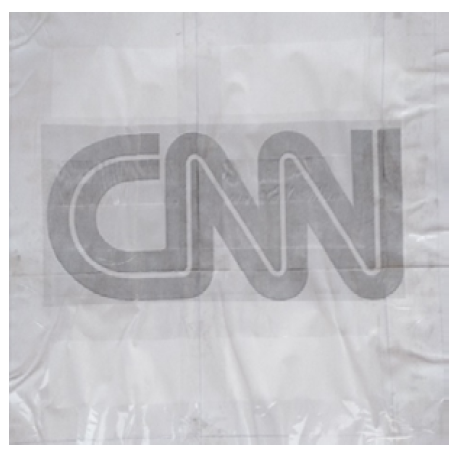
Figure 4: CNN logo outline
Source: Akinde, Toyin Emmanuel
Figure 5: System Desktop Page with Diverse Icons
Source: Adedokun Oluwatosin
Figure 6: Activating CorelDrawX5 Home Page
Source: Adedokun Oluwatosin
Figure 7: Welcome Screen Page
Source: Adedokun Oluwatosin
Figure 8: New Document Page
Source: Adedokun Oluwatosin
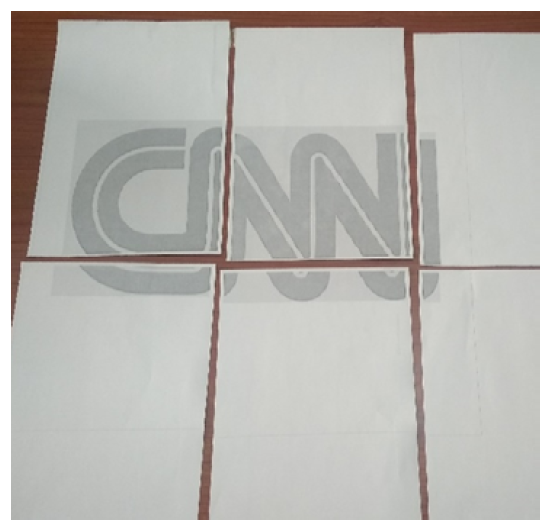
The print came out in six A4 paper sheets (Figure 13), which were trimmed and tapped to retain only the required logo outline and form a single piece (Figure 14).
Figure 9: Space-Image Disparity
Source: Adedokun Oluwatosin
Figure 10: Space-Image Alignment
Source: Adedokun Oluwatosin
Figure 12: Print Preview
Source: Adedokun Oluwatosin
Figure 13: Tiled Print Out of CNN Logo, Six A4 sheets
Source: Akinde, Toyin Emmanuel
Figure 14: Tapped Print Out of CNN Logo, 18’’ x 18’’ Square
Source: Akinde, Toyin Emmanuel
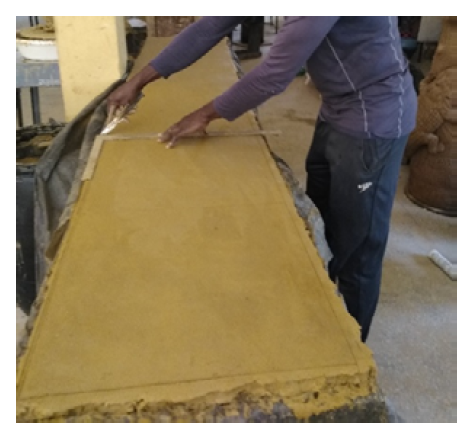
Figure 15: Measuring Streached Clay Sheet 20’’ x 67’’
Source: Akinde, Toyin Emmanuel
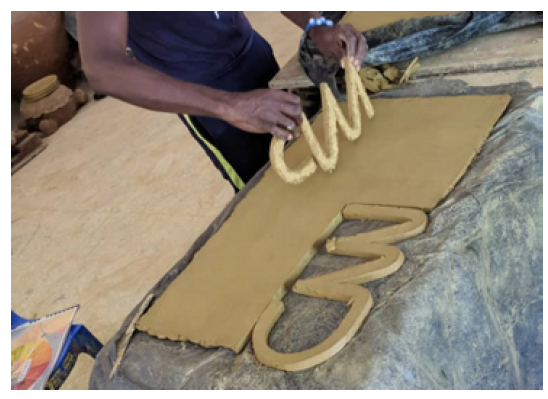
Figure 16: Careful Handling of Text Cut Out, 18’’x18’’ square each
Source: Akinde, Toyin Emmanuel
Construction of Potlogo
This is the ultimate phase of the exercise, which was of five sub-phases: clay preparation to slab (flat stretched sheet), slab cut out to parts, tracing of print image on parts, parts assembly to Potlogo and Potlogo dehydration to firing. First and foremost, it is ideal to note that clay is a variety of earthy materials formed by the decomposition of granite, through contact with diverse other materials, forming what can be termed natural or primary clay bodies; in other words, a blend of clay and non-plastic ceramic material that is workable and has certain firing properties with differing maturing points. Arguably, man’s demystification of nature or primary clay body, brought to the fore secondary clay bodies, artificially prepared and formulated to serve peculiar purposes and achieve maturity at any of terracotta, earthenware, stoneware and porcelain firing temperature [33,34]. Adopted however, was terracotta or earthenware body mainly, because of its composites preponderance and utilitarian possibilities in Nigeria [35,36].
It is significant to keep in mind that, slab forming is a technical approach in hand built pottery, which can be achieved without special equipment, plasticity or experience compare to pinching and coiling [37]. However, it gives special cognizance to clay consistent homogeneity or uniformity. To achieve this, the duo of Adobe clays from Igbon and Odo-Alamo deports in Ogbomoso, Southwest Nigeria was mined with the addition of grog [38]. They were consequently, prepared to formulate a desired clay body by wedging and kneading, taking advantage of the final year ceramic art undergraduate studio floor, LAUTECH, Ogbomoso [39]. The latter was aimed at getting rid of lumps, expel the air bubbles and achieve homogenous consistency of the configured clay body. Though, wedging table (plaster, wood or concrete) would have been a more appropriate alternative for the kneading, but in its absence, what was available and accessible was made do with.
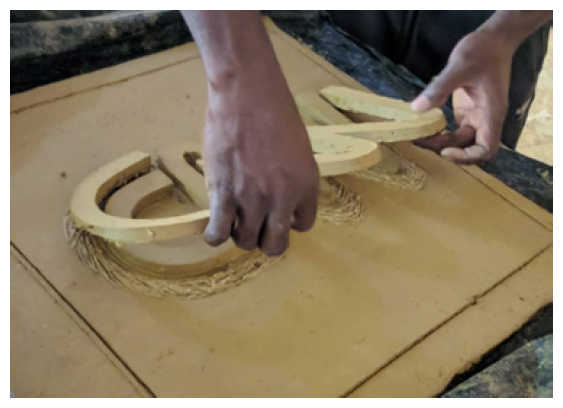
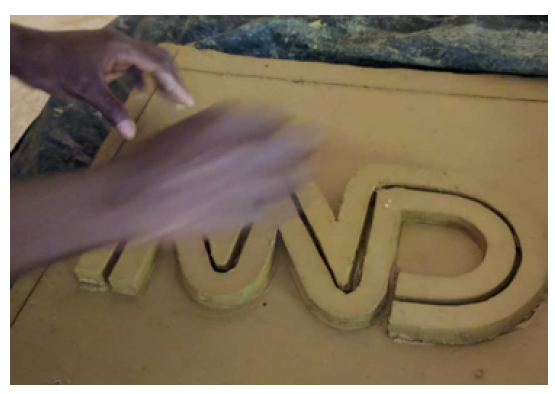
Thereafter, the prepared clay body was spread on a long flat planked table (24 x 108 inches) by slamming, hammering and pressing to form a flat stretched plastic clay sheet. The stretched plastic clay sheet was consequently measured in tandem with the image print out of 18” x 18” squares; they were immediately cut into parts; their joining was delayed to allow them dry to rigidity or leather-hard gradually. While waiting for the parts to be rigid enough for use, the tapped logo prints out was placed on the parts surfaces one at a time for tracing. The tracing was equally carefully done on two separate surfaces. One on the actual or receiving part surface and the other on the duplicate; the traced impression of the duo are significant in the finishing of the parts patterns or crests. Interestingly, the impression on the actual surface was to serve as guide or register for the incoming emboss duplicate, which was cut out and eventually placed as attachment to the roughened actual parts surfaces with the aid of slurry (Figures 15-18).
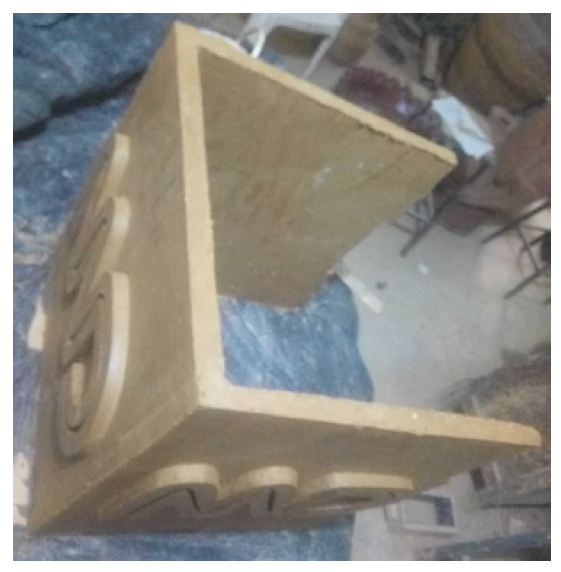
Having done that, fastening of the patterned parts to produce or construct Potlogo becomes imminent. Construction of Potlogo however, may simply be likened to an open box, because of it cuboidal rectilinear nature. It is equally worthy of note to stress that, the constituent parts (the base and the sides) of the pot must have been measured, cut, impressed and crested and cut along with their impressed outline or pattern. They are allowed to dry out slowly for a few days. When the patterned parts were observed stiff enough to be handled without deforming, all the edges to be joined are roughened by scratching with a toothed or sharp metal projectile (fork or knife); providing a better surface for the slurry to adhered.
Figure 17: Registring Emboss Text on Host Surface 15’’ x 30’’
Source: Akinde, Toyin Emmanuel
Figure 18: Fins Trimming of the Emboss Text 18’’ x 18’’ square
Source: Akinde, Toyin Emmanuel
Figure 19: Joint Crested Side Parts
Source: Raji ilias
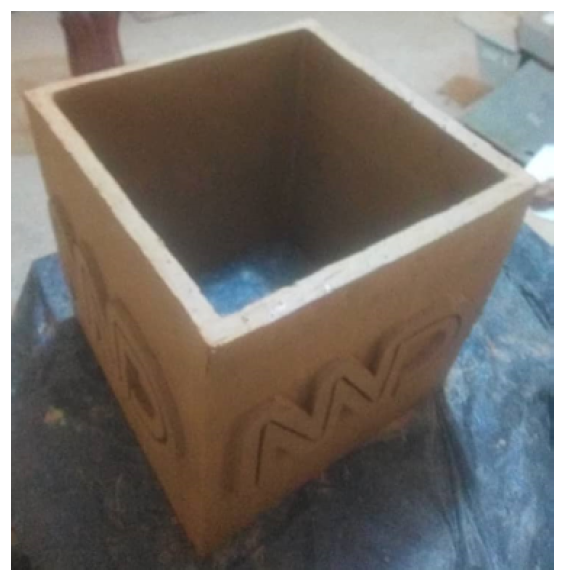
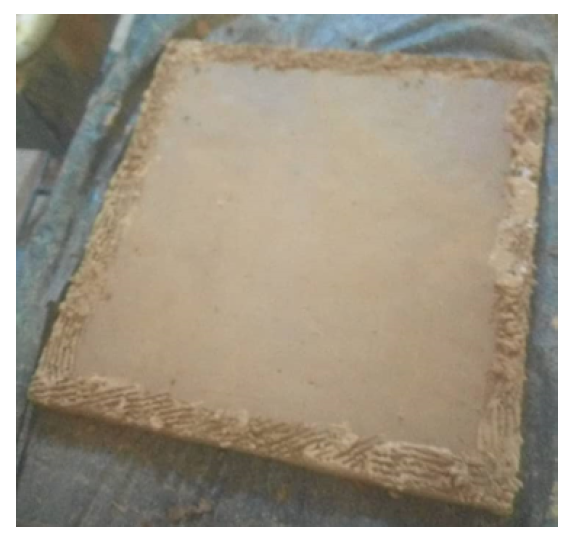
For the assembly, one may choose to start with the bottom or the sides. In this case, the parts constituting sides of the Potlogo whose edges has been roughened and painted with slurry were joined in quick succession, standing each side upright and the parts edges pressed together, holding them firmly at angle 90o position for some seconds until they are evidently joined. This bounding process must be done pretty fast to avoid slurry bounding slack. Thereafter the base was joined in the same manner. The assembly was well done, as such; there was no need for reinforcements at any of the parts.
Figure 20: Squred Joint Parts
Source: Raji ilias
Figure 21: Scrched Cum Slipped Base Parts
Source: Raji ilias
Figure 22: Base Fins, Angular view
Source: Raji ilias
The rectilinear pot was allowed to stiffen enough and its surface fins and all other observed irregularities were trimmed and squared off (Figures 19 - 24).
The base and pattern of the formed Potlogo of CNN logo was further neatened and closely monitored for several days to ensure complete dehydration of its water of plasticity. It is however imperative to note that, attempt to abridge the dehydration process may lead to steam forming and eventual busting or cracking of wares in the kiln during firing. Either open or compact kiln may be employed for ware firing. After thorough dehydration of the CNN Potlogo, it was stacked in an open kiln alongside other wares; initially preheated slowly to drive off atmospheric moisture present in the kiln (also known as water smoking), which was observed for almost an hour. Thereafter, the firing main source of fuel (wood) was intensely poked consistently for heat until it was evident the wares were matured (Figure 25).
CONCLUSION
Tita, riro laa n ko’la.
To ba ji na tan, lo n do gbe.
Burning, paining is the art of scarified markings.
But when matured, it becomes elegant
Summarily, the simple summation of the above Yoruba maxim is no pain, no gain and that light shines at the end of a tunnel. This implied that, rigorous or cumbersome as the processes or phases of constructing Potlogo may appear, its end product was an amazingly unique container, which can be likened to an ideogram or ideogramatic piece [40], embodying the full complement of the particular corporation where ever it is domiciled, interior or exterior serving both aesthetic and utilitarian functions, instanced in public and private entrances, pavilions, porches, lobbies, gardens, parks and even the streets. Simply put, it is a planter for horticultural species like aloevera, palm-front, irises, shrubs, heathers, mahonia, jasmine, clematis, forsythia and bulbs [41].
It practicality signified advertorial promotions in pottery and further adding to the trajectory of corporate logo. Finishing of Potlogo can be either bisque (terracotta), painted or glazed; its dimensions can be small, medium and large. Similarly, its production and eventual patronage by corporations around the globe will most definitely be a game changer; a corporate pottery sock halting sundry pots and planters in corporate space adornment and therefore opening a new paradigm, boosting in no small measure corporate imaging globally. Consequently, interested or inquisitive individuals and groups who wish to try their hand on Potlogo may attempt the rendered CNN prototype as a springboard or try something entirely new possibly, Union Bank, twitter and PDP logos (Figures 26-28) or logos outside the few mentioned.
However, this CNN Potlogo prototype avail its host organisation or any other corporations the choice of advancing their logos beyond print advertorial (daily newspaper, magazine) or virtual simulations and embrace realistic adaptation of their logos to Potlogo through hand built, either by coil or slab method, which may further be mass produced by casting with any of these media: plaster of Paris, cement, silicon rubber, fiber glass or wood. The latter bring to mind this Yoruba maxim;
Figure 26: Union Bank Logo Outline
Source: Akinde, Toyin Emmanu
Figure 27: Twitter Logo Outline
Source: Akinde, Toyin Emmanu
Figure 28: PDP Logo Outline
Source: Akinde, Toyin Emmanu
Ka r’aso modi
Ka rodi m’aso
K’idi mati gbofo…
Wrapped cloth to the buttock
Wrapped buttock to the cloth
Lest the buttock is left uncovered…
The above lines simply acknowledged possible diversified approaches to solving an issue inasmuch as the end goal is unwaveringly projecting result regardless of method or medium adopted. In other words, producing a Potlogo with creative finesse is nonnegotiable for any prospective corporation or enthusiast. Though the success trajectory of Potlogo may not be clear but what is clear is that when fully embraced, it is hoped to open new frontier in ceramic-pottery production, patronage and boost corporate imaging globally and Nigeria in particular.
Acknowledgements
With a sincere heart of appreciation, I specially thanked Mr. Raji Illias and Mr. Adedokun Oluwatosin for their hand of fellowship during the course of writing this article. The duos are students of the Department of Fine and Applied Arts, LAUTECH Ogbomoso, Nigeria and were no doubt terrific source of assistance. Mr. Raji, a Ceramics Postgraduate major was very helpful in the construction of the CNN Potlogo while Tosin, a Graphics Undergraduate major was equally useful in editing the downloaded CNN logo. To them both, I say a big thank you for their unwavering support, which is definitely dear to me.
REFERENCES
Powell, A. The Origins of Western Art. Thames and Hudson Ltd, 1973, pp. 8–9.
Hughes, G.B. The Country Life Collector’s Pocket Book of China. Revised ed., Country Life, Hamlyn Publishing Group Limited, 1965, pp. 325–355.
Abiodun, S.O. et al. “Small scale ceramic industry in Oyo state: Challenges and prospects.” Journal of Economics and Sustainable Development, vol. 4, no. 11, 2013, pp. 103–111.
Akintonde, M.A. et al. “Clay, clay bodies and strength: The example of southwestern Nigeria.” Academic Research International, vol. 5, no. 3, 2014, pp. 282–289, http://www.savp.org.pk.
Londaker, D.J. Art, Style and History: A Selective Survey of Art. Scott, Foresman and Company, 1970, pp. 1–7.
Leuzinger, E. The Art of Black Africa. Studio Vista Publishers, 1972, p. 5.
Lawal, B. “Art for life’s sake, life for art’s sake.” Inaugural Lecture Series 70, University of Ife, 18 May 1982, p. 11.
Kalilu, R.O.R. “Crisis in African art studies: yoruba gourd carving and the need for historical concern in art history.” African Art: Definition, Forms and Styles, edited by R.O.R. Kalilu, Ladoke Akintola University of Technology, 1994, pp. 18–42.
Soper, R.C. “Carved posts at old Oyo.” The Nigerian Field, vol. 43, no. 1, 1978, pp. 12–21.
Willett, F. “Investigations at old Oyo, 1956-1957: An interim report.” Journal of the Historical Society of Nigeria, vol. 2, no. 1, 1961, pp. 59–77.
Willett, F. “Archaeology in the sources of Yoruba history.” Sources of Yoruba History, edited by S.O. Biobaku, Oxford University Press, 1973, pp. 111–139.
Sheba, E. “The place of symbol in Yoruba culture.” Orita–Meta: Spirit of the Crossroads, edited by Moyo Okediji, Department of Architecture, Obafemi Awolowo University, 1991, pp. 29–34.
Woods, T.H. et al. “Design and designers of nigerian postage stamp.” International Institute for Science, Technology and Education, vol. 45, 2016, pp. 14–24.
Kalilu, R.O.R. et al. Ceramics: Art and Technology in the 21st Century Southwestern Nigeria. Pemilter, 2006, pp. 61–75.
Akinde, T.E. “Fruit peelings as ash glazes.” Ladoke Akintola University of Technology, Ogbomoso, 2009. M.Tech. dissertation, pp. 1–3.
Abiodun, S.O. and T.E. Akinde. “Transfer as alternative to direct drawing in Yoruba hand built pottery.” International Journal of African Culture and Ideas, Department of General Studies, Ladoke Akintola University of Technology, Ogbomoso, 2014.
Akinde, T.E. “Adeta alamoyo algorithmic wares firing from wastes.” International Journal of Progressive Sciences and Technologies, vol. 29, no. 2, 2021, pp. 667–680, http://ijpsat.ijsht-journals.org.
Barnet, S. A Short Guide to Writing about Art. 6th ed., Library of Congress Cataloging-in-Publication Data, 2000, p. 87.
Sayre, H.M. A World of Art. Revised 4th ed., Pearson Prentice Hall, 2004, p. 32.
Rhodes, D. Clay and Glazes for the Potter. Krause Publications, 1973, pp. 53–55 and 106.
Akinde, T.E. “Potlogo: A definition.” *The Early Visual Manifest: Zaria to London (Pa. Rev. John Noserime Thomas: 1924-2005)*, edited by Ejiroghene Noserime and Rukeme Noserime, Pan Atlantic University, LBS (Lagos Business School) and Concept Nigeriannese (CN), 2017, p. 178.
Ajadi, M.O. and T.E. Akinde. “Ceramic art training in art schools of Oyo state.” The Artist Journal: Journal of the Faculty of Environmental Studies, University of Uyo, vol. 3, no. 2, 2019, pp. 13–27.
Frutiger, A. Sign and Symbols: Their Design and Meaning. Studio Editions, 1989, pp. 60–100.
Jung, G.C. et al. Man and his Symbols. The Bantam Doubleday Dell Publishing Group Inc., 1964, pp. 256–322.
Akinde, T.E. “Overview of Potteryscape in selected two dimensional works.” International Journal of African Culture and Ideas, vol. 16, no. 16, 2018, pp. 117 and 120.
Hofstetter, T.F. Internet Technologies at Work. McGraw Hill Education, 2005, pp. 59–102.
Geddes and Grosset. Reader’s Digest Webster’s Canadian Dictionary and Thesaurus: An Authoritative Guide to Speaking and Writing Canadian English. Reader’s Digest, 2010, p. 164.
Ewusi-Mensah, K. Software Development Failures: Anatomy of Abandoned Projects. The Massachusetts Institute of Technology, 2003, pp. 29–46.
Valacich, J. and C. Schneider. Information Systems Today: Managing in the Digital World. Global Edition cum Fourth Edition, Person Education, Inc., publishing as Prentice Hall, 2010, p. 66.
Gralla, P. The Complete Idiot’s Guide to Buying a Computer. OUe (A Division of Macmillan Computer Publishing), 1999, pp. 7–16.
Gookin, D. Laptops for Dummies. 3rd ed., Wiley Publishing Inc., 2008, pp. 1–50.
Rothenberg, P. The Complete Book of Ceramic Art. Crown Publishes, Inc., 1972, pp. 4–5.
Akinde, T.E. “Cobclay test viability and introduction as clay body.” International Journal of Progressive Sciences and Technologies, vol. 30, no. 1, 2021, pp. 587–602.
Akintonde, M.A. et al. “Outdoor pottery sculpture in Ife art school.” Academic Journal of Interdisciplinary Studies, vol. 4, no. 3, 2015, pp. 219–232.
Akinde, T.E. “Individual fired brick production in Nigeria.” Journal of Visual Art and Design, vol. 9, no. 1, 2017, pp. 49–63.
Norton, H.F. Ceramic: For the Artist Potter. Addison-Wesley Publishing Company, Inc., 1956, pp. 14–15.
Chapman, H.L. Art: Images and Ideas. Davis Publications, Inc., 1992, p. 273.
Akinde, T.E. “Comparative study of the strength of glazes derived from horticulture and animal by-products.” Ladoke Akintola University of Technology, Ogbomoso, 2016. Ph.D. thesis, pp. 49–51.
Brown, D. The Da Vinci Code: A Novel. Anchor Books: A Division of Random House, Inc., 2003, p. 9.
Lloyd, C. and R. Bird. The Cottage Garden. Dorling Kindersley (DK), 1990, pp. 18–21.
Recommended Articles
Research Article
Administrative Control Mechanisms over Acts of Public Administration in Iraqi Law
Khaleel Ali Fadhel ALkaddoli
Published: 25/01/2026
Download PDF
Research Article
The Effectiveness of Using AI-Generated Visual Forms (ChatGPT) on Biology Achievement and Learning Motivation among Second-Grade Intermediate Students
Hashim Hasan Misto Sheikho
Published: 25/02/2026
Download PDF
Research Article
China in Ghana: a Benefactor or an Exploiter?
Shafiu Alidu,
Basak Ozoral
Download PDF
Research Article
The vulnerability of children and the incidence of ‘baby factory’ in Ngwaland, Abia State of Nigeria
Patrick Ifechukwude Okonji
Download PDF
PO Box 101, Nakuru
Kenya.
Email: office@iarconsortium.org
Editorial Office:
J.L Bhavan, Near Radison Blu Hotel,
Jalukbari, Guwahati-India



 Download PDF
 Download XML