Contents
Download PDF
pdf Download XML
279 Views
200 Downloads
Share this article
Research Article | Volume 2 Issue 2 (July-Dec, 2021) | Pages 1 - 4
Use of Fractal Batik Software for Batik Motif Design in Semarang Small and Medium Enterprises
 ,
1
Faculty of Information Technology, Stikubank University Semarang, Indonesia
2
Faculty of Economics and Business, Stikubank University Semarang, Indonesia
Under a Creative Commons license
Open Access
Received
July 22, 2021
Revised
Aug. 2, 2021
Accepted
Sept. 29, 2021
Published
Oct. 20, 2021
Abstract

The purpose of this study is to explore the potential of Batik SMEs in Semarang, Indonesia, in developing computer-assisted batik motifs so that they can enrich the repertoire of Semarang batik motifs. Batik motif design is an activity in making batik, both for written batik, stamped batik and printing. In designing batik motifs, there are many things that can be done by multiplying the imagination or by symbolizing several existing objects which are then translated in the form of writing grooves on a piece of batik cloth. The expertise of the motif design will also affect the selling value of a batik. Motifs can also describe and characterize the origin of batik with its local characteristics. How to design batik with the help of a computer with the concept of fractals has been developed but in combination with other software to minimize design monotony, several design patterns are needed to form the overall batik motif design so that batik becomes a unique work that is not only suitable for use as clothing material but also can exude the uniqueness of the owner. The importance of batik motif design that can be a strength for batik craftsmen in Semarang, Indonesia, it is necessary to use all devices that can explore batik motifs to be taught to craftsmen so that they can explore imagination and design, by providing batik designs using fractal batik software.

Keywords
INTRODUCTION

Batik business is a form of creative industry. To build a creative industry, a continuous innovation is needed that can produce creative ideas and innovations. A creative effort is needed starting from the design of motifs that can characterize the uniqueness of the batik produced, a production process that can speed up batik production, tools that can be used to accelerate the design of motifs whose end results can produce products that are unique and able to compete with other products [1].


A more in-depth finding regarding the problems of written batik in Semarang (results of a survey and research conducted by Tjahjaningsih et al. [2] in science and technology for the community in the batik cluster is that most batik makers make batik motifs regardless of the existing market needs. This is because most Semarangan handwritten batik craftsmen are in a new phase of growing for about three to four years. This makes the experience and skills of batik craftsmen not reliable. The location of Semarang handwritten batik craftsmen spread across several areas of Semarang makes the lack of communication, concern and togetherness among batik craftsmen to be one of the problems [3]. Although facilitation in the form of coaching, mentoring, training has been carried out to clusterization carried out by the government, this cannot run optimally due to lack of assistance and mapping/classification of potential craftsmen [3].


There are two things related to the identification of batik, namely with regard to the process and batik motifs (batik ornaments). Batik is known for its color barrier by using wax to the process of dyeing fabrics using synthetic colors and natural colors [4-6]. As for the motif itself, it is found in existing batik ornaments such as the machete motif, the kawung motif which has meaning or naturalist motifs taken from nature such as butterfly motifs, tamarind trees and so on [7].


Batik Semarang is one of the coastal batik that developed rapidly in 1870. Semarang batik motifs that developed at that time with the main characteristic were free-style motifs with bright and bold colors. Semarang batik motifs which developed in the Dutch colonial period with very rapid development by looking at the batik motifs that have meaning with red (from noni roots) and blue Indigo [8]. One of the efforts to develop creative and innovative works is related to the design of Semarang batik motifs that can be accepted by the market without leaving the unique characteristics of Semarang as one of the coastal batik [9].


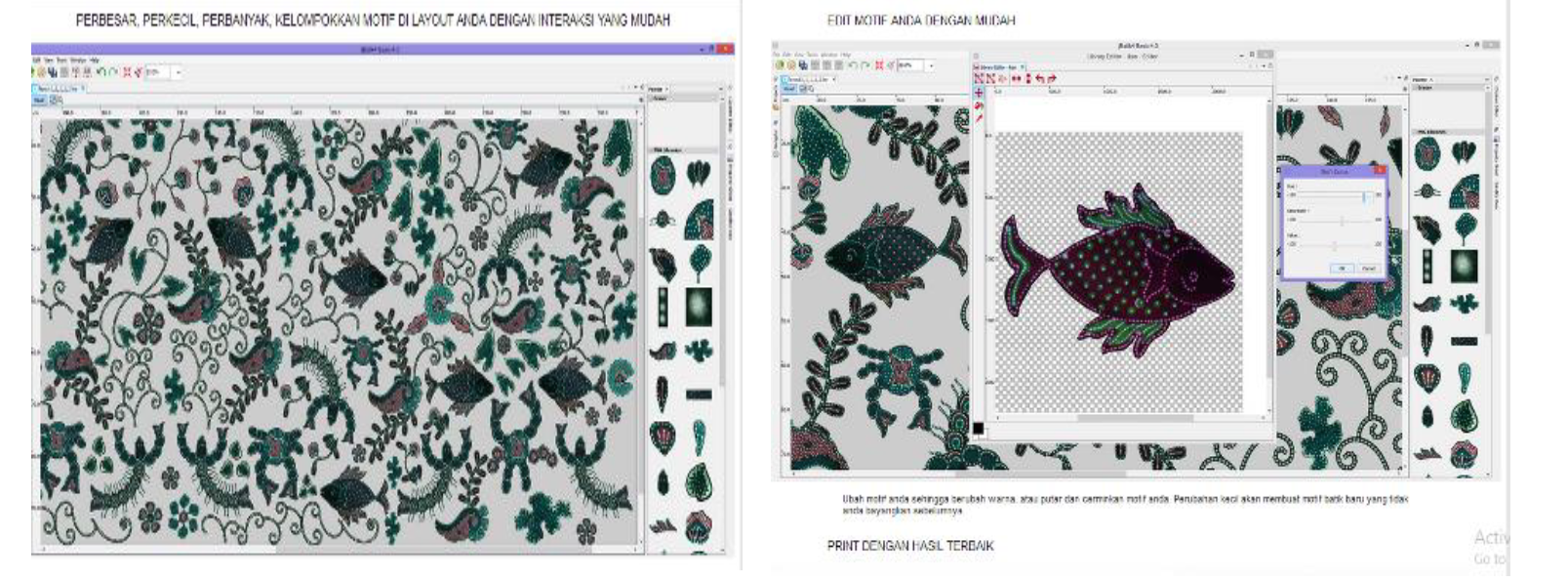
By using algorithms and mathematical calculations, batik motifs can be made easily via a computer. As a result, batik motifs can be made relatively quickly and easily reproduced [10]. Besides being able to be applied to a piece of cloth, this batik motif can also be applied to wood and acrylic media. Fractal Batik is batik whose design touches (patterns and decorations) are made using mathematical formulas that are done using computer technology (Figure 1).


The use of computer-assisted designs using fractal concept software can combine drawing techniques with effects or with electronic brushes it can speed up the creation of motifs which are then reproduced for further processing in batik. The design of batik motifs and their characteristics is currently growing very rapidly. Adnyana [11], Hermawan [12] and Noviana [13] explain that the use of information technology to speed up the process and help identify the pattern of motifs produced in each stroke of batik motifs produced by craftsmen in the area with computer algorithms. One of the weaknesses of craftsmen is to develop motif designs that can characterize the craftsman's style. It is hoped that the computer-aided design of batik motifs in the form of fractal batik training can explore and explore motifs according to the style of Semarang batik craftsmen.


The purpose of making batik motif designs using fractal batik software at UKM batik Semarang Indonesia is an effort to explore and explore batik motifs which are expected to enrich the batik ornaments of each craftsman according to the characteristics of each craftsman and utilize computers to design in speeding up the process of drawing motifs. Furthermore, it can explore the potential of the craftsmen in developing computer-assisted batik motifs so that they can enrich the repertoire of motifs from Semarang batik, Indonesia.


Figure 1: Fractal Batik Motif Design

Source: Karya Kriya Batik 
RESEARCH METHODS

Most of the craftsmen who still exist are above average productive age, the ability to explore designs with a computer is a problem in itself. From the various motifs produced, they still tend to be monotonous, there has not been much effort to innovate and be creative in developing patterns and designs of batik motifs that can become the hallmark of the city or become the hallmark of craftsmen. The method of implementing the program is divided into several activities as follows:


  • Making tutorials on how to operate the fractal batik application program and directions and explanations from the instructor

  • The instructor demonstrates how to design batik motifs with an existing library

  • The craftsman prepares the motifs that are his trademark to be developed via a computer using fractal batik software

  • Direct practice and make some ready-to-print batik motifs for the final picture of the design

RESULTS AND DISCUSSION

The implementation of making batik motifs using fractal batik software begins by providing an understanding of new ways of designing batik motifs, which are usually by first drawing on tracing paper (tracing paper is translucent paper that is usually used by designers to design designs or drawings). With this tracing paper, designers can more easily complete the drawings they make and to use this tracing paper is also very easy compared to other papers because this paper is designed with a structure like a clear glass that can be seen through from the surface to the back of the tracing paper). Before blating on the fabric, using computer aids to speed up the design of the ornaments on batik. Preparation for using the software by providing examples of how to use the menus in the fractal batik software.


The provision of material in the form of this training contains the concept of fractal batik and motifs that can be developed by first determining the motifs to be developed which are stored in the library. After being given a general explanation and providing guidance on how to use the fractal batik software, the next stage provides examples of various batik motifs that can be produced from fractal batik software in a fast time so that craftsmen can have an initial picture of how batik motif designs are produced from fractal batik software.


The fractal batik software used comes from JBATIK with specifications for the use of software to design 2-dimensional motifs of motifs already available in the jBatik starter kit which is intended for beginners/basic levels. The material used for training and assistance in making batik motifs using fractals from software issued by Jbatik Bandung (Figure 2).


Figure 2: Fractal Batik Motif 

(Source: Jbatik library)


Minimum Specifications


  • Windows operating system, Windows 7 edition or later

  • Intel Core i3 Processor Series 3rd Gen

  • 4GB of RAM

  • 215MB of free hard disk or more.

  • 1280×800 display (1366×768 or more recommended)

  • OpenGL 2.0-capable system (JBatik Pro)

  • Internet is required to enter the JBatik Serial Number


The implementation of this fractal batik software is that the craftsmen directly practice and print the designs that can be used as a reference in developing other motifs.


By exploring various batik motifs according to the style of each craftsman. For further mastery of this software so that every user can use it based on the existing parameters, it must be continued to advanced/Pro training.

CONCLUSION

Making batik motif designs using Batik Fractal software is very useful for craftsmen to be able to explore Semarangan batik motifs based on objects provided in the fractal batik library. The resulting motifs can be very many and made in a very short time so that many batik motifs can be produced according to the style of each craftsman. The use of fractal batik software is useful for speeding up the processing time in drawing motifs and can explore various diverse motifs in a very easy way to do without having to master the computer field. For better mastery it is suggested to be developed to an advanced level in Fractal Batik PRO level.


Acknowledgment

We would like to thank the Research Centre (LPPM) of Stikubank University Semarang, Indonesia for its support. We would also like to thank our lecturers from the Faculty of Economics and Business, Stikubank University, Semarang, Indonesia, for their useful discussions and contributions.

REFERENCE
  1. Kuncoro, M. Strategi: Bagaimana Meraih Keunggulan Kompetitif. Erlangga, 2006.

  2. Tjahjaningsih, Endang et al. "Grand Design Strategy of Accelerating the Development of Batik Semarangan Craftsmen Based on Advantage of Specific Creative Technique." International Journal of Applied Business and Economic Research, vol. 13, no. 9, 2015, pp. 6745–6761, ISSN 0972-7302.

  3. Tjahjaningsih, Endang et al. "Development and Empowerment of Semarang Batik Craftsmen Based on Assistance Strategy of Fractal Batik in the Effort to Build Sustainable Competitive Advantage." International Journal of Applied Business and Economic Research, vol. 14, no. 13, 2016, pp. 8853–8866, ISSN 0972-7302.

  4. Soesanto, S. Seni dan Teknologi Kerajinan Batik. Departemen Perindustrian RI, 1982.

  5. Soesanto, S. Sejarah Batik Yogyakarta. Rumah Penerbitan Merapi, 1992.

  6. Soesanto, Sewan. Tinjauan Motif Batik Berbagai Daerah. Cetakan I, Departemen Perindustrian RI, 1992.

  7. Mashadi, Wisjnuwati et al. Maha Karya Penuh Pesona. Kaki Langit Kencana, 2015.

  8. Veldhuisen, H.C. Batik Belanda 1840–1940. Gaya Favorit Press, 2007.

  9. Sumarsono, H. Batik Pesisir Pusaka Indonesia. Kepustakaan Populer Gramedia (KPG), 2011.

  10. Aswin, I. et al. "Preserving Local Ornament Through Algorithm." Journal of Computer Science and Information, vol. 6, no. 2, June 2013.

  11. Adnyana, I.P. Wandra. "Pengembangan Aplikasi Pembuatan Pola Motif Batik Dengan Menggunakan Pengolahan Citra Digital." Jurnal Nasional Pendidikan Teknik Informatika (JANAPATI), vol. 1, no. 2, July 2013, Universitas Pendidikan Ganesha, ISSN 2089-8673.

  12. Hermawan, Fany. "Implementasi Jaringan Syaraf Tiruan Backpropagation Untuk Mengenali Motif Batik." Jurnal Ilmiah Komputer dan Informatika (KOMPUTA), 2014, ISSN 2089-9033.

  13. Noviana, M. and S. Hastanto. "Aplikasi Motif Batik Baru Khas Kalimantan Timur pada Elemen Dekorasi Interior." Simposium Nasional RAPI XIII, FT UMS, 2014, ISSN 1412-9612.

Recommended Articles
Research Article
The Possibility of Treating Corrosion in Iron Valves of Flow Regulators, Pumping Station Components, and Suspended Solids Filtration Networks in Rivers and Streams in Al-Qadisiyah Governorate
...
Published: 02/03/2026
Download PDF
Research Article
OBSERVATIONS ON THE HOMOGENEOUS TERNARY QUADRATIC DIOPHANTINE EQUATION x2 + 4xy + 9y2 = 21z2
Download PDF
Research Article
Computer Driven Library Management and Service Rendering System: Mobile Library Landscape
...
Published: 10/06/2020
Download PDF
Research Article
The Availability and Utilization of Some Selected Digital Technology Facilities among Students of Mathematical Sciences Using Krejcie and Morgan’s Sample Size Determination Technique, A Case Study of Kogi State University Anyigba
Download PDF
Chat on WhatsApp
Flowbite Logo
PO Box 101, Nakuru
Kenya.
Email: office@iarconsortium.org

Editorial Office:
J.L Bhavan, Near Radison Blu Hotel,
Jalukbari, Guwahati-India
Useful Links
Order Hard Copy
Privacy policy
Terms and Conditions
Refund Policy
Shipping Policy
Others
About Us
Team Members
Contact Us
Online Payments
Join as Editor
Join as Reviewer
Subscribe to our Newsletter
+91 60029-93949
Follow us
MOST SEARCHED KEYWORDS
Copyright © iARCON International LLP . All Rights Reserved.