Information and Communication Technologies (ICTs) has transformed traditional learning methods and strategies at different levels of education in many countries. Tanzania, has been struggling to integrate ICT in education but with relatively limited achievement recorded. This study aimed at exploring key achievement indicators towards ICT integration in Tanzania secondary schools. The study used a pen and paper self-administered questionnaire for data collection. Using a repeated cross-sectional survey, data were collected from 297 teachers from different secondary schools in Tanzania who participated in ICT skills training in 2017, 2018 and 2019. Data were analysed using a general-purpose statistical software package, Stata Version 11. Chi-square and logistic regression were performed to examine the association of variables and their predictive power respectively. Findings reveals that despite the existing challenges such as ICT infrastructure, high student-to-computer ratio, limited ICT knowledge and skills to teachers in learning and teaching, some schools have built and accord well with the process of ICT education at secondary level. Few teachers have acquired skills in using computer and Internet particularly in lessons preparation. Furthermore, findings indicate that at each school there is at least one teacher capable of using ICT devices. The study recommends that the effective grow into second world economy a continuous integration of ICT in secondary schools is inevitable.
Keywords
ICT in Education
ICT in Secondary Schools
Access of ICT in Learning and Teaching
INTRODUCTION
Information and Communications Technology (ICT) has changed the ways people learn in almost every field of knowledge all around the globe. In this study, ICT has been used to mean all electronic media enabling users to create access, store, disseminate, communicate and manage information [1].
Recognizing the impact of ICT in education, several education institutions are restructuring their curriculum as well as learning and teaching approaches to reach a good number of learners who could not attend in-campus training. Through the use of ICT, peoples can construct and distribute knowledge regardless of their geographical location, social, time and economic barriers [2,3]. Through ICT integration many education institutions have realized an improved administration and a significant increase in academic performance.
As ICT continues to reshape education by improving quality and pedagogical methods, it necessitates all education stakeholders to be proficient user of the technology. Thus, the effort of integrating ICT in education systems continues to receive a significant attention throughout the globe.
Government Support to Promote use of ICT in Education
Recognizing the role of ICT in education, the Tanzanian government has introduced various policy papers and initiatives to promote effective use of ICT in education. They include, to mention few the National Science and Technology Policy [4], the National ICT Policy [5], ICT Policy for Basic Education [6]and recently a reviewed National ICT policy [7] which among other things they simply advocate for the integration of technology in education and provide a provision for adequate ICT learning and teaching facilities to improve the quality of science-based education and to create acknowledge-based society in general. To enhance learning the policies suggest the use of a number of technologies, such as radio, television, computers, mobile phones and the Internet [2,8]. The area of priority has been Teachers’ Training Colleges, secondary schools and finally, primary schools [6].
Other ICT education initiatives such as ICT for Education, ICT4E project, TanEdu project, The Bridge-IT initiative, The Distance Education Learning Services, DILES project [2,9], The Bright Education Trust Fund (BETF) initiative, [10], The ICT-Connect-TED [8]and Computer for Tanzania schools project [11] have joined the government’s efforts to support, enhance and enable the education delivery using ICT.A recent ICT educational initiative is the African Digital Schools Initiative (ADSI) programme implemented in 40 secondary schools across Tanzania aimed at transforming secondary schools into Digital Schools of Distinction[12]. A more recent government ICT initiative coordinated by Universal Communications Service Access Fund (UCSAF) has managed to connect more than 700 primary and secondary schools all around Tanzania and the target is to connect all rural and urban areas with minimum or limited ICT access [13].
Challenges of using ICT in Education
The battle to bridge the digital divide is yet to show encouraging signs despite the government efforts to integrate ICT in education and most particular, secondary education. Some success and unsuccessful stories on these initiatives have been documented in many literatures resulting in dilemma whether we are on the right track to achieve the 2025 millennium goals or not. A recent study by Ngeze [14] that investigated readiness of Tanzania secondary schools to integrate ICT in learning and teaching activities, found that a remarkable number of secondary schools have limited ICT devices for effective integration. For example, student to computer ratios in 16 sampled schools around key educational zones in Tanzania were found to range from 20:1 to 110:1 implying that the available computers are inadequate to serve the effective learning needs of the students [14-18] a problem found to exist across many countries in Africa [19,20].
This data is consistent with URT [16] that shows number of desktop computers available in public and non-public secondary schools in Tanzania were only 60,451. With all 1,562,770 secondary school students in Tanzania [16] it implies that one desktop computer is shared among 26 students. However, the current trend shows that computer to student ratio in Tanzania is positively declining. To date Tanzania has about 145,334 desktop computers available in public and non-public secondary schools [4]. With 2,338,457 students enrolled in these secondary schools [4] it can imply that computer to student ratio is about 1:16. Nevertheless, the ratio is yet to be realistic as the market price of desktop computers has gone down to less than $400.
Apart from inadequate computers, Sedoyeka and Gafufen [11] remark that ICT adaptation to some schools are still low as some secondary schools supplied with computer could not even switch on. Similarly, Banele [15] found desktop computers dumped at the backside of computer labs in some secondary schools due to technical defaults. This can be attributed by either lack of knowledge and skills, technophobia or negative attitude towards ICT. This needs an immediate intervention as the number of secondary schools in the country is gradually increasing. For example, in 2013 Tanzania had 4,576 public and private secondary schools and three years later the number increased to 4,759 [16] and 5,001 in 2019 [4] with corresponding increasing number of schools teaching ICT.
ICT Infrastructure
ICT infrastructure in most secondary schools has also been reported as a challenge [4,14,19]. In most Sub-Saharan Africa countries, limited or inadequate ICT infrastructure is most common that Tanzania is not isolated. Most education institutions and in particular secondary schools in Tanzania faces hardware and software constrains, limited computer rooms and Internet access and among several initiatives to enhance ICT infrastructure in education have been supported mainly by the government, NGOs and international organizations [19]. In addition, all public secondary schools in Tanzania depend on the government annual budgets to operate them which is always limited, hindering purchase and service of ICT devices as well as staff training in ICT [21].
Challenges of infrastructure to support ICTs in Tanzania secondary schools have also been reported in several literatures [10,11,14,15,17,20-25] implying much need to be addressed if ICT is to be realized in secondary education in Tanzania.
Power Supplies and Associated power Generation Sources for Running ICT
The lack of access to energy greatly hinders learning and teaching.Without electricity, teachers are not able to produce copies of school assignments or connect to the Internet for further learning. Nevertheless, many ICT equipment consumes power therefore, using a stored energy from solar sources found to be not reliable for teaching environment.
In the past century electrical power has been mentioned in many studies as a blocking factor for spread and use of ICT equipment.Compared to private schools, government schools were the most affected by having no connection to the national power grid. This has almost changed suddenly in the last five years where the country mobilized itself to power source of power also reached over 2.766 million from 1.473 million, an increase of about 1.293 million new connections. According to the report, power generation in the country had also increased to 1,601.84 megawatts as of April 2020 from only 1,308 megawatts in 2015 [26].
Teachers ICT Training
Limited number of trained ICT teachers and lack of computer technicians have also been reported to hinder effective implementation of ICT curriculum and sustainability of ICT devices in most secondary schools in Tanzania. Banele [15] remarks that even for the few schools with computers, “restrictions, bureaucratic procedures, rules and regulations, lack of technical support in computer laboratories are among factors fostering teachers’ low use of ICT in classrooms” (p. 244).
By 2016 the number of teachers with ICT skills needed to teach secondary schools were 272, however only 72 (26.5%) were available [16] making a gap of 200 teachers. This is contrary to the increasing number of secondary schools scattered all over the country. This data indicates that there is inadequate number of teachers with ICT skills to feed the growing number of secondary schools with ICT devices.
Nevertheless, to combat basic technical problems related to ICT devices in secondary schools in Tanzania, the government through UCSAF has managed to train 1,029 teachers to perform such operations [27] and the program is still continuing.
Budget on Education Sector
Financing education sector in Tanzania is a shared effort among government, communities, parents and end-users. Government budgetary allocation to education is being enhanced annually to ensure better delivery of education and training services in terms of infrastructure as well as learning and teaching materials [16]. Public institutions including secondary schools are highly dependent on the government budget and integrating ICT in education to its schools is highly dependent on how much money is allocated by the government.
The education sector budget in Tanzania has generally been decreasing in recent years. For example, the budget allocated to education sector decreased from 19.1% in 2012/13 to 16.2% of the total budget in 2016/2017 [16]. Notwithstanding to other factors, the share of education budget allocated to secondary schools has been relatively low compared to other education levels. For example, between 2005 and 2017 primary education, non-formal and supporting services in the whole education sector were allocated with the largest share (60.6%) compared to 14.5% allocated to secondary education and the remaining 24.9% was directed to teacher education (1.5%) and 23.3% to technical and higher education [16]. Although the government budget allocation to the education sector is gradually enhanced annually, its impact is yet to bring a significant change [28].
To date, several studies have been conducted to show how ICT can best be used to enhance access to education at all levels of learning in Tanzania [2,10,9,14,15,21,23,25,29]. In particular, the studies have explored on access to, use, opportunities and challenges of ICTs in secondary schools in Tanzania and revealed issues hindering its use related to inadequate ICT infrastructure (low band width and electricity problems), absence of in-service training related to ICTs and lack of implementation policy. Interestingly, in a study that explored readiness of ICT Integration in Teaching and Learning in Secondary Schools in Tanzania, Ngeze [14] found that most secondary school teachers possess either a laptop or a Smartphone or both implying that teachers are ready to use ICT in classrooms.
Thus, a number of efforts have been tried to promote effective use of ICT in education in Tanzania at different political arena. However, currently, much more motivation and effort has been invested in ICT growth. Therefore, the present repeated cross-sectional study investigates the status of ICT integration in secondary schools in Tanzania and comment on whether we are on the right path to achieve the 2025 millennium goals or not. The study is attempting to answer main research question son how ICT is recently integrated in learning at secondary school.To achieve the goal, the following sub theme were studies:
What is the status of ICT integration in secondary schools?
How is ICT access in classrooms?
What are the ICT based activities and material used for teaching?
What are the challenges of using ICT in learning and teaching?
MATERIALS AND METHODS
Study Design
The study was a repeated cross-sectional where a survey was administered to a new sample of interviewees at three successive years. For each survey respondents in one year were different from those in a previous year.
Data were collected from 297 teachers who attended an ICT training programme supported by the Universal Communications Service Access Fund (UCSAF) in 2017, 2018 and 2019 at the Dar es Salaam Institute of Technology (DIT), where 95 (31.9%) teachers participated in the study in the year 2017, 120 (40.4%) teachers in 2018 and 82 (27.6%) teachers were involved in 2019.All participants came from 19 regions of Tanzania Mainland and were sampled by the Ministry of Education to join the ICT training program at DIT.
All participants were invited to fill in a paper-and-pencil questionnaire that collected teachers’ opinions on ICT access and status at their secondary schools (Table 1).
Ethics research clearance was received for the study and that informed consent was sought from all of respondents who participated in the study.
Table 1: Data Collection Seasons
Year of data collection
Access to ICT
2017
2018
2019
Total
No
25
57
21
103
26.32%
47.5%
25.61%
34.68%
Yes
70
63
61
194
73.68%
52.5%
74.39%
65.32%
Total
95
120
82
297
100%
100%
100%
100%
Pearson chi2(2) = 14.6182
ρ = 0.001
Reliability Testing
Cronbach alpha was used for data reliability test to ensure that the 13-item scale measured the same underlying construct for all 297 participants. The scale was subjected to Cronbach Alpha test for internal consistency and the Cronbach Alpha coefficient obtained was 0.88 (Table 2) meaning that items in an instrument measured the same underlying concept. Therefore, it was reliable.
Table 2: Data Reliability Test
Data reliability (Cronbach's alpha Test)
Average inter-item covariance:
0. 3885772
Number of items in the scale:
13
Scale reliability coefficient:
0.8790
Data Analysis Procedure
Data were analysed using a general-purpose statistical software package, Stata Version 11. Chi-square and logistic regression were performed to examine the association of variables and their predictive power respectively.
RESULTS AND DISCUSSION
Respondents’ Demographic Characteristics
The study collected data from 297 teachers from 19 regions of the country. Teachers completed a self-administered paper-and-pencil closed-ended questionnaires. Summary for descriptive analysis about teachers is given in Table 3.
The results show that females accounted for 45.5% whereas 54.6% were males. In terms of age group, results demonstrated that majority of teachers responded (70.0%) were between age 30 to 40 years while few of them were aged between 40 to 50 years.The results show that the majority of teachers’ age group lies between 30 to 40 years which highly reflects the entire population [4,16].
The results on teaching experience revealed that 36.7% of teachers have teaching experience from 1 to 3 years and 36.7% have teaching experience from 4 to 10 years. Furthermore, few teachers participated in this study found to have more than 30 years of teaching experience.
Teaching hours per week indicated that 11.1% of teachers had less than 10 teaching hours per week, while 28.3 percent of teachers had between 16 to 20 teaching hours per week. Furthermore, teachers with more than 25 teaching hours where 33.3%.
Generally, information from Table 3 suggests that majority of teachers in this study were males between 30 to 40 years of age, with teaching experience from 1 to 10 years having more than 25 teaching hours per week.
The survey was conducted from 2017 to 2019 and involved 19 regions (provinces) of Tanzania (Table 1). The highest number of participants recorded was in 2018 where 120 (40.4%) teachers were involved in the study.
Table 3: Characteristics of Teachers Participated in the Study (N = 297)
Characteristic
Category
Freq.
Percent
Gender
Female
135
45.5
Male
162
54.6
Age Group
Under 30
87
29.3
30-40
208
70.0
40-50
2
0.7
Teaching experience
Less than 1 yr
42
14.1
1-3 yrs
109
36.7
4-10 yrs
109
36.7
11-20 yrs
28
9.4
21-30 yrs
7
2.4
More than 30 yrs
2
0.7
Teaching hours per week
Less than 10 hrs
33
11.1
10-15 hrs
56
18.9
16-20 hrs
84
28.3
21-25 hrs
25
8.4
More than 25 hrs
99
33.3
Total
297
100.0
ICT Integration Status in Secondary Education
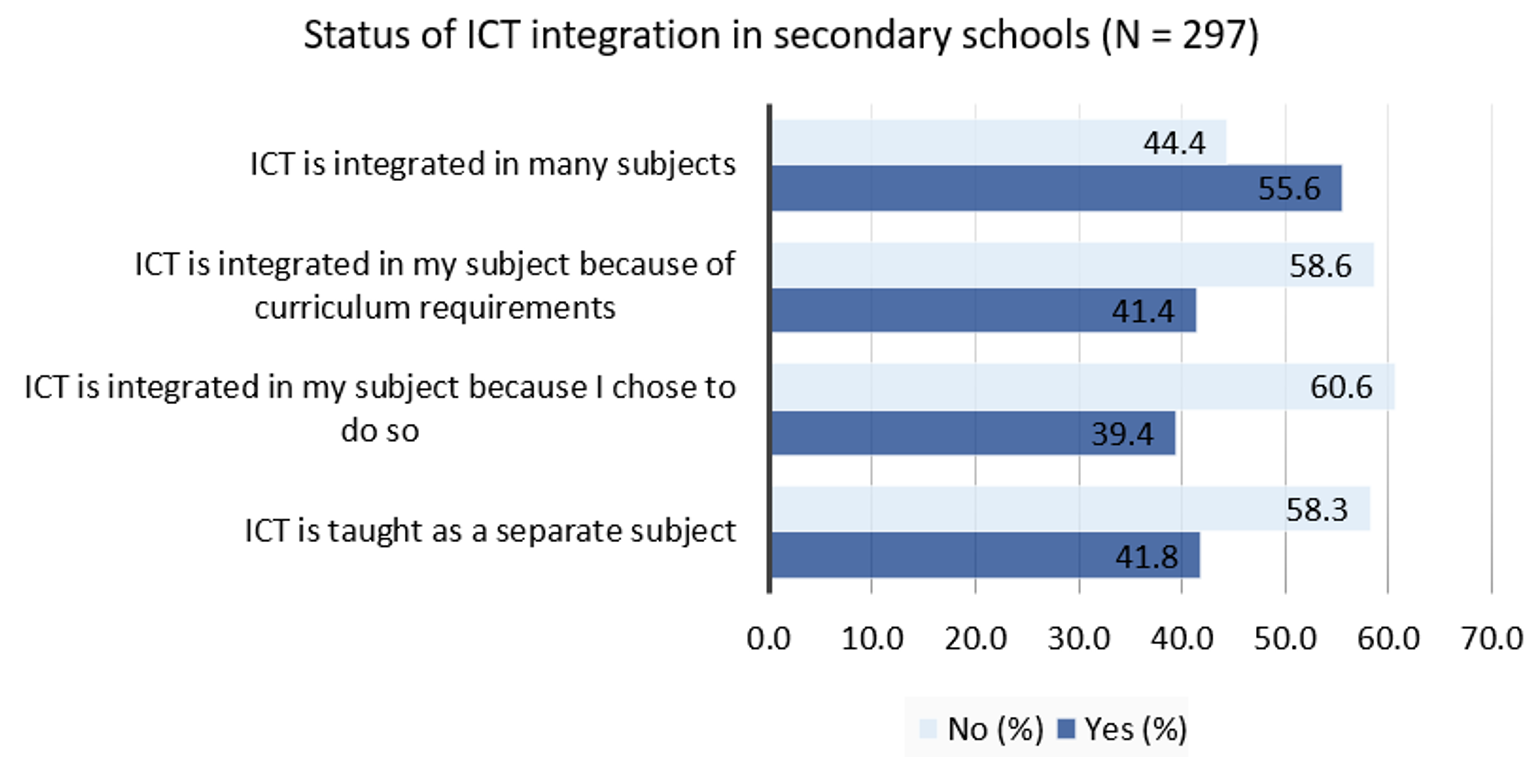
The first research question explored how ICT has penetrated into secondary education in Tanzania. In particular, the study aimed to establish the status of ICT integration in secondary schools. Respondents in this study were requested to respond either Yes or no to the following four statements:
ICT is integrated in many subjects in my school
ICT is integrated in my subject because of curriculum requirements
ICT is integrated in my subject because I chose to do so
ICT is taught as a separate subjecting at my school
The results are summarized in Figure 1.
Generally, Figure 1 shows that ICT is still not effectively owned by secondary school educators. This can be demonstrated by statements such as, “ICT is integrated in my subject because of curriculum requirement”, “ICT is integrated in my subject because I chose to do so” as well as “ICT is taught as a separate subject in my school” which have been disagreed by about 60% of teachers involved in the study. However, the results show that there are signs of ICT integration into many subjects as agreed by 55.6% teachers.
Figure 1: Status of ICT Integration in Secondary Schools
ICT Access to Learning and Teaching
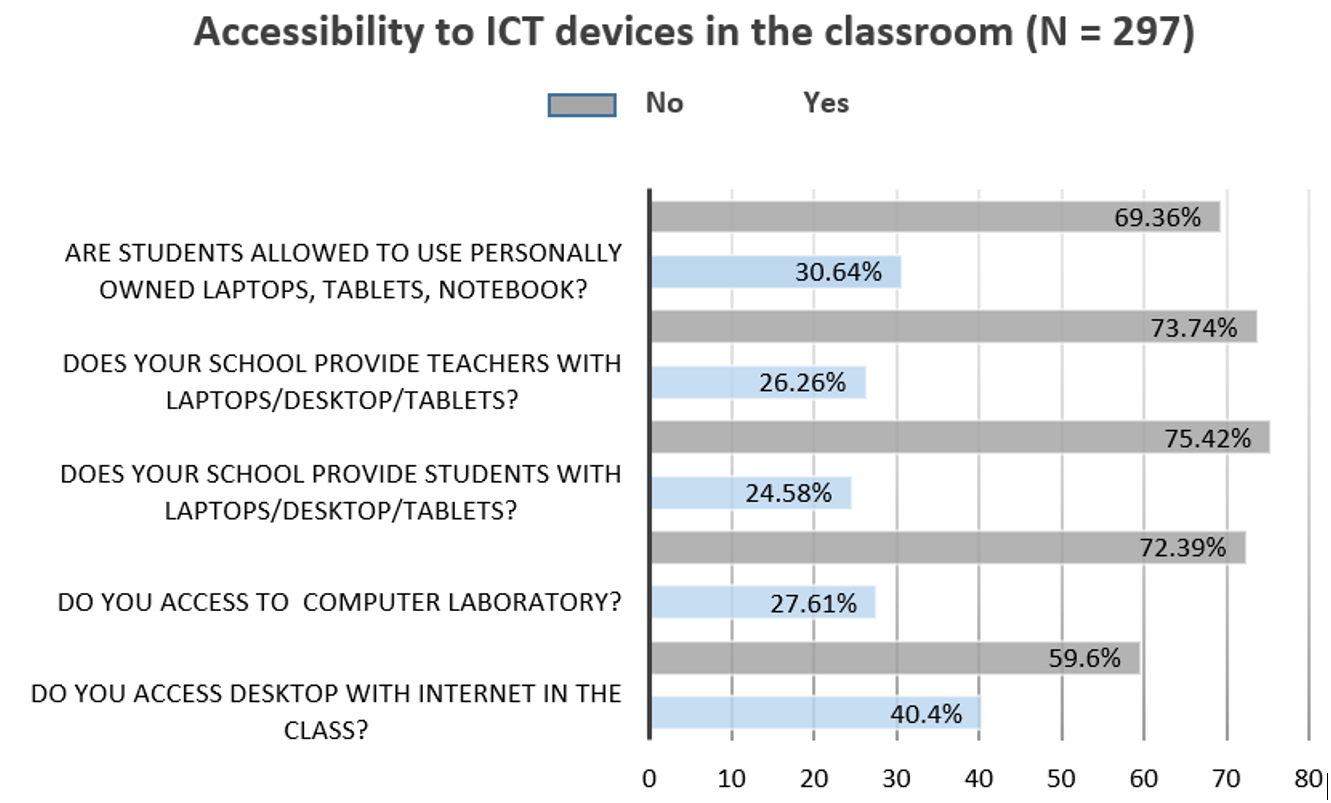
The second research question explored accessibility of ICT in secondary education in Tanzania. In particular, the authors wanted to establish whether or not computers and/or Internet is accessed by both teachers and students in secondary schools. Teachers were requested to respond either Yes or no to the statements:
Are students allowed to use personally owned laptops, tablets, notebook?
Does your school provide teachers with laptops/desktop/tablets?
Does your school provide students with laptops/desktop/tablets?
Do you have access to computer laboratory?
Do you access desktop with Internet in the class?
Figure 2 present the accessibility to ICT devices in learning and teaching.
The results in Figure 2 shows a relatively higher number of respondents disagreed to all five items that neither students nor teachers have access to ICT devices and the Internet in their schools. Furthermore, the results show an average of 70% of respondents disagreed to all five items compared with only 30% respondents who agreed to have access to ICT devices in their classrooms. The existence of 30% respondents who agreed to have access to ICT devices in their schools cannot be neglected. The results may indicate that there are some ICT devices or access in their schools.
Figure 2: Accessibility to ICT Devices in Learning and Teaching
The study sought to identify if there were any associations between access to ICT in terms of teaching experience, age group, gender, teachers’ frequency of using computers, teachers’ frequency of using Internet and students’ access to computers.To establish an association, the observed data were subjected to a Chi-square test.
Access to ICT and Teaching Experience
Table 4 shows that there were minor differences in access to ICT by years of teaching experience. Percentage within group comparisons showed that teachers with more than 5 years of teaching experience had about 2.6% more access to ICT than those with less than 5 years.
Table 4: Access to ICT and Teaching Experience
Experience in Teaching
Access to ICT
Lessthan5 yrs
Above 5 yrs
Total
No
91 (35.00)
12 (32.43)
103 (34.68)
Yes
169 (65.00)
25 (67.57)
194( 65.32)
Total
260 (100)
37 (100)
297 (100)
Pearson chi2(1) = 0.0943
ρ = 0.759
Results indicated that there was no statistically significant association between access to ICT and teaching experience as revealed from statistical tests:
χ2 (1, n =297) = 0.0943, ρ = 0.76
Access to ICT and Gender
The authors further needed to examine if there was a statistically significant difference in access to ICT and gender.
Table 5 shows that both 86(63.7%) female and 108 (66.67%) male teachers had access to ICT. However, further analysis on percentage difference reveals that percentage of male teachers with access to ICT outnumbered that of the female teachers by about 3%.Although the percentage difference would appear to be quite small, findings indicated that there was a difference in access to ICT between female and male teachers.Male teachers had slightly more access to ICT than female teachers. However, a Chi-square test results indicated that there was no statistically significant association between access to ICT and gender:
χ2 (1, n = 297) = 0.29, ρ = 0.59
Table 5: Access to ICT and Gender
Gender
Access to ICT
Female
Male
Total
No
49(36.3)
54 (33.33)
103(34.68)
Yes
86(63.7)
108 (66.67)
194(65.32)
Total
135 (100)
162(100)
297(100)
Pearson chi2(1) = 0.2854 ρ = 0.593
Access to ICT and Age Group
Table 6 shows that there were minor differences in access to ICT by age group. Percentage within group comparison showed that teachers with more than 30 years were slightly higher in access to ICT by 4.6% more than teachers with less than 30 years of age. Although the percentage difference would appear to be small, findings indicated that there was a difference in access to ICT between teachers with more than 30 years to those with less than 30 years of age. The reason for such result is not well clear. However, it is contemplating that teachers with more than 30 years may probably have longer working years and thus own ICT gadgets such as smart phone and laptops compare with teachers with less than 30 years of age. Also, most of them in one way or another have attended ICT short training courses that boosted their need to get access to ICT. However, a Chi-square test results indicated that there was no statistically significant association between access to ICT and age group:
χ2 (1, n=297) = 0.574, ρ = 0.45
Table 6: Access to ICT and Age Group
Age Group
Access to ICT
<30yrs
>30yrs
Total
No
33 (37.93)
70 (33.33)
103 (34.68)
Yes
54 (62.07)
140 (66.67)
194 (65.32)
Total
87(100)
210 (100)
297(100)
Pearson chi2(1) = 0.574 ρ = 0.449
ICT Based Activities and Material Used for Teaching
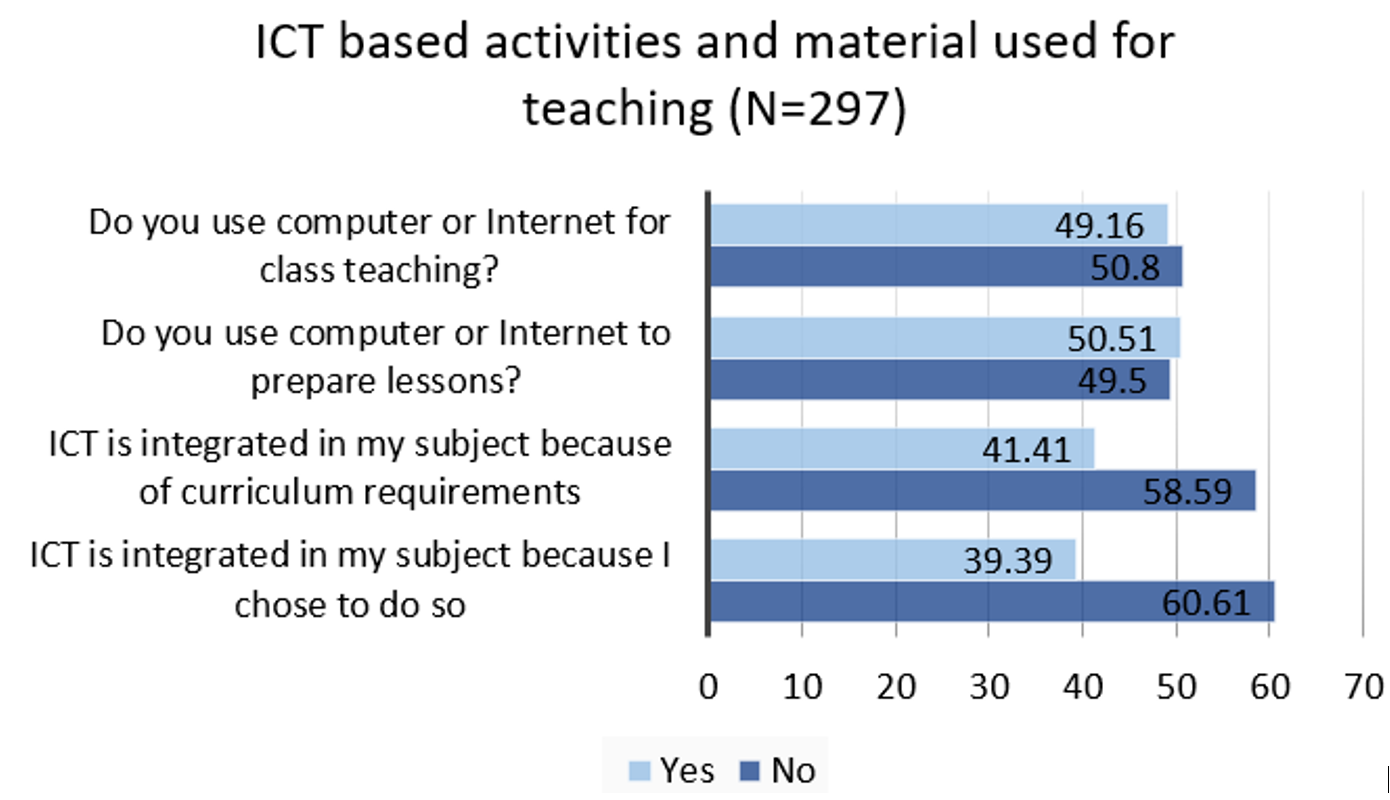
The third research question investigated the ICT based activities and material used for teaching in the schools involved in the study. In particular, the study aimed at answering the question, “What are the ICT based activities and material used for teaching?” Five ICT based activities were listed and teachers were requested to respond either Yes or no to each statement as shown in Figure 3.
Figure 3: ICT based Activities and Material used for Teaching
The results revealed that majority of teachers do not integrate ICT in their subjects.Figure 3 shows that about 60% of teachers who participated in the study do not integrate ICT in their subjects neither demanded by the curriculum nor by choice and about 50% of teachers would rather use ICT on personal basis, including lesson preparations. The result can suggest that teachers could either not cope-up with the existing technology in schools or schools had outdated ICT devices or there are no ICT facilities altogether in the schools.
The study also examined whether there was a statistically significant difference in access to ICT with ICT based activities and material used for teaching. Table 7 describe the cross tabulation of different variables in relation to access to ICT as a dependent variable. Results on the access to ICT with school that had computer facilities shows that teachers who reported to have access to ICT and their schools had computer facilities were 71.9% while those who had access to ICT but their school had no computer faculties were 60.4%. The percentage difference reveals that percentage of teachers with computer facilities in school and access to ICT outnumbered that of teachers without computer facilities in school but with access to ICT by 11.5%. The result suggests that there is a possible association between computer facilities in schools and access to ICT. A Chi-square test was performed to determine whether or not the observed findings were statistically significant.Results indicated that there was a statistically significant association between access to ICT and computer facilities in schools:
χ2 (1, n = 297) = 4.2669, ρ = 0.039
Results from Table 7 further show that 68.4% of teachers who have access to ICT are integrating ICT with their subjects while 63.3% teachers who have access to ICT are not integrating with their subjects. The results concur with above findings that there is a possible association that teachers who integrates ICT in subjects are more likely to have access to ICT. Nevertheless, a Chi-square test results indicated that there was no statistically significant association between access to ICT and integration of ICT in subjects (ρ>0.05).
Similarly, results in Table 7 shows that both groups of teachers who use computers or Internet (69.3%) to prepare lessons and those who do not use computers or Internet (61.2%) to prepare lessons had access to ICT. When further analysis was done on percentage difference it reveals that percentage of teachers who use computers or Internet to prepare lessons outnumbered those who do not use computers or Internet to prepare lessons by 8.1%.Nevertheless, a Chi-square test results indicated that there was no statistically significant association between access to ICT and use computers or Internet to prepare lessons (ρ>0.05).
The results on access to ICT and use of computer or Internet in classroom teaching has produced an interesting scenario. Only 62.3% of teachers who had access to ICT use computers or Internet in classroom teaching while 68.2% of teachers who had access to ICT were not using computers or Internet in classroom teaching. This may be attributed by lack of computers and Internet facilitates in most secondary schools in the country. However, a Chi-square test results indicated that there was no statistically significant association between access to ICT and use of computers or Internet in classroom teaching (ρ>0.05).
Similarly, the analysis between access to ICT and integrating ICT in subjects based on curriculum requirements show that about 56.2% of teachers whom did not integrated ICT in subject based on curriculum requirement had access to ICT, whereas only 43.8% of teachers who integrated had access to ICT.
Percentage difference reveals that teachers who did not integrate ICT in their subjects based on curriculum requirements were by 12.4% higher in access to ICT than those who integrated ICT in their subjects. This can imply that having access to ICT does not exclusively mean that teachers can integrate ICT in subjects based on curriculum requirements. Nevertheless, a Chi-square test results indicated that there was no statistically significant association between access to ICT and integrating ICT in subjects based on curriculum requirements (ρ>0.05).
Table 7: Access to ICT and ICT based Activities
Computer facilities in Schools
Access to ICT
Yes
No
Total
No
36 (28.13)
67(39.6)
103 (34.68)
Yes
92 (71.88)
102 (60.36)
194(65.32)
Total
128 (100)
169(100)
297(100)
Pearson chi2 (1) = 4.2669
ρ = 0.039
Integrating ICT in subjects
Access to ICT
Yes
No
Total
No
37 (31.62)
66 (36.67)
103 (34.68)
Yes
80 (68.38)
114 (63.33)
194 (65.32)
Total
117 (100)
180 (100)
297 (100)
Pearson chi2 (1) = 0.7960
ρ = 0.372
Use of Computer or Internet to prepare Lessons
Access to ICT
Yes
No
Total
No
46 (30.67)
57 (38.78)
103 (34.68)
Yes
104 (69.33)
90 (61.22)
194 (65.32)
Total
150 (100)
147 (100)
297 (100)
Pearson chi2 (1) = 2.1550
ρ = 0.142
Use of Computer or Internet in Classroom Teaching
Access to ICT
Yes
No
Total
No
55(37.67)
48 (31.79)
103 (34.68)
Yes
91 (62.33)
103 (68.21)
194 (65.32)
Total
146 (100)
151(100)
297 (100)
Pearson chi2(1) = 1.1341
ρ = 0.287
Integrating ICT in subjects based on curriculum requirements
Access to ICT
Yes
No
Total
No
38 (36.89)
65 (63.11)
103 (100)
Yes
85 (43.81)
109 (56.19)
194 (100)
Total
123 (41.41)
174 (58.59)
297 (100)
Pearson chi2(1) = 1.3283
ρ = 0.249
Logistic Regression Mode for ICT Factors in Education
Logistic regression was performed to assess the impacts of the 11 independent variables (Table 8) on access to ICT. Results revealed that the full model containing all predictor variables was statistically significant, Prob > chi2 = 0.007, (N = 297) indicating that the model was able to distinguish between teachers with and without access to ICT.
Table 8: Logistics Regression for ICT Factors
Logistic regression
Number of obs
= 297
p-value
Log likelihood = -171.32587
LR chi2(20)
= 40.74
Prob > chi2
= 0.004
Pseudo R2
= 0.1063
Variables
Odds Ratio
Std. Err.
[95% Conf.
Age
Under 30
1.00(Ref)
0.352
0.646 - 2.106
0.61
30 and Above
1.17
Gender
Female
1.00(Ref)
0.288
0.617-1.799
0.847
Male
1.05
School have Computer facilities
Yes
1.00(Ref)
0.229
0.414-1.368
0.351
No
0.75
Average Number of students in class
Under 35
1.00(Ref)
0.646
1.080-3.780
0.028
35 and Above
2.02
Experience in Teaching
Under 3 years
1.00(Ref)
0.397
0.495-2.201
0.91
Under 5 years
1.04
5 Years and Above
1.14
0.6361286
0.380-3.404
0.818
ICT integrated In my Subject
Yes
1.00(Ref)
0.288
0.446-1.659
0.654
No
0.86
Use Computer to Prepare Lesson
Yes
1.00(Ref)
0.236
0.464-1.439
0.484
No
0.82
Using ICT in front of students
Yes
1.00(Ref)
0.458
0.873-2.768351
0.134
No
1.55
ICT integrated In Curriculum
Yes
1.00(Ref)
0.348
0.536-1.999
0.919
No
1.03
How computer is available To Teacher and Students
Never
1.00(Ref)
0.142
0.239-0.832
0.011
Rarely
0.45
Often
0.46
0.342
0.104-1.987
0.295
How Student Own Computer
Never
1.00 (Ref)
0.806
1.431-4.785
0.002
Rarely
2.62
Often
1.09
0.631
0.348-3.393
0.887
Table 8 presents factors associated with access to ICT. The average number of students in class with 35 and above had significantly higher odds of accessing ICT compared with average number of students in class less than 35 students (adjusted OR = 2.02; 95%CI = 1.08-3.788). This indicated that teachers with more than 35 students in class were over 2 times more likely to have access to ICT than teachers with less than 35 students in class, controlling for all other factors in the model. This can imply that; the large class size demand teachers to seek for alternative solutions that can ease their work. In this case access to ICT outnumber other alternatives. Student own computer had significantly higher odds of accessing ICT compared those with no computer (adjusted OR = 2.62, 95% CI = 1.43-4.78).
In this model, other variables, age, gender, school have Computer facilities, teaching experience, ICT integration in subject, use of computer to prepare lesson, using ICT in front of students, ICT integration in curriculum, computer availability to teachers and students, using computer in class and students’ ownership of computers were not statistically significant (ρ>0.05) implying that they had poor contribution to the model.
Generally, findings from statistically significant association concur with the initial observation from descriptive statics (Figure 3) that majority of teachers do not integrate ICT in their subjects neither demanded by the curriculum nor by choice. About 50% of teachers would rather use ICT on personal basis, including lesson preparations due to the increase of class size that may lead into more and tedious paper work which can be avoided by the use of ICT.
Challenges of Using ICT in Learning and Teaching
The last research questions sought to explore challenges of using ICT in learning and teaching. The question focused on providing insight into challenges faced by teachers in using ICT in their classrooms. To understand better the challenges, twenty-one questions concerning possible factors limiting ICT usage were subjected to teachers and requested to respond either not at all, a little, considerably or a lot.
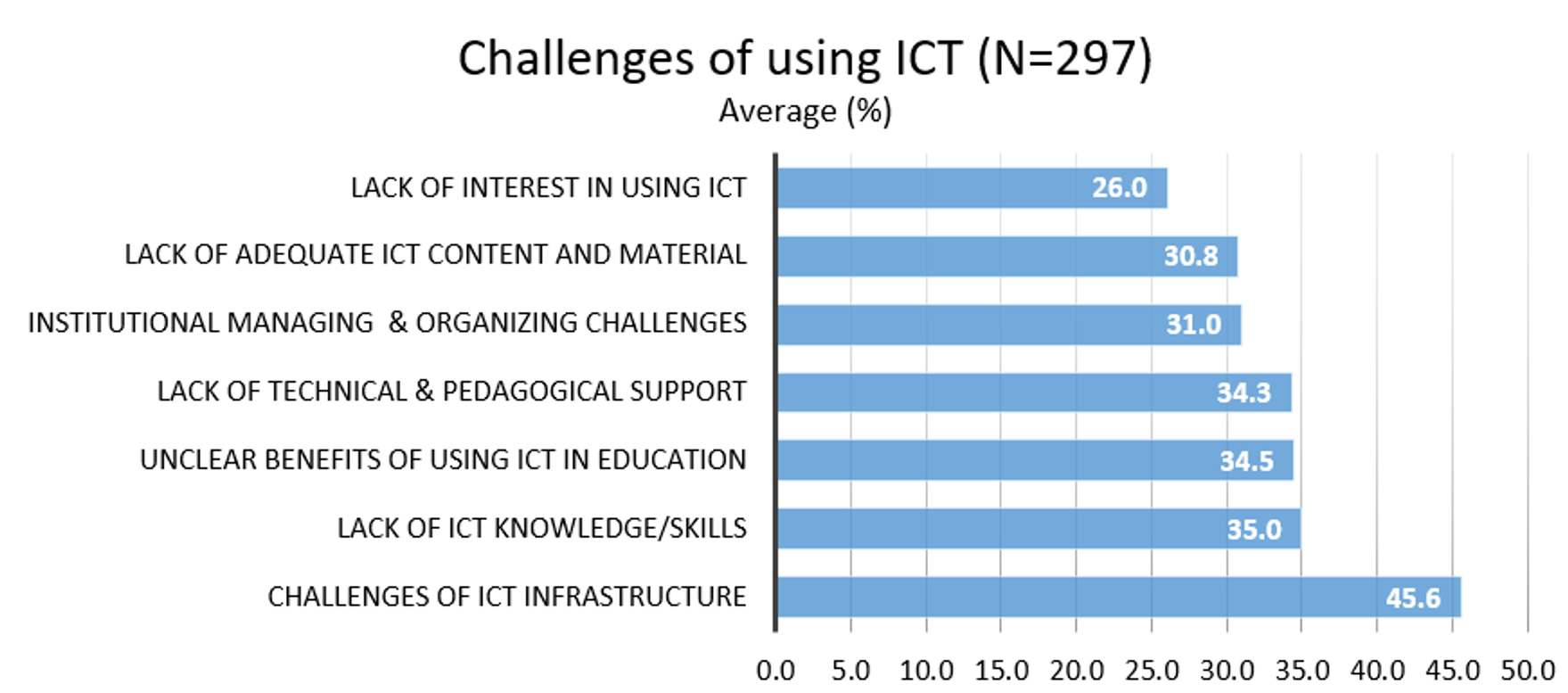
The findings from the study revealed seven themes which are, challenges of ICT infrastructure, lack of ICT knowledge/skills, lack of technical and pedagogical support, challenges in ICT content and material, institutional managing and organizing challenges, interest in using ICT and unclear benefits of using ICT in education (Figure 4). Each theme is presented in the next Sub-sections.
Figure 4: Challenges of using ICT in Teaching and Learning (Emerging Themes)
Challenges of ICT Infrastructure
The most significant challenge revealed from the study is the challenge related to ICT infrastructure. Generally, about 45.6% of teachers (Figure 4) have the opinion that their schools have insufficient ICT infrastructure. When teachers were asked if the use of ICT in learning and teaching adversely affected by insufficient number of Internet connected computers 50.2% of teachers stated ‘a lot’ (Table 9), insufficient Internet bandwidth or speed (48.5%) stated ‘a lot’, insufficient number of computers (47.5%) also stated ‘a lot’ as well as insufficient number of interactive whiteboards (47.5%) of teachers stated ‘a lot’ too.
Other factors that the majority of respondents claimed limiting their ICT usage in teaching and learning ‘a lot’ were insufficient number of laptops/notebooks (44.1%) as well as existence of outdated computers reported by (35.5%) respondents (Table 9).
It is therefore evident from the findings that teachers have associated their ICT usage in teaching with the provision of ICT infrastructure in their schools. This is a relatively major factor revealed from the present study found to be limiting teachers’ ICT usage in secondary schools although it was not the case to some of teachers (an average of 22.5%) who stated ‘not at all’ to all factors.
Table 9: Challenges of using ICT in Learning and Teaching
Characteristic
Category
Freq.
Percent
Theme 1
1
Insufficient number of computers
Not at all
72
24.2
A little
60
20.2
Partially
24
8.1
A lot
141
47.5
2
Insufficient number of Internet connected computers
Not at all
60
20.2
A little
57
19.2
Considerably
31
10.4
A lot
149
50.2
3
Insufficient Internet bandwidth or speed
Not at all
61
20.5
A little
57
19.2
Considerably
35
11.8
A lot
144
48.5
4
Insufficient number of interactive whiteboards
Not at all
66
22.2
A little
45
15.2
Considerably
45
15.2
A lot
141
47.5
5
Insufficient number of laptops/notebooks
Not at all
67
22.6
A little
62
20.9
Considerably
37
12.5
A lot
131
44.1
6
School computers out of date and/or need repair
Not at all
71
23.9
A little
67
22.6
Considerably
53
17.9
A lot
106
35.7
Theme 2
7
Lack of adequate skills of teachers
Not at all
64
21.6
A little
68
22.9
Considerably
61
20.5
A lot
104
35
Theme 3
8
No or unclear benefits to use ICT for teaching
Not at all
93
31.3
A little
63
21.2
Considerably
47
15.9
A lot
94
31.7
9
Using ICT in teaching and learning not being our goal in our school
Not at all
68
22.9
A little
71
23.9
Considerably
47
15.8
A lot
111
37.4
Theme 4
10
Insufficient technical support for teachers
Not at all
57
19.2
A little
67
22.6
Considerably
72
24.2
A lot
101
34
11
Insufficient pedagogical support for teachers
Not at all
58
19.5
A little
73
24.6
Considerably
61
20.5
A lot
105
35.4
12
Too difficult to integrate ICT use into the curriculum
Not at all
76
25.6
A little
63
21.2
Considerably
51
17.2
A lot
107
36
13
Lack of pedagogical models on how to use ICT for learning
Not at all
73
24.6
A little
78
26.3
Considerably
51
17.2
A lot
95
32
Theme 5
14
School time organization (fixed lesson time, etc)
Not at all
74
24.9
A little
69
23.2
Considerably
54
18.2
A lot
100
33.7
15
School space organization (classroom size and furniture, etc)
Not at all
78
26.3
A little
71
23.9
Considerably
63
21.2
A lot
85
28.6
16
Pressure to prepare students for exams and tests
Not at all
94
31.7
A little
65
21.9
Considerably
47
15.8
A lot
91
30.6
Theme 6
17
Lack of adequate content/material for teaching
Not at all
68
22.9
A little
94
31.7
Considerably
49
16.5
A lot
86
29
18
Lack of content in national language
Not at all
80
26.9
A little
75
25.3
Considerably
45
15.2
A lot
97
32.7
Theme 7
19
Most parents not in favor of the use of ICT at school
Not at all
90
30.3
A little
65
21.9
Considerably
63
21.2
A lot
79
26.6
20
Most of teachers not in favor of the use of ICT at school
Not at all
94
31.7
A little
80
26.9
Considerably
52
17.5
A lot
71
23.9
21
Lack of interest of teachers
Not at all
103
34.7
A little
62
20.9
Considerably
50
16.8
A lot
82
27.6
Total
297
100
Lack of ICT Knowledge/Skills
The second major challenge highlighted here is lack of ICT knowledge/skills. This was reported by an average of 35.0% teachers (Figure 4). Nevertheless, data from Table 9 show that majority of respondents (35.5%) stated ‘a lot’ to mean that teachers lack adequate ICT skills as another factor that influence the use of ICT in teaching and learning in secondary schools.
Further analysis on teachers’ ICT training was conducted and teachers were requested to respond either yes or no to the following two questions: “Is participation in ICT training compulsory for teachers in your school?” and “have you undertaken any introductory courses on Internet use and general applications such as basic word-processing, spreadsheets, presentations, database, etc.?” The results show that 53.2% and 58.6% of teachers responded no to both questions respectively which further cement the earlier findings on lack of knowledge/skills to ICT. However, data from Table 9 shows that 21.6% of teachers disagreed that lack of adequate skills of teachers do not influence their ICT usage in teaching by stating ‘not at all’. This indicate that there is some positive progression to ICT knowledge to some secondary schools’ teachers in Tanzania.
Unclear Benefits of using ICT in Education
The third factor revealed from the study was unclear benefits of using ICT in teaching and learning. Data from the question that whether the use of ICT in teaching is affected by absence or unclear benefits of ICT in teaching shows about the same number of teachers who stated ‘a lot’ (31.7%) to that who stated ‘not at all’ (31.3%) as shown in Table 9. Having a minor difference between the two extremes is not a case, but having 31.7% of teachers who believe that absence or unclear benefits of ICT in teaching is limiting their usage of ICT in teaching cannot be neglected. This suggests that ICT has not penetrated enough into education to yield significant results.
When the responses were split into two, “no” to mean, not at all and a little and “yes” to mean, considerably and a lot, the results showed that 52.5% disagreed while to 47.5% agreed that the benefits of using ICT in teaching were not clear.
Table 9 further shows that using ICT in learning and teaching is not the goal in most secondary schools involved in the study since 37.4% of respondents indicated it as a factor limiting ICT usage in teaching. Schools should be urged to include ICT in their mission and vision if we want a successful ICT integration into education.
Lack of Technical and Pedagogical Support
Lack of technical and pedagogical support was the fourth factor affecting the use of ICT in learning and teaching. When teachers were asked whether the use of ICT in learning and teaching adversely affected by insufficient technical support for teachers, 34.0% of teachers stated ‘a lot’; insufficient pedagogical support for teachers 35.4% of teachers stated ‘a lot’ and too difficult to integrate ICT use into the curriculum 36.0% of teachers also stated ‘a lot’. Furthermore, 32.0% of teachers declared lack of pedagogical models on how to use ICT for learning was another factor hindering teachers’ ICT usage in teaching. In particular lack of technical support calls for education stakeholders’ attention including technical institutions to increase production of ICT technician to address the current situation. These challenges may remain for long because most of the technical institutions produce graduates from field different from education, in that sense, they lack pedagogy and education philosophy.
Institutional Managing and Organizing Challenges
Though not to a remarkable effect, managing events/activities and organizing school infrastructure have also been revealed as a factor that limits the use of ICT in learning and teaching. When teachers were asked if the use of ICT in teaching is affected by school time organization (fixed lesson time, etc.), 33.7% of teachers stated ‘a lot’. Similarly, 28.6% of teachers said that the school space organization, particularly classroom size and furniture, influence the use of ICT in teaching. However, these results should not be taken to be consistent across all factors since 31.7% of teachers consider the pressure to prepare students for exams and test was not at all a constraint.
Lack of Adequate ICT Content and Material
The second last factor that teachers observed as limiting their use of ICT in teaching is the lack of adequate ICT content and material. When teachers were asked whether the use of ICT in teaching is affected by lack of adequate content/material for teaching 31.7% of teachers stated ‘a little’. This imply that there is a need to improve ICT syllabus and material to enhance usage of ICT in teaching to most secondary schools in Tanzania. Concerning the lack of content in national language 32.7% of teachers were of the opinion that it affects the usage of ICT in learning and teaching in secondary schools.
Lack of Interest in using ICT
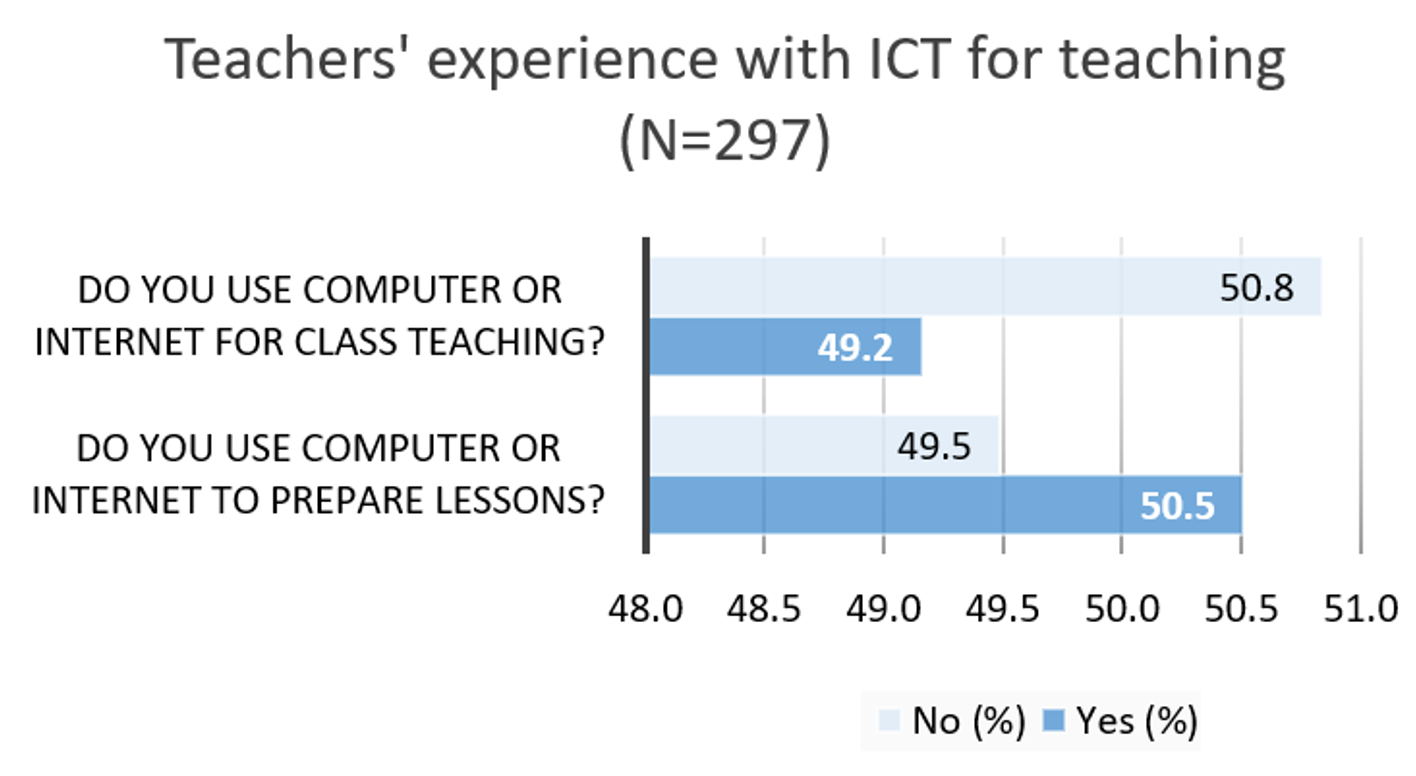
Contrary to all other factors, lack of interest in using ICT was not found as a constrain to usage of ICT in learning and teaching. When teachers were asked whether the use of ICT in learning and teaching adversely was affected by lack of teachers’ interest, 34.7% of teachers responded ‘not at all’ (Table 9). Similarly, the factors “most of parents and teachers not in favor of the use of ICT” were tested whether or not can influence the use of ICT in teaching. The results were negative to both factors. Teachers’ interest in ICT is supported by another data in this study. Teachers were requested to respond yes or no to the question, “do you use computer or Internet to prepare lessons?” Majority of teachers (50.5%) responded ‘yes’ (Figure 5).
Figure 5: Teachers' Experience with ICT for Teaching
This finding justifies the government efforts through the Universal Communications Service Access Fund (UCSAF) that aims to provide ICT training to all secondary school teachers by 2025.Contrary to Malekani [21] and other previous studies, results from this study indicate that access to ICT as a tool to learning and teaching is now getting attention and interest to secondary schools’ teachers implying a right path the nation has opted to achieve the 2025 millennium goals.
CONCLUSION
Generally, findings from the study suggest that there are still challenges in integrating and implementing ICT in secondary education. The primary barrier being problems related to ICT infrastructure (such as insufficient number of computers/lap tops, Internet bandwidth, interactive whiteboards and existence of outdated computers). Consistent with Banele [15], Chirwa [17], Ngenze [14] as well as Tarimo and Kavishe [25], it was evident from the present study that there are still ICT infrastructural problems in secondary schools in Tanzania that need to be continuously addressed to eradicate the digital divide. Supply of ICT tools including computers and ICT training to teachers and students need to receive a continuous support by all stakeholders since lack of ICT knowledge, technical and pedagogical support were also revealed as challenges in this study. In addition, institutional managing and organizing challenges as well as lack of adequate ICT content and material were also seen as factors preventing teachers’ ICT usage in learning and teaching. However, lack of interest in using ICT and unclear benefits of using ICT in education was found not to be a constrain any more.
Regardless of the said challenges, to date many secondary schools in the country have ICT infrastructure to run ICT courses. In addition, the ministry of education and its associated education stakeholder have established a new combination at higher secondary school that accommodate ICT. Consistent with URL (2019) and URT [13] the capacity building that used to hinder a practical integration and implementation of ICT in secondary schools is now taken care. But most importantelectrical power is no longer a major blocking factor as many rural areas have been connected into the national grid minimizing the gap of ICT between rural and urban. Furthermore, findings from this study indicate there is at least one teacher capable of using ICT devices in most secondary schools in Tanzania.This data justifies the government efforts through the Universal Communications Service Access Fund (UCSAF) that aims to provide ICT training to all secondary school teachers by 2025.Contrary to Malekani [21] and other previous studies, results from this study indicate that access to ICT as a tool to learning and teaching is now getting attention and interest to secondary schools’ teachers implying a right path the nation has opted to achieve the 2025 millennium goals.
Referring to recentCOVID-19 epidemic, learning through ICT (distance learning) is found to be the only solution to most academic institutions including secondary schools. For example, many universities relied on a mix of digital and classroom-based instruction across a semester. However, the experience has gone down to the nursery schools where pupils remained home and supported by teachers and parents through mobile devices and Internet services.The effect of Covid-19 has opened up new lesson that we cannot afford to close the door of using ICT in basic and secondary education. Results from this study provided a useful springboard for further ICT training to teachers as well as students as education is now turning to be on remote communication and instructional technology at all education levels.
The study recommends that to effectively grow into second world economy a continuous integration of ICT in secondary schools is inevitable. Recently, Tax collections, managing government asset, controlling financial vandalism and many more have proved successfully with the use of ICT in Tanzania.
REFERENCES
Meenakshi, K. “Importance of ICT in Education.” Journal of Research and Method in Education (IOSR-JRME), vol. 1, no. 4, 2013, pp. 03–08.
Barakabitze, A.A. “The Context of education initiatives, importance and inhibitors of ICTs towards improving teaching and learning in Tanzania: A critical literature review.” Context, vol. 4, no. 10, 2014.
Ratheeswari, K. “Information communication technology in education.” Journal of Applied and Advanced Research, vol. 3, no. S1, 2018, pp. 45–47.
United Republic of Tanzania. National Basic Educational Statistics in Tanzania (BEST): 2019 National Data. Ministry of Education, Science and Technology, 2019.
United Republic of Tanzania. National Information and Communications Technologies Policy. Ministry of Communications and Transport, 2003.
United Republic of Tanzania. Information and Communication Technology (ICT) Policy for Basic Education. Ministry of Education and Vocational Training, 2007.
United Republic of Tanzania. National Information and Communications Technology Policy. Ministry of Works, Transport and Communication, 2016a.
Swarts, P.and E.M. Wachira. Tanzania: ICT in Education Situational Analysis. Global e-Schools and Communities Initiative, 2010, pp. 20–33.
Barakabitze, A.A. et al. Exploring students’ skills and attitudes on effective use of ICTs: Case study of selected Tanzanian public secondary schools. Universal Journal of Educational Research, vol. 3, no. 6, 2015, pp. 407–425.
Kira, E.and N. Mahumbwe. Utilization of the Internet Facility in Dar es Salaam Secondary Schools in Tanzania, 2015.
Sedoyeka, E.and G. Gafufen. “Computers in Tanzania secondary schools-challenges and opportunities.” International Journal of Computing and ICT Research, vol. 7, no. 1, 2013.
“Tanzanian Government Lauds GESCI Programme, Promises Continuity.” GESCI, 2020, www.gesci.org/news-room/.
United Republic of Tanzania. Taarifa ya Utekelezaji wa Miradi ya Mfuko wa Mawasiliano kwa Wote hadi Disemba 2019. Universal Communications Service Access Fund (UCSAF), 2020.
Ngeze, L.C. “ICT integration in teaching and learning in secondary schools in Tanzania: Readiness and way forward.” International Journal of Information and Education Technology, vol. 7, no. 6, 2017, pp. 424–427.
Banele, S.D. “Factors for teachers’ low use of ICT in secondary schools in Tanzania.” International Journal of Research and Innovation in Social Science (IJRISS), vol. 3, no. 3, 2019, pp. 242–246.
United Republic of Tanzania. National Basic Educational Statistics in Tanzania (BEST): 2012–2016 National Data. Ministry of Education, Science and Technology, 2016b.
Chirwa, M. “Access and use of internet in teaching and learning at two selected teachers’ colleges in Tanzania.” International Journal of Education and Development using ICT, vol. 14, no. 2, 2018.
UNESCO. Guide to Measuring Information and Communication Technologies (ICT) in Education. UNESCO Institute for Statistics, 2009.
Hennessy, S. et al. Developing the Use of Information and Communication Technology to Enhance Teaching and Learning in East African Schools: Review of the Literature. Centre for Commonwealth Education and Aga Khan University Institute for Educational Development–Eastern Africa, 2010.
UNESCO. Information and Communication Technology (ICT) in Education in Sub-Saharan Africa: A Comparative Analysis of Basic E-Readiness in Schools. UNESCO Institute for Statistics, 2015.
Malekani, A.A. “Access to, use and challenges of ICTs in secondary schools in Tanzania: A study of selected secondary schools in Morogoro municipality.” Information Impact: Journal of Information and Knowledge Management, vol. 9, no. 2, 2018, pp. 44–57.
Malero, A. et al. “ICT Usage readiness for private and public secondary schools in Tanzania: A case of dodoma municipality.” International Journal of Computer Applications, vol. 129, no. 3, 2015, pp. 2013–2016.
Kihoza, P. et al. “Classroom ICT integration in Tanzania: Opportunities and challenges from the perspectives of TPACK and SAMR Models.” International Journal of Education and Development using ICT, vol. 12, no. 1, 2016.
UNESCO. Measuring ICTs in Education: The UIS Role and Its Regional Approach to Data Collection. ESCAP Committee on Statistics, Bangkok, 2012.
Tarimo, R.and G. Kavishe. “Internet access and usage by secondary school students in Morogoro municipality, Tanzania.” International Journal of Education and Development using ICT, vol. 13, no. 2, 2017.
United Republic of Tanzania. Energy Access and Use Situation Survey in Tanzania Mainland 2019/20: Summary of Key Findings. Ministry of Energy, 2020.
Kisanga, D.H. Investigation of attitudinal factors towards the transition from face-to-face to e-learning in Tanzanian higher learning institutions: A mixed methods approach. PhD thesis, Nottingham Trent University, 2015.
Pima, J. “Factors that motivate teachers to use ICT in teaching: A case of Kaliua district secondary schools in Tanzania.” International Journal of Education and Development using ICT, vol. 15, no. 1, 2019.
Advertisement
Recommended Articles
Research Article
Pedagogic Competencies Provided To Student Teachers through Biology Teacher Education in Universities in Kenya In Light of Classroom Practice
Download PDF
Research Article
Outcome of COVID-19 in Patients with Myasthenia May Not Only Depend on the Immunologic Disease
Josef Finsterer,
...
Ana C Fiorini
Published: 31/10/2020
Download PDF
Research Article
Enhancing Research Scholarship and Publications: Creating a Positive and Productive Research Culture through Comprehensive Collaborations
Daya Singh Sandhu,
Jeffrey Crane
Published: 30/08/2022
Download PDF
Research Article
Ovarian Pathologies in Paediatric Age Group - Our Experience and Review of Literature
Jyotsna Kulkarni,
...
Rajendra Chaudhari
Published: 20/05/2021
Download PDF
PO Box 101, Nakuru
Kenya.
Email: office@iarconsortium.org
Editorial Office:
J.L Bhavan, Near Radison Blu Hotel,
Jalukbari, Guwahati-India
Ndume, V. A., Kisanga, D. H. & Selemani, M. (2021). Integrating ICT in Tanzania Secondary Schools: Experience of Tanzania as it Grows to Second World Economy. International Academic Journal of Education & Literature, 2(2), 1-13.
MLA
Ndume, Vitalis A., Dalton H. Kisanga and Majige Selemani. "Integrating ICT in Tanzania Secondary Schools: Experience of Tanzania as it Grows to Second World Economy." International Academic Journal of Education & Literature 2.2 (2021): 1-13.
Chicago
Ndume, Vitalis A., Dalton H. Kisanga and Majige Selemani. "Integrating ICT in Tanzania Secondary Schools: Experience of Tanzania as it Grows to Second World Economy." International Academic Journal of Education & Literature 2, no. 2 (2021): 1-13.
Harvard
Ndume, V. A., Kisanga, D. H. and Selemani, M. (2021) 'Integrating ICT in Tanzania Secondary Schools: Experience of Tanzania as it Grows to Second World Economy' International Academic Journal of Education & Literature 2(2), pp. 1-13.
Vancouver
Ndume VA, Kisanga DH, Selemani M. Integrating ICT in Tanzania Secondary Schools: Experience of Tanzania as it Grows to Second World Economy. International Academic Journal of Education & Literature. 2021 Jul;2(2):1-13.


 Download PDF
 Download XML