Contents
Download PDF
pdf Download XML
988 Views
239 Downloads
Share this article
Research Article | Volume 2 Issue 1 (Jan-June, 2021) | Pages 1 - 3
The Influence of Integral Calculus Basic Theorems in Learning Radioactivity Materials Students of Physics Education Umn Al Washliyah Medan
1
Department of Physics Education UMN Al-Washliyah, Indonesia
Under a Creative Commons license
Open Access
Received
March 8, 2021
Revised
April 22, 2021
Accepted
May 14, 2021
Published
June 10, 2021
Abstract

This study aims to determine the ability of students in mastering the basic theorems of integral calculus, radioactivity material and to determine how much influence the ability of the basic theorems of integral calculus in studying radioactivity material. In collecting the data, a test on the basic theorem of integral calculus and radioactivity was used. The test was given after learning the basic theorems of integral calculus and radioactivity material was completed. To analyze the data in this study using statistical concepts, the steps taken are calculating the normality test, regression linearity test, correlation coefficient, test of the significance of the correlation coefficient and the coefficient to be determined. From the data analysis, it was obtained that the correlation coefficient value = 0.66, the meaning of the correlation coefficient = 5.043 and the coefficient of termination = 0.4356. These results indicate that 43.56% of the variable x can explain the variable y. The data show that there is a significant contribution to the ability of the basic theorem of integral calculus in studying radioactivity material. 

Keywords
INTRODUCTION

Education plays an important role in creating and giving birth to intelligent and skilled people, capable of mastering science and technology. An intelligent human being will be able to innovate in the field of technology and consciously utilize his every ability for the welfare of mankind in the future. Humans as users and developers of science and technology need to have the ability to absorb, manage and use science and technology. Mastery of science and technology can be invested if there is a development of education in humans using the knowledge and technology. Mastery of science and technology can be achieved if humans can formulate various scientific disciplines.


Education is an effort so that humans can develop their potential through thelearning process and/or other ways known and recognized by society [1]. There has been considerable discussion regarding Education for Sustainable Development (ESD) at a policy level, very few countries and com-munities have moved to integrate ESD into their educational curriculum, letalone implemented it as the basis of a reorienting or transforming education [2]. ESD is recognized as a key element of quality education and a crucial enabler for SD. The 2030 Agenda for Sustainable Development, accepted by United Nations in 2015 [3], clearly reflects this visionand the importance of appropriate educational respons. Educators must be able to understand and articulate the meaning of Sustainable Development (SD), and thus education for sustainable development, in order to implement these concepts and use them as a framework for education [4].


Mathematics as one of the basic sciences which is always related to other basic sciences and applied sciences will be indispensable as a condition to be able to study and understand other sciences properly [5]. Mathematics emphasizes deductive processes that require logical and axiomatic reasoning. Besides that, mathematics with its material that is very hierarchical in nature and produces an efficient language is needed by other sciences, especially physics. Physical theory will be easy to learn and understand if mathematical theories are well mastered. In this study, the mathematics used is mathematics whose material is related to the needs in studying radioactivity material [6]. Student difficulties in learning are one of the reasons for the lack of success of students in following lecture material. Students who have learning difficulties will see that their learning outcomes are low or not in accordance with their abilities. One source of difficulty is caused by supporting factors in learning an inadequate course material. In the learning of certain material, it is often collided with a lack of mastery of other materials that must be mastered as a prerequisite that supports the creation of an optimal learning atmosphere in the material being pursued [7]. 


For example, in studying radioactivity material, it is necessary to master the basic theorems of integral calculus to be able to follow this material [8]. For example, in determining the activity of a radioactive nuclide sample and other calculations, it is necessary to master the basic theorem of integral calculus. Experimental measurements of radioactive sample activity show that in each case the activity decreases exponentially with time [9]. If the equations and the steps to use the basic theorem of integral calculus are not well mastered, of course, you will experience difficulties in studying radioactivity material. Based on temporary observations in the field, it shows that many students find it difficult to follow and solve questions on radioactivity material. Meanwhile, to follow the material and solve these problems, adequate basic theorem skills of integral calculus are required. For this reason, a study is needed to see how much influence the ability of the basic theorems of integral calculus in studying the radioactivity material of students of the Physics Education Study Program UMN Al Washliyah.
MATERIALS AND METHODS

Correlation Research was conducted in the Physics Education Study Program of UMN Al Washliyah. Pearson Correlation is used to identify the relationship between the two variables. Statistics Solutions described the Pearson r as the most widely used correlations statistic to measure the degree of the relationship between linearly related variables [10]. The purpose of a correlational study is to look for possible relationships among variables of interest [11]. These relationships were examined to determine if there is a positive, negative, or no correlation among the variables of interest.


The sample size was 35 students who met the requirements to be the object of research. Although students have received basic theorems material on integral calculus and radioactivity material, for the purposes of this research learning is still being carried out. After carrying out the next lesson, it was continued with data collection. The data was collected by giving a test about the basic theorem of integral calculus and radioactivity material. Before conducting research, the instruments that have been compiled are tested for their validity. The validity test is carried out to determine the test used actually measures what should be measured. In this study, the data taken is in the form of numbers which are the test results of the basic theorems of integral calculus and radioactivity material. To analyze the data, statistical concepts are used. By using these statistical concepts, it will be easier to obtain the desired results, in accordance with the research objectives. The steps taken are as follows: Determining the standard deviation, calculating the normality test, calculating the regression linearity test, calculating the correlation coefficient, calculating the correlation significance test and calculating the coefficient of termination. Calculating the correlation coefficient r using the formula:


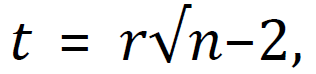
Calculate the significance test of the correlation coefficient using the formula: 


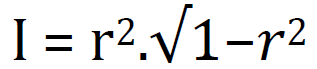
calculate the coefficient of determination with the formula:


The results of the calculation of this equation will determine the influence of mastering the basic theorem of integral calculus in studying radioactivity material.

RESULTS AND DISCUSSION

The following is the frequency distribution of the basic theorem test scores for integral calculus and radioactivity material.


From Table 1, it is obtained that the average score of students in the basic theorem material of integral calculus is 13.07 and a standard deviation of 2.97. While Table 2 The average score of students in radioactivity material is 11.78 and a standard deviation of 2.87. The research discussion of the steps taken is the normality test, regression linearity test, test the significance of the correlation coefficient, calculating the correlation coefficient and calculating the coefficient of termination. For the normality test of the basic theorem of integral calculus, it is obtained X2 count = 3,2008 and X2 table = 7,8150. Whereas for radioactivity material obtained X2 count = 6.5653 and X2 table = 7.8150. This means that the two variables above show a normally distributed sample. From the calculation of the correlation coefficient r, it is obtained that the value of rXY = 0.66 followed by a test of the significance of the correlation coefficient and the value of t = 5.043 is obtained. This is the value of t count, while the value of t table for the significance level of 0.05 and degrees of freedom of 33 = 1.70. This means that the data between variable X and variable Y has a high linear correlation with a meaningful correlation coefficient. In the calculation of the coefficient of termination, the value of 0.4356 is obtained, this result shows   that  43.56%  of   variable can explain variable Y


Table 1:  Frequency Distribution of Integral Calculus Basic Theorem Test Scores

Score

fi

xi

xi2

fixi

fixi2

8-9

5

8,5

72,25

42,50

361,25

10-11

5

10,5

110,25

52,50

551,25

12-13

11

12,5

156,25

137,50

1718,75

14-15

6

14,5

210,25

87,00

1261,50

16-17

5

16,5

272,25

82,50

1361,25

18-19

3

18,5

342,25

55,50

1026,75

Total

35

-

-

457,50

6280,75


Table 2: Frequency Distribution of Radioactivity Material Test Scores

Score

fi


xi

xi2

fixi

fixi2

7-8

5


7,5

56,25

42,50

361,25

9-10

6


9,5

90,25

52,50

551,25

11-12

12


11,5

132,25

137,50

1718,75

13-14

6


13,5

182,25

87,50

1261,75

15-16

3


15,5

240,25

82,50

1361,75

17-18

3


17,5

306,25

55,50

1026,75

Total

35


-

-

457,50

6280,75


The data shows that there is a relationship between the ability of the basic theorem of integral calculus in studying radioactivity material.


From data analysis and hypothesis testing, it shows the ability of the basic theorem of integral calculus in studying radioactivity material. The results also explain the contribution of variable X to variable Y of 43.56%. Apart from the above factors, of course there are other factors that affect students' learning ability in radioactivity material. Perhaps in other research, it will answer other factors that affect students' learning ability in radioactivity material besides mastery of the basic theorem of integral calculus. 

CONCLUSION

Based on the research results obtained, it can be concluded as follows: (1) the data shows that the ability of students in radioactivity material has something to do with the ability of students in the basic theorem material of integral calculus. (2) The effect of the ability of the basic theorem of integral calculus in studying radioactivity is 43.56%.

REFERENCES
  1. Yogiantoro, M. et al. I. “Effects of education funding in increasing human development index.” JEJAK: Jurnal Ekonomi dan Kebijakan, vol. 12, no. 2, 2019, https://doi.org/10.15294/jejak.v12i2.2339.

  2. Glavic, P. “Identifying key issues of education for sustainable development.” Sustainability, vol. 12, no. 1, 2020, p. 6500, https://doi.org/10.3390/su12166500.

  3. United Nations, General Assembly. Transforming our world: The 2030 agenda for sustainable development. 2015, http://www.un.org/ga/search/view_doc.asp?symbol=A/RES/70/1&Lang=E.

  4. Dlouha, J. and Pospišilova, M. “Education for sustainable development goals in public debate: The importance of participatory approach in reflecting and supporting the consultation process in developing a vision for Czech education.” Journal of Cleaner Production, vol. 172, no. 1, 2018, pp. 4314–4327.

  5. Cho, J. and Baek, W. “Identifying factors affecting the quality of teaching in basic science education: Physics, biological sciences, mathematics, and chemistry.” Sustainability, vol. 11, no. 1, 2019, p. 3958, https://doi.org/10.3390/su11143958.

  6. Freeman, S. et al. “Active learning increases student performance in science, engineering, and mathematics.” Proceedings of the National Academy of Sciences of the United States of America, vol. 111, no. 23, 2014, pp. 8410–8415.

  7. Baek, W. and Cho, J. “Challenging the sustainability of an education system of evaluation and labor market outcomes.” Sustainability, vol. 7, no. 1, 2015, pp. 16060–16075.

  8. Sparavigna, A.C. and Marazzato, R. “Experiments on radioactivity in a student laboratory.” International Journal of Sciences, vol. 3, no. 2, 2014, pp. 7–11.

  9. Benghin, V.V. et al. “An experiment in radiation measurement using the Depron instrument.” Space Science Reviews, vol. 214, no. 9, 2018, https://doi.org/10.1007/s11214-017-0445-6.

  10. Montalban, E.J. et al. “Correlational analysis of COVID-19 deaths and recoveries per country.” SSRN Electronic Journal, Jan. 2020, https://doi.org/10.2139/ssrn.3624543.

  11. Phillips, C.A. A correlational study of the motivation and engagement in teachers: Experience and effectiveness. Liberty University, 2016.

Advertisement
Recommended Articles
Research Article
Pedagogic Competencies Provided To Student Teachers through Biology Teacher Education in Universities in Kenya In Light of Classroom Practice
Download PDF
Research Article
Outcome of COVID-19 in Patients with Myasthenia May Not Only Depend on the Immunologic Disease
...
Published: 31/10/2020
Download PDF
Research Article
Enhancing Research Scholarship and Publications: Creating a Positive and Productive Research Culture through Comprehensive Collaborations
Published: 30/08/2022
Download PDF
Research Article
Ovarian Pathologies in Paediatric Age Group - Our Experience and Review of Literature
...
Published: 20/05/2021
Download PDF
Chat on WhatsApp
Flowbite Logo
PO Box 101, Nakuru
Kenya.
Email: office@iarconsortium.org

Editorial Office:
J.L Bhavan, Near Radison Blu Hotel,
Jalukbari, Guwahati-India
Useful Links
Order Hard Copy
Privacy policy
Terms and Conditions
Refund Policy
Shipping Policy
Others
About Us
Team Members
Contact Us
Online Payments
Join as Editor
Join as Reviewer
Subscribe to our Newsletter
+91 60029-93949
Follow us
MOST SEARCHED KEYWORDS
Copyright © iARCON International LLP . All Rights Reserved.