Womanhood is a term ascribed to being woman and its characteristics and idiosyncrasies. It is a term ascribed to a mature adult of the female gender. In some areas of Africa womanhood is so debased that one wonders if the wrongs of gender inequality and sensibility can ever be redressed. Even after the Beijing conference and the twenty first century, some of these unspeakable abominations are enshrined in the culture that when you raise objections you are quickly labelled a feminist and an anti-cultural person. This issue raises three hypothetical questions: Is being a woman in some regions of the world synonymous with marginalization, in which way can a woman vividly portray what she feels as a person irrespective of her gender and can a three dimensional art aptly capture the travails of womanhood. Anchoring on the theoretical frame of Karl Marx conflict theory and methodologically adopting the qualitative mode of enquiry and sculpture studio research methods of welding, modelling, dicing piecing stringing and wrapping. Manised labourer placed in a strategically place sent out direct messages to the onlooker to pensively review without haggling of words the travails of women in the society.
Keywords
Manised Labourer
Travails of Womanhood
Sculpture
Abstract
Waste
INTRODUCTION
In some areas of Africa and Nigeria in particular the women are so encumbered that if some open up and recount their travails in their homes one would shudder at their peril. In Urhobo land in Delta State of Nigeria some women that are married to polygamists and are meant to take care of the man and her own children amid rivalry and jealousy in the height of competition with other wives. It is in the light of this that after watching and hearing these travails of women that one decided to vividly document in Manised Labourer. Manised is a term used figuratively to describe a woman who has been subjected to so much labour that she seizes to be a woman but has been masculinized. Every attributes of a woman both philologically and mentally has been denuded. The African society encourages such abuses that is not gender sensitive in the name of culture and it is this apathy that Manised Labourer attempts to bring to the fore.
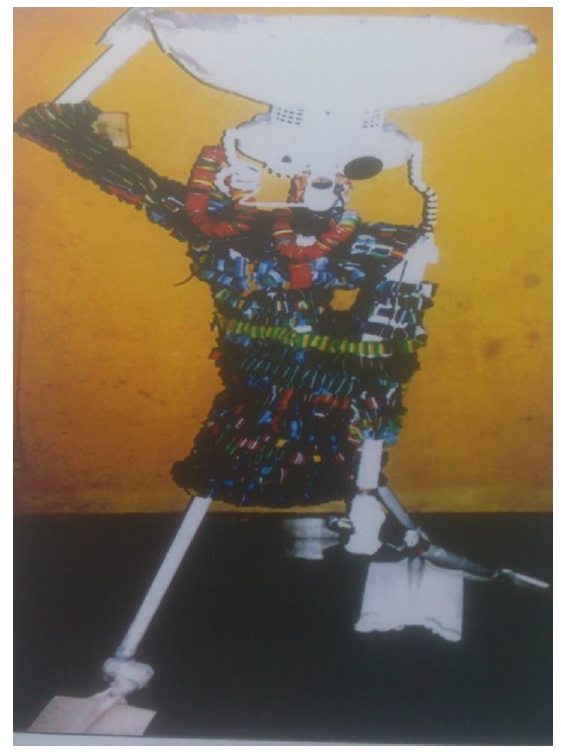
Manised Labourer as a waste sculpture is an abstracted three dimensional form. Waste Metals of metal head-pan, chains, shovels, hoe, generator part and rods bottle crowns as well as diced slippers and fibres. Various techniques were employed in this studio experience.
Literature Review and Cited Works
Theories of feminism are many but are majorly three, main stream feminism, radical feminism and Socialist/Marxist feminism. However this study hinges on the theoretical frame of Karl Marx conflict theory which states that the society is in an unending state of flux in terms of resources therefore there will always be conflict. It is cultural family conflict that a man shies away from his family responsibility that the woman takes up and s squarely carries this responsibility in some Africa homes that they become manised. National Research Council [1] concerns itself with issues of developing countries and demography and issues of diseases. Bullwinkle [2] wrote that in 1972 the United Nation declared the International Women’s year and this premised the gathering of people from 136 countries and 144 international organizations to deliberate in a conference to narrow the gap between men and women. Here too they discovered that traditions economic reasons and lack of enthusiasm of African governments were some of the hindrances in achieving gender quality. Efuribe [3] opined in Women and societal issues in Africa that Nigerian women face some cultural practices on widows, discrimination against women with child bearing issues and sexes of child delivered, lack of inheritance for the girl child, genital mutilation and a lot more challenges that women face in Nigeria. Olayiwola and Olowonmi [4] averred that motherhood defines womanhood in Africa. Maide [5] stated that the extended family has a good bearing on the entire family. Falola [6] thinks that people are beclouded by the issues of marginalization and other vices against the women that they fail to see some of the contributions of women in family and nation building. Mutume [7] comprehensively catalogued the various problems of women in Africa ranging from poverty deprivation and education. Llesanmi [8] states that reversing discriminating practices can be possible by implementing the right mechanism across the continent (Figure 1).
Studio Procedural Practices in Manised Labourer
Step 1: Female labourers at construction site are pitiful sight to behold just as the one below (Figure 2). It is this degrading sight of woman that philosophically gave birth to Manised Labourer
Step 2: Acquisition of metal components
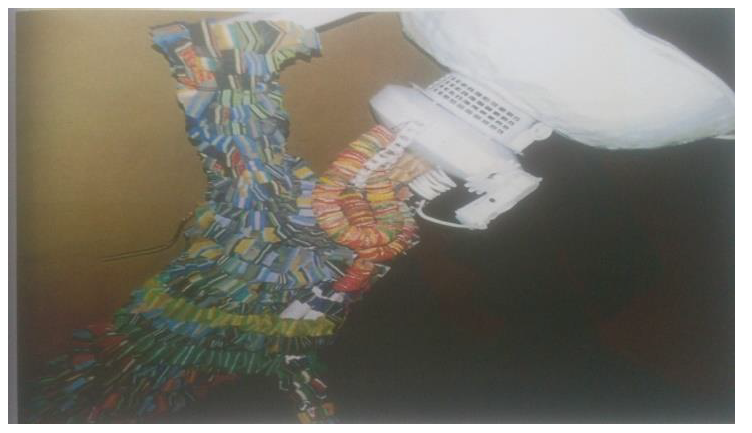
Step 3: Attempts at organizing the components, dicing and stringing of plastic slippers
Step 4: Welding of the different components and balancing the composition (Figure 3)
Step 5: De-rusting and painting with white oil paint
Step 6: Wrapping the composition with the plastic diced slippers (Figure 4 and 5)
This face is characterized by two eyes, one starry and penetrating and the other with alluring tired subdued gaze. This was achieved with two circular pieces of meal; one with uneven edge while the other is a short cylindrical edged rim. The nose is a shank that runs in-between the eyes down to the mouth which clutched the coiled ¾ ins (1.905cm) rod that serves as a pipe ruggedly presented, similitude or data rendition of the ‘Mechanical Head’ and The Spirit of Our Age’ Royal Haussmann (Figure 6).
The hand is a square pipe that was bent to clutch the head of the shovel bangles as coiled electrical wires. The same was used to embellish the pipe of the shovel towards the shovel’s handle but at this juncture it was not too embellish but to strengthen the weak shovel that has been over utilized showing visible signs of giving way all in the bid to portray the abuse of the weak female strength (Figure 7).
This part of Manised Labourer is the area that is tensed with sculptural activities. The diced stringed slippers are wrapped round the metal armature as colourful attire for the sculpture. The gait exhibited is that of a person that is in a haste which could be understood when one tries to depict labour especially one that is connoted as being abused (Figure 8 and 9).
Certain practices within Africa, Nigeria precisely have exposed many women as hard labourers to building sites, thus as concrete mixers and such odd jobs within the society. It is this practice that informed the production of the Female Labourer Manised. A woman in the family is a help mate but the economy down turn has taken the femininity off many Africa women. Some are no longer help mates but sole bread winners in the home.
Figure 1: Okogwu A, Travails of Womanhood, Installation, and Waste Plastics 6ft.x3ft.x2ft. 2020
Figure 4: Manised Labourer, The first attempt on Wrapping Bare Metals, 2014/2015, Photograph: Okogwu Antonia
This work tried to capture this essence with symbols of labour, such as the shovel, the chain and the head pan, the stylized body posture or gait trusts forward encumbered but not broken, penetrating eyes focusing on the hard day ahead, the legs abused battered shovel heads while she steps out with an overused shovel.
Figure 5: Manised Labourer, Detail of the Face, 2014/2015, Photograph: Okogwu Antonia
Figure 6: Manised Labourer, Detail of the hand, 2014/2015, Photograph: Okogwu Antonia
The only remaining female metaphors are the chain and earrings which are also symbols of slavery right from inception in the bible where only slaves who refused freedom were pierced in the ear and rings placed on them to inform the public that they were slaves. The multi coloured gown was made of diced wrapped slippers.
The Manised Labourer is an emaciated, uncomely figure that is neither a female nor a male. In other words it is a transitory figure just like a bat that is neither a bird nor an animal making the name aptly and appropriate.
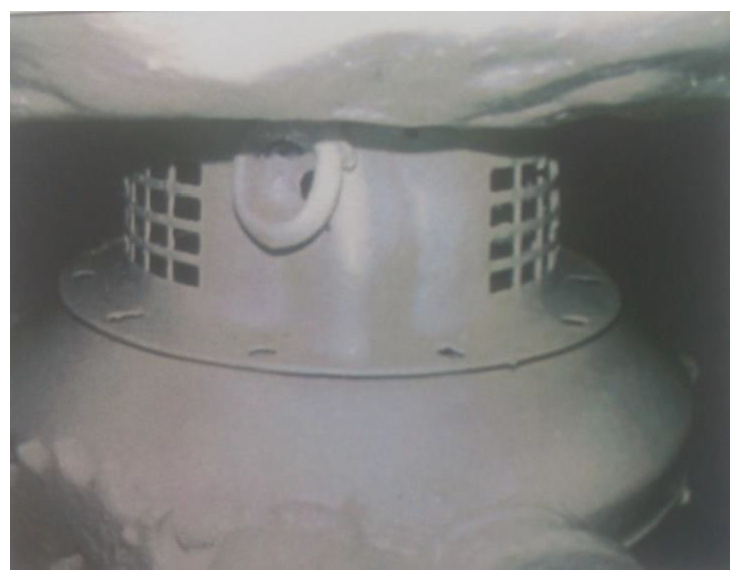
Figure 8: Manised Labourer: The Head-pad, perforated metal of generator part, 2014/2015, Photograph: Okogwu Antonia
Figure 9: Manised Labourer, Discarded Metal Head-Pan, Chains, Shovels, Diced Slippers and Fibres, (5ft.6ins) 167.64cm, 2014/2015, Photograph: Okogwu Antonia
The head is made of the fan component that housed the coil which is the engine of the ceiling fan which is round flat and squashy symbolizing the many uses of concrete mixture (mortar) carriage. The squashy head is emphasized by the long thin neck. The Head-pan on the head is also suggestive of many days of toil as the wear and tear is obvious through the numerous dents on it and one of its handles is already off. The perforated generator metal that serves as pad contrasts sharply with the head pan. The head pan is bartered and disorderly while the pad is orderly with ruled pattern and this emphasized the orderliness. The perforated pad also contrasts with the solid mass of the Head-pan.
The miniature size was purposeful to buttress unseemliness and the weight is also controlled purposefully to allow for traveling convenience and also to buttress the abused labour for which the work geared to portray. The choice of old warped shovels as feet and the outstretched step and gait were also calculated to give away a woman in a hurry to go to her duty post which is the building site. The use of enhances or energy boosters to sustain her strength and deaden her nerves to pain is metaphoric in the tobacco pipe protruding from her mouth forged with the coiling of a three quarter ins. rod.
The diced slippers were threaded with metal fibre and wrapped round the body and contrasts with the white painted body of the labourer. The colourfulness is so attractive that it halts attention to enable the viewer to take a second look at the work and then engage the eyes for critical study of the work.
This creation was methodological carried out with assembling of waste metals of used shovels, hoe, head pan, generator, coiled rod as pipe are all symbols of hard labour that supposedly associated with real macho men. However these labour tools were use in configuration of a female and that is why is titled manised labourer .When a woman leaves the domain of her creation to the other, not just to the other side but to the extreme of the continuum then her femininity is altered. Hence she is no longer a female but a manised female. On the contrary one can conveniently cite the case of Bobrisky, Okuneye Idris Olanrewaju the Nigerian transgender dresser (Daily Media) who has consciously altered his maleness to the similitude of the female gender that one cannot wholly associate him as a male again. Nigerian woman has been subjected to being not just a mother, a wife and the bread winner that you can hardly associate her as a feminine female that all these aforementioned jobs have altered that in her physiognomy makeup.
Drug Abuse Associated with Manising Womanhood
The continued hash strong labour indulged by these women with the same thing over and over and to maintain this nature of labour on the already altered physiognomy they are forced take hard drugs such as Cannabis, over dose of Tramadol Snuff cigarettes cola nuts and many more. All in the bid to deal with the ‘manization’.
DISCUSSION
This creation was methodological carried out with assembling of waste metals of used shovels, hoe, head pan, generator, coiled rod as pipe are all symbols of hard labour that supposedly associated with real macho men. However these labour tools were use in configuration of a female and that is why is titled manised labourer .When a woman leaves the domain of her creation to the other, not just to the other side but to the extreme of the continuum then her femininity is altered. Hence she is no longer a female but a manised female. On the contrary one can conveniently cite the case of Bobrisky, Okuneye Idris Olanrewaju the Nigerian transgender dresser (Daily Media) who has consciously altered his maleness to the similitude of the female gender that one cannot wholly associate him as a male again .Nigerian woman has been subjected to being not just a mother, a wife and the bread winner that you can hardly associate her as a feminine female that all these aforementioned jobs have altered that in her physiognomy makeup.
Drug Abuse Associated with Manising Womanhood
The continued hash strong labour indulged by these women with the same thing over and over and to maintain this nature of labour on the already altered physiognomy they are forced take hard drugs such as Cannabis, over dose of Tramadol Snuff cigarettes cola nuts and many more. All in the bid to deal with the ‘manization’.
CONCLUSION
African is encumbered with some cultural practices that are inimical to the growth of women such cultural practices as polygamy deliberate marginalization of women through and suppression and its attendant results manization which rubs a woman of her womanhood.
REFERENCES
National Research Council. “Epidemiological transition: Policy and planning implications for developing countries.” Washington, DC: National Academy Press, 1993. https://doi.org/10.17226/2225.
Bullwinkle, A.D. “Women and their role in African society: The literature of the seventies.”A Current Bibliography on African Affairs, 1983. https://doi.org/10.117/001132558301500403.
Efuribe, A. “Women and societal issues in Africa.”Empower Women, 2018, www.empowerwomen.org.
Olayiwola, A. and A. Olowonmi. “Mothering children in Africa: Interrogating single parenthood in African literature.”Centro de Estudos Internacionals, 2013, journals.openedition.org.
Maide, B. “Social norms and the role of the extended family.”Institute for Fiscal Studies Economic and Social Research Council, 2014, www.ifs.org.
Falola, O.T. “The role of Nigerian women.”Encyclopedia Britannica, 2007, www.britannica.com.
Mutume, G. “African women battle for equality.”African Renewal, 2005, www.un.org.
Ilesanmi, O.O. “Women visibility in decision making processes in Africa: Progress, challenges and way forward.”Frontiers in Sociology, 2018, https://doi.org/10.3389/fsoc.2018.00038.
Advertisement
Recommended Articles
Research Article
Pedagogic Competencies Provided To Student Teachers through Biology Teacher Education in Universities in Kenya In Light of Classroom Practice
Download PDF
Research Article
Outcome of COVID-19 in Patients with Myasthenia May Not Only Depend on the Immunologic Disease
Josef Finsterer,
...
Ana C Fiorini
Published: 31/10/2020
Download PDF
Research Article
Enhancing Research Scholarship and Publications: Creating a Positive and Productive Research Culture through Comprehensive Collaborations
Daya Singh Sandhu,
Jeffrey Crane
Published: 30/08/2022
Download PDF
Research Article
Ovarian Pathologies in Paediatric Age Group - Our Experience and Review of Literature
Jyotsna Kulkarni,
...
Rajendra Chaudhari
Published: 20/05/2021
Download PDF
PO Box 101, Nakuru
Kenya.
Email: office@iarconsortium.org
Editorial Office:
J.L Bhavan, Near Radison Blu Hotel,
Jalukbari, Guwahati-India
Antonia, O. (2021). ‘Manised Labourer’, the Travails of Womanhood: Abstract Waste Sculpture. International Academic Journal of Education & Literature, 2(1), 1-5.
MLA
Antonia, Okogwu. "‘Manised Labourer’, the Travails of Womanhood: Abstract Waste Sculpture." International Academic Journal of Education & Literature 2.1 (2021): 1-5.
Chicago
Antonia, Okogwu. "‘Manised Labourer’, the Travails of Womanhood: Abstract Waste Sculpture." International Academic Journal of Education & Literature 2, no. 1 (2021): 1-5.
Harvard
Antonia, O. (2021) '‘Manised Labourer’, the Travails of Womanhood: Abstract Waste Sculpture' International Academic Journal of Education & Literature 2(1), pp. 1-5.
Vancouver
Antonia O. ‘Manised Labourer’, the Travails of Womanhood: Abstract Waste Sculpture. International Academic Journal of Education & Literature. 2021 Jan;2(1):1-5.



 Download PDF
 Download XML