Different concentrations of the peptide produced from the local isolate Lactobacillus delbrueckii JKD5 were applied in preserving minced meat and prolonging its shelf life during different periods because of their beneficial effects on consumer health. Meat and meat products have always been an important part of the human diet, as they contain valuable nutrients for growth and health. However, they are perishable and susceptible to microbial contamination, which leads to increased health risks to consumers as well as to economic losses in the meat industry. Bioactive peptides have anti-microbial activity and are important in both human health, food safety and quality. Therefore, efforts have been focused on their use as preservatives due to their safe use, low cost, long shelf life, as well as their many benefits in supporting consumer health. The peptides were added at concentrations (0.05, 0.1, 0.2) to the minced meat tablets were kept for different storage periods (0, 5, 10, 15) days at a temperature 4°C. During these different periods, the total number of bacteria and of the peroxide value were estimated, it was noted that the best concentration of peptide was 0.2, as a clear decrease in the number of bacteria was observed compared to other concentrations, as well as for its effect on the peroxide number. Thus, it can be said that the higher concentration of the peptide, greater its effectiveness in preserving minced meat.
At the end of the last century, the concern about the presence of chemical additives in foods increased. Consumers decided to use fresh and natural foods that do not contain chemical additives, as a result of the health effects that accompanied the consumption of foods containing them. At the same time, the demand by consumers for canned foods increased, which motivated researchers. To study the use of natural and biological materials that extend life of food storage and make it more suitable for consumption. The researchers concluded that peptides produced from lactic acid bacteria as natural preservatives or biological materials can meet these needs, as they are considered anti-biotic compounds that prevent and inhibit unwanted microorganisms, improve food safety and prolong storage life [1]. These peptides can be added as preservatives either indirectly by adding peptide-producing lactic acid bacteria to the food to be preserved or adding them in the form of pure or semi-pure peptides, or by adding them in the form of fermenters that already contain peptides. It is worth mentioning that use of peptides is not only in the field of food preservation, as it has many applications in other fields, including pharmaceutical, medical, veterinary and environmental protection. More than 60 peptides have been approved by Food and Drug Administration they are now available in the market used as treatments for some diseases [2,3], on this basis, peptides have been used in the biological preservation of foodstuffs, especially meat preservation.
In general, many studies have indicated the application of peptides in food to enhance its safety, adding it directly to food or immersion in a solution containing the peptide or adsorption of peptides in plastic films of type polyethylene and edible cellulose films on surfaces such as ethylene vinyl acetate, polypropylene, polyester or Antimicrobial coatings containing peptide preparations and lactic acid bacteria cultures [4-7].
In addition, their numerous nutritional properties, fermented foods are receiving greater attention, especially in the microbes that carry them. These microbes can manufacture metabolic products during fermentation with huge health potential such as organic acids, short-chain fatty acids and vitamins in addition to the ability to produce biologically active peptides [8]. Lactobacillus has shown good adaptability and adhesion in the digestive system and the potential to affect health or through various beneficial activities, including antimicrobial, antioxidant, anti-inflammatory and enhancing immunity in vitro and in vivo [8,9]. Means of controlling spoilage and pathogenic microorganisms transmitted through meat present a major challenge to food manufacturers who have devoted extensive efforts to combat the emergence of infesting microbes, often using heat treatment methods for preservation which may have unacceptable nutritional and sensory effects, in addition to growing consumer concern about food safety and lack of Acceptance of chemical additives, which led to the use of modern methods of smart treatment, namely, bio-metabolic products or anti-microbial metabolites of lactic acid bacteria, which can extend the shelf life of meat through the inhibition of spoilage and the exacerbation of other pathogens [10,11].
Rely on use natural products derived from microbes as part of biological food preservation strategies [12]. These products can be primary or secondary metabolites of microorganisms and have a high potential to reduce fat oxidation, preserve color and prolong the preservation period as possible. It's used with other preservative agents [13]. Peptides are classified as complex compounds that are synthesized within the bacterial ribosome [14]. They differ in their structural and chemical properties and the mechanism of antimicrobial action [15] and peptides have been proposed with a unique potential in biological food preservation, such as their high heat resistance [16]. The bacitracin was used instead of nitrite in preserving cured meats that's nitrites produce carcinogenic substances nitrosamines as a result of the reaction of nitrites with secondary amines in meat.
Kim et al. [17], pointed to the possibility of adding an antimicrobial peptide cocktail in ground turkey meat with a final concentration 1.08 mm or 5 mm. Microbiological tests were carried out in (0, 1, 3 and 5) days of storage under refrigeration at temperature -4 ° C, it showed strong antibacterial activity. Antimicrobial and stable even after 5 days of storage.
De Martinez et al. [18], of using lactic acid bacteria with high efficiency in preserving beef and poultry meat, by spraying the products with a mixture of nisin : lactic acid (1.5%, 25 C), which gave more effective in reducing the number of aerobic and coli bacteria than using bacteriocin alone, as the peptide was added On meat as a preservative (0.5%) it reduced fat oxidation by 60% to delay meat rancidity. The peptide also inhibited microbial growth under refrigeration for 14 days.
Most of the research on use peptides as meat preservatives has focused on the inhibitory ability of Listeria spp. It is worth noting that these bacteria are Gram-positive, bacillary, non-forming facultatively anaerobic sporophytes and most of them produce catalase, are motile and can decompose Esculin. Temperature (0-45) C and because of the ability of this bacteria to grow at low temperatures and under anaerobic conditions, it is a major problem that threatens food security. Raw meat and meat products are common environments for growth of [19] Monocytogene.
Bacterial Isolation Sources
Local isolate Lactobacillus delbrueckii JKD5 isolated from yogurt was obtained and used in peptide production. MRS broth media was inoculated with activated bacteria and incubated under anaerobic conditions at 37°C for 48 hours.
Extraction and Quantification of Product Peptide
The bacterial filtrate was taken and precipitation method with ammonium sulphate mentioned by Levieux et al., [20], was followed to separate the proteins from bacterial filtrate by adding 27 g of ammonium sulphate (NH4)2SO4 for every 50 mL of the filtrate for 24 hours with stirring with a magnetic stirrer to obtain 75% saturation. Then centrifugation was carried out at 10,000 rpm for 10 minutes. Then, a membrane leaching process (Dialysis) was carried out to get rid of ammonium sulphate and the filtrate was lyophilized using a Freeze Dryer. Then, the process of separation and purification of peptides resulting from the lyophilized bacterial filtrate was carried out using the gel filtration method using ÄKTA pure 25 technology.
It was injected into the apparatus based on the method described by Ling et al. [21], featured by Yang et al. [22], with some modifications. A Superdex TM peptide 10/300 GL column with a diameter of 10 mm and a volume of 23.562 mL filled with agarose gel and Dextran and with dimensions (10 × 30) mm was used. 0.5 of the prepared sample was injected into the column after it was filtered using a filter with a diameter of 0.22 mm micron and the column was equilibrated with a buffer sodium phosphate solution prepared at a ratio of 0.15 M and pH 7. The conditions of purification and separation process were fixed under a pressure of 1.3 MPa and a flow rate of 0.5 mL/min the separated peaks were followed at a wavelength of 220 nm through the chromatograph that appears on the computer screen. Then, the resulting peaks were collected after each separation process at a rate of 2 mL/part through an F9-R bit collector, then the obtained peptides were lyophilized by Freeze - drying and kept in the refrigerator for testing.
Incorporation of Purified Peptide into Beef
The beef patties were prepared according to the method mentioned in Al- Naimah et al. [23], where the grease-free meat was minced with a sterilized electric mincer, 15% fat and 2% salt was added to it. The ingredients were mixed well then divided into four treatments with three replicates for each group. The first group included the control tablets without fat. The second group included meat tablets with peptide added at a concentration of 0.05, while the third group included meat tablets with peptide added at a concentration of 0.1 and the fourth group included meat tablets with peptide added at a concentration of 0.2. The meat tablets were stored at a temperature of 4 °C for 15 days and the tests were conducted during (0, 5, 10, 15) days respectively.
Estimation of the Total Number of Bacteria in Ground Meat
The Spread Plate Count method mentioned in APHA [24], was followed, as Nutrient agar medium was used and the dishes were incubated at 37°C for 48 hours. The test was carried out by taking 1 gm of untreated and peptide-treated minced meat tablets of each concentration and adding it to 9 mL of sterile peptone water solution. In a circular motion in a clockwise and counterclockwise direction, all dishes were incubated upside down at 37°C for 24 hours, then the number of developing colonies was counted.
Peroxide Value (P.V.)
The peroxide value was determined according to the method described in A.O.A.C. [25], as 5 g of the sample was weighed and 30 mL of a mixture containing three parts of glacial acetic acid, two parts of chloroform, 4 mL of the prepared saturated potassium iodide, 20 mL of distilled water and some drops of starch evidence were added, then the mixture was wiped with sodium thiosulfate solution. With a calibre of (0.01) until the disappearance of the blue colour, then the value of the peroxide was calculated according to the following equation:
Peroxide number value (mEq/kg fat) = Number of millimeters of Sodium thiosulfate × thiosulfate standard × 100
Sample Weight
Statistical Analysis
The results were statistically analyzed according to Schmuller, [26], using the ready-made statistical program GenStat Ver.12.1 to analyze the data of the obtained results and the significant differences between means of the transactions were compared with the least significant test L.S.D. At the level of significance p ≤0.05.
The Effect of Adding Peptides On the Total Microbial Count
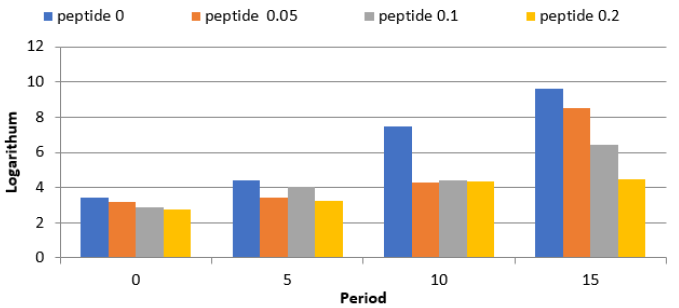
The results of total microbial count in Figure 1, indicate that total bacterial number of minced meats in the samples in general increases in storage periods in the meat tablets. The higher peptide concentration and lower bacterial count. We note that the bacterial count increased in the untreated control samples as the storage period increased, so the number of bacteria after 15 days became cfu/mL 6.2275. When using a concentration of 0.05 g the peptide produced from isolate JKD5, the number of bacterial colonies decreased to 4.8600 cfu/mL during 15 days at a temperature of 4 °C and the bacterial numbers in meat tablets decreased to 4.4550 cfu/mL when using a concentration of 0.1 g of the produced peptides during 15 days as well as. And when the concentration of the peptide added to the minced meat tablets was increased to 0.2 g, it was observed that the number of bacteria gave a low value compared with the control samples and the samples treated with peptide at concentrations 0.05 and 0.1 and the number of bacteria in the concentration of 0.2 g cfu/mL was 3.7100. The reason for this is due to the ability of the peptides to reduce the total microbial numbers in the minced meat, which leads to an improvement in the ability to preserve.

Figure 1: Total Microbial Count (cfu/mL) of Ground Beef Treated with Different Peptide Concentrations When Stored for Different Periods
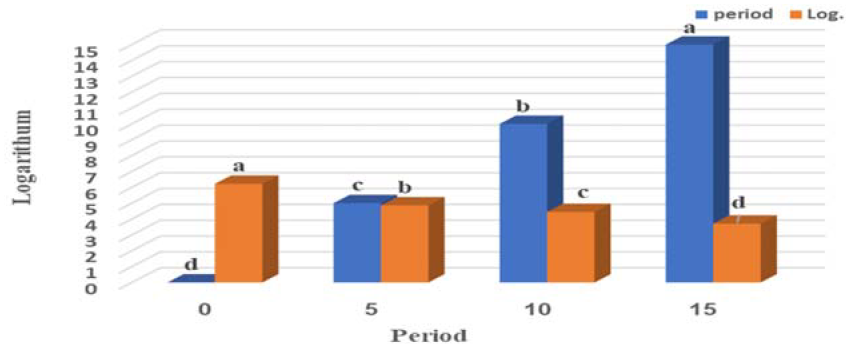
It is noticed in Figure 2, there are significant differences between the logarithm of bacterial colonies and storage periods at a significant level (0.05), as the number of bacterial colonies decreased significantly, which indicates the effective inhibitory effect of the peptide produced from isolate JKD5 the higher concentration of peptide added to ground meat as a substance An effective additive preservative that can be used in meat preservation systems besides its strong antimicrobial activity.
The results are consistent with Al-Manhal et al. who concluded that the inhibitory action of peptides when applied in preserving minced meat increases with increasing peptide concentration. The researcher obtained the highest inhibition when using a concentration of 2% of peptide compared to other concentrations used. This is what Al-Half [27], found that the inhibitory action of peptides on microorganisms in minced meat increases by increasing its concentration when using two concentrations of peptide 50 and 100 mg /100 g of minced meat and it obtained the highest inhibitory action at a concentration of 100 mg peptide and it matched the results of the study. Kim et al. concluded. [17]. By adding an antimicrobial peptide cocktail in ground turkey meat with a final concentration of 1.08 mm or 5 mm and microbiological tests were conducted in 0, 1, 3 and 5 days of storage and under refrigeration at a temperature of 4 ° C and it showed strong anti-microbial activity. And stable even after 5 days of storage.

Figure 2: Statistical Analysis of the Total Microbial Count of Ground Beef (cfu/mL) for Different Periods
Effect of Adding Peptides On the Peroxide Value in Ground Beef
The peroxide value of reveals the cumulative level of peroxide and hydroperoxide that are formed in the first stages of lipid oxidation and are used in many types of research in assessing the oxidative decomposition of fats, according to mentioned [28].
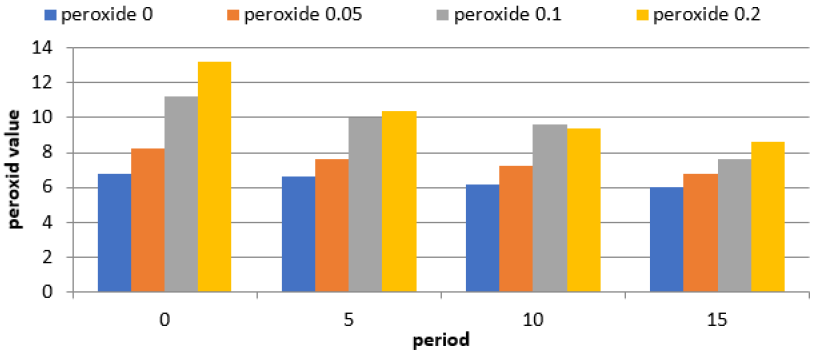
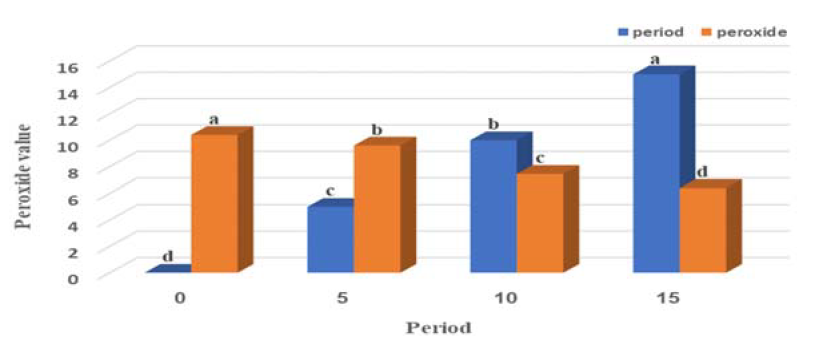
Figure 3, shows the results of estimating the peroxide value of minced meat samples treated with peptides and also not treated, as it is noted that the peroxide value in the control samples untreated with peptides was almost constant during the different storage periods (0, 5, 10, 15) days. While there were significant differences in the values of the peroxide value when adding the purified peptide at a concentration of 0.05 g after 15 days of storage at a temperature of 4 ° C, as the peroxide number decreased from 8.2 mEq/kg to 6.8 mEq/kg of meat and the reason is due to the presence of The natural antioxidants in the peptide extract that work to displace free radicals (which are considered the key to the oxidative chain reaction) and the binding of copper and iron (which are considered as stimulating factors for the formation of free radicals) as indicated by Chander et al., [29]. When measuring the peroxide value of the samples treated with a concentration of 0.1 of peptide, it was noticed that there was an increase in the decrease of the peroxide number and the presence of significant differences between the treatments during the storage periods, as the peroxide number decreased from 11.2 mEq/kg to 7.6 mEq/kg of meat. The addition of the peptide worked to reduce the peroxide number because it contains effective groups that have antioxidant properties with a sophisticated mechanism and a biological system to reduce the sequence of the oxidation process, but the increase in the value of the peroxide number during storage periods may be due to the composition of meat fat and the process of oxidation during storage periods, which It leads to the formation of aldehydes and ketones as well as peroxides [30].

Figure 3: Peroxide Values (mEq/kg) for Minced Beef Samples Treated with Different Peptide Concentrations During Different Periods
The results showed a continuation of the decrease in the peroxide value when adding the peptide at a concentration of 0.2 g after 15 days of storage at a temperature of 4 ° C, as the peroxide value decreased from 13.2 mEq/kg to 8.6 mEq/kg of meat. It was found that the higher the peptide concentration according to the internationally permissible concentrations, the greater its ability to preserve meat for a longer period in refrigeration. It can be said that the effect of lactic acid bacteria from isolate JKD5 as an effective additive in meat preservation systems can also be useful as an antibacterial for food-borne bacterial diseases due to heat-producing bacteria. The widespread use of peptides application should not be considered as a single solution, but as a good alternative in terms of food safety, especially when combined with other technologies.
Figure 4 shows the statistical analysis of the peroxide values for the aforementioned transactions during different storage periods.

Figure 4: Statistical Analysis of Peroxide Values (in Milli Equivalent/kg) of Ground Beef Treatments During Different Periods
De Martinez et al. [18], used Lactic acid bacteria with high efficiency in preserving beef and poultry meat, by spraying the products with a mixture of nisin and lactic acid (1.5%, 25 C), which gave more effective in reducing the number of aerobic and coliform bacteria than using bacteriocin alone, through the study of adding peptide On meat as a preservative (0.5%) it reduced fat oxidation by 60% to delay meat rancidity. The addition of the peptide inhibited microbial growth under refrigeration for 14 days.
The produced peptide is used as a preserved material and applied it in meat saving.
Acknowledgment
I would like to thank my supervisors for their support and our grateful to the food science department/college of agriculture/university of Basrah.
Schillinger, U. et al. “Potential of antagonistic microorganisms and bacteriocins for the biological preservation of food.” Trends in Food Science and Technology, vol. 7, no. 5, 1996, pp. 158–164.
Fosgerau, K. and Hoffmann, T. “Peptide therapeutics: Current status and future directions.” Drug Discovery Today, vol. 20, no. 1, 2015, pp. 122–128.
Wan, J. et al. “Incorporation of nisin in microparticles of calcium alginate.” Letters in Applied Microbiology, vol. 24, no. 3, 1997, pp. 153–158.
Da Costa, R.J. et al. “Preservation of meat products with bacteriocins produced by lactic acid bacteria isolated from meat.” Journal of Food Quality, 2019, Article ID 4726510, 12 pages. https://doi.org/10.1155/2019/4726510.
Gautam, N. and Sharma, N. “Bacteriocin: Safest approach to preserve food products.” Indian Journal of Microbiology, vol. 49, no. 3, 2009, pp. 204–211.
Gillor, O. et al. “The dual role of bacteriocins as anti- and probiotics.” Applied Microbiology and Biotechnology, vol. 81, no. 4, 2008, pp. 591–606.
Nascimento, M.S. et al. “Bacteriocins in food: A review.” Brazilian Journal of Food Technology, vol. 11, 2008, pp. 120–127.
Marcone, S. et al. “Milk-derived bioactive peptides and their health promoting effects: A potential role in atherosclerosis.” British Journal of Clinical Pharmacology, vol. 83, no. 1, 2017, pp. 152–162.
Kumariya, R. et al. “Bacteriocins: Classification, synthesis, mechanism of action and resistance development in food spoilage causing bacteria.” Microbial Pathogenesis, vol. 128, 2019, pp. 171–177.
Barcenilla, C. et al. “Application of lactic acid bacteria for the biopreservation of meat products: A systematic review.” Meat Science, vol. 183, 2022, Article ID 108661.
Sadaghiani, S.K. et al. “Anti-listeria activity and shelf-life extension effects of lactobacillus along with garlic extract in ground beef.” Journal of Food Safety, vol. 39, no. 6, 2019, e12709.
Pisoschi, A.M. et al. “An overview of natural antimicrobials’ role in food.” European Journal of Medicinal Chemistry, vol. 143, 2018, pp. 922–935.
Gálvez, A. et al. “Bacteriocin-based strategies for food biopreservation.” International Journal of Food Microbiology, vol. 120, nos. 1–2, 2007, pp. 51–70.
Silva, C.C. et al. “Application of bacteriocins and protective cultures in dairy food preservation.” Frontiers in Microbiology, vol. 9, 2018, 594.
Zouhir, A. et al. “A new structure-based classification of gram-positive bacteriocins.” The Protein Journal, vol. 29, no. 6, 2010, pp. 432–439.
Bolívar-Monsalve, J. et al. “Mechanisms of action of novel ingredients used in edible films to preserve microbial quality and oxidative stability in sausages—A review.” Trends in Food Science and Technology, vol. 89, no. 30, 2019, pp. 100–109.
Kim, J.Y. et al. “Targeting a pathogenic cysteine mutation: discovery of a specific inhibitor of Y279C SHP2.” Biochemistry, vol. 59, no. 37, 2020, pp. 3498–3507.
De Martinez et al. “Combined effects of lactic acid and nisin solution in reducing levels of microbiological contamination in red meat carcasses.” Journal of Food Protection, vol. 65, no. 11, 2002, pp. 1780–1783.
Ryser, E.T. and Marth, E.H. Foodborne Listeriosis. Food Science and Technology–New York: Marcel Dekker, 1999, pp. 299–358.
Levieux, D. et al. “Immunochemical quantification of heat denaturation of camel (Camelus dromedarius) whey proteins.” Journal of Dairy Research, vol. 73, no. 1, 2006, pp. 1–9.
Ling, L. et al. “A buffalo milk antioxidant peptide and its separation and preparation method.” Patent no. 201810310855.2, China, 2018.
Yang, P. et al. “Effect of peptides synthesized from lactoferrin of buffalo milk on oxidative stress in kunming mice.” Journal of Animal and Plant Sciences, vol. 30, no. 1, 2020, pp. 65–71.
Naimah, A.K. et al. “Study of inhibitory spectrum of metabolic extract from Saccharomyces boulardii yeast against some food related bacteria.” Pakistan Journal of Food Sciences, vol. 27, no. 1, 2017, pp. 26–32.
A.P.H.A. American Public Health Association. Standard Methods for the Examination of Dairy Products. 14th ed., Washington, 1978.
A.O.A.C. Official Methods of Analysis of the Association of Official Analytical Chemists. Washington, U.S.A., 2000.
Schmuller, J. Statistical Analysis with R for Dummies. John Wiley and Sons, 111 River Street, Hoboken, Canada, 2017, 438 pp.
Al-Halfi, A.Z.H. Extraction, Purification and Characterization of Protein Hydrolysates from Fish and Shrimp By-products and Testing Their Efficiency in Preserving Beef Briquettes. PhD thesis, College of Agriculture, University of Basra, 2016, 142 pages.
Olafsdottir, G. et al. “Methods to evaluate fish freshness in research and industry.” Trends in Food Science and Technology, vol. 8, no. 8, 1997, pp. 258–265.
Chander, R. et al. “Antioxidant and lipid lowering activities of indian black tea.” Indian Journal of Clinical Biochemistry, vol. 20, no. 1, 2005, pp. 153–159.
Al-Taii, M.A.J. Meat and Fish Technology. Dar Al Kutb Press, University of Basrah, 1987, 421 pp.