Chickens belong to poultry and contribute lots as a source of meat and egg for human. There is no restriction to consume meat and eggs from chicken considering religion, nation, cast, health status etc. Since early history the chickens are jangle fowl (Gallus gallus) and have different varieties distributed throughout the globe. Considering lower productivity but increasing demand of animal protein due to growing population researchers has studied to improve their productivity. Finally, two types of commercial chickens have innovated separately for egg and meat production. Broiler is specialized for higher meat production within short period but consuming less feed. In comparison to native chicken it provides two times more meat (2.0 kg vs 1.0 kg) within short duration (5-week vs 24 weeks) and less feed (feed conversion ratio 1.5 vs 4.0). Mentioned characteristics helps to increase their productivity more than 300, but meat from other poultry species, beef, pork and red meat has decreased dramatically during last decades. Due to low production cost it contributes nutrition security for low income group of people especially in developing countries. Its contribution is mentionable because it is a good source of animal protein containing all the essential amino acids required for growth and development of body. But, in many countries broiler industry has facing challenges due to some rumor and unethical business manner, which need to be addressed for sustainable development of this sector considering importance of global nutrition and food security.
Keywords
Broiler
Native Chicken
Productivity
Nutrition
Security
INTRODUCTION
Protein from animal origin is essential to incorporate in food, because the amino acid present in animal protein is essential component to build protein present in our body [1]. The amino acids known as ‘dietary essential’ is higher in meat, milk and fish from the animals [2]. Among those meats from different animal species covers greater part for human consumption. Major sources of meat are poultry, cattle, sheep, goat, buffalo and pig. Among different poultry species chicken contributes a lots and already innovated commercial strain known as broiler for meat production has profound contribution on global nutrition security, which has compared with the native chicken.
Native Chicken
The native chicken or simply chicken (Gallus gallus domesticus) is a subspecies of the red jungle fowl [3]. It is a type of domesticatedfowl, originally from Southeastern Asia. Rooster or cock is a term for an adult male bird and younger male may be called a cockerel, those are free-range and scavenger poultry traditionally raised by rural people especially by women [4]. They show high levels of morphological and phenotypic variability and greater adaptability in natural environments. Those native chickens were the main sources of poultry meat for the global population since early history. Their production parameters vary especially mature body weight, age of maturity and feed efficiency in different part of the globe.
Productivity of Native Chicken
Different study found that domesticated chickens like Naked Neck, Non-Descriptive Local, Cap headed chickens has body weight at sexual maturity ranged from 967 grams to 1039 gram which has achieved at 52 weeks of age. In a study recommended that average age of first lay was around 26 weeks [5]. When intensively reared the feed conversion ratio (kilogram feed intake/kilogram live weight gain) found 9.02 [6]. In other study feed conversion ratio found 4.0 at week 12 and at 22 weeks the weight was 1500g [7].
Sexual maturity of native chicken found at 25 weeks and body weight at sexual maturity was 800 g [8]. The BLRI improved Hilly and Improved Native Chicken utilized feed more efficiently with an average FCR of 3.26 and 3.31., respectively. Out of four indigenous chicken genotype, non-descriptive native had the poor efficiency of feed utilization (FCR = 4.58), which was almost close to the FCR of BLRI Improved Naked Neck Chicken [9]. Other study demonstrated that native, hilly and naked neck chick which has age 8 weeks 700 g and FCR was 3.5 [10]. There is a summary table shows that age of sexual maturity varies from 133 days to 225 days, feed conversion ratio 5.2 to 15.6 and final body weight 361 to 1599g. All the parameters are depending upon the feeding, management as well as the variety of chicken. Following table shows basic parameters of native chickens found by different researcher.
In general, non-descriptive native as well as other varieties of native chickens require more time for sexual maturity and final body weight at maturity, but FCR found very limited. In different experiments on native chicken achieved little improvement of growth parameters, which is not enough to serve nutrition for increasing global demand. As per literature above it would be estimated that the age of sexual maturity varies among different varieties but it is more or less 26 weeks. Body weight during maturity also varies but it’s also not more than 1.0 kg. Not only that the minimum feed conversation ratio is more than 4.0. There are few researchers has trying to improve the quality of those native and some other indigenous chicken, but their improvement is little as well as not too much to spread globally.
Broiler
Before the development of modern commercial meat breeds, broilers were mostly young male chickens culled from farm flocks. Pedigree breeding began around 1916 [11]. A full-scale breeding program for commercial strain was commenced in 1958, with commercial shipments in Canada and the US in 1959 and in Europe in 1963 [12]. As a second example, color sexing broilers was proposed by Shaver in 1973. Worldwide, in 2005 production of broiler was 71,851,000 tons. From 1985 to 2005, the broiler industry grew by 158%. Now in 2021 it has profound increase and become a cost effective source of animal protein due to its higher productivity than other varieties of poultry. Aviagen (with the Ross, Hubbard, Arbor Acres, Indian River and Peterson brands) and Cobb-Vantress (with the Cobb, Avian, Sasso and Hybro brands) are the pioneer breeding companies introduce the commercial broiler.
Productivity of Broiler
The marketing age of broiler varies and most commercial broilers reach slaughter weight between 04 and 07 weeks of age, although slower growing breeds reach slaughter weight at approximately 14 weeks of age. Broiler or sometimes broiler-fryer is also used sometimes to refer specifically to younger chickens under 2.0 kilograms.
A key measure of performance of broiler is the FCR, the ability to convert feed into edible product as meat. There are several experiments under similar experimental condition shows that the final body weight is 1500 g at age of 30 days (around 4 weeks) and FCR is 1.4 to 1.6. Author has worked in Germany, Bangladesh and Switzerland and found 1500 g live weight within 28 days against 1.5 feed conversion ratios [13-15].
In general, most of the broiler strain within 4 weeks of age attained 1550g and FCR is 1.50, which means to attain 1.0 kg LW require 1.5 kilo feed when reared for a period of 4 weeks. This efficiency further improved and due to rapid growth many people don’t like due to leanness in some countries. So, many farmers continue their rearing further to get more fat and reduced moisture content.
Comparison Productivity of Broiler and Native Chicken
As above the growth, age of maturity and feed conversion efficiency varies a lots for different varieties, feeding management and other conditions. Overall native chicken gain attained live weight 1.0 kilogram after 24 weeks’ age and consume about 4.0-kilogram feed, as per more or less estimation. Estimated performance of broiler strain also varies and estimated 1.5-kilogram weight within 4 weeks of age. So, weight gain increased 1.5 times (1.0 kg from native but broiler 1.5 kg), feed conversion ratio increased 2.66 times (providing 1.5 kg feed weight gained 1.0 kg, but native chickens needed 4.0 kg feed for 1.0 kg gain) and producing number of birds 6 times (1 broiler within 4 weeks but 1 native bird took 24 weeks, ignored the interval for cleaning the houses for next batch). So, technically a broiler has producing 24 times (1.5×6×2.66) than native chicken. This 24 times more meat yield from commercial broiler contributes nutrition security especially as a source of animal protein throughout the worlds.
Comparison Productivity of Broiler and Improved Native Chicken
In an experiment conducted in Bangladesh showed that when improved the native chicken, hilly chicken and necked neck chicken comparison to native chicken weight gain increased very little and FCR also improved, but not comparable to the broiler (Table 1). When considered the final body weight and FCR within the age of four weeks the productivity of broiler ranged from 14.82 to 21.51 times. That means within the age of 4 weeks using similar amount of feed we will get around 21.5 times more meat from broiler.
Carcass Trait of Native Chicken and Broiler
In a study broiler has compared with different varieties of native chickens for dressed carcass weight and meat bone ratio for male female as well as their combination. Dressed weight recorded was 65.2, 60.2, 62.2 and 61.3% in males of broiler, Vanraja, Aseel and Kadaknath respectively. The corresponding mean percent dressed weight recorded were 65.0, 60.6, 61.7 and 61.8 in females respectively. For pooled sex, the percent dressed weight computed were 65.1, 60.4, 61.9 and 61.5 respectively. All the cases the broiler has more dressing percentage considering male (65.2%), female (65.0%) and mixed (65.0%). The meat bone ratio recorded was 2.7, 2.2, 2.3 and 2.0 in male broiler, Vanraja, Aseel and Kadaknath respectively. The corresponding female chicken meat bone ratio was computed meat bone ratio as 2.5, 2.0, 2.1 and 1.9 respectively. When pooled over sexes the values of meat bone ratio were 2.6, 2.1, 2.2 and 1.9 respectively. Both cases considering male and female commercial broiler produces more meat as well as more meat to bone comparison to other native variety.
Global meat Consumption from Broiler
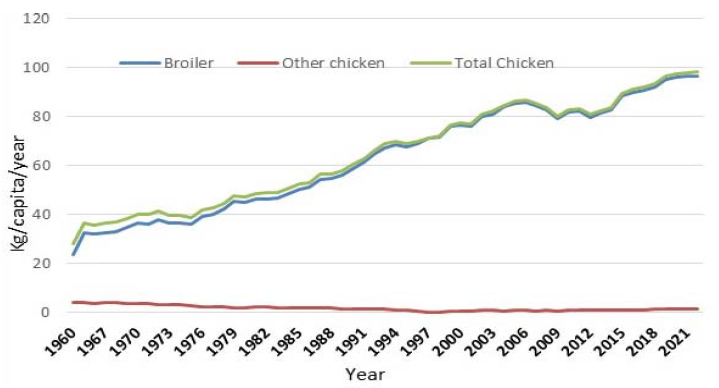
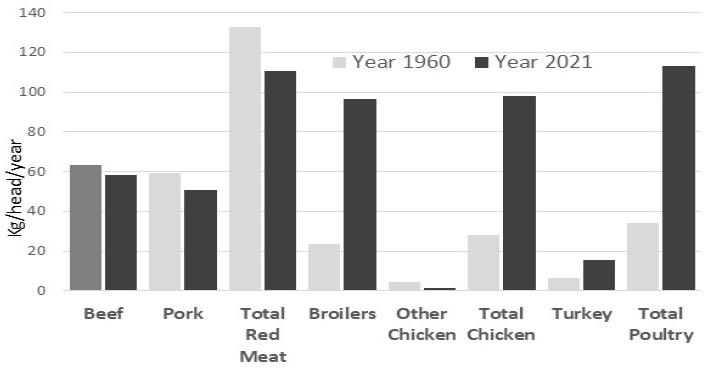
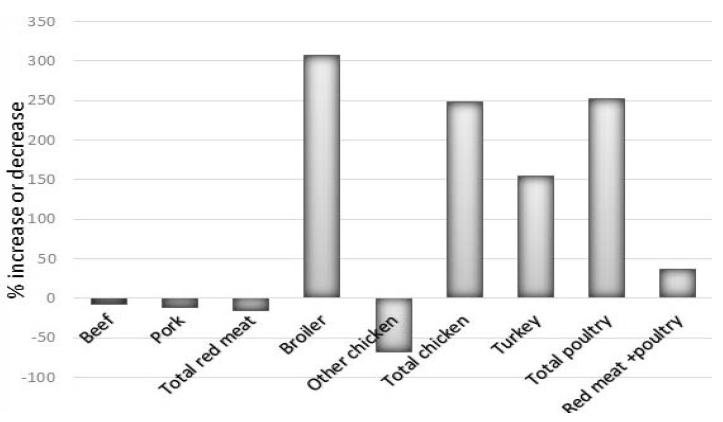
There is linear increment the consumption of broiler meat in comparison to the native chicken during last few decades, even the production of native chicken decreased (Table 4 and Figure 1,2,3). The broiler has innovated in 1960, which has distributed throughout globe. Data shown in the Table 4 reflected that the broiler meat consumption has increased 307.6% which has influence on total chicken meat (248.6%) consumption and consumption of total poultry meat (252.2%). Alternatively, other chicken production has decreased (-68.0%) and red meat consumption also decreased (-15.9%). As consumption of red meat and meat other than broiler has decreased the increased amount of chicken plus red meat is only due to the higher production of broiler.
From the Figure 1 it is clear that the poultry other than broiler has decreased as the meat consumption from those decreased from 1960 to 2020. But the meat consumption from total chicken seems mostly from broiler in 2020, although which little difference was during 1960. From Figure 2 it is clear that the meat from broiler has increased largely which has influence meat consumption from total chicken and total poultry. There is little influence to increase meat from total poultry due to increase the production of turkey, but majority is due to broiler as shown in Table 1.
Constraints of Broiler Production in Developing Countries
Most of the broiler farmers are marginal, poor and illiterate in developing countries. They raise small flock in open air house with poor bio-security.
Table 1: Growth Related Parameters of Native Chicken
Characteristics
Description
References
Age at sexual maturity (days)
148-173
Akinokun
225
Barun
218-225
Rashid et al.
154
Kadigi
157-165
Adedokun and Sonaiya
133-137
Okitoi and Mukisira
Feed conversion ratio
Confinement = 5.2-5.5
Scavenging = 7.6-15.6
Scavenging plus protein supplement = 5.8-6.0
Chemjr
Kingori
Kingori
Body weight at 8 weeks g/bird
Cockerels = 361
Pullet = 329
Kingori
Mohammed 1995
Body weight at 20 weeks g/bird
Pullets = 242-262
Adedokun and Sonaiya
Cockerels = 925-1258
Akinokun
Hens = 1482-1599
Olwande et al.
Table 2: Performance of Broiler Strain in Different Experiments
Parameters
Final body weight
Age of marketing
FCR
[13,14]
Cobb-500 strain
1775
35
1.25
Ross
2000
35
1.70
Hubbard Classic
1760
35
1.40
Husna et al., [16]
Cobb 500
1553
30
1.39
Ross broiler
1490
30
1.64
Lohman
1548
30
1.51
Hubbard classic
1511
30
1.44
Table 3: Comparison Among Different Improved Chickens and Broiler for Productivity Within 4 Weeks of Age
Parameters
Broiler
Native chicken
Improved native chicken
Improved Hilly chicken
Improved Necked Neck chicken
Performance of broiler (estimated), native and improved variety of native chicken [17]
Initial body weight (g)
50
31
31
30
31
Final Body weight (g)
1700
184
214
224
189
LWG (g)
1650
153
183
194
158
FI (g)
2475
537
568
568
568
FCR
1.50*
3.51
3.10
2.92
3.59
Calculated comparison to the broiler
Times live weight of broiler (1650/153)
-
9.0
7.9
7.6
9.0
Times FCR of broiler (3.51/1.50)
-
2.34
2.66
1.95
2.39
Times productivity of broiler (9.0×2.34)
-
21.0
21.0
14.82
21.51
N.B. Productivity of broiler has calculated for live weight gain and FCR within 4 weeks, but not compared for the mature or final body weight during marketing age. *Estimated for different broiler strain
Table 4: Per Capita Meat Consumption (kg/year) in the Globes from Different Sources from 1960 to 2020
Year
Beef
Pork
Total red meat
Broiler
Other chicken
Total chicken
Turkey
Total poultry
Red meat plus poultry
Fish and Shell fish
1960
63.3
59.1
133.0
23.6
4.4
28.0
6.2
32.2
167.2
10.3
1970
84.4
55.4
145.1
36.5
3.7
40.1
8.1
48.2
193.3
11.7
1980
76.4
56.8
136.1
45.2
2.1
47.4
10.2
57.6
193.7
12.4
1990
67.5
49.4
119.4
59.0
1.7
60.6
17.5
78.1
197.5
14.9
2000
67.5
50.8
120.2
76.6
0.8
77.4
17.3
94.7
214.9
15.2
2010
59.3
47.2
107.9
81.8
1.0
82.8
16.0
98.8
206.7
15.8
2020
58.4
52.0
111.8
96.2
1.4
97.6
15.8
113.4
225.2
-
Source: Source: Economic Research Service/USDA; Last updated June 28, 2021; https://www.nationalchickencouncil.org/about/
Figure 1: Per Capita Consumption of Broiler, Other Chicken and Total Chicken from 1960 to 2021
Figure 2: Showing the Changes of Per Capita Meat Consumption from 1960 to 2021
Figure 3: Percent Increase or Decrease Meat Consumption from Different Sources from 1960 to 2020
Source: Economic Research Service/USDA; Last updated June 28, 2021; https://www.nationalchickencouncil.org/about/
Due to small scale farming the production cost is higher than large farmer, because per unit higher production cost. Moreover, due to poor housing the birds are exposed to the pathogens and that is the reason farmers are routinely added antibiotics but don’t know about withdrawal. They bound to add medicine as they don’t have insurance for their farming. Ultimately the broilers from those farms are not guaranteed for safe meat from broiler, because most of them are not under legislative control. Not only about the antibiotic growth promoter, but also chromium contamination, steroid addition, addition of low quality meat and bone meat etc. become rumor which is related to food safety. As those countries are poor and they have no control on small scale farming and absence of enough analytical or testing facilities the rumor discriminate rapidly, so the price become less and farmers are losing their investments. Ultimately broiler industry become weaker in developing countries and the poor people deprived from quality animal protein like meat from broiler.
Overcome the Constraints of Broiler Production
Constraints of broiler production are mostly in developed countries are low profit due to small scale farming, obligatory to use medicine randomly due to lack of biosecurity, lack of legislative control which is important for secured food from broiler, lack of confidence of consumers about safety status of broiler meat. To overcome the situation, it is important to extend large scale farming under legislative control to produce safe and economic broiler, as large scale production is cost effective and possible to protect birds from exposure to pathogenic organism. Moreover, it would be further increase processing industry as well as industries to produce value added products from broiler meat to ensure entering the meat in food chain of all classes of people.
CONCLUSION
Domestic chicken (Gallus gallus domesticus) was the major sources of animal protein, have wider variations for their productivity in different geographic location and varieties available. Their age of maturity is around 24 weeks (more or less), their body weight during maturity is around 1.0 kg and required feed is 4.0 kg for 1.0 kg lives weight gain. On other hands commercial broiler achieved 2.0kg (more or less) within age of 4 weeks against less amount of feed (1.5 kg feed for 1.0 kg live weight gain). Considering age at marketing, final body weight and feed conversion ratio commercial broiler produces more than 24 times than native chicken. Since 1960 till today production of broiler increased more than 300 times. Not only that due to higher productivity broiler become economic source of animal protein for developing countries especially for poor people. But in different countries the industry facing difficulties due to food safety issue, economic issue as well as lacing legislative control. There are few local verities of poultry has developing considering consumer perception and entering into food chain but found little expensive than broiler, but still broiler remains more economic and covers major area of poultry production and contribute global nutrition security. The industry need more care in developing countries through increasing farming as well as processing industry.
Authors’ Contributions
All authors contributed to the study conception and design. Material preparation, data collection and analysis were performed by K.M.S. Islam, J. Aktar and S. Islam. The frst draft of the manuscript was written by K.M.S. Islam and all authors commented on previous versions of the manuscript. All authors read and approved the final manuscript.
REFERENCES
Wu, G. et al. “Production and supply of high-quality food protein for human consumption: Sustainability, challenges and innovations.” Annals of the New York Academy of Sciences, vol. 1321, no. 1, 2014, pp. 1–19.
Wyness, L. “The role of red meat in the diet: nutrition and health benefits.” Proceedings of the Nutrition Society, vol. 75, no. 3, 2016, pp. 227–232.
Lawal, R.A. et al. “The wild species genome ancestry of domestic chickens.” BMC Biology, vol. 18, no. 1, 2020, pp. 1–18.
Saleque, A. “Scaling-Up: Critical factors in leadership, management, human resource development and institution building in going from pilot project to large scale implementation. the BRAC poultry model in Bangladesh.” Poultry as a Tool in Poverty Eradication of Gender Equality: Proceedings of a Workshop Held at Tune, Denmark, March 1999, pp. 22–26.
Mammo, M. et al. “Village chicken characteristics and their seasonal production situation in jamma district, south Wollo, Ethiopia.” Livestock Research for Rural Development, vol. 20, 2008.
Kingori, A.M. et al. “Protein requirements of growing indigenous chickens during the 14–21 weeks growing period.” South African Journal of Animal Science, vol. 33, no. 2, 2003, pp. 78–82.
Teketel, F. Studies on the Meat Production Potential of Some Local Strains of Chicken in Ethiopia. PhD thesis, J.L. University of Giessen, 1986.
Jahan, S. et al. “Productive and reproductive performances of indigenous chicken in the rural condition of Bangladesh.” Bangladesh Journal of Animal Science, vol. 46, no. 2, 2017, pp. 121–127.
Akhter, A. et al. “Growth Performance of Local and Genetically Improved Chicken of Bangladesh: Growth and Carcass Characteristics of Bangladeshi Chicken.” Bangladesh Journal of Animal Science, vol. 47, no. 2, 2018, pp. 76–84.
Faruque, S. et al. “Breeding for the improvement of indigenous chickens of Bangladesh: Evaluation of performance of first generation of indigenous chicken.” Asian Journal of Medical and Biological Research, vol. 3, no. 1, 2017, pp. 72–79.
Hardiman, J. “How 90 years of poultry breeding has shaped today’s industry.” Poultry International, May 2012.
Smith, K. “The History of Shaver Breeding Farms.” Hendrix Genetics, 31 Dec. 2013.
Islam, K.M.S. et al. “Effect of dietary citric acid on the performance and mineral metabolism of broiler.” Journal of Animal Physiology and Animal Nutrition, vol. 96, no. 5, 2012, pp. 808–817.
Islam, K.M.S. et al. “Compatibility of a combination of tiamulin and chlortetracycline with Salinomycin in feed during a pulsed medication program co-administration in broilers.” Poultry Science, vol. 87, no. 12, 2008, pp. 2528–2534.
Schuhmacher, A. et al. “Tiamulin and Semduramicin: effects of simultaneous administration on performance and health of growing broiler chickens.” Poultry Science, vol. 85, no. 3, 2006, pp. 441–445.
Husna, A. et al. “Evaluation of productive performance of selected broiler strains under field condition at sylhet district of Bangladesh.” Annals of Veterinary and Animal Science, 2017, pp. 104–110.
Faruque, S. et al. “Performance of native chickens under intensive system.” Journal of Bangladesh Agricultural University, vol. 5, 2007, pp. 283–288.
Recommended Articles
Research Article
Valorization of Cofactor-Enriched Whey for Sustainable Lactic Acid Production Using Bifidobacterium bifidum and Lactobacillus acidophilus
Sahar Adnan Sheet
Published: 30/06/2026
Download PDF
Review Article
Rview: Nisin its Importance and Applications
Shaymaa Jawad Mahmood,
...
Sumyia Kh. Badawi
Published: 30/06/2026
Download PDF
Review Article
Review: Nisin its Importance and Applications
Shaymaa Jawad Mahmood,
...
Sumyia Kh. Badawi
Published: 30/06/2026
Download PDF
Research Article
In- Vitro Protein Digestibility, Starch Digestibility and Sensory Property of Fermented and Extruded Blends of Cassava and African Yam Beans
O. Ayomide Omojokun,
...
A. Felix Akinyosoye
Published: 10/09/2021
Download PDF
PO Box 101, Nakuru
Kenya.
Email: office@iarconsortium.org
Editorial Office:
J.L Bhavan, Near Radison Blu Hotel,
Jalukbari, Guwahati-India
Islam, K. M. S., Aktar, J. & Islam, S. (2022). Broiler Industry and Global Nutrition Security. International Academic Journal of Nutrition & Food Sciences, 3(2), 1-5.
MLA
Islam, K. M. S., Jesmin Aktar and Sharmila Islam. "Broiler Industry and Global Nutrition Security." International Academic Journal of Nutrition & Food Sciences 3.2 (2022): 1-5.
Chicago
Islam, K. M. S., Jesmin Aktar and Sharmila Islam. "Broiler Industry and Global Nutrition Security." International Academic Journal of Nutrition & Food Sciences 3, no. 2 (2022): 1-5.
Harvard
Islam, K. M. S., Aktar, J. and Islam, S. (2022) 'Broiler Industry and Global Nutrition Security' International Academic Journal of Nutrition & Food Sciences 3(2), pp. 1-5.
Vancouver
Islam KMS, Aktar J, Islam S. Broiler Industry and Global Nutrition Security. International Academic Journal of Nutrition & Food Sciences. 2022 Jul;3(2):1-5.


 Download PDF
 Download XML