Ready to eat tomato curry in see through retort pouches was developed using steam air retort. The product was found to be commercially sterile after retorting to an F0 value of 7.34 minutes. The heat penetration characteristics of the product was studied and revealed a total process time of 30.38 minutes to attain the above F0 value and the cook value was 66.03 minutes. The characteristics of the see through retort pouch used for the study was analyzed and our results showed that it had good barrier properties and is suitable for food contact applications. Tomato is known as a rich source of lycopene, thus in this study the ready to eat tomato curry was also analyzed to determine the changes that occurred in the lycopene content during processing. Shelf life studies conducted revealed a shelf life of one year at ambient temperature (26 to 28°C).
Tomato is an important vegetable with high commercial value. It has its own characteristic taste, colour and flavour which is having great consumer acceptance. It is a rich source of Vitamin C, carotenes and other nutrients. [1]. According to the reports from Department of Agriculture, Cooperation and Farmers Welfare, Ministry of Agriculture and Farmers Welfare, Government of India, tomato production in India during 2018-19 was estimated to be 194.96 lakh Tonnes. The worldwide production of tomato exceeds 100million tonnes/Year. It is used as a main ingredient in many vegetable and spicy dishes. [2].
Tomato is a seasonal crop due to which it is produced in large quantities during the harvest season and thus a huge load of the raw material arrives at the processing industries. This forces the manufacturer to process in high volumes into various products since it is highly perishable in its fresh state [3]. The seasonal production of tomato in bulk quantities has led to the need for processing of tomato into different products in order to extend the shelf life and ensure its availability round the year. Preserved tomato products have gained great commercial importance [4]. Application of ultra sound [5], High pressure processing [6], combination of thermal processing along with high pressure processing [7], High intensity pulsed electric fields [8] and thermos-sonication [9], are the various novel technologies adopted for the extension of shelf life for tomato based products.
The increase in the expendable income and working women population has led to the increased demand for ready to serve consumer products which are shelf stable. Value addition and preservation of tomato in a ready to serve form will have great demand. Retort processing is a thermal preservation technique which is used for the production of ready to eat processed food products in retortable pouches that are shelf stable at ambient temperatures [10].
During the glut production of tomato processing of tomato into shelf stable products will reduce the post-harvest losses. The main products developed out of tomato are tomato paste or tomato ketchup. Hence, the previous research works reported on processing of tomato has mainly dealt with these products. In India tomato is also used as a main ingredient for many spicy dishes. In this scenario, the present study was taken up with the objective to develop a ready to eat shelf stable spicy product from tomato in retortable pouches.
Raw Materials
Tomato (Solanum lycopersicum) purchased from the local market of Cochin was used for the experiment. Garlic (Allium sativum) along with other spices were the minor ingredients used. The product (150g each) was packed in See through retort pouch and sealed using vacuum sealing machine. Thermal processing was done using Steam Air retort.
Retort Pouch
The packaging material used for the study was see through retort pouches having a dimension of 18.5 x 14cmand made of polyester coated with silicon dioxide/ nylon/cast polypropylene. The pouches were procured from Floeter India Retort Pouches Private Limited.
Packaging Material Properties
Physical properties of packaging material were tested to determine the quality requirements of the see through retort pouch that was used for the study. Universal Testing machine (Lloyd instruments LRX plus, UK) was used to determine the tensile strength expressed in Kgcm-2 and elongation at break expressed in percentage (%). Heat seal strength was determined as per ASTM. The water vapour transmission rate (WVTR) was determined as per ASTM E 96-80 and oxygen transmission rate (OTR) was determined as per ASTM-D-1434. The suitability of the standy retort pouch for food contact application was determined as per IS: 9845 [11-14].
Preparation of Tomato Curry
The ingredients used for the preparation of tomato curry is mentioned in Table 1.
Table 1: Ingredients Used for Preparation of Tomato Paste
| Ingredients | Quantity (in grams) |
| Tomato | 100 |
| Garlic | 10 |
| Mustard | 1.4 |
| Chilli powder | 1.6 |
| Turmeric powder | 0.1 |
| Asafoetida | 0.1 |
| Salt | 4.5 |
| Oil | 4.5 |
| Red chilly | 1 piece |
| Black gram | 0.5 |
Tomato was the major ingredient along with garlic and other spices as minor ingredients. Oil was heated in a pan and mustard seeds were popped along with black gram and red chilli. Finely chopped garlic was added and sauted along with the other spices. Finely sliced tomato was added and cooked until a thick paste was obtained.
Thermal Processing of Tomato Curry
Tomato curry (150g each) was filled in see through retort pouch and Vacuum sealed using Automatic vacuum packing machine (Wenzhou Forlong Machinery Co. LTD). The geometric centre of the pouches were fitted with glands and thermocouple tips (type SSA 12080-G700-TS, Ellab Co., Denmark) were inserted to measure the core temperature. The thermocouples have a capability to measure temperatures in the range of -45°C to 135°C (±0.1°C). The thermocouples help in monitoring the core temperature during processing. The pouches were loaded into Steam air retort. The heating medium is steam. The thermocouple output was measured using an Ellab E- Val Flex, 14592 data recorder.
The retort temperature during thermal processing was maintained at 121.1°C and the pouches were processed to an F0 Value of 7.34minutes. The temperature and F0 value was monitored continuously and after a particular period of heating to attain the required F0 value the supply of steam was cut off and cold water was recirculated through the retort chamber as a cooling medium to facilitate rapid cooling. Cooling was continued till the core temperature reached 30ºC. The process was stopped and the pouches were unloaded from the retort and kept immersed in cold water for some time. The surface of the pouches was wiped to dryness and stored at ambient temperature (26 to 28°C).
The heat penetration data was analysed and plotted on an inverted semi log paper with temperature deficit (retort temperature–core temperature) against time. Lag factor for heating (Jh), lag factor for cooling (Jc), slope of the heating curve (fh), time in minutes for sterilization at retort temperature (U), final temperature deficit (g) and come up time (CUT) in minutes were determined.
The cook value (Cg) which is a measure of heat treatment with respect to nutrient degradation and textural changes that occur during processing, was determined according to the following formula [15].
![]()
where t, z, T and Tref represent the time (min), z value of the heat liable component (33°C), core temperature at any given time and reference processing temperature for the heat liable component (100°C), respectively.
The Ball’s process time (B) was calculated by Formula method [16]. Actual process time (T) was determined by adding process time (B) and the effective heating period during come up time i.e., 58% of the come up time [17].
Process time (B) = fh [log JhI –log g]
Total process time (T) = B + 58%of come up time
Commercial Sterility
The thermally processed pouches were stored at ambient temperature and equilibrated at atmospheric conditions. Commercial sterility of the samples was tested to determine the adequacy of processing. The test was carried out as per IS 2168 [19]. The processed pouches after equilibration were incubated at 37°C for 15 days to promote the growth of mesophylls and at 55°C for 5 days to promote the growth of thermophiles if present any.
The incubated pouches were asceptically opened and 1-2g of the sample was taken with sterilized forceps and inoculated into the sterilized fluid thioglycolate broth dispensed in test tubes. A little sterilized liquid paraffin was put on the top of the broth to create anaerobic condition and incubated at 37°C for 48 hours and at 55°C for 4 days. The growth of organism leads to development of turbidity in the tubes and clear tubes indicates that the product is commercially sterile and the process is adequate.
Chemical Parameters
The moisture (method 925.10), ash (method 923.03), protein (N x 6.25) (960.52) (KEL PLUS digestion (KES 06 R) and distillation systems (DISTYL EM S), M/s Pelican Equipments, Tamil Nadu, India) and lipid contents (2003.05) (SOCS PLUS SCS2 R, M/s Pelican Equipments, Tamil Nadu, India) were determined according to AOAC. The total dietary fiber (TDF) was determined using FIBRA PLUS FES 02 E (M/s Pelican Equipments, Tamil Nadu, India). The calorific value of the tomato curry was calculated using the Atwater factor formula, where by the major biochemical constituents were converted into calorific values using standard calorific equivalents, i.e., 5.65, 9.45 and 4.20 for proteins, lipids and carbohydrates, respectively [20]
Total carbohydrate (g/100g) = 100 – (moisture+protein+lipid+ash)
Calorific value (kcal/g) = (5.65 x P + 9.45 x L + 4.20 x C) / 100
Where,
P: Protein content
L= Crude lipid content
C= Carbohydrate content
The reducing and non-reducing sugars were determined by Lane and Eynon method [21].
Estimation of Lycopene
Tomato is a rich source of lycopene which is the major antioxidant in it. The high utility of tomato has made it the predominant source of lycopene in the world’s diet. [22]. The lycopene content of raw tomato used for processing and that of tomato curry after retorting was estimated in order to determine the amount of degradation of lycopene during thermal treatment. High performance Liquid Chromatography was used for the estimation of lycopene content. Lycopene was extracted from raw tomato and retort processed tomato curry [23]. The sample (2±0.5g) was weighed and mixed with 20ml of extraction buffer. The extraction buffer was prepared by mixing hexane, acetone and ethanol in the ratio of 2:1:1 respectively. The sample was stirred in the buffer for 1minute on ice and was transferred to a separating funnel. Saturated Sodium chloride (50ml) was added to it and mixed well. The separating funnel was left undisturbed to aid separation of the layers. After formation of two distinct layers the aqueous phase was removed and 10ml of 10% methanolic KOH was added to the organic phase and kept in dark for 2hours with occasional shaking at regular intervals of 20 minutes. Washing was done three times using 50mM ammonium acetate solution. The organic phase was separated and dried under nitrogen. The residue was then dissolved in THF with BHP and 0.05% TEA to a known volume prior to injection.
Estimation of Alliin
The amount of alliin present in the tomato curry was determined using HPLC method. The ready to eat tomato curry prepared contained 10g of garlic per 100g tomato used. Thus the amount of alliin present in the tomato curry was determined using HPLC method and was compared with the amount present in raw garlic that was used for processing. Alliin extraction was done using 50g of sample which was blended with 80ml of ethyl acetate for 5minutes. This was kept still for 1hour and then centrifuged at 8000rpm for 5minutes. The supernatant was discarded and the residue was mixed with water in the ratio 1:5 at 35ºC with continuous stirring for 60minutes. It was then vacuum filtered and freeze dried prior to injection [24].
Vitamin C
The amount of Vitamin C present in tomato and tomato curry prior to thermal processing was estimated and was compared with the amount present in retort processed tomato curry. The method of National institute of Nutrition and that reported by almajidi was adopted for the estimation of Vitamin C [25].
Titratable Acidity
The titratable acidity of the product was analysed at a regular interval of 30 days. It helps to determine the total acid concentration in the food. Citric acid is the predominant acid in tomato. [26]. Titratable acidity was expressed in terms of the predominant acid (g/100g citric acid). A known quantity of sample was homogenised and titrated against a standard base using phenolphthalein as indicator to neutralise the amount of acid present in the sample [27].
Colour
The CIE Lab coordinate of tomato curry was determined using Color Flex EZ (Hunterlab, USA) reporting lightness (L*), redness (a*) and yellowness (b*) [28]. Measurements were done at three different points and mean values were reported. The measurements were done throughout the period of storage at regular intervals of 30 days each [29].
Sensory Evaluation
The sensory characteristics of tomato curry like taste, odour, appearance and overall acceptability was evaluated. The sensory panel was constituted by 10 trained panelists on a 10-point hedonic scale [30]. Sensory evaluation was carried out by the same panellists at regular intervals of 30 days during the period of storage. The pouches which were stored at room temperature was selected randomly and heated up by dipping in hot water and was served in equal quantities to the panel members. The sensory score card was prepared as prescribed by [31]. The panelists were asked to assign a score of 1–10 where 4.0 was taken as the margin of acceptance.
Statistical Analysis
All the results obtained are expressed as mean ± standard deviation. The time temperature data during retort processing of the pouches were monitored using a minimum of two containers. The physical and biochemical analysis were performed for triplicate samples each. Analysis of variance (ANOVA) was used to define the significance of differences at p<0.05.
Packaging Material Properties
The packaging material used for the study was Standy retort pouches which was made of polyester coated with silicon dioxide/ nylon/cast polypropylene. The properties of the packaging material help to identify its suitability for withstanding the processing conditions and barrier properties of the film. Overall migration residue analysis helps to identify suitability of the packaging material for food contact applications
Table 2 depicts the properties of the see through retort pouch which was used.
Table 2: Properties of the Packaging Material
| Properties | See through Retort Pouch |
| Thickness (µm) | 100 ± 0.01 |
Tensile strength (Kg/cm2)
| 782±0.01 (Machine direction) |
615±0.01 (Cross direction) | |
| Heat seal strength (kg cm-2) | 562±1.1 (Machine direction) |
439±1.3 (Cross direction) | |
| Elongation at break (%) | 82±0.02 (Machine direction) |
96±0.03 (Cross direction) | |
WVTR (g m-2 24 h-1 at 37 0C and 92% RH) | 0.95±.01 |
OTR (cc m-2 24 h-1 at 1 atm. pressure) | 2.14±.01 |
| Overall Migration Residue | |
| Water extractives (mg L-1) | 4.5±0.16 |
| n-heptane extractives | 1.3±0.11 |
| 3% acetic acid extractives | 1.88±0.23 |
The physical properties like thickness, tensile strength, heat seal strength and elongation at break shows that the packaging material can withstand thermal processing temperature of 121.1°C and a working pressure of 28 psig. See through films were made of three layers viz., outer polyester, middle nylon coated with silicon dioxide and inner layer of cast polypropylene. The silicon dioxide is a nano particle, specially incorporated to provide good barrier properties.
This is in accordance with the results of WVTR and OTR observed. The high barrier properties of the film provide better protection to the product from water vapour and oxygen when stored at room temperature and thereby extending the shelf life of the product. The results of overall migration residue for See through retort pouch shows that it was <10 mg L-1 which is well below the acceptable limit of 60 mg L-1, indicating its suitability for food contact applications.
Heat Penetration Characteristics
The heat penetration parameters determined for the thermal processing of tomato curry packed in standy retort pouches at a temperature of 121.1°C is given in Table 3.
Table 3: Heat Penetration Parameters
| Parameters | |
| Jh | 0.36 |
| Jc | 0.61 |
| fh | 15min |
| U | 7.34min |
| fh/U | 2.04 |
| g | 1.04C |
| B | 23.42min |
| CUT | 12min |
| TPT | 30.38min |
| Cg | 66.03min |
| F0 Value | 7.34min |
The come up time which is the time taken to attain 121.1°C for the processing of tomato curry was 12 minutes. Previous studies have reported that the come up time should be kept as short as possible which helps to increase the rate of heat penetration in the product [32].
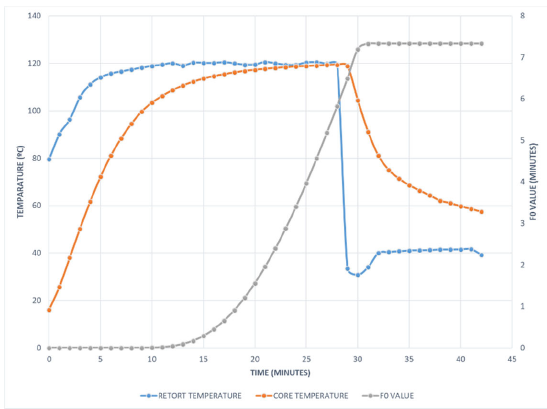
The total process time for the processing of tomato curry to an F0 value of 7.34minutes was 30.38 minutes which takes into account 58% of the Come Up Time along with Balls process time which was 23.42 minutes. The Figure 1 shows the heat penetration characteristics of tomato curry with respect to F0value. Core temperature, retort temperature and F0 value with respect to time is depicted here. The graph clearly shows a sudden decrease in the retort temperature during the 28th minute of processing which is due to the steam cut off and circulation of cold water. A simultaneous decrease in the core temperature of the product can also be observed and cooling is continued till the core temperature decreased below 45°C. This is essential for preventing overcooking and also the growth of thermophiles.

Figure 1: Heat Penetration Characteristics and F0 Value of Tomato Curry
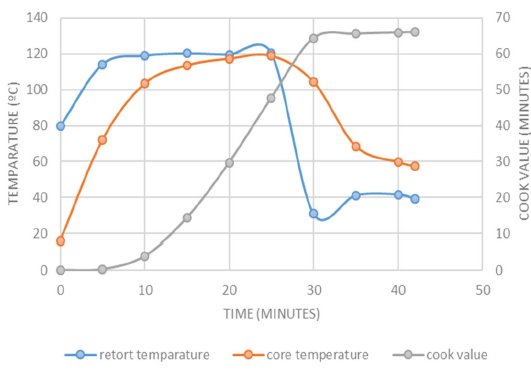
Thermal processing of food has a remarkable impact on nutrient degradation. The nutrient degradation that occurs in food during thermal processing is indicated by Cook value (Cg). It should be as low as possible at any given lethality. In the present study, results show that the Cg is 66.03 minutes which indicates better nutrient retention in the product. Cook value reported for mackerel in brine processed at 121.1°C where slightly higher than that of the present study observed in the present study [33]. Cook values which was even more higher was reported for prawn kuruma in retortable pouch and aluminium cans [34]. The Figure 2 represents the heat penetration characteristics and cook value of tomato curry with respect to time.

Figure 2: Heat Penetration Characteristics and Cook Value of Tomato Curry
Commercial Sterility
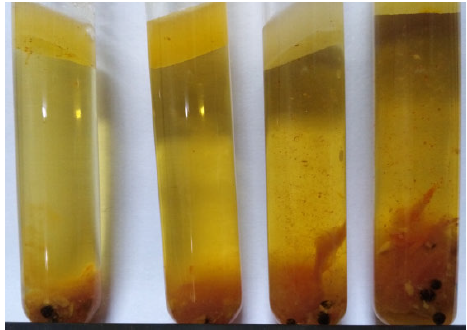
Tomato curry processed to an F0 value of 7.34minutes was found to be commercially sterile. The absence of turbidity in tubes inoculated with tomato curry and incubated at 37ºC for 48 hours and 55ºC for 4 days shows the commercial sterility of the product. It also represents that the thermal processing of tomato curry to an F0 value of 7.34 minutes is sufficient for the sterility of the product. Figure 3 shows clear tubes after commercial sterility test.

Figure 3: Tubes After Test for Commercial Sterility of Tomato Curry
Chemical Parameters
The chemical parameters including the proximate composition of ready to eat tomato curry is given in Table 4. The product contributes 3.12 Kcal/g for the daily energy requirement.
Table 4: Chemical Composition of Tomato Curry
| Parameter | Amount |
| Moisture (g%) | 73.61 ± 0.84 |
| Carbohydrate (g%) | 15 ± 0 |
| Ash (g%) | 4.40 ± 0.10 |
| Fat (g%) | 4.40 ± 0.10 |
| Protein (g%) | 2.57 ± 0.02 |
| Fiber (g%) | 3.76 ± 0.30 |
| Reducing sugar (g%) | 4.69 ± 0.05 |
| Non-reducing sugar (g%) | 4.82 ± 0.08 |
| Total sugar (g%) | 9.76 ± 0.03 |
| Calories (kcal/g) | 3.12 |
Estimation of Lycopene
Tomatoes are the most important sources of lycopene as a result tomato based products like tomato juice, canned tomato, ketchup, etc. are also lycopene rich. According to reports the total lycopene content in tomatoes ranged from 33.3 to 103.7 μg/g. [23]. Similarly, many previous reports show high variability in the lycopene content. [35-37]. The amount of lycopene in raw tomato was 17.26µg/g and that in retort processed tomato curry was 17.20µg/g. The results indicate very minute degradation in the lycopene content due to thermal processing. The processing of food products which includes different types of cooking, extrusion, blanching, etc. and environmental factors like air, light and temperature can lead to isomerization and autoxidation of lycopene in foods. This will also affect the bioavailability of lycopene [38].
Estimation of Alliin
Garlic (Allium sativum) is a rich source of alliin which is stable and found in garlic even after cooking. It is said to have antioxidant properties [39]. The enzyme allinase along with alliin produces allicin. It has antibacterial effects [40], ability to reduce serum cholesterol and triglyceridesand helps to inhibit platelet aggregation [41]. The amount of alliin in garlic varies depending on the variety of garlic [42]. In the present study tomato curry was incorporated with 10g garlic for every 100g tomato. The amount of alliin was estimated to be 665.4µg/g in Raw garlic that was used for the curry and the amount present in tomato curry was 412.27µg/g. alliin is reported as quite heat stable [39]. The decrease in the quantity can be attributed to the less amount of garlic added in tomato curry.
Vitamin C
The amount of vitamin C present in raw tomato used for the processing, tomato curry before retort processing and tomato curry after retort processing was analyzed to study the effect of thermal degradation in vitamin C. The amount of Vitamin C in Raw tomato, tomato curry before retort processing and tomato curry after retort processing was found to be 226.42±4.44µg/g, 195.92±1.14µg/g and 119.31±0.35µg/g respectively.
Titratable Acidity
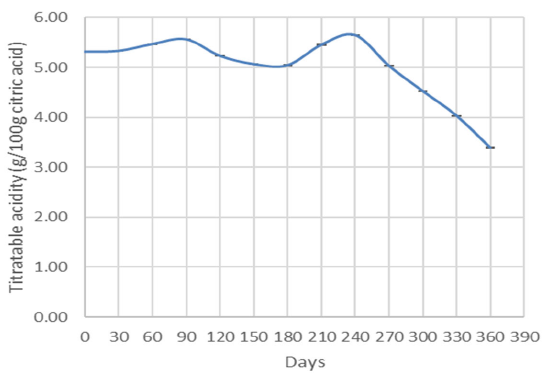
The most common organic food acids are citric acid, mallic acid, lactic acid, tartaric acid and acetic acid. Citric acid is the predominant acid present in tomato which plays a significant role in providing flavour. Titratable acidity is also a measure of the keeping quality of fruits [27]. The Figure 4 shows the changes in titratable acidity of tomato curry during storage. The decrease in titratable acidity by the end of storage life can be assumed to be due to the loss of citric acid.

Figure 4: Change in Titratable Acidity of Tomato Curry During Storage
Although citric acid is the predominant acid in tomato malic acid and glutamic acid also contribute significantly to the titratable acidity [43]. The decrease in titratable acidity is in accordance with the results reported for the storage study of mango pickle. Copolymerisation of organic acids with sugar and amino acids can lead to decrease in titratable acidity of the product [44].
Colour
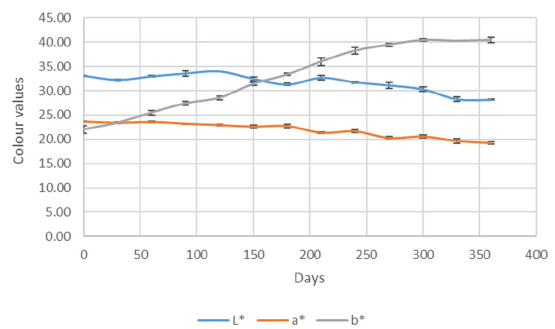
The changes that take place in taste of a food can be significantly related to the change in appearance [45]. According to Francis and Clydesdale., [16], colour is considered as the most significant attribute of a food’s appearance. Spoilage of food causes a visible deterioration of colour in the food [47]. The Figure 5 shows the changes in appearance of the product during storage. The L* and a* values were stable during the entire period of storage. b* values showed an increase which shows the change in colour of the product towards the yellow side [45].

Figure 5: Colour Changes in Tomato Curry During Storage
Sensory Evaluation
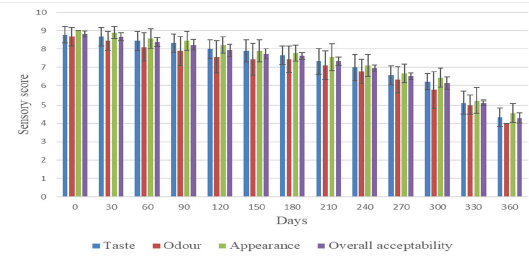
Consumer researchers are well aware of the quality of products. The food industry constantly faces the demand to maintain both quality and profitability simultaneously. Quality, however, is an elusive concept and as such must be operationalized and measured in order for it to be maintained.” H. R. Moskowitz., [48]. Sensory evaluation was done long back since the existence of human beings who have been evaluating the goodness or badness of foods to test whether it can be consumed or not [49]. Quality assurance is made easy with the help of sensory evaluation [50]. The Figure 6 clearly represents the sensory score assigned by the trained sensory panel members for the sensory attributes like taste, odour, appearance and overall acceptability of the product during the period of storage. The sensory score for overall acceptability was found to decrease from 8.82 on the 0th day to 4.30 on 360th day which shows the decrease in acceptability. The product obtained an acceptable sensory score during the entire period of storage.

Figure 6: The Changes in Sensory Score of Tomato Curry During the Period of Storage
Tomato is a seasonal fruit that is produced in bulk quantities during the period of harvest. This leads to a glut which affects the primary producers. This scenario can be overcome only by the production of value added products that are shelf stable and can be utilised when there is a shortage. Ready to eat tomato curry is a spicy product from tomato. Retort processing of the product packed in see through retort pouches having good barrier properties were done using steam air retort. The Total Process Time for attaining an F0 value of 7.34minutes was 30.38 minutes. The product was found to be commercially sterile and retain its sensory attributes and nutritional characteristics after retorting. The storage studies conducted showed that the product can be stored at ambient temperatures (26°C to 28°C) without refrigeration or addition of preservatives and hence retaining its natural characteristics.
Acknowledgment
The authors are thankful to Kerala University of Fisheries and Ocean Studies for the financial support provided to carry out the work. We acknowledge the whole hearted support and guidance given by The Vice Chancellor, Kerala University of Fisheries and Ocean Studies.
Banat, F. et al. “Effect of operating parameters on the spray drying of tomato paste.”Engineering in Life Sciences, vol. 2, no. 12, 2002, pp. 403–407.
Jafari, S.M. et al. “Arrhenius equation modeling for the shelf life prediction of tomato paste containing a natural preservative.” Journal of the Science of Food and Agriculture, vol. 97, no. 15, 2017, pp. 5216–5222.
Jafari, S.M. et al. “Neural networks modeling of aspergillus flavus growth in tomato paste containing microencapsulated olive leaf extract.” Journal of Food Safety, vol. 38, no. 1, 2017, e12396.
Shi, J. et al. “Effect of heating and exposure to light on the stability of lycopene in tomato puree.” Food Control, vol. 19, no. 5, 2008, pp. 514–520.
Adekunte, A.O. et al. “Effect of sonication on colour, ascorbic acid and yeast inactivation in tomato juice.” Food Chemistry, vol. 122, no. 3, 2010, pp. 500–507.
Hsu, K.C. et al. “Evaluation of microbial inactivation and physicochemical properties of pressurized tomato juice during refrigerated storage.” LWT-Food Science and Technology, vol. 41, no. 3, 2008, pp. 367–375.
Rodrigo, D. et al. “Combined thermal and high pressure inactivation kinetics of tomato lipoxygenase.” European Food Research and Technology, vol. 222, no. 5–6, 2006, pp. 636–643.
Aguilo-Aguayo, I. et al. “Comparative study on color, viscosity and related enzymes of tomato juice treated by high-intensity pulsed electric fields or heat.” European Food Research and Technology, vol. 227, no. 2, 2008, pp. 599–606.
Wu, J. et al. “Effect of thermosonication on quality improvement of tomato juice.”Innovative Food Science and Emerging Technologies, vol. 9, no. 2, 2008, pp. 186–195.
Bindu, J. et al. “Ready-to-eat mussel meat processed in retort pouches for the retail and export market.” Packaging Technology and Science: An International Journal, vol. 17, no. 3, 2004, pp. 113–117.
ASTM. Standard Methods of Test for Seal Strength of Flexible Barrier Materials. American Society for Testing and Materials, Philadelphia, 1973.
ASTM. Standard Operating Procedure for the Determination of Water Vapour Transmission Rate E 96-80. American Society for Testing and Materials, Philadelphia, 1987.
ASTM. Standard Method of Test for Gas Transmission Rate of Plastic Film Sheeting, D 1434. American Society for Testing and Materials, Philadelphia, 1975.
Bureau of Indian Standards. Methods of Analysis for the Determination of Specific or Overall Migration Constituents of Plastic Materials and Articles Intended to Come into Contact with Food Stuff. IS:9845, New Delhi, 1981.
Ranganna, S. Handbook of Canning and Aseptic Packaging. Tata McGraw-Hill Publishing Co. Ltd., New Delhi, 2000, pp. 507–508.
Ball, C.O. Thermal Process Time for Canned Foods. Bull 37, National Research Council, Washington DC, 1923.
Stumbo, C.R. Thermobacteriology in Food Processing. 2nd ed., Academic Press, New York, 1973, pp. 93–120.
AOAC. Official Methods of Analysis. Association of Official Analytical Chemists, 2000.
Indian Standard Institute. Specification for Pomfret Canned in Oil. IS:2168, New Delhi, 1971.
Dare, P.J. and D.B. Edwards. “Seasonal changes in flesh weight and biochemical composition of mussels (Mytilus edulis L.) in the conwy estuary, north wales.” Journal of Experimental Marine Biology and Ecology, vol. 18, 1975, pp. 89–97.
Lane and Eynon. “Determination of reducing sugars by means of Fehling’s solution with methylene blue as internal indicator.” Journal of the Society of Chemical Industry, vol. 42, 1923, pp. 32T–37T.
Choksi, P.M. and V.Y. Joshi. “A review on lycopene extraction, purification, stability and applications.” International Journal of Food Properties, vol. 10, no. 2, 2007, pp. 289–298.
Cucu, T. et al. “A simple and fast HPLC method to determine lycopene in foods.” Food Analytical Methods, vol. 5, no. 5, 2012, pp. 1221–1228.
Mallika, T. et al. “Separation and purification of alliinase and alliin from garlic (Allium sativum).” Journal of Academia and Industrial Research, vol. 2, no. 11, 2014, pp. 599–605.
Majidi, M.I.H.A. and H. Al-Gubury. “Determination of vitamin c (Ascorbic Acid) contents in various fruit and vegetable by UV-spectrophotometry and titration methods.” Journal of Chemical and Pharmaceutical Sciences, vol. 9, no. 4, 2016, pp. 2972–2974.
Agius, C. et al. “Quantification of sugars and organic acids in tomato fruits.” MethodsX, vol. 5, 2018, pp. 537–550.
Tyl, C. and G.D. Sadler. “pH and titratable acidity.” In Food Analysis, edited by S. Nielsen, Food Science Text Series, Springer, Cham, 2017.
ASTM. Standards on Color and Appearance Measurement. 6th ed., American Society for Testing and Materials, Philadelphia, 2000.
CIE. Colorimetry. 2nd ed., CIE Publication 15.2, Commission Internationale de l’Eclairage, Vienna, 1986.
Bureau of Indian Standards. Guide for Sensory Evaluation of Foods (Part II, Methods and Evaluation Cards). IS:6273 (II), Indian Standard Institute, New Delhi, 1971.
Vijayan, P.K. and K.K. Balachandran. “Development of canned fish curry.” Fishery Technology, vol. 23, 1986, pp. 57–60.
Anon. Laboratory Manual for Food Canners and Processors. Vol. 1, National Canners Association, AVI Publishing Co., Westport, 1968.
Sreenath, P.G. et al. “Standardization of process parameters for ready-to-eat shrimp curry in tin-free steel cans.” Journal of Food Processing and Preservation, vol. 32, 2008, pp. 247–269.
Mohan, C.O. et al. “Thermal processing of prawn ‘kuruma’ in retortable pouches and aluminium cans.” International Journal of Food Science and Technology, vol. 43, 2008, pp. 200–207.
Sancho, L.E.G.G. et al. “Identification and quantification of phenols, carotenoids and vitamin c from papaya (Carica papaya L., cv. Maradol) fruit determined by HPLC-DAD-MS/MS-ESI.” Food Research International, vol. 44, no. 5, 2011, pp. 1284–1291.
Barba, A.O. et al. “Application of a UV–vis detection-hplc method for a rapid determination of lycopene and β-carotene in vegetables.” Food Chemistry, vol. 95, no. 2, 2006, pp. 328–336.
Perkins-Veazie, P. et al. “Carotenoid content of 50 watermelon cultivars.” Journal of Agricultural and Food Chemistry, vol. 54, no. 7, 2006, pp. 2593–2597.
Chen, J. et al. “Comparison of lycopene stability in water- and oil-based food model systems under thermal and light-irradiation treatments.”LWT-Food Science and Technology, vol. 42, no. 3, 2009, pp. 740–747.
Kourounakis, P.N. and E.A. Rekka. “Effect on active oxygen species of alliin and allium sativum (Garlic) powder.” Research Communications in Chemical Pathology and Pharmacology, vol. 74, no. 2, 1991, pp. 249–252.
Cavallito, C.J. and J.H. Bailey. “Allicin, the antibacterial principle of allium sativum. i. isolation, physical properties and antibacterial action.” Journal of the American Chemical Society, vol. 66, no. 11, 1944, pp. 1950–1951.
Lawson, L.D. et al. “Inhibition of whole blood platelet-aggregation by compounds in garlic clove extracts and commercial garlic products.” Thrombosis Research, vol. 65, no. 2, 1992, pp. 141–156.
Lawson, L.D. et al. “Identification and hplc quantitation of the sulfides and Dialk (en) yl Thiosulfinates in commercial garlic products.” Planta Medica, vol. 57, no. 4, 1991, pp. 363–370.
Anthon, G.E. et al. “Changes in pH, acids, sugars and other quality parameters during extended vine holding of ripe processing tomatoes.” Journal of the Science of Food and Agriculture, vol. 91, no. 7, 2011, pp. 1175–1181.
Thakur, N.S. et al. “Studies on Development and Storage Quality of Seedling Mango (Mangifera indica L.) Pickle of Himachal Pradesh.” Unpublished study.
MacDougall, D.B. “Colour measurement of food: principles and practice.” In Colour Measurement, Woodhead Publishing, 2010, pp. 312–342.
Francis, F.J. and F.M. Clydesdale. Food Colorimetry: Theory and Applications. AVI, Westport, CT, 1975.
Francis, F.J. Colorants. Eagen Press, St. Paul, Minnesota, 1999.
Moskowitz, H.R. and B. Krieger. “The contribution of sensory liking to overall liking: An analysis of six food categories.”Food Quality and Preference, vol. 6, no. 2, 1995, pp. 83–90.
Meilgaard, M.C. et al. Sensory Evaluation Techniques. CRC Press, 1999.
Vazquez, L. et al. “Changes in Physico-chemical properties, hydroxyl-methyl-furfural and volatile compounds during concentration of honey and sugars in alicante and jijona turron.” European Food Research and Technology, vol. 225, no. 5–6, 2007, pp. 757–767.